
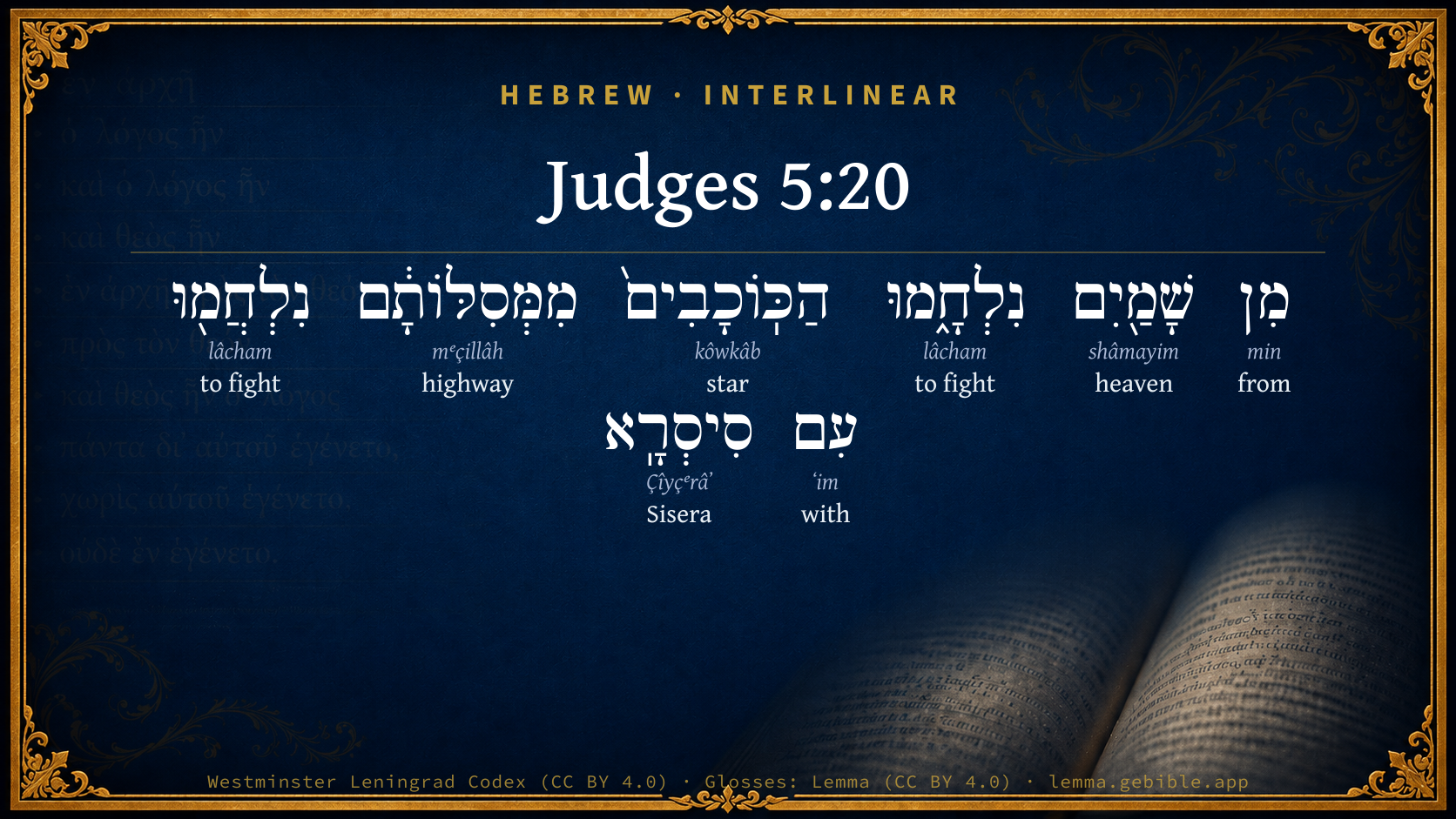
Judges 5:20

Hebrew (Westminster Leningrad Codex) Judges 5:20 appears in the Hebrew Old Testament. The text above is from the Westminster Leningrad Codex. Each word links to its Strong’s number, a concise gloss, and parsing drawn from the Open Scriptures Hebrew Bible morphology. Click any word for its full Brown-Driver-Briggs (BDB) entry.
Download image
Cite this verse

Judges 5:20 (World English Bible). Public Domain. Lemma interlinear Bible study tool, https://lemma.gebible.app/v/judges/5/20.

Show BibTeX & RIS
BibTeX
RIS
English Translation
From the sky the stars fought, From their courses they fought against Sisera.
World English Bible · Public Domain
Download a study sheet

One document with this verse’s original text, its word-by-word gloss line, the meaning frame, cross-references with their text, attributed commentary, and full source and license credits — printable, and it pastes into notes with its structure intact.

This verse Autodidact and up

Study sheet (.html) Plain text (.txt)

A passage Seminary Student

Up to 50 verses in one chapter. A passage sheet keeps up to 6 commentary sources and 12 cross-references per verse, in the order this page ranks them, and says so on the sheet whenever that leaves anything out. Ask for a single verse and you get the Autodidact verse sheet above.

Everything on this page stays free to read, with no account — the sheet is a download of what is already on screen, not access to it.

Want to remove ads? Support Godless Engineer
Compare translations 3

The same verse in 3 English versions, stacked beneath the original-language interlinear above. Click any original word for its lexicon entry.

Each is an independent rendering of the whole verse — the interlinear is not word-aligned to these translations.

Highlighted words mark where these versions differ — a whole-verse word diff, not a word-by-word alignment.

  • World English Bible Public Domain
    From the sky the stars fought, From their courses they fought against Sisera.
  • King James Version Public Domain
    They fought from heaven; the stars in their courses fought against Sisera.
  • unfoldingWord Literal Text CC BY-SA 4.0
    From the heavens the stars fought, from their courses they fought against Sisera.

unfoldingWord Literal Text — © unfoldingWord, licensed CC BY-SA 4.0. Word-aligned USFM3 via Door43 (git.door43.org/unfoldingWord/en_ult).

Versions to compare (up to 4)

3 of 4 selected

Show all 18 translations

Every available English version of this verse, each an independent rendering of the whole verse.

  • World English Bible Public Domain
    From the sky the stars fought, From their courses they fought against Sisera.
  • Berean Standard Bible Public Domain
    From the heavens the stars fought; from their courses they fought against Sisera.
  • Majority Standard Bible Public Domain
    From the heavens the stars fought; from their courses they fought against Sisera.
  • King James Version Public Domain
    They fought from heaven; the stars in their courses fought against Sisera.
  • American Standard Version (1901) Public Domain
    From heaven fought the stars, From their courses they fought against Sisera.
  • Revised Version (1885) Public Domain
    They fought from heaven, the stars in their courses fought against Sisera.
  • Geneva Bible (1599) Public Domain
    They fought from heauen, euen the starres in their courses fought against Sisera.
  • Douay-Rheims (1899) Public Domain
    War from heaven was made against them, the stars remaining in their order and courses fought against Sisara.
  • Young's Literal Translation Public Domain
    From the heavens they fought: The stars from their highways fought with Sisera.
  • Literal Standard Version CC BY-SA 4.0
    They fought from the heavens: The stars fought with Sisera from their highways.
  • Unlocked Literal Bible CC BY-SA 4.0
    From heaven the stars fought, from their paths across the heavens they fought against Sisera.
  • unfoldingWord Literal Text CC BY-SA 4.0
    From the heavens the stars fought, from their courses they fought against Sisera.
  • Darby Bible Public Domain
    From heaven fought the stars, from their courses they fought against Sis'era.
  • World Messianic Bible Public Domain
    From the sky the stars fought. From their courses, they fought against Sisera.
  • Webster's Bible Public Domain
    They fought from heaven; the stars in their courses fought against Sisera.
  • Free Bible Version CC BY-SA 4.0
    The stars fought from heaven. The stars in their courses fought against Sisera.
  • Bible in Basic English Public Domain
    The stars from heaven were fighting; from their highways they were fighting against Sisera.
  • JPS Tanakh (1917) Public Domain
    They fought from heaven, the stars in their courses fought against Sisera.

Literal Standard Version (2020), Covenant Press — licensed CC BY-SA 4.0. Text via the HelloAO Bible API (eBible.org). Unlocked Literal Bible (unfoldingWord) — licensed CC BY-SA 4.0. Text via the HelloAO Bible API (eBible.org). unfoldingWord Literal Text — © unfoldingWord, licensed CC BY-SA 4.0. Word-aligned USFM3 via Door43 (git.door43.org/unfoldingWord/en_ult). Free Bible Version, Dr. Jonathan Gallagher — licensed CC BY-SA 4.0. Text via the HelloAO Bible API (eBible.org).

Word by word

More ways to search: Search by grammar → Find every occurrence → Compare this word →

Practice this passage: Drill this verse → Learn its vocabulary →

About this verse

These counts appear in no published source. They are computed here, from the morphology-tagged text and Lemma’s own curated glosses. What Lemma adds →

8
words
7
distinct lemmas
Historical
section

Notable vocabulary

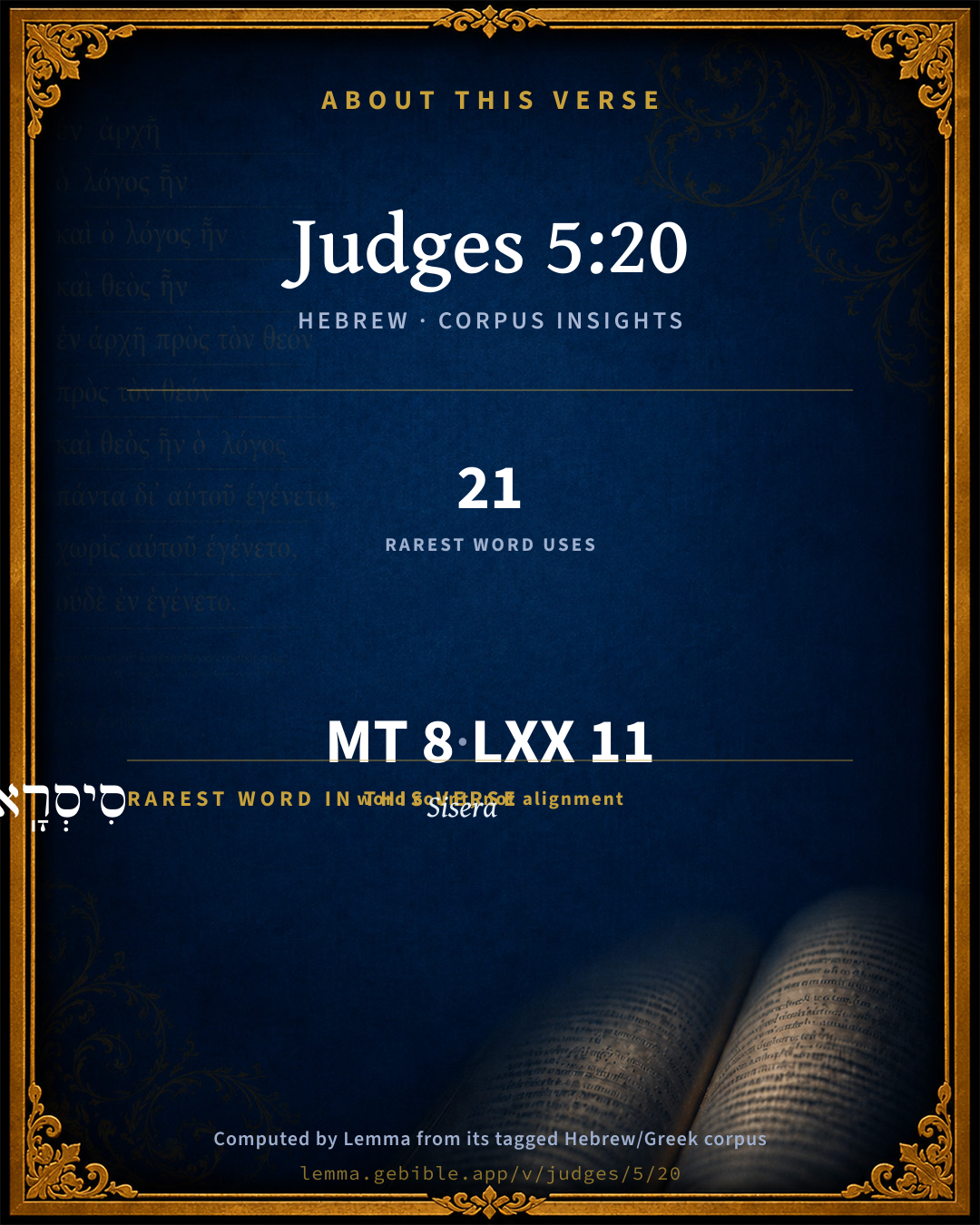
The rarest word here is סִיסְרָֽא Sisera H5516 — appearing just 21 times in the whole Hebrew Bible.

Shared distinctive vocabulary

סִיסְרָֽא Sisera H5516 occurs in 19 verses of the Hebrew Bible. Also found in:

Grammatical profile

  • 2 verbs
  • 4 nouns
  • 2 prepositions

Verb forms

  • נִלְחָ֑מוּ Niphal · Perfect
  • נִלְחֲמ֖וּ Niphal · Perfect

Repetition

A word recurs within this verse — often emphatic in Hebrew:

  • נִלְחָ֑מוּ to fight H3898 ×2

Hebrew & Septuagint length

In English translation the verse runs 13 words from the Hebrew and 19 from the Septuagint (LXX English) — the Septuagint runs noticeably longer here. See the side-by-side →

A rough comparison of the two English renderings, which tokenize alike — not a word-level alignment.

Word counts can differ between the Hebrew and the Greek without any difference in meaning — e.g. the Hebrew direct-object marker אֵת has no separate Greek word, and Greek often adds the article ὁ.

In the original languages it is 8 Hebrew tokens and 11 Greek tokens — but the two are counted differently (Hebrew bundles its prefixes and suffixes into one token; the Greek is in lemma form), so that isn’t a like-for-like length.

Cross-references

4

Topical passages linked to Judges 5:20 in the Treasury of Scripture Knowledge — connected by theme and wording, ordered by reader-vote popularity; previews shown in the World English Bible.

  • Joshua 10:11 It happened, as they fled from before Israel, while they were at the descent of Beth Horon, that Yahweh cast down great stones from the sky on them to Azekah, and they died: they were more who died with the hailstones than they whom the children of Israel killed with the sword.
  • Judges 4:15 Yahweh confused Sisera, and all his chariots, and all his host, with the edge of the sword before Barak; and Sisera alighted from his chariot, and fled away on his feet.
  • 1 Samuel 7:10 As Samuel was offering up the burnt offering, the Philistines drew near to battle against Israel; but Yahweh thundered with a great thunder on that day on the Philistines, and confused them; and they were struck down before Israel.
  • Psalms 77:17–18 The clouds poured out water. The skies resounded with thunder. Your arrows also flashed around.

Cross-references courtesy of OpenBible.info (CC BY 4.0).

Hebrew and Greek witnesses Masoretic Hebrew ↔ Greek Septuagint

The same verse in the two great witnesses to the Old Testament, shown verse-for-verse.

Here the Septuagint runs noticeably longer than the Hebrew — LXX2012 (modern English Septuagint) 19 words vs World English Bible 13. A rough length comparison of the two English translations, not a word-level alignment — read both below.

These are two independent witnesses, not word-aligned to each other, and the Septuagint is shown in lemma (dictionary) form.

Hebrew Judges 5:20 Masoretic · Westminster Leningrad Codex

מִן שָׁמַ֖יִם נִלְחָ֑מוּ הַכּֽוֹכָבִים֙ מִמְּסִלּוֹתָ֔ם נִלְחֲמ֖וּ עִם סִיסְרָֽא

From the sky the stars fought, From their courses they fought against Sisera.

World English Bible · Public Domain

Greek LXX Judges 5:20 Septuagint · lemma form

ἐκ οὐρανός παρατάσσω ὁ ἀστήρ ἐκ τρίβος αὐτός παρατάσσω μετά σισαρα

The stars from heaven set themselves in array, they set themselves to fight with Sisara out of their paths.

LXX2012 (modern English Septuagint) · Public Domain

On this verse, Haydock's Catholic Bible Commentary discusses the Septuagint’s reading. Read the note in Commentary ↓

Hebrew: Westminster Leningrad Codex (CC BY 4.0). Greek: Septuagint (public domain); English from LXX2012 (modern English Septuagint) (Public Domain). How the Septuagint differs from the Hebrew →

Targum (Aramaic paraphrase)

1

The Targum is the ancient Jewish Aramaic paraphrase of the Hebrew Scriptures — an interpretive translation, not the Hebrew text itself. Onkelos (literal) and Pseudo-Jonathan (expansive) render the Torah, and Jonathan the Prophets. Coverage is partial: where no permissively-licensed English translation exists for a verse, only the Aramaic is shown. This is verse-level text, not a word-by-word alignment to the Hebrew.

  1. Targum Jonathan Prophets (Joshua–Malachi)
    מִן שְׁמַיָא אִתְגַח עִמְהוֹן קְרָבָא מַאֲתַר דְנַפְקִין כּוֹכְבַיָא מְכַבְשֵׁי דַבָּרֵיהוֹן תַּמָן אִתָּגַח קְרָבָא עִם סִיסְרָא:

    (no public-domain English translation for this verse)

    Targum Jonathan — Aramaic: “Mikraot Gedolot” (public domain). English: “Sefaria Community Translation” (CC0 1.0 (public-domain dedication)); “London "Chaldee Paraphrase," 1871” (public domain). Text via Sefaria.

Commentary

Notes on Judges 5:20 from classic Christian and Jewish commentators (each source and its license shown beneath its notes). The classic Christian expositions comment on the surrounding passage and are grouped to its opening verse, so a note may address several verses; the Jewish commentaries on the Tanakh (Rashi and others) are per-verse, so they appear only where the commentator wrote on this verse.

Lemma curates 59 commentaries, every one of them public domain or Creative Commons licensed, each selected and text-cleaned for this edition rather than reprinted as found. About our sources →

Trapp's Complete Commentary

John Trapp

Jdg 5:20 They fought from heaven; the stars in their courses fought against Sisera.

Ver. 20. They fought from heaven.] Where the Lord of hosts hath his Magnleh cheloth, his upper forces, say the Rabbins, as on earth he hath his Matteh cheloth, his lower forces ready prest. And sins unpardoned can soon raise the posse comitatus, all the armies of God against men.

The stars in their courses.] Like soldiers that observed both rank and file.

Fought against Sisera,] s.c., By their extraordinary influences stirring up storms and tempests. See Joseph. "Antiq.," lib. v.

John Trapp, A Commentary or Exposition upon All the Books of the Old and New Testament (1647–1656) — public domain. Text from a community e-Sword module.

Joseph Benson's Commentary

Jdg 5:20. They fought from heaven — The prophetess, having in the foregoing verse mentioned who were the allies and helpers of Jabin, does here, in a very magnificent manner, represent who were the allies and helpers of Israel. They fought from heaven on this side; namely, the very angels of God themselves, the hosts of heaven, the armies of the Almighty. The very stars in their courses fought for Israel against Sisera — The elements, by the order of God, came to their assistance. The air and waters ranged themselves on their side; the rivers, even the small streams, lift up themselves and swept away their enemies. This is the magnificent and tremendous idea which the prophetess gives us of this victory over Sisera: see on Jdg 4:15. In the poetical scriptures, thunder and lightning are represented as the artillery of heaven. The Prophet Habakkuk, speaking of the defeat of the confederate kings of Canaan by Joshua, where there is no mention of thunder and lightning in the history, thus addresses Jehovah, Hab 3:11 —

The sun and moon stood still in their habitation;

By their light thine arrows went abroad;

And by their shining thy glittering spear.

Joseph Benson's Commentary on the Old and New Testaments (1811–1818) — public domain. Text from a community e-Sword module.

MacLaren's Expositions of Holy Scripture

Alexander MacLaren

Judges

‘ALL THINGS ARE YOURS’

Jdg 5:20. - Job 5:23.

These two poetical fragments present the same truth on opposite sides. The first of them comes from Deborah’s triumphant chant. The singer identifies God with the cause of Israel, and declares that heaven itself fought against those who fought against God’s people. There may be an allusion to the tempest which Jewish tradition tells us burst over the ranks of the enemy, or there may be some trace of ancient astrological notions, or the words may simply be an elevated way of saying that Heaven fought for Israel. The silent stars, as they swept on their paths through the sky, advanced like an avenging host embattled against the foes of Israel and of God. All things fight against the man who fights against God.

The other text gives the other side of the same truth. One of Job’s friends is rubbing salt into his wounds by insisting on the commonplace, which needs a great many explanations and limitations before it can be accepted as true, that sin is the cause of sorrow, and that righteousness brings happiness; and in the course of trying to establish this heartless thesis to a heavy heart he breaks into a strain of the loftiest poetry in describing the blessedness of the righteous. All things, animate and inanimate, are upon his side. The ground, which Genesis tells us is ‘cursed for his sake,’ becomes his ally, and the very creatures whom man’s sin set at enmity against him are at peace with him. All things are the friends and servants of him who is the friend and servant of God.

I. So, putting these two texts together, we have first the great conviction to which religion clings, that God being on our side all things are for us, and not against us.

Now, that is the standing faith of the Old Testament, which no doubt was more easily held in those days, because, if we accept its teaching, we shall recognise that Israel lived under a system in so far supernatural as that moral goodness and material prosperity were a great deal more closely and indissolubly connected than they are to-day. So, many a psalmist and many a prophet breaks out into apostrophes, warranted by the whole history of Israel, and declaring how blessed are the men who, apart from all other defences and sources of prosperity, have God for their help and Him for their hope.

But we are not to dismiss this conviction as belonging only to a system where the supernatural comes in, as it does in the Old Testament history, and as antiquated under a dispensation such as that in which we live. For the New Testament is not a whit behind the Old in insisting upon this truth. ‘All things work together for good to them that love God.’ ‘All things are yours, and ye are Christ’s, and Christ is God’s.’ ‘Who is he that will harm you if ye be followers of that which is good?’ The New Testament is committed to the same conviction as that to which the faith of Old Testament saints clung as the sheet anchor of their lives.

That conviction cannot be struck out of the creed of any man, who believes in the God to whom the Old and the New Testament alike bear witness. For it rests upon this plain principle, that all this great universe is not a chaos, but a cosmos, that all these forces and creatures are not a rabble, but an ordered host.

What is the meaning of that great Name by which, from of old, God in His relations to the whole universe has been described-the ‘Lord of Hosts’? Who are the ‘hosts’ of which He is ‘the Lord,’ and to whom, as the centurion said, He says to this one, ‘Go!’ and he goeth; and to another, ‘Come!’ and he cometh; and to another, ‘Do this!’ and he doeth it? Who are ‘the hosts’? Not only these beings who are dimly revealed to us as rational and intelligent, who ‘excel in strength,’ because they ‘hearken to the voice of His word’, but in the ranks of that great army are also embattled all the forces of the universe, and all things living or dead. ‘All are Thy servants; they continue this day’-angels, stars, creatures of earth-’ according to Thine ordinances.’

And if it be true that the All is an ordered whole, which is obedient to the touch and to the will of that divine Commander, then all His servants must be on the same side, and cannot turn their arms against each other. As an old hymn says with another reference-

‘All the servants of our King

In heaven and earth are one,’

and none of them can injure, wound, or slay a fellow-servant. If all are travelling in the same direction there can be no collision. If all are enlisted under the same standard they can never turn their weapons against each other. If God sways all things, then all things which God sways must be on the side of the men that are on the side of God. ‘Thou shalt make a league with the stones of the field: and the beasts of the field shall be at peace with thee.’

II. Note the difficulties arising from experience, in the way of holding fast by this conviction of faith.

The grim facts of the world, seen from their lowest level, seem to shatter it to atoms. Talk about ‘the stars in their courses fighting’ for or against anybody! In one aspect it is superstition, in another aspect it is a dream and an illusion. The prose truth is that they shine down silent, pitiless, cold, indifferent, on battlefields or on peaceful homes; and the moonlight is as pure when it falls upon broken hearts as when it falls upon glad ones. Nature is utterly indifferent to the moral or the religious character of its victims. It goes on its way unswerving and pitiless; and whether the man who stands in its path is good or bad matters not. If he gets into a typhoon he will be wrecked; if he tumbles over Niagara he will be drowned. And what becomes of all the talk about an embattled universe on the side of goodness, in the face of the plain facts of life-of nature’s indifference, nature’s cruelty which has led some men to believe in two sovereign powers, one beneficent and one malicious, and has led others to say, ‘God is a superfluous hypothesis, and to believe in Him brings more enigmas than it solves,’ and has led still others to say, ‘Why, if there is a God, does it look as if either He was not all-powerful, or was not all-merciful?’ Nature has but ambiguous evidence to give in support of this conviction.

Then, if we turn to what we call Providence and its mysteries, the very book of Job, from which my second text is taken, is one of the earliest attempts to grapple with the difficulty and to untie the knot; and I suppose everybody will admit that, whatever may be the solution which is suggested by that enigmatical book, the solution is by no means a complete one, though it is as complete as the state of religious knowledge at the time at which the book was written made possible to be attained. The seventy-third psalm shows that even in that old time when, as I have said, supernatural sanctions were introduced into the ordinary dealings of life, the difficulties that cropped up were great enough to bring a devout heart to a stand, and to make the Psalmist say, ‘My feet were almost gone; my steps had well-nigh slipped.’ Providence, with all its depths and mysteries, often to our aching hearts seems in our own lives to contradict the conviction, and when we look out over the sadness of humanity, still more does it seem impossible for us to hold fast by the faith ‘that all which we behold is full of blessings.’

I doubt not that there are many of ourselves whose lives, shadowed, darkened, hemmed in, perplexed, or made solitary for ever, seem to them to be hard to reconcile with this cheerful faith upon which I am trying to insist. Brethren, cling to it even in the darkness. Be sure of this, that amongst all our mercies there are none more truly merciful than those which come to us shrouded in dark garments, and in questionable shapes. Let nothing rob us of the confidence that ‘all things work together for good.’

III. I come, lastly, to consider the higher form in which this conviction is true for ever.

I have said that the facts of life seem often to us, and are felt often by some of us, to shatter it to atoms; to riddle it through and through with shot. But, if we bring the Pattern-life to bear upon the illumination of all life, and if we learn the lessons of the Cradle and the Cross, and rise to the view of human life which emerges from the example of Jesus Christ, then we get back the old conviction, transfigured indeed, but firmer than ever. We have to alter the point of view. Everything always depends on the point of view. We have to alter one or two definitions. Definitions come first in geometry and in everything else. Get them right, and you will get your theorems and problems right.

So, looking at life in the light of Christ, we have to give new contents to the two words ‘good’ and ‘evil,’ and a new meaning to the two words ‘for’ and ‘against.’ And when we do that, then the difficulties straighten themselves out, and there are not any more knots, but all is plain; and the old faith of the Old Testament, which reposed very largely upon abnormal and extraordinary conditions of life, comes back in a still nobler form, as possible to be held by us amidst the commonplace of our daily existence.

For everything is my friend, is for me and not against me, that helps me nearer to God. To live for Him, to live with Him, to be conscious ever of communion with Himself, to feel the touch of His hand on my hand, and the pressure of His breast against mine, at all moments of my life, is my true and the highest good. And if it is true that the ‘river of the water of life’ which ‘flows from the Throne of God’ is the only draught that can ever satisfy the immortal thirst of a soul, then whatever drives me away from the cisterns and to the fountain, is on my side. Better to dwell in a ‘dry and thirsty land, where no water is,’ if it makes me long for the water that rises at the gate of the true Bethlehem-the house of bread-than to dwell in a land flowing with milk and honey, and well watered in every part! If the cup that I would fain lift to my lips has poison in it, or if its sweetness is making me lose my relish for the pure and tasteless river that flows from the Throne of God, there can be no truer friend than that calamity, as men call it, which strikes the cup from my hands, and shivers the glass before I have raised it to my lips. Everything is my friend that helps me towards God.

Everything is my friend that leads me to submission and obedience. The joy of life, and the perfection of human nature, is an absolutely submitted will, identified with the divine, both in regard to doing and to enduring. And whatever tends to make my will flexible, so that it corresponds to all the sinuosities, so to speak, of the divine will, and fits into all its bends and turns, is a blessing to me. Raw hides, stiff with dirt and blood, are put into a bath of bitter infusion of oak-bark. What for? For the same end as, when they are taken out, they are scraped with sharp steels,-that they may become flexible. When that is done the useless hide is worth something.

‘Our wills are ours, we know not how;

Our wills are ours, to make them Thine.’

And whatever helps me to that is my friend.

Everything is a friend to the man that loves God, in a far sweeter and deeper sense than it can ever be to any other. Like a sudden burst of sunshine upon a gloomy landscape, the light of union with God and friendship with Him flooding my daily life flashes it all up into brightness. The dark ribbon of the river that went creeping through the black copses, when the sun glints upon it, gleams up into links of silver, and the trees by its bank blaze out into green and gold. Brethren! ‘Who follows pleasure follows pain’; who follows God finds pleasure following him. There can be no surer way to set the world against me than to try to make it for me, and to make it my all They tell us that if you want to count those stars that ‘like a swarm of fire-flies tangled in a silver braid’ make up the Pleiades, the surest way to see the greatest number of them is to look a little on one side of them. Look away from the joys and friendships of creatural things right up to God, and you will see these sparkling and dancing in the skies, as you never see them when you gaze at them only. Make them second and they are good and on your side. Make them first, and they will turn to be your enemies and fight against you.

This conviction will be established still more irrefragably and wonderfully in that future. Nothing lasts but goodness. ‘He that doeth the will of God abideth for ever.’ To oppose it is like stretching a piece of pack-thread across the rails before the express comes; or putting up some thin wooden partition on the beach on one of the Western Hebrides, exposed to the whole roll of the Atlantic, which will be battered into ruin by the first winter’s storm. Such is the end of all those who set themselves against God.

But there comes a future in which, as dim hints tell us, these texts of ours shall receive a fulfilment beyond that realised in the present condition of things. ‘Then comes the statelier Eden back to man,’ and in a renewed and redeemed earth ‘they shall not hurt nor destroy in all My holy mountain’; and the ancient story will be repeated in higher form. The servants shall be like the Lord who, when He had conquered temptation, ‘was with the wild beasts’ that forgot their enmity, and ‘angels ministered unto Him.’ That scene in the desert may serve as a prophecy of the future when, under conditions of which we know nothing, all God’s servants shall, even more markedly and manifestly than here, help each other; and every man that loves God will find a friend in every creature.

If we take Him for our Commander, and enlist ourselves in that embattled host, then all weathers will be good; ‘stormy winds, fulfilling His word,’ will blow us to our port; ‘the wilderness will rejoice and blossom as the rose’; and the whole universe will be radiant with the light of His presence, and ringing with the music of His voice. But if we elect to join the other army-for there is another army, and men have wills that enable them to lift themselves up against God, the Ruler of all things-then the old story, from which my first text is taken, will fulfil itself again in regard to us-’the stars in their courses will fight against’ us; and Sisera, lying stiff and stark, with Jael’s tent-peg through his temples, and the swollen corpses being swirled down to the stormy sea by ‘that ancient river, the river Kishon,’ will be a grim parable of the end of the men that set themselves against God, and so have the universe against them. ‘Choose ye this day whom ye will serve.’

Alexander MacLaren, Expositions of Holy Scripture (1904–1910) — public domain. Text from a community e-Sword module.

Jamieson, Fausset & Brown

Robert Jamieson, A. R. Fausset & David Brown

the stars in their courses fought--A fearful tempest burst upon them and threw them into disorder.

Jamieson, Fausset & Brown — Commentary Critical and Explanatory on the Whole Bible (1871) — public domain (CC PDM 1.0). Text via the HelloAO Bible API.

Adam Clarke's Commentary

Verse 20. They fought from heaven] The angels of God came to the assistance of Israel: and the stars in their orbits fought against Sisera; probably some thunder storm, or great inundation from the river Kishon, took place at that time, which in poetic language was attributed to the stars. So our poet sung relative to the storms which dispersed the Spanish armada in 1588: -

"Both winds and waves at once conspire

To aid old England-frustrate Spain's desire."

Perhaps it means no more than this: the time which was measured and ruled by the heavenly bodies seemed only to exist for the destruction of the Canaanites. There may be also a reference to the sun and moon standing still in the days of Joshua.

Adam Clarke's Commentary on the Bible (1810–1826) — public domain. Text from a community e-Sword/MySword module.

Ellicott's Commentary for English Readers

(20) They fought from heaven.—The “they” is impersonal—the powers above. (Comp. Luk_12:20, Greek, and for the fact, Jdg_4:22.)

The stars in their courses.—This is probably a general reference to the providential storms which had secured the victory to Israel. To understand the “stars” as meaning “angels” is a mistaken inference from Job_38:7. There is a striking parallel in Claudian’s poem on the Consulship of Honorius:—

“Oh nimium dilecte Deo, cui militat aether

Et conjurati veniunt ad classica venti.”

Similarly, Æschylus represents “water and fire, in ruin reconciled,” fighting against the Greek fleet.

A Bible Commentary for English Readers, edited by Charles John Ellicott (1878–1897) — public domain. Text from a community e-Sword module.

The Cambridge Bible for Schools and Colleges

gen. ed. J. J. S. Perowne

20. Render with a slight change of the stop:

From heaven fought the stars:

From their highways they fought with Sisera.

The kings fought … The stars fought] A splendid contrast. Jehovah used the forces of nature as His allies and instruments; cf. Jos_10:11; 1Sa_7:10; Psa_18:14; Jer_23:19. Here it was the tempest (Jdg_5:4 f.), flooding the Kishon (Jdg_5:21), which providentially helped the Israelites.

The Cambridge Bible for Schools and Colleges (gen. ed. J. J. S. Perowne; Cambridge University Press, 1878–1918) — public domain. Text from a community e-Sword module.

John Gill's Exposition

They fought from heaven,.... Either the angels of heaven, afterwards called stars; or the heavens, the elements, fought for Israel, and against Sisera; a violent storm of rain and hail falling at this time, which discomfited Sisera's army; See Gill on Jdg 4:15, or this victory was obtained in such a manner as plainly showed it was not of man, but of God from heaven; so the Targum,"from heaven war was made with them;''with the kings before mentioned; God fought against them, and no wonder they were conquered:

the stars in their courses fought against Sisera it seems as if it was in the night that this battle was fought, at least that the pursuit lasted till night, when the stars by their brightness and clear shining favoured the Israelites, and were greatly to the disadvantage of the Canaanites; unless it can be thought, as is by some, that the stars had an influence to cause a tempest of rain, hail, thunder, and lightnings, by which the army of Sisera was discomfited in the daytime, as before observed.

John Gill's Exposition of the Whole Bible (1746–1763) — public domain (CC PDM 1.0). Text via the HelloAO Bible API.

Albert Barnes' Notes on the Bible

God fought on the side of Israel, and gave them the victory. Josephus relates that, just as the battle began, a violent tempest came on with a great downfall of rain; and a hailstorm, which, driving full in the faces of the Canaanites, so blinded and benumbed them with cold, that they could neither use their bows with effect nor even hold their swords.

Albert Barnes' Notes on the Bible (1834–1885) — public domain. Text from a community e-Sword/MySword module.

Haydock's Catholic Bible Commentary

Stars, or angels, who are compared to the stars, and often fought for Israel, 2 Machabees x. 29. (Vales, Philos. chap. xxxi.) (Calmet) --- The favourable and malignant influences of the stars, which the Rabbins talk of, would here be nugatory, (Haydock) unless they might contribute to bring on rain. (Cajetan) --- Josephus ([Antiquities?] v. 6.) informs us that a furious tempest of hail, &c., met the enemy in the face, and rendered all their efforts useless. (Calmet) --- A similar instance of the divine protection was obtained by the prayers of the thundering legion, in the army of M. Aurelius; (Tertullian; Eusebius, Hist. v. 5.) and again, when Theodosius attacked the tyrant Eugenius, of which Claudian speaks, (in 3 Cons. Honor.) "Te propter gelidis Aquilo de monte procellis---Obruit adversas acies, revolutaque tela---Vertit in Auctores et trubine repulit hastas---O nimium dilecte Deo, cui fundit ab antris---Æolus armatas hiemes, cui militat æther---Et conjurati veniunt ad classica venti." (Haydock) --- Courses. This miracle was of a different kind from that which proved so fatal to the enemies of Josue. (Lyranus) --- Septuagint (Alexandrian), "They fought with (meta) Israel," for which Grabe puts, against Sisara. (Haydock)

George Leo Haydock (1774–1849), Haydock's Catholic Family Bible and Commentary, 1859 edition — public domain. Excludes Psalms (Douay-Rheims chapter numbering differs from Protestant) and Deuterocanonical books (Catholic canon only).

Matthew Poole's English Annotations

Or, they from heaven, or the heavenly host fought, by thunder, and lightning, and hailstones, possibly mingled with fire. Compare Jos 10:11; 1Sa 7:10.

The stars; which raised those storms by their influences, which they do naturally and ordinarily, but now far more, when God sharpened their influences, and disposed the air to receive and improve their impressions.

In their courses, or, from their paths, or stations, or high places. As soldiers fight in their ranks and places assigned them, so did these, and that with advantage, as those enemies do which fight from the higher ground.

Matthew Poole's English Annotations on the Holy Bible (1683–1685) — public domain. Text from a community e-Sword/MySword module.

Whedon's Commentary on the Bible

Daniel D. Whedon

20. From heaven they fought — The elements of nature assisted in the strife. The violent thunder storm on which Jehovah rode over the fields of Edom was so terrible that the very heavens appeared to drop. See on Jdg_5:4 and Jdg_4:15.

The stars from their courses fought — This is a more minute defining of the thought in the preceding line. The bursting clouds and darting lightnings are poetically spoken of as if the stars had started from their orbits and mingled in the war of elements.

Daniel D. Whedon (gen. ed.), Commentary on the Old and New Testaments (1874–1909) — public domain. Text from a community e-Sword module.

The Pulpit Commentary

According to Josephus, a great storm in the face of the Canaanites led to their utter discomfiture, and also swelled the Kishon to overflow its banks.

The hopelessness of opposition to God.

This verse is variously interpreted as an astrological allusion as descriptive of a thunder-storm, accompanied by wind, hail, and floods, producing confusion (Josephus); or as suggestive of the delay which lost Sisera the opportunity. The explanation of Berthau, referring it to the Divine intervention, appears more reasonable and spiritually sufficient. All through the mind of the prophetess dwells upon God as the Helper and Avenger. But there is room for an intermediate idea. The stars are symbols of an unvarying law and universal destiny. Generalise upon the great contest between right and wrong. The combatants are not only men; the whole universe is involved. Angels join in the fray. God himself is against the sinner. The latter must be vanquished.

I THE ULTIMATE CHARACTER OF THE CONTEST OF THE WICKED WITH THE RIGHTEOUS. An accidental circumstance may excuse it; a temporary character may be assumed by it. We may not divine the whole scope and drift of the quarrel. Truth may not be wholly on one side or the other. Sometimes a prophetic insight assures us that we are with God, or against him. Ultimately the question is one of right and wrong.

II THE COMBATANTS INVOLVED. Not human opponents merely; the question too large for this. The laws of the universe; the angels of God; destiny; God himself visibly contending in the person of his Son, invisibly in the councils of eternity.

III THE CERTAINTY OF THE ISSUE. M.

The Pulpit Commentary (1880–1919), ed. H.D.M. Spence-Jones & Joseph S. Exell — public domain. Text from a community e-Sword module.

John Wesley's Explanatory Notes

From heaven - Or, they from heaven, or the heavenly host fought, by thunder, and lightning, and hail-stones, possibly mingled with fire. The stars - Raising these storms by their influences, which they do naturally. Courses - Or, from their paths, or stations. As soldiers fight in their ranks and places assigned them, so did these.

John Wesley, Explanatory Notes Upon the Whole Bible (1754–1765) — public domain. Text via the GEBible commentary corpus.

Keil & Delitzsch

C. F. Keil & F. Delitzsch

For not only did the Israelites fight against them, but he powers of heaven also. "From heaven" is more minutely defined by "the stars from their courses." These words explain the statement in Jdg 4:15, "the Lord discomfited Sisera;" though in our opinion not so clearly as to enable us to define more precisely the natural phenomenon by which God threw the enemy into confusion. In all probability we have to think of a terrible storm, with thunder and lightning and hail, or the sudden bursting of a cloud, which is poetically described as though the stars of heaven had left their courses to fight for the Lord and His kingdom upon earth.

Keil & Delitzsch — Biblical Commentary on the Old Testament (1861–1891) — public domain (CC PDM 1.0). Text via the HelloAO Bible API. (Old Testament only.)

Rashi

Rabbi Shlomo Yitzchaki (Rashi)

War was waged from heaven. The Holy One blessed is He, as well, dispatched His hosts against them. They, too, have no desire for any payment.

In their pathways. The upper tip of the star was in heaven, the bottom on earth. This teaches that the width of the firmament is equivalent to the distance between heaven and earth. For the star is suspended across the firmament like a sort of bolt across a door, its length measuring the same as the width of the firmament. From this passage, which attests that they waged war in their pathways, we learn that the width of the firmament is the same as the elevation of heaven from earth.

Rashi on the Tanakh — English translations: “The Judaica Press complete Tanach with Rashi, translated by A. J. Rosenberg” (CC BY 4.0); “Pentateuch with Rashi's commentary by M. Rosenbaum and A.M. Silbermann, 1929-1934” (public domain); “The Metsudah Tanach series, Lakewood, N.J” (CC BY 4.0); and “The Book of Joshua, Metsudah Publications, 1997” (CC BY 4.0). Text via Sefaria.

Radak

Rabbi David Kimhi (Radak)

They fought from heaven: So great was the victory in which Israel defeated Sisera's army that it was as if they fought with Sisera from the heavens.

The stars from their paths: Along the same lines as (Joel 4:11), "cause Your mighty ones to come down there, O Lord." And according to the homiletical approach (Pesachim 118b), it is that the stars heated them up, and they were wearing armor. So from the great heat, they went into the Kishon River to cool down; but the river washed them away. That is why it placed the verse of the Kishon River adjacent to the verse, "They fought from the skies." But according to the simple approach: Because the war was in the desert on the shore of the Kishon River, they went [into it] - whether to flee or whether to fight the war with Israel - but the chariots stumbled, like in Egypt, as it stated (Exodus 14:28), "He removed the wheels of their chariots." So the horsemen fell into the river, the river washed them away and they drowned. But it was not like this with Israel, but they rather marched through the river with courage, and passed through it without any incident or injury. And this is [the meaning of] that which is written (in the next verse), "march on, my soul, with courage." Meaning, with courage did my soul march through that river which washed them away. It is a sign that the heavens fought with them for my sake. And Yonatan translated (in the Targum), "march on, my soul, with courage" [as], "my soul trampled their dead warriors with power." And the explanation of the kedumim river, is that it is a river that was there from antiquity (kedem); as if it were created there from antiquity to take vengeance on the enemies of the Lord, along the lines of (Proverbs 16:4), "God did everything for His sake, etc."

Radak on the Tanakh — English translations: “Sefaria Community Translation” (CC0 1.0 (public-domain dedication)); “Eliyahu Munk, HaChut Hameshulash” (CC BY 4.0); “Rabbi Mike Feuer, Jerusalem Anthology” (CC BY 4.0); and “R. David Kimhi on the first book of Psalms, Translated by R.G. Finch, London, 1919” (public domain). Text via Sefaria.

Lesson kit

Teaching starters — assembled from the data on this page, not authored interpretation. Every prompt links to the verse data it draws on. Edit before teaching.

Judges, in the Historical, opens this verse with 8 words (7 distinct Hebrew lemmas). Its most distinctive word is Çîyçᵉrâʼ (“Sisera”). The Greek Septuagint runs longer here. A historical commentator’s framing appears above. Read the whole chapter for the surrounding context.

Discussion questions

  1. What does “Sisera” (Çîyçᵉrâʼ) contribute to the verse as a whole?
  2. How does Judges 4:2, which shares the word «Sisera», read alongside this verse?
  3. What does the repetition of “to fight” (2× in this one verse) do in this verse?
  4. The Septuagint runs longer here than the Hebrew. What might account for the difference?
  5. The translations on this page render this verse differently — a whole-verse word diff, not a word-by-word alignment. What might account for the different wordings?
  6. «נִלְחָ֑מוּ» is a Niphal Perfect verb. How does that grammatical form shape the action described?
  7. Compare how Trapp's Complete Commentary and Joseph Benson's Commentary read this verse. Where do they agree or differ?

Things to notice

Reading settings

Reading text

Shown beneath each verse's original-language words.

Old Testament
Old Testament edition

Read the OT as the Masoretic Hebrew (MT) or the Greek Septuagint (LXX).

English shown for the Greek Septuagint (in the Hebrew ↔ Greek comparison).

Comparing translations? Open the Compare panel on any verse page to stack up to four side by side.