
Judges 20:40

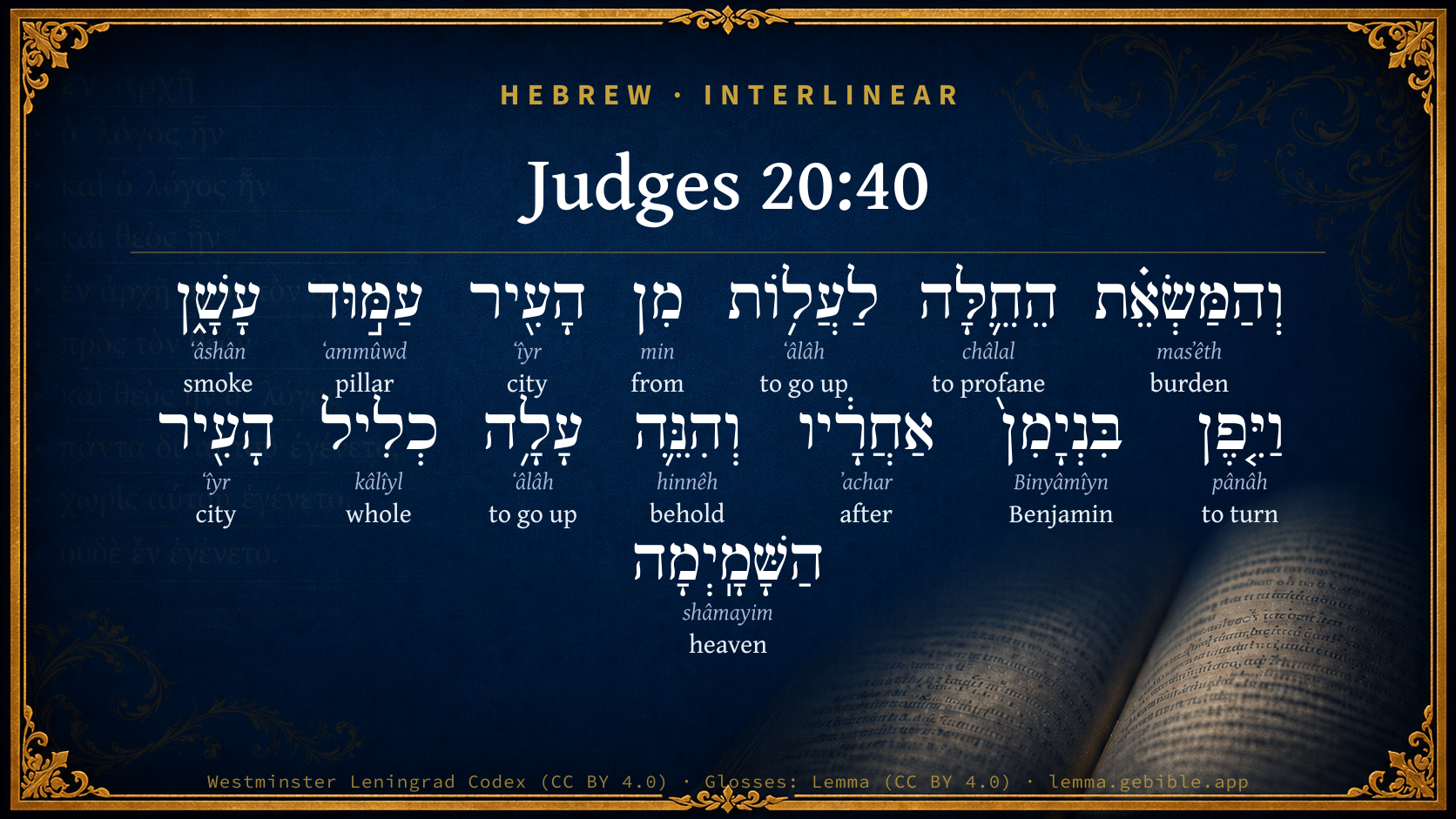
Hebrew (Westminster Leningrad Codex) Judges 20:40 appears in the Hebrew Old Testament. The text above is from the Westminster Leningrad Codex. Each word links to its Strong’s number, a concise gloss, and parsing drawn from the Open Scriptures Hebrew Bible morphology. Click any word for its full Brown-Driver-Briggs (BDB) entry.
Download image
Cite this verse

Judges 20:40 (World English Bible). Public Domain. Lemma interlinear Bible study tool, https://lemma.gebible.app/v/judges/20/40.

Show BibTeX & RIS
BibTeX
RIS
English Translation
But when the cloud began to arise up out of the city in a pillar of smoke, the Benjamites looked behind them; and, behold, the whole of the city went up in smoke to the sky.
World English Bible · Public Domain
Download a study sheet

One document with this verse’s original text, its word-by-word gloss line, the meaning frame, cross-references with their text, attributed commentary, and full source and license credits — printable, and it pastes into notes with its structure intact.

This verse Autodidact and up

Study sheet (.html) Plain text (.txt)

A passage Seminary Student

Up to 50 verses in one chapter. A passage sheet keeps up to 6 commentary sources and 12 cross-references per verse, in the order this page ranks them, and says so on the sheet whenever that leaves anything out. Ask for a single verse and you get the Autodidact verse sheet above.

Everything on this page stays free to read, with no account — the sheet is a download of what is already on screen, not access to it.

Want to remove ads? Support Godless Engineer
Compare translations 3

The same verse in 3 English versions, stacked beneath the original-language interlinear above. Click any original word for its lexicon entry.

Each is an independent rendering of the whole verse — the interlinear is not word-aligned to these translations.

Highlighted words mark where these versions differ — a whole-verse word diff, not a word-by-word alignment.

  • World English Bible Public Domain
    But when the cloud began to arise up out of the city in a pillar of smoke, the Benjamites looked behind them; and, behold, the whole of the city went up in smoke to the sky.
  • King James Version Public Domain
    But when the flame began to arise up out of the city with a pillar of smoke, the Benjamites looked behind them, and, behold, the flame of the city ascended up to heaven.
  • unfoldingWord Literal Text CC BY-SA 4.0
    But the signal began to go up from the city, a column of smoke, and Benjamin turned after it, and behold, the whole of the city had gone up to the heavens.

unfoldingWord Literal Text — © unfoldingWord, licensed CC BY-SA 4.0. Word-aligned USFM3 via Door43 (git.door43.org/unfoldingWord/en_ult).

Versions to compare (up to 4)

3 of 4 selected

Show all 18 translations

Every available English version of this verse, each an independent rendering of the whole verse.

  • World English Bible Public Domain
    But when the cloud began to arise up out of the city in a pillar of smoke, the Benjamites looked behind them; and, behold, the whole of the city went up in smoke to the sky.
  • Berean Standard Bible Public Domain
    But when the column of smoke began to go up from the city, the Benjamites looked behind them and saw the whole city going up in smoke.
  • Majority Standard Bible Public Domain
    But when the column of smoke began to go up from the city, the Benjamites looked behind them and saw the whole city going up in smoke.
  • King James Version Public Domain
    But when the flame began to arise up out of the city with a pillar of smoke, the Benjamites looked behind them, and, behold, the flame of the city ascended up to heaven.
  • American Standard Version (1901) Public Domain
    But when the cloud began to arise up out of the city in a pillar of smoke, the Benjamites looked behind them; and, behold, the whole of the city went up `in smoke' to heaven.
  • Revised Version (1885) Public Domain
    But when the cloud began to arise up out of the city in a pillar of smoke, the Benjamites looked behind them, and, behold, the whole of the city went up in smoke to heaven.
  • Geneva Bible (1599) Public Domain
    But when the flame bega to arise out of the citie, as a pillar of smoke, the Beniamites looked backe, and behold, the flame of the citie began to ascend vp to heauen.
  • Douay-Rheims (1899) Public Domain
    And perceived as it were a pillar of smoke rise up from the city; and Benjamin looking back, saw that the city was taken, and that the flames ascended on high:
  • Young's Literal Translation Public Domain
    and the volume hath begun to go up from the city -- a pillar of smoke -- and Benjamin turneth behind, and lo, gone up hath the perfection of the city toward the heavens.
  • Literal Standard Version CC BY-SA 4.0
    but the volume has begun to go up from the city—a pillar of smoke—and Benjamin turns behind, and behold, the perfection of the city has gone up toward the heavens.
  • Unlocked Literal Bible CC BY-SA 4.0
    But when a pillar of smoke began to rise up out of the city, the Benjamites turned and saw the smoke rising to the sky from the whole city.
  • unfoldingWord Literal Text CC BY-SA 4.0
    But the signal began to go up from the city, a column of smoke, and Benjamin turned after it, and behold, the whole of the city had gone up to the heavens.
  • Darby Bible Public Domain
    But when the signal began to rise out of the city in a column of smoke, the Benjaminites looked behind them; and behold, the whole of the city went up in smoke to heaven.
  • World Messianic Bible Public Domain
    But when the cloud began to arise up out of the city in a pillar of smoke, the Benjamites looked behind them; and behold, the whole city went up in smoke to the sky.
  • Webster's Bible Public Domain
    But when the flame began to rise from the city with a pillar of smoke, the Benjaminites looked behind them, and behold, the flame of the city ascended to heaven.
  • Free Bible Version CC BY-SA 4.0
    However, when the Israelites saw the columns of smoke rising heavenwards to form a great cloud over the whole of the town,
  • Bible in Basic English Public Domain
    Then the sign went up out of the town in the pillar of smoke, and the Benjamites, turning back, saw all the town going up in smoke to heaven.
  • JPS Tanakh (1917) Public Domain
    But when the beacon began to arise up out of the city in a pillar of smoke, the Benjamites looked behind them, and, behold, the whole of the city went up in smoke to heaven.

Literal Standard Version (2020), Covenant Press — licensed CC BY-SA 4.0. Text via the HelloAO Bible API (eBible.org). Unlocked Literal Bible (unfoldingWord) — licensed CC BY-SA 4.0. Text via the HelloAO Bible API (eBible.org). unfoldingWord Literal Text — © unfoldingWord, licensed CC BY-SA 4.0. Word-aligned USFM3 via Door43 (git.door43.org/unfoldingWord/en_ult). Free Bible Version, Dr. Jonathan Gallagher — licensed CC BY-SA 4.0. Text via the HelloAO Bible API (eBible.org).

Word by word

More ways to search: Search by grammar → Find every occurrence → Compare this word →

Practice this passage: Drill this verse → Learn its vocabulary →

כְלִיל
kâlîyl
H3632
“whole of”
Adjective, Adjective, Masculine, Singular, Construct
Part of Speech
Adjective
Type
Adjective
Gender
Masculine
Number
Singular
State
Construct
Full BDB Definition

Origin: from H3634

TWOT: 985b

entire, all, perfect (adjective) - entirety (substantive) - whole, whole burnt offering, holocaust, entirety (substantive)
  1. וְהַמַּשְׂאֵ֗ת masʼêth H4864 “and · the · burden” Conjunction + Particle, Definite Article + Noun, Common, Feminine, Singular, Absolute
  2. הֵחֵ֛לָּה châlal H2490 “to profane” Verb, Hiphil, Perfect, 3rd Person, Feminine, Singular
  3. לַעֲל֥וֹת ʻâlâh H5927 “to go up” Preposition + Verb, Qal, Infinitive Construct
  4. מִן min H4480 “from” Preposition
  5. הָעִ֖יר ʻîyr H5892 “the · city” Particle, Definite Article + Noun, Common, Feminine, Singular, Absolute
  6. עַמּ֣וּד ʻammûwd H5982 “pillar of” Noun, Common, Masculine, Singular, Construct
  7. עָשָׁ֑ן ʻâshân H6227 “smoke” Noun, Common, Masculine, Singular, Absolute
  8. וַיִּ֤פֶן pânâh H6437 “and · to turn” Conjunction + Verb, Qal, Sequential Imperfect, 3rd Person, Masculine, Singular
  9. בִּנְיָמִן֙ Binyâmîyn H1144 “Benjamin” Noun, Proper
  10. אַחֲרָ֔יו ʼachar H310 “after · him” Preposition + Suffix, Personal, 3rd Person, Masculine, Singular
  11. וְהִנֵּ֛ה hinnêh H2009 “and · behold” Conjunction + Particle, Demonstrative
  12. עָלָ֥ה ʻâlâh H5927 “to go up” Verb, Qal, Perfect, 3rd Person, Masculine, Singular
  13. הָעִ֖יר ʻîyr H5892 “the · city” Particle, Definite Article + Noun, Common, Feminine, Singular, Absolute
  14. הַשָּׁמָֽיְמָה shâmayim H8064 “the · heaven(s) · toward” Particle, Definite Article + Noun, Common, Masculine, Plural, Absolute + Suffix, Demonstrative

About this verse

These counts appear in no published source. They are computed here, from the morphology-tagged text and Lemma’s own curated glosses. What Lemma adds →

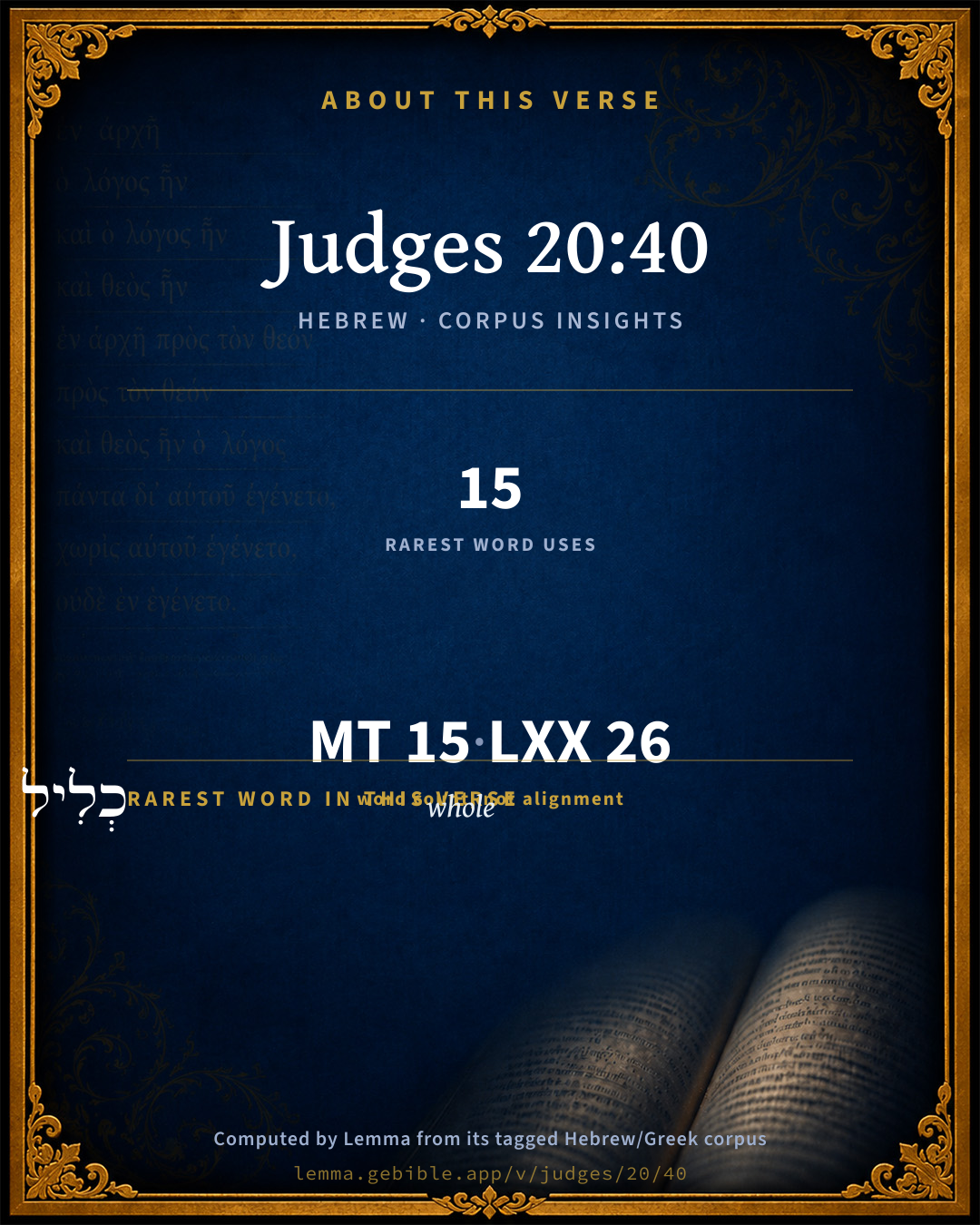
15
words
13
distinct lemmas
Historical
section

Notable vocabulary

The rarest word here is כְלִיל whole H3632 — appearing just 15 times in the whole Hebrew Bible.

Shared distinctive vocabulary

כְלִיל whole H3632 occurs in 15 verses of the Hebrew Bible. Also found in:

Grammatical profile

  • 4 verbs
  • 7 nouns
  • 1 adjective
  • 2 prepositions
  • 1 particle

Verb forms

  • הֵחֵ֛לָּה Hiphil · Perfect
  • לַעֲל֥וֹת Qal · Infinitive Construct
  • וַיִּ֤פֶן Qal · Sequential Imperfect
  • עָלָ֥ה Qal · Perfect

Repetition

Words recur within this verse — often emphatic in Hebrew:

  • לַעֲל֥וֹת to go up H5927 ×2
  • הָעִ֖יר city H5892 ×2

Hebrew & Septuagint length

In English translation the verse runs 36 words from the Hebrew and 30 from the Septuagint (LXX English) — closely comparable.

A rough comparison of the two English renderings, which tokenize alike — not a word-level alignment.

Word counts can differ between the Hebrew and the Greek without any difference in meaning — e.g. the Hebrew direct-object marker אֵת has no separate Greek word, and Greek often adds the article ὁ.

In the original languages it is 15 Hebrew tokens and 26 Greek tokens — but the two are counted differently (Hebrew bundles its prefixes and suffixes into one token; the Greek is in lemma form), so that isn’t a like-for-like length.

Cross-references

5

Topical passages linked to Judges 20:40 in the Treasury of Scripture Knowledge — connected by theme and wording, ordered by reader-vote popularity; previews shown in the World English Bible.

  • Joshua 8:20 When the men of Ai looked behind them, they saw, and, behold, the smoke of the city ascended up to heaven, and they had no power to flee this way or that way: and the people who fled to the wilderness turned back on the pursuers.
  • Joel 2:30 I will show wonders in the heavens and in the earth: Blood, fire, and pillars of smoke.
  • Revelation 19:3 A second said, "Hallelujah! Her smoke goes up forever and ever."
  • Genesis 19:28 He looked toward Sodom and Gomorrah, and toward all the land of the plain, and looked, and saw that the smoke of the land went up as the smoke of a furnace.
  • Song of Solomon 3:6 Who is this who comes up from the wilderness like pillars of smoke, Perfumed with myrrh and frankincense, With all spices of the merchant?

Cross-references courtesy of OpenBible.info (CC BY 4.0).

Hebrew and Greek witnesses Masoretic Hebrew ↔ Greek Septuagint

The same verse in the two great witnesses to the Old Testament, shown verse-for-verse.

These are two independent witnesses, not word-aligned to each other, and the Septuagint is shown in lemma (dictionary) form.

Hebrew Judges 20:40 Masoretic · Westminster Leningrad Codex

וְהַמַּשְׂאֵ֗ת הֵחֵ֛לָּה לַעֲל֥וֹת מִן הָעִ֖יר עַמּ֣וּד עָשָׁ֑ן וַיִּ֤פֶן בִּנְיָמִן֙ אַחֲרָ֔יו וְהִנֵּ֛ה עָלָ֥ה כְלִיל הָעִ֖יר הַשָּׁמָֽיְמָה

But when the cloud began to arise up out of the city in a pillar of smoke, the Benjamites looked behind them; and, behold, the whole of the city went up in smoke to the sky.

World English Bible · Public Domain

Greek LXX Judges 20:40 Septuagint · lemma form

καί ὁ σύσσημον ἀναβαίνω ἐπί πολύς ἐπί ὁ πόλις ὡς στῦλος καπνός καί ἐπιβλέπω βενιαμίν ὀπίσω αὐτός καί ἰδού ἀναβαίνω ὁ συντέλεια ὁ πόλις ἕως οὐρανός

And the signal went up increasingly over the city as a pillar of smoke; and Benjamin looked behind him, and behold the destruction of the city went up to heaven.

LXX2012 (modern English Septuagint) · Public Domain

On this verse, Ellicott's Commentary for English Readers discusses the Septuagint’s reading. Read the note in Commentary ↓

Hebrew: Westminster Leningrad Codex (CC BY 4.0). Greek: Septuagint (public domain); English from LXX2012 (modern English Septuagint) (Public Domain). How the Septuagint differs from the Hebrew →

Targum (Aramaic paraphrase)

1

The Targum is the ancient Jewish Aramaic paraphrase of the Hebrew Scriptures — an interpretive translation, not the Hebrew text itself. Onkelos (literal) and Pseudo-Jonathan (expansive) render the Torah, and Jonathan the Prophets. Coverage is partial: where no permissively-licensed English translation exists for a verse, only the Aramaic is shown. This is verse-level text, not a word-by-word alignment to the Hebrew.

  1. Targum Jonathan Prophets (Joshua–Malachi)
    וּתְנָנָא שְׁרֵי לְאַסָקָא מִן קַרְתָּא יְטוּר דִתְנָן וְאִתְפְּנִיאוּ דְּבֵית בִּנְיָמִין בַּתְרֵיהוֹן וְהָא סְלִיק תְּנָנָא דְקַרְתָּא לְצֵית שְׁמַיָא:

    (no public-domain English translation for this verse)

    Targum Jonathan — Aramaic: “Mikraot Gedolot” (public domain). English: “Sefaria Community Translation” (CC0 1.0 (public-domain dedication)); “London "Chaldee Paraphrase," 1871” (public domain). Text via Sefaria.

Commentary

Notes on Judges 20:40 from classic Christian and Jewish commentators (each source and its license shown beneath its notes). The classic Christian expositions comment on the surrounding passage and are grouped to its opening verse, so a note may address several verses; the Jewish commentaries on the Tanakh (Rashi and others) are per-verse, so they appear only where the commentator wrote on this verse.

Lemma curates 59 commentaries, every one of them public domain or Creative Commons licensed, each selected and text-cleaned for this edition rather than reprinted as found. About our sources →

Trapp's Complete Commentary

John Trapp

Jdg 20:40 But when the flame began to arise up out of the city with a pillar of smoke, the Benjamites looked behind them, and, behold, the flame of the city ascended up to heaven.

Ver. 40. The flame of the city.] To be an example of that rule, that great sins bring great punishments from God, as Herodotus wisely observeth of the destruction of Troy by fire.

John Trapp, A Commentary or Exposition upon All the Books of the Old and New Testament (1647–1656) — public domain. Text from a community e-Sword module.

Joseph Benson's Commentary

Jdg 20:40. The Benjamites looked behind them — It is likely the Israelites shouted when they turned about to fall upon the Benjamites, which made them look back to see what unexpected supplies they had received. Then they saw their city on fire, which, with the sudden turning of the Israelites from flight to attack them, quite put them in confusion.

Joseph Benson's Commentary on the Old and New Testaments (1811–1818) — public domain. Text from a community e-Sword module.

Ellicott's Commentary for English Readers

(40) When the flame began to arise up.—Rather, when the column (of smoke), as in Jdg_20:38.

The flame of the city.—Literally, the whole of the city—i.e., the universal conflagration—a very powerful expression. (LXX., συντέλεια τῆς πόλεως.)

A Bible Commentary for English Readers, edited by Charles John Ellicott (1878–1897) — public domain. Text from a community e-Sword module.

The Cambridge Bible for Schools and Colleges

gen. ed. J. J. S. Perowne

40. looked behind them] Cf. Jos_8:20. It almost seems as if the account of the capture of Ai by a similar stratagem had influenced the present narrative.

the whole of the city] Cf. Deu_13:16 ‘and thou shalt burn the city with fire as a whole offering unto Jehovah thy God’; but perhaps the word is hardly intended to bear its technical sense of holocaust here.

The Cambridge Bible for Schools and Colleges (gen. ed. J. J. S. Perowne; Cambridge University Press, 1878–1918) — public domain. Text from a community e-Sword module.

John Gill's Exposition

And when the men of Israel turned again,.... Turned their faces to the Benjaminites, on whom they had turned their backs; and which they did on hearing the sound of the trumpet, or seeing the flame of the city, or both, and that in order to fight the Benjaminites, and smite them, as now was their opportunity:

the men of Benjamin were amazed; at this strange and sudden change of things, at the sight of the flame of their city behind them, and at the Israelites turning back to fight them, when they thought themselves sure of victory, as at other times:

for they saw that evil was come upon them; that they were in the utmost danger, between two fires, as we usually say, liers in wait behind them, which had seized their city and burnt it, and the army of Israel turning upon them with great spirit and resolution.

John Gill's Exposition of the Whole Bible (1746–1763) — public domain (CC PDM 1.0). Text via the HelloAO Bible API.

unfoldingWord translationNotes

Door43 World Missions Community

General Information:

This verse continues to give background information that the writer inserted to explain to the readers how the ambush defeated the Benjamites. (See: Background Information)

disaster

great harm, trouble, misery

come on them

This idiom means it happened to them. AT: "happened to them" (See: Idiom)

translationWords

column

raise

heaven

terror

unfoldingWord translationNotes — © Distant Shores Media and the Door43 World Missions Community, licensed CC BY-SA 4.0. Source: git.door43.org/Door43/en_tn.

Lesson kit

Teaching starters — assembled from the data on this page, not authored interpretation. Every prompt links to the verse data it draws on. Edit before teaching.

Judges, in the Historical, opens this verse with 15 words (13 distinct Hebrew lemmas). Its most distinctive word is kâlîyl (“whole”). A historical commentator’s framing appears above. Read the whole chapter for the surrounding context.

Discussion questions

  1. What does “whole” (kâlîyl) contribute to the verse as a whole?
  2. Exodus 28:31 shares the word «whole» with this verse. How do the two illuminate each other?
  3. “to go up” occurs 2× in this one verse. What is the effect of the repetition?
  4. The translations on this page render this verse differently — a whole-verse word diff, not a word-by-word alignment. What might account for the different wordings?
  5. The verb «הֵחֵ֛לָּה» is Hiphil Perfect. How does its form color the action?
  6. Reading how Trapp's Complete Commentary and Joseph Benson's Commentary read this verse, where do the two commentators agree and where do they part?

Things to notice

Reading settings

Reading text

Shown beneath each verse's original-language words.

Old Testament
Old Testament edition

Read the OT as the Masoretic Hebrew (MT) or the Greek Septuagint (LXX).

English shown for the Greek Septuagint (in the Hebrew ↔ Greek comparison).

Comparing translations? Open the Compare panel on any verse page to stack up to four side by side.