
Judges 7:17

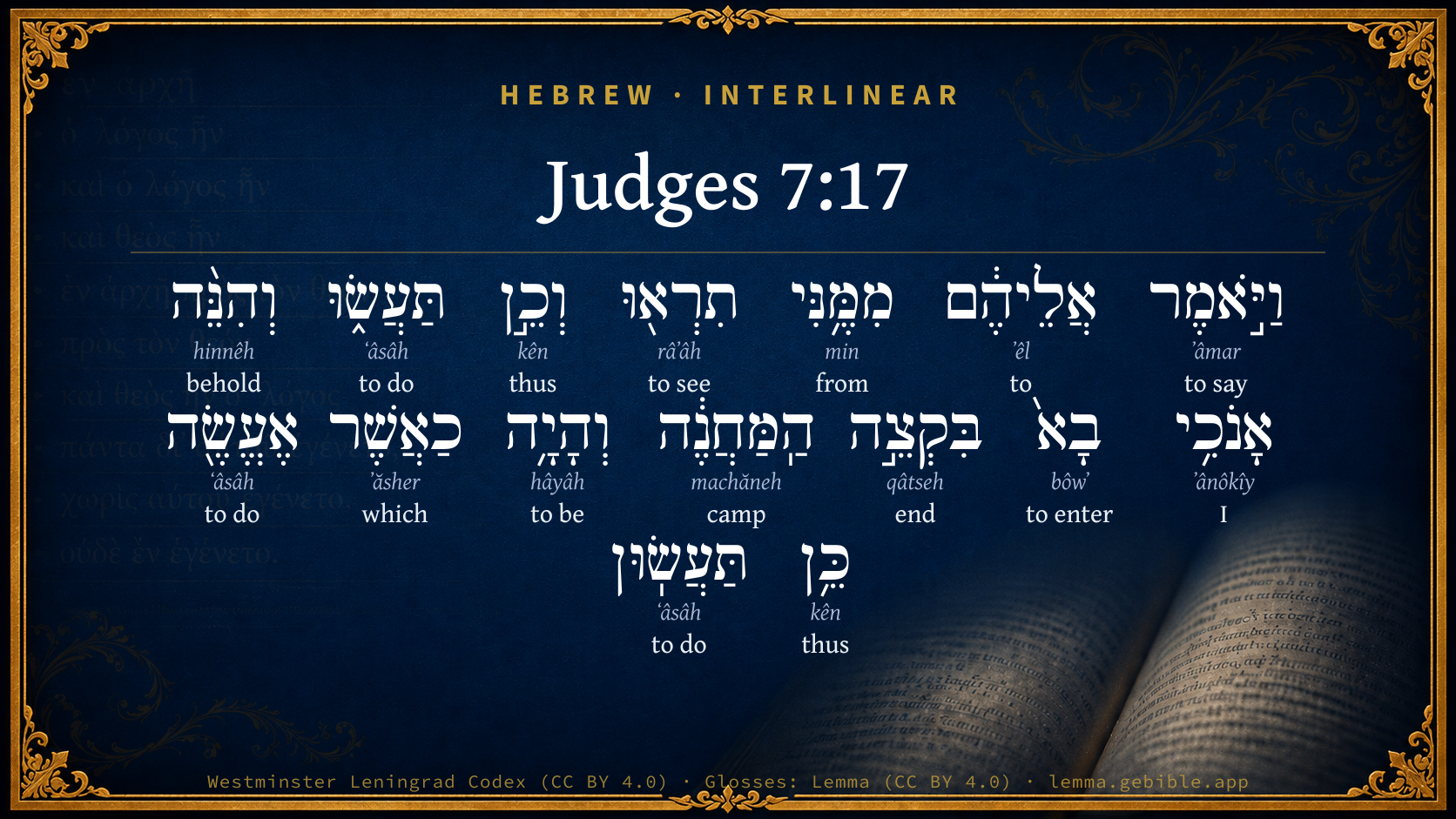
Hebrew (Westminster Leningrad Codex) Judges 7:17 appears in the Hebrew Old Testament. The text above is from the Westminster Leningrad Codex. Each word links to its Strong’s number, a concise gloss, and parsing drawn from the Open Scriptures Hebrew Bible morphology. Click any word for its full Brown-Driver-Briggs (BDB) entry.
Download image
Cite this verse

Judges 7:17 (World English Bible). Public Domain. Lemma interlinear Bible study tool, https://lemma.gebible.app/v/judges/7/17.

Show BibTeX & RIS
BibTeX
RIS
English Translation
He said to them, Look on me, and do likewise: and, behold, when I come to the outermost part of the camp, it shall be that, as I do, so shall you do.
World English Bible · Public Domain
Download a study sheet

One document with this verse’s original text, its word-by-word gloss line, the meaning frame, cross-references with their text, attributed commentary, and full source and license credits — printable, and it pastes into notes with its structure intact.

This verse Autodidact and up

Study sheet (.html) Plain text (.txt)

A passage Seminary Student

Up to 50 verses in one chapter. A passage sheet keeps up to 6 commentary sources and 12 cross-references per verse, in the order this page ranks them, and says so on the sheet whenever that leaves anything out. Ask for a single verse and you get the Autodidact verse sheet above.

Everything on this page stays free to read, with no account — the sheet is a download of what is already on screen, not access to it.

Want to remove ads? Support Godless Engineer
Compare translations 3

The same verse in 3 English versions, stacked beneath the original-language interlinear above. Click any original word for its lexicon entry.

Each is an independent rendering of the whole verse — the interlinear is not word-aligned to these translations.

Highlighted words mark where these versions differ — a whole-verse word diff, not a word-by-word alignment.

  • World English Bible Public Domain
    He said to them, Look on me, and do likewise: and, behold, when I come to the outermost part of the camp, it shall be that, as I do, so shall you do.
  • King James Version Public Domain
    And he said unto them, Look on me, and do likewise: and, behold, when I come to the outside of the camp, it shall be that, as I do, so shall ye do.
  • unfoldingWord Literal Text CC BY-SA 4.0
    And he said to them, “You shall look at me, and thus you shall do. And behold, I am arriving at the edge of the camp, then it shall be, just as I do, thus shall you do.

unfoldingWord Literal Text — © unfoldingWord, licensed CC BY-SA 4.0. Word-aligned USFM3 via Door43 (git.door43.org/unfoldingWord/en_ult).

Versions to compare (up to 4)

3 of 4 selected

Show all 18 translations

Every available English version of this verse, each an independent rendering of the whole verse.

  • World English Bible Public Domain
    He said to them, Look on me, and do likewise: and, behold, when I come to the outermost part of the camp, it shall be that, as I do, so shall you do.
  • Berean Standard Bible Public Domain
    “Watch me and do as I do,” Gideon said. “When I come to the outskirts of the camp, do exactly as I do.
  • Majority Standard Bible Public Domain
    “Watch me and do as I do,” Gideon said. “When I come to the outskirts of the camp, do exactly as I do.
  • King James Version Public Domain
    And he said unto them, Look on me, and do likewise: and, behold, when I come to the outside of the camp, it shall be that, as I do, so shall ye do.
  • American Standard Version (1901) Public Domain
    And he said unto them, Look on me, and do likewise: and, behold, when I come to the outermost part of the camp, it shall be that, as I do, so shall ye do.
  • Revised Version (1885) Public Domain
    And he said unto them, Look on me, and do likewise: and, behold, when I come to the outermost part of the camp, it shall be that, as I do, so shall ye do.
  • Geneva Bible (1599) Public Domain
    And he sayd vnto them, Looke on me, and do likewise, when I come to the side of the hoste: euen as I do, so do you.
  • Douay-Rheims (1899) Public Domain
    And he said to them: What you shall see me do, do you the same: I will go into one part of the camp, and do you as I shall do.
  • Young's Literal Translation Public Domain
    And he saith unto them, `Look at me, and thus do; and lo, I am coming into the extremity of the camp -- and it hath been -- as I do so ye do;
  • Literal Standard Version CC BY-SA 4.0
    And he says to them, “Look at me, and thus do; and behold, I am coming into the extremity of the camp—and it has been—as I do so you do;
  • Unlocked Literal Bible CC BY-SA 4.0
    He said to them, “Look at me and do what I do. Watch! When I come to the edge of the camp, you must do what I do.
  • unfoldingWord Literal Text CC BY-SA 4.0
    And he said to them, “You shall look at me, and thus you shall do. And behold, I am arriving at the edge of the camp, then it shall be, just as I do, thus shall you do.
  • Darby Bible Public Domain
    And he said to them, "Look at me, and do likewise; when I come to the outskirts of the camp, do as I do.
  • World Messianic Bible Public Domain
    He said to them, “Watch me, and do likewise. Behold, when I come to the outermost part of the camp, it shall be that, as I do, so you shall do.
  • Webster's Bible Public Domain
    And he said to them, Look on me, and do likewise: and behold, when I come to the outside of the camp, it shall be that as I do, so shall ye do.
  • Free Bible Version CC BY-SA 4.0
    “Watch me and follow my example,” he told them. “So when I get to the edge of the camp, do exactly what I do.
  • Bible in Basic English Public Domain
    And he said to them, Keep your eyes on me, and do what I do; when I come to the outer line of tents, whatever I do, you are to do the same.
  • JPS Tanakh (1917) Public Domain
    And he said unto them: 'Look on me, and do likewise; and, behold, when I come to the outermost part of the camp, it shall be that, as I do, so shall ye do.

Literal Standard Version (2020), Covenant Press — licensed CC BY-SA 4.0. Text via the HelloAO Bible API (eBible.org). Unlocked Literal Bible (unfoldingWord) — licensed CC BY-SA 4.0. Text via the HelloAO Bible API (eBible.org). unfoldingWord Literal Text — © unfoldingWord, licensed CC BY-SA 4.0. Word-aligned USFM3 via Door43 (git.door43.org/unfoldingWord/en_ult). Free Bible Version, Dr. Jonathan Gallagher — licensed CC BY-SA 4.0. Text via the HelloAO Bible API (eBible.org).

Word by word

More ways to search: Search by grammar → Find every occurrence → Compare this word →

Practice this passage: Drill this verse → Learn its vocabulary →

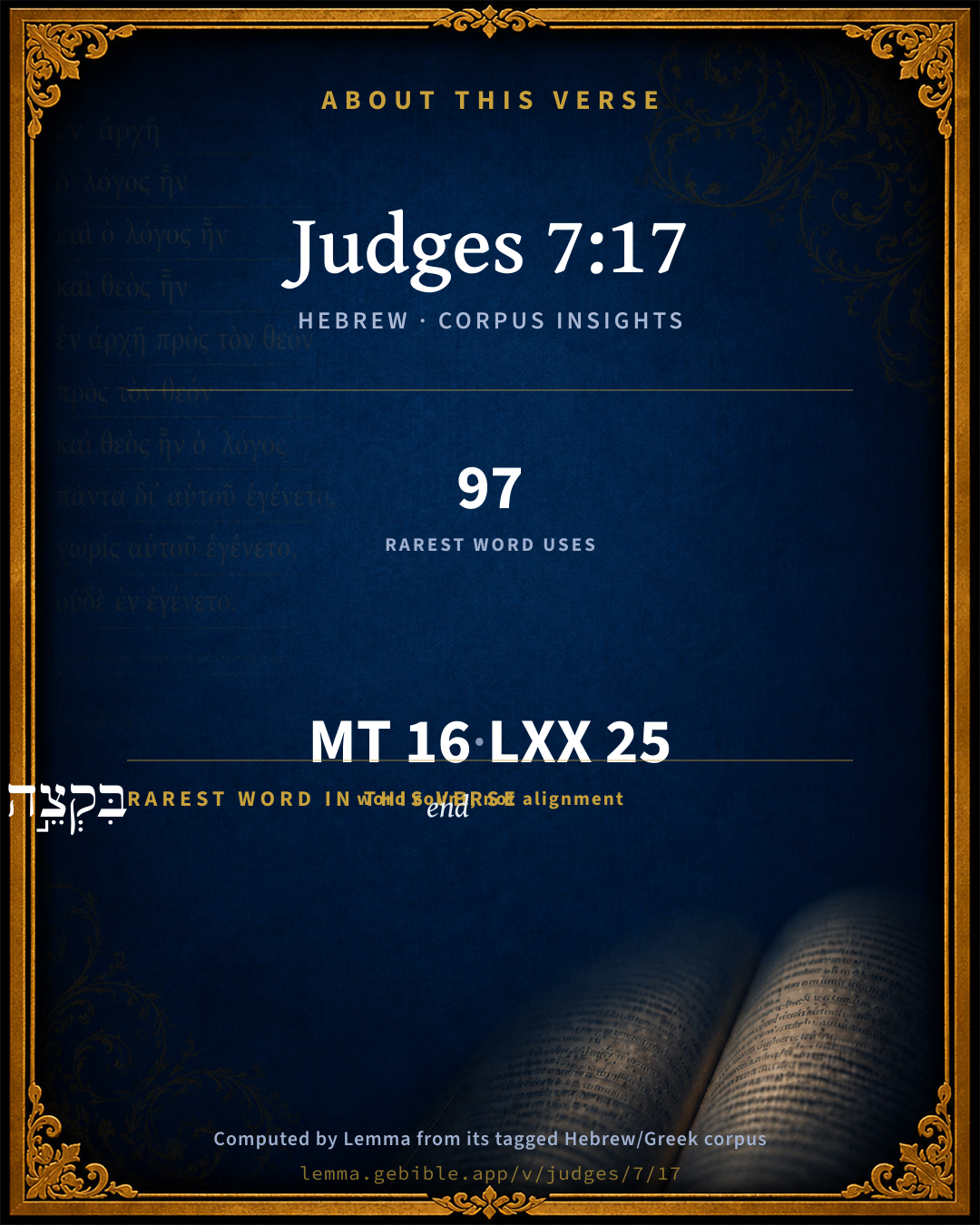
בִּקְצֵ֣ה
qâtseh
H7097
“in/at · end of”
Preposition + Noun, Common, Both, Singular, Construct
Part of Speech
Preposition + Noun
Type
Common
Gender
Both
Number
Singular
State
Construct
Full BDB Definition

Origin: from H7096

TWOT: 2053a , 2053c

end, extremity - end, mouth, extremity - border, outskirts - the whole (condensed term for what is included within extremities) - at the end of (a certain time)
  1. וַיֹּ֣אמֶר ʼâmar H559 “and · to say” Conjunction + Verb, Qal, Sequential Imperfect, 3rd Person, Masculine, Singular
  2. אֲלֵיהֶ֔ם ʼêl H413 “to · them” Preposition + Suffix, Personal, 3rd Person, Masculine, Plural
  3. מִמֶּ֥נִּי min H4480 “from · me” Preposition + Suffix, Personal, 1st Person, Common, Singular
  4. תִרְא֖וּ râʼâh H7200 “to see” Verb, Qal, Imperfect, 2nd Person, Masculine, Plural
  5. וְכֵ֣ן kên H3651 “and · thus” Conjunction + Particle, Demonstrative
  6. תַּעֲשׂ֑וּ ʻâsâh H6213 “to do” Verb, Qal, Imperfect, 2nd Person, Masculine, Plural
  7. וְהִנֵּ֨ה hinnêh H2009 “and · behold” Conjunction + Particle, Demonstrative
  8. אָנֹכִ֥י ʼânôkîy H595 “I” Pronoun, Personal, 1st Person, Common, Singular
  9. בָא֙ bôwʼ H935 “entering” Verb, Qal, Participle Active, Masculine, Singular, Absolute
  10. הַֽמַּחֲנֶ֔ה machăneh H4264 “the · camp” Particle, Definite Article + Noun, Common, Both, Singular, Absolute
  11. וְהָיָ֥ה hâyâh H1961 “and · to be” Conjunction + Verb, Qal, Sequential Perfect, 3rd Person, Masculine, Singular
  12. כַאֲשֶׁר ʼăsher H834 “like/as · which” Preposition + Particle, Relative
  13. אֶעֱשֶׂ֖ה ʻâsâh H6213 “to do” Verb, Qal, Imperfect, 1st Person, Common, Singular
  14. כֵּ֥ן kên H3651 “thus” Particle, Demonstrative
  15. תַּעֲשֽׂוּן ʻâsâh H6213 “to do” Verb, Qal, Imperfect, 2nd Person, Masculine, Plural + Suffix, n

About this verse

These counts appear in no published source. They are computed here, from the morphology-tagged text and Lemma’s own curated glosses. What Lemma adds →

16
words
13
distinct lemmas
Historical
section

Grammatical profile

  • 7 verbs
  • 2 nouns
  • 1 pronoun
  • 2 prepositions
  • 4 particles

Verb forms

  • וַיֹּ֣אמֶר Qal · Sequential Imperfect
  • תִרְא֖וּ Qal · Imperfect
  • תַּעֲשׂ֑וּ Qal · Imperfect
  • בָא֙ Qal · Participle Active
  • וְהָיָ֥ה Qal · Sequential Perfect
  • אֶעֱשֶׂ֖ה Qal · Imperfect
  • תַּעֲשֽׂוּן Qal · Imperfect

Repetition

Words recur within this verse — often emphatic in Hebrew:

  • תַּעֲשׂ֑וּ to do H6213 ×3
  • וְכֵ֣ן thus H3651 ×2

Hebrew & Septuagint length

In English translation the verse runs 33 words from the Hebrew and 40 from the Septuagint (LXX English) — closely comparable.

A rough comparison of the two English renderings, which tokenize alike — not a word-level alignment.

Word counts can differ between the Hebrew and the Greek without any difference in meaning — e.g. the Hebrew direct-object marker אֵת has no separate Greek word, and Greek often adds the article ὁ.

In the original languages it is 16 Hebrew tokens and 25 Greek tokens — but the two are counted differently (Hebrew bundles its prefixes and suffixes into one token; the Greek is in lemma form), so that isn’t a like-for-like length.

Cross-references

5

Topical passages linked to Judges 7:17 in the Treasury of Scripture Knowledge — connected by theme and wording, ordered by reader-vote popularity; previews shown in the World English Bible.

  • Matthew 16:24 Then Jesus said to his disciples, "If anyone desires to come after me, let him deny himself, and take up his cross, and follow me.
  • 1 Corinthians 11:1 Be imitators of me, even as I also am of Christ.
  • Hebrews 13:7 Remember your leaders, men who spoke to you the word of God, and considering the results of their conduct, imitate their faith.
  • Judges 9:48 Abimelech got him up to Mount Zalmon, he and all the people who were with him; and Abimelech took an axe in his hand, and cut down a bough from the trees, and took it up, and laid it on his shoulder: and he said to the people who were with him, What you have seen me do, make haste, and do as I have done.
  • 1 Peter 5:3 neither as lording it over the charge allotted to you, but making yourselves examples to the flock.

Cross-references courtesy of OpenBible.info (CC BY 4.0).

Hebrew and Greek witnesses Masoretic Hebrew ↔ Greek Septuagint

The same verse in the two great witnesses to the Old Testament, shown verse-for-verse.

These are two independent witnesses, not word-aligned to each other, and the Septuagint is shown in lemma (dictionary) form.

Hebrew Judges 7:17 Masoretic · Westminster Leningrad Codex

וַיֹּ֣אמֶר אֲלֵיהֶ֔ם מִמֶּ֥נִּי תִרְא֖וּ וְכֵ֣ן תַּעֲשׂ֑וּ וְהִנֵּ֨ה אָנֹכִ֥י בָא֙ בִּקְצֵ֣ה הַֽמַּחֲנֶ֔ה וְהָיָ֥ה כַאֲשֶׁר אֶעֱשֶׂ֖ה כֵּ֥ן תַּעֲשֽׂוּן

He said to them, Look on me, and do likewise: and, behold, when I come to the outermost part of the camp, it shall be that, as I do, so shall you do.

World English Bible · Public Domain

Greek LXX Judges 7:17 Septuagint · lemma form

καί εἶπον πρός αὐτός ἀπό ἐγώ ὁράω καί οὕτως ποιέω καί ἰδού ἐγώ εἰςπορεύομαι ἐν ἀρχή ὁ παρεμβολή καί εἰμί καθώς ἄν ποιέω οὕτως ποιέω

and he said to them, You⌃ shall look at me, and so shall you⌃ do; and behold, I will go into the beginning of the host, and it shall come to pass that as I do, so shall you⌃ do.

LXX2012 (modern English Septuagint) · Public Domain

Hebrew: Westminster Leningrad Codex (CC BY 4.0). Greek: Septuagint (public domain); English from LXX2012 (modern English Septuagint) (Public Domain). How the Septuagint differs from the Hebrew →

Targum (Aramaic paraphrase)

1

The Targum is the ancient Jewish Aramaic paraphrase of the Hebrew Scriptures — an interpretive translation, not the Hebrew text itself. Onkelos (literal) and Pseudo-Jonathan (expansive) render the Torah, and Jonathan the Prophets. Coverage is partial: where no permissively-licensed English translation exists for a verse, only the Aramaic is shown. This is verse-level text, not a word-by-word alignment to the Hebrew.

  1. Targum Jonathan Prophets (Joshua–Malachi)
    וַאֲמַר לְהוֹן מִנִי תֶחֱזוּן וְכֵן תַּעְבְּדוּן וְהָא אֲנָא אָתֵי בִּסְיָפֵי מַשְׁרִיתָא וִיהֵי כְּמָא דְאַעֲבֵּיד כֵּן תַּעְבְּדוּן:

    (no public-domain English translation for this verse)

    Targum Jonathan — Aramaic: “Mikraot Gedolot” (public domain). English: “Sefaria Community Translation” (CC0 1.0 (public-domain dedication)); “London "Chaldee Paraphrase," 1871” (public domain). Text via Sefaria.

Commentary

Notes on Judges 7:17 from classic Christian and Jewish commentators (each source and its license shown beneath its notes). The classic Christian expositions comment on the surrounding passage and are grouped to its opening verse, so a note may address several verses; the Jewish commentaries on the Tanakh (Rashi and others) are per-verse, so they appear only where the commentator wrote on this verse.

Lemma curates 59 commentaries, every one of them public domain or Creative Commons licensed, each selected and text-cleaned for this edition rather than reprinted as found. About our sources →

Trapp's Complete Commentary

John Trapp

Jdg 7:17 And he said unto them, Look on me, and do likewise: and, behold, when I come to the outside of the camp, it shall be [that], as I do, so shall ye do.

Ver. 17. Look on me, and do likewise.] He was sure of the victory, and yet giveth military precepts, and useth the means.

John Trapp, A Commentary or Exposition upon All the Books of the Old and New Testament (1647–1656) — public domain. Text from a community e-Sword module.

Joseph Benson's Commentary

Jdg 7:17-18. He said to them, Look on me — For though two hundred of his men were placed on other sides of the camp, yet they were so disposed, that some persons, set as watchmen, might see what was done, and give notice to the rest to follow the example. The sword of the Lord, and of Gideon — He mentions his own name, together with God’s, not out of arrogance, as if he would equal himself with God, but from prudent policy, because his name was grown formidable to them, and so was likely to further his design. See Jdg 7:14.

Joseph Benson's Commentary on the Old and New Testaments (1811–1818) — public domain. Text from a community e-Sword module.

Ellicott's Commentary for English Readers

(17) Look on me.—He showed all the three hundred the way in which he wished them, at a given signal, to break the pitchers, wave the torches, and shout. The signal would be given by the one hundred whom he himself headed.

A Bible Commentary for English Readers, edited by Charles John Ellicott (1878–1897) — public domain. Text from a community e-Sword module.

The Cambridge Bible for Schools and Colleges

gen. ed. J. J. S. Perowne

17. it shall be that, as I do, so shall ye do] This repetition of the first half of the verse is perhaps due to an attempt to harmonize a double narrative. Omit the words and the connexion with Jdg_7:18 is improved: ‘when I come … and blow the trumpet (Jdg_7:18) … then blow ye.’

The Cambridge Bible for Schools and Colleges (gen. ed. J. J. S. Perowne; Cambridge University Press, 1878–1918) — public domain. Text from a community e-Sword module.

John Gill's Exposition

And he said unto them, look on me, and do likewise,.... Observe what I do, and do the same, in blowing a trumpet, breaking a pitcher, and shouting with the words expressed by him:

and, behold, when I come to the outside of the camp; where the sentinels stood, and the watch was set:

it shall be, that as I do, so shall ye do; and not before; a trumpet was not to be blown, nor a pitcher broken, nor a torch held out, nor a word spoken, till just they came to the outside of the camp: and then they were to observe the motions of Gideon, and do as he did.

John Gill's Exposition of the Whole Bible (1746–1763) — public domain (CC PDM 1.0). Text via the HelloAO Bible API.

Haydock's Catholic Bible Commentary

Camp. The three divisions stopt at the entrance, ver. 21. (Calmet)

George Leo Haydock (1774–1849), Haydock's Catholic Family Bible and Commentary, 1859 edition — public domain. Excludes Psalms (Douay-Rheims chapter numbering differs from Protestant) and Deuterocanonical books (Catholic canon only).

Matthew Poole's English Annotations

For though two hundred of his men were placed on other sides of the camp; yet they were so disposed, that some person or persons, set as watchmen, might see what was done, and give notice to the rest to follow the example.

Matthew Poole's English Annotations on the Holy Bible (1683–1685) — public domain. Text from a community e-Sword/MySword module.

John Wesley's Explanatory Notes

Look on me - For though two hundred of his men were placed on other sides of the camp; yet they were so disposed, that some persons, set as watchmen, might see what was done, and give notice to the rest to follow the example.

John Wesley, Explanatory Notes Upon the Whole Bible (1754–1765) — public domain. Text via the GEBible commentary corpus.

unfoldingWord translationNotes

Door43 World Missions Community

For Yahweh and for Gideon!

The words "we fight" are implied. AT: "We fight for Yahweh and for Gideon!" (See: Assumed Knowledge and Implicit Information)

translationWords

watch

trumpet

Yahweh

Gideon

unfoldingWord translationNotes — © Distant Shores Media and the Door43 World Missions Community, licensed CC BY-SA 4.0. Source: git.door43.org/Door43/en_tn.

Rashi

Rabbi Shlomo Yitzchaki (Rashi)

Watch me. Watch my actions, and follow suit.

Rashi on the Tanakh — English translations: “The Judaica Press complete Tanach with Rashi, translated by A. J. Rosenberg” (CC BY 4.0); “Pentateuch with Rashi's commentary by M. Rosenbaum and A.M. Silbermann, 1929-1934” (public domain); “The Metsudah Tanach series, Lakewood, N.J” (CC BY 4.0); and “The Book of Joshua, Metsudah Publications, 1997” (CC BY 4.0). Text via Sefaria.

Lesson kit

Teaching starters — assembled from the data on this page, not authored interpretation. Every prompt links to the verse data it draws on. Edit before teaching.

Judges, in the Historical, opens this verse with 16 words (13 distinct Hebrew lemmas). Its most distinctive word is qâtseh (“end”). A historical commentator’s framing appears above. Read the whole chapter for the surrounding context.

Discussion questions

  1. The word qâtseh carries the sense “end.” How does it shape the verse?
  2. How does Matthew 16:24, which shares this passage’s theme, read alongside this verse?
  3. What does the repetition of “to do” (3× in this one verse) do in this verse?
  4. These translations render this verse differently; the difference is in the English rendering, not the original. What questions does that raise?
  5. «וַיֹּ֣אמֶר» is a Qal Sequential Imperfect verb. How does that grammatical form shape the action described?
  6. Compare how Trapp's Complete Commentary and Joseph Benson's Commentary read this verse. Where do they agree or differ?

Things to notice

Reading settings

Reading text

Shown beneath each verse's original-language words.

Old Testament
Old Testament edition

Read the OT as the Masoretic Hebrew (MT) or the Greek Septuagint (LXX).

English shown for the Greek Septuagint (in the Hebrew ↔ Greek comparison).

Comparing translations? Open the Compare panel on any verse page to stack up to four side by side.