
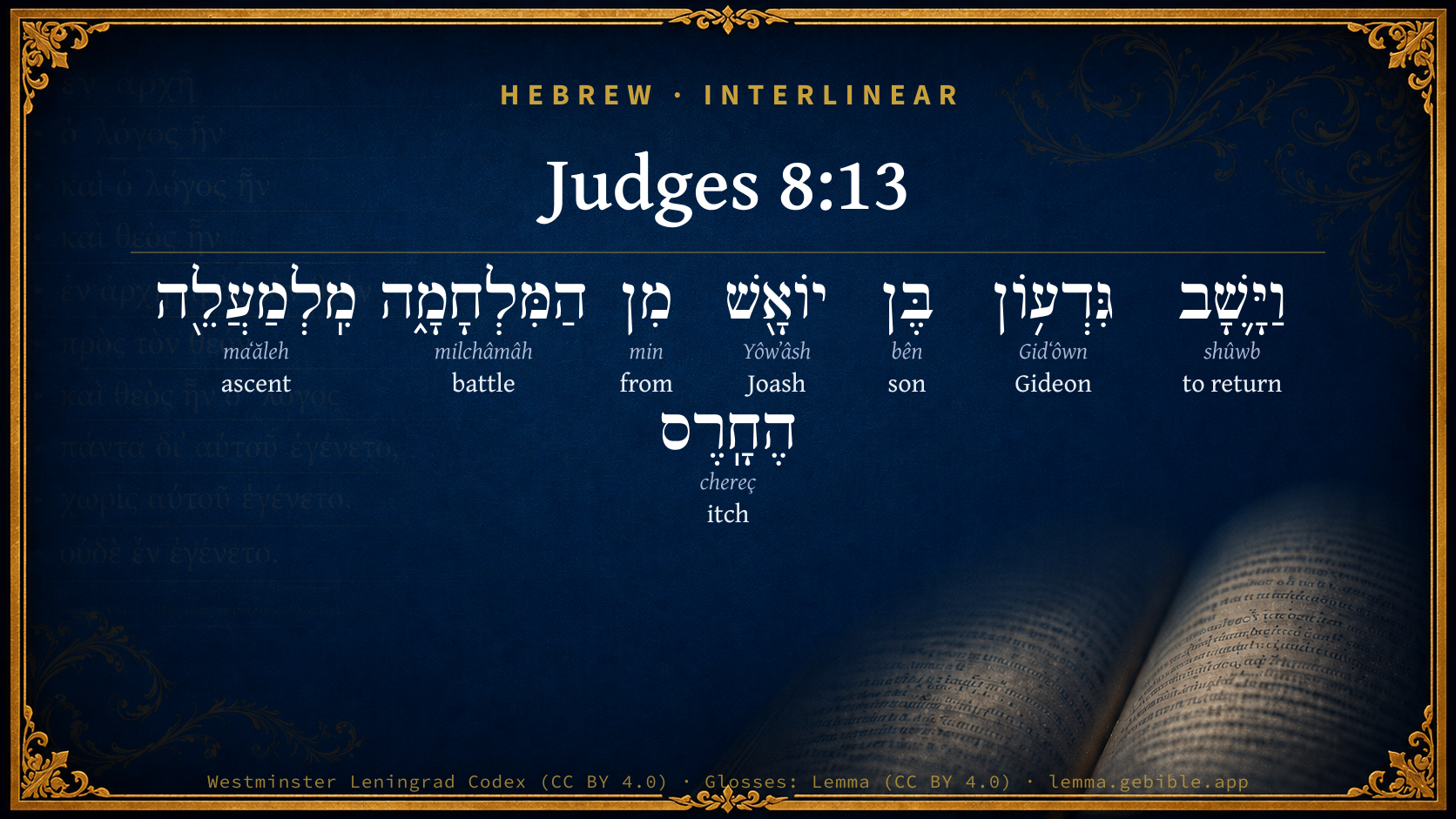
Judges 8:13

Hebrew (Westminster Leningrad Codex) Judges 8:13 appears in the Hebrew Old Testament. The text above is from the Westminster Leningrad Codex. Each word links to its Strong’s number, a concise gloss, and parsing drawn from the Open Scriptures Hebrew Bible morphology. Click any word for its full Brown-Driver-Briggs (BDB) entry.
Download image
Cite this verse

Judges 8:13 (World English Bible). Public Domain. Lemma interlinear Bible study tool, https://lemma.gebible.app/v/judges/8/13.

Show BibTeX & RIS
BibTeX
RIS
English Translation
Gideon the son of Joash returned from the battle from the ascent of Heres.
World English Bible · Public Domain
Download a study sheet

One document with this verse’s original text, its word-by-word gloss line, the meaning frame, cross-references with their text, attributed commentary, and full source and license credits — printable, and it pastes into notes with its structure intact.

This verse Autodidact and up

Study sheet (.html) Plain text (.txt)

A passage Seminary Student

Up to 50 verses in one chapter. A passage sheet keeps up to 6 commentary sources and 12 cross-references per verse, in the order this page ranks them, and says so on the sheet whenever that leaves anything out. Ask for a single verse and you get the Autodidact verse sheet above.

Everything on this page stays free to read, with no account — the sheet is a download of what is already on screen, not access to it.

Want to remove ads? Support Godless Engineer
Compare translations 3

The same verse in 3 English versions, stacked beneath the original-language interlinear above. Click any original word for its lexicon entry.

Each is an independent rendering of the whole verse — the interlinear is not word-aligned to these translations.

Highlighted words mark where these versions differ — a whole-verse word diff, not a word-by-word alignment.

  • World English Bible Public Domain
    Gideon the son of Joash returned from the battle from the ascent of Heres.
  • King James Version Public Domain
    And Gideon the son of Joash returned from battle before the sun was up,
  • unfoldingWord Literal Text CC BY-SA 4.0
    Then Gideon, the son of Joash, returned from the battle through the Ascent of Heres.

unfoldingWord Literal Text — © unfoldingWord, licensed CC BY-SA 4.0. Word-aligned USFM3 via Door43 (git.door43.org/unfoldingWord/en_ult).

Versions to compare (up to 4)

3 of 4 selected

Show all 18 translations

Every available English version of this verse, each an independent rendering of the whole verse.

  • World English Bible Public Domain
    Gideon the son of Joash returned from the battle from the ascent of Heres.
  • Berean Standard Bible Public Domain
    After this, Gideon son of Joash returned from the battle along the Ascent of Heres.
  • Majority Standard Bible Public Domain
    After this, Gideon son of Joash returned from the battle along the Ascent of Heres.
  • King James Version Public Domain
    And Gideon the son of Joash returned from battle before the sun was up,
  • American Standard Version (1901) Public Domain
    And Gideon the son of Joash returned from the battle from the ascent of Heres.
  • Revised Version (1885) Public Domain
    And Gideon the son of Joash returned from the battle from the ascent of Heres.
  • Geneva Bible (1599) Public Domain
    So Gideon the sonne of Ioash returned from battel, the sunne being yet hie,
  • Douay-Rheims (1899) Public Domain
    And returning from the battle before the sun rising,
  • Young's Literal Translation Public Domain
    And Gideon son of Joash turneth back from the battle, at the going up of the sun,
  • Literal Standard Version CC BY-SA 4.0
    And Gideon son of Joash turns back from the battle, at the going up of the sun,
  • Unlocked Literal Bible CC BY-SA 4.0
    Gideon, son of Joash, returned from the battle going through the pass of Heres.
  • unfoldingWord Literal Text CC BY-SA 4.0
    Then Gideon, the son of Joash, returned from the battle through the Ascent of Heres.
  • Darby Bible Public Domain
    Then Gideon the son of Jo'ash returned from the battle by the ascent of Heres.
  • World Messianic Bible Public Domain
    Gideon the son of Joash returned from the battle from the ascent of Heres.
  • Webster's Bible Public Domain
    And Gideon the son of Joash returned from battle before the sun had risen,
  • Free Bible Version CC BY-SA 4.0
    Then Gideon, son of Joash, returned from the battle through the Heres Pass.
  • Bible in Basic English Public Domain
    Then Gideon, the son of Joash, went back from the fight:
  • JPS Tanakh (1917) Public Domain
    And Gideon the son of Joash returned from the battle from the ascent of Heres.

Literal Standard Version (2020), Covenant Press — licensed CC BY-SA 4.0. Text via the HelloAO Bible API (eBible.org). Unlocked Literal Bible (unfoldingWord) — licensed CC BY-SA 4.0. Text via the HelloAO Bible API (eBible.org). unfoldingWord Literal Text — © unfoldingWord, licensed CC BY-SA 4.0. Word-aligned USFM3 via Door43 (git.door43.org/unfoldingWord/en_ult). Free Bible Version, Dr. Jonathan Gallagher — licensed CC BY-SA 4.0. Text via the HelloAO Bible API (eBible.org).

Word by word

More ways to search: Search by grammar → Find every occurrence → Compare this word →

Practice this passage: Drill this verse → Learn its vocabulary →

About this verse

These counts appear in no published source. They are computed here, from the morphology-tagged text and Lemma’s own curated glosses. What Lemma adds →

8
words
8
distinct lemmas
Historical
section

Notable vocabulary

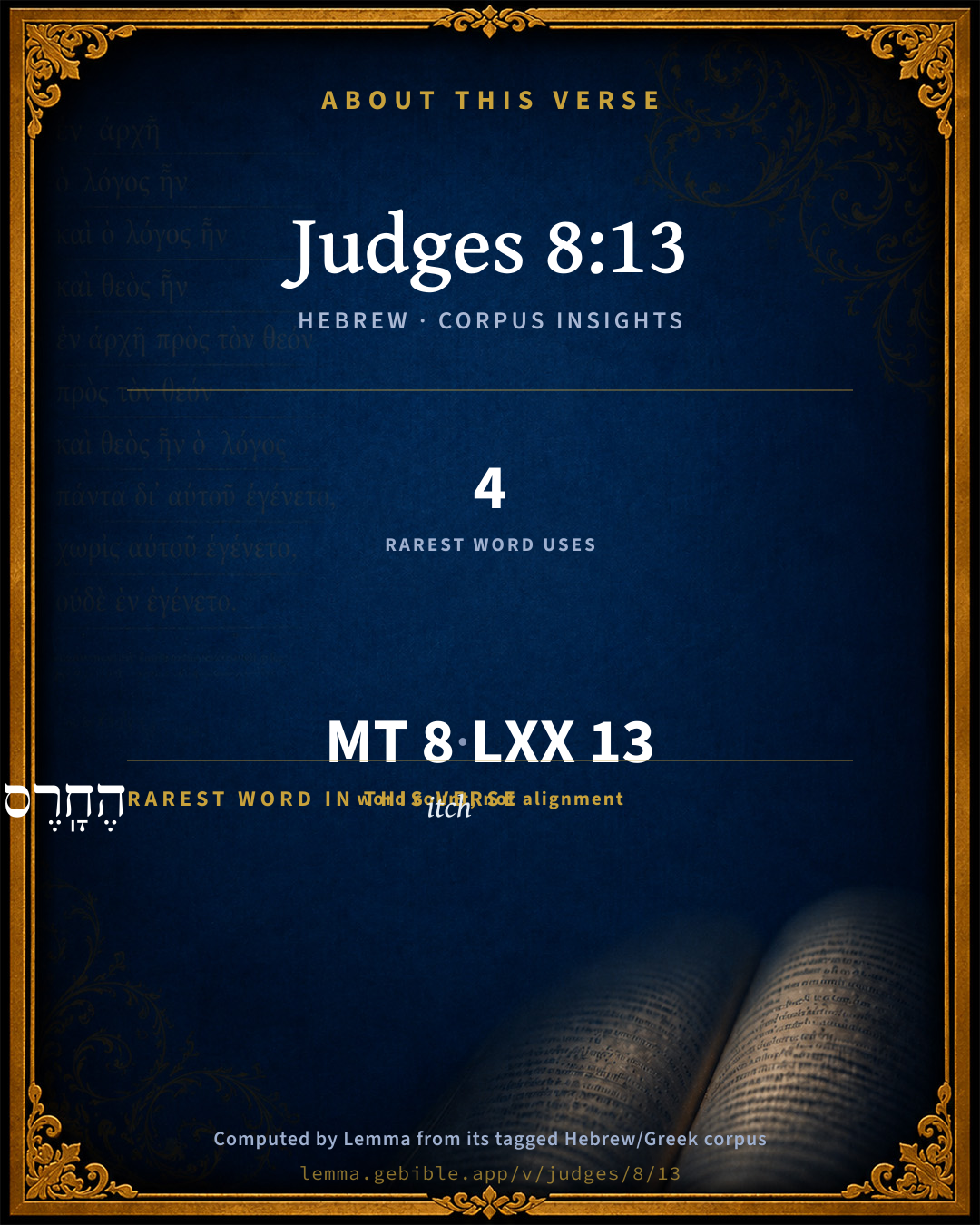
The rarest word here is הֶחָֽרֶס itch H2775 — appearing just 4 times in the whole Hebrew Bible.

Shared distinctive vocabulary

הֶחָֽרֶס itch H2775 occurs in 4 verses of the Hebrew Bible. Also found in:

Grammatical profile

  • 1 verb
  • 6 nouns
  • 1 preposition

Verb forms

  • וַיָּ֛שָׁב Qal · Sequential Imperfect

Hebrew & Septuagint length

In English translation the verse runs 14 words from the Hebrew and 16 from the Septuagint (LXX English) — closely comparable.

A rough comparison of the two English renderings, which tokenize alike — not a word-level alignment.

Word counts can differ between the Hebrew and the Greek without any difference in meaning — e.g. the Hebrew direct-object marker אֵת has no separate Greek word, and Greek often adds the article ὁ.

In the original languages it is 8 Hebrew tokens and 13 Greek tokens — but the two are counted differently (Hebrew bundles its prefixes and suffixes into one token; the Greek is in lemma form), so that isn’t a like-for-like length.

Hebrew and Greek witnesses Masoretic Hebrew ↔ Greek Septuagint

The same verse in the two great witnesses to the Old Testament, shown verse-for-verse.

These are two independent witnesses, not word-aligned to each other, and the Septuagint is shown in lemma (dictionary) form.

Hebrew Judges 8:13 Masoretic · Westminster Leningrad Codex

וַיָּ֛שָׁב גִּדְע֥וֹן בֶּן יוֹאָ֖שׁ מִן הַמִּלְחָמָ֑ה מִֽלְמַעֲלֵ֖ה הֶחָֽרֶס

Gideon the son of Joash returned from the battle from the ascent of Heres.

World English Bible · Public Domain

Greek LXX Judges 8:13 Septuagint · lemma form

καί ἐπιστρέφω γεδεων υἱός ιωας ἀπό ὁ παράταξις ἀπό ἐπάνωθεν ὁ παράταξις αρες

And Gedeon the son of Joas returned from the battle, down from the battle of Ares.

LXX2012 (modern English Septuagint) · Public Domain

On this verse, Keil & Delitzsch discusses the Septuagint’s reading. Read the note in Commentary ↓

Hebrew: Westminster Leningrad Codex (CC BY 4.0). Greek: Septuagint (public domain); English from LXX2012 (modern English Septuagint) (Public Domain). How the Septuagint differs from the Hebrew →

Targum (Aramaic paraphrase)

1

The Targum is the ancient Jewish Aramaic paraphrase of the Hebrew Scriptures — an interpretive translation, not the Hebrew text itself. Onkelos (literal) and Pseudo-Jonathan (expansive) render the Torah, and Jonathan the Prophets. Coverage is partial: where no permissively-licensed English translation exists for a verse, only the Aramaic is shown. This is verse-level text, not a word-by-word alignment to the Hebrew.

  1. Targum Jonathan Prophets (Joshua–Malachi)
    וְתַב גִדְעוֹן בַּר יוֹאָשׁ מִן קְרָבָא עַד לָא מֵעַל שִׁמְשָׁא:

    (no public-domain English translation for this verse)

    Targum Jonathan — Aramaic: “Mikraot Gedolot” (public domain). English: “Sefaria Community Translation” (CC0 1.0 (public-domain dedication)); “London "Chaldee Paraphrase," 1871” (public domain). Text via Sefaria.

Commentary

Notes on Judges 8:13 from classic Christian and Jewish commentators (each source and its license shown beneath its notes). The classic Christian expositions comment on the surrounding passage and are grouped to its opening verse, so a note may address several verses; the Jewish commentaries on the Tanakh (Rashi and others) are per-verse, so they appear only where the commentator wrote on this verse.

Lemma curates 59 commentaries, every one of them public domain or Creative Commons licensed, each selected and text-cleaned for this edition rather than reprinted as found. About our sources →

Trapp's Complete Commentary

John Trapp

Jdg 8:13 And Gideon the son of Joash returned from battle before the sun [was up],

Ver. 13. Before the sun was up.] Still he set upon them in the night, because of the weakness of his army, which by night appeared not. Julius Caesar, indeed, held the night unfit for battle, Lucem enim pudorem oculis militum afferre. But I cannot think with Vatablus and others, that this war here was begun and ended in one night. {a}

{a} Hoc bellum una nocte fuit incaeptum et confectum: quod refertur ad laudem Dei. - Vat.

John Trapp, A Commentary or Exposition upon All the Books of the Old and New Testament (1647–1656) — public domain. Text from a community e-Sword module.

Joseph Benson's Commentary

Jdg 8:13. Gideon returned before the sun was up — By which it may be gathered, that he came upon them in the night, which was most convenient for him who had so small a number with him, and most likely to terrify them by the remembrance of the last night’s sad work. It must be acknowledged, however, that different interpretations are given of this passage. The Seventy, the Syriac, and Arabic versions take החרס, hechares, here rendered sun, for the name of a place, in which they are followed by Houbigant, who translates the words, By that place which is above Hares. It is well known, however, that the word just quoted does properly mean the sun, and is so translated in other passages of Scripture, and the translating it so here both gives a more important sense to the passage, and is more agreeable to the context than the amendment proposed.

Joseph Benson's Commentary on the Old and New Testaments (1811–1818) — public domain. Text from a community e-Sword module.

Whedon's Commentary on the Bible

Daniel D. Whedon

PUNISHMENT OF SUCCOTH AND PENUEL, Jdg_8:13-17.

13. Before the sun was up — Thus the Vulgate, Luther, and others. But most modern scholars take חרס, here rendered sun, as a proper name, Cheres, and translate: Gideon returned from the battle by the ascent of Cheres. The ascent of Cheres was probably some mountain road, or pass, now unknown.

Daniel D. Whedon (gen. ed.), Commentary on the Old and New Testaments (1874–1909) — public domain. Text from a community e-Sword module.

Keil & Delitzsch

C. F. Keil & F. Delitzsch

Punishment of the Towns of Succoth and Pnuel, and Execution of the Captures Kings of Midian.

Jdg 8:13-14

Gideon returned victorious from the war, החרס מלמעלה, "from by the ascent (or mountain road) of Hecheres," a place in front of the town of Succoth, with which we are not acquainted. This is the rendering adopted by the lxx, the Peshito, and the Arabic; but the rest of the early translators have merely guessed at the meaning. The Chaldee, which has been followed by the Rabbins and Luther, has rendered it "before sunset," in utter opposition to the rules of the language; for although cheres is a word used poetically to denote the sun, מעלה cannot mean the setting of the sun. Aquila and Symmachus, on the other hand, confound חרס with הרים. - Gideon laid hold of a young man of the people of Succoth, and got him to write down for him the princes and elders (magistrates and rulers) of the city, - in all seventy-seven men. ויּכתּב ויּשׁאלהוּ is a short expression for "he asked him the names of the princes and elders of the city, and the boy wrote them down." אליו, lit. to him, i.e., for him.

Jdg 8:15-16

Gideon then reproached the elders with the insult they had offered him (Jdg 8:6), and had them punished with desert thorns and thistles. "Men of Succoth" (Jdg 8:15 and Jdg 8:16) is a general expression for "elders of Succoth" (Jdg 8:16); and elders a general term applied to all the representatives of the city, including the princes. אתי חרפתּם אשׁר, with regard to whom ye have despised me. אשׁר is the accusative of the more distant or second object, not the subject, as Stud. supposes. "And he taught the men of Succoth (i.e., caused them to know, made them feel, punished them) with them (the thorns)." There is no good ground for doubting the correctness of the reading ויּדע. The free renderings of the lxx, Vulg., etc., are destitute of critical worth; and Bertheau's assertion, that if it were the Hiphil it would be written יודע, is proved to be unfounded by the defective writing in Num 16:5; Job 32:7.

Jdg 8:17

Gideon also inflicted upon Pnuel the punishment threatened in Jdg 8:9. The punishment inflicted by Gideon upon both the cities was well deserved in all respects, and was righteously executed. The inhabitants of these cities had not only acted treacherously to Israel as far as they could, from the most selfish interests, in a holy conflict for the glory of the Lord and the freedom of His people, but in their contemptuous treatment of Gideon and his host they had poured contempt upon the Lord, who had shown them to be His own soldiers before the eyes of the whole nation by the victory which He had given them over the innumerable army of the foe. Having been called by the Lord to be the deliverer and judge of Israel, it was Gideon's duty to punish the faithless cities.

Jdg 8:18-21

After punishing these cities, Gideon repaid the two kings of Midian, who had been taken prisoners, according to their doings. From the judicial proceedings instituted with regard to them (Jdg 8:18, Jdg 8:19), we learn that these kings had put the brothers of Gideon to death, and apparently not in open fight; but they had murdered them in an unrighteous and cruel manner. And Gideon made them atone for this with their own lives, according to the strict jus talionis. איפה, in Jdg 8:18, does not mean where? but "in what condition, of what form, were the men whom he slew at Tabor?" i.e., either in the city of Tabor or at Mount Tabor (see Jdg 4:6, and Jos 19:22). The kings replied: "As thou so they" (those men), i.e., they were all as stately as thou art, "every one like the form of kings' sons." אחד, one, for every one, like אחד אישׁ in Kg2 15:20, or more frequently אישׁ alone. As the men who had been slain were Gideon's own brothers, he swore to those who had done the deed, i.e., to the two kings, "As truly as Jehovah liveth, if ye had let them live I should not have put you to death;" and then commanded his first-born son Jether to slay them, for the purpose of adding the disgrace of falling by the hand of a boy. "But the boy drew not his sword from fear, because he was yet a boy." And the kings then said to Gideon, "Rise thou and stab us, for as the man so is his strength," i.e., such strength does not belong to a boy, but to a man. Thereupon Gideon slew them, and took the little moons upon the necks of their camels as booty. "The little moons" were crescent-shaped ornaments of silver or gold, such as men and women wore upon their necks (see Jdg 8:26, and Isa 3:18), and which they also hung upon the necks of camels-a custom still prevalent in Arabia (see Schrder, de vestitu mul. hebr. pp. 39, 40, and Wellsted, Reisen in Arab. i. p. 209).

Keil & Delitzsch — Biblical Commentary on the Old Testament (1861–1891) — public domain (CC PDM 1.0). Text via the HelloAO Bible API. (Old Testament only.)

Geneva Bible (1599)

Geneva Bible translators

Some read, before the Sun rose up.

Geneva Bible (1599) marginal notes — public domain. Text via Bolls.life.

Jamieson, Fausset & Brown

Robert Jamieson, A. R. Fausset & David Brown

Gideon returned from battle before the sun was up--He seems to have returned by a nearer route to Succoth, for what is rendered in our version "before the sun was up," means "the heights of Heres, the sun-hills."

Jamieson, Fausset & Brown — Commentary Critical and Explanatory on the Whole Bible (1871) — public domain (CC PDM 1.0). Text via the HelloAO Bible API.

Adam Clarke's Commentary

Verse 13. Returned from battle before the sun was up] This does not appear to be a proper translation of מלמעלה החרס milmaaleh hechares. It should be rendered from the ascent of Chares: this is the reading of the Septuagint, the Syriac, and the Arabic.

Adam Clarke's Commentary on the Bible (1810–1826) — public domain. Text from a community e-Sword/MySword module.

Ellicott's Commentary for English Readers

(13) Before the sun was up.—If the rendering were certain, it would prove that he had made a night attack on Karkor; but it seems more probable that the words should be rendered “from the ascent of Heres,” or “of Hechares,” as in the LXX., Peshito, and Arabic. If so, it implies that he came round by some other road to attack Succoth. The word for “going up” is maaleh, as in Maaleh Ahrabbim, “the ascent of scorpions” (see Note on Jdg_1:36), which is also applied to sunrise. (Gen_19:15.) It cannot possibly mean “before sunset” (ehe die Sonne heraufgekommen war), as Luther renders it, following the Chaldee and various Rabbis. The ordinary word for “sun” is shemesh, not cheres; but the latter word occurs in various names (see on Jdg_1:35; Jdg_2:9), which makes it perhaps more probable that this also is the name of some place. It might, indeed, be prudent for Gideon to desist from further pursuit when the dawn revealed the paucity and exhaustion of his followers; and in poetic style (Job_9:7) cheres may mean “sun,” so that here the phrase might be an archaism, as cheresah is in Jdg_14:18; but the preposition used (min) cannot mean “before.” Aquila renders it “from the ascent of the groves” and Symmachus “of the mountains;” but this is only due to a defective reading.

A Bible Commentary for English Readers, edited by Charles John Ellicott (1878–1897) — public domain. Text from a community e-Sword module.

The Cambridge Bible for Schools and Colleges

gen. ed. J. J. S. Perowne

13. from the ascent of Heres] So LXX. A and Luc., with a slight correction of the text; or upwards to Heres, with further corrections. The word Ḥeres = ‘the sun’ lends itself to various experiments, which are to be seen in the Versions. The general sense of the verse seems to be that Gideon returned from the battle by some different way.

The Cambridge Bible for Schools and Colleges (gen. ed. J. J. S. Perowne; Cambridge University Press, 1878–1918) — public domain. Text from a community e-Sword module.

John Gill's Exposition

And Gideon the son of Joash returned from battle,.... To Penuel and Succoth, to chastise them for their ill treatment of him and his men:

before the sun was up; by which it appears that it was in the night that he fell upon the host at Karkor, which must be the night following; it could not be the same night in which he had defeated them in the valley of Jezreel; though Vatablus thinks this battle was begun and finished in one night; but there were, according to this history, so many things done after the first defeat, as sending messengers to Mount Ephraim and the Ephraimites, upon the taking the fords of Jordan, and bringing the heads of Oreb and Zeeb to Gideon, expostulating with him, and his answer to them, and his stay at Succoth and Penuel; which make it more probable that the day following was spent in the pursuit, and that it was the night after that that the whole affair was finished; and before sunrise Gideon returned to Penuel and Succoth again; so Ben Gersom and Abarbinel; but according to the Targum, Jarchi, and Kimchi, this phrase is to be rendered, "before the sunset", while it yet appeared, and was above the horizon; and so it must be in the daytime that he pursued the two kings and took them, and returned before sunset. Abendana observes the word for "sun" may be the name of a place, and so the Septuagint, Syriac, and Arabic versions call it the ascent of Ares or Heres; as if it was the name of the place from whence Gideon returned, so called in like manner as the ascent of Akrabbim, and the like.

John Gill's Exposition of the Whole Bible (1746–1763) — public domain (CC PDM 1.0). Text via the HelloAO Bible API.

Albert Barnes' Notes on the Bible

Before the sun was up - The translation of the words is doubtful, because of the rarity of the word rendered “sun” (חרס cheres). Many suppose it to be the name of a mountain pass, and render it from the ascent of Heres.

Albert Barnes' Notes on the Bible (1834–1885) — public domain. Text from a community e-Sword/MySword module.

Haydock's Catholic Bible Commentary

Sun-rising. It would seem as if all these exploits had been performed between midnight and sun-rising, in the month of May, which is quite incredible; and hence many translate, "the sun being up." Septuagint and Theodotion, "from the height or ascent of Hares," (the situation of which we know not,) or "of the mountains," (Aquila) or "woods," (Symmachus) or perhaps "from the eastward." (Calmet) --- The Scripture does not, however, specify that all this took place in the space of six or seven hours, or of one night, but only that Gedeon came to Soccoth so early, as to take the magistrates unawares, being informed by a young man where they lived. This might probably happen on the second morning, after he had surprised the camp of the Madianites, at Jezrael. Protestants and Chaldean agree with the Vulgate, "before the sun was up." The other translations explain chares, as if it denoted the place or situation from which Gedeon was returning. (Haydock) --- Described. The text may signify either that the boy marked them out, or that Gedeon took down a memorandum of their names. (Calmet) --- He would not punish the innocent with the guilty. (Menochius)

George Leo Haydock (1774–1849), Haydock's Catholic Family Bible and Commentary, 1859 edition — public domain. Excludes Psalms (Douay-Rheims chapter numbering differs from Protestant) and Deuterocanonical books (Catholic canon only).

Matthew Poole's English Annotations

By which it may be gathered that he came upon them in the night, which was most convenient for him, who had so small a number with him; and most likely both to surprise and terrify them by the remembrance of the last night’s sad work, and the expectation of another like it.

Matthew Poole's English Annotations on the Holy Bible (1683–1685) — public domain. Text from a community e-Sword/MySword module.

The Pulpit Commentary

Before the sun was up. There is a wonderful diversity in the renderings of this verse. Some of the old versions and Jewish Rabbis interpret it before sunset. Many of the best Jewish commentators, however, understand the phrase as the A.V does the going up of the sun," i.e. before sunrise; supposing Gideon"s attack on the Midianitish camp to have been a night attack, and Succoth to have been so near to Karkor that he was able to reach it by sunrise. But others say that the word here rendered sun (heres) is only used in poetry, and that the word rendered up is never used of sunrise, but, as, in the phrase "the going up of Akrabbim", (Jud 1:36) of an ascent up a hill. They therefore take heres as a proper name, and translate "from the going up of Hems." Others again, by an almost imperceptible change in the last letter, read "the mountains" instead of Heres. But the A.V may be well defended, and gives an excellent sense. In Jud_1:14:18 the same word for the sun issued in the very similar phrase, "before the sun went down." In Gen_19:15 the phrase, "the morning arose," has the verb from which the word here rendered up is derived; and a note of time here exactly suits the context. It marks the celerity of Gideon"s movements that he was actually on his way back to Succoth at sunrise, after having routed the Midianites and taken their two kings prisoners.

Vers. 13-21. The complete revenge.

If any man ever stood on the very apex of success and triumph, it was Gideon on his return from the pursuit of the Midianites. He had saved his country; he had set a whole people free from a foreign yoke; he had restored the worship of the true and living God in his native land, and uprooted a vile and debasing idolatry; he was the conqueror of a vast host with most inadequate means; he had subdued and taken prisoners two powerful kings; he had avenged the death of his own brothers upon those who, in pride and wantonness, had slain them; and he had chastised the insolent, cowardly, and unpatriotic conduct of his own countrymen who, at his time of greatest need, had insulted instead of helping him; and he stood in the proud position of having undertaken an almost impossible task, and having succeeded beyond his utmost expectation. But in the very height of this success we seem to see an overbalancing towards a fall. It is very slight; there was still a wonderful moderation of mind (as seen in vers. 22, 23); but the weak human heart had a stronger draught of success than it could bear. As long, indeed, as his eye was quite single, and it was only the glory of God that he sought, and the welfare of his country, all went well (see ver. 2). But Gideon was not perfect. Had he been without the pride of fallen humanity, he would not have slain the captive kings, he would not have put to death the insolent men of Succoth and Penuel, richly as they deserved punishment. But it is here that we seem to see the first clouding of the singular brightness of Gideon"s disinterested zeal. When we have made every allowance for the customs and opinions of the age, we cannot help feeling that something different from zeal and love for God was at work within him when he took away those lives. Zebah and Zahnunna had slain his brothers, and so had done an injury to him, and put a slight upon him; the men of Succoth and Penuel had taunted and affronted him, they had undervalued his power, they had taken advantage of his momentary weakness to put him to shame. He must have his revenge. In his hour of more than human greatness the littleness of humanity started into birth. It was no doubt true that the law of the avenger of blood justified the slaughter of the kings, and the base conduct of the Succothites and Penuelites would secure a universal acquiescence in the justice of their punishment. But still we cannot help seeing that the pride of self, albeit unperceived by Gideon, had a hand in these actions, which cast a distinct shade upon Gideon"s shining path, and which we cannot read of even at this distance of time without a pang of regret. How glad we should be if that noble spirit, in the very flush of victory, had risen sufficiently above the spirit of his age and above his own anger to spare his prostrate foes; and if in the height of his glory he had despised the meanness of the men of Succoth, and left them to the punishment of their own shame, and the contempt of their fellow-men! (see 2Sa_19:23) But it could not be. And perhaps the lesson of human weakness is more valuable to us as it is; for it leaves us a warning not to seek a complete revenge for ourselves under any circumstances, but to be content to commit our cause to God: and that it is better for man to be thwarted and humiliated than to have everything his own way. He cannot bear it.

The Pulpit Commentary (1880–1919), ed. H.D.M. Spence-Jones & Joseph S. Exell — public domain. Text from a community e-Sword module.

John Wesley's Explanatory Notes

Before the sun was up - By which it might be gathered, that he came upon them in the night, which was most convenient for him who had so small a number with him; and most likely to terrify them by the remembrance of the last Night's sad work.

John Wesley, Explanatory Notes Upon the Whole Bible (1754–1765) — public domain. Text via the GEBible commentary corpus.

unfoldingWord translationNotes

Door43 World Missions Community

the pass of Heres

This is the name of a road that passes between two mountains. (See: How to Translate Names)

questioned him

It can be stated explicitly what Gideon asked the young man. AT: "he asked him to identify all the names of the leaders in the town" (See: Assumed Knowledge and Implicit Information)

seventy-seven officials

"77 officials" (See: Numbers)

translationWords

Gideon

Joash

Succoth

elder

unfoldingWord translationNotes — © Distant Shores Media and the Door43 World Missions Community, licensed CC BY-SA 4.0. Source: git.door43.org/Door43/en_tn.

Rashi

Rabbi Shlomo Yitzchaki (Rashi)

With the sun high. Before sunset, with the sun still visible high above the horizon.

Rashi on the Tanakh — English translations: “The Judaica Press complete Tanach with Rashi, translated by A. J. Rosenberg” (CC BY 4.0); “Pentateuch with Rashi's commentary by M. Rosenbaum and A.M. Silbermann, 1929-1934” (public domain); “The Metsudah Tanach series, Lakewood, N.J” (CC BY 4.0); and “The Book of Joshua, Metsudah Publications, 1997” (CC BY 4.0). Text via Sefaria.

Lesson kit

Teaching starters — assembled from the data on this page, not authored interpretation. Every prompt links to the verse data it draws on. Edit before teaching.

Judges, in the Historical, opens this verse with 8 words (8 distinct Hebrew lemmas). Its most distinctive word is chereç (“itch”). A historical commentator’s framing appears above. Read the whole chapter for the surrounding context.

Discussion questions

  1. How does “itch” (chereç) shape what this verse is saying?
  2. Deuteronomy 28:27 shares the word «itch» with this verse. How do the two illuminate each other?
  3. These translations render this verse differently; the difference is in the English rendering, not the original. What questions does that raise?
  4. The verb «וַיָּ֛שָׁב» is Qal Sequential Imperfect. How does its form color the action?
  5. Reading how Trapp's Complete Commentary and Joseph Benson's Commentary read this verse, where do the two commentators agree and where do they part?

Things to notice

Reading settings

Reading text

Shown beneath each verse's original-language words.

Old Testament
Old Testament edition

Read the OT as the Masoretic Hebrew (MT) or the Greek Septuagint (LXX).

English shown for the Greek Septuagint (in the Hebrew ↔ Greek comparison).

Comparing translations? Open the Compare panel on any verse page to stack up to four side by side.