Judges 6:38

Hebrew (Westminster Leningrad Codex) Judges 6:38 appears in the Hebrew Old Testament. The text above is from the Westminster Leningrad Codex. Each word links to its Strong’s number, a concise gloss, and parsing drawn from the Open Scriptures Hebrew Bible morphology. Click any word for its full Brown-Driver-Briggs (BDB) entry.
Download image
Cite this verse

Judges 6:38 (World English Bible). Public Domain. Lemma interlinear Bible study tool, https://lemma.gebible.app/v/judges/6/38.

Show BibTeX & RIS
BibTeX
RIS
English Translation
It was so; for he rose up early on the next day, and pressed the fleece together, and wrung the dew out of the fleece, a bowl full of water.
World English Bible · Public Domain
Highlights
  • 1 first appearance in the Hebrew Bible
Full analysis ↓
Download a study sheet

One document with this verse’s original text, its word-by-word gloss line, the meaning frame, cross-references with their text, attributed commentary, and full source and license credits — printable, and it pastes into notes with its structure intact.

This verse Autodidact and up

Study sheet (.html) Plain text (.txt)

A passage Seminary Student

Up to 50 verses in one chapter. A passage sheet keeps up to 6 commentary sources and 12 cross-references per verse, in the order this page ranks them, and says so on the sheet whenever that leaves anything out. Ask for a single verse and you get the Autodidact verse sheet above.

Everything on this page stays free to read, with no account — the sheet is a download of what is already on screen, not access to it.

Want to remove ads? Support Godless Engineer
Compare translations 3

The same verse in 3 English versions, stacked beneath the original-language interlinear above. Click any original word for its lexicon entry.

Each is an independent rendering of the whole verse — the interlinear is not word-aligned to these translations.

Highlighted words mark where these versions differ — a whole-verse word diff, not a word-by-word alignment.

  • World English Bible Public Domain
    It was so; for he rose up early on the next day, and pressed the fleece together, and wrung the dew out of the fleece, a bowl full of water.
  • King James Version Public Domain
    And it was so: for he rose up early on the morrow, and thrust the fleece together, and wringed the dew out of the fleece, a bowl full of water.
  • unfoldingWord Literal Text CC BY-SA 4.0
    And it happened that he arose early on the next day and squeezed the fleece and wrung dew from the fleece, the fulness of a bowl water.

unfoldingWord Literal Text — © unfoldingWord, licensed CC BY-SA 4.0. Word-aligned USFM3 via Door43 (git.door43.org/unfoldingWord/en_ult).

Versions to compare (up to 4)

3 of 4 selected

Show all 18 translations

Every available English version of this verse, each an independent rendering of the whole verse.

  • World English Bible Public Domain
    It was so; for he rose up early on the next day, and pressed the fleece together, and wrung the dew out of the fleece, a bowl full of water.
  • Berean Standard Bible Public Domain
    And that is what happened. When Gideon arose the next morning, he squeezed the fleece and wrung out the dew—a bowlful of water.
  • Majority Standard Bible Public Domain
    And that is what happened. When Gideon arose the next morning, he squeezed the fleece and wrung out the dew—a bowlful of water.
  • King James Version Public Domain
    And it was so: for he rose up early on the morrow, and thrust the fleece together, and wringed the dew out of the fleece, a bowl full of water.
  • American Standard Version (1901) Public Domain
    And it was so; for he rose up early on the morrow, and pressed the fleece together, and wrung the dew out of the fleece, a bowlful of water.
  • Revised Version (1885) Public Domain
    And it was so: for he rose up early on the morrow, and pressed the fleece together, and wringed the dew out of the fleece, a bowlful of water.
  • Geneva Bible (1599) Public Domain
    And so it was: for he rose vp earely on the morow, and thrust the fleece together, and wringed the dew out of the fleece, and filled a bowle of water.
  • Douay-Rheims (1899) Public Domain
    I will put this fleece of wool on the floor: if there be dew on the fleece only, and it be dry on all the ground beside, I, shall know that by my hand, as thou hast said, thou wilt deliver Israel.
  • Young's Literal Translation Public Domain
    and it is so, and he riseth early on the morrow, and presseth the fleece, and wringeth dew out of the fleece -- the fulness of the bowl, of water.
  • Literal Standard Version CC BY-SA 4.0
    and it is so, and he rises early on the next day, and presses the fleece, and wrings dew out of the fleece—the fullness of the bowl of waters.
  • Unlocked Literal Bible CC BY-SA 4.0
    This is what happened—Gideon rose early the next morning, he pressed the fleece together, and wrung out the dew from the fleece, enough to fill a bowl with water.
  • unfoldingWord Literal Text CC BY-SA 4.0
    And it happened that he arose early on the next day and squeezed the fleece and wrung dew from the fleece, the fulness of a bowl water.
  • Darby Bible Public Domain
    And it was so. When he rose early next morning and squeezed the fleece, he wrung enough dew from the fleece to fill a bowl with water.
  • World Messianic Bible Public Domain
    It was so; for he rose up early on the next day, and pressed the fleece together, and wrung the dew out of the fleece, a bowl full of water.
  • Webster's Bible Public Domain
    And it was so: for he rose early on the morrow, and pressed the fleece, and wrung the dew out of the fleece, a bowl-full of water.
  • Free Bible Version CC BY-SA 4.0
    That's what happened. When Gideon got up early the next morning, he pressed on the fleece and squeezed out the dew, enough water to fill a bowl.
  • Bible in Basic English Public Domain
    And it was so: for he got up early on the morning after, and twisting the wool in his hands, he got a basin full of water from the dew on the wool.
  • JPS Tanakh (1917) Public Domain
    And it was so; for he rose up early on the morrow, and pressed the fleece together, and wrung dew out of the fleece, a bowlful of water.

Literal Standard Version (2020), Covenant Press — licensed CC BY-SA 4.0. Text via the HelloAO Bible API (eBible.org). Unlocked Literal Bible (unfoldingWord) — licensed CC BY-SA 4.0. Text via the HelloAO Bible API (eBible.org). unfoldingWord Literal Text — © unfoldingWord, licensed CC BY-SA 4.0. Word-aligned USFM3 via Door43 (git.door43.org/unfoldingWord/en_ult). Free Bible Version, Dr. Jonathan Gallagher — licensed CC BY-SA 4.0. Text via the HelloAO Bible API (eBible.org).

Word by word

More ways to search: Search by grammar → Find every occurrence → Compare this word →

Practice this passage: Drill this verse → Learn its vocabulary →

הַסֵּ֖פֶל
çêphel
H5602
“the · bowl”
Particle, Definite Article + Noun, Common, Masculine, Singular, Absolute
Part of Speech
Particle + Noun
Type
Common
Gender
Masculine
Number
Singular
State
Absolute
Full BDB Definition

Origin: from an unused root meaning to depress

TWOT: 1536

bowl, basin
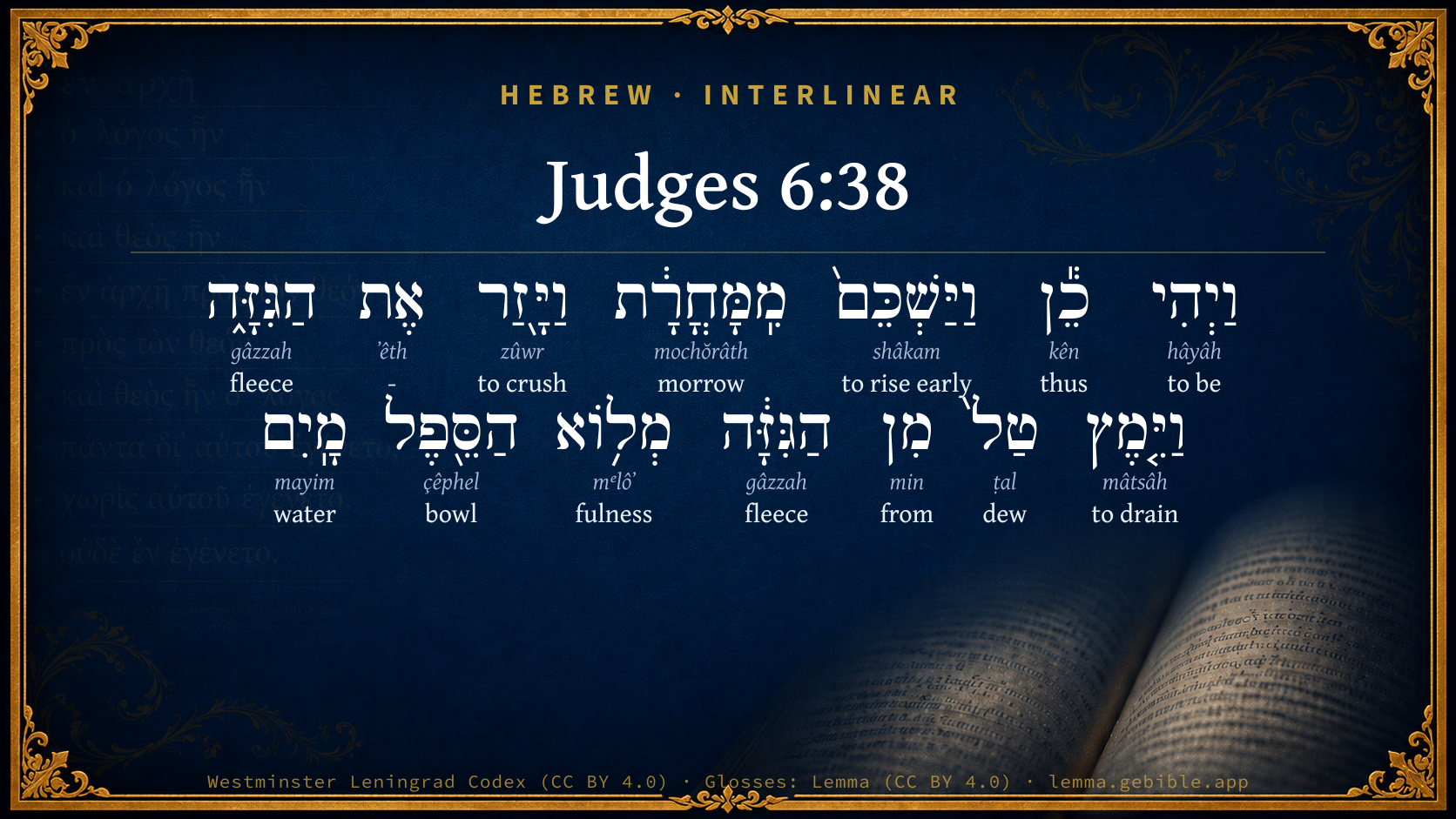
  1. וַיְהִי hâyâh H1961 “and · to be” Conjunction + Verb, Qal, Sequential Imperfect, 3rd Person, Masculine, Singular
  2. כֵ֕ן kên H3651 “thus” Adverb
  3. וַיַּשְׁכֵּם֙ shâkam H7925 “and · to rise early” Conjunction + Verb, Hiphil, Sequential Imperfect, 3rd Person, Masculine, Singular
  4. מִֽמָּחֳרָ֔ת mochŏrâth H4283 “from · morrow” Preposition + Noun, Common, Feminine, Singular, Absolute
  5. וַיָּ֖זַר zûwr H2115 “and · to crush” Conjunction + Verb, Qal, Sequential Imperfect, 3rd Person, Masculine, Singular
  6. אֶת ʼêth H853 “-” Particle, Direct Object
  7. הַגִּזָּ֑ה gâzzah H1492 “the · fleece” Particle, Definite Article + Noun, Common, Feminine, Singular, Absolute
  8. וַיִּ֤מֶץ mâtsâh H4680 “and · to drain” Conjunction + Verb, Qal, Sequential Imperfect, 3rd Person, Masculine, Singular
  9. טַל֙ ṭal H2919 “dew” Noun, Common, Masculine, Singular, Absolute
  10. מִן min H4480 “from” Preposition
  11. הַגִּזָּ֔ה gâzzah H1492 “the · fleece” Particle, Definite Article + Noun, Common, Feminine, Singular, Absolute
  12. מְל֥וֹא mᵉlôʼ H4393 “fulness of” Noun, Common, Masculine, Singular, Construct
  13. מָֽיִם mayim H4325 “water(s)” Noun, Common, Masculine, Plural, Absolute

About this verse

These counts appear in no published source. They are computed here, from the morphology-tagged text and Lemma’s own curated glosses. What Lemma adds →

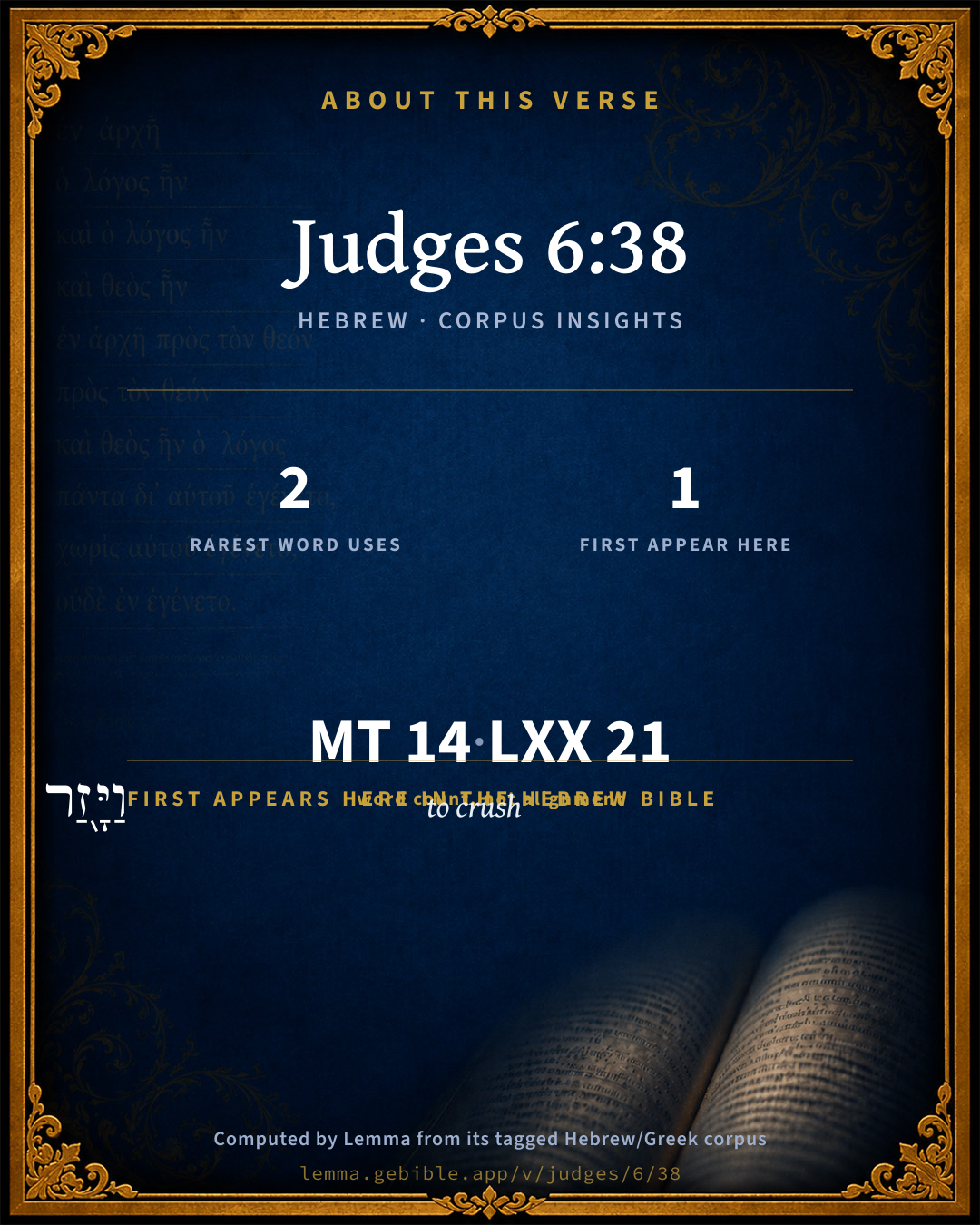
14
words
13
distinct lemmas
Historical
section

Notable vocabulary

The rarest word here is הַסֵּ֖פֶל bowl H5602 — appearing just 2 times in the whole Hebrew Bible.

First appearance in Scripture

This word makes its first canonical appearance in the Hebrew Bible here:

  • וַיָּ֖זַר to crush H2115

Shared distinctive vocabulary

הַסֵּ֖פֶל bowl H5602 occurs in 2 verses of the Hebrew Bible. Also found in:

Grammatical profile

  • 4 verbs
  • 7 nouns
  • 1 preposition
  • 1 adverb
  • 1 particle

Verb forms

  • וַיְהִי Qal · Sequential Imperfect
  • וַיַּשְׁכֵּם֙ Hiphil · Sequential Imperfect
  • וַיָּ֖זַר Qal · Sequential Imperfect
  • וַיִּ֤מֶץ Qal · Sequential Imperfect

Repetition

A word recurs within this verse — often emphatic in Hebrew:

  • הַגִּזָּ֑ה fleece H1492 ×2

Hebrew & Septuagint length

In English translation the verse runs 30 words from the Hebrew and 27 from the Septuagint (LXX English) — closely comparable.

A rough comparison of the two English renderings, which tokenize alike — not a word-level alignment.

Word counts can differ between the Hebrew and the Greek without any difference in meaning — e.g. the Hebrew direct-object marker אֵת has no separate Greek word, and Greek often adds the article ὁ.

In the original languages it is 14 Hebrew tokens and 21 Greek tokens — but the two are counted differently (Hebrew bundles its prefixes and suffixes into one token; the Greek is in lemma form), so that isn’t a like-for-like length.

Cross-references

1

Topical passages linked to Judges 6:38 in the Treasury of Scripture Knowledge — connected by theme and wording, ordered by reader-vote popularity; previews shown in the World English Bible.

  • Isaiah 35:7 The glowing sand shall become a pool, and the thirsty ground springs of water: in the habitation of jackals, where they lay, shall be grass with reeds and rushes.

Cross-references courtesy of OpenBible.info (CC BY 4.0).

Hebrew and Greek witnesses Masoretic Hebrew ↔ Greek Septuagint

The same verse in the two great witnesses to the Old Testament, shown verse-for-verse.

These are two independent witnesses, not word-aligned to each other, and the Septuagint is shown in lemma (dictionary) form.

Hebrew Judges 6:38 Masoretic · Westminster Leningrad Codex

וַיְהִי כֵ֕ן וַיַּשְׁכֵּם֙ מִֽמָּחֳרָ֔ת וַיָּ֖זַר אֶת הַגִּזָּ֑ה וַיִּ֤מֶץ טַל֙ מִן הַגִּזָּ֔ה מְל֥וֹא הַסֵּ֖פֶל מָֽיִם

It was so; for he rose up early on the next day, and pressed the fleece together, and wrung the dew out of the fleece, a bowl full of water.

World English Bible · Public Domain

Greek LXX Judges 6:38 Septuagint · lemma form

καί γίγνομαι οὕτως καί ὀρθρίζω ὁ ἐπαύριον καί ἐκ ἐπιἰάομαι ὁ πόκος καί στάζω δρόσος ἀπό ὁ πόκος πλήρης λεκάνη ὕδωρ

And it was so: and he rose up early in the morning, and wrung the fleece, and dew dropped from the fleece, a bowl full of water.

LXX2012 (modern English Septuagint) · Public Domain

On this verse, Haydock's Catholic Bible Commentary discusses the Septuagint’s reading. Read the note in Commentary ↓

Hebrew: Westminster Leningrad Codex (CC BY 4.0). Greek: Septuagint (public domain); English from LXX2012 (modern English Septuagint) (Public Domain). How the Septuagint differs from the Hebrew →

Targum (Aramaic paraphrase)

1

The Targum is the ancient Jewish Aramaic paraphrase of the Hebrew Scriptures — an interpretive translation, not the Hebrew text itself. Onkelos (literal) and Pseudo-Jonathan (expansive) render the Torah, and Jonathan the Prophets. Coverage is partial: where no permissively-licensed English translation exists for a verse, only the Aramaic is shown. This is verse-level text, not a word-by-word alignment to the Hebrew.

  1. Targum Jonathan Prophets (Joshua–Malachi)
    וַהֲוָה כֵן וְאַקְדֵים מִיוֹמָא דְבַתְרוֹהִי וַעֲצַר יַת גִזְתָא וּנְפַץ טַלָא מִן גִזְתָא מְלֵי לַקְנָא דְמַיָא:

    (no public-domain English translation for this verse)

    Targum Jonathan — Aramaic: “Mikraot Gedolot” (public domain). English: “Sefaria Community Translation” (CC0 1.0 (public-domain dedication)); “London "Chaldee Paraphrase," 1871” (public domain). Text via Sefaria.

Commentary

Notes on Judges 6:38 from classic Christian and Jewish commentators (each source and its license shown beneath its notes). The classic Christian expositions comment on the surrounding passage and are grouped to its opening verse, so a note may address several verses; the Jewish commentaries on the Tanakh (Rashi and others) are per-verse, so they appear only where the commentator wrote on this verse.

Lemma curates 59 commentaries, every one of them public domain or Creative Commons licensed, each selected and text-cleaned for this edition rather than reprinted as found. About our sources →

Ellicott's Commentary for English Readers

(38) A bowl full of water.—The word used for bowl is sêphel, as in Jdg_5:25.

A Bible Commentary for English Readers, edited by Charles John Ellicott (1878–1897) — public domain. Text from a community e-Sword module.

John Gill's Exposition

And Gideon said unto God,.... In the same way as before, and on the morning when he had been favoured with the sight of the above miracle:

let not thine anger be hot against me, and I will speak but this once; he was conscious to himself that it showed great presumption and boldness in him to repeat his request, and that it had the appearance of great diffidence and distrust in him, after he had been indulged with such a sign to confirm his faith; but as it was not so much on his own account as others, and promising to ask no more favours of this kind, he hoped his boldness would not be resented:

let me prove, l pray thee, but this once with the fleece one time more with it, and that not to try the power of God, of which he had no doubt, but the will of God, whether it was the good pleasure of God to save Israel by his hand, and whether now was the time, or another:

let it now be dry only upon the fleece, and upon all the ground let there be dew; which might seem to be a greater, at least a plainer miracle than the former, and less liable to cavil and objection; for it might be urged, that a fleece of wool naturally draws in and drinks up moisture about it; wherefore that to be dry, and the ground all around it wet, would be a sure sign and evidence of the wonderful interposition of the power and providence of God, in directing the fall of the dew on the one, and not on the other.

John Gill's Exposition of the Whole Bible (1746–1763) — public domain (CC PDM 1.0). Text via the HelloAO Bible API.

Haydock's Catholic Bible Commentary

So. Gedeon besought the Lord to confirm his mission, in order to raise the drooping spirits of his soldiers. If he had not believed that he was chosen for the purpose of rescuing Israel, he would never have exposed himself, by destroying the idol and grove of Baal, and by calling the people to arms. Yet he might fear at present, lest he might be destitute of some of the necessary qualifications, and might entertain some apprehensions, lest the promises of God might by only conditional. The readiness with which God grants his requests, shews that he was inspired to act as he did, and his faith is greatly commended, Hebrews xi. 32. Other great saints have asked for a miraculous confirmation of what was promised, Exodus iv. 1., Josue v. 13., and Luke i. 34. (Calmet) --- Vessels. Hebrew sephel, Septuagint lecane, "a dish." Syriac, "a basin." The dew in Chanaan is very copious, resembling a shower of rain, insomuch that the roads are rendered extremely slippery. (Roger. i. 2.) (Calmet)

George Leo Haydock (1774–1849), Haydock's Catholic Family Bible and Commentary, 1859 edition — public domain. Excludes Psalms (Douay-Rheims chapter numbering differs from Protestant) and Deuterocanonical books (Catholic canon only).

Whedon's Commentary on the Bible

Daniel D. Whedon

38. A bowl full of water — Heavy dews are wont to fall in Palestine, especially on the highlands, and wool naturally absorbs much dew. Kitto says, that while travelling in some parts of western Asia he “often found cloaks of sheepskin, exposed to the open air, as heavy with dew as if they had been dipped in water.” The preternatural sign in this case of Gideon lay in the fact implied, but not stated, that, while the fleece was so heavy with dew, the ground all around was dry.

Daniel D. Whedon (gen. ed.), Commentary on the Old and New Testaments (1874–1909) — public domain. Text from a community e-Sword module.

unfoldingWord translationNotes

Door43 World Missions Community

Gideon rose

"Gideon got out of bed"

wrung

twist and squeeze something to remove water

translationWords

Gideon

raise

unfoldingWord translationNotes — © Distant Shores Media and the Door43 World Missions Community, licensed CC BY-SA 4.0. Source: git.door43.org/Door43/en_tn.

Rashi

Rabbi Shlomo Yitzchaki (Rashi)

That is what occurred. The dew condensed on the fleece alone more than everywhere else, as it is said, "a full bowl of water." However, "while all of the ground is dry" did not materialize, as a Divine covenant assures perpetual dew fall.

He squeezed. The word connotes pressure. Similarly, "They were neither pressed nor bandaged." They were not strapped in bandages to draw out the discharge.

Rashi on the Tanakh — English translations: “The Judaica Press complete Tanach with Rashi, translated by A. J. Rosenberg” (CC BY 4.0); “Pentateuch with Rashi's commentary by M. Rosenbaum and A.M. Silbermann, 1929-1934” (public domain); “The Metsudah Tanach series, Lakewood, N.J” (CC BY 4.0); and “The Book of Joshua, Metsudah Publications, 1997” (CC BY 4.0). Text via Sefaria.

Lesson kit

Teaching starters — assembled from the data on this page, not authored interpretation. Every prompt links to the verse data it draws on. Edit before teaching.

Judges, in the Historical, opens this verse with 14 words (13 distinct Hebrew lemmas). Its most distinctive word is çêphel (“bowl”). A historical commentator’s framing appears above. Read the whole chapter for the surrounding context.

Discussion questions

  1. What does “bowl” (çêphel) contribute to the verse as a whole?
  2. This is the first place “to crush” appears in Scripture (first appears here). What does its debut here establish?
  3. How does Judges 5:25, which shares the word «bowl», read alongside this verse?
  4. What does the repetition of “fleece” (2× in this one verse) do in this verse?
  5. These translations render this verse differently. What is at stake in choosing one wording over another?
  6. «וַיְהִי» is a Qal Sequential Imperfect verb. How does that grammatical form shape the action described?
  7. Compare how Ellicott's Commentary for English Readers and John Gill's Exposition read this verse. Where do they agree or differ?

Things to notice

Reading settings

Reading text

Shown beneath each verse's original-language words.

Old Testament
Old Testament edition

Read the OT as the Masoretic Hebrew (MT) or the Greek Septuagint (LXX).

English shown for the Greek Septuagint (in the Hebrew ↔ Greek comparison).

Comparing translations? Open the Compare panel on any verse page to stack up to four side by side.