
Jeremiah 51:59

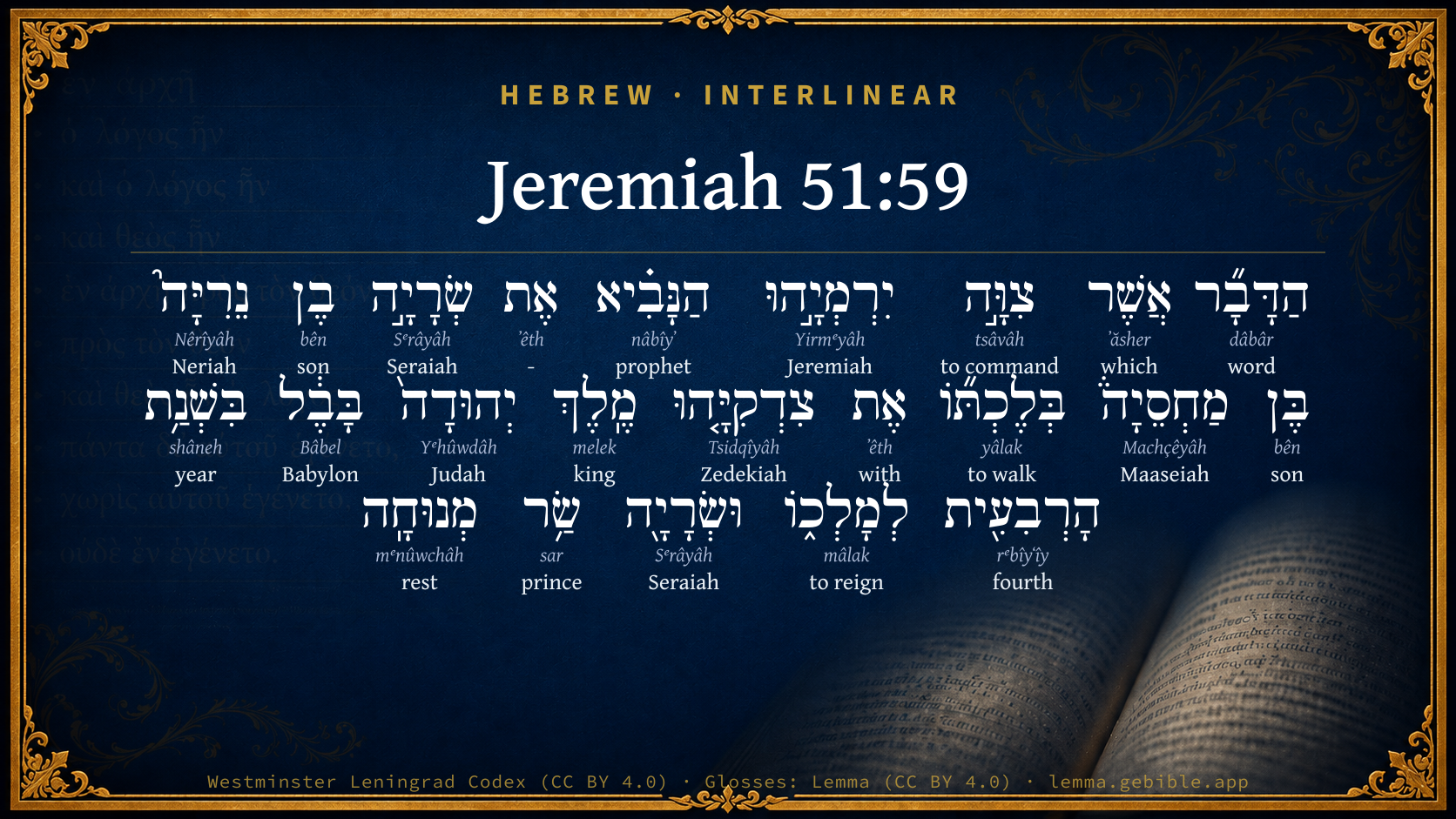
Hebrew (Westminster Leningrad Codex) Jeremiah 51:59 appears in the Hebrew Old Testament. The text above is from the Westminster Leningrad Codex. Each word links to its Strong’s number, a concise gloss, and parsing drawn from the Open Scriptures Hebrew Bible morphology. Click any word for its full Brown-Driver-Briggs (BDB) entry.
Download image
Cite this verse

Jeremiah 51:59 (World English Bible). Public Domain. Lemma interlinear Bible study tool, https://lemma.gebible.app/v/jeremiah/51/59.

Show BibTeX & RIS
BibTeX
RIS
English Translation
The word which Jeremiah the prophet commanded Seraiah the son of Neriah, the son of Mahseiah, when he went with Zedekiah the king of Judah to Babylon in the fourth year of his reign. Now Seraiah was chief chamberlain.
World English Bible · Public Domain
Download a study sheet

One document with this verse’s original text, its word-by-word gloss line, the meaning frame, cross-references with their text, attributed commentary, and full source and license credits — printable, and it pastes into notes with its structure intact.

This verse Autodidact and up

Study sheet (.html) Plain text (.txt)

A passage Seminary Student

Up to 50 verses in one chapter. A passage sheet keeps up to 6 commentary sources and 12 cross-references per verse, in the order this page ranks them, and says so on the sheet whenever that leaves anything out. Ask for a single verse and you get the Autodidact verse sheet above.

Everything on this page stays free to read, with no account — the sheet is a download of what is already on screen, not access to it.

Want to remove ads? Support Godless Engineer
Compare translations 3

The same verse in 3 English versions, stacked beneath the original-language interlinear above. Click any original word for its lexicon entry.

Each is an independent rendering of the whole verse — the interlinear is not word-aligned to these translations.

Highlighted words mark where these versions differ — a whole-verse word diff, not a word-by-word alignment.

  • World English Bible Public Domain
    The word which Jeremiah the prophet commanded Seraiah the son of Neriah, the son of Mahseiah, when he went with Zedekiah the king of Judah to Babylon in the fourth year of his reign. Now Seraiah was chief chamberlain.
  • King James Version Public Domain
    The word which Jeremiah the prophet commanded Seraiah the son of Neriah, the son of Maaseiah, when he went with Zedekiah the king of Judah into Babylon in the fourth year of his reign. And this Seraiah was a quiet prince.
  • unfoldingWord Literal Text CC BY-SA 4.0
    This is the word that Jeremiah the prophet commanded Seraiah son of Neriah son of Mahseiah when he went with Zedekiah king of Judah to Babylon in the fourth year of his reign. Now Seraiah was a chief officer.

unfoldingWord Literal Text — © unfoldingWord, licensed CC BY-SA 4.0. Word-aligned USFM3 via Door43 (git.door43.org/unfoldingWord/en_ult).

Versions to compare (up to 4)

3 of 4 selected

Show all 18 translations

Every available English version of this verse, each an independent rendering of the whole verse.

  • World English Bible Public Domain
    The word which Jeremiah the prophet commanded Seraiah the son of Neriah, the son of Mahseiah, when he went with Zedekiah the king of Judah to Babylon in the fourth year of his reign. Now Seraiah was chief chamberlain.
  • Berean Standard Bible Public Domain
    This is the message that Jeremiah the prophet gave to the quartermaster Seraiah son of Neriah, the son of Mahseiah, when he went to Babylon with King Zedekiah of Judah in the fourth year of Zedekiah’s reign.
  • Majority Standard Bible Public Domain
    This is the message that Jeremiah the prophet gave to the quartermaster Seraiah son of Neriah, the son of Mahseiah, when he went to Babylon with King Zedekiah of Judah in the fourth year of Zedekiah’s reign.
  • King James Version Public Domain
    The word which Jeremiah the prophet commanded Seraiah the son of Neriah, the son of Maaseiah, when he went with Zedekiah the king of Judah into Babylon in the fourth year of his reign. And this Seraiah was a quiet prince.
  • American Standard Version (1901) Public Domain
    The word which Jeremiah the prophet commanded Seraiah the son of Neriah, the son of Mahseiah, when he went with Zedekiah the king of Judah to Babylon in the fourth year of his reign. Now Seraiah was chief chamberlain.
  • Revised Version (1885) Public Domain
    The word which Jeremiah the prophet commanded Seraiah the son of Neriah, the son of Mahseiah, when he went with Zedekiah the king of Judah to Babylon in the fourth year of his reign. Now Seraiah was chief chamberlain.
  • Geneva Bible (1599) Public Domain
    The worde which Ieremiah the Prophet commanded Sheraiah the sonne of Neriiah, the sonne of Maaseiah, when he went with Zedekiah the King of Iudah into Babel, in the fourth yeere of his reigne: and this Sheraiah was a peaceable prince.
  • Douay-Rheims (1899) Public Domain
    The word that Jeremias the prophet commanded Saraias the son of Nerias, the son of Maasias, when he went with king Sedecias to Babylon, in the fourth year of his reign: now Saraias was chief over the prophecy.
  • Young's Literal Translation Public Domain
    The word that Jeremiah the prophet hath commanded Seraiah son of Neriah, son of Maaseiah, in his going with Zedekiah king of Judah to Babylon, in the fourth year of his reign -- and Seraiah `is' a quiet prince;
  • Literal Standard Version CC BY-SA 4.0
    The word that Jeremiah the prophet has commanded Seraiah son of Neriah, son of Maaseiah, in his going with Zedekiah king of Judah to Babylon, in the fourth year of his reign—and Seraiah [is] a quiet prince;
  • Unlocked Literal Bible CC BY-SA 4.0
    This is the word that Jeremiah the prophet commanded Seraiah son of Neriah son of Mahseiah when he went with Zedekiah king of Judah to Babylon in the fourth year of his reign. Now Seraiah was a chief officer.
  • unfoldingWord Literal Text CC BY-SA 4.0
    This is the word that Jeremiah the prophet commanded Seraiah son of Neriah son of Mahseiah when he went with Zedekiah king of Judah to Babylon in the fourth year of his reign. Now Seraiah was a chief officer.
  • Darby Bible Public Domain
    The word that Jeremiah the prophet commanded Seraiah the son of Nerijah, the son of Mahseiah, when he went with Zedekiah the king of Judah to Babylon in the fourth year of his reign. Now Seraiah was chief chamberlain.
  • World Messianic Bible Public Domain
    The word which Jeremiah the prophet commanded Seraiah the son of Neriah, the son of Mahseiah, when he went with Zedekiah the king of Judah to Babylon in the fourth year of his reign. Now Seraiah was chief quartermaster.
  • Webster's Bible Public Domain
    The word which Jeremiah the prophet commanded Seraiah the son of Neriah, the son of Maaseiah, when he went with Zedekiah the king of Judah into Babylon in the fourth year of his reign. And this Seraiah was a quiet prince.
  • Free Bible Version CC BY-SA 4.0
    This is the message that Jeremiah the prophet gave to Seraiah son of Neriah, son of Mahseiah, when he accompanied King Zedekiah of Judah to Babylon in the fourth year of Zedekiah's reign. Seraiah was the king's personal assistant.
  • Bible in Basic English Public Domain
    The order which Jeremiah the prophet gave to Seraiah, the son of Neriah, the son of Mahseiah, when he went with Zedekiah, the king of Judah, to Babylon in the fourth year of his rule. Now Seraiah was the chief controller of the house.
  • JPS Tanakh (1917) Public Domain
    The word which Jeremiah the prophet commanded Seraiah the son of Neriah, the son of Mahseiah, when he went with Zedekiah the king of Judah to Babylon in the fourth year of his reign. Now Seraiah was quartermaster.

Literal Standard Version (2020), Covenant Press — licensed CC BY-SA 4.0. Text via the HelloAO Bible API (eBible.org). Unlocked Literal Bible (unfoldingWord) — licensed CC BY-SA 4.0. Text via the HelloAO Bible API (eBible.org). unfoldingWord Literal Text — © unfoldingWord, licensed CC BY-SA 4.0. Word-aligned USFM3 via Door43 (git.door43.org/unfoldingWord/en_ult). Free Bible Version, Dr. Jonathan Gallagher — licensed CC BY-SA 4.0. Text via the HelloAO Bible API (eBible.org).

Word by word

More ways to search: Search by grammar → Find every occurrence → Compare this word →

Practice this passage: Drill this verse → Learn its vocabulary →

מַחְסֵיָה֒
Machçêyâh
H4271
“Maaseiah”
Noun, Proper
Part of Speech
Noun
Type
Proper
Full BDB Definition

Origin: from H4268 and H3050

TWOT: None

Maaseiah = "Jehovah is a shelter" - a priest and ancestor of Baruch, the friend and scribe of Jeremiah - ancestor of Seraiah who carried Jeremiah's book to Babylon
  1. הַדָּבָ֞ר dâbâr H1697 “the · word” Particle, Definite Article + Noun, Common, Masculine, Singular, Absolute
  2. אֲשֶׁר ʼăsher H834 “which” Particle, Relative
  3. צִוָּ֣ה tsâvâh H6680 “to command” Verb, Piel, Perfect, 3rd Person, Masculine, Singular
  4. יִרְמְיָ֣הוּ Yirmᵉyâh H3414 “Jeremiah” Noun, Proper
  5. הַנָּבִ֗יא nâbîyʼ H5030 “the · prophet” Particle, Definite Article + Noun, Common, Masculine, Singular, Absolute
  6. אֶת ʼêth H853 “-” Particle, Direct Object
  7. שְׂרָיָ֣ה Sᵉrâyâh H8304 “Seraiah” Noun, Proper
  8. בֶן bên H1121 “son of” Noun, Common, Masculine, Singular, Construct
  9. נֵרִיָּה֮ Nêrîyâh H5374 “Neriah” Noun, Proper
  10. בֶּן bên H1121 “son of” Noun, Common, Masculine, Singular, Construct
  11. בְּלֶכְתּ֞וֹ yâlak H3212 “in/at · to walk · him” Preposition + Verb, Qal, Infinitive Construct + Suffix, Personal, 3rd Person, Masculine, Singular
  12. אֶת ʼêth H854 “with” Preposition
  13. צִדְקִיָּ֤הוּ Tsidqîyâh H6667 “Zedekiah” Noun, Proper
  14. מֶֽלֶךְ melek H4428 “king of” Noun, Common, Masculine, Singular, Construct
  15. יְהוּדָה֙ Yᵉhûwdâh H3063 “Judah” Noun, Proper
  16. בָּבֶ֔ל Bâbel H894 “Babylon” Noun, Proper
  17. בִּשְׁנַ֥ת shâneh H8141 “in/at · year of” Preposition + Noun, Common, Feminine, Singular, Construct
  18. הָרְבִעִ֖ית rᵉbîyʻîy H7243 “the · fourth” Particle, Definite Article + Adjective, Ordinal number, Feminine, Singular, Absolute
  19. לְמָלְכ֑וֹ mâlak H4427 “to reign · him” Preposition + Verb, Qal, Infinitive Construct + Suffix, Personal, 3rd Person, Masculine, Singular
  20. וּשְׂרָיָ֖ה Sᵉrâyâh H8304 “and · Seraiah” Conjunction + Noun, Proper
  21. שַׂ֥ר sar H8269 “prince of” Noun, Common, Masculine, Singular, Construct
  22. מְנוּחָֽה mᵉnûwchâh H4496 “rest” Noun, Common, Both, Singular, Absolute

About this verse

These counts appear in no published source. They are computed here, from the morphology-tagged text and Lemma’s own curated glosses. What Lemma adds →

23
words
21
distinct lemmas
Prophets
section

Notable vocabulary

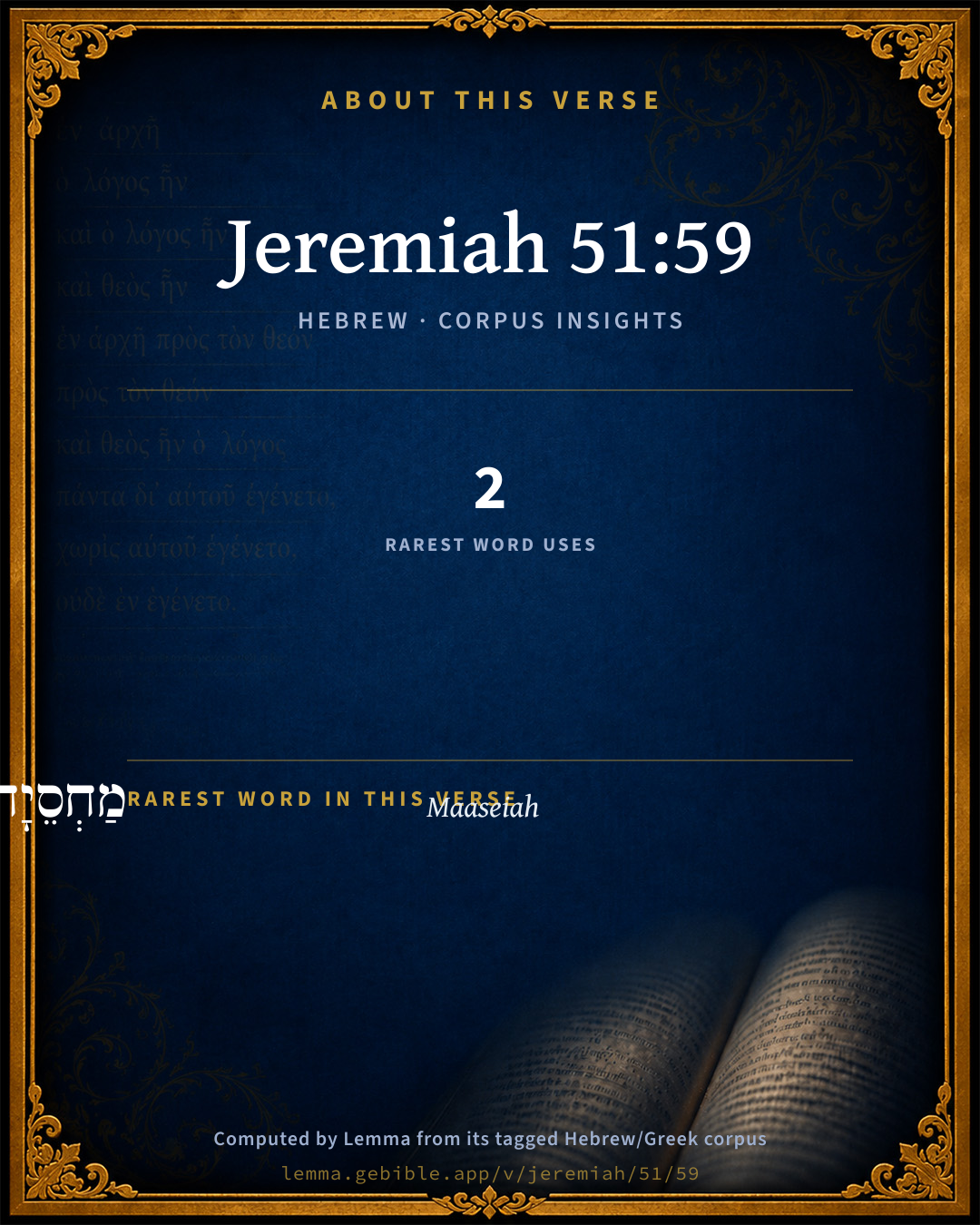
The rarest word here is מַחְסֵיָה֒ Maaseiah H4271 — appearing just 2 times in the whole Hebrew Bible.

Shared distinctive vocabulary

מַחְסֵיָה֒ Maaseiah H4271 occurs in 2 verses of the Hebrew Bible. Also found in:

Grammatical profile

  • 3 verbs
  • 16 nouns
  • 1 adjective
  • 1 preposition
  • 2 particles

Verb forms

  • צִוָּ֣ה Piel · Perfect
  • בְּלֶכְתּ֞וֹ Qal · Infinitive Construct
  • לְמָלְכ֑וֹ Qal · Infinitive Construct

Repetition

Words recur within this verse — often emphatic in Hebrew:

  • שְׂרָיָ֣ה Seraiah H8304 ×2
  • בֶן son H1121 ×2

Cross-references

5

Topical passages linked to Jeremiah 51:59 in the Treasury of Scripture Knowledge — connected by theme and wording, ordered by reader-vote popularity; previews shown in the World English Bible.

  • Jeremiah 32:12 and I delivered the deed of the purchase to Baruch the son of Neriah, the son of Mahseiah, in the presence of Hanamel my uncle's son, and in the presence of the witnesses who subscribed the deed of the purchase, before all the Jews who sat in the court of the guard.
  • Jeremiah 36:4 Then Jeremiah called Baruch the son of Neriah; and Baruch wrote from the mouth of Jeremiah all the words of Yahweh, which he had spoken to him, on a scroll of a book.
  • Jeremiah 28:1 It happened the same year, in the beginning of the reign of Zedekiah king of Judah, in the fourth year, in the fifth month, that Hananiah the son of Azzur, the prophet, who was of Gibeon, spoke to me in the house of Yahweh, in the presence of the priests and of all the people, saying,
  • Jeremiah 45:1 The word that Jeremiah the prophet spoke to Baruch the son of Neriah, when he wrote these word in a book at the mouth of Jeremiah, in the fourth year of Jehoiakim the son of Josiah, king of Judah, saying,
  • Jeremiah 52:1 Zedekiah was twenty-one years old when he began to reign; and he reigned eleven years in Jerusalem: and his mother's name was Hamutal the daughter of Jeremiah of Libnah.

Cross-references courtesy of OpenBible.info (CC BY 4.0).

Hebrew and Greek witnesses Masoretic Hebrew ↔ Greek Septuagint

The same verse in the two great witnesses to the Old Testament, shown verse-for-verse.

These are two independent witnesses, not word-aligned to each other, and the Septuagint is shown in lemma (dictionary) form.

Hebrew Jeremiah 51:59 Masoretic · Westminster Leningrad Codex

הַדָּבָ֞ר אֲשֶׁר צִוָּ֣ה יִרְמְיָ֣הוּ הַנָּבִ֗יא אֶת שְׂרָיָ֣ה בֶן נֵרִיָּה֮ בֶּן מַחְסֵיָה֒ בְּלֶכְתּ֞וֹ אֶת צִדְקִיָּ֤הוּ מֶֽלֶךְ יְהוּדָה֙ בָּבֶ֔ל בִּשְׁנַ֥ת הָרְבִעִ֖ית לְמָלְכ֑וֹ וּשְׂרָיָ֖ה שַׂ֥ר מְנוּחָֽה

The word which Jeremiah the prophet commanded Seraiah the son of Neriah, the son of Mahseiah, when he went with Zedekiah the king of Judah to Babylon in the fourth year of his reign. Now Seraiah was chief chamberlain.

World English Bible · Public Domain

Greek LXX Structure differs

In the Septuagint, Jeremiah is about an eighth shorter than the Hebrew and arranges its material differently — the Oracles Against the Nations (Hebrew chapters 46–51) appear in the middle of the Greek book, after 25:13. Because the chapter and verse boundaries do not line up, a verse-for-verse comparison with the Hebrew is not shown.

A verse-for-verse comparison isn’t shown here because the chapters and verses don’t line up. Switch to the LXX edition with the MT / LXX toggle above to read the Greek directly.

On this verse, The Cambridge Bible for Schools and Colleges discusses the Septuagint’s reading. Read the note in Commentary ↓

Hebrew: Westminster Leningrad Codex (CC BY 4.0). Greek: Septuagint (public domain); English from a public-domain English Septuagint. How the Septuagint differs from the Hebrew →

Targum (Aramaic paraphrase)

1

The Targum is the ancient Jewish Aramaic paraphrase of the Hebrew Scriptures — an interpretive translation, not the Hebrew text itself. Onkelos (literal) and Pseudo-Jonathan (expansive) render the Torah, and Jonathan the Prophets. Coverage is partial: where no permissively-licensed English translation exists for a verse, only the Aramaic is shown. This is verse-level text, not a word-by-word alignment to the Hebrew.

  1. Targum Jonathan Prophets (Joshua–Malachi)
    פִּתְגָמָא דִי פַקֵיד יִרְמְיָה נְבִיָא יַת שְׂרָיָה בַר נֵרִיָה בַר מַחְסֵיָה כַּד אָזֵל בִּשְׁלִיחוּת צִדְקִיָה מְלַךְ שִׁבְטָא דְבֵית יְהוּדָה לְבָבֶל בְּשַׁתָּא רְבִיעֲתָא לְמַמְלְכֵיהּ וּשְׂרָיָה רַב תּוּקְרַבְתָּא:

    (no public-domain English translation for this verse)

    Targum Jonathan — Aramaic: “Mikraot Gedolot” (public domain). English: “Sefaria Community Translation” (CC0 1.0 (public-domain dedication)); “London "Chaldee Paraphrase," 1871” (public domain). Text via Sefaria.

Commentary

Notes on Jeremiah 51:59 from classic Christian and Jewish commentators (each source and its license shown beneath its notes). The classic Christian expositions comment on the surrounding passage and are grouped to its opening verse, so a note may address several verses; the Jewish commentaries on the Tanakh (Rashi and others) are per-verse, so they appear only where the commentator wrote on this verse.

Lemma curates 59 commentaries, every one of them public domain or Creative Commons licensed, each selected and text-cleaned for this edition rather than reprinted as found. About our sources →

Matthew Henry's Commentary

We have been long attending the judgment of Babylon in this and the foregoing chapter; now here we have the conclusion of that whole matter. 1. A copy is taken of this prophecy, it should seem by Jeremiah himself, for Baruch his scribe is not mentioned here (Jer 51:60): Jeremiah wrote in a book all these words that are here written against Babylon. He received this notice that he might give it to all whom it might concern. It is of great advantage both to the propagating and to the perpetuating of the word of God to have it written, and to have copies taken of the law, prophets, and epistles. 2. It is sent to Babylon, to the captives there, by the hand of Seraiah, who went there attendant on or ambassador for king Zedekiah, in the fourth year of his reign, Jer 51:59. He went with Zedekiah, or (as the margin reads it) on the behalf of Zedekiah, into Babylon. The character given of him is observable, that this Seraiah was a quiet prince, a prince of rest. He was in honour and power, but not, as most f the princes then were, hot and heady, making parties, and heading factions, and driving things furiously. He was of a calm temper, studied the things that made for peace, endeavoured to preserve a good understanding between the king his master and the king of Babylon, and to keep his master from rebelling. He was no persecutor of God's prophets, but a moderate man. Zedekiah was happy in the choice of such a man to be his envoy to the king of Babylon, and Jeremiah might safely entrust such a man with his errand too. Note, it is the real honour of great men to be quiet men, and it is the wisdom of princes to put such into places of trust. 3. Seraiah is desired to read it to his countrymen that had already gone into captivity: "When thou shalt come to Babylon, and shalt see what a magnificent place it is, how large a city, how strong, how rich, and how well fortified, and shalt therefore be tempted to think, Surely, it will stand forever" (as the disciples, when they observed the buildings of the temple, concluded that nothing would throw them down but the end of the world, Mat 24:3), "then thou shalt read all these words to thyself and thy particular friends, for their encouragement in their captivity: let them with an eye of faith see to the end of these threatening powers, and comfort themselves and one another herewith." 4. He is directed to make a solemn protestation of the divine authority and unquestionable certainty of that which he had read (Jer 51:62): Then thou shalt look up to God, and say, O Lord! it is thou that hast spoken against this place, to cut it off. This is like the angel's protestation concerning the destruction of the New Testament Babylon. These are the true sayings of God, Rev 19:9. These words are true and faithful, Rev 21:5. Though Seraiah sees Babylon flourishing, having read this prophecy he must foresee Babylon falling, and by virtue of it must curse its habitation, though it be taking root (Job 5:3): "O Lord! thou hast spoken against this place, and I believe what thou hast spoken, that, as thou knowest every thing, so thou canst do every thing. Thou hast passed sentence upon Babylon, and it shall be executed. Thou hast spoken against this place, to cut it off, and therefore we will neither envy its pomp nor fear its power." When we see what this world is, how glittering its shows are and how flattering its proposals, let us read in the book of the Lord that its fashion passes away, and it shall shortly be cut off and be desolate for ever, and we shall learn to look upon it with a holy contempt. Observe here, When we have been reading the word of God it becomes us to direct to him whose word it is a humble believing acknowledgment of the truth, equity, and goodness, of what we have read. 5. He must then tie a stone to the book and throw it into the midst of the river Euphrates, as a confirming sign of the things contained in it, saying, "Thus shall Babylon sink, and not rise; for they shall be weary, they shall perfectly succumb, as men tired with a burden, under the load of the evil that I will bring upon them, which they shall never shake off, nor get from under," Jer 51:53, Jer 51:64. In the sign it was the stone that sunk the book, which otherwise would have swum. But in the thing signified it was rather the book that sunk the stone; it was the divine sentence passed upon Babylon in this prophecy that sunk that city, which seemed as firm as a stone. The fall of the New Testament Babylon was represented by something like this, but much more magnificent, Rev 18:21. A mighty angel cast a great millstone into the sea, saying, Thus shall Babylon fall. Those that sink under the weight of God's wrath and curse sink irrecoverably. The last words of the chapter seal up the vision and prophecy of this book: Thus far are the words of Jeremiah. Not that this prophecy against Babylon was the last of his prophecies; for it was dated in the fourth year of Zedekiah (Jer 51:59), long before he finished his testimony; but this is recorded last of his prophecies because it was to be last accomplished of all his prophecies against the Gentiles, Jer 46:1. And the chapter which remains is purely historical, and, as some think, was added by some other hand.

Matthew Henry's Commentary on the Whole Bible (1708–1710) — public domain (CC PDM 1.0). Text via the HelloAO Bible API.

The Cambridge Bible for Schools and Colleges

gen. ed. J. J. S. Perowne

59. Seraiah … when he went with Zedekiah] See introd. note.

chief chamberlain] mg. (rightly) quartermaster, lit. captain of the camping place. His duty, as in attendance on the king in a journey, was to arrange that matters should be in readiness at the next halting place. The LXX, however, have commissary (lit. ruler) of the presents. The change involved in MT.’s reading is but slight.

59–64. Seraiah’s mission

The rejection as non-Jeremianic of the preceding prophecy against Babylon (see introd. note to chs. 50, 51) by no means need involve suspicion of this section. Here impassioned denunciation finds no place and the forecast of the overthrow of the great Eastern power is quite in keeping with the attitude of the prophet in Jer_29:10 in limiting her dominion over Israel to seventy years. It is true that the latter part of Jer_51:60 identifies the prophecy conveyed by Seraiah to Babylon with the preceding utterances; but see note there. That Zedekiah should himself visit Babylon at the time here specified has been already shewn to be by no means improbable (see introd. note on Jer_27:2-11). Even those who doubt the king’s journey thither are mostly willing to accept that of Seraiah, who, as Baruch’s brother (cp. his ancestry here with that given in Jer_32:12 for Baruch), would very naturally bring a message of hope from Jeremiah to the exiles.

We may summarize the section as follows.

Jer_51:59-64. The directions given by the prophet to Seraiah when the latter accompanied Zedekiah to Babylon. He was to take with him a scroll containing the doom of the city, and after reading it aloud there, to attach to it a stone and sink it in the river as a symbol of Babylon’s approaching fall.

The Cambridge Bible for Schools and Colleges (gen. ed. J. J. S. Perowne; Cambridge University Press, 1878–1918) — public domain. Text from a community e-Sword module.

Trapp's Complete Commentary

John Trapp

Jer 51:59 The word which Jeremiah the prophet commanded Seraiah the son of Neriah, the son of Maaseiah, when he went with Zedekiah the king of Judah into Babylon in the fourth year of his reign. And [this] Seraiah [was] a quiet prince.

Ver. 59. The word which Jeremiah the prophet commanded Seraiah.] This is now the last part, viz., a type used for confirmation of this long time preceding prophecy, uttered at Jerusalem haply in the fourth year of Jehoiakim, which was the first of Nebuchadnezzar, and now to be read at Babylon in the fourth year of Zedekiah, which was seven years before the destruction of Jerusalem, and above sixty years before the destruction of Babylon. God loveth to foresignify, but Babylon would not be warned, which was a just both desert and presage of her ruin.

When he went with Zedekiah.] In company with him, say some, out of the Jews’ chronicle. At which time Nebuchadnezzar, who had made him king, took an oath of him to be true to him, which he afterward brake, and was punished accordingly. {2Ch 36:13} Others think that Seraiah went not with Zedekiah, but for him, and from him, with a present to Nebuchadnezzar, that he might keep his favour, or that he might he reconciled unto him after his revolt from him. {2Ki 24:20}

And this Seraiah was a great prince.] One that opposed the rebellion against Nebuchadnezzar, or a peace maker at court, or the great chamberlain. Heb., A prince of rest; or, Prince of Menucha, a place so called, {Jdg 20:43} or a quiet, honest, and humble prince; otherwise he would not have been thus commanded by a poor prophet, especially in a matter of so great danger, as it might have proved if publicly noticed.

John Trapp, A Commentary or Exposition upon All the Books of the Old and New Testament (1647–1656) — public domain. Text from a community e-Sword module.

Albert Barnes' Notes on the Bible

Historical appendix. In his fourth year Zedekiah journeyed to Babylon either to obtain some favor from Nebuchadnezzar, or because he was summoned to be present on some state occasion. Jeremiah took the opportunity of sending to the exiles at Babylon this prophecy.

Jer 51:59

Seraiah - Brother to Baruch.

A quiet prince - literally, “prince of the resting place, i. e., quartermaster.” It was his business to ride forward each day, and select the place where the king would halt and pass the night.

Jer 51:60

In a book - literally, in one book, on one scroll of parchment.

Jer 51:61

And shalt see, and shalt read - Or, then see that thou read etc.

Jer 51:62-64

The sinking of the scroll was not for the purpose of destroying it, but was a symbolic act (compare the marginal reference); and the binding of a stone to it signified the certainty of the hasty ruin of the city.

Jer 51:64

Thus far ... - Whoever added Jer. 52, evidently felt it his duty to point out that it was not written by Jeremiah.

Albert Barnes' Notes on the Bible (1834–1885) — public domain. Text from a community e-Sword/MySword module.

Joseph Benson's Commentary

Jer 51:59. The word which Jeremiah commanded Seraiah. when he went with Zedekiah — The Hebrew בלכתו את צדקיהו, is rendered by the LXX., οτε επορευετο παρα Σεδεκιου, when he went from Zedekiah, on his behalf, or by virtue of his commission; which seems to be the meaning of the clause; for we have no reason to suppose that Zedekiah went in person to Babylon at that time. Instead of, This Seraiah was a quiet prince, as our translators render שׁר מנוחה, the LXX. read, αρχων δωρων, a prince, or chief master of gifts, which Blaney interprets to mean, chief of the embassy, or who had the principal charge of the present sent from Zedekiah to the king of Babylon, judging, that in these words is specified the business on which Seraiah was sent. He was employed to carry the present, or customary tribute, which Zedekiah was obliged to pay to the king of Babylon, in acknowledgment of his subjection and vassalage.

Joseph Benson's Commentary on the Old and New Testaments (1811–1818) — public domain. Text from a community e-Sword module.

Whedon's Commentary on the Bible

Daniel D. Whedon

59. The word, etc. — This is the caption of the brief historical appendage comprised in Jer_51:59-64, which was sent to the captives at Babylon by Zedekiah. As to the reasons of Zedekiah’s visit to Babylon we have no intimation. In the Records of the Past, 3:107, 120, we have a copy of a document from which we learn that Esar-haddon assembled twenty-two kings of Syria at the commencement of his great palace in Nineveh, and this may suggest how, for some similar reason of pomp and state, Zedekiah may have been summoned to Babylon. Or it may be, that his fidelity was suspected, and so he had to go to Babylon to vindicate himself.

A quiet prince — Literally, prince of the resting place. The plural of this word is rendered “resting places” in Isa_32:18. This officer answers to the modern quarter-master, his duty being to go forward and select the places where the king and his train would stop for refreshments, and also where they would pass the night.

Daniel D. Whedon (gen. ed.), Commentary on the Old and New Testaments (1874–1909) — public domain. Text from a community e-Sword module.

Keil & Delitzsch

C. F. Keil & F. Delitzsch

Epilogue. - Jer 51:59. "The word which Jeremiah the prophet commanded Seraiah the son of Nerijah, the son of Maaseiah, when he went with Zedekiah the king of Judah to Babylon, in the fourth year of his reign. Now Seraiah was 'quartermaster-general'" (Ger. Reisemarschall).

(Note: The Peshito renders שׂר מנוּחה by "chief of the camp," evidently reading מחנה. Gesenius, following in this line, though that Seraiah held an office in the Babylonian army similar to that of quartermaster-general. It is evident, however, that he was rather an officer of the Jewish court in attendance on the king. Maurer, who is followed by Hitzig, and here by Keil, in his rendering "Reisemarschall," suggested the idea that he was a functionary who took charge of the royal caravan when on the march, and fixed the halting-place. - Tr.)

Seraiah the son of Nerijah was, no doubt, a brother of Baruch the son of Nerijah; cf. Jer 32:12. שׂר מנוּחה does not mean "a peaceful prince" (Luther), "a quiet prince," English Version, but "prince of the resting-place" (cf. Num 10:33), i.e., the king's "quartermaster-general." What Jeremiah commanded Seraiah, or charged him with, does not follow till Jer 51:61; for the words of Jer 51:60, "And Jeremiah wrote in a book all the evil that was to come on Babylon, namely all these words which are written against Babylon" (in the preceding address, Jer 50 and 51), form a parenthetic remark, inserted for the purpose of explaining the charge that follows. This remark is attached to the circumstantial clause at the end of Jer 51:59, after which "the word which he commanded" is not resumed till Jer 51:61, with the words, "and Jeremiah spake to Seraiah;" and the charge itself is given in vv. 61b-64: "When thou comest to Babylon, then see to it, and read all these words, and say, O Jahveh, Thou hast spoken against this place, to destroy it, so that there shall be no inhabitant in it, neither man nor beast, but it shall be eternal desolations. And it shall be, when thou hast finished reading this book, that thou shalt bind a stone to it, and cast it into the midst of the Euphrates (v. 64), and say, Thus shall Babylon sink, and shall not rise again, because of the evil that I bring upon her; and they shall be weary." כּבאך בבל does not mean, "when thou shalt have got near Babylon, so that thou beholdest the city lying in its full extent before thee" (Hitzig), but, according to the simple tenor of the words, "when thou shalt have come into the city." The former interpretation is based on the erroneous supposition that Seraiah had not been able to read the prophecy in the city, from fear of being called to account for this by the Babylonians. But it is nowhere stated that he was to read it publicly to the Babylonians themselves in an assembly of the people expressly convened for this purpose, but merely that he is to read it, and afterwards throw the book into the Euphrates. The reading was not intended to warn the Babylonians of the destruction threatened them, but was merely to be a proclamation of the word of the Lord against Babylon, on the very spot, for the purpose of connecting with it the symbolic action mentioned in v. 63f. וראית does not belong to כּבאך ("when thou comest to Babylon, and seest"), but introduces the apodosis, "then see to it, and read," i.e., keep it in your eye, in your mind, that you read (cf. Gen 20:10); not, "seek a good opportunity for reading" (Ewald). At the same time, Seraiah is to cry to God that He has said He will bring this evil on Babylon, i.e., as it were to remind God that the words of the prophecy are His own words, which He has to fulfil. On the contents of Jer 51:62, cf. Jer 50:3; Jer 51:26.

After the reading is finished, he is to bind the book to a stone, by means of which to sink it in the Euphrates, uttering the words explanatory of this action, "Thus shall Babylon sink," etc. This was to be done, not for the purpose of destroying the book (which certainly took place, but was not the object for which it was sunk), but in order to symbolize the fulfilment of the prophecy against Babylon. The attachment of the stone was not a precautionary measure to prevent the writing from being picked up somewhere, and thus bringing the writer or the people of the caravan into trouble (Hitzig), but was merely intended to make sure that the book would sink down into the depths of the Euphrates, and render it impossible that it should rise again to the surface, thus indicating by symbol that Babylon would not rise again. the words which Seraiah is to speak on throwing the book into the Euphrates, contain, in nuce, the substance of the prophecy. The prophet makes this still more plain, by concluding the words he is likewise to utter with ויעפוּ as the last word of the prophecy. Luther has here well rendered יעף, "to weary," by "succumb" (erliegen). The Babylonians form the subject of יעפוּ.

(Note: Mistaking the meaning of the repetition of the word ויעפוּ, Movers, Hitzig, and Graf have thereon based various untenable conjectures. Movers infers from the circumstance that the whole epilogue is spurious; Hitzig and Graf conclude from it that the closing words, "Thus far are the words of Jeremiah," originally came after Jer 51:58, and that the epilogue, because it does not at all admit of being separated from the great oracle against Babylon, originally preceded the oracle beginning Jer 50:1, but was afterwards placed at the end; moreover, that the transposer cut off from Jer 51:58 the concluding remark, "Thus far," etc., and put it at the end of the epilogue (Jer 51:64), but, at the same time, also transferred ויעפוּ, in order to show that the words, i.e., the prophecies of Jeremiah, strictly speaking, extend only thus far. This intimation is, indeed, quite superfluous, for it never could occur to the mind of any intelligent reader that the epilogue, Jer 51:59-64, was an integral portion of the prophecy itself. And there would be no meaning in placing the epilogue before Jer 50:1.)

The symbolic meaning of this act is clear; and from it, also, the meaning of the whole charge to the prophet is not difficult to perceive. The sending of the prophecy through Seraiah, with the command to read it there, at the same time looking up to God, and then to sink it in the Euphrates, was not intended as a testimony to the inhabitants of Babylon of the certainty of their destruction, but was meant to be a substantial proof for Israel that God the Lord would, without fail, fulfil His word regarding the seventy years' duration of Babylon's supremacy, and the fall of this great kingdom which was to ensue. This testimony received still greater significance from the circumstances under which it was given. The journey of King Zedekiah to Babylon was, at least in regard to its official purpose, an act of homage shown by Zedekiah to Nebuchadnezzar, as the vassal of the king of Babylon. This fact, which was deeply humiliating for Judah, was made use of by Jeremiah, in the name of the Lord, for the purpose of announcing and transmitting to Babylon, the city that ruled the world, the decree which Jahveh, the God of Israel, as King of heaven and earth, had formed concerning the proud city, and which He would execute in His own time, that He might confirm the hope of the godly ones among His people in the deliverance of Israel from Babylon.

The statement, "Thus far are the words of Jeremiah," is an addition made by the editor of the prophecies. From these words, it follows that Jer 52 does not belong to these prophecies, but forms a historical appendix to them.

Finally, if any question be asked regarding the fulfilment of the prophecy against Babylon, we must keep in mind these two points: 1. The prophecy, as is shown both by its title and its contents, is not merely directed against the city of Babylon, but also against the land of the Chaldeans. It therefore proclaims generally the devastation and destruction of the Chaldean kingdom, or the fall of the Babylonian empire; and the capture and destruction of Babylon, the capital, receive special prominence only in so far as the world-wide rule of Babylon fell with the capital, and the supremacy of the Chaldeans over the nations came to an end. 2. In addition to this historical side, the prophecy has an ideal background, which certainly is never very prominent, but nevertheless is always more or less to be discovered. Here Babylon, as the then mistress of the world, is the representative of the God-opposing influences on the earth, which always attempt to suppress and destroy the kingdom of God. The fulfilment of the historical side of this prophecy began with the capture of Babylon by the united forces of the Medes and Persians under the leadership of Cyrus, and with the dissolution of the Chaldean empire, brought about through that event. By this means, too, the people of Israel were delivered from the Babylonish captivity, while Cyrus gave them permission to return to their native land and rebuild the temple of the Lord in Jerusalem; Ch2 36:22., Ezr 1:1. But Babylon was not destroyed when thus taken, and according to Herodotus, iii. 159, even the walls of the city remained uninjured, while, according to a notice of Berosus in Josephus, contra Ap. i. 19, Cyrus is said to have given orders for the pulling down of the outer wall. Cyrus appointed Babylon, after Susa and Ecbatana, the third city in the kingdom, and the winter residence of the Persian kings (according to Xenophon, Cyrop. viii. 6. 22). Darius Hystaspes, who was obliged to take the city a second time, in consequence of its revolt in the year 518 b.c., was the first who caused the walls to be lowered in height; these were diminished to 50 ells royal cubits - about 85 feet, and the gates were torn away (Herodotus, iii. 158f.). Xerxes spoiled the city of the golden image of Belus (Herodot. i. 183), and caused the temple of Belus to be destroyed (Arrian, vii. 17. 2). Alexander the Great had intended not merely to rebuild the sanctuary of Belus, but also to make the city the capital of his empire; but he was prevented by his early death from carrying out this plan. The decay of Babylon properly began when Seleucus Nicator built Seleucia, ion the Tigris, only 300 stadia distant. "Babylon," says Pliny, vi. 30, "ad solitudinem rediit, exhausta vicinitate Seleuciae." And Strabo (born 60 b.c.) says that, even in his time, the city was a complete wilderness, to which he applies the utterance of a poet: ἐρημία μεγάλη ἐστὶν ἡ μεγάλη πόλις (xvi. l. 5). This decay was accelerated under the rule of the Parthians, so that, within a short time, only a small space within the walls was inhabited, while the rest was used as fields (Diodorus Siculus, ii. 9; Curtius, Ezr 1:4. 27). According to the statements of Jerome and Theodoret, there were still living at Babylon, centuries afterwards, a pretty considerable number of Jews; but Jerome (ad Jerem. 51) was informed by a Persian monk that these ruins stood in the midst of a hunting district of the Persian kings. The notices of later writers, especially of modern travellers, have been collected by Ritter, Erdkunde, xi. S. 865f.; and the latest investigations among the ruins are described in his Expdition scient. en Msopotamie, i. pp. 135-254 (Paris, 1863).

(Note: Fresh interest in Babylonian archaeology has of late been awakened, especially in this country, by Mr. George Smith, of the British Museum, who has collected and deciphered about eighty fragments of some tablets that had been brought from Assyria, and that give an account of the deluge different in some respects from the Mosaic one. The proprietors of the Daily Telegraph have also shown much public spirit in sending out, at their own cost, an expedition to Assyria, for further investigation of the ruins there. - Tr.)

John the evangelist has taken the ideal elements of this prophecy into his apocalyptic description of the great city of Babylon (Rev. 16ff.), whose fall is not to begin till the kingdom of God is completed in glory through the return of our Lord.

Keil & Delitzsch — Biblical Commentary on the Old Testament (1861–1891) — public domain (CC PDM 1.0). Text via the HelloAO Bible API. (Old Testament only.)

Lange's Commentary on the Holy Scriptures

21. HISTORICAL CONCLUSION

Jer_51:59-64

59The word which Jeremiah the prophet commanded Seraiah the son of Neriah, the son of Maaseiah, when he went with Zedekiah the king of Judah into Babylon in the fourth year of his reign. And this Seraiah was a quiet prince [caravan-marshall]. 60So Jeremiah wrote in a book all the evil that should come39 upon Babylon, 61even all these words that are written against Babylon. And Jeremiah said to Seraiah, When thou comest to Babylon, and shalt see, and shalt [see that thou]40 62read all these words; then shalt thou say, O Lord [and say, O Jehovah], thou hast spoken against this place, to cut it off, that none shall remain in it, neither 63man nor beast, but that it shall be desolate for ever. And it shall be, when thou hast made an end of reading this book, that thou shalt bind a stone to it, and cast 64it into the midst of Euphrates: And thou shalt say, Thus shall Babylon sink,41 and shall not rise from [because of] the evil that I will bring upon her: and they shall be weary [exhausted].42 Thus far are the words of Jeremiah.

EXEGETICAL AND CRITICAL

When King Zedekiah, in the fourth year of his reign, made a journey to Babylon, Jeremiah gave to Seraiah, the brother of Baruch, the marshall, the prophecy against Babylon to take with him and read in Babylon, and then with prayer to the Lord to cast it into the Euphrates.

Jer_51:59. The word … caravan-marshall. The commission which Seraiah receives really forms the chief part of this section. For after Jer_51:60, in which the restoration of the roll forming the basis of this commission is described, all the rest contains only the words in which Jeremiah imparts the commission.—Seraiah, according to Jer_32:13, must be a brother of Baruch, the friend and assistant of our prophet, which explains why the commission was given to him. Other persons named Seraiah are mentioned in this book, Jer_36:26; Jer_40:8; Jer_52:24. It seems to have been a common name among the priests. Comp. 1Ch_7:6; 1Ch_7:14; Ezr_7:1; Ezr_7:4; Neh_10:2; Neh_11:11; Neh_12:1; Neh_12:12.—It is not perfectly clear why Zedekiah went to Babylon. His fourth year is the same in which the envoys of the neighboring nations met in Jerusalem, to treat concerning a defensive alliance against the Chaldean power. Comp. rems. on Jer_27:1 and Jer_28:1. Niebuhr thinks that the diversion then made by Nebuchadnezzar’s war with Media was the occasion of this meeting (Ass. u. Bab., S. 211). The journey to Babylon shows that nothing came of the project, whether that the reports from the East caused the matter to appear too dangerous, or that the warnings of Jeremiah made some impression.—A quiet prince (שׂר־מנוחה). This expression has been interpreted in the most various and strangest ways, concerning which comp. Rosenmueller and J. D. Michaelisad loc. The latter was the first to give the substantially correct rendering in his Translation of the Old Testament, 1778, Leader of the caravan. Maurer first proposed “Reisemarschall,” marshall of the journey. Literally it denotes “Prince of the resting-place.” Comp. Num_10:33.

Jer_51:60-64. So Jeremiah wrote .… exhausted. We may assume that this journey of Zedekiah was the occasion of the prophecy against Babylon. For homage, if not the only object, was certainly one of the objects, of the journey, and it therefore involved a deep disgrace to the theocracy. How fitting it was that the prophet should make use of this journey to furnish the medal with an appropriate reverse. While the king of Judah, in view of all, was casting himself in homage before the throne of the Chaldean king, Seraiah was to cast a roll in the Euphrates, on which was recorded as a divine decree the destruction of Babylon and deliverance of Israel.—That Jeremiah copied the prophecy from the book-roll mentioned in Jer_36:32 (Graf) is only supposable, in case Jeremiah successively increased that collection of writings begun in the fifth year of Jehoiakim, first inserting the present prophecy in it, and thus giving Seraiah a copy, a confirmation of which hypothesis may be found in the expression in a [אֶחָד, one] book. It is, however, possible that Jeremiah would thus intimate that he purposely wrote the prophecy upon one roll, in antithesis to the many rolls forming the main collection. The reason of the prophet’s care to write the whole on one roll, would then doubtless be that one could be handled more easily and safely than two.—The reading was evidently for a threefold purpose: 1. With respect to the city of Babylon it was an announcement of judgment (Hitzig), which appears the more significant, as the announcers were not in a condition to make a declaration against Babylon, coming, as they did in all humility, to do homage. 2. With respect to God, it was to be affirmed that the people of Israel had taken solemn notice of the divine promise. Hence after the reading the Lord is to be expressly addressed and reminded of the word of His promise in its main features (comp. Jer_51:62 with Jer_50:3; Jer_51:26). He is thus, as it were, to be taken at His word and pledged. 3. To the Israelites there was naturally a great comfort in all this, which must have been of special value to them in that moment of deep shame.—The sinking of the roll in the Euphrates is added to the reading as supplementary and confirming the words by a visible symbolic action. The roll being compelled to sink by the stone and thus outwardly given up to destruction, suggests the thought that this external part was no longer necessary after, by the reading, the purport had been received into the living spiritual archives of the consciousness. At the same time, as is expressly stated in Jer_51:64, the sinking by the weight of the stone is to represent symbolically the ruin of Babylon.—Shall not rise, as the roll with the stone will not.—From the evil does not designate the element in which Babylon is to sink, but the figure is here forsaken and the transition made to literal speech. מִפְּנֵי then=in consequence of [because of, the evil].—Shall be weary. These words might certainly be dispensed with, as they rather injure than promote the clearness of the sense. As is well understood, however, the easier reading is by no means always the more correct. The question depends on whether the finer and more hidden sense which may be contained in the words is able to balance the formal reasons which favor their spuriousness. Comp. the Textual remarks.

Thus far the words of Jeremiah. These words, which I cannot regard as misplaced (comp. rems. on Jer_51:64) have simply the object of indicating that ch.52 does not proceed from Jeremiah himself, but is the addition made by another person.

Footnotes:

[39]Jer_51:60.—On the sense of the Imperfect תָּבוֹא comp. Naegelsb. Gr., § 87, 1.

[40]Jer_51:61.—וראית. This word cannot mean “and when thou seest it (for the first time).” The suffix would certainly not be wanting in that case. Nor can we see why the reading should take place at the first sight of the city. Both time and place might then be vary unfavorable. It is rather the apodosis; then see to it. It is inculcated upon him that he discharge his commission with circumspection. Comp. 1Ki_12:16; Psa_37:37; Isa_22:11.

[41]Jer_51:64.—שָׁקַע, demergi, desidere, in Jeremiah here only. Comp. Amo_8:8; Amo_9:5.

[42]Jer_51:64.—If the word ויעפו is not genuine, it can have come here only through the transposition of the following words, “Thus far,” etc., with which the copyist, through carelessness or of purpose, connected this. This, however, involves the inauthenticity of Jer_51:59-64 or their original position before Jer_50:1. Hitzig says the passage “bears some marks of genuineness, none of the contrary,” and it is incredible that it stood before Jer_50:1, since it would then appear that this great prophecy was only of secondary importance. If, then, Jer_51:59-64 are genuine and in their original position, the same must be said of the concluding words, since they could never have had their position before Jer_51:59. A copyist could not have added ויעפו by mistake. Jeremiah, then, must have done it. His object probably was to give a token of identity to the sinking prophecy by an unmistakable quotation from it. The ancient translations, with the exception of the LXX., which is of no authority, all express the word. Comp. Naegelsb. Jer. u. Bab., S. 96.

DOCTRINAL AND ETHICAL

1. “Daniel’s Babylonian empire resumes, as it were, the thread which was broken off with the tower-erection and kingdom of Nimrod. In the Babylonian tower-building the whole of the then existing humanity was united against God; with the Babylonian kingdom began the period of the universal monarchies, which again aspired after an atheistical union of entire humanity. Babylon has since and even to the Revelation (Jeremiah 18) remained the standing type of this world.” Auberlen, Der proph. Daniel, S. 230.

2. For what reason does Babylon appear as a type of the world? Why not Nineveh, or Persepolis, or Tyre, or Memphis, or Rome? Certainly not because Babylon was greater, more glorious, more powerful or prouder and more ungodly than those cities and kingdoms. Nineveh especially was still greater than Babylon (comp. Duncker, Gesch. d. Alterth. I. S. 474, 5), and Assyria was not less hostile to the theocracy, having carried away into captivity the northern and larger half of the people of Israel. Babylon is qualified for this representation in two ways: 1. because it is the home of worldly princedom and titanic arrogance (Gen_10:8; Gen_11:1-4); 2. because Babylon destroyed the centre of the theocracy, Jerusalem, the temple and the theocratic kingdom, and first assumed to be the single supreme power of the globe.

3. “When God has used a superstitious, wicked and tyrannical nation long enough as His rod, He breaks it in pieces and finally throws it into the fire. For even those whom He formerly used as His chosen anointed instruments He then regards as but the dust in the streets or as chaff before the wind.” Cramer.

4. “No monarch is too rich, too wicked, too strong for God the Lord. And He can soon enlist and engage soldiers whom He can use against His declared enemies.” Cramer.

5. “Israel was founded on everlasting foundations, even God’s word and promise. The sins of the people brought about that it was laid low in the dust, but not without hope of a better resurrection. Babylon, on the other hand, must perish forever, for in it is the empire of evil come to its highest bloom. Jeremiah owns the nothingness of all worldly kingdoms, since they are all under this national order to serve only for a time. We are to be subject to them and seek their welfare for the sake of the souls of men, whom God is educating therein; a Christian however cannot be enthusiastic for them after the manner of the ancient heathen nor of ancient Israel, for here we have no abiding city, our citizenship is in heaven. The kingdoms of this world are no sanctuaries for us and we supplicate their continuance only with the daily bread of the fourth petition. Jeremiah applies many words and figures to Babylon which he has already used in the judgments on other nations, thus to intimate that in Babylon all the heathenism of the world culminates, and that here also must be the greatest anguish. What, however, is here declared of Babylon must be fulfilled again on all earthly powers in so far as, treading in its footprints, they take flesh for their arm and regard the material of this world as power, whether they be called states or churches.” Diedrich.

6. On Jer_50:2. In putting into the mouth of Israel, returning from Babylon, the call to an everlasting covenant with Jehovah, the prophet causes them 1. to confess that they have forgotten the first covenant; 2. he shows us that the time of the new covenant begins with the redemption from the Babylonish captivity. He was far, however, from supposing that this redemption would be only a weak beginning, that the appearance of the Saviour would be deferred for centuries, that Israel would sink still deeper as an external πολιτεία, and that finally the Israel of the new covenant would itself appear as a μυστήριον, εἰς ὃ ἐπιθυμοῦσιν ἄγγελοι παρακύψαι (1Pe_1:9-12).

7. From what Jeremiah has already said in Jer_31:31-34 of the new covenant we see that its nature and its difference from the old is not unknown to him. Yet he knows the new covenant only in general. He knows that it will be deeply spiritual and eternal, but how and why it will be so is still to him part of the μυστήριον.

8. On Jer_50:6. Jeremiah here points back to Jeremiah 23. Priests, kings and prophets, who should discharge the office of shepherds, prove to be wolves. Yea, they are the worst of wolves, who go about in official clothing. There is therefore no more dangerous doctrine than that of an infallible office. Jer_14:14; Mat_7:15; Mat_23:2-12.

9. On Jer_50:7. It is the worst condition into which a church of God can come, when the enemies who desolate it can maintain that they are in the right in doing so. It is, however, a just nemesis when those who will not hear the regular messengers of God must be told by the extraordinary messengers of God what they should have done. Comp. Jer_40:2-3.

10. On Jer_50:8. “Babylon is opened, and it must be abandoned not clung to, for the captivity is a temporary chastisement, not the divine arrangement for the children of God. God’s people must in the general redemption go like rams before the herd of the nations, that these may also attach themselves to Israel, as this was fulfilled at the time of Christ in the first churches and the apostles, who now draw the whole heathen world after them to eternal life. Here the prophet recognizes the new humanity, which proceeds from the ruins of the old, in which also ancient Israel leads the way; thus all, who follow it, become Israel.” Diedrich.—“The heathen felt somewhat of the divine punishment when they overcame so easily the usually so strongly protected nation. But Jeremiah shows them still how they deceived themselves in thinking that God had wholly rejected His people, for of the eternal covenant of grace they certainly understood nothing.” Heim and Hoffmann on the Major Prophets.

11. On Jer_50:18. “The great powers of the world form indeed the history of the world, but they have no future. Israel, however, always returns home to the dear and glorious land. The Jews might as a token of this return under Cyrus; the case is however this, that the true Holy One in Israel, Christ, guides us back to Paradise, when we flee to His hand from the Babylon of this world and let it be crucified for us.” Diedrich.

12. On Jer_50:23. “Although the Chaldeans were called of God for the purpose of making war on the Jewish nation on account of their multitudinous sins, yet they are punished because they did it not as God with a pure intention, namely, to punish the wrong in them and keep them for reformation; for they were themselves greater sinners than the Jews and continued with impenitence in their sins. Therefore they could not go scot-free and remain unpunished. Moreover, they acted too roughly and dealt with the Jews more harshly than God had commanded, for which He therefore fairly punished them. As God the Lord Himself says (Isa_47:6): When I was angry with My people I gave them into thine hands; but thou shewedst them no mercy. Therefore it is not enough that God’s will be accomplished, but there must be the good intention in it, which God had, otherwise such a work may be a sin and call down the divine punishment upon it.” Würtemb. Summ.

13. On Jer_50:31-34. “God calls Babylon Thou Pride, for pride was their inward force and impulse in all their actions. But worldly pride makes a Babylon and brings on a Babylon’s fate .… Pride must fall, for it is in itself a lie against God, and all its might must perish in the fire; thus will the humble and meek remain in possession of the earth: this has a wide application through all times, even to eternity.” Diedrich.

14. On Jer_51:33. “Israel is indeed weak and must suffer in a time of tyranny; it cannot help itself, nor needs it to do so, for its Redeemer is strong, His name The Lord Zebaoth—and He is, now, having assumed our flesh, among us and conducts our cause so that the world trembles.” Diedrich.

15. On Jer_50:45. “An emblem of the destruction of anti-christian Babylon, which was also the true hammer of the whole world. This has God also broken and must and will do it still more. And this will the shepherd-boys do, as is said here in Jer_51:45 (according to Luther’s translation), that is, all true teachers and preachers.” Cramer.

16. On Jeremiah 51. “The doctrines accord in all points with the previous chapter. And the prophet Jeremiah both in this and the previous chapter does nothing else but make out for the Babylonians their final discharge and passport, because they behaved so valiantly and well against the people of Judah, that they might know they would not go unrecompensed. For payment is according to service. And had they done better it would have gone better with them. It is well that when tyrants succeed in their evil undertakings they should not suppose they are God’s dearest children and lean on His bosom, since they will yet receive the recompense on their crown, whatever they have earned.” Cramer.

17. [“Though in the hand of Babylon is a golden cup; she chooses such a cup, in order that men’s eyes may be dazzled with the glitter of the gold, and may not inquire what it contains. But mark well, in the golden cup of Babylon is the poison of idolatry, the poison of false doctrines, which destroy the souls of men. I have often seen such a golden cup, in fair speeches of seductive eloquence: and when I have examined the venomous ingredients of the golden chalice, I have recognized the cup of Babylon.” Origen in Wordsworth.—S. R. A.]

“The seat and throne of Anti-christ is expressly named Babylon, namely, the city of Rome, built on the seven hills (Rev_17:9). Just as Babylon brought so many lands and kingdoms under its sway and ruled them with great pomp and pride (the golden cup, which made all the world drunk, was Babylon in the hand of the Lord (Jer_51:7), and all the heathen drank of the wine and became mad)—so has the spiritual Babylon a cup in its hand, full of the abomination and uncleanness of its whoredom, of which the kings of the earth and all who dwell on the earth have been made drunk. As it is said of Babylon that she dwells by great waters and has great treasures, so writes John of the Romish Babylon, that it is clothed in silk and purple and scarlet and adorned with gold, precious stones and pearls (Rev_18:12). Of Babylon it is said that the slain in Israel were smitten by her; so also the spiritual Babylon is become drunk with the blood of the saints (Rev_17:6). Just, however, as the Chaldean Babylon is a type of the spiritual in its pride and despotism, so also is it a type of the destruction which will come upon it. Many wished to heal Babylon but she would not be healed; so many endeavor to support the ruinous anti-christian Babylon, but all in vain. For as Babylon was at last so destroyed as to be a heap of stones and abode of dragons, so will it be with anti-christian Babylon. Of this it is written in Rev_14:8 : She is fallen, fallen, that great city, for she has made all nations drink of the wine of her fornication. And again, Babylon the great is fallen, and is become the habitation of devils and a hold of all foul and hateful birds (Rev_18:2). As the inhabitants of Babylon were admonished to flee from her, that every man might deliver his soul (Jer_51:6)—and again, My people, go ye out from the midst of her and deliver every man his soul, etc. (Jer_51:45)—so the Holy Spirit admonishes Christians almost in the same words to go out from the spiritual Babylon, that they be not polluted by her sins and at the same time share in her punishment. For thus it is written in Rev_18:4, I heard, says John, a voice from heaven saying, Go ye out of her, My people, that ye be not partakers of her sins and that ye receive not of her plagues, for her sins reach unto heaven and God remembers her iniquities.” Wurtemb. Summarien.

18. On Jer_51:5. “A monarch can sooner make an end of half a continent than draw a nail from a hut which the Lord protects.—And if it is true that Kaiser Rudolph, when he revoked the toleration of the Picards and the same day lost one of his principal forts, said, ‘I thought it would be so, for I grasped at God’s sceptre’ (Weismanni, Hist. Eccl. Tom. II. p. 320)—this was a sage remark, a supplement to the words of the wise.” Zinzendorf.

19. On Jer_51:9. We heal Babylon, but she will not be healed. Babylon is an outwardly beautiful but inwardly worm-eaten apple. Hence sooner or later the foulness must become noticeable. So is it with all whose heart and centre is not God. All is inwardly hollow and vain. When this internal vacuity begins to render itself externally palpable, when here and there a rent or foul spot becomes visible, then certainly come the friends and admirers of the unholy form and would improve, cover up, sew up, heal. But it does not avail. When once there is death in the body no physician can effect a cure.

20. On Jer_51:17; Jer_51:19-20. “The children of God have three causes why they may venture on Him. 1. All men are fools, their treasure is it not; 2. The Lord is their hammer; He breaks through everything, and 3, they are an instrument in His hand, a heritage; in this there is happiness.” Zinzendorf.

21. On Jer_51:41-44. “How was Sheshach thus won, the city renowned in all the world thus taken? No one would have thought it possible, but God does it. He rules with wonders and with wonders He makes His church free. Babylon is a wonder no longer for its power, but for its weakness. We are to know the world’s weakness even where it still appears strong. A sea of hostile nations has covered Babylon. Her land is now a desolation. God takes Bel, the principal idol of Babylon, symbolizing its whole civil powers in hand, and snatches his prey from his teeth. Our God is stronger than all worldly forces, and never leaves us to them.” Diedrich.

22. On Jer_51:58. “Yea, so it is with all walls and towers, in which God’s word is not the vital force, even though they be entitled churches and cathedrals … God’s church alone possesses permanence through His pure word.” Diedrich.

23. On Jer_51:60-64. When we wish to preserve an archive safely, we deposit it in a record-office where it is kept in a dry place that no moisture may get to it. Seraiah throws his book-roll into the waters of the Euphrates, which must wash it away, dissolve and destroy it. But this was of no account. The main point was that he, Seraiah, as representative of the holy nation had taken solemn stock of the word of God against Babylon, and as it were taken God at His word, and reminded Him of it. In this manner the matter was laid up in the most enduring and safest archive that could be imagined; it was made a case of honor with the omniscient and omnipotent God. Such matters can, however, neither be forgotten, nor remain in dead silence, nor be neglected. They must be brought to such an end as the honor of God requires.

HOMILETICAL AND PRACTICAL

1. On Jer_50:2. This text may be used on the feast of the Reformation, or any other occasion with reference to a rem bene gestam. The Triumph of the Good Cause, 1. over what enemies it is gained; 2. to what it should impel us; (a) to the avoidance of that over which we new triumph; (b) to the grateful proclamation of what the Lord has done for us, by word and by deed.

2. On Jer_50:4-8. The deliverance of Israel from the Babylonian captivity a type of the deliverance of the Church. 1. The Church must humbly acknowledge the captivity suffered as a judgment of God. 2. She must turn like Israel inwardly with an upright heart unto the Lord; 3. She must become like Israel to all men a pattern and leader to freedom.

3. On Jer_50:5. A confirmation sermon. “What is the hour of confirmation? 1. An hour which calls to separation; 2. an hour which leads to new connections; 3. an hour which fixes forever the old covenant with the soul’s friend.” Florey, 1853.

4. On Jer_50:18-20. Assyria and Babylon the types of all the spiritual enemies of the church as of individual Christians. Every one has his Assyria and his Babylon. Sin is the destruction of men. Forgiveness of sins is the condition of life, for only where forgiveness of sins is, is there life and blessedness. In Christ we find the forgiveness of sins. He destroys the handwriting. He washes us clean. He is also the good shepherd who leads our souls into green pastures, to the spiritual Carmel.

5. On Jer_50:31-32. Warning against pride. Babylon was very strong and powerful, rich and splendid. It seemed invincible by nature and by art. Had it not then a certain justification in being proud, at least towards men? No; for no one has to contend only with men. Every one who contends has the Lord either for his friend or his enemy. It is the Lord from whom cometh victory (Pro_21:31). He it is who teacheth our hands to fight (Psa_18:35; Psa_144:1). His strength is made perfect in weakness (2Co_12:9). He can make the lame (Isa_33:23; Mic_4:7) and mortally wounded (Jer_37:10) so strong that they overmaster the sound (comp. Jer_51:45). He can make one man put to flight a thousand (Deu_32:30; Isa_30:17). With him can one dash in pieces a troop and leap over a wall (Psa_18:29). No one accordingly should be proud. The word of the Lord, “I am against thee, thou proud one!” is a terrible word which no one should conjure up against himself.

6. On Jer_50:33-34. The consolation of the Church in persecution. 1. It suffers violence and injustice. 2. Its redeemer is strong.

7. On Jer_51:5. God the Lord manifests such favor to Israel as to declare Himself her husband (Jer_2:2; Jer_3:1). But now that Israel and Judah are in exile, it seems as if they were rejected or widowed women. This, however, is only appearance. Israel’s husband does not die. He may well bring a period of chastisement, of purification and trial on His people, but when this period is over, the Lord turns the handle, and smites those through whom He chastised Israel, when they had forgotten that they were not to satisfy their own desire, but only to accomplish the Lord’s will on Israel.

8. On Jer_51:6. A time may come when it is well to separate one’s self. For although it is said in Pro_18:1; he who separateth himself, seeketh that which pleaseth him and opposeth all that is good—and therefore separation, as the antipodes of churchliness, i.e., of churchly communion and humble subjection to the law of the co-operation of members (1Co_12:25 sqq.) is to be repudiated, yet there may come moments in the life of the church, when it will be a duty to leave the community and separate one’s self. Such a moment is come when the community has become a Babylon. It should, however, be noted that one should not be too ready with such a decision. For even the life of the church is subject to many vacillations. There are periods of decay, obscurations, as it were, comparable to eclipses of the stars, but to these, so long as the foundations only subsist, must always follow a restoration and return to the original brightness. No one is to consider the church a Babylon on account of such a passing state of disease. It is this only when it has withheld the objective divine foundations, the means of grace, the word and sacrament, altogether and permanently in their saving efficacy. Then, when the soul can no longer find in the church the pure and divine bread of life; it is well “to deliver the soul that it perish not in the iniquity of the church.” From this separation from the church is, however, to be carefully distinguished the separation within the church, from all that which is opposed to the healthy life of the church, and is therefore to be regarded as a diseased part of the ecclesiastical body. Such separation is the daily duty of the Christian. He has to perform it with respect to his private life in all the manifold relations, indicated to us in Mat_18:17; Rom_16:17; 1Co_5:9 sqq.; 2Th_3:6; Tit_3:10; 2Jn_1:10-11.—Comp. the article on Sects, by Palmer in Herzog, R.-Enc., XXI., S. 21, 22.

9. On Jer_51:10. The righteousness which avails before God. 1. Its origin (not our work or merit, but God’s grace in Christ); 2. Its fruit, praise of that which the Lord has wrought in us (a) by words, (b) by works.

10. On Jer_51:50. This text may be used at the sending out of missionaries or the departure of emigrants. Occasion may be taken to speak 1, of the gracious help and deliverance, which the Lord has hitherto shown to the departing; 2, they may be admonished to remain united in their distant land with their brethren at home by (a) remembering the Lord, i.e., ever remaining sincerely devoted to the Lord as the common shield of salvation; (b) faithfuly serving Jerusalem, i.e., the common mother of us all (Gal_4:26), the church, with all our powers in the proper place and measure, and ever keeping her in our hearts.

IV. Conclusion

Historical Appendix, Containing A Brief Survey Of The Events From The Beginning Of The Reign Of Zedekiah, To The Death Of Jehoiachin (Jeremiah 52)

By the concluding words of Jer_51:64 (Thus far, etc.) the final editor of the book evidently wished to indicate that the words of Jeremiah cease with Jeremiah 51, and that, therefore, what follows is not from him, but some other. We are thus expressly warned by those concluding words against the mistake of attributing chap. 52 to the prophet. Nevertheless the chapter has been considered by D. Kimchi, Abarbanel and many others, as a work of Jeremiah. Seb. Schmidt, e.g., in opposition to the opinion of Abarbanel, says that the men of the great synagogue took the history of the destruction of Jerusalem from the Book of Kings and inserted it here, “ne forte erremus in eo, quod supra scriptum est.” And afterwards “Contrarium potius statuimus, scripta hæc esse a Jeremia propheta et transsumta in librum Regum, sicut in eum historia Hiskiæ ex Jesaja translata est, cum aliqua tamen variatione, ut appareat, utrumque scriptorem habere quod sibi proprium et a Spiritu sancto inspiratum.” All orthodox commentators of the older period do not however adopt this view. The strict Lutheran Förster, e.g., says in his Commentary, which appeared in 1672, “Hucusque fuit prophetia Jeremiæ. Caput istud ultimum ab alio quodam viro pio et sancto ἐπεισάγματος quasi loco superadditum fuit vel huc transscriptum ex II. Reg. c. 25.”—Among the more modern authors Haevernick adopts the view that Jeremiah wrote the history of Jehoiachin and Zedekiah just as Isaiah wrote that of Hezekiah. He then, as editor of the Book of Kings allotted its natural place to this description in 2 Kings 25. (Einl. II., 1, S. 172) while Jeremiah 52 was added to these by the collectors of the prophecies. He afterwards (II. 2, S. 248) modifies this view, at least declaring Jer_51:31-34 to be a subsequently added notice, which, however, passed naturally and probably at the same time to 2 Kings 25—Keil (Einl. II., Aufl., S. 261; Comm. über die proph. Geschichtsbücher des A. T., III. Bd., 1865, S. 378, 9) is of opinion that an extended history of the last times of the kingdom of Judah, composed “perhaps by Jeremiah or Baruch” (in the Einl., etc., it is “either by Jeremiah or by Baruch”), was in existence. The two narratives of Jeremiah 52 and 2 Kings 25 were brief extracts from this. Most commentators, however, are of opinion that the present passage belonged originally to the Book of Kings, and was inserted by a later hand with several lesser and one great modification (the insertion of Jer_52:28-30, in the place of 2Ki_25:22-26). I also adopt this view in substance, for the following reasons: 1. The introduction of the passage (Jer_52:1-2) contains the standing formula of the Book of Kings, with which the succession of a new king is usually recorded. This introduction is thus undoubtedly original in the Book of Kings. For whoever composed it, and from whatever source it may have been drawn, it was at any rate, as it now reads, written originally for the Book of Kings, and in Jeremiah 52 is only a transposition from thence. 2. The rest also is so composed that it cannot be said there is anything contained in it contrary in form or purport to the usual character of the Books of the Kings. 3. There is, therefore, a strong presumption that the narrative also thus introduced was originally written for the Book of Kings, to which it is essential and indispensable, and which, without it, would be so much mutilated, while the Book of Jeremiah receives in it a conclusion however useful, yet essentially foreign. 4. The transference from the Book of Kings is made purposely and with consideration. This is evident from the fact that the brief section, Jer_51:28-30, was inserted instead of the narrative concerning the fate of the Jews remaining in the country, which is only a brief extract from Jeremiah, chh. 39–43, and therefore in the Book of Jeremiah would have been an unnecessary repetition. 5. As to the form of the text the relation is as follows: (a) in Jer_51:1-5, Jeremiah 52 has some traces of an older form of the text, not yet purified from roughnesses. Comp. וִיחוּדָה עַד־הִשְׁלִיכוֹ, Jer_51:3, with 2Ki_24:20. Likewise the older form [Illigible] נְבוּכַדְרֶ Jer_51:4, with 2Ki_25:1. On the other hand וַיַהֽנֲוּ ib. betrays the hand of an emendator, (b) In Jer_51:6-11, the text of Jeremiah 52. is in general, especially as regards completeness and correctness much better; Jer_51:6 contains the indispensable statement of the month, which is strangely lacking in 2Ki_25:3; so also Jer_52:7 contains the verbs indispensable to the sense, יבִרִחוּ וַיֵצְאוּ ו׳. Jer_51:10 b contains the statement concerning princes of Judah, Jer_51:11 a similar one concerning the imprisonment of Zedekiah, which are both wanting in 2 Kings 25. The text of 2 Kings 25. thus appears here to be more than contracted (comp. also אֹתוֹ, 2Ki_25:5 with אֶת־צִדְקִיָהוּ Jer_52:8, whereby the harshness occasioned in 2Ki_25:7 by a change of subjects is removed). The absence of those essential parts of speech in Jer_51:3-4, can be the result only of the transformations which the text has suffered. Thus also the other wants of the text may be explained, and there is no necessity for assuming the common use of a third source. (e). From Jer_51:12-23 the Book of Kings shows in Jer_51:8-17 a text variously emended and purged from real or apparent offences. In Jer_51:8 Nebuchadnezzar, ib. עֶבֶד for עָמַד, and ירְוּשָלֵם for בּי׳, in Jer_51:9 כָּל־בֵּית־גָדוֹל for the more difficult הַגָּדוֹל. In Jer_51:10 the superfluous כֹּל is absent before חוֹמֹת; in Jer_51:11 for the same reason is wanting וּמִדַּלּוֹת הָעָם; the rare word הִָאָמוֹן is altered into the more current הֶהָמוֹן, in Jer_51:12 we read דַּלַּת for דַּלּוֹת, which does not occur elsewhere; ib. the name Nebuzaradan seemed superfluous; ib. גָּבִים Chethibh for יֹגְבִּים, not occurring elsewhere; in Jer_51:14 מִזְדָקוֹת, and likewise in Jer_51:15 סִפִּים and סִירוֹת, because otherwise these names would be mentioned twice, also in Jer_51:15 the two neighboring words to the two last mentioned have disappeared; in Jer_51:16 with perfect justice the statement concerning the twelve oxen is absent; ib. we find the easier לִנְהשֶׁת; in Jer_51:17 the apparently superfluous וְהָעַמּוּדִים is wanting in the beginning, then all from חוּט, perhaps because these statements were already to be found in 1Ki_7:15-16; in Jer_51:17 אַחַת is wanting after הַכֹּתֶרֶת; ib. שָׁלשׁ is an evident mistake; after Jer_51:17 that is entirely wanting which forms Jer_52:23, perhaps because its main import had been already expressed in 1Ki_7:20.—(d). In verses 24–27 again the text of Jeremiah 52. shows itself to have been emended, but not, happily; in Jer_51:24 הַמִּשְׁנֶה is only an apparent improvement; in Jer_51:25 אֲשֶׁר הָיהָ is certainly plainer; ib. שִׁבְעָה is doubtful; the absence of the article before סֹפֶר seems to proceed from ignorance. (e). In the concluding section, Jer_51:31-34; again the text of the book of Kings betrays the hand of the emendator; in Jer_51:27 (2 Kings 25.) הֲמִשָׁה is obscure, but וַיוֹצֵא אֹתוֹ seemed evidently superfluous; instead of the rarer form כְּלִיא stands the more usual מֵעֵל כִּסֵּא ,כֶּלֶא is a simplification; שִׁנָּא in Jer_51:29 is a later Aramaic form; in Jer_51:30 בָּבֶל is wanting as superfluous, for the same reason also עַד יוֹם מוֹתוֹ

From all this it seems to follow that Jeremiah 52. is certainly a transposition of 2 Kings 25. but that in the former passage we have a better text, neither disfigured by needless correction nor by other injuries. Whether the author of the book of Kings is Jeremiah himself, or whether especially at the close of his history he made use of this prophet’s writings, I leave undecided. This much, however, is certain, that this chapter neither stood originally in this place, nor is it an extract made by another person from the same source, from which 2Ki_25:18-25; 2Ki_25:30 was derived. Whatever opinion, however, may be held regarding the sources, Jeremiah 52. was not drawn therefrom by another person, but transposed from the book of Kings, and yet has preserved the text more pure than the original passage.

The object of the transposition was evidently first to furnish the reader of the prophecies with the necessary historical guidance. The object may also have been prominent to show how completely and exactly the threatenings of the prophet against the stiff-necked people were fulfilled.

Lange's Commentary on the Holy Scriptures (Critical, Doctrinal, and Homiletical), ed. John Peter Lange, English translation edited by Philip Schaff (1864–1880) — public domain. Text from a community e-Sword module.

Tyndale Open Study Notes

Tyndale Open Resources

51:59-64 Just as Babylon had destroyed Jerusalem, this great kingdom would itself be destroyed. This passage contains a message sent to Babylon seven years before the fall of Jerusalem.

51:59 King Zedekiah made a trip to Babylon to build trust between himself and Nebuchadnezzar. It was probably during this visit that Zedekiah swore an oath of loyalty to the Babylonian king (2 Chr 36:13).

Tyndale Open Study Notes — © Tyndale Open Resources, licensed CC BY-SA 4.0. Text via the HelloAO Bible API.

Geneva Bible (1599)

Geneva Bible translators

This was not in the time of his captivity, but seven years before, when he went either to gratulate Nebuchadnezzar, or to entreat of some matters.

Geneva Bible (1599) marginal notes — public domain. Text via Bolls.life.

Jamieson, Fausset & Brown

Robert Jamieson, A. R. Fausset & David Brown

A special copy of the prophecy prepared by Jeremiah was delivered to Seraiah, to console the Jews in their Babylonian exile. Though he was to throw it into the Euphrates, a symbol of Babylon's fate, no doubt he retained the substance in memory, so as to be able orally to communicate it to his countrymen.

went with Zedekiah--rather, "in behalf of Zedekiah"; sent by Zedekiah to appease Nebuchadnezzar's anger at his revolt [CALVIN].

fourth year--so that Jeremiah's prediction of Babylon's downfall was thus solemnly written and sealed by a symbolical action, six whole years before the capture of Jerusalem by the Babylonians.

quiet prince--Compare Ch1 22:9, "a man of rest." Seraiah was not one of the courtiers hostile to God's prophets, but "quiet" and docile; ready to execute Jeremiah's commission, notwithstanding the risk attending it. GLASSIUS translates, "prince of Menuchah" (compare Ch1 2:52, Margin). MAURER translates, "commander of the caravan," on whom it devolved to appoint the resting-place for the night. English Version suits the context best.

Jamieson, Fausset & Brown — Commentary Critical and Explanatory on the Whole Bible (1871) — public domain (CC PDM 1.0). Text via the HelloAO Bible API.

Adam Clarke's Commentary

Verse 59. The word which Jeremiah] On account of the message sent by Jeremiah to the Jewish captives in Babylon.

Adam Clarke's Commentary on the Bible (1810–1826) — public domain. Text from a community e-Sword/MySword module.

John Calvin's Commentaries

This is a remarkable sealing of the whole of what we have hitherto found said respecting the destruction of Babylon; for the Prophet not only spoke and promulgated what the Spirit of God had dictated, but also put it down in a book; and not contented with this, he delivered the book to Seraiah the son of Neriah, when he went to Babylon by the command of Zedekiah the king, that he might read it there, east it into the Euphrates, and strengthen himself in the hope of all those things which had been divinely predicted.

He says first that he commanded Seraiah what he was to do, even to read the volume and to throw it into the Euphrates, as we shall hereafter see. But he points out the time and mentions the disposition of Seraiah, that we might not think it strange that the Prophet dared to give an authoritative command to the king’s messenger, which a man of another character would have refused. As to the time, it was the fourth year of the reign of Zedekiah; seven years before the city was taken, being besieged the ninth year and taken the eleventh. Then seven years before the destruction and ruin of the city, Seraiah was sent by the king to Babylon. There is no doubt but that the message was sent to pacify the king of Babylon, who had been offended with the fickleness and perfidy of King Zedekiah; an ambassador was then sent to seek pardon. But what the Jews say, that Zedekiah went to Babylon, is wholly groundless; and we know that Sederola, whence they have taken this, is full of all kinds of fables and trifles; and on such a point as this, sacred history would not have been silent, for it was a thing of great moment; and then the particle את, at, expresses no such thing, but may be rendered in this sense, that the messenger was sent for, or by, or in the place of Zedekiah. Let us then be satisfied with this simple and obvious explanation, that Seraiah was the king’s messenger sent to remove the offenses taken by the Babylonians. And this happened in the fourth year of Zedekiah.

Now, by calling Seraiah a prince of quietness, I doubt not but that a reference is made to his gentleness and meekness; and I wonder that in so plain a thing interpreters have toiled so much. One renders it, even the Chaldean paraphrase, “the prince of the oblations,” as though he was set over to examine the presents offered to the king. Others imagine that he was a facetious man who amused the king in his fears; and others think that he was called “prince of quietness,” because he preserved the city in a quiet state. But all these things are groundless. No other view, then, seems to me right, but that he was a prince of a quiet disposition. Therefore the word “quietness” ought not to be referred to any office, but a noun in the genitive case used instead of an adjective. He was, then, a quiet prince, or one of a placid disposition. And this commendation was not without reason added, because we know how haughtily the princes rejected everything commanded them by the servants of God. Seraiah might have objected, and said that he was sent to Babylon, not by a private person, and one of the common people, but by the king himself. He might then have haughtily reproved the Prophet for taking too much liberty with him, “Who art thou, that thou darest to command me, when I sustain the person of the king? and when I am going in his name to the king of Babylon? and then thou seekest to create disturbances by ordering me to read this volume. What if it be found on me? what if some were to suspect that I carry such a thing to Babylon? would I not, in the first place, carry death in my bosom? and would I not, in the second place, be perfidious to my king? for thus my message would be extremely disliked.”

As then Seraiah might have stated all these things, and have rejected the command which Jeremiah gave him, his gentleness is expressly mentioned, even that he was a meek man, and who withheld not his service — who, in short, was ready to obey God and his servant. What, in a word, is here commended, is the meekness of Seraiah, that he received the Prophet with so much readiness, — that he suffered himself to be commanded by him, and that he also hesitated not to execute what he had commanded, when yet it might have been a capital offense, and it might especially have been adverse to his mission, which was to reconcile the king of Babylon. And surely it is an example worthy of being noticed, that Seraiah was not deterred by danger from rendering immediate obedience to the Prophet’s command, nor did he regard himself nor the omee committed to him, so as to reject the Prophet, according to the usual conduct of princes, under the pretext of their own dignity; but laying aside his own honor and forgetting all his greatness, he became a disciple to Jeremiah, who yet, as it is well known, had been long despised by the people, and had sometimes been nearly brought to death. It was, then, a remarkable instance of virtue in Seraiah, that he received with so much modesty and readiness what had been said to him by the Prophet, and that he obeyed his command, to the evident danger of his own life. It now follows, —

John Calvin's Commentaries (1540-1563) — public domain. Text from the Calvin Translation Society English edition (1840s-50s) via the Christian Classics Ethereal Library (ccel.org). Calvin's coverage is partial (roughly two-thirds of the Bible); uncommented books and verses are honest gaps, never fabricated. The 19th-century editor's footnotes and remarks are omitted so the notes are faithfully Calvin's own voice.

Ellicott's Commentary for English Readers

(59) Seraiah the son of Neriah.—The great prophecy has reached its close, and the remainder of the chapter is of the nature of an historical appendix. The mention of both father and grandfather leaves no doubt that Seraiah was the brother of Jeremiah’s friend and secretary, Baruch (Jer_32:13). It was, therefore, natural that the prophet should select him as the depository of the great prediction. The term “quiet prince,” which the Authorised version adopts from Luther, means really prince of the resting-place, and describes an office like that of our quartermaster-general. He would seem to have been attendant on Zedekiah, probably appointed by Nebuchadnezzar to regulate the details of the journey to Babylon, and arrange the resting-places at its several stages. The versions seem to have been perplexed by the unusual title, the LXX. giving “ruler of the gifts,” and the Vulgate “prince of prophecy.” The prediction would seem to have been of the nature of a parting gift to him.

In the fourth year of his reign.—The date is significant as giving a missing link in the history. The beginning of Zedekiah’s reign was memorable for the gathering at Jerusalem of ambassadors from the kings of Edom, Moab, Ammon, Tyre, and Zidon, obviously for the purpose of forming a confederacy against Nebuchadnezzar, and Jeremiah had condemned all such schemes as contrary to the will of Jehovah (Jer_27:1-13). It is probable that Nebuchadnezzar summoned the king of Judah to Babylon to question him as to this scheme, and to demand an act of renewed homage. On this journey he was accompanied by the brother of the prophet’s friend and fellow-worker, and Jeremiah takes the opportunity of committing to his charge what we may call an esoteric prophecy, lifting up the veil of the future. He counselled submission for the present, because resistance was premature, and would prove futile. He looked forward to the time when the law of retribution would be fulfilled in Babylon as it had been fulfilled in Jerusalem. The whole proceeding was in perfect harmony with the prediction of Jer_27:7, that all nations should serve Nebuchadnezzar and his son and his son’s son till the “very time of his land” should come. It lies in the nature of the case that a duplicate copy was kept by Baruch or Jeremiah, of which the present text of Jeremiah 50, 51 is a transcript.

A Bible Commentary for English Readers, edited by Charles John Ellicott (1878–1897) — public domain. Text from a community e-Sword module.

John Gill's Exposition

And Jeremiah said to Seraiah,.... At the time he delivered the copy to him:

when thou comest to Babylon; or art come to Babylon, to the city of Babylon, and to the captive Jews there:

and shalt see them; the captives; or rather the great and populous city of Babylon, its high walls, gates, and towers, whose destruction is foretold in this book, and which might seem incredible. Abarbinel interprets it of his looking into the book given him; which he thinks was not to be opened and looked into till he came to Babylon:

and shalt read all these words; not before the king of Babylon and his princes, and yet not privately to himself; but in some proper place, in the presence of the captive Jews, or the chief of them, convened for that purpose.

John Gill's Exposition of the Whole Bible (1746–1763) — public domain (CC PDM 1.0). Text via the HelloAO Bible API.

Haydock's Catholic Bible Commentary

With. Hebrew also, (Calmet) "on behalf of." (Protestant marginal note) (Haydock) --- It is no where else asserted that Sedecias went in person, and Septuagint, Chaldean, &c., explain it in this manner. Baruch accompanied his brother Sararias, and probably took the letter, Baruch i. 2. Saraias went to petition for the sacred vessels. --- Prophecy, or of the embassy to speak (Calmet) in the king’s name. Hebrew menucha, was a caution of Benjamin. It means, "rest;" whence some have inferred that he was chamberlain, (Canticle of Canticles iii. 8.) or a favourite. Most translate, "chief of the presents," Septuagint and Chaldean, as if they they had read mincha, which he carried as a tribute to Babylon. Jeremias gave him charge of the parcel, perhaps before Baruch had determined to go.

George Leo Haydock (1774–1849), Haydock's Catholic Family Bible and Commentary, 1859 edition — public domain. Excludes Psalms (Douay-Rheims chapter numbering differs from Protestant) and Deuterocanonical books (Catholic canon only).

Matthew Poole's English Annotations

Of this

Seraiah we read no more than we have in this verse, though, Jer 36:26, there be mention made of another Seraiah.

When he went with Zedekiah the king of Judah into Babylon: we no where read of any journey Zedekiah made into Babylon till he was carried a prisoner thither, it is therefore probable that with should be translated from, as the same particle is in other places, Gen 4:1; 44:4, it being not usual with great princes to make visits one to another at such distances, though the Jews tell us a story of some such thing.

In the fourth year of his reign: the expressing of this circumstance of time lets us know that this prophecy was many years before Babylon was destroyed, for it was seven years before Jerusalem was taken; so as it must be above sixty years before it was fulfilled in the first degree.

And this Seraiah was a quiet prince: the Hebrew word admits of various interpretations; some think that Menucha was a place over which Seraiah had some authority under Zedekiah, the same with Manahath, 1Ch 8:6. Others think it was a name of office, and signified lord chamberlain; but the best interpreters see no reason to vary from our translation, the sense of which is, that he was a man of a moderate, quiet temper, that persuaded to peace.

Matthew Poole's English Annotations on the Holy Bible (1683–1685) — public domain. Text from a community e-Sword/MySword module.

The Pulpit Commentary

Vers. 59-64. Epilogue. The word, etc. (see ver. 61). Seraiah. Apparently the brother of Baruch. With Zedekiah. The Septuagint has "from Zedekiah," which is referred by Bleek and Gratz. It would thus be an embassy, of which Seraiah was the head. According to the ordinary reading, Zedekiah went himself. A quiet prince. Not so. The Hebrew means probably, "in command over the resting place," i.e. he took charge of the royal caravan, and arranged the halting places. But the Targum and the Septuagint have a more probable reading (not, however, one involving a change in the consonants of the text, "in command over the gifts," i.e. the functionary who took charge of the presents made to the king. M. Lenormant speaks of an official called "magister largitionum" (bel tabti) in the Assyrian court ("Syllabaires Cundiformes," par. 1877, p. 171).

The Pulpit Commentary (1880–1919), ed. H.D.M. Spence-Jones & Joseph S. Exell — public domain. Text from a community e-Sword module.

John Wesley's Explanatory Notes

In the fourth year - This circumstance lets us know that this prophecy was many years before Babylon was destroyed; for it was seven years before Jerusalem was taken; so as it must be above sixty years before it was fulfilled in the first degree.

John Wesley, Explanatory Notes Upon the Whole Bible (1754–1765) — public domain. Text via the GEBible commentary corpus.

unfoldingWord translationNotes

Door43 World Missions Community

Seraiah ... Neriah ... Mahseiah

These are the names of men. (See: How to Translate Names)

in the fourth year of his reign

"after he had been king for three years." This "fourth" is the ordinal number for four. (See: Ordinal Numbers)

that were written about Babylon

This can be translated in active form. AT: "that he had written about Babylon"

translationWords

word

Jeremiah

prophet

command

Zedekiah

kingdom of Judah

reign

written

scroll

unfoldingWord translationNotes — © Distant Shores Media and the Door43 World Missions Community, licensed CC BY-SA 4.0. Source: git.door43.org/Door43/en_tn.

Lesson kit

Teaching starters — assembled from the data on this page, not authored interpretation. Every prompt links to the verse data it draws on. Edit before teaching.

Jeremiah, in the Prophets, opens this verse with 23 words (21 distinct Hebrew lemmas). Its most distinctive word is Machçêyâh (“Maaseiah”). A historical commentator’s framing appears above. Read the whole chapter for the surrounding context.

Discussion questions

  1. How does “Maaseiah” (Machçêyâh) shape what this verse is saying?
  2. How does Jeremiah 32:12, which shares the word «Maaseiah», read alongside this verse?
  3. What does the repetition of “Seraiah” (2× in this one verse) do in this verse?
  4. These translations render this verse differently; the difference is in the English rendering, not the original. What questions does that raise?
  5. «צִוָּ֣ה» is a Piel Perfect verb. How does that grammatical form shape the action described?
  6. Compare how Matthew Henry's Commentary and The Cambridge Bible for Schools and Colleges read this verse. Where do they agree or differ?

Things to notice

Reading settings

Reading text

Shown beneath each verse's original-language words.

Old Testament
Old Testament edition

Read the OT as the Masoretic Hebrew (MT) or the Greek Septuagint (LXX).

English shown for the Greek Septuagint (in the Hebrew ↔ Greek comparison).

Comparing translations? Open the Compare panel on any verse page to stack up to four side by side.