Jeremiah 44:20

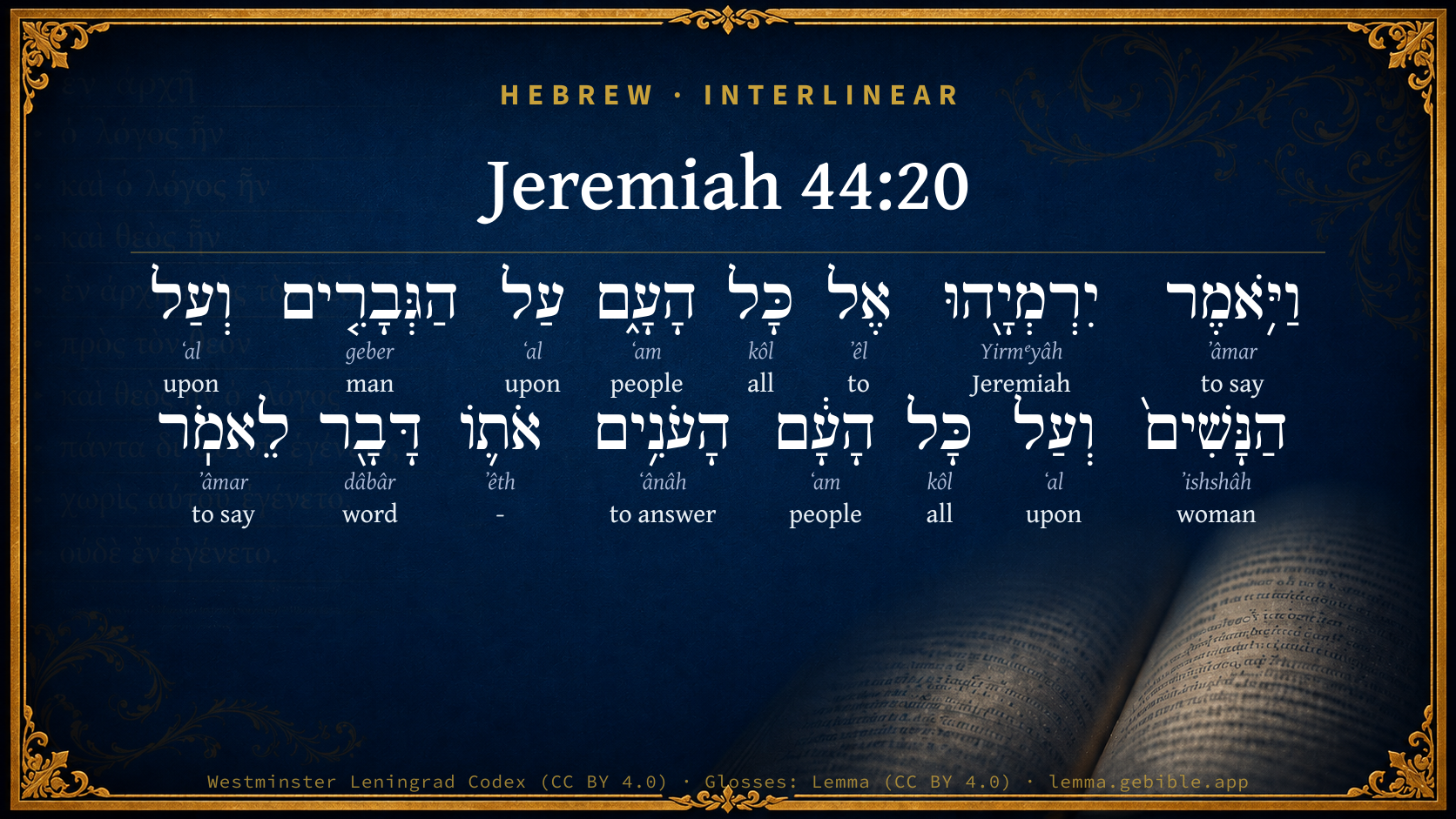
Hebrew (Westminster Leningrad Codex) Jeremiah 44:20 appears in the Hebrew Old Testament. The text above is from the Westminster Leningrad Codex. Each word links to its Strong’s number, a concise gloss, and parsing drawn from the Open Scriptures Hebrew Bible morphology. Click any word for its full Brown-Driver-Briggs (BDB) entry.
Download image
Cite this verse

Jeremiah 44:20 (World English Bible). Public Domain. Lemma interlinear Bible study tool, https://lemma.gebible.app/v/jeremiah/44/20.

Show BibTeX & RIS
BibTeX
RIS
English Translation
Then Jeremiah said to all the people, to the men, and to the women, even to all the people who had given him who answer, saying,
World English Bible · Public Domain
Download a study sheet

One document with this verse’s original text, its word-by-word gloss line, the meaning frame, cross-references with their text, attributed commentary, and full source and license credits — printable, and it pastes into notes with its structure intact.

This verse Autodidact and up

Study sheet (.html) Plain text (.txt)

A passage Seminary Student

Up to 50 verses in one chapter. A passage sheet keeps up to 6 commentary sources and 12 cross-references per verse, in the order this page ranks them, and says so on the sheet whenever that leaves anything out. Ask for a single verse and you get the Autodidact verse sheet above.

Everything on this page stays free to read, with no account — the sheet is a download of what is already on screen, not access to it.

Want to remove ads? Support Godless Engineer
Compare translations 3

The same verse in 3 English versions, stacked beneath the original-language interlinear above. Click any original word for its lexicon entry.

Each is an independent rendering of the whole verse — the interlinear is not word-aligned to these translations.

Highlighted words mark where these versions differ — a whole-verse word diff, not a word-by-word alignment.

  • World English Bible Public Domain
    Then Jeremiah said to all the people, to the men, and to the women, even to all the people who had given him who answer, saying,
  • King James Version Public Domain
    Then Jeremiah said unto all the people, to the men, and to the women, and to all the people which had given him that answer, saying,
  • unfoldingWord Literal Text CC BY-SA 4.0
    Then Jeremiah said to all the people—to the men and women, and all the people who answered him—he proclaimed and said,

unfoldingWord Literal Text — © unfoldingWord, licensed CC BY-SA 4.0. Word-aligned USFM3 via Door43 (git.door43.org/unfoldingWord/en_ult).

Versions to compare (up to 4)

3 of 4 selected

Show all 18 translations

Every available English version of this verse, each an independent rendering of the whole verse.

  • World English Bible Public Domain
    Then Jeremiah said to all the people, to the men, and to the women, even to all the people who had given him who answer, saying,
  • Berean Standard Bible Public Domain
    Then Jeremiah said to all the people, both men and women, who were answering him,
  • Majority Standard Bible Public Domain
    Then Jeremiah said to all the people, both men and women, who were answering him,
  • King James Version Public Domain
    Then Jeremiah said unto all the people, to the men, and to the women, and to all the people which had given him that answer, saying,
  • American Standard Version (1901) Public Domain
    Then Jeremiah said unto all the people, to the men, and to the women, even to all the people that had given him that answer, saying,
  • Revised Version (1885) Public Domain
    Then Jeremiah said unto all the people, to the men, and to the women, even to all the people which had given him that answer, saying,
  • Geneva Bible (1599) Public Domain
    Then said Ieremiah vnto all the people, to the men, and to the women, and to all the people which had giuen him that answere, saying,
  • Douay-Rheims (1899) Public Domain
    And Jeremias spoke to all the people, to the men, and to the women, and to all the people which had given him that answer, saying:
  • Young's Literal Translation Public Domain
    And Jeremiah saith unto all the people, concerning the men and concerning the women, and concerning all the people who are answering him, saying:
  • Literal Standard Version CC BY-SA 4.0
    And Jeremiah says to all the people, concerning the men and concerning the women, and concerning all the people who are answering him, saying,
  • Unlocked Literal Bible CC BY-SA 4.0
    Then Jeremiah said to all the people—to the men and women, and all the people who answered him—he proclaimed and said,
  • unfoldingWord Literal Text CC BY-SA 4.0
    Then Jeremiah said to all the people—to the men and women, and all the people who answered him—he proclaimed and said,
  • Darby Bible Public Domain
    And Jeremiah said unto all the people, to the men, and to the women, and to all the people that had given him that answer, saying,
  • World Messianic Bible Public Domain
    Then Jeremiah said to all the people—to the men and to the women, even to all the people who had given him an answer, saying,
  • Webster's Bible Public Domain
    Then Jeremiah said to all the people, to the men, and to the women, and to all the people who had given him that answer, saying,
  • Free Bible Version CC BY-SA 4.0
    Jeremiah replied to all the people, both men and women, who were responding to him,
  • Bible in Basic English Public Domain
    Then Jeremiah said to all the people, to the men and women and all the people who had given him that answer,
  • JPS Tanakh (1917) Public Domain
    Then Jeremiah said unto all the people, to the men, and to the women, even to all the people that had given him that answer, saying:

Literal Standard Version (2020), Covenant Press — licensed CC BY-SA 4.0. Text via the HelloAO Bible API (eBible.org). Unlocked Literal Bible (unfoldingWord) — licensed CC BY-SA 4.0. Text via the HelloAO Bible API (eBible.org). unfoldingWord Literal Text — © unfoldingWord, licensed CC BY-SA 4.0. Word-aligned USFM3 via Door43 (git.door43.org/unfoldingWord/en_ult). Free Bible Version, Dr. Jonathan Gallagher — licensed CC BY-SA 4.0. Text via the HelloAO Bible API (eBible.org).

Word by word

More ways to search: Search by grammar → Find every occurrence → Compare this word →

Practice this passage: Drill this verse → Learn its vocabulary →

הַגְּבָרִ֤ים
geber
H1397
“the · men”
Particle, Definite Article + Noun, Common, Masculine, Plural, Absolute
Part of Speech
Particle + Noun
Type
Common
Gender
Masculine
Number
Plural
State
Absolute
Full BDB Definition

Origin: from H1396

TWOT: 310a

man, strong man, warrior (emphasizing strength or ability to fight)
  1. וַיֹּ֥אמֶר ʼâmar H559 “and · to say” Conjunction + Verb, Qal, Sequential Imperfect, 3rd Person, Masculine, Singular
  2. יִרְמְיָ֖הוּ Yirmᵉyâh H3414 “Jeremiah” Noun, Proper
  3. אֶל ʼêl H413 “to” Preposition
  4. כָּל kôl H3605 “all of” Noun, Common, Masculine, Singular, Construct
  5. הָעָ֑ם ʻam H5971 “the · people” Particle, Definite Article + Noun, Common, Masculine, Singular, Absolute
  6. עַל ʻal H5921 “upon” Preposition
  7. וְעַל ʻal H5921 “and · upon” Conjunction + Preposition
  8. הַנָּשִׁים֙ ʼishshâh H802 “the · women” Particle, Definite Article + Noun, Common, Feminine, Plural, Absolute
  9. וְעַל ʻal H5921 “and · upon” Conjunction + Preposition
  10. כָּל kôl H3605 “all of” Noun, Common, Masculine, Singular, Construct
  11. הָעָ֔ם ʻam H5971 “the · people” Particle, Definite Article + Noun, Common, Masculine, Singular, Absolute
  12. הָעֹנִ֥ים ʻânâh H6030 “the · answering” Particle, Definite Article + Verb, Qal, Participle Active, Masculine, Plural, Absolute
  13. אֹת֛וֹ ʼêth H853 “- · him” Particle, Direct Object + Suffix, Personal, 3rd Person, Masculine, Singular
  14. דָּבָ֖ר dâbâr H1697 “word” Noun, Common, Masculine, Singular, Absolute
  15. לֵאמֹֽר ʼâmar H559 “to say” Preposition + Verb, Qal, Infinitive Construct

About this verse

These counts appear in no published source. They are computed here, from the morphology-tagged text and Lemma’s own curated glosses. What Lemma adds →

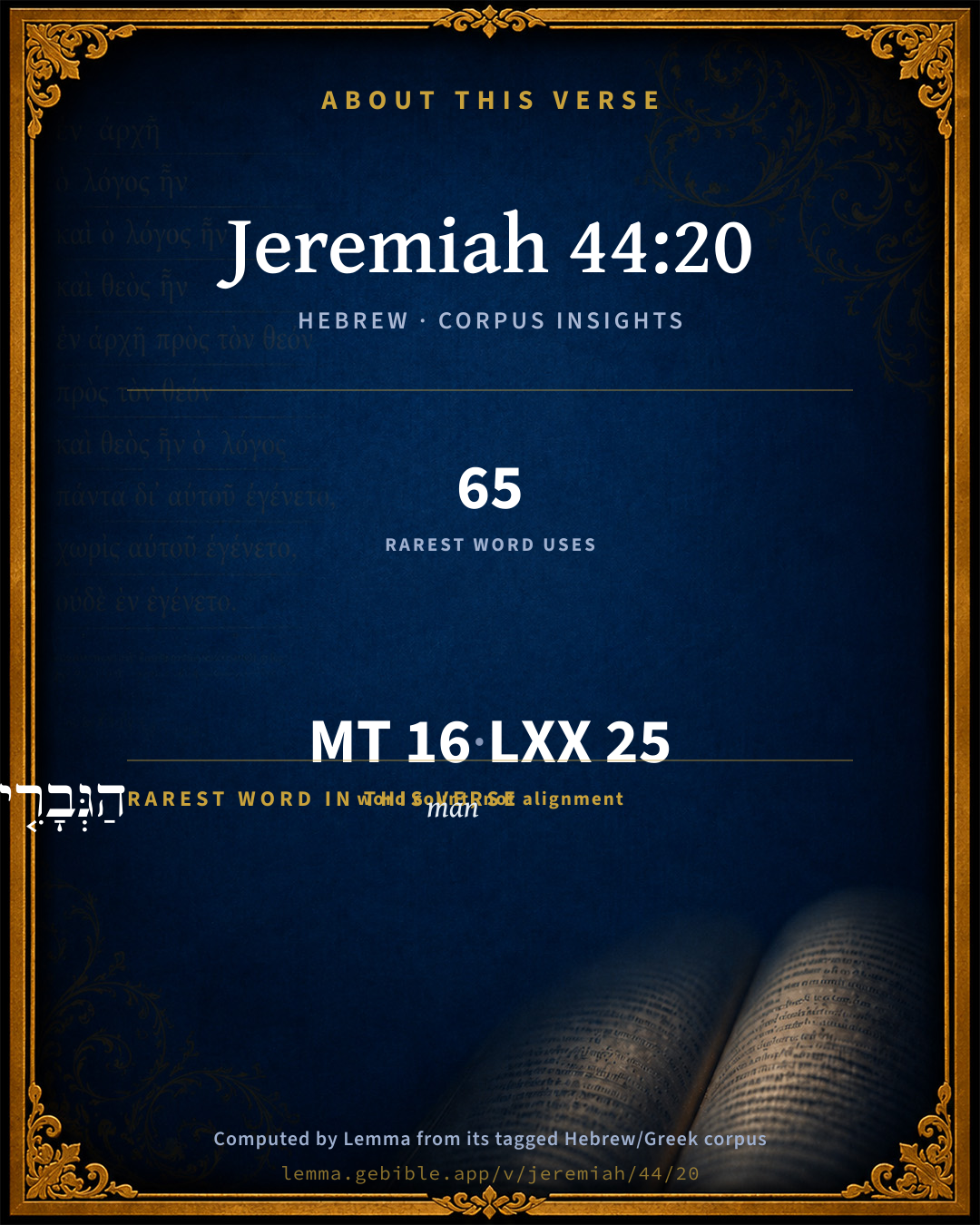
16
words
11
distinct lemmas
Prophets
section

Grammatical profile

  • 3 verbs
  • 8 nouns
  • 4 prepositions
  • 1 particle

Verb forms

  • וַיֹּ֥אמֶר Qal · Sequential Imperfect
  • הָעֹנִ֥ים Qal · Participle Active
  • לֵאמֹֽר Qal · Infinitive Construct

Repetition

Words recur within this verse — often emphatic in Hebrew:

  • עַל upon H5921 ×3
  • וַיֹּ֥אמֶר to say H559 ×2
  • כָּל all H3605 ×2
  • הָעָ֑ם people H5971 ×2

Hebrew & Septuagint length

In the original languages it is 16 Hebrew tokens and 25 Greek tokens — but the two are counted differently (Hebrew bundles its prefixes and suffixes into one token; the Greek is in lemma form), so that isn’t a like-for-like length.

Hebrew and Greek witnesses Masoretic Hebrew ↔ Greek Septuagint

The same verse in the two great witnesses to the Old Testament, shown verse-for-verse.

These are two independent witnesses, not word-aligned to each other, and the Septuagint is shown in lemma (dictionary) form.

Hebrew Jeremiah 44:20 Masoretic · Westminster Leningrad Codex

וַיֹּ֥אמֶר יִרְמְיָ֖הוּ אֶל כָּל הָעָ֑ם עַל הַגְּבָרִ֤ים וְעַל הַנָּשִׁים֙ וְעַל כָּל הָעָ֔ם הָעֹנִ֥ים אֹת֛וֹ דָּבָ֖ר לֵאמֹֽר

Then Jeremiah said to all the people, to the men, and to the women, even to all the people who had given him who answer, saying,

World English Bible · Public Domain

Greek LXX Structure differs

In the Septuagint, Jeremiah is about an eighth shorter than the Hebrew and arranges its material differently — the Oracles Against the Nations (Hebrew chapters 46–51) appear in the middle of the Greek book, after 25:13. Because the chapter and verse boundaries do not line up, a verse-for-verse comparison with the Hebrew is not shown.

A verse-for-verse comparison isn’t shown here because the chapters and verses don’t line up. Switch to the LXX edition with the MT / LXX toggle above to read the Greek directly.

Hebrew: Westminster Leningrad Codex (CC BY 4.0). Greek: Septuagint (public domain); English from a public-domain English Septuagint. How the Septuagint differs from the Hebrew →

Targum (Aramaic paraphrase)

1

The Targum is the ancient Jewish Aramaic paraphrase of the Hebrew Scriptures — an interpretive translation, not the Hebrew text itself. Onkelos (literal) and Pseudo-Jonathan (expansive) render the Torah, and Jonathan the Prophets. Coverage is partial: where no permissively-licensed English translation exists for a verse, only the Aramaic is shown. This is verse-level text, not a word-by-word alignment to the Hebrew.

  1. Targum Jonathan Prophets (Joshua–Malachi)
    וַאֲמַר יִרְמְיָה לְכָל עַמָא לְגַבְרַיָא וְלִנְשַׁיָא וְעַל כָּל עַמָא דִמְתִיבִין יָתֵיהּ פִּתְגָמָא לְמֵימָר:

    (no public-domain English translation for this verse)

    Targum Jonathan — Aramaic: “Mikraot Gedolot” (public domain). English: “Sefaria Community Translation” (CC0 1.0 (public-domain dedication)); “London "Chaldee Paraphrase," 1871” (public domain). Text via Sefaria.

Commentary

Notes on Jeremiah 44:20 from classic Christian and Jewish commentators (each source and its license shown beneath its notes). The classic Christian expositions comment on the surrounding passage and are grouped to its opening verse, so a note may address several verses; the Jewish commentaries on the Tanakh (Rashi and others) are per-verse, so they appear only where the commentator wrote on this verse.

Lemma curates 59 commentaries, every one of them public domain or Creative Commons licensed, each selected and text-cleaned for this edition rather than reprinted as found. About our sources →

Matthew Henry's Commentary

Daring sinners may speak many a bold word and many a big word, but, after all, God will have the last word; for he will be justified when he speaks, and all flesh, even the proudest, shall be silent before him. Prophets may be run down, but God cannot; nay, here the prophet would not.

I. Jeremiah has something to say to them from himself, which he could say without a spirit of prophecy, and that was to rectify their mistake (a wilful mistake it was) concerning the calamities they had been under and the true intent and meaning of them. They said that these miseries came upon them because they had now left off burning incense to the queen of heaven. "No," says he, "it was because you had formerly done it, not because you had now left it off." When they gave him that answer, he immediately replied (Jer 44:20) that the incense which they and their fathers had burnt to other gods did indeed go unpunished a great while, for God was long-suffering towards them, and during the day of his patience it was perhaps, as they said, well with them, and they saw no evil; but at length they grew so provoking that the Lord could no longer bear (Jer 44:22), but began a controversy with them, whereupon some of them did a little reform; their sins left them, for so it might be said, rather than that they left their sins. But their old guilt being still upon the score, and their corrupt inclinations still the same, God remembered against them the idolatries of their fathers, their kings, and their princes, in the streets of Jerusalem, which they, instead of being ashamed of, gloried in as a justification of them in their idolatries; they all came into his mind (Jer 44:21), all the abominations which they had committed (Jer 44:22) and all their disobedience to the voice of the Lord (Jer 44:23), all were brought to account; and therefore, to punish them for these, is their land a desolation and a curse, as at this day (Jer 44:22); therefore, not for their late reformation, but for their old transgressions, has all this evil happened to them, as at this day, Jer 44:23. Note, The right understanding of the cause of our troubles, one would think, should go far towards the cure of our sins. Whatever evil comes upon us, it is because we have sinned against the Lord, and should therefore stand in awe and sin not.

II. Jeremiah has something to say to them, to the women particularly, from the Lord of hosts, the God of Israel, They have given their answer; now let them hear God's reply, Jer 44:24. Judah, that dwells in the land of Egypt, has God speaking to them, even there; that is their privilege. Let them observe what he says; that is their duty, Jer 44:26. Now God, in his reply, tells them plainly,

1. That, since they were fully determined to persist in their idolatry, he was fully determined to proceed in his controversy with them; if they would go on to provoke him, he would go on to punish them, and see which would get the better at last. God repeats what they had said (Jer 44:25): "You and your wives are agreed in this obstinacy; you have spoken with your mouths and fulfilled with your hands; you have said it, and you stand to it, have said it and go on to do accordingly, We will surely perform our vows that we have vowed, to burn incense to the queen of heaven," as if, though it were a sin, yet their having vowed to do it were sufficient to justify them in the doing of it; whereas no man can by his vow make that lawful to himself, much less duty, which God has already made sin. "Well" (says God), "you will accomplish, you will perform, your wicked vows: now hear what is my vow, what I have sworn by my great name;" and, if the Lord hath sworn, he will not repent, since they have sworn and will not repent. With the froward he will show himself froward, Psa 18:26. (1.) He had sworn that what little remains of religion there were among them should be lost, Jer 44:26. Though they joined with the Egyptians in their idolatries, yet they continued upon many occasions to make mention of the name of Jehovah, particularly in their solemn oaths; they said, Jehovah liveth, he is the living God, so they owned him to be, though they worshipped dead idols; they swear, The Lord liveth (Jer 5:2), but I fear they retained this form of swearing more in honour of their nation than of their God. But God declares that his name shall no more be thus named by any man of Judah in all the land of Egypt; that is, there shall be no Jews remaining to use this dialect of their country, or, if there be, they shall have forgotten it and shall learn to swear, as the Egyptians do, by the life of Pharaoh, not of Jehovah. Note, Those are very miserable whom God has so far left to themselves that they have quite forgotten their religion and lost all the remains of their good education. Or this may intimate that God would take it as an affront to him and would resent it accordingly, if they did make mention of his name and profess any relation to him. (2.) He hath sworn that what little remnant of people there was there should all be consumed (Jer 44:27): I will watch over them for evil; no opportunity shall be let slip to bring some judgment upon them, until there be an end of them and they be rooted out. Note, To those whom God finds impenitent sinners he will be found an implacable Judge. And, when it comes to this, they shall know (Jer 44:28) whose word shall stand, mind or theirs. They said that they should recover themselves when they returned to worship the queen of heaven; God said they should ruin themselves; and now the event will show which was in the right. The contest between God and sinners is whose word shall stand, whose will shall be done, and who shall get the better. Sinners say that they shall have peace though they go on; God says they shall have no peace. But when God judges he will overcome; God's word shall stand, and not the sinner's.

2. He tells them that a very few of them should escape the sword, and in process of time return into the land of Judah, a small number (Jer 44:28), next to none, in comparison with the great numbers that should return out of the land of the Chaldeans. This seems designed to upbraid those who boasted of their numbers that concurred in sin; there were none to speak of that did not join in idolatry: "Well," says God, "and there shall be as few that shall escape the sword and famine."

3. He gives them a sign that all these threatenings shall be accomplished in their season, that they shall be consumed here in Egypt and shall quite perish: Pharaoh-hophra, the present king of Egypt, shall be delivered into the hand of his enemies that seek his life - of his own rebellious subjects (so some) under Amasis, who usurped his throne - of Nebuchadnezzar king of Babylon (so others), who invaded his kingdom; the former is related by Herodotus, the latter by Josephus. It is likely that this Pharaoh had tempted the Jews to idolatry by promises of his favour; however, they depended upon him for his protection, and it would be more than a presage of their ruin, it would be a step towards it, if he were gone. They expected more from him than from Zedekiah king of Judah; he was a more potent and politic prince. "But," says God, "I will give him into the hand of his enemies, as I gave Zedekiah." Note, Those creature-comforts and confidences that we promise ourselves most from may fail us as soon as those that we promise ourselves least from, for they are all what God makes them, not what we fancy them.

The sacred history records not the accomplishment of this prophecy, but its silence is sufficient; we hear no more of these Jews in Egypt, and therefore conclude them, according to this prediction, lost there; for no word of God shall fall to the ground.

Matthew Henry's Commentary on the Whole Bible (1708–1710) — public domain (CC PDM 1.0). Text via the HelloAO Bible API.

Trapp's Complete Commentary

John Trapp

Jer 44:20 Then Jeremiah said unto all the people, to the men, and to the women, and to all the people which had given him [that] answer, saying,

Ver. 20. Then Jeremiah said unto all the people.] The prophet, without any special command from God, moved with a spirit of zeal, confuteth that blasphemy of theirs, and showeth plainly that idolatry maketh no people happy, but the contrary; though this be an old plea, or rather cavil, answered fully long since by Cyprian against Demetrian, Augustine De Civit. Dei, and Orosius.

John Trapp, A Commentary or Exposition upon All the Books of the Old and New Testament (1647–1656) — public domain. Text from a community e-Sword module.

Joseph Benson's Commentary

Jer 44:20-23. Then Jeremiah said, The incense that ye burned, &c. — In these verses the prophet shows that they interpreted the dispensations of God’s providence toward them in a sense directly contrary to their true intent and meaning. They concluded that their omission of late to burn incense to the queen of heaven was the cause of the calamities which had befallen them; but the prophet shows them that the true cause was, not their leaving off that practice, but their being formerly guilty of it. This their idolatry, with their other sins, did indeed go unpunished a great while: for God was longsuffering toward them, and during the time of his patience it was perhaps, as they said, well with them, and they saw no evil; but at length they became so provoking that, as the prophet tells them, Jer 44:22, the Lord could no longer bear, but began a controversy with them. Upon this, it seems, some of them did in a degree reform their conduct: but their old guilt being uncancelled, and their corrupt inclinations being still the same, God remembered against them the idolatries of their fathers, their kings, and their princes, which they, instead of being ashamed of, gloried in: all these, he intimates, Jer 44:21, came into his mind, with all the abominations which they had committed, Jer 44:22, and all their disobedience to the voice of the Lord, Jer 44:23: all was brought to account; and to punish them for these was their land made a desolation, an astonishment, and a curse, as they saw it to be. Therefore — Not for their late reformation, he assures them, but for their old transgressions, had all that evil happened to them.

Joseph Benson's Commentary on the Old and New Testaments (1811–1818) — public domain. Text from a community e-Sword module.

Keil & Delitzsch

C. F. Keil & F. Delitzsch

Refutation of these statements of the people. - Jer 44:20. "And Jeremiah spake to all the people, to the men and women, and to all the people that had given him answer, saying, Jer 44:21. Did not the incense-burning which he performed in the cities of Judah and in the streets of Jerusalem, ye and your fathers, your kings and your princes, and the people of the land-did not Jahveh remember them, and did it not arise in His mind? Jer 44:22. And Jahveh could no longer endure it, because of the wickedness of your deeds, because of the abominations which ye committed; thus your land became a desolation, and a waste, and a curse, without an inhabitant, as at this day. Jer 44:23. Because ye burned incense and sinned against Jahveh, and did not hearken to the voice of Jahveh, and in His law, in His statutes, and in His testimonies ye walked not; therefore this evil hath befallen you, as at this day." Jeremiah answers them that their idol-worship, by which they have provoked the Lord their God, is the very cause of the misfortune that has befallen them, because God could no longer endure this abomination which they would not forsake. הקּטּר is a noun, "the burning of incense," which includes, besides, all the other elements of idolatrous worship hence the word is resumed, at the close, under the plur. אותם, "these things." ותּעלה is 3rd pers. sing. neut., lit., "it has come into His mind," i.e., He has carefully considered it, and that in the way of punishment, for He could no longer endure such abomination. The imperf. יוּכל is used for the historic tense (imperf. with ו consec.), because the ו would necessarily be separated from the verb by the לא; and it is employed instead of the perfect, which we would be inclined to expect after the preceding זכר, since that which is treated of is something that endures for a considerable time; cf. Ewald, 346, b. On the expression "because of the evil," etc., cf. Jer 21:12; Jer 4:4, etc.; on the last clause in Jer 44:22, cf. Jer 44:6 and Jer 44:12.

Keil & Delitzsch — Biblical Commentary on the Old Testament (1861–1891) — public domain (CC PDM 1.0). Text via the HelloAO Bible API. (Old Testament only.)

Lange's Commentary on the Holy Scriptures

c. The Rejoinder of the Prophet (Jer_4:20-30)

a. Refutation of the Popular Assertions

Jer_44:20-23

20Then Jeremiah said unto16 all the people, to the men, and to the women, and to 21all the people which had given him that answer, saying, Is it not so? The incense17 that ye burned in the cities of Judah, and in the streets of Jerusalem, ye, and your fathers, your kings, and your princes, and the people of the land, did not the Lord remember them, and came it not into his mind? [Jehovah remembered 22it,18 and it came into his mind].19 So that the Lord [Jehovah] could no longer bear20 because of the evil of your doings,21 and because of the abominations which ye have committed; therefore is your land a desolation,22 and an astonishment [a waste] and 23a curse, without an inhabitant,23 as at this day. Because ye have burned incense, and because ye have sinned against the Lord, and have not obeyed the voice of the Lord, nor walked in his law, nor in his statutes, nor in his testimonies; therefore this evil is happened24 unto you, as at this day.

EXEGETICAL AND CRITICAL

To the assertion of the people that it had gone well with them so long as they had served the queen of heaven, and that their misfortunes dated from their cessation of this service, the prophet answers with a non post hoc sed propter hoc. It was precisely on account of this idolatrous cult (Jer_44:21) which Jehovah could no longer suffer, that their misfortunes had come upon them (Jer_44:22). And for the sake of emphasis Jeremiah repeats this bitter truth once more (Jer_44:23).

DOCTRINAL AND ETHICAL

1. “Obfirment animum suum ministri ecclesiæ hujus capitis meditatione, ne pertinacia auditorum se territuri patiantur, sed ut potius dehortando, objurgando, comminando intrepide instent ex præcepto apostoli 2Ti_4:2.” Förster.

2. On Jer_44:2-13. A mirror of the stubborn heart of man! For centuries unceasingly warned by the prophets—and how warned! Not by sentimental talk, but by words of thunder and strokes of power,—think only of Elijah, Elisha, Hosea, Isaiah, etc.!—yet Judah bowed not his stubborn neck. Then at last when long-suffering love was exhausted, the judgment of just love was executed. And yet in the wretched remnant the old root of unbelief and disobedience remains still unbroken.

3. On Jer_44:9. “Though thou shouldest bray a fool in a mortar with a pestle as vetches, yet will his foolishness not depart from him (Pro_27:22). And he that sings songs to a heavy heart, it is like a torn garment in winter, and vinegar on nitre (Pro_25:20).” Cramer.

4. On Jer_44:15. “Hoc loco imaginem quandam conspicere licet seditionis, de qua Ethnicus: ἐν τῆστάσει πᾶσα ἰδέα κακον͂ ἔνεστιν,—itemque confusionis plus quam cyclopicæ, de qua notum est illud tritum: οὐδεὶς οὐδενὸς οὐδὲν ἀκούει.” Förster.

5. On Jer_44:16. “Ungodliness continually extends and even goes beyond itself. In the foregoing chapter they wish it to be considered as having to do only with Jeremiah’s private person, but now they are become bolder so that they contradict him officially and thus God Himself, not considering that they know what he says to be spoken not on his own, but on God’s account, which is a great blasphemy of God.” Cramer.

6. On Jer_44:17. “The ungodly are blind. For they ascribe all their good fortune to their idolatry. When, however, a misfortune comes God and His word must be to blame, and they say: It is vain to serve God (Mal_3:14). The charge of the Papists is used again now-a-days. when times are dear and the country suffers such like chastisements, that it is the fault of the Gospel; since on the other hand their mass is regarded as a regular Egyptian Meleket, by which they think to obtain temporal and eternal blessings both for the living and the dead.” Cramer.

7. On Jer_44:17. “Non ovum ovo tam simile est atque huic Judæorum orationi nostrorum hominum vox contendentium, sub papatu aureum fuisse sæculum, cum tamen contrarium testentur historæ de bellis, peste et fame in papatu, præsertim ea, quæ incidit in annum Christi 1315, quo tempore fere tertia pars Germaniæ partim fame, partim peste extincta. Hinc versus: Ut lateat nullum tempus famis, ecce cucullum” Förster.

8. On Jer_44:17. “Non mirum, quod urbes peste vexentur, cum Æsculapius et Dii ab iis procul absint, nam ex quo Jesus colitur, nihil jam utilitatis a Diis consequimur. Porphyrius.” MS. note in my copy of Cramer’s Bible.

9. On Jer_44:19. “There is no doubt that the inconstant, frivolous women were the first to be seduced into idolatry, as Eve (2Co_11:3). When these are taken captive, he then proceeds farther, and knows how to bring in the Adam also. Therefore keep the doors of thy mouth from her that lieth in thy bosom (Mic_7:5).” Cramer.

10. On Jer_44:19. “The harmony and complaisance of married people is never more easily secured than when it is against the Lord, and it is nothing unusual for domestic peace to be adduced as the cause of a lack of zeal in religion. It is an ancient custom; Ahab, Ahaziah and Solomon only followed Adam. The wife had to be deceived by a subtle serpent; the man was bound to keep peace in the family; she gave him and he ate.” Zinzendorf.

11. On Jer_44:20. “God remembers the good and the evil; the good that He may reward it, the evil that He may punish it.” Cramer. [“God will have the last word. The prophets may be run down, but God cannot.” Henry.—S. R. A]

12. On Jer_44:26. “This is the severest punishment of all, that God takes away His holy name and word, as He says in Deu_32:20 : I will hide my face from them, I will see what their end shall be. And this is the famine, not of bread, but of the word of God which they seek and yet do not find (Amo_8:11).” Cramer.

13. On Jer_44:29-30. Between Moses and Jeremiah, between the exodus from Egypt and the return thither of the remnant, there lies a period of almost a thousand years, and what a history! But the Pharaoh, under whom Israel made the exodus, Menephthes (comp. Lepsius in Herz., R.-Enc, I., S. 146) is described by Herodotus as an arrogant and ungodly man (II., 111), just like Hophra. And at both times Israel was a poor despised heap in the land of Egypt. But the heathen were to know that the God of this despised heap is the only true God, and that their idols were naught, as also Nebuchadnezzar, Belshazzar and Darius the Mede had also to learn (Daniel 2-6.).

HOMILETICAL AND PRACTICAL

1. On Jer_44:1-14. The holy love of God: 1. long-suffering; 2. just.

2. On Jer_44:9-14. How ruinous a course it is to forget the chastisements of the Lord. This will be shown, if we ponder that this forgetfulness 1. implies chastisement already suffered, 2. proves its want of good results, 3. calls forth severer chastisements from God.

3. On Jer_44:15-18. The utmost alienation of a people from their God, shown in the example of the Jews in Egypt. 1. They place the benefits received to the account of their idols. 2. The evils suffered they place to the account of the Lord. 3. They renounce their obedience to the Lord. 4. They vow their service to their idols.

4. On Jer_44:26-27. The severest punishment which the Lord can bring upon a people, who have hitherto served Him. 1. It consists in this, that the Lord removes the candlestick of His word from among this people, i.e. that by depriving them of the means of grace, He brings Himself into forgetfulness among the people. 2. It is founded in this, that this people on their part have striven to forget the Lord. 3. It has the effect, that this people is given up to the powers of evil to their complete destruction.

Footnotes:

[16]Jer_44:20.—On the interchange of עַל and אֵל comp. rems. on Jer_10:1.

[17]Jer_44:21.—The Piel form קִטֵּר, which occurs here only (comp. Olsh. § 182, e) corresponds to the German “Geraücher” [fumigating, incensing]. Observe also the emphatic position of the word at the beginning of the sentence [the incensing that ye did].

[18]Jer_44:21.—The plural suffix in אוֹתֹם refers to the plural idea contained in the intensive form. Compare remarks on Jer_11:4.

[19]Jer_44:21.—Comp. rems. on Jer_3:16.

[20]Jer_44:22.—יובל ולא. The imperf. is evidently used here in an aoristic sense, but since the fact in question is removed from all objective human perception, it is consequently founded, notwithstanding its undoubted correctness, on a subjective conception, Comp. Isa_37:4; 1Ki_8:5.

[21]Jer_44:22.—לשּאת. With מִפְּנֵי following, here only. It seems to be used in the absolute sense of “endure, hold out,” also in Isaiah 1. Proverbs 30.—21—וגו׳ רע. Comp. Jer_4:4; Jer_21:12; Jer_23:2; Jer_23:22; Jer_24:2 sqq.; Jer_26:3.

[22]Jer_44:22.—לחרבה. Comp. Jer_44:6; Jer_44:12.

[23]Jer_44:22.—יושׁב מאין. Comp. rems. on Jer_2:15.

[24]Jer_44:23.—קראת Comp. Olsh. S. 449, 478.—Ges., § 74, Anm. 1; Ewald, § 194, b.

Lange's Commentary on the Holy Scriptures (Critical, Doctrinal, and Homiletical), ed. John Peter Lange, English translation edited by Philip Schaff (1864–1880) — public domain. Text from a community e-Sword module.

Tyndale Open Study Notes

Tyndale Open Resources

44:20-30 This group of Judeans in Egypt had severed themselves from all meaningful relationship with the one true God of Israel; they were condemned to death.

44:20-23 The destruction of Judah and Jerusalem had not been due to the Lord’s inability to provide prosperity; rather, he could no longer bear all the disgusting things the people were doing.

Tyndale Open Study Notes — © Tyndale Open Resources, licensed CC BY-SA 4.0. Text via the HelloAO Bible API.

John Calvin's Commentaries

The Prophet refutes the impious objections by which the Jews had attempted to subvert and to render contemptible his doctrine, he then turns against them all that they had falsely boasted. They had at the beginning said, “Our kings, our princes, and our fathers, had before used these rites; and they have been delivered to us, as it were, by their hands.” To this Jeremiah answers, “This is certainly true, and for this reason it was that God became so severe a judge of their impiety, when he took away your fathers from the world, when he wholly destroyed the kingdom itself, when he demolished the city, and when at length he afflicted you with all kinds of evils: for except your kings, and your fathers, and your princes, had been impious towards God, he would have never treated them with so much severity; for he has promised to be a Father to the children of Abraham. God, then, must have been grievously offended with you, and your fathers, and your kings, when his wrath thus burned against them.”

There is, then, here a retort; for as we see that the Prophet turns against them what they had adduced against him. This is the sum of what is said.

He says that he spoke to the whole people, both men and women, and he repeats the whole people, because all had subscribed to the impious calumny. Then God says, “For this reason have I destroyed your city and you, even because ye burnt incense to-your idols.” The truth of what they had boasted is allowed, but it is turned to a meaning different from what they thought. For, as their fathers and their kings had imbibed superstitions, they supposed that they were doing right in following them; for, as we have said, hypocrites consider use and custom as sufficient reasons for disregarding the Law. Then, as to the fact itself, the Prophet admits that what they said was quite true, that this had been the cause of all their evils; for had not the kings and the whole people provoked the wrath of God, the temple would not have been demolished, nor the kingdom destroyed; God, in short, would not have alienated himself from his own people whom he had adopted. This is the meaning.

John Calvin's Commentaries (1540-1563) — public domain. Text from the Calvin Translation Society English edition (1840s-50s) via the Christian Classics Ethereal Library (ccel.org). Calvin's coverage is partial (roughly two-thirds of the Bible); uncommented books and verses are honest gaps, never fabricated. The 19th-century editor's footnotes and remarks are omitted so the notes are faithfully Calvin's own voice.

Ellicott's Commentary for English Readers

(20-23) Then Jeremiah said . . .—The prophet makes an effective rejoinder to the assertion that the prosperity of past years had coincided with the idolatrous worship which he condemned. That prosperity had not been lasting, and though the long-suffering of God had borne with them, the judgments had at last come. The tenor of his argument was that which Augustine adopts in his treatise De Civitate Dei. See Note on Jer_44:16.

A Bible Commentary for English Readers, edited by Charles John Ellicott (1878–1897) — public domain. Text from a community e-Sword module.

The Cambridge Bible for Schools and Colleges

gen. ed. J. J. S. Perowne

20–23. Du., Erbt and Co. agree in considering that these vv. are a later addition, merely reproducing the thoughts contained in Jer_44:2-14.

20–30. See introd. summary of the ch.

The Cambridge Bible for Schools and Colleges (gen. ed. J. J. S. Perowne; Cambridge University Press, 1878–1918) — public domain. Text from a community e-Sword module.

John Gill's Exposition

Then Jeremiah said unto all the people,.... Immediately, being influenced, directed, and assisted by the Spirit of God; though what he says, in Jer 44:21; he does not declare as coming from the Lord; but what was upon his mind, and was a full refutation of all that had been said: and which he delivered

to the men, and to the women, and to all the people which had given him that answer; in which they all agreed, though delivered by one; and to which he made a reply:

saying; as follows:

John Gill's Exposition of the Whole Bible (1746–1763) — public domain (CC PDM 1.0). Text via the HelloAO Bible API.

The Pulpit Commentary

Vers. 20-30. Jeremiah"s rejoinder.

The Pulpit Commentary (1880–1919), ed. H.D.M. Spence-Jones & Joseph S. Exell — public domain. Text from a community e-Sword module.

unfoldingWord translationNotes

Door43 World Missions Community

Did not Yahweh remember ... of the land?

Jeremiah uses a question to scold the people. AT: "Yahweh certainly knew about ... of the land." (See: Rhetorical Question)

For Yahweh calls this to mind; it comes to his thoughts

Both of these phrases mean the same thing. They emphasize that Yahweh knows that the people were worshiping false gods. AT: "Yes, Yahweh knows what you were doing, and he does not forget" (See: Parallelism)

translationWords

people group

preach

Judah

king

mind

unfoldingWord translationNotes — © Distant Shores Media and the Door43 World Missions Community, licensed CC BY-SA 4.0. Source: git.door43.org/Door43/en_tn.

Lesson kit

Teaching starters — assembled from the data on this page, not authored interpretation. Every prompt links to the verse data it draws on. Edit before teaching.

Jeremiah, in the Prophets, opens this verse with 16 words (11 distinct Hebrew lemmas). Its most distinctive word is geber (“man”). A historical commentator’s framing appears above. Read the whole chapter for the surrounding context.

Discussion questions

  1. The word geber carries the sense “man.” How does it shape the verse?
  2. What does the repetition of “upon” (3× in this one verse) do in this verse?
  3. These translations render this verse differently. What is at stake in choosing one wording over another?
  4. «וַיֹּ֥אמֶר» is a Qal Sequential Imperfect verb. How does that grammatical form shape the action described?
  5. Compare how Matthew Henry's Commentary and Trapp's Complete Commentary read this verse. Where do they agree or differ?

Things to notice

Reading settings

Reading text

Shown beneath each verse's original-language words.

Old Testament
Old Testament edition

Read the OT as the Masoretic Hebrew (MT) or the Greek Septuagint (LXX).

English shown for the Greek Septuagint (in the Hebrew ↔ Greek comparison).

Comparing translations? Open the Compare panel on any verse page to stack up to four side by side.