
Jeremiah 26:20

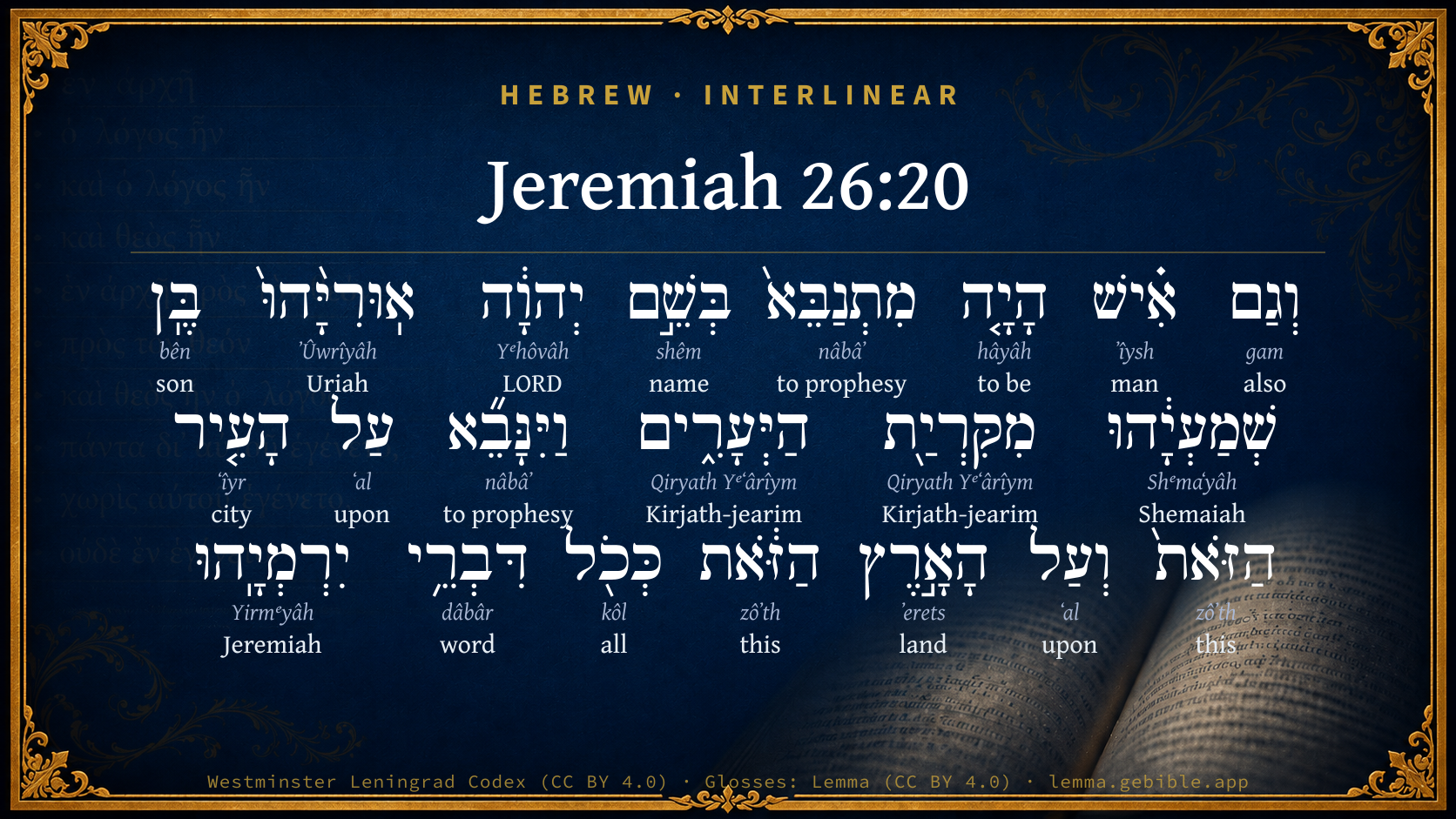
Hebrew (Westminster Leningrad Codex) Jeremiah 26:20 appears in the Hebrew Old Testament. The text above is from the Westminster Leningrad Codex. Each word links to its Strong’s number, a concise gloss, and parsing drawn from the Open Scriptures Hebrew Bible morphology. Click any word for its full Brown-Driver-Briggs (BDB) entry.
Download image
Cite this verse

Jeremiah 26:20 (World English Bible). Public Domain. Lemma interlinear Bible study tool, https://lemma.gebible.app/v/jeremiah/26/20.

Show BibTeX & RIS
BibTeX
RIS
English Translation
There was also a man who prophesied in the name of Yahweh, Uriah the son of Shemaiah of Kiriath Jearim; and he prophesied against this city and against this land according to all the words of Jeremiah:
World English Bible · Public Domain
Download a study sheet

One document with this verse’s original text, its word-by-word gloss line, the meaning frame, cross-references with their text, attributed commentary, and full source and license credits — printable, and it pastes into notes with its structure intact.

This verse Autodidact and up

Study sheet (.html) Plain text (.txt)

A passage Seminary Student

Up to 50 verses in one chapter. A passage sheet keeps up to 6 commentary sources and 12 cross-references per verse, in the order this page ranks them, and says so on the sheet whenever that leaves anything out. Ask for a single verse and you get the Autodidact verse sheet above.

Everything on this page stays free to read, with no account — the sheet is a download of what is already on screen, not access to it.

Want to remove ads? Support Godless Engineer
Compare translations 3

The same verse in 3 English versions, stacked beneath the original-language interlinear above. Click any original word for its lexicon entry.

Each is an independent rendering of the whole verse — the interlinear is not word-aligned to these translations.

Highlighted words mark where these versions differ — a whole-verse word diff, not a word-by-word alignment.

  • World English Bible Public Domain
    There was also a man who prophesied in the name of Yahweh, Uriah the son of Shemaiah of Kiriath Jearim; and he prophesied against this city and against this land according to all the words of Jeremiah:
  • King James Version Public Domain
    And there was also a man that prophesied in the name of the LORD, Urijah the son of Shemaiah of Kirjathjearim, who prophesied against this city and against this land according to all the words of Jeremiah.
  • unfoldingWord Literal Text CC BY-SA 4.0
    And also there was a man prophesying in the name of Yahweh, Uriah son of Shemaiah, from Kiriath Jearim, and he prophesied against this city and against this land according to all the words of Jeremiah.

unfoldingWord Literal Text — © unfoldingWord, licensed CC BY-SA 4.0. Word-aligned USFM3 via Door43 (git.door43.org/unfoldingWord/en_ult).

Versions to compare (up to 4)

3 of 4 selected

Show all 18 translations

Every available English version of this verse, each an independent rendering of the whole verse.

  • World English Bible Public Domain
    There was also a man who prophesied in the name of Yahweh, Uriah the son of Shemaiah of Kiriath Jearim; and he prophesied against this city and against this land according to all the words of Jeremiah:
  • Berean Standard Bible Public Domain
    Now there was another man prophesying in the name of the LORD, Uriah son of Shemaiah from Kiriath-jearim. He prophesied against this city and against this land the same things that Jeremiah did.
  • Majority Standard Bible Public Domain
    Now there was another man prophesying in the name of the LORD, Uriah son of Shemaiah from Kiriath-jearim. He prophesied against this city and against this land the same things that Jeremiah did.
  • King James Version Public Domain
    And there was also a man that prophesied in the name of the LORD, Urijah the son of Shemaiah of Kirjathjearim, who prophesied against this city and against this land according to all the words of Jeremiah.
  • American Standard Version (1901) Public Domain
    And there was also a man that prophesied in the name of Jehovah, Uriah the son of Shemaiah of Kiriath-jearim; and he prophesied against this city and against this land according to all the words of Jeremiah:
  • Revised Version (1885) Public Domain
    And there was also a man that prophesied in the name of the LORD, Uriah the son of Shemaiah of Kiriath-jearim; and he prophesied against this city and against this land according to all the words of Jeremiah:
  • Geneva Bible (1599) Public Domain
    And there was also a man that prophecied in the Name of the Lord, one Vriiah the sonne of Shemaiah, of Kiriath-iarem, who prophecied against this citie, and against this lande, according to all the wordes of Ieremiah.
  • Douay-Rheims (1899) Public Domain
    There was also a man that prophesied in the name of the Lord, Urias the son of Semei of Cariathiarim: and he prophesied against this city, and against this land, according to all the words of Jeremias.
  • Young's Literal Translation Public Domain
    `And also there hath been a man prophesying in the name of Jehovah, Urijah son of Shemaiah, of Kirjath-Jearim, and he prophesieth against this city, and against this land according to all the words of Jeremiah,
  • Literal Standard Version CC BY-SA 4.0
    And there has also been a man prophesying in the Name of YHWH, Urijah son of Shemaiah, of Kirjath-Jearim, and he prophesies against this city, and against this land according to all the words of Jeremiah,
  • Unlocked Literal Bible CC BY-SA 4.0
    Meanwhile there was another man who prophesied in the name of Yahweh—Uriah son of Shemaiah from Kiriath Jearim—he also prophesied against this city and this land, agreeing with all of Jeremiah's words.
  • unfoldingWord Literal Text CC BY-SA 4.0
    And also there was a man prophesying in the name of Yahweh, Uriah son of Shemaiah, from Kiriath Jearim, and he prophesied against this city and against this land according to all the words of Jeremiah.
  • Darby Bible Public Domain
    And there was also a man that prophesied in the name of Jehovah, Urijah the son of Shemaiah of Kirjath-jearim: and he prophesied against this city and against this land according to all the words of Jeremiah;
  • World Messianic Bible Public Domain
    There was also a man who prophesied in the LORD’s name, Uriah the son of Shemaiah of Kiriath Jearim; and he prophesied against this city and against this land according to all the words of Jeremiah.
  • Webster's Bible Public Domain
    And there was also a man that prophesied in the name of the LORD, Urijah the son of Shemaiah of Kirjath-jearim, who prophesied against this city and against this land according to all the words of Jeremiah:
  • Free Bible Version CC BY-SA 4.0
    At around that time there was another man prophesying in the name of the Lord, Uriah, son of Shemaiah, from Kiriath-jearim. He prophesied against Jerusalem and against the country just as Jeremiah did.
  • Bible in Basic English Public Domain
    And there was another man who was a prophet of the Lord, Uriah, the son of Shemaiah of Kiriath-jearim; he said against this town and against this land all the words which Jeremiah had said:
  • JPS Tanakh (1917) Public Domain
    And there was also a man that prophesied in the name of the LORD, Uriah the son of Shemaiah of Kiriath-jearim; and he prophesied against this city and against this land according to all the words of Jeremiah;

Literal Standard Version (2020), Covenant Press — licensed CC BY-SA 4.0. Text via the HelloAO Bible API (eBible.org). Unlocked Literal Bible (unfoldingWord) — licensed CC BY-SA 4.0. Text via the HelloAO Bible API (eBible.org). unfoldingWord Literal Text — © unfoldingWord, licensed CC BY-SA 4.0. Word-aligned USFM3 via Door43 (git.door43.org/unfoldingWord/en_ult). Free Bible Version, Dr. Jonathan Gallagher — licensed CC BY-SA 4.0. Text via the HelloAO Bible API (eBible.org).

Word by word

More ways to search: Search by grammar → Find every occurrence → Compare this word →

Practice this passage: Drill this verse → Learn its vocabulary →

אֽוּרִיָּ֨הוּ֙
ʼÛwrîyâh
H223
“Uriah”
Noun, Proper
Part of Speech
Noun
Type
Proper
Full BDB Definition

Origin: from H217 and H3050

TWOT: None

Uriah or Urijah = "Jehovah (Yahweh) is my light (flame)" - Hittite husband of Bathsheba - a priest who built king Ahaz' heathen altar - a priest who rebuilt Jerusalem's wall - a prophet slain by Jehoiakim
  1. וְגַם gam H1571 “and · also” Conjunction + Particle, Accusative
  2. אִ֗ישׁ ʼîysh H376 “man” Noun, Common, Masculine, Singular, Absolute
  3. הָיָ֤ה hâyâh H1961 “to be” Verb, Qal, Perfect, 3rd Person, Masculine, Singular
  4. מִתְנַבֵּא֙ nâbâʼ H5012 “prophesying” Verb, Hithpael, Participle Active, Masculine, Singular, Absolute
  5. בְּשֵׁ֣ם shêm H8034 “in/at · name of” Preposition + Noun, Common, Masculine, Singular, Construct
  6. יְהוָ֔ה Yᵉhôvâh H3068 “LORD” Noun, Proper
  7. בֶּֽן bên H1121 “son of” Noun, Common, Masculine, Singular, Construct
  8. שְׁמַעְיָ֔הוּ Shᵉmaʻyâh H8098 “Shemaiah” Noun, Proper
  9. מִקִּרְיַ֖ת Qiryath Yᵉʻârîym H7157 “from · Kirjath-jearim” Preposition + Noun, Proper
  10. הַיְּעָרִ֑ים Qiryath Yᵉʻârîym H7157 “Kirjath-jearim” Noun, Proper
  11. וַיִּנָּבֵ֞א nâbâʼ H5012 “and · to prophesy” Conjunction + Verb, Niphal, Sequential Imperfect, 3rd Person, Masculine, Singular
  12. עַל ʻal H5921 “upon” Preposition
  13. הָעִ֤יר ʻîyr H5892 “the · city” Particle, Definite Article + Noun, Common, Feminine, Singular, Absolute
  14. הַזֹּאת֙ zôʼth H2063 “the · this” Particle, Definite Article + Pronoun, Demonstrative, Feminine, Singular
  15. וְעַל ʻal H5921 “and · upon” Conjunction + Preposition
  16. הָאָ֣רֶץ ʼerets H776 “the · land” Particle, Definite Article + Noun, Common, Both, Singular, Absolute
  17. הַזֹּ֔את zôʼth H2063 “the · this” Particle, Definite Article + Pronoun, Demonstrative, Feminine, Singular
  18. כְּכֹ֖ל kôl H3605 “like/as · all of” Preposition + Noun, Common, Masculine, Singular, Construct
  19. דִּבְרֵ֥י dâbâr H1697 “words of” Noun, Common, Masculine, Plural, Construct
  20. יִרְמְיָֽהוּ Yirmᵉyâh H3414 “Jeremiah” Noun, Proper

About this verse

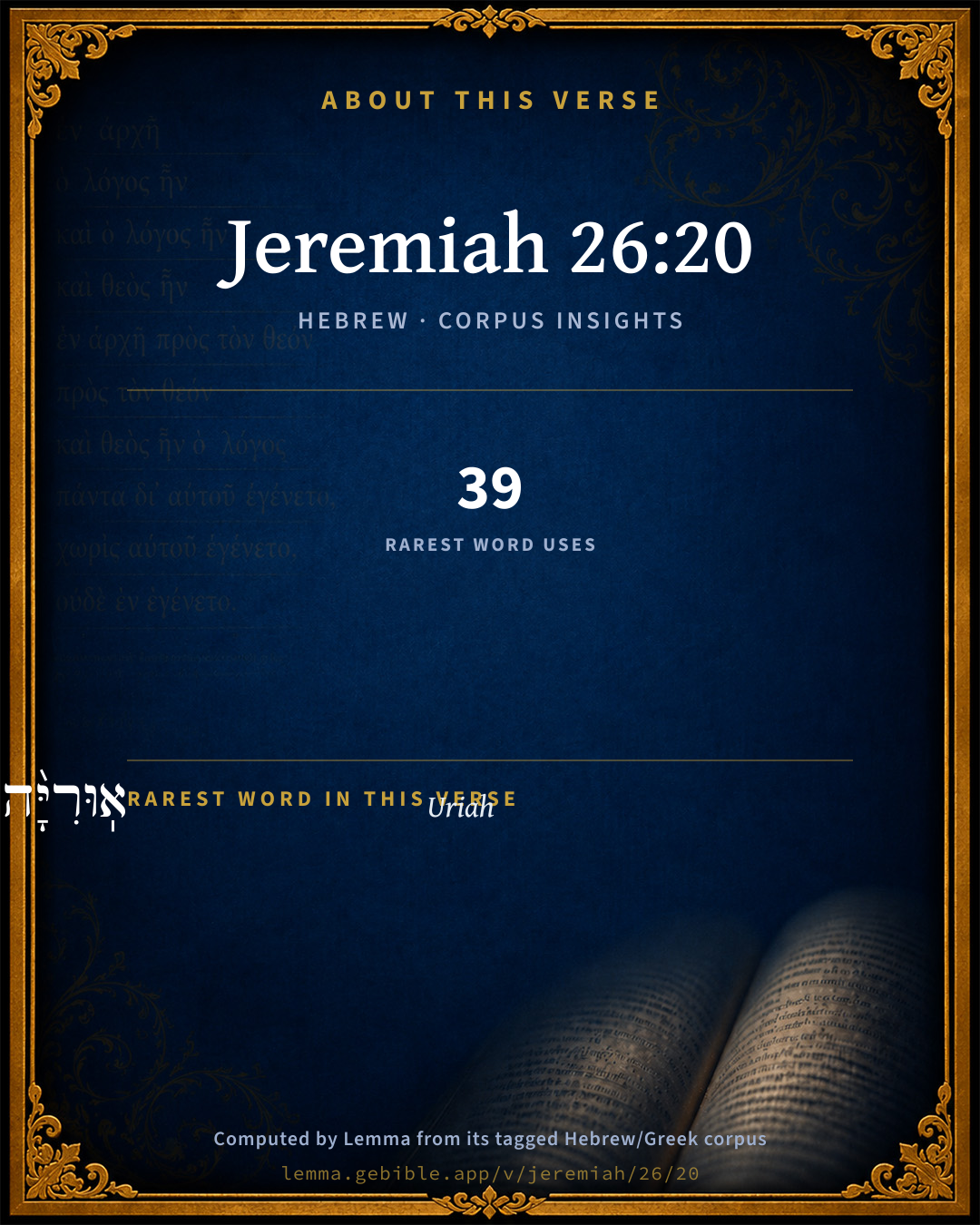
These counts appear in no published source. They are computed here, from the morphology-tagged text and Lemma’s own curated glosses. What Lemma adds →

21
words
17
distinct lemmas
Prophets
section

Shared distinctive vocabulary

אֽוּרִיָּ֨הוּ֙ Uriah H223 occurs in 33 verses of the Hebrew Bible. Also found in:

Grammatical profile

  • 3 verbs
  • 13 nouns
  • 2 pronouns
  • 2 prepositions
  • 1 particle

Verb forms

  • הָיָ֤ה Qal · Perfect
  • מִתְנַבֵּא֙ Hithpael · Participle Active
  • וַיִּנָּבֵ֞א Niphal · Sequential Imperfect

Repetition

Words recur within this verse — often emphatic in Hebrew:

  • מִתְנַבֵּא֙ to prophesy H5012 ×2
  • מִקִּרְיַ֖ת Kirjath-jearim H7157 ×2
  • עַל upon H5921 ×2
  • הַזֹּאת֙ this H2063 ×2

Cross-references

5

Topical passages linked to Jeremiah 26:20 in the Treasury of Scripture Knowledge — connected by theme and wording, ordered by reader-vote popularity; previews shown in the World English Bible.

  • 1 Samuel 7:2 It happened, from the day that the ark abode in Kiriath Jearim, that the time was long; for it was twenty years: and all the house of Israel lamented after Yahweh.
  • Joshua 9:17 The children of Israel traveled, and came to their cities on the third day. Now their cities were Gibeon, and Chephirah, and Beeroth, and Kiriath Jearim.
  • Joshua 15:60 Kiriath Baal (the same is Kiriath Jearim), and Rabbah; two cities with their villages.
  • Joshua 18:14 The border extended [there], and turned about on the west quarter southward, from the mountain that lies before Beth Horon southward; and the goings out of it were at Kiriath Baal (the same is Kiriath Jearim), a city of the children of Judah: this was the west quarter.
  • 1 Samuel 6:21 They sent messengers to the inhabitants of Kiriath Jearim, saying, The Philistines have brought back the ark of Yahweh; come you down, and bring it up to you.

Cross-references courtesy of OpenBible.info (CC BY 4.0).

Hebrew and Greek witnesses Masoretic Hebrew ↔ Greek Septuagint

The same verse in the two great witnesses to the Old Testament, shown verse-for-verse.

These are two independent witnesses, not word-aligned to each other, and the Septuagint is shown in lemma (dictionary) form.

Hebrew Jeremiah 26:20 Masoretic · Westminster Leningrad Codex

וְגַם אִ֗ישׁ הָיָ֤ה מִתְנַבֵּא֙ בְּשֵׁ֣ם יְהוָ֔ה אֽוּרִיָּ֨הוּ֙ בֶּֽן שְׁמַעְיָ֔הוּ מִקִּרְיַ֖ת הַיְּעָרִ֑ים וַיִּנָּבֵ֞א עַל הָעִ֤יר הַזֹּאת֙ וְעַל הָאָ֣רֶץ הַזֹּ֔את כְּכֹ֖ל דִּבְרֵ֥י יִרְמְיָֽהוּ

There was also a man who prophesied in the name of Yahweh, Uriah the son of Shemaiah of Kiriath Jearim; and he prophesied against this city and against this land according to all the words of Jeremiah:

World English Bible · Public Domain

Greek LXX Structure differs

In the Septuagint, Jeremiah is about an eighth shorter than the Hebrew and arranges its material differently — the Oracles Against the Nations (Hebrew chapters 46–51) appear in the middle of the Greek book, after 25:13. Because the chapter and verse boundaries do not line up, a verse-for-verse comparison with the Hebrew is not shown.

A verse-for-verse comparison isn’t shown here because the chapters and verses don’t line up. Switch to the LXX edition with the MT / LXX toggle above to read the Greek directly.

On this verse, The Cambridge Bible for Schools and Colleges discusses the Septuagint’s reading. Read the note in Commentary ↓

Hebrew: Westminster Leningrad Codex (CC BY 4.0). Greek: Septuagint (public domain); English from a public-domain English Septuagint. How the Septuagint differs from the Hebrew →

Targum (Aramaic paraphrase)

1

The Targum is the ancient Jewish Aramaic paraphrase of the Hebrew Scriptures — an interpretive translation, not the Hebrew text itself. Onkelos (literal) and Pseudo-Jonathan (expansive) render the Torah, and Jonathan the Prophets. Coverage is partial: where no permissively-licensed English translation exists for a verse, only the Aramaic is shown. This is verse-level text, not a word-by-word alignment to the Hebrew.

  1. Targum Jonathan Prophets (Joshua–Malachi)
    וְאַף גַבְרָא הֲוָה מִתְנַבֵּי בִּשְׁמָא דַייָ אוּרִיָה בַּר שְׁמַעְיָה מִקִרְיַת יְעָרִים וְאִתְנַבֵּי עַל קַרְתָּא הָדָא וְעַל אַרְעָא הָדָא כְּכֹל פִּתְגָמֵי יִרְמְיָה:

    (no public-domain English translation for this verse)

    Targum Jonathan — Aramaic: “Mikraot Gedolot” (public domain). English: “Sefaria Community Translation” (CC0 1.0 (public-domain dedication)); “London "Chaldee Paraphrase," 1871” (public domain). Text via Sefaria.

Commentary

Notes on Jeremiah 26:20 from classic Christian and Jewish commentators (each source and its license shown beneath its notes). The classic Christian expositions comment on the surrounding passage and are grouped to its opening verse, so a note may address several verses; the Jewish commentaries on the Tanakh (Rashi and others) are per-verse, so they appear only where the commentator wrote on this verse.

Lemma curates 59 commentaries, every one of them public domain or Creative Commons licensed, each selected and text-cleaned for this edition rather than reprinted as found. About our sources →

The Cambridge Bible for Schools and Colleges

gen. ed. J. J. S. Perowne

20. Kiriath-jearim] perhaps Karyet-el-Enab seven miles N.W. of Jerusalem on the road to Joppa (Jaffa).

20–24. See introd. summary to ch. The story is introduced by the compiler (probably Baruch) to illustrate the risk to which Jeremiah was exposed; perhaps also to contrast Jeremiah’s courage and Uriah’s cowardice. Du. suggests that the occurrence took place at the same Feast, but at a moment when the king was himself present, and that Uriah’s words may have specially pointed at him as the protégé of Egypt. Co. holds that, as the incident can hardly have occurred before Jeremiah’s prophecy—otherwise the latter would not have produced such an excitement—it must be considered to have been subsequent to it. He places Jer_26:24, as being the natural ending of the narrative concerning Jeremiah himself, before Jer_26:20-23; but against such transposition we may hold that the point of Jer_26:24 is the contrast between the case of the friendless Uriah and that of Jeremiah. In 21–23 the LXX omit various names and otherwise abbreviate.

The Cambridge Bible for Schools and Colleges (gen. ed. J. J. S. Perowne; Cambridge University Press, 1878–1918) — public domain. Text from a community e-Sword module.

Trapp's Complete Commentary

John Trapp

Jer 26:20 And there was also a man that prophesied in the name of the LORD, Urijah the son of Shemaiah of Kirjathjearim, who prophesied against this city and against this land according to all the words of Jeremiah:

Ver. 20. And there was also a man.] This seemeth to be the plea of the adverse party, producing an example opposite to the former, and showing what the way was now, whatever it had been heretofore. New lords, new laws.

According to all the words of Jeremiah.] Whose contemporary he was, and his memory was yet fresh bleeding.

John Trapp, A Commentary or Exposition upon All the Books of the Old and New Testament (1647–1656) — public domain. Text from a community e-Sword module.

Joseph Benson's Commentary

Jer 26:20-23. And there was also a man — There are three different opinions respecting the following passage. The first ascribes it to an opposite party, who, by a contrary precedent to the foregoing, urged the condemnation of Jeremiah, a precedent in which the speaking such words as he had spoken was adjudged treason. But against this view of the passage it is objected that such a transition of the speakers would have had some mark of distinction prefixed. Others suppose that this instance was alleged by the same persons that adduced the former, and with an intent to mark the different consequences that had ensued, and to caution the people and government against taking another step of a similar kind, and thereby adding sin to sin. As if he had said, Hezekiah, who had protected Micah, prospered; but did Jehoiakim, who slew Urijah, prosper? No: they all saw the contrary: one prophet had been slain already, let them not fill up the measure of national iniquity by slaying another. But Blaney thinks the least exceptionable opinion is, “that the elders concluded their speeches Jer 26:19, and that the writer of the narrative goes on here to observe, in his own person, that notwithstanding the precedent of Micah, there had been a later precedent in the present reign, which might have operated very unfavourably to the cause of Jeremiah, but for the influence and authority of Ahikam the son of Shaphan, which was exerted to save him.”

Who prophesied against this city, &c., according to all the words of Jeremiah — The prophets of the Lord agreed in their testimony, and one would have supposed that this circumstance should have caused their word to be regarded. And the king sought to put him to death — Being, with his courtiers, greatly exasperated against him on account of the faithful testimony which he bore, and the true predictions of approaching judgments which God commissioned him to utter. But when Urijah heard it, he was afraid, and fled — In this, it seems, he was faulty, and that through the weakness of his faith: he was too much under the power of that fear of man which brings a snare, and did not sufficiently confide in the power of God to protect him in the faithful execution of his office. And Jehoiakim sent men into Egypt, &c. — One would have thought Jehoiakim’s malice might have been satisfied with driving him out of the country; but they are blood-thirsty that hate the upright, Pro 29:10. It was the life, the precious life, that Jehoiakim hunted after, and nothing less would satisfy him. So implacable is his revenge, that he sends a party of soldiers into Egypt, (there being a strict alliance between him and Pharaoh-nechoh,) some hundreds of miles, and they bring him back by force of arms unto Jehoiakim, who slew him with the sword — Some think, even with his own hands, but this appears improbable. Neither did even this satisfy the king’s insatiable malice, but he loads the body of the good man with infamy, would not allow it the decent respects usually and justly paid to the remains of persons of distinction, but cast it into the graves of the common people — As if he had not been a prophet of the Lord. Thus Jehoiakim hoped both to ruin Urijah’s reputation with the people, that no heed might be given to his predictions, and to deter others from prophesying in like manner: but in vain. Jeremiah bears the same testimony. There is no contending with the word of God. Herod thought he had gained his point when he had cut off John the Baptist’s head, but found himself deceived when, soon after, he heard of Jesus Christ, and said in a fright, This is John the Baptist; he is risen from the dead.

Joseph Benson's Commentary on the Old and New Testaments (1811–1818) — public domain. Text from a community e-Sword module.

Whedon's Commentary on the Bible

Daniel D. Whedon

THE FATE OF URIJAH THE PROPHET, Jer_26:20-24.

20. The case of the prophet Urijah is here cited, but whether by the elders, in continuation of their speech, or by Jeremiah himself, as the historian, has been disputed. Its close connexion with the preceding and its general agreement as to subject-matter, favours the former view; but the essential incongruity of the two histories as to their apparent bearing on the case of Jeremiah, and the difficulty, if not impossibility, of finding time for this history of Urijah in the reign of Jehoiakim before this time, which, as stated in Jer_26:1, was “in the beginning” of his reign, seem well-nigh conclusive in favour of the latter, it would seem, then, that Jeremiah added this incident in order to perfect the contrast between Hezekiah and Jehoiakim, and thus still more perfectly illustrate the difficulties and dangers by which he was environed. The phrase according to all the words of Jeremiah falls in and confirms this view.

As to the history itself, this passage is alone. We have no other information about this man Urijah than is given here. But the passage shows that Jeremiah did not stand absolutely alone in his work, but that other men sympathized with, supported, and, as in this instance, actually assisted. So true is it that that extreme sense of loneliness sometimes exhibited by such men as Jeremiah and Elijah is not warranted.

Daniel D. Whedon (gen. ed.), Commentary on the Old and New Testaments (1874–1909) — public domain. Text from a community e-Sword module.

Keil & Delitzsch

C. F. Keil & F. Delitzsch

The prophet Urijah put to death. - While the history we have just been considering gives testimony to the hostility of the priests and false prophets towards the true prophets of the Lord, the story of the prophet Urijah shows the hostility of King Jehoiakim against the proclaimers of divine truth. For this purpose, and not merely to show in how great peril Jeremiah then stood (Gr., Nהg.), this history is introduced into our book. It is not stated that the occurrence took place at the beginning of Jehoiakim's reign, nor can we infer so much from its being placed directly after the events of that time. The time is not specified, because it was irrelevant for the case in hand. Jer 26:20. A man, Urijah the son of Shemaiah - both unknown - from Kirjath-Jearim, now called Kuriyet el 'Enab, about three hours to the north-west of Jerusalem, on the frontiers of the tribe of Benjamin (see on Jos 9:17), prophesied in the name of Jahveh against Jerusalem and Judah very much in the same terms as Jeremiah had done. When King Jehoiakim and his great men heard this, discourse, he sought after the prophet to kill him. Urijah, when he heard of it, fled to Egypt; but the king sent men after him, Elnathan the son of Achbor with some followers, and had him brought back thence, caused him to be put to death, and his body to be thrown into the graves of the common people. Hitz. takes objection to "all his mighty men," Jer 26:21, because it is not found in the lxx, and is nowhere else used by Jeremiah. But these facts do not prove that the words are not genuine; the latter of the two, indeed, tells rather in favour of their genuineness, since a glossator would not readily have interpolated an expression foreign to the rest of the book. The "mighty men" are the distinguished soldiers who were about the king, the military commanders, as the "princes" are the supreme civil authorities. Elnathan the son of Achbor, according to Jer 36:12, Jer 36:25, one of Jehoiakim's princes, was a son of Achbor who is mentioned in Kg2 22:12-14 as amongst the princes of Josiah. Whether this Elnathan was the same as the Elnathan whose daughter Nehushta was Jehoiachin's mother (Kg2 24:8), and who was therefore the king's father-in-law, must remain an undecided point, since the name Elnathan is of not unfrequent occurrence; of Levites, Ezr 8:16. בּני העם (see on Jer 17:19) means the common people here, as in Kg2 22:6. The place of burial for the common people was in the valley of the Kidron; see on Kg2 22:6.

Keil & Delitzsch — Biblical Commentary on the Old Testament (1861–1891) — public domain (CC PDM 1.0). Text via the HelloAO Bible API. (Old Testament only.)

Jamieson, Fausset & Brown

Robert Jamieson, A. R. Fausset & David Brown

As the flight and capture of Urijah must have occupied some time, "the beginning of the reign of Jehoiakim" (Jer 26:1) must not mean the very beginning, but the second or third year of his eleven years' reign.

And . . . also--perhaps connected with Jer 26:24, as the comment of the writer, not the continuation of the speech of the elders: "And although also a man that prophesied . . . Urijah . . . (proving how great was the danger in which Jeremiah stood, and how wonderful the providence of God in preserving him), nevertheless the hand of Ahikam," &c. [GLASSIUS]. The context, however, implies rather that the words are the continuation of the previous speech of the elders. They adduce another instance besides that of Micah, though of a different kind, namely, that of Urijah: he suffered for his prophecies, but they imply, though they do not venture to express it, that thereby sin has been added to sin, and that it has done no good to Jehoiakim, for that the notorious condition of the state at this time shows that a heavier vengeance is impending if they persevere in such acts of violence [CALVIN].

Jamieson, Fausset & Brown — Commentary Critical and Explanatory on the Whole Bible (1871) — public domain (CC PDM 1.0). Text via the HelloAO Bible API.

Adam Clarke's Commentary

Verse 20. Urijah - who prophesied] The process against Jeremiah is finished at the nineteenth verse; and the case of Urijah is next brought on, for he was also to be tried for his life; but hearing of it he fled to Egypt. He was however condemned in his absence; and the king sent to Egypt, and brought him thence and slew him, and caused him to have an ignominious burial, Jer 26:21-23.

Adam Clarke's Commentary on the Bible (1810–1826) — public domain. Text from a community e-Sword/MySword module.

John Calvin's Commentaries

Another example is brought forward, partly different, and partly alike, — different as to the king, the like as to a Prophet. Uriah, mentioned here, faithfully discharged his office; but Jehoiakim could not bear his preaching, and therefore slew him. Some explain the whole in the same manner, as though the elders designed to shew that the wicked can gain nothing by resisting God’s prophets, except that by contending they make themselves more and more guilty. But others think that this part was brought forward by the opposite party, and the words, “And also,” וגם, ugam, favor this opinion; for they may be taken adversatively, as though they said, “But there was another Prophet, who did not speak of the ruin of the city and of the destruction of the Temple with impunity.” And this opinion seems to be confirmed by what follows in the last verse of the chapter, Nevertheless the hand of Ahikam, etc.; the particle אך, ak, is properly nevertheless; but it means sometimes, at least, or only. But in this place, as I shall shew again presently, it retains, I think, its proper meaning; for the Prophet declares, that though he was in great danger, yet Ahikam fought so bravely for him, that at length he gained his cause.

But as to the present passage, both expositions may be admitted; that is, either that the malignants adduced the death of Uriah in order to overwhelm Jeremiah, — or that God’s faithful followers intended to shew that there was no reason of acting in this manner, for the state of things had become worse, since King Jehoiakim had cruelly slain God’s servant.

But the time ought especially to be noticed. We have seen that this prophecy was committed to Jeremiah, and also promulgated at the beginning of Jehoiakim’s reign; but this beginning is not to be confined either to the first or second year; but as he became tributary to the king of Babylon, he afterwards endeavored to throw off the yoke and was at length disgracefully dethroned; hence the beginning of his reign must be during the time that his power was entire. While then Jehoiakim retained his dignity, Jeremiah was bidden to proclaim this message. However this may have been, the King Jehoiakim thus enjoyed a tranquil reign; he was at Jerusalem. It is not therefore said here, that Uriah had threatened the city in his days; but the history is given as of a present thing. One thing then is evident, that this discourse was delivered, when King Jehoiakim was not afar off. His palace was nigh the Temple; his counsellors were present who had come down, as we have seen, on account of the tumult. For the affair could not be hidden; since the priests and the false prophets everywhere inflamed the rage of the people. The king’s counsellors therefore came to quell the disturbances. If this part of the address is to be ascribed to the defenders of Jeremiah, then they must have been endued with great courage and firmness, to allege against the king a nefarious murder, and also to condemn him for a sacrilege, for he had not only done an injury to a holy Prophet, but had directly opposed God himself. There are on both sides probable conjectures; for if we follow this opinion, that the servants of God, who favored Jeremiah and sought to deliver him from danger, spoke these words, it might be objected and said, that no such thing is expressed But the narrative goes on continuously, And there was also a man, etc. Now when different persons speak and oppose one another, it is usual to mark the change. It seems then that the whole is to be read connectedly, so that they who first adduced the example of Micah, then added on the other hand, that Uriah indeed suffered punishment, but that thus a crime was added to a crime, so that Jehoiakim gained nothing by furiously persecuting God’s Prophet. And that they did not speak of the consequences, ought not to appear strange, for the condition of the city and of the people was known to all, and a more grievous danger was nigh at hand. Hence a simple narrative might well have been given by them; and as they did not dare to exasperate the mind of the king, it was the more necessary to leave that part untouched.

But if the other view be more approved, that the enemies of Jeremiah did here rise against him, and alleged the case of Uriah, there is also some appearance of reason in its favor; the king was living, his counsellors were present, as we have said. It might then be, that those who wished the death of Jeremiah, referred to this recent example in order to have him destroyed, — “Why should he escape, since Uriah was lately put to death, for the cause is exactly the same? Uriah did not go any farther than Jeremiah; he seems indeed to have taken the words from his mouth. As, then, the king did slay him, why should Jeremiah be spared? Why should he escape the punishment the other underwent, when his crime is more grievous?” It hence appears that this view can without absurdity be defended, that is, that the enemies of Jeremiah endeavored to aggravate his case by referring to the punishment the king inflicted on Uriah, whose case was not dissimilar; and I do not reject this view. If any approve of the other, that this part was spoken by the advocates of Jeremiah, I readily allow it; but I dare not yet reject wholly the idea, that Jeremiah was loaded with prejudice by having the case of Uriah brought forward, who was killed by the king for having prophesied against the city and the Temple.

Let us now consider the words; There was also a man who prophesied in the name of Jehovah, etc. If we receive the opinion of those who think that Jeremiah’s enemies speak here, then the name of Jehovah is to be taken for a false pretense, as though they had said, “It is a very common thing to pretend the name of God; for every one who claims to himself the office of teaching, boasts that he is sent from above, and that what he speaks has been committed to him by God.” Thus they indirectly condemned Jeremiah; for it was not enough for him to pretend God’s name, as Uriah, of whom they spoke, had also professed most loudly that he was God’s prophet, that he brought nothing as his own, and that he had a sure call. But if this part is to be ascribed to God’s true worshippers, whose object it was to protect and defend Jeremiah, to speak in the name of Jehovah, as we said yesterday, was not only to glory on account of the prophetic office, but also to give evidence of faithfulness and of integrity, so as really and by the effect to prove that he was God’s prophet, such as he wished to be thought.

They then added, he prophesied against this city and against this land according to all the words of Jeremiah If the adversaries of Jeremiah were the speakers, we see that he was so overpowered, that it was afterwards superfluous to know anything more of his cause; for another had already been condemned, whose case was in no way dissimilar or different; “He spoke according to the words of Jeremiah, and he was condemned, why then should we now hesitate respecting Jeremiah?” We see how malignantly they turned against Jeremiah this example, as though he was condemned beforehand in the person of another. But if these were the words of the godly, they are to be accounted for in another way; what is intimated is, that if Jeremiah was slain, God’s vengeance would be provoked; for it was more than enough to shed the innocent blood of one Prophet.

John Calvin's Commentaries (1540-1563) — public domain. Text from the Calvin Translation Society English edition (1840s-50s) via the Christian Classics Ethereal Library (ccel.org). Calvin's coverage is partial (roughly two-thirds of the Bible); uncommented books and verses are honest gaps, never fabricated. The 19th-century editor's footnotes and remarks are omitted so the notes are faithfully Calvin's own voice.

Ellicott's Commentary for English Readers

(20) And there was also a man that prophesied . . .—The verses that follow, seeing that they state a fact which tends in the opposite direction, cannot be regarded as part of the argument of the “elders” of Jer_26:17. Nor is there any sufficient reason for supposing, in the absence of any statement to that effect, that the case of Urijah was alleged in a counter-argument by the priests and prophets. Jer_26:24 shows rather that Jeremiah, or the compiler of the book, wished to record the fact that he did not stand absolutely alone, and that at least one prophet had been, as an Abdiel,—“faithful found among the faithless,”—who had courage to follow his example. He took up the strain of Jeremiah, and reproduced it. Of this Urijah we know nothing beyond what is here recorded. It is, perhaps, worth noting that the history of his native place may in some measure have influenced his thoughts, as presenting, like Shiloh, the history of a sacred place that had lost its sanctity (1Sa_7:1; 2Sa_6:2), and that its position on the border of the tribe of Benjamin may have brought him into contact with the prophet of Anathoth. The distance between the two towns was but a short day’s journey.

A Bible Commentary for English Readers, edited by Charles John Ellicott (1878–1897) — public domain. Text from a community e-Sword module.

John Gill's Exposition

And there was also a man that prophesied in the name of the Lord,.... These are not the words of the same persons continued; because the following instance is against them; but of some other persons in the sanhedrim, who were on the side of the priests and prophets; who in effect said, why tell you us of an instance in Hezekiah's time, when there is so recent an one in the present reign, of a man that prophesied just as Jeremiah has done, and was put to death, and so ought he? after this manner Kimchi interprets it; and so Jarchi, who adds, that it is so explained in an ancient book of theirs, called Siphri; though some think they are the words of the same persons that espoused the prophet's cause; and observe the following instance with this view; that whereas there had been one prophet of the Lord lately put to death for the same thing, should they take away the life of another, it would be adding sin to sin, and bring great evil upon their souls; and it might be observed, that Hezekiah prevented much evil by the steps he took; whereas, should they proceed as they had begun in the present reign, they might expect nothing but ruin, which they might easily see with their own eyes was coming upon them: others are of opinion that this instance is added by the penman of this book, either the prophet himself or Baruch, to show the wonderful preservation of him; that though there had been very lately a person put to death for the very same thing, yet he was preserved through the good offices of a person mentioned at the close of the chapter; and which seems to make this account probable. The name of the prophet was

Urijah the son of Shemaiah of Kirjathjearim; which was a city of Judah, Jos 18:14; but who he was is not known, there being no account of him elsewhere:

who prophesied against this city, and against this land, according to all the words of Jeremiah; just as he had done, in much the same words, if not altogether; so that their case was similar.

John Gill's Exposition of the Whole Bible (1746–1763) — public domain (CC PDM 1.0). Text via the HelloAO Bible API.

Albert Barnes' Notes on the Bible

This narrative of Urijah’s fate was no part of the speech of the elders, who would not be likely to contrast the behavior of the reigning king so unfavorably with that of Hezekiah. Moreover, it would have been a precedent, not for acquitting Jeremiah, but for putting him to death. Jeremiah, when he reduced the narrative to writing, probably added this history to show the ferocity of Jehoiakim, and the danger to which he had been himself exposed.

Albert Barnes' Notes on the Bible (1834–1885) — public domain. Text from a community e-Sword/MySword module.

Haydock's Catholic Bible Commentary

There was. The adversaries make this reply, or the others contrast the conduct of Joakim with the piety of Ezechias.

George Leo Haydock (1774–1849), Haydock's Catholic Family Bible and Commentary, 1859 edition — public domain. Excludes Psalms (Douay-Rheims chapter numbering differs from Protestant) and Deuterocanonical books (Catholic canon only).

Matthew Poole's English Annotations

This is a piece of story which we have recorded in no other part of Scripture. Some judge these words were the words of the same that spake before; but this is not likely, for then they had brought one instance for acquitting him, another for the condemning of him. They are therefore rather to be interpreted as the words of some others, either of the court, who were enemies to Jeremiah, or of his accusers, or their counsel, urging a later precedent, in the time of Jehoiakim, the king that at this time reigned, who also pretended to speak in the name of the Lord, and whose prophecy was the same in substance with this of Jeremiah.

Matthew Poole's English Annotations on the Holy Bible (1683–1685) — public domain. Text from a community e-Sword/MySword module.

The Pulpit Commentary

Vers. 20-23. The murder of the prophet Urijah. At first sight, these four verses appear to belong to the speech of the elders, but the appearance is delusive,

(1) because the issue of the affair of Urijah cannot possibly have taken place "in the beginning of the reign of Jehoiakim" (ver. 1); and

(2) because the passage stands in no connection with what precedes, whereas it is related, and that very closely, to ver. 24 (see below). The case is similar to that of certain passages in St. John"s Gospel, where the reflections of the evangelist are put side by side with the sayings of our Lord. Jeremiah, writing down his experiences at a later time, introduces the story of Urijah to show the magnitude of the danger to which he had been exposed. The notice of Urijah has an additional importance, as it shows incidentally how isolated a spiritual prophet like Jeremiah was, and how completely the order of prophets had fallen below its high ideal. We have no further knowledge of the prophet Urijah.

Kirjath-jearim; a city in the territory of Judah, on the west frontier of Benjamin.

Vers. 20-23. The story of an obscure martyr.

I UNORIGINAL MEN MAY DO GOOD SERVICE IF THEY FOLLOW GOOD LEADERS. Urijah had no new message; but he followed Jeremiah fully and firmly. Accordingly, though not especially inspired, he was able to prophesy "in the Name of the Lord." It is more important to be true than to be original. It is the duty of the Christian teacher to speak in the Name of God, but only according to the teaching of prophets and apostles, and above all, Jesus Christ. If we do this we can speak "with authority.

II SMALL MEN MAY EXERT GREAT POWER WHEN THEY ARE ON THE SIDE OF RIGHT AND TRUTH. Urijah is an insignificant personage, yet all the court is in dismay at his preaching. There is irony in this fact, if not intended by the language with which it is described. We have "Jehoiakim the king, with all his mighty men, and all his princes," alarmed and enraged at the preaching of one obscure man. What a testimony to the power of truth! Magna est veritas et prevalebit .

III OBSCURE MEN MAY SUFFER WHEN GREATER MEN ARE SPARED. Urijah is killed; Jeremiah is acquitted. The Jews were overawed by Jeremiah; Urijah was an enemy small enough to be made a victim without danger. There is something terribly humiliating to human nature in this. How often do we see the same meanness choosing the underling rather than the leader for spiteful but safe revenge!

IV IT IS SOMETIMES SAFER TO FACE DANGER THAN TO FLEE FROM IT. Jeremiah held his ground, and his life was spared; Urijah fled to Egypt, and he was dragged back to Jerusalem and ignominiously slain. The dauntless courage of the one man overpowered opposition; the cowardice of the other tempted it. It is always better even for ourselves to be brave and faithful. After his previous recantations Archbishop Cranmer could feel little of the triumph of a Ridley and a Latimer in the flames of his martyrdom.

The Pulpit Commentary (1880–1919), ed. H.D.M. Spence-Jones & Joseph S. Exell — public domain. Text from a community e-Sword module.

John Wesley's Explanatory Notes

And there was - This is a story which we have recorded in no other part of scripture. They are probably the words of some others, who were enemies to Jeremiah.

John Wesley, Explanatory Notes Upon the Whole Bible (1754–1765) — public domain. Text via the GEBible commentary corpus.

unfoldingWord translationNotes

Door43 World Missions Community

Connecting Statement:

Jeremiah stops telling about his own life and begins telling about what happened to another prophet.

Meanwhile there was

"While what I was just telling you about was happening, there was"

in the name of Yahweh

The person's name is a metonym for his authority. See how you translated this in Jeremiah 26:16. AT: "with the authority of Yahweh" (See: Metonymy)

prophesied against this city and this land

The words "city" and "land" are metonyms for the people who live there. AT: "prophesied that bad things would happen to the people who lived in this city and this land" (See: Metonymy)

heard his word

"heard what he said"

translationWords

Jeremiah

king

Jehoiakim

fear

Egypt

unfoldingWord translationNotes — © Distant Shores Media and the Door43 World Missions Community, licensed CC BY-SA 4.0. Source: git.door43.org/Door43/en_tn.

Rashi

Rabbi Shlomo Yitzchaki (Rashi)

Also a man was prophesying The one who said this did not say this. I.e., those who related the incident of Micah did not relate the incident concerning Uriah. Up to here are the words of the righteous. Now the wicked who were there arose and said, “Also a man was prophesying, etc.” Just as Uriah was killed, so shall Jeremiah be killed. In this way it is explained in Sifrei (Num. 11:7).

Rashi on the Tanakh — English translations: “The Judaica Press complete Tanach with Rashi, translated by A. J. Rosenberg” (CC BY 4.0); “Pentateuch with Rashi's commentary by M. Rosenbaum and A.M. Silbermann, 1929-1934” (public domain); “The Metsudah Tanach series, Lakewood, N.J” (CC BY 4.0); and “The Book of Joshua, Metsudah Publications, 1997” (CC BY 4.0). Text via Sefaria.

Lesson kit

Teaching starters — assembled from the data on this page, not authored interpretation. Every prompt links to the verse data it draws on. Edit before teaching.

Jeremiah, in the Prophets, opens this verse with 21 words (17 distinct Hebrew lemmas). Its most distinctive word is ʼÛwrîyâh (“Uriah”). A historical commentator’s framing appears above. Read the whole chapter for the surrounding context.

Discussion questions

  1. What does “Uriah” (ʼÛwrîyâh) contribute to the verse as a whole?
  2. How does 2 Samuel 11:3, which shares the word «Uriah», read alongside this verse?
  3. What does the repetition of “to prophesy” (2× in this one verse) do in this verse?
  4. The translations on this page render this verse differently — a whole-verse word diff, not a word-by-word alignment. What might account for the different wordings?
  5. «הָיָ֤ה» is a Qal Perfect verb. How does that grammatical form shape the action described?
  6. Compare how The Cambridge Bible for Schools and Colleges and Trapp's Complete Commentary read this verse. Where do they agree or differ?

Things to notice

  • These translations choose different wording for 9 words in this verse.
  • “to prophesy” occurs 2× in this single verse.
  • 17 distinct Hebrew lemmas span 21 words in this verse.

Reading settings

Reading text

Shown beneath each verse's original-language words.

Old Testament
Old Testament edition

Read the OT as the Masoretic Hebrew (MT) or the Greek Septuagint (LXX).

English shown for the Greek Septuagint (in the Hebrew ↔ Greek comparison).

Comparing translations? Open the Compare panel on any verse page to stack up to four side by side.