
Jeremiah 20:2

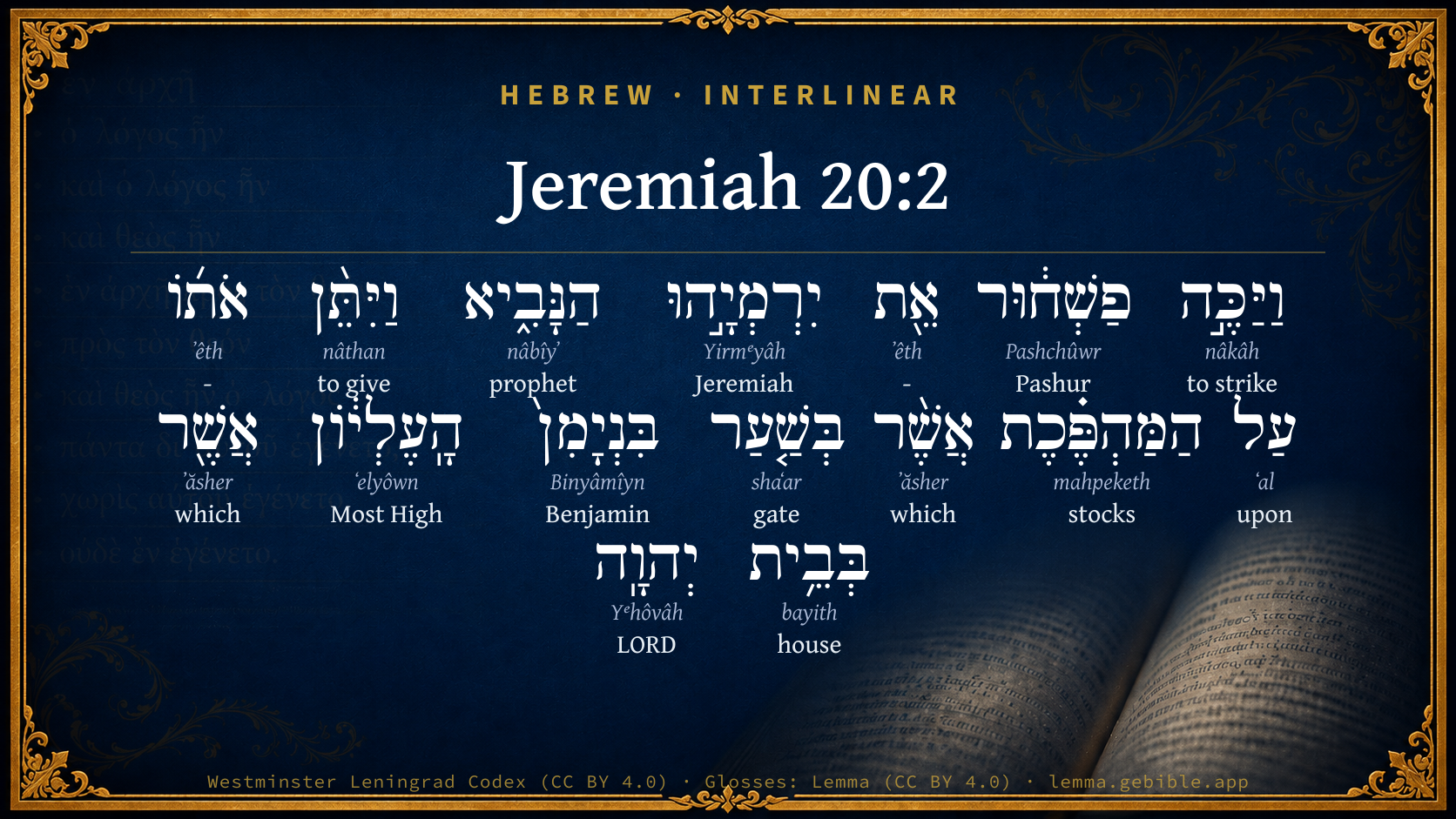
Hebrew (Westminster Leningrad Codex) Jeremiah 20:2 appears in the Hebrew Old Testament. The text above is from the Westminster Leningrad Codex. Each word links to its Strong’s number, a concise gloss, and parsing drawn from the Open Scriptures Hebrew Bible morphology. Click any word for its full Brown-Driver-Briggs (BDB) entry.
Download image
Cite this verse

Jeremiah 20:2 (World English Bible). Public Domain. Lemma interlinear Bible study tool, https://lemma.gebible.app/v/jeremiah/20/2.

Show BibTeX & RIS
BibTeX
RIS
English Translation
Then Pashhur struck Jeremiah the prophet, and put him in the stocks that were in the upper gate of Benjamin, which was in the house of Yahweh.
World English Bible · Public Domain
Download a study sheet

One document with this verse’s original text, its word-by-word gloss line, the meaning frame, cross-references with their text, attributed commentary, and full source and license credits — printable, and it pastes into notes with its structure intact.

This verse Autodidact and up

Study sheet (.html) Plain text (.txt)

A passage Seminary Student

Up to 50 verses in one chapter. A passage sheet keeps up to 6 commentary sources and 12 cross-references per verse, in the order this page ranks them, and says so on the sheet whenever that leaves anything out. Ask for a single verse and you get the Autodidact verse sheet above.

Everything on this page stays free to read, with no account — the sheet is a download of what is already on screen, not access to it.

Want to remove ads? Support Godless Engineer
Compare translations 3

The same verse in 3 English versions, stacked beneath the original-language interlinear above. Click any original word for its lexicon entry.

Each is an independent rendering of the whole verse — the interlinear is not word-aligned to these translations.

Highlighted words mark where these versions differ — a whole-verse word diff, not a word-by-word alignment.

  • World English Bible Public Domain
    Then Pashhur struck Jeremiah the prophet, and put him in the stocks that were in the upper gate of Benjamin, which was in the house of Yahweh.
  • King James Version Public Domain
    Then Pashur smote Jeremiah the prophet, and put him in the stocks that were in the high gate of Benjamin, which was by the house of the LORD.
  • unfoldingWord Literal Text CC BY-SA 4.0
    And Pashhur struck Jeremiah the prophet and put him in the stocks that at the Upper Gate of Benjamin, which in the house of Yahweh.

unfoldingWord Literal Text — © unfoldingWord, licensed CC BY-SA 4.0. Word-aligned USFM3 via Door43 (git.door43.org/unfoldingWord/en_ult).

Versions to compare (up to 4)

3 of 4 selected

Show all 18 translations

Every available English version of this verse, each an independent rendering of the whole verse.

  • World English Bible Public Domain
    Then Pashhur struck Jeremiah the prophet, and put him in the stocks that were in the upper gate of Benjamin, which was in the house of Yahweh.
  • Berean Standard Bible Public Domain
    he had Jeremiah the prophet beaten and put in the stocks at the Upper Gate of Benjamin, which was by the house of the LORD.
  • Majority Standard Bible Public Domain
    he had Jeremiah the prophet beaten and put in the stocks at the Upper Gate of Benjamin, which was by the house of the LORD.
  • King James Version Public Domain
    Then Pashur smote Jeremiah the prophet, and put him in the stocks that were in the high gate of Benjamin, which was by the house of the LORD.
  • American Standard Version (1901) Public Domain
    Then Pashhur smote Jeremiah the prophet, and put him in the stocks that were in the upper gate of Benjamin, which was in the house of Jehovah.
  • Revised Version (1885) Public Domain
    Then Pashhur smote Jeremiah the prophet, and put him in the stocks that were in the upper gate of Benjamin, which was in the house of the LORD.
  • Geneva Bible (1599) Public Domain
    Then Pashur smote Ieremiah the Prophet, and put him in the stockes that were in the hie gate of Beniamin which was by the House of the Lord.
  • Douay-Rheims (1899) Public Domain
    And Phassur struck Jeremias the prophet, and put him in the stocks, that were in the upper gate of Benjamin, in the house of the Lord.
  • Young's Literal Translation Public Domain
    and Pashhur smiteth Jeremiah the prophet, and putteth him unto the stocks, that `are' by the high gate of Benjamin, that `is' by the house of Jehovah.
  • Literal Standard Version CC BY-SA 4.0
    and Pashhur strikes Jeremiah the prophet, and puts him in the stocks that [are] by the Upper Gate of Benjamin, that [is] by the house of YHWH.
  • Unlocked Literal Bible CC BY-SA 4.0
    So Pashhur beat Jeremiah the prophet and then placed him in the stocks that were at the Upper Gate of Benjamin in Yahweh's house.
  • unfoldingWord Literal Text CC BY-SA 4.0
    And Pashhur struck Jeremiah the prophet and put him in the stocks that at the Upper Gate of Benjamin, which in the house of Yahweh.
  • Darby Bible Public Domain
    And Pashur smote Jeremiah the prophet, and put him in the stocks that were in the upper gate of Benjamin, which was in the house of Jehovah.
  • World Messianic Bible Public Domain
    Then Pashhur struck Jeremiah the prophet and put him in the stocks that were in the upper gate of Benjamin, which was in the LORD’s house.
  • Webster's Bible Public Domain
    Then Pashur struck Jeremiah the prophet, and put him in the stocks that were in the high gate of Benjamin, which was by the house of the LORD.
  • Free Bible Version CC BY-SA 4.0
    he beat Jeremiah the prophet and had him put in the stocks at the Upper Benjamin Gate, near to the Lord's Temple.
  • Bible in Basic English Public Domain
    And Pashhur gave blows to Jeremiah and had his feet chained in a framework of wood in the higher doorway of Benjamin, which was in the house of the Lord.
  • JPS Tanakh (1917) Public Domain
    Then Pashhur smote Jeremiah the prophet, and put him in the stocks that were in the upper gate of Benjamin, which was in the house of the LORD.

Literal Standard Version (2020), Covenant Press — licensed CC BY-SA 4.0. Text via the HelloAO Bible API (eBible.org). Unlocked Literal Bible (unfoldingWord) — licensed CC BY-SA 4.0. Text via the HelloAO Bible API (eBible.org). unfoldingWord Literal Text — © unfoldingWord, licensed CC BY-SA 4.0. Word-aligned USFM3 via Door43 (git.door43.org/unfoldingWord/en_ult). Free Bible Version, Dr. Jonathan Gallagher — licensed CC BY-SA 4.0. Text via the HelloAO Bible API (eBible.org).

Word by word

More ways to search: Search by grammar → Find every occurrence → Compare this word →

Practice this passage: Drill this verse → Learn its vocabulary →

הַמַּהְפֶּ֗כֶת
mahpeketh
H4115
“the · stocks”
Particle, Definite Article + Noun, Common, Feminine, Singular, Absolute
Part of Speech
Particle + Noun
Type
Common
Gender
Feminine
Number
Singular
State
Absolute
Full BDB Definition

Origin: from H2015

TWOT: 512e

stocks - similar instrument of punishment (compelling crooked posture or distorting) - house of stocks, prison-house
  1. וַיַּכֶּ֣ה nâkâh H5221 “and · to strike” Conjunction + Verb, Hiphil, Sequential Imperfect, 3rd Person, Masculine, Singular
  2. פַשְׁח֔וּר Pashchûwr H6583 “Pashur” Noun, Proper
  3. אֵ֖ת ʼêth H853 “-” Particle, Direct Object
  4. יִרְמְיָ֣הוּ Yirmᵉyâh H3414 “Jeremiah” Noun, Proper
  5. הַנָּבִ֑יא nâbîyʼ H5030 “the · prophet” Particle, Definite Article + Noun, Common, Masculine, Singular, Absolute
  6. וַיִּתֵּ֨ן nâthan H5414 “and · to give” Conjunction + Verb, Qal, Sequential Imperfect, 3rd Person, Masculine, Singular
  7. אֹת֜וֹ ʼêth H853 “- · him” Particle, Direct Object + Suffix, Personal, 3rd Person, Masculine, Singular
  8. עַל ʻal H5921 “upon” Preposition
  9. אֲשֶׁ֨ר ʼăsher H834 “which” Particle, Relative
  10. בְּשַׁ֤עַר shaʻar H8179 “in/at · gate of” Preposition + Noun, Common, Masculine, Singular, Construct
  11. בִּנְיָמִן֙ Binyâmîyn H1144 “Benjamin” Noun, Proper
  12. הָֽעֶלְי֔וֹן ʻelyôwn H5945 “the · Most High” Particle, Definite Article + Adjective, Adjective, Masculine, Singular, Absolute
  13. אֲשֶׁ֖ר ʼăsher H834 “which” Particle, Relative
  14. בְּבֵ֥ית bayith H1004 “in/at · house of” Preposition + Noun, Common, Masculine, Singular, Construct
  15. יְהוָֽה Yᵉhôvâh H3068 “LORD” Noun, Proper

About this verse

These counts appear in no published source. They are computed here, from the morphology-tagged text and Lemma’s own curated glosses. What Lemma adds →

16
words
14
distinct lemmas
Prophets
section

Notable vocabulary

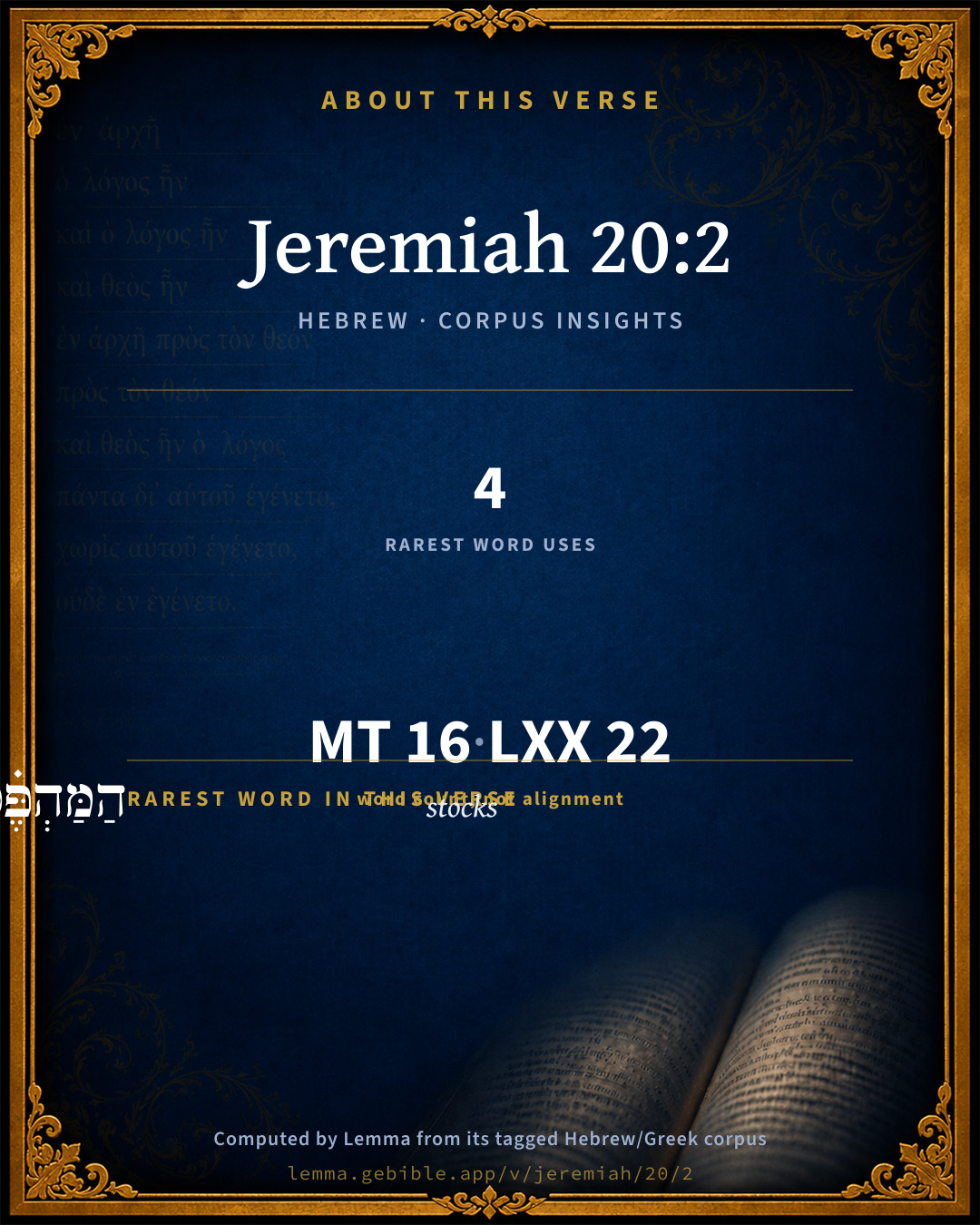
The rarest word here is הַמַּהְפֶּ֗כֶת stocks H4115 — appearing just 4 times in the whole Hebrew Bible.

Shared distinctive vocabulary

הַמַּהְפֶּ֗כֶת stocks H4115 occurs in 4 verses of the Hebrew Bible. Also found in:

Grammatical profile

  • 2 verbs
  • 8 nouns
  • 1 adjective
  • 1 preposition
  • 4 particles

Verb forms

  • וַיַּכֶּ֣ה Hiphil · Sequential Imperfect
  • וַיִּתֵּ֨ן Qal · Sequential Imperfect

Repetition

A word recurs within this verse — often emphatic in Hebrew:

  • אֲשֶׁ֨ר which H834 ×2

Hebrew & Septuagint length

In the original languages it is 16 Hebrew tokens and 22 Greek tokens — but the two are counted differently (Hebrew bundles its prefixes and suffixes into one token; the Greek is in lemma form), so that isn’t a like-for-like length.

Cross-references

25

Topical passages linked to Jeremiah 20:2 in the Treasury of Scripture Knowledge — connected by theme and wording, ordered by reader-vote popularity; previews shown in the World English Bible.

  • Jeremiah 37:13 When he was in the gate of Benjamin, a captain of the guard was there, whose name was Irijah, the son of Shelemiah, the son of Hananiah; and he laid hold on Jeremiah the prophet, saying, You are falling away to the Chaldeans.
  • 2 Chronicles 16:10 Then Asa was angry with the seer, and put him in the prison-house; for he was in a rage with him because of this thing. Asa oppressed some of the people at the same time.
  • Jeremiah 1:19 They shall fight against you; but they shall not prevail against you: for I am with you, says Yahweh, to deliver you.
  • Zechariah 14:10 All the land will be made like the Arabah, from Geba to Rimmon south of Jerusalem; and she will be lifted up, and will dwell in her place, from Benjamin's gate to the place of the first gate, to the corner gate, and from the tower of Hananel to the king's wine-presses.
  • 1 Kings 22:27 and say, Thus says the king, Put this fellow in the prison, and feed him with bread of affliction and with water of affliction, until I come in peace.
  • 2 Chronicles 24:21 They conspired against him, and stoned him with stones at the commandment of the king in the court of the house of Yahweh.
  • Jeremiah 29:26 Yahweh has made you priest in the place of Jehoiada the priest, that there may be officers in the house of Yahweh, for every man who is mad, and makes himself a prophet, that you should put him in the stocks and in shackles.
  • Jeremiah 36:26 The king commanded Jerahmeel the king's son, and Seraiah the son of Azriel, and Shelemiah the son of Abdeel, to take Baruch the scribe and Jeremiah the prophet; but Yahweh hid them.
  • Amos 7:10–13 Then Amaziah the priest of Beth El sent to Jeroboam king of Israel, saying, "Amos has conspired against you in the midst of the house of Israel. The land is not able to bear all his words.
  • Job 13:27 You also put my feet in the stocks, And mark all my paths. You set a bound to the soles of my feet:
  • Jeremiah 19:14–15 Then came Jeremiah from Topheth, where Yahweh had sent him to prophesy; and he stood in the court of Yahweh's house, and said to all the people:
  • Jeremiah 26:8 It happened, when Jeremiah had made an end of speaking all that Yahweh had commanded him to speak to all the people, that the priests and the prophets and all the people laid hold on him, saying, You shall surely die.
  • Jeremiah 37:15–16 The princes were angry with Jeremiah, and struck him, and put him in prison in the house of Jonathan the scribe; for they had made that the prison.
  • Jeremiah 38:6–7 Then took they Jeremiah, and cast him into the dungeon of Malchijah the king's son, that was in the court of the guard: and they let down Jeremiah with cords. In the dungeon there was no water, but mire; and Jeremiah sank in the mire.
  • Matthew 5:10–12 Blessed are those who have been persecuted for righteousness' sake, For theirs is the Kingdom of Heaven.
  • Matthew 21:35 The farmers took his servants, beat one, killed another, and stoned another.
  • Matthew 23:34–37 Therefore, behold, I send to you prophets, wise men, and scribes. Some of them you will kill and crucify; and some of them you will scourge in your synagogues, and persecute from city to city;
  • Acts 4:3 They laid hands on them, and put them in custody until the next day, for it was now evening.
  • Acts 5:18 and laid hands on the apostles, and put them in public custody.
  • Acts 5:40 They agreed with him. Summoning the apostles, they beat them and charged them not to speak in the name of Jesus, and let them go.
  • Acts 7:52 Which of the prophets didn't your fathers persecute? They killed those who foretold the coming of the Righteous One, of whom you have now become betrayers and murderers.
  • Acts 16:22–24 The multitude rose up together against them, and the magistrates tore their clothes off of them, and commanded them to be beaten with rods.
  • Hebrews 11:36–37 Others were tried by mocking and scourging, yes, moreover by bonds and imprisonment.
  • Revelation 2:10 Don't be afraid of the things which you are about to suffer. Behold, the devil is about to throw some of you into prison, that you may be tested; and you will have oppression for ten days. Be faithful to death, and I will give you the crown of life.
  • Revelation 17:6 I saw the woman drunken with the blood of the saints, and with the blood of the martyrs of Jesus. When I saw her, I wondered with great amazement.

Cross-references courtesy of OpenBible.info (CC BY 4.0).

Hebrew and Greek witnesses Masoretic Hebrew ↔ Greek Septuagint

The same verse in the two great witnesses to the Old Testament, shown verse-for-verse.

These are two independent witnesses, not word-aligned to each other, and the Septuagint is shown in lemma (dictionary) form.

Hebrew Jeremiah 20:2 Masoretic · Westminster Leningrad Codex

וַיַּכֶּ֣ה פַשְׁח֔וּר אֵ֖ת יִרְמְיָ֣הוּ הַנָּבִ֑יא וַיִּתֵּ֨ן אֹת֜וֹ עַל הַמַּהְפֶּ֗כֶת אֲשֶׁ֨ר בְּשַׁ֤עַר בִּנְיָמִן֙ הָֽעֶלְי֔וֹן אֲשֶׁ֖ר בְּבֵ֥ית יְהוָֽה

Then Pashhur struck Jeremiah the prophet, and put him in the stocks that were in the upper gate of Benjamin, which was in the house of Yahweh.

World English Bible · Public Domain

Greek LXX Structure differs

In the Septuagint, Jeremiah is about an eighth shorter than the Hebrew and arranges its material differently — the Oracles Against the Nations (Hebrew chapters 46–51) appear in the middle of the Greek book, after 25:13. Because the chapter and verse boundaries do not line up, a verse-for-verse comparison with the Hebrew is not shown.

A verse-for-verse comparison isn’t shown here because the chapters and verses don’t line up. Switch to the LXX edition with the MT / LXX toggle above to read the Greek directly.

On this verse, John Gill's Exposition discusses the Septuagint’s reading. Read the note in Commentary ↓

Hebrew: Westminster Leningrad Codex (CC BY 4.0). Greek: Septuagint (public domain); English from a public-domain English Septuagint. How the Septuagint differs from the Hebrew →

Targum (Aramaic paraphrase)

1

The Targum is the ancient Jewish Aramaic paraphrase of the Hebrew Scriptures — an interpretive translation, not the Hebrew text itself. Onkelos (literal) and Pseudo-Jonathan (expansive) render the Torah, and Jonathan the Prophets. Coverage is partial: where no permissively-licensed English translation exists for a verse, only the Aramaic is shown. This is verse-level text, not a word-by-word alignment to the Hebrew.

  1. Targum Jonathan Prophets (Joshua–Malachi)
    וְאַלְקֵי פַּשְׁחוּר יַת יִרְמְיָה נְבִיָא וִיהַב יָתֵיהּ לְכֵיפְתָּא דְבִתְרַע שִׁבְטָא בִּנְיָמִין עִלָאָה דִי בְּבֵית מַקְדְשָׁא דַיָי:

    (no public-domain English translation for this verse)

    Targum Jonathan — Aramaic: “Mikraot Gedolot” (public domain). English: “Sefaria Community Translation” (CC0 1.0 (public-domain dedication)); “London "Chaldee Paraphrase," 1871” (public domain). Text via Sefaria.

Commentary

Notes on Jeremiah 20:2 from classic Christian and Jewish commentators (each source and its license shown beneath its notes). The classic Christian expositions comment on the surrounding passage and are grouped to its opening verse, so a note may address several verses; the Jewish commentaries on the Tanakh (Rashi and others) are per-verse, so they appear only where the commentator wrote on this verse.

Lemma curates 59 commentaries, every one of them public domain or Creative Commons licensed, each selected and text-cleaned for this edition rather than reprinted as found. About our sources →

Trapp's Complete Commentary

John Trapp

Jer 20:2 Then Pashur smote Jeremiah the prophet, and put him in the stocks that [were] in the high gate of Benjamin, which [was] by the house of the LORD.

Ver. 2. Then Pashur smote Jeremiah the prophet.] Either with his fist, as Zedekiah did Micaiah, {1Ki 22:24} and as Bonner did Hawkes and other martyrs, pulling off part of their beards; or else with a staff, as they dealt by our Saviour, {Mat 26:67} and as that Popish bishop, degrading a martyr minister, struck him so hard with his crosier staff as he was kneeling on the stairs at Paul’s, that he fell down backwards and broke his head. {a} Atqui lapidandi sunt haeretici sacrarum literarura argumentis, saith Athanasius. {b} But heretics are to be stoned with Scripture arguments; and men may a great deal sooner be cudgelled into a treaty than into a tenet.

And put him in the stocks.] As they did afterwards Paul and Silas; {Act 16:22-24} Clerinus the martyr, mentioned in Cyprian’s epistles; {c} Mr Philpot, in the Bishop of London’s coal house; and that good woman who, suffering afterwards for the same cause, rejoiced much that her leg was put in the same hole of the stocks where Philpot’s leg had lain before.

That were in the high gate of Benjamin.] Which might be a prison like Lollard’s tower in London whereunto were sent the martyrs, many of them for their zeal and forwardness. Action and passion go together - omne agens agendo repatitur - especially if men go a little faster than others do. "They who will live godly in Christ Jesus" - and be set upon it - "shall suffer persecution." This gate-house might well be the priests’ prison, whither they used to send such as they took for false prophets.

{a} Acts and Mon.

{b} Contra Arrian., orat. ii.

{c} Epist., lib. iv.

John Trapp, A Commentary or Exposition upon All the Books of the Old and New Testament (1647–1656) — public domain. Text from a community e-Sword module.

Joseph Benson's Commentary

Jer 20:2. Then Pashur smote Jeremiah, &c. — He thought, no doubt, that Jeremiah’s speaking so plainly of the overthrow of Jerusalem, and of the miseries which should befall it, deserved that he should be arrested and put in confinement, to prevent his speaking thus freely: and accordingly he treats him as they treated, or rather, ought to have treated, the false prophets. And put him in the stocks — The word המהפכת, here translated the stocks, is rendered the prison by Houbigant, and the house of correction by Blaney. It occurs twice besides, namely, Jer 29:26, and 2Ch 16:10, in both which places it is rendered simply a prison, and is mentioned as a punishment due to, or inflicted on, one who assumed the character of a prophet, without a proper call, or was presumed to have behaved unbecomingly as such. The word which properly signifies the stocks, is סד: see Job 13:27; Job 33:11. It is very natural to understand here that Pashur, having caused Jeremiah to be beaten, or scourged, ordered him into confinement afterward; from whence he released him the next day.

Joseph Benson's Commentary on the Old and New Testaments (1811–1818) — public domain. Text from a community e-Sword module.

Geneva Bible (1599)

Geneva Bible translators

Thus we see that the thing which neither the King, nor the princes, nor the people durst enterprise against the Prophet of God, this Priest as a chief instrument of Satan first attempted, read Jer. 18:18.

Geneva Bible (1599) marginal notes — public domain. Text via Bolls.life.

Jamieson, Fausset & Brown

Robert Jamieson, A. R. Fausset & David Brown

The fact that Pashur was of the same order and of the same family as Jeremiah aggravates the indignity of the blow (Kg1 22:24; Mat 26:67).

stocks--an instrument of torture with five holes, in which the neck, two hands, and two feet were thrust, the body being kept in a crooked posture (Jer 29:26). From a Hebrew root, to "turn," or "rack." This marks Pashur's cruelty.

high--that is, the upper gate (Kg2 15:35).

gate of Benjamin--a gate in the temple wall, corresponding to the gate of Benjamin, properly so called, in the city wall, in the direction of the territory of Benjamin (Jer 7:2; Jer 37:13; Jer 38:7). The temple gate of Benjamin, being on a lofty position, was called "the high gate," to distinguish it from the city wall gate of Benjamin.

Jamieson, Fausset & Brown — Commentary Critical and Explanatory on the Whole Bible (1871) — public domain (CC PDM 1.0). Text via the HelloAO Bible API.

Adam Clarke's Commentary

Verse 2. Put him in the stocks] Probably such a place near the gate as we term the lock-up, the coal-hole; or it may mean a sort of dungeon.

Adam Clarke's Commentary on the Bible (1810–1826) — public domain. Text from a community e-Sword/MySword module.

Ellicott's Commentary for English Readers

(2) Then Pashur smote Jeremiah the prophet.—It is the first time that he has been so described, the office to which he was called being apparently named to emphasise the outrage which had been inflicted on him. Other prophets had, under Ahab or Manasseh, been slain with the sword, but none, so far as we know (with the one exception of Hanani the seer in 2Ch_16:10), had ever before been subjected to an ignominious punishment such as this. It was so far analogous to the outrage against which St. Paul protested in Act_23:2-3. The word “smote” implies a blow struck with the priest’s own hands rather than the infliction of the legal punishment of forty stripes save one (Deu_25:3). The English word “stocks” expresses adequately enough the instrument of torture which, like the nervus of Roman punishment, kept the body (as in Act_16:24) in a crooked and painful position. The word here used occurs in the Hebrew of 2Ch_16:10, as above, and in Jer_29:26, but the A. V. there renders it as “prison-house.” In that humiliating position the prophet was left for the whole night in one of the most conspicuous places of the city, the temple-gate of Benjamin (the upper gate) on the northern side of the inner court, probably the higher or northern gate of Eze_8:3; Eze_8:5; Eze_9:2.

A Bible Commentary for English Readers, edited by Charles John Ellicott (1878–1897) — public domain. Text from a community e-Sword module.

The Cambridge Bible for Schools and Colleges

gen. ed. J. J. S. Perowne

2. the stocks] Cp. Jer_29:26. See HDB. I. 527 for anything that is known with reference to this mode of punishment as applied then.

upper gate of Benjamin, which was in, etc.] the northern gate (built by Jotham, 2Ki_15:35) of the upper (inner) court of the Temple, and to be distinguished from the city gate of the same name (Jer_37:13, Jer_38:7).

The Cambridge Bible for Schools and Colleges (gen. ed. J. J. S. Perowne; Cambridge University Press, 1878–1918) — public domain. Text from a community e-Sword module.

John Gill's Exposition

Then Pashur smote Jeremiah the prophet,.... Either with his fist, or with a rod, while he was prophesying, to stop his mouth, and hinder him from going on, and to show his resentment, and influence, the people not to believe him; or he ordered him to be smitten and scourged by some inferior officer. This was very ill treatment of a prophet, a prophet of the Lord, and one that was a priest too, of the same order with himself;

and put him in the stocks; or ordered him to be put there; but whether it was such an engine or instrument as we call "stocks", in which the feet of prisoners are put, is not certain. Kimchi's father says, it was an instrument made of two pieces of wood, in which the necks of prisoners were put; and some say it had besides two holes for the two hands to be put in; and so the same with our "pillory". The Septuagint render it "a cataract", a ditch or dungeon. Jarchi interprets it a prison; and so our translators render the word in Jer 29:26; however, it was a place of confinement, if not of torture and pain;

that were in the high gate of Benjamin; here were these stocks, pillory, or prison; which was either a gate of the city of Jerusalem, so called, because it looked towards and led out to the tribe of Benjamin, Jer 37:13; or a gate of the temple, which stood on that side of it that belonged to the tribe of Benjamin; both the city and temple being partly in the tribe of Judah, and partly in the tribe of Benjamin; and it seems by this that there was an upper and lower gate of this name; and the following clause seems to incline to this sense:

which was by the house of the Lord; or, "in the house of the Lord" (w); the temple.

(w) "in domo Jehovae", Pagninus, Montanus, Vatablus, Piscator, Cocceius, Schmidt.

John Gill's Exposition of the Whole Bible (1746–1763) — public domain (CC PDM 1.0). Text via the HelloAO Bible API.

Albert Barnes' Notes on the Bible

Jeremiah the prophet - Jeremiah is nowhere so called in the first 19 chapters. In this place he thus characterizes himself, because Pashur’s conduct was a violation of the respect due to the prophetic office.

The stocks - This instrument of torture comes from a root signifying to “twist.” It thus implies that the body was kept in a distorted position. Compare Act 16:24.

The high gate ... - Rather, “the upper gate of Benjamin in the house of Yahweh (compare 2Ki 15:35);” to be distinguished from the city gate of Benjamin leading toward the north.

Albert Barnes' Notes on the Bible (1834–1885) — public domain. Text from a community e-Sword/MySword module.

Haydock's Catholic Bible Commentary

Struck, or seized. (Grotius) --- Upper gate, nearer the temple. (Calmet)

George Leo Haydock (1774–1849), Haydock's Catholic Family Bible and Commentary, 1859 edition — public domain. Excludes Psalms (Douay-Rheims chapter numbering differs from Protestant) and Deuterocanonical books (Catholic canon only).

Matthew Poole's English Annotations

Then Pashur smote Jeremiah; it is not said how he struck him, though some think it most probable that it was with his fist, as the false prophet struck Micaiah, 1Ki 22:24. We are as uncertain what is here meant by

stocks, whether such an engine as is in use amongst us to punish offenders, which we call by that name; or, as others. an engine like our pillory, where malefactors are fastened by the necks; or, as others, with three holes, one for the neck of the offender, one for each hand; or whether merely a prison, where he was kept all night a prisoner; the Hebrew word will not determine us further than that it was a place of restraint, and where that will not determine, other conjectures are as uncertain as needless. There is as much uncertainty as to the place where this prison or these stocks were; we are told it was near the temple, and

in the high gate of Benjamin; but whether this was a gate belonging to the temple that opened toward that part of the country which was the lot of Benjamin, or a gate of the city that opened that way, whether in the inner wall or outer wall, whether called the high gate, because nearer the temple, or upon some other account, are nice and curious speculations, the determination of which is of no moment for us to know.

Matthew Poole's English Annotations on the Holy Bible (1683–1685) — public domain. Text from a community e-Sword/MySword module.

Whedon's Commentary on the Bible

Daniel D. Whedon

2. Jeremiah the prophet — This designation indicates that he had come to have a public recognition in his prophetical character. It occurs here for the first time.

Stocks — This word occurs besides only in Jer_29:26, and 2Ch_16:10. In this last passage it is translated “prison-house.” It comes from a root which means to twist, and was a contrivance for confining the body in a crooked and painful position. Paul and Silas were subjected to this mode of punishment. Act_16:24.

High gate of Benjamin — Further designated as a temple gate.

By the house of the Lord — The epithet “high,” or upper, implies that it was a gate to the inner court of the temple, which was raised above the outer court.

Daniel D. Whedon (gen. ed.), Commentary on the Old and New Testaments (1874–1909) — public domain. Text from a community e-Sword module.

The Pulpit Commentary

Pashur, being charged with the police of the temple, smites Jeremiah, i.e. causes stripes to be given him, (a legal punishment, Deu_25:3; comp. 2Co_11:24) and then orders him to be put into the stocks; literally, that which distorts some instrument of punishment which held the body in a bent or crooked position. (comp. Jer_29:26) The "stocks" were sometimes kept in a special house; (2Ch_16:10) these mentioned here, however, apparently stood in public, at the high or rather, uppergate of Benjamin, which was by or, atthe house of the Lord. The gate, then, was one of the temple gates, and is called "the upper" to distinguish it from one of the city gates which bore the same name. (Jer_37:13 Jer_38:7) It is presumably the same which is called "the new gate of the Lord"s house", (Jer_26:10 Jer_36:10) as having been comparatively lately built. (2Ki_15:35)

The Pulpit Commentary (1880–1919), ed. H.D.M. Spence-Jones & Joseph S. Exell — public domain. Text from a community e-Sword module.

Rashi

Rabbi Shlomo Yitzchaki (Rashi)

and placed him in the prison the name of a place of a prison, and Jonathan rendered: לכיפתא (arvolud in O.F.), a vault.

Rashi on the Tanakh — English translations: “The Judaica Press complete Tanach with Rashi, translated by A. J. Rosenberg” (CC BY 4.0); “Pentateuch with Rashi's commentary by M. Rosenbaum and A.M. Silbermann, 1929-1934” (public domain); “The Metsudah Tanach series, Lakewood, N.J” (CC BY 4.0); and “The Book of Joshua, Metsudah Publications, 1997” (CC BY 4.0). Text via Sefaria.

Lesson kit

Teaching starters — assembled from the data on this page, not authored interpretation. Every prompt links to the verse data it draws on. Edit before teaching.

Jeremiah, in the Prophets, opens this verse with 16 words (14 distinct Hebrew lemmas). Its most distinctive word is mahpeketh (“stocks”). A historical commentator’s framing appears above. Read the whole chapter for the surrounding context.

Discussion questions

  1. What does “stocks” (mahpeketh) contribute to the verse as a whole?
  2. How does 2 Chronicles 16:10, which shares the word «stocks», read alongside this verse?
  3. What does the repetition of “which” (2× in this one verse) do in this verse?
  4. These translations render this verse differently. What is at stake in choosing one wording over another?
  5. «וַיַּכֶּ֣ה» is a Hiphil Sequential Imperfect verb. How does that grammatical form shape the action described?
  6. Compare how Trapp's Complete Commentary and Joseph Benson's Commentary read this verse. Where do they agree or differ?

Things to notice

Reading settings

Reading text

Shown beneath each verse's original-language words.

Old Testament
Old Testament edition

Read the OT as the Masoretic Hebrew (MT) or the Greek Septuagint (LXX).

English shown for the Greek Septuagint (in the Hebrew ↔ Greek comparison).

Comparing translations? Open the Compare panel on any verse page to stack up to four side by side.