
Jeremiah 28:10

Hebrew (Westminster Leningrad Codex) Jeremiah 28:10 appears in the Hebrew Old Testament. The text above is from the Westminster Leningrad Codex. Each word links to its Strong’s number, a concise gloss, and parsing drawn from the Open Scriptures Hebrew Bible morphology. Click any word for its full Brown-Driver-Briggs (BDB) entry.
Download image
Cite this verse

Jeremiah 28:10 (World English Bible). Public Domain. Lemma interlinear Bible study tool, https://lemma.gebible.app/v/jeremiah/28/10.

Show BibTeX & RIS
BibTeX
RIS
English Translation
Then Hananiah the prophet took the bar from off the prophet Jeremiah's neck, and broke it.
World English Bible · Public Domain
Download a study sheet

One document with this verse’s original text, its word-by-word gloss line, the meaning frame, cross-references with their text, attributed commentary, and full source and license credits — printable, and it pastes into notes with its structure intact.

This verse Autodidact and up

Study sheet (.html) Plain text (.txt)

A passage Seminary Student

Up to 50 verses in one chapter. A passage sheet keeps up to 6 commentary sources and 12 cross-references per verse, in the order this page ranks them, and says so on the sheet whenever that leaves anything out. Ask for a single verse and you get the Autodidact verse sheet above.

Everything on this page stays free to read, with no account — the sheet is a download of what is already on screen, not access to it.

Want to remove ads? Support Godless Engineer
Compare translations 3

The same verse in 3 English versions, stacked beneath the original-language interlinear above. Click any original word for its lexicon entry.

Each is an independent rendering of the whole verse — the interlinear is not word-aligned to these translations.

Highlighted words mark where these versions differ — a whole-verse word diff, not a word-by-word alignment.

  • World English Bible Public Domain
    Then Hananiah the prophet took the bar from off the prophet Jeremiah's neck, and broke it.
  • King James Version Public Domain
    Then Hananiah the prophet took the yoke from off the prophet Jeremiah's neck, and brake it.
  • unfoldingWord Literal Text CC BY-SA 4.0
    And Hananiah the prophet took the yoke bar from upon the neck of Jeremiah the prophet and broke it.

unfoldingWord Literal Text — © unfoldingWord, licensed CC BY-SA 4.0. Word-aligned USFM3 via Door43 (git.door43.org/unfoldingWord/en_ult).

Versions to compare (up to 4)

3 of 4 selected

Show all 18 translations

Every available English version of this verse, each an independent rendering of the whole verse.

  • World English Bible Public Domain
    Then Hananiah the prophet took the bar from off the prophet Jeremiah's neck, and broke it.
  • Berean Standard Bible Public Domain
    Then the prophet Hananiah took the yoke off the neck of Jeremiah the prophet and broke it.
  • Majority Standard Bible Public Domain
    Then the prophet Hananiah took the yoke off the neck of Jeremiah the prophet and broke it.
  • King James Version Public Domain
    Then Hananiah the prophet took the yoke from off the prophet Jeremiah's neck, and brake it.
  • American Standard Version (1901) Public Domain
    Then Hananiah the prophet took the bar from off the prophet Jeremiah's neck, and brake it.
  • Revised Version (1885) Public Domain
    Then Hananiah the prophet took the bar from off the prophet Jeremiah’s neck, and brake it.
  • Geneva Bible (1599) Public Domain
    Then Hananiah the Prophet tooke the yoke from the Prophet Ieremiahs necke, and brake it.
  • Douay-Rheims (1899) Public Domain
    And Hananias the prophet took the chain from the neck of Jeremias the prophet, and broke it.
  • Young's Literal Translation Public Domain
    And Hananiah the prophet taketh the yoke from off the neck of Jeremiah the prophet, and breaketh it,
  • Literal Standard Version CC BY-SA 4.0
    And Hananiah the prophet takes the yoke from off the neck of Jeremiah the prophet, and breaks it,
  • Unlocked Literal Bible CC BY-SA 4.0
    But Hananiah the prophet took the yoke from the neck of Jeremiah the prophet and broke it.
  • unfoldingWord Literal Text CC BY-SA 4.0
    And Hananiah the prophet took the yoke bar from upon the neck of Jeremiah the prophet and broke it.
  • Darby Bible Public Domain
    And the prophet Hananiah took the yoke from off the prophet Jeremiah's neck, and broke it.
  • World Messianic Bible Public Domain
    Then Hananiah the prophet took the bar from off the prophet Jeremiah’s neck, and broke it.
  • Webster's Bible Public Domain
    Then Hananiah the prophet took the yoke from off the prophet Jeremiah's neck, and broke it.
  • Free Bible Version CC BY-SA 4.0
    Then the prophet Hananiah removed the yoke from the prophet Jeremiah's neck and broke it.
  • Bible in Basic English Public Domain
    Then Hananiah the prophet took the yoke from the neck of the prophet Jeremiah and it was broken by his hands.
  • JPS Tanakh (1917) Public Domain
    Then Hananiah the prophet took the bar from off the prophet Jeremiah's neck, and broke it.

Literal Standard Version (2020), Covenant Press — licensed CC BY-SA 4.0. Text via the HelloAO Bible API (eBible.org). Unlocked Literal Bible (unfoldingWord) — licensed CC BY-SA 4.0. Text via the HelloAO Bible API (eBible.org). unfoldingWord Literal Text — © unfoldingWord, licensed CC BY-SA 4.0. Word-aligned USFM3 via Door43 (git.door43.org/unfoldingWord/en_ult). Free Bible Version, Dr. Jonathan Gallagher — licensed CC BY-SA 4.0. Text via the HelloAO Bible API (eBible.org).

Word by word

More ways to search: Search by grammar → Find every occurrence → Compare this word →

Practice this passage: Drill this verse → Learn its vocabulary →

הַמּוֹטָ֔ה
môwṭâh
H4133
“the · bar”
Particle, Definite Article + Noun, Common, Feminine, Singular, Absolute
Part of Speech
Particle + Noun
Type
Common
Gender
Feminine
Number
Singular
State
Absolute
Full BDB Definition

Origin: from H4132

TWOT: 1158b

pole, bar of yoke - pole - bar of yoke - of oppression (figuratively)
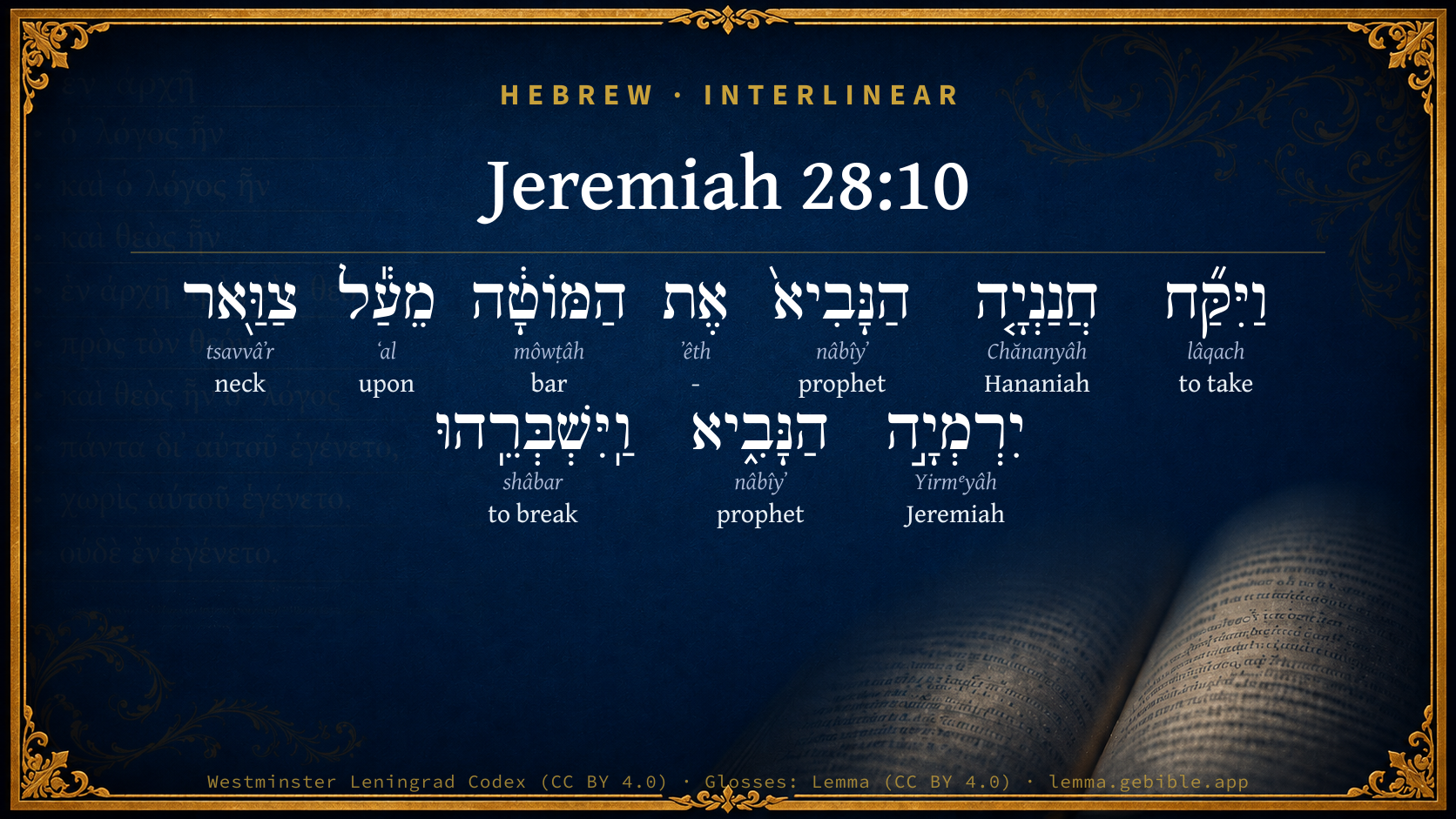
  1. וַיִּקַּ֞ח lâqach H3947 “and · to take” Conjunction + Verb, Qal, Sequential Imperfect, 3rd Person, Masculine, Singular
  2. חֲנַנְיָ֤ה Chănanyâh H2608 “Hananiah” Noun, Proper
  3. הַנָּבִיא֙ nâbîyʼ H5030 “the · prophet” Particle, Definite Article + Noun, Common, Masculine, Singular, Absolute
  4. אֶת ʼêth H853 “-” Particle, Direct Object
  5. מֵעַ֕ל ʻal H5921 “from · upon” Preposition + Preposition
  6. צַוַּ֖אר tsavvâʼr H6677 “neck of” Noun, Common, Masculine, Singular, Construct
  7. יִרְמְיָ֣ה Yirmᵉyâh H3414 “Jeremiah” Noun, Proper
  8. הַנָּבִ֑יא nâbîyʼ H5030 “the · prophet” Particle, Definite Article + Noun, Common, Masculine, Singular, Absolute
  9. וַֽיִּשְׁבְּרֵֽהוּ shâbar H7665 “and · to break · him” Conjunction + Verb, Qal, Sequential Imperfect, 3rd Person, Masculine, Singular + Suffix, Personal, 3rd Person, Masculine, Singular

About this verse

These counts appear in no published source. They are computed here, from the morphology-tagged text and Lemma’s own curated glosses. What Lemma adds →

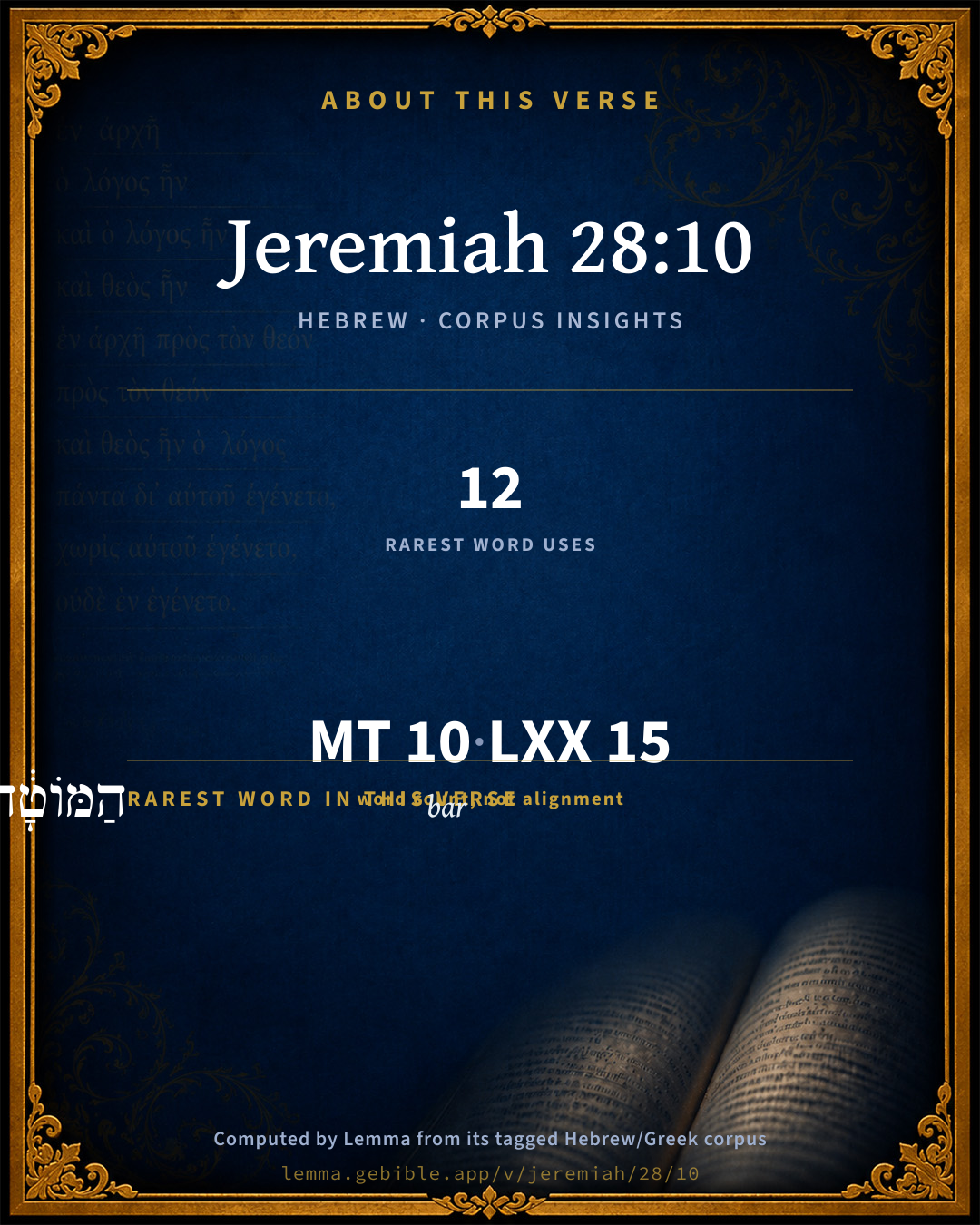
10
words
9
distinct lemmas
Prophets
section

Notable vocabulary

The rarest word here is הַמּוֹטָ֔ה bar H4133 — appearing just 12 times in the whole Hebrew Bible.

Shared distinctive vocabulary

הַמּוֹטָ֔ה bar H4133 occurs in 10 verses of the Hebrew Bible. Also found in:

Grammatical profile

  • 2 verbs
  • 6 nouns
  • 1 preposition
  • 1 particle

Verb forms

  • וַיִּקַּ֞ח Qal · Sequential Imperfect
  • וַֽיִּשְׁבְּרֵֽהוּ Qal · Sequential Imperfect

Repetition

A word recurs within this verse — often emphatic in Hebrew:

  • הַנָּבִיא֙ prophet H5030 ×2

Hebrew & Septuagint length

In the original languages it is 10 Hebrew tokens and 15 Greek tokens — but the two are counted differently (Hebrew bundles its prefixes and suffixes into one token; the Greek is in lemma form), so that isn’t a like-for-like length.

Cross-references

7

Topical passages linked to Jeremiah 28:10 in the Treasury of Scripture Knowledge — connected by theme and wording, ordered by reader-vote popularity; previews shown in the World English Bible.

  • Jeremiah 27:2 Thus says Yahweh to me: Make you bonds and bars, and put them on your neck;
  • 1 Kings 22:11 Zedekiah the son of Chenaanah made him horns of iron, and said, Thus says Yahweh, With these shall you push the Syrians, until they be consumed.
  • 1 Kings 22:24–25 Then Zedekiah the son of Chenaanah came near, and struck Micaiah on the cheek, and said, Which way went the Spirit of Yahweh from me to speak to you?
  • Jeremiah 28:2 Thus speaks Yahweh of Hosts, the God of Israel, saying, I have broken the yoke of the king of Babylon.
  • Jeremiah 28:4 and I will bring again to this place Jeconiah the son of Jehoiakim, king of Judah, with all the captives of Judah, who went to Babylon, says Yahweh; for I will break the yoke of the king of Babylon.
  • Jeremiah 36:23–24 It happened, when Jehudi had read three or four leaves, that [the king] cut it with the penknife, and cast it into the fire that was in the brazier, until all the scroll was consumed in the fire that was in the brazier.
  • Malachi 3:13 "Your words have been stout against me," says Yahweh. "Yet you say, 'What have we spoken against you?'

Cross-references courtesy of OpenBible.info (CC BY 4.0).

Hebrew and Greek witnesses Masoretic Hebrew ↔ Greek Septuagint

The same verse in the two great witnesses to the Old Testament, shown verse-for-verse.

These are two independent witnesses, not word-aligned to each other, and the Septuagint is shown in lemma (dictionary) form.

Hebrew Jeremiah 28:10 Masoretic · Westminster Leningrad Codex

וַיִּקַּ֞ח חֲנַנְיָ֤ה הַנָּבִיא֙ אֶת הַמּוֹטָ֔ה מֵעַ֕ל צַוַּ֖אר יִרְמְיָ֣ה הַנָּבִ֑יא וַֽיִּשְׁבְּרֵֽהוּ

Then Hananiah the prophet took the bar from off the prophet Jeremiah's neck, and broke it.

World English Bible · Public Domain

Greek LXX Structure differs

In the Septuagint, Jeremiah is about an eighth shorter than the Hebrew and arranges its material differently — the Oracles Against the Nations (Hebrew chapters 46–51) appear in the middle of the Greek book, after 25:13. Because the chapter and verse boundaries do not line up, a verse-for-verse comparison with the Hebrew is not shown.

A verse-for-verse comparison isn’t shown here because the chapters and verses don’t line up. Switch to the LXX edition with the MT / LXX toggle above to read the Greek directly.

Hebrew: Westminster Leningrad Codex (CC BY 4.0). Greek: Septuagint (public domain); English from a public-domain English Septuagint. How the Septuagint differs from the Hebrew →

Targum (Aramaic paraphrase)

1

The Targum is the ancient Jewish Aramaic paraphrase of the Hebrew Scriptures — an interpretive translation, not the Hebrew text itself. Onkelos (literal) and Pseudo-Jonathan (expansive) render the Torah, and Jonathan the Prophets. Coverage is partial: where no permissively-licensed English translation exists for a verse, only the Aramaic is shown. This is verse-level text, not a word-by-word alignment to the Hebrew.

  1. Targum Jonathan Prophets (Joshua–Malachi)
    וּנְסֵיב חֲנַנְיָה נְבִיָא שִׁקְרָא יַת נִירָא מֵעַל צַוַר יִרְמְיָה נְבִיָא וְתַבְּרֵיהּ:

    (no public-domain English translation for this verse)

    Targum Jonathan — Aramaic: “Mikraot Gedolot” (public domain). English: “Sefaria Community Translation” (CC0 1.0 (public-domain dedication)); “London "Chaldee Paraphrase," 1871” (public domain). Text via Sefaria.

Commentary

Notes on Jeremiah 28:10 from classic Christian and Jewish commentators (each source and its license shown beneath its notes). The classic Christian expositions comment on the surrounding passage and are grouped to its opening verse, so a note may address several verses; the Jewish commentaries on the Tanakh (Rashi and others) are per-verse, so they appear only where the commentator wrote on this verse.

Lemma curates 59 commentaries, every one of them public domain or Creative Commons licensed, each selected and text-cleaned for this edition rather than reprinted as found. About our sources →

Trapp's Complete Commentary

John Trapp

Jer 28:10 Then Hananiah the prophet took the yoke from off the prophet Jeremiah’s neck, and brake it.

Ver. 10. Then Hananiah the prophet took the yoke from off the prophet Jeremiah’s neck, and brake it.] This was a most insolent and desperate fact in Hananiah - but nihil est audacius illis deprensis - and a most dangerous temptation to the people to believe his prophesying. Such another bold henchman was Nestorius the heretic: Audax erat, saith Zanchius, et magnae loquentiae, qua unica fretus nihil non audebat, et quidem saepenumero feliciter quod volebat, obtinebat {a} - that is, Bold he was and big spoken, trusting whereunto he durst attempt anything; and too too oft he effected also that which he attempted; so that he seduced for a while the good emperor Theodosius, and caused him to eject Cyril, an orthodox bishop, whom afterwards, upon better consideration, he restored again to his place with greater honour, and condemned that hypocrite and heretic Nestorius, of whom what became afterwards I wot not; but Hananiah died, as he well deserved, for his thus daring to fight against God.

{a} Zanch., Miscell. Epist. Dedic.

John Trapp, A Commentary or Exposition upon All the Books of the Old and New Testament (1647–1656) — public domain. Text from a community e-Sword module.

Joseph Benson's Commentary

Jer 28:10-14. Then Hananiah took the yoke from off Jeremiah’s neck — Thus it appears that Jeremiah wore this yoke, agreeably to the command given him by God, as a symbol of that subjection to the king of Babylon to which he admonished the Jews and other neighbouring nations to submit, in order that they might prevent the extreme evil which would otherwise fall upon them: and this yoke Hananiah took off the prophet’s neck, and broke it, by way of a symbolical sign that the Jews, and these other nations, should be freed from the Babylonian yoke within two years. And the Prophet Jeremiah went his way — Quietly and patiently, knowing that it would answer no good end to contend with one whose mind was heated, and in the midst of the priests and people that were violently set against him. Doubtless he expected that God would soon send a special message to Hananiah, and he would say nothing till he received it. It is often our wisdom and duty to yield to violence, to bear revilings with patience, and to retreat rather than contend. Then the word of the Lord came unto Jeremiah — To ratify and confirm the prophecy he had lately uttered; saying, Go and tell Hananiah, Thou hast broken the yokes of wood, &c. — Which were light and easy; but thou shalt make for them yokes of iron — Such as no human strength can break; that is, thou shalt bring a heavier and more grievous yoke upon them than they otherwise would have had, by persuading them not to submit to Nebuchadnezzar.

Joseph Benson's Commentary on the Old and New Testaments (1811–1818) — public domain. Text from a community e-Sword module.

Tyndale Open Study Notes

Tyndale Open Resources

28:10-11 The false prophet Hananiah broke the yoke that Jeremiah was wearing (27:2) as a sign of what the Lord would do. • Jeremiah left the confrontation without replying, probably because he had not yet received the Lord’s response.

Tyndale Open Study Notes — © Tyndale Open Resources, licensed CC BY-SA 4.0. Text via the HelloAO Bible API.

Geneva Bible (1599)

Geneva Bible translators

This declareth the impudence of the wicked hirelings, which have no zeal to the truth, but are led with ambition to get the favor of men, and therefore cannot abide any that might discredit them but burst forth into rages and contrary to their own conscience, pass not what lies they report or how wickedly they do, so that they may maintain their estimation.

Geneva Bible (1599) marginal notes — public domain. Text via Bolls.life.

Matthew Henry's Commentary

We have here an instance,

I. Of the insolence of the false prophet. To complete the affront he designed Jeremiah, he took the yoke from off his neck which he carried as a memorial of what he had prophesied concerning the enslaving of the nations to Nebuchadnezzar, and he broke it, that he might give a sign of the accomplishment of this prophecy, as Jeremiah had given of his, and might seem to have conquered him, and to have defeated the intention of his prophecy. See how the lying spirit, in the mouth of this false prophet, mimics the language of the Spirit of truth: Thus saith the Lord, So will I break the yoke of the king of Babylon, not only from the neck of this nation, but from the neck of all nations, within two full years. Whether by the force of a heated imagination Hananiah had persuaded himself to believe this, or whether he knew it to be false, and only persuaded them to believe it, does not appear; but it is plain that he speaks with abundance of assurance. It is no new thing for lies to be fathered upon the God of truth.

II. Of the patience of the true prophet. Jeremiah quietly went his way, and when he was reviled he reviled not again, and would not contend with one that was in the height of his fury and in the midst of the priests and people that were violently set against him. The reason why he went his way was not because he had nothing to answer, but because he was willing to stay till God was pleased to furnish him with a direct and immediate answer, which as yet he had not received. He expected that God would send a special message to Hananiah, and he would say nothing till he had received that. I, as a deaf man, heard not, for thou wilt hear, and thou shalt answer, Lord, for me. It may sometimes be our wisdom rather to retreat than to contend. Currenti cede furori - Give place unto wrath.

III. Of the justice of God in giving judgment between Jeremiah and his adversary. Jeremiah went his way, as a man in whose mouth there was no rebuke, but God soon put a word into his mouth; for he will appear for those who silently commit their cause to him. 1. The word of God, in the mouth of Jeremiah, is ratified and confirmed. Let not Jeremiah himself distrust the truth of what he had delivered in God's name because it met with such a daring opposition and contradiction. If what we have spoken be the truth of God, we must not unsay it because men gainsay it; for great is the truth and will prevail. It will stand, therefore let us stand to it, and not fear that men's unbelief or blasphemy will make it of no effect. Hananiah has broken the yokes of wood, but Jeremiah must make for them yokes of iron, which cannot be broken (Jer 28:13), for (says God) "I have put a yoke of iron upon the neck of all these nations, which shall lie heavier, and bind harder, upon them (Jer 28:14), that they may serve the king of Babylon, and not be able to shake off the yoke however they may struggle, for they shall serve him whether they will or no;" and who is he that can contend with God's counsel? What was said before is repeated again: I have given him the beasts of the field also, as if there were something significant in that. Men had by their wickedness made themselves like the beasts that perish, and therefore deserved to be ruled by an arbitrary power, as beasts are ruled, and such a power Nebuchadnezzar ruled with; for whom he would he slew and whom he would he kept alive. 2. Hananiah is sentenced to die for contradicting it, and Jeremiah, when he has received commission from God, boldly tells him so to his face, though before he received that commission he went away and said nothing. (1.) The crimes of which Hananiah stands convicted are cheating the people and affronting God: Thou makest this people to trust in a lie, encouraging them to hope that they shall have peace, which will make their destruction the more terrible to them when it comes; yet this was not the worst: Thou hast taught rebellion against the Lord; thou hast taught them to despise all the good counsel given them in God's name by the true prophets, and hast rendered it ineffectual. Those have a great deal to answer for who, by telling sinners that they shall have peace though they go on, harden their hearts in a contempt of the reproofs and admonitions of the word, and the means and methods God takes to bring them to repentance. (2.) The judgment given against him is, "I will cast thee off from the face of the earth, as unworthy to live upon it; thou shalt be buried in it. This year thou shalt die, and die as a rebel against the Lord, to whom death will come with a sting and a curse." This sentence was executed, Jer 28:17. Hananiah died the same year, within two months; for his prophecy is dated the fifth month (Jer 28:1) and his death the seventh. Good men may perhaps be suddenly taken off by death in the midst of their days, and in mercy to them, as Josiah was; but this being foretold as the punishment of his sin, and coming to pass accordingly, it may safely be construed as a testimony from Heaven against him and a confirmation of Jeremiah's mission. And, if the people's hearts had not been wretchedly hardened by the deceitfulness of sin, it would have prevented their being further hardened by the deceitfulness of their prophets.

Matthew Henry's Commentary on the Whole Bible (1708–1710) — public domain (CC PDM 1.0). Text via the HelloAO Bible API.

Jamieson, Fausset & Brown

Robert Jamieson, A. R. Fausset & David Brown

the yoke-- (Jer 27:2). Impious audacity to break what God had appointed as a solemn pledge of the fulfilment of His word. Hence Jeremiah deigns no reply (Jer 28:11; Mat 7:6).

Jamieson, Fausset & Brown — Commentary Critical and Explanatory on the Whole Bible (1871) — public domain (CC PDM 1.0). Text via the HelloAO Bible API.

Adam Clarke's Commentary

Verse 10. Then Hananiah - took the yoke - and brake it.] He endeavoured by this symbolical act to persuade them of the truth of his prediction.

Adam Clarke's Commentary on the Bible (1810–1826) — public domain. Text from a community e-Sword/MySword module.

John Calvin's Commentaries

It was not enough for the impostor to resist the holy servant of God to his face, without laying sacrilegious hands on that visible symbol, by which it had pleased God to testify that the Prophet’s message was true. For such was the tardiness of the people, nay, their insensibility, that they could not be much moved by words; therefore God added a symbol, for Jeremiah carried cords or bands around his neck: and it was a sign of reproach before men, yet, in order to touch the people, he refused not to undergo that reproach.

The band then on the neck of Jeremiah was like a sacrament; for it was a visible sign to establish the credit of his message. And what did Hananiah do? After having insolently inveighed against Jeremiah, and promised deliverance to the people after two years, he violently broke and took off the cord or the band which Jeremiah had around his neck.

We hence see how great and how impetuous is the fury of those whom the devil impels: for when once they arrive at that degree of temerity as to dare to resist the word of God, and, were it possible, to cast him from his own throne, they spare no symbols of his power and glory. We ought especially to notice this madness of Hananiah; for he not only resisted God’s servant, and endeavored to subvert his prophecy, but also snatched away the bands, that he might set up the falsehood of the devil in opposition to the true sacrament. This sign, as we have said, availed to confirm the prophecy of which we have heard; but what was done by Hananiah? he not only took away that sign, but by breaking the bands he attracted the attention of men, and by such a representation made them to believe that there would be in two years a deliverance. Then Hananiah displayed his furious zeal in two ways; for he profaned that symbol which Jeremiah had adopted according to God’s command, and he also took it away, as though he aimed to be above God, and to overthrow his truth, and would triumph over it.

The same thing we now see done under the Papacy: for we know that what Christ had commanded has been either corrupted, or obscured, or blotted out by them; and they have also devised fictitious sacraments and innumerable pompous rites, by which they fascinate foolish and credulous men. The same did Hananiah; and therefore his disciples and imitators are the Papists; who not only reject or extenuate the testimonies which have come from God, but plainly dishonor his sacraments by arrogantly bringing forward their own devices and inventions.

John Calvin's Commentaries (1540-1563) — public domain. Text from the Calvin Translation Society English edition (1840s-50s) via the Christian Classics Ethereal Library (ccel.org). Calvin's coverage is partial (roughly two-thirds of the Bible); uncommented books and verses are honest gaps, never fabricated. The 19th-century editor's footnotes and remarks are omitted so the notes are faithfully Calvin's own voice.

Ellicott's Commentary for English Readers

(10, 11) Then Hananiah the prophet took the yoke . . .—We are reminded of the conduct of Zedekiah, the son of Chenaanah, in 1Ki_22:24. Personal violence, as has been the case in some Christian controversies, takes the place of further debate. The hateful symbols of servitude should not be allowed to outrage the feelings of the people any longer. His success in breaking that was to be the pledge of the destruction of the power which it represented. Jeremiah, it will be noted, does not resist or retaliate, but commits himself to Him that judgeth righteously. “He went his way.”

A Bible Commentary for English Readers, edited by Charles John Ellicott (1878–1897) — public domain. Text from a community e-Sword module.

John Gill's Exposition

Then Hananiah the prophet took the yoke from off the prophet Jeremiah's neck,.... Which he wore as a symbol of the subjection of Judea, and other nations, to the king of Babylon: an impudent and insolent action this was, to take the prophet's yoke from his neck; and the more so, as it was by the command of God that he made it, and wore it:

and brake it; being made of wood, as it afterwards appears, and so might easily be broken.

John Gill's Exposition of the Whole Bible (1746–1763) — public domain (CC PDM 1.0). Text via the HelloAO Bible API.

Albert Barnes' Notes on the Bible

The multitude would see in Hananiah’s act a symbol of deliverance.

Albert Barnes' Notes on the Bible (1834–1885) — public domain. Text from a community e-Sword/MySword module.

Haydock's Catholic Bible Commentary

Chain, or wooden yoke, chap. xxvii. 2. (Haydock)

George Leo Haydock (1774–1849), Haydock's Catholic Family Bible and Commentary, 1859 edition — public domain. Excludes Psalms (Douay-Rheims chapter numbering differs from Protestant) and Deuterocanonical books (Catholic canon only).

Matthew Poole's English Annotations

The prophet Jeremiah’s coming into the temple with a yoke upon his neck, as a type of the yoke of the king of Babylon, under which the Jews were to come, gave occasion to the affront given him by the false prophet; in a further degree of impudence, being thus confronted by Jeremiah, he pulls the yoke off Jeremiah’s neck, and breaketh it in a high and impudent contempt of God, and his will revealed by this prophet, and confirmed by this yoke as a sign, adding also the following words.

Matthew Poole's English Annotations on the Holy Bible (1683–1685) — public domain. Text from a community e-Sword/MySword module.

Whedon's Commentary on the Bible

Daniel D. Whedon

10. Took the yoke… and brake it — Thus showing all unwillingness to wait for the event. Hananiah seeks to make a still more vivid and emphatic expression of his prediction by breaking in pieces Jeremiah’s yoke in the presence of the multitude — an act that doubtless gave great delight to the people.

Jeremiah went his way — In the popular disfavour, but strong and peaceful in the faith of God.

Daniel D. Whedon (gen. ed.), Commentary on the Old and New Testaments (1874–1909) — public domain. Text from a community e-Sword module.

The Pulpit Commentary

Vers. 10, 11. Instead of any rejoinder, Hananiah has recourse to violence, tears off and breaks the yoke on Jeremiah"s neck, and repeats his declaration of the fall of Nebuchadnezzar within two years. Jeremiah meekly suffers.

Vers. 10, 11. Presumption increasing with impunity.

The meekness of Jeremiah"s reply emboldened the false prophet, and he forthwith proceeded from words to actions. The symbol appointed by God was publicly removed from the shoulders of Jeremiah and destroyed. Opposition to the spirit and will of God could scarcely go further. The interpretation given to the action reveals how false and dangerous the position assumed.

I THE SERVANTS OF GOD ARE FREQUENTLY AT APPARENT DISADVANTAGE AS COMPARED WITH THE SERVANTS OF SATAN. The action was so sudden and unexpected that Jeremiah had but little to say, and eventually went his way, sad but silent. Everything seemed to favor his opponent. The "patriotic party" was enthusiastic, and not to be restrained. The wisdom of this world is prompt and versatile because it is unprincipled; and it is bold because it is profane and unbelieving. Yet this is the condition under which the followers of the truth are to contend.

II THE SERVANTS OF SATAN ARE THEREBY ENCOURAGED TO MORE PRONOUNCED BEHAVIOR, AND COMMIT THEMSELVES BEYOND RECALL. Hananiah"s case illustrates this in two ways, viz.:

1. Sacrilegious action. Touching the person of the prophet. Deliberately destroying the yoke which he must have known was of Divine appointment.

2. Its definitive interpretation. He not only rebelled against the Lord, but committed himself to a prediction with a fixed date, and one that must soon arrive. The necessity of the position he had assumed was upon him. Woe to the prophet of lies who ventures upon definite and verifiable prophecies! There is no halting-place to those who begin systematically to oppose God"s truth. They must ere long be caught in their own snares. With the sense of reverence the fear of consequences is forgotten and caution is discarded.

III BY SO DOING THEY HASTEN THEIR OWN JUDGMENT. The triumph is brilliant but short-lived, and purchased at terrible cost. Let sinners pause when their crimes are made easy for them and excess follows upon excess. The motion of the rapid may but precede the fall. (Jud_1:8-13) When human resources and precautions are exhausted, it may be a sign that God will undertake his own cause. His servants are justified at such a time in looking for and invoking his help, which is likely to be of a very signal and determining kind. M.

The Pulpit Commentary (1880–1919), ed. H.D.M. Spence-Jones & Joseph S. Exell — public domain. Text from a community e-Sword module.

Keil & Delitzsch

C. F. Keil & F. Delitzsch

Had Hananiah been sent by the Lord, he might have been satisfied with Jeremiah's opinion, and have contentedly awaited the issue. But instead of this, he seeks by means of violence to secure credence for his prophesying. He takes the yoke from off the neck of the prophet, and breaks it in pieces, as he repeats before the people his former prediction: "Thus hath Jahveh said: Even so will I break the yoke of Nebuchadnezzar king of Babylon from the neck of all nations within two years." - Thereupon Jeremiah went his way without answering a word, calmly entrusting to the Lord the vindication of the truth of His own word.

Keil & Delitzsch — Biblical Commentary on the Old Testament (1861–1891) — public domain (CC PDM 1.0). Text via the HelloAO Bible API. (Old Testament only.)

unfoldingWord translationNotes

Door43 World Missions Community

Just like this

"Just as Hananiah has taken the yoke off Jeremiah's neck"

I will break from off the neck of every nation the yoke imposed by Nebuchadnezzar king of Babylon

Hananaiah speaks of the people being in slavery as if they were oxen on which the Babylonians had put yokes to make them do heavy work. AT: "I will make it so all nations are no longer slaves of Nebuchadnezzar king of Babylon" or "I will set every nation free from slavery to Nebuchadnezzar king of Babylon" (See: Metaphor)

every nation

The word "nation" is a metonym for the people of that nation. AT: "the people of every nation" (See: Metonymy)

the yoke imposed by Nebuchadnezzar king of Babylon

This can be translated in active form. AT: "the yoke that Nebuchadnezzar king of Babylon has imposed" (See: Active or Passive)

imposed

put on people

translationWords

yoke

king

Babylon

unfoldingWord translationNotes — © Distant Shores Media and the Door43 World Missions Community, licensed CC BY-SA 4.0. Source: git.door43.org/Door43/en_tn.

Lesson kit

Teaching starters — assembled from the data on this page, not authored interpretation. Every prompt links to the verse data it draws on. Edit before teaching.

Jeremiah, in the Prophets, opens this verse with 10 words (9 distinct Hebrew lemmas). Its most distinctive word is môwṭâh (“bar”). A historical commentator’s framing appears above. Read the whole chapter for the surrounding context.

Discussion questions

  1. What does “bar” (môwṭâh) contribute to the verse as a whole?
  2. Leviticus 26:13 shares the word «bar» with this verse. How do the two illuminate each other?
  3. “prophet” occurs 2× in this one verse. What is the effect of the repetition?
  4. These translations render this verse differently. What is at stake in choosing one wording over another?
  5. The verb «וַיִּקַּ֞ח» is Qal Sequential Imperfect. How does its form color the action?
  6. Reading how Trapp's Complete Commentary and Joseph Benson's Commentary read this verse, where do the two commentators agree and where do they part?

Things to notice

Reading settings

Reading text

Shown beneath each verse's original-language words.

Old Testament
Old Testament edition

Read the OT as the Masoretic Hebrew (MT) or the Greek Septuagint (LXX).

English shown for the Greek Septuagint (in the Hebrew ↔ Greek comparison).

Comparing translations? Open the Compare panel on any verse page to stack up to four side by side.