

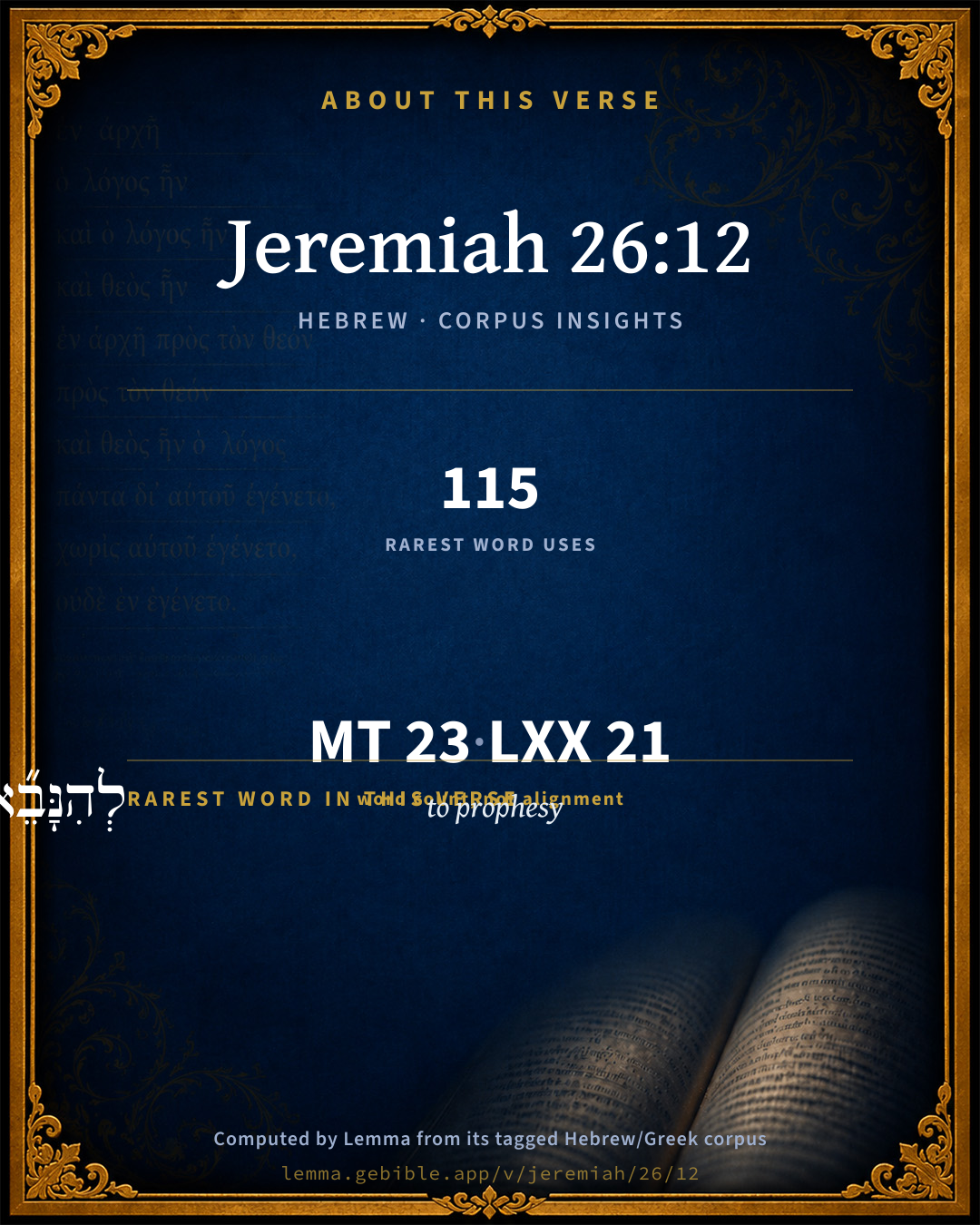
Jeremiah 26:12

Hebrew (Westminster Leningrad Codex) Jeremiah 26:12 appears in the Hebrew Old Testament. The text above is from the Westminster Leningrad Codex. Each word links to its Strong’s number, a concise gloss, and parsing drawn from the Open Scriptures Hebrew Bible morphology. Click any word for its full Brown-Driver-Briggs (BDB) entry.
Download image
Cite this verse

Jeremiah 26:12 (World English Bible). Public Domain. Lemma interlinear Bible study tool, https://lemma.gebible.app/v/jeremiah/26/12.

Show BibTeX & RIS
BibTeX
RIS
English Translation
Then spoke Jeremiah to all the princes and to all the people, saying, Yahweh sent me to prophesy against this house and against this city all the words that you have heard.
World English Bible · Public Domain
Download a study sheet

One document with this verse’s original text, its word-by-word gloss line, the meaning frame, cross-references with their text, attributed commentary, and full source and license credits — printable, and it pastes into notes with its structure intact.

This verse Autodidact and up

Study sheet (.html) Plain text (.txt)

A passage Seminary Student

Up to 50 verses in one chapter. A passage sheet keeps up to 6 commentary sources and 12 cross-references per verse, in the order this page ranks them, and says so on the sheet whenever that leaves anything out. Ask for a single verse and you get the Autodidact verse sheet above.

Everything on this page stays free to read, with no account — the sheet is a download of what is already on screen, not access to it.

Want to remove ads? Support Godless Engineer
Compare translations 3

The same verse in 3 English versions, stacked beneath the original-language interlinear above. Click any original word for its lexicon entry.

Each is an independent rendering of the whole verse — the interlinear is not word-aligned to these translations.

Highlighted words mark where these versions differ — a whole-verse word diff, not a word-by-word alignment.

  • World English Bible Public Domain
    Then spoke Jeremiah to all the princes and to all the people, saying, Yahweh sent me to prophesy against this house and against this city all the words that you have heard.
  • King James Version Public Domain
    Then spake Jeremiah unto all the princes and to all the people, saying, The LORD sent me to prophesy against this house and against this city all the words that ye have heard.
  • unfoldingWord Literal Text CC BY-SA 4.0
    And Jeremiah said to all the officials and to all the people, saying, “Yahweh sent me to prophesy against this house and against this city all the words that you have heard.

unfoldingWord Literal Text — © unfoldingWord, licensed CC BY-SA 4.0. Word-aligned USFM3 via Door43 (git.door43.org/unfoldingWord/en_ult).

Versions to compare (up to 4)

3 of 4 selected

Show all 18 translations

Every available English version of this verse, each an independent rendering of the whole verse.

  • World English Bible Public Domain
    Then spoke Jeremiah to all the princes and to all the people, saying, Yahweh sent me to prophesy against this house and against this city all the words that you have heard.
  • Berean Standard Bible Public Domain
    But Jeremiah said to all the officials and all the people, “The LORD sent me to prophesy against this house and against this city all the words that you have heard.
  • Majority Standard Bible Public Domain
    But Jeremiah said to all the officials and all the people, “The LORD sent me to prophesy against this house and against this city all the words that you have heard.
  • King James Version Public Domain
    Then spake Jeremiah unto all the princes and to all the people, saying, The LORD sent me to prophesy against this house and against this city all the words that ye have heard.
  • American Standard Version (1901) Public Domain
    Then spake Jeremiah unto all the princes and to all the people, saying, Jehovah sent me to prophesy against this house and against this city all the words that ye have heard.
  • Revised Version (1885) Public Domain
    Then spake Jeremiah unto all the princes and to all the people, saying, The LORD sent me to prophesy against this house and against this city all the words that ye have heard.
  • Geneva Bible (1599) Public Domain
    Then spake Ieremiah vnto all the princes, and to al the people, saying, The Lord hath sent me to prophecie against this house and against this citie all the things that ye haue heard.
  • Douay-Rheims (1899) Public Domain
    Then Jeremias spoke to all the princes, and to all the people, saying: The Lord sent me to prophesy concerning this house, and concerning this city all the words you have heard.
  • Young's Literal Translation Public Domain
    And Jeremiah speaketh unto all the heads, and unto all the people, saying, `Jehovah sent me to prophesy concerning this house, and concerning this city, all the words that ye have heard;
  • Literal Standard Version CC BY-SA 4.0
    And Jeremiah speaks to all the heads, and to all the people, saying, “YHWH sent me to prophesy concerning this house, and concerning this city, all the words that you have heard.
  • Unlocked Literal Bible CC BY-SA 4.0
    So Jeremiah spoke to all the officials and all the people and said, “Yahweh has sent me out to prophesy against this house and this city, to say all the words that you have heard.
  • unfoldingWord Literal Text CC BY-SA 4.0
    And Jeremiah said to all the officials and to all the people, saying, “Yahweh sent me to prophesy against this house and against this city all the words that you have heard.
  • Darby Bible Public Domain
    And Jeremiah spoke to all the princes and to all the people, saying, Jehovah sent me to prophesy against this house and against this city all the words that ye have heard.
  • World Messianic Bible Public Domain
    Then Jeremiah spoke to all the princes and to all the people, saying, “The LORD sent me to prophesy against this house and against this city all the words that you have heard.
  • Webster's Bible Public Domain
    Then Jeremiah spoke to all the princes, and to all the people, saying, The LORD sent me to prophesy against this house and against this city all the words that ye have heard.
  • Free Bible Version CC BY-SA 4.0
    Jeremiah addressed all the leaders and all the people, saying, “The Lord sent me to deliver every word of this prophecy against this Temple as you've heard.
  • Bible in Basic English Public Domain
    Then Jeremiah said to all the rulers and to all the people, The Lord has sent me as his prophet to say against this house and against this town all the words which have come to your ears.
  • JPS Tanakh (1917) Public Domain
    Then spoke Jeremiah unto all the princes and to all the people, saying: 'The LORD sent me to prophesy against this house and against this city all the words that ye have heard.

Literal Standard Version (2020), Covenant Press — licensed CC BY-SA 4.0. Text via the HelloAO Bible API (eBible.org). Unlocked Literal Bible (unfoldingWord) — licensed CC BY-SA 4.0. Text via the HelloAO Bible API (eBible.org). unfoldingWord Literal Text — © unfoldingWord, licensed CC BY-SA 4.0. Word-aligned USFM3 via Door43 (git.door43.org/unfoldingWord/en_ult). Free Bible Version, Dr. Jonathan Gallagher — licensed CC BY-SA 4.0. Text via the HelloAO Bible API (eBible.org).

Word by word

More ways to search: Search by grammar → Find every occurrence → Compare this word →

Practice this passage: Drill this verse → Learn its vocabulary →

לְהִנָּבֵ֞א
nâbâʼ
H5012
“to prophesy”
Preposition + Verb, Niphal, Infinitive Construct
Part of Speech
Preposition + Verb
Stem
Niphal
Form
Infinitive Construct
Full BDB Definition

Origin: a primitive root

TWOT: 1277

to prophesy - (Niphal) - to prophesy - under influence of divine spirit - of false prophets - (Hithpael) - to prophesy - under influence of divine spirit - of false prophets
  1. וַיֹּ֤אמֶר ʼâmar H559 “and · to say” Conjunction + Verb, Qal, Sequential Imperfect, 3rd Person, Masculine, Singular
  2. יִרְמְיָ֨הוּ֙ Yirmᵉyâh H3414 “Jeremiah” Noun, Proper
  3. אֶל ʼêl H413 “to” Preposition
  4. כָּל kôl H3605 “all of” Noun, Common, Masculine, Singular, Construct
  5. הַשָּׂרִ֔ים sar H8269 “the · princes” Particle, Definite Article + Noun, Common, Masculine, Plural, Absolute
  6. וְאֶל ʼêl H413 “and · to” Conjunction + Preposition
  7. כָּל kôl H3605 “all of” Noun, Common, Masculine, Singular, Construct
  8. הָעָ֖ם ʻam H5971 “the · people” Particle, Definite Article + Noun, Common, Masculine, Singular, Absolute
  9. לֵאמֹ֑ר ʼâmar H559 “to say” Preposition + Verb, Qal, Infinitive Construct
  10. יְהוָ֣ה Yᵉhôvâh H3068 “LORD” Noun, Proper
  11. שְׁלָחַ֗נִי shâlach H7971 “to send · me” Verb, Qal, Perfect, 3rd Person, Masculine, Singular + Suffix, Personal, 1st Person, Common, Singular
  12. אֶל ʼêl H413 “to” Preposition
  13. הַבַּ֤יִת bayith H1004 “the · house” Particle, Definite Article + Noun, Common, Masculine, Singular, Absolute
  14. הַזֶּה֙ zeh H2088 “the · this” Particle, Definite Article + Pronoun, Demonstrative, Masculine, Singular
  15. וְאֶל ʼêl H413 “and · to” Conjunction + Preposition
  16. הָעִ֣יר ʻîyr H5892 “the · city” Particle, Definite Article + Noun, Common, Feminine, Singular, Absolute
  17. הַזֹּ֔את zôʼth H2063 “the · this” Particle, Definite Article + Pronoun, Demonstrative, Feminine, Singular
  18. אֵ֥ת ʼêth H853 “-” Particle, Direct Object
  19. כָּל kôl H3605 “all of” Noun, Common, Masculine, Singular, Construct
  20. הַדְּבָרִ֖ים dâbâr H1697 “the · words” Particle, Definite Article + Noun, Common, Masculine, Plural, Absolute
  21. אֲשֶׁ֥ר ʼăsher H834 “which” Particle, Relative
  22. שְׁמַעְתֶּֽם shâmaʻ H8085 “to hear” Verb, Qal, Perfect, 2nd Person, Masculine, Plural

About this verse

These counts appear in no published source. They are computed here, from the morphology-tagged text and Lemma’s own curated glosses. What Lemma adds →

23
words
17
distinct lemmas
Prophets
section

Grammatical profile

  • 5 verbs
  • 10 nouns
  • 2 pronouns
  • 4 prepositions
  • 2 particles

Verb forms

  • וַיֹּ֤אמֶר Qal · Sequential Imperfect
  • לֵאמֹ֑ר Qal · Infinitive Construct
  • שְׁלָחַ֗נִי Qal · Perfect
  • לְהִנָּבֵ֞א Niphal · Infinitive Construct
  • שְׁמַעְתֶּֽם Qal · Perfect

Repetition

Words recur within this verse — often emphatic in Hebrew:

  • כָּל all H3605 ×3
  • וַיֹּ֤אמֶר to say H559 ×2
  • אֶל to H413 ×4

Hebrew & Septuagint length

In the original languages it is 23 Hebrew tokens and 21 Greek tokens — but the two are counted differently (Hebrew bundles its prefixes and suffixes into one token; the Greek is in lemma form), so that isn’t a like-for-like length.

Cross-references

7

Topical passages linked to Jeremiah 26:12 in the Treasury of Scripture Knowledge — connected by theme and wording, ordered by reader-vote popularity; previews shown in the World English Bible.

  • Jeremiah 26:15 Only know for certain that, if you put me to death, you will bring innocent blood on yourselves, and on this city, and on the inhabitants of it; for of a truth Yahweh has sent me to you to speak all these words in your ears.
  • Acts 4:19 But Peter and John answered them, "Whether it is right in the sight of God to listen to you rather than to God, judge for yourselves,
  • Acts 5:29 But Peter and the apostles answered, "We must obey God rather than men.
  • Jeremiah 1:17–18 You therefore gird up your loins, and arise, and speak to them all that I command you: don't be dismayed at them, lest I dismay you before them.
  • Jeremiah 26:2 Thus says Yahweh: Stand in the court of Yahweh's house, and speak to all the cities of Judah, which come to worship in Yahweh's house, all the words that I command you to speak to them; don't diminish a word.
  • Jeremiah 19:1–3 Thus said Yahweh, Go, and buy a potter's earthen bottle, and [take] of the elders of the people, and of the elders of the priests;
  • Amos 7:15–17 and Yahweh took me from following the flock, and Yahweh said to me, 'Go, prophesy to my people Israel.'

Cross-references courtesy of OpenBible.info (CC BY 4.0).

Hebrew and Greek witnesses Masoretic Hebrew ↔ Greek Septuagint

The same verse in the two great witnesses to the Old Testament, shown verse-for-verse.

These are two independent witnesses, not word-aligned to each other, and the Septuagint is shown in lemma (dictionary) form.

Hebrew Jeremiah 26:12 Masoretic · Westminster Leningrad Codex

וַיֹּ֤אמֶר יִרְמְיָ֨הוּ֙ אֶל כָּל הַשָּׂרִ֔ים וְאֶל כָּל הָעָ֖ם לֵאמֹ֑ר יְהוָ֣ה שְׁלָחַ֗נִי לְהִנָּבֵ֞א אֶל הַבַּ֤יִת הַזֶּה֙ וְאֶל הָעִ֣יר הַזֹּ֔את אֵ֥ת כָּל הַדְּבָרִ֖ים אֲשֶׁ֥ר שְׁמַעְתֶּֽם

Then spoke Jeremiah to all the princes and to all the people, saying, Yahweh sent me to prophesy against this house and against this city all the words that you have heard.

World English Bible · Public Domain

Greek LXX Structure differs

In the Septuagint, Jeremiah is about an eighth shorter than the Hebrew and arranges its material differently — the Oracles Against the Nations (Hebrew chapters 46–51) appear in the middle of the Greek book, after 25:13. Because the chapter and verse boundaries do not line up, a verse-for-verse comparison with the Hebrew is not shown.

A verse-for-verse comparison isn’t shown here because the chapters and verses don’t line up. Switch to the LXX edition with the MT / LXX toggle above to read the Greek directly.

Hebrew: Westminster Leningrad Codex (CC BY 4.0). Greek: Septuagint (public domain); English from a public-domain English Septuagint. How the Septuagint differs from the Hebrew →

Targum (Aramaic paraphrase)

1

The Targum is the ancient Jewish Aramaic paraphrase of the Hebrew Scriptures — an interpretive translation, not the Hebrew text itself. Onkelos (literal) and Pseudo-Jonathan (expansive) render the Torah, and Jonathan the Prophets. Coverage is partial: where no permissively-licensed English translation exists for a verse, only the Aramaic is shown. This is verse-level text, not a word-by-word alignment to the Hebrew.

  1. Targum Jonathan Prophets (Joshua–Malachi)
    וַאֲמַר יִרְמְיָה לְכָל רַבְרְבַיָא וּלְכָל עַמָא לְמֵימַר יְיָ שַׁלְחַנִי לְאִתְנַבָּאָה עַל בֵּיתָא הָדֵין וְעַל קַרְתָּא הָדָא יַת כָּל פִּתְגָמַיָא דִשְׁמַעֲתּוּן:

    (no public-domain English translation for this verse)

    Targum Jonathan — Aramaic: “Mikraot Gedolot” (public domain). English: “Sefaria Community Translation” (CC0 1.0 (public-domain dedication)); “London "Chaldee Paraphrase," 1871” (public domain). Text via Sefaria.

Commentary

Notes on Jeremiah 26:12 from classic Christian and Jewish commentators (each source and its license shown beneath its notes). The classic Christian expositions comment on the surrounding passage and are grouped to its opening verse, so a note may address several verses; the Jewish commentaries on the Tanakh (Rashi and others) are per-verse, so they appear only where the commentator wrote on this verse.

Lemma curates 59 commentaries, every one of them public domain or Creative Commons licensed, each selected and text-cleaned for this edition rather than reprinted as found. About our sources →

Trapp's Complete Commentary

John Trapp

Jer 26:12 Then spake Jeremiah unto all the princes and to all the people, saying, The LORD sent me to prophesy against this house and against this city all the words that ye have heard.

Ver. 12. The Lord sent me to prophesy against this house.] In this apology of the prophet thus answering for himself with a heroic spirit, five noble virtues, fit for a martyr, are by an expositor well observed: (1.) His prudence in alleging his divine mission; (2.) His charity in exhorting his enemies to repent; (3.) His humility in saying, "Behold, I am in your hand," &c.; (4.) His magnanimity and freedom of speech, in telling them that God would revenge his death; (5.) His spiritual security and fearlessness of death in so good a cause, and with so good a conscience.

John Trapp, A Commentary or Exposition upon All the Books of the Old and New Testament (1647–1656) — public domain. Text from a community e-Sword module.

Tyndale Open Study Notes

Tyndale Open Resources

26:12-13 Jeremiah argued that the Lord had sent him to speak against the city and the Temple; he added that the impending disaster would not occur if the people of Jerusalem chose to obey the Lord.

Tyndale Open Study Notes — © Tyndale Open Resources, licensed CC BY-SA 4.0. Text via the HelloAO Bible API.

Geneva Bible (1599)

Geneva Bible translators

He both showeth the cause of his doings plainly, and also threateneth them that they should nothing avail, though they should put him to death, but heap greater vengeance upon their heads.

Geneva Bible (1599) marginal notes — public domain. Text via Bolls.life.

Jamieson, Fausset & Brown

Robert Jamieson, A. R. Fausset & David Brown

Lord sent me--a valid justification against any laws alleged against him.

against . . . against--rather, "concerning." Jeremiah purposely avoids saying, "against," which would needlessly irritate. They had used the same Hebrew word (Jer 26:11), which ought to be translated "concerning," though they meant it in the unfavorable sense. Jeremiah takes up their word in a better sense, implying that there is still room for repentance: that his prophecies aim at the real good of the city; for or concerning this house . . . city [GROTIUS].

Jamieson, Fausset & Brown — Commentary Critical and Explanatory on the Whole Bible (1871) — public domain (CC PDM 1.0). Text via the HelloAO Bible API.

Adam Clarke's Commentary

Verse 12. The Lord sent me to prophesy] My commission is from him, and my words are his own. I sought not this painful office. I did not run before I was sent.

Adam Clarke's Commentary on the Bible (1810–1826) — public domain. Text from a community e-Sword/MySword module.

John Calvin's Commentaries

Jeremiah pleads only his own calling and the command of God; and thus he confutes the preposterous charge which they most impudently brought against him. There is no doubt but that he might have spoken at large, but he deemed it enough to include the substance of his defense. Had he made a long discourse, the main point might have been more obscure. He now clearly makes known the state of the question on both sides. The priests by their own authority condemned Jeremiah, because he reduced to nothing [as they thought] God’s promises, for he had threatened destruction to the city and to the temple; but Jeremiah on the other side answers, that he had declared nothing but what God had enjoined. There was need of proof, when the priests held that God was inconsistent with himself in denouncing destruction on that city, which he had undertaken to defend and protect. But the confutation of this was ready at hand, — that God had never bound himself to hypocrites and ungodly men; nay, the whole glory of the city and the majesty of the Temple were dependent on his worship; nor is there any doubt but that Jeremiah had alleged these things. But as it was the main thing, he was satisfied with stating that he had been sent by God.

Thus he indirectly condemned their vain boastings, — that God was on their side; but he says, “I come not except by God’s command.” Now, though he declares briefly and distinctly that he had been sent by God, he yet presents himself as ready to prove everything; and as I have already said, there is no doubt but that he answered and discussed that frivolous question on which the priests so much insisted.

It is further worthy of being noticed, that he addressed both the princes and the people; and thus he intimated that the priests and the prophets were deaf, and not worthy of being spoken to; for it was their determination proudly to despise God, and to carry on war, as it were avowedly, with his servants; for he would have otherwise no doubt gladly endeavored to restore them to the way of safety. But as he saw that they had closed the door against themselves, he passed them by. This is the reason why he says, that he spoke to the princes and to the people, having passed by those, on whom he must have spent labor in vain. And surely when they said that he was worthy of death, they proved by such a presumption that they would not be taught by him; and also their cruelty prevented them from being teachable. But the Prophet had regard to the very source of evil, because their object was obstinately to resist God and all his prophets.

By saying, that he was sent to prophesy all that they had heard, he made them judges, though he did not address them together with the princes; for we have seen that the latter were in the king’s palace, and had been sent for when there was a fear of some commotion. But there is no doubt but that the address was repeated again. Jeremiah then made them judges and arbitrators, when he said that he retracted nothing, but that what they had heard, he had faithfully declared according to the command of God. It follows, —

John Calvin's Commentaries (1540-1563) — public domain. Text from the Calvin Translation Society English edition (1840s-50s) via the Christian Classics Ethereal Library (ccel.org). Calvin's coverage is partial (roughly two-thirds of the Bible); uncommented books and verses are honest gaps, never fabricated. The 19th-century editor's footnotes and remarks are omitted so the notes are faithfully Calvin's own voice.

Ellicott's Commentary for English Readers

(12) The Lord sent me to prophesy . . .—The answer of the accused is that of all true prophets and preachers of the word, “The Lord God hath spoken, and he can but prophesy” (Amo_3:8). He must “obey God rather than man” (Act_5:29). And in this instance the prophet has nothing in the way of credentials but the message itself. He worked no signs or wonders.

A Bible Commentary for English Readers, edited by Charles John Ellicott (1878–1897) — public domain. Text from a community e-Sword module.

The Cambridge Bible for Schools and Colleges

gen. ed. J. J. S. Perowne

12. Jeremiah’s defence is that the message is from God and therefore true. His conviction is unshaken. Let his accusers beware, lest in putting him to death they be really fighting against God. Cp. Gamaliel in Act_5:39.

The Cambridge Bible for Schools and Colleges (gen. ed. J. J. S. Perowne; Cambridge University Press, 1878–1918) — public domain. Text from a community e-Sword module.

John Gill's Exposition

Then spake Jeremiah unto all the princes, and to all the people, saying,.... In his own defence; which, as Jerom observes, was with prudence, humility, and constancy:

the Lord sent me to prophesy against this house, and against this city, all the words that ye have heard; he does not deny but that he had prophesied against the city of Jerusalem and against the temple, and that they should both come to ruin, unless the people repented and reformed; but then he urges, that he was sent by the Lord on this errand, and that every word that he had said, and they had heard, he was ordered to say by the Lord; and therefore what was he, that he should withstand God? he surely was not to be blamed for doing what the Lord commanded him to do; besides, all this was threatened only in case they continued obstinate and impenitent; wherefore he renews his exhortations to them in Jer 26:13.

John Gill's Exposition of the Whole Bible (1746–1763) — public domain (CC PDM 1.0). Text via the HelloAO Bible API.

Albert Barnes' Notes on the Bible

The answer of Jeremiah is simple and straightforward. Yahweh, he affirmed, had truly sent him, but the sole object of his prophesying had been to avert the evil by leading them to repentance. If they would amend their ways God would deliver them from the threatened doom. As for himself he was in their hands, but if they put him to death they would bring the guilt of shedding innocent blood upon themselves and upon the city.

Albert Barnes' Notes on the Bible (1834–1885) — public domain. Text from a community e-Sword/MySword module.

Matthew Poole's English Annotations

The priests having given Jeremiah his charge, he makes his defence. The sum of which was, he acknowledgeth that he had prophesied against the temple, and against the city, and tacitly acknowledgeth their power to take cognizance of seditious persons and false prophets, and doth not deny but such persons deserved to die; but denieth that he was a false prophet, or guilty of any design to stir up sedition, for he had said nothing but what God had sent him to speak; and therefore could not prophesy what was false, nor was to be charged with any seditious design.

Matthew Poole's English Annotations on the Holy Bible (1683–1685) — public domain. Text from a community e-Sword/MySword module.

Whedon's Commentary on the Bible

Daniel D. Whedon

12. The Lord sent me — How simple and how perfect this justification! The prophets, men of his own class, join with the priests in calling for Jeremiah’s condemnation; a circumstance which must have had great weight with the people. Yet his answer is sufficient. It exculpates him, and virtually condemns them; for they, so far from giving free course to the word of God, actually hindered it.

Daniel D. Whedon (gen. ed.), Commentary on the Old and New Testaments (1874–1909) — public domain. Text from a community e-Sword module.

The Pulpit Commentary

Vers. 12-15. Jeremiah"s defense. He is conscious that he has not spoken uncommissioned, and leaves the result. He urges the people to amendment of life, while there is time, and warns them that his own unmerited death will bring a curse upon themselves.

Vers. 12-15. The defense of the witness for the truth.

I AN APPEAL TO CONSCIENCE. The message repeated in its baldest form. Its genuineness insisted upon, and its reception earnestly urged upon men. A high moral standpoint is maintained, and there is no compromise or apology. He stands at the bar of human conscience.

II OBEDIENCE TO LAWFUL AUTHORITY. He hands himself over to them to deal with him as they will; is careful to state his case as God gives him ability; and appeals to no unlawful means of deliverance.

III REFERENCE OF THE WHOLE MATTER TO GOD. God sent him that is sufficient. He has been faithful to his instructions; is really not to be judged by man, but leaves all with God. M.

The Pulpit Commentary (1880–1919), ed. H.D.M. Spence-Jones & Joseph S. Exell — public domain. Text from a community e-Sword module.

Kretzmann's Popular Commentary

Paul E. Kretzmann

Jeremiah’s Defense and Deliverance

v. 12. Then spake Jeremiah unto all the princes and to all the people, saying, The Lord sent me to prophesy against this house and against this city, rather, "to" or "concerning this house and this city"; for Jeremiah purposely avoided any expression which might cause irritation, all the words that ye have heard. He was not giving his own personal opinion or voicing any spite which he might have felt, but he had only done his duty.

v. 13. Therefore, now amend your ways and your doings, this appeal showing his disinterested motives, his desire to help his people in this emergency, and obey the voice of the Lord, your God; and the Lord will repent Him of the evil that He has pronounced against you. It was the one condition under which he could promise salvation.

v. 14. As for me, behold, I am in your hand, he was resigned to his fate at their hands; do with me as seemeth good and meet unto you; he bowed in humility and submission to the constituted authority.

v. 16. But know ye for certain that, if ye put me to death, in the hope of thereby getting rid of an unpleasant exhorter and escaping his warnings, ye shall surely bring innocent blood upon yourselves and upon this city and upon the inhabitants thereof, thereby increasing their guilt and incurring heavier penalties; for of a truth the Lord hath sent me unto you to speak all these words in your ears, Jeremiah feeling it necessary to affirm this truth a second time in order to give emphasis to his warning.

v. 16. Then said the princes and all the people unto the priests and to the prophets, in giving their verdict in this important matter, convinced of the truth of Jeremiah’s statements, This man is not worthy to die, he has not deserved to be executed as a blasphemer, for he hath spoken to us in the name of the Lord, our God. Although they had, in the beginning, clamored for his death, they had quickly been influenced in the opposite direction, after the manner of fickle mobs the world over.

v. 17. Then rose up certain of the elders of the land, either the most venerable and experienced of the princes or aged representatives of the people, who were highly respected for their wisdom, and spake to all the assembly of the people, saying,

v. 18. Micah, the Morasthite, called so after a village in the tribe of Judah, prophesied in the days of Hezekiah, king of Judah, and spake to all the people of Judah, saying, Thus saith the Lord of hosts, Zion shall be plowed like a field, after being utterly destroyed, and Jerusalem shall become heaps, a pile of ruins, and the mountain of the house, the hill Moriah, on which the Temple stood, as the high places of a forest, so that the trees of the forest would freely get a foothold there. Cf Mic 3:12. It was thus a historical fact that Jeremiah was not the first prophet or the only one who had prophesied against Jerusalem and the Temple.

v. 19. Did Hezekiah, king of Judah, and all Judah put him at all to death? Did they attempt to escape his unpleasant message by putting him to death? Did he not, instead of venting a possible personal spite in such a manner, fear the Lord and besought the Lord, begging Him to show mercy upon His people, and the Lord repented Him of the evil which He had pronounced against them? Thus, namely by killing Jeremiah as had been suggested, might we procure great evil against our souls, they might bring upon themselves the swift judgment of God. Moreover, the elders have still another historical example to urge in this case.

v. 20. And there was also a man that prophesied in the name of the Lord, Urijah, the son of Shemaiah, of Kirjath-jearim, a prophet otherwise unknown, who prophesied against this city and against this land according to all the words of Jeremiah, that is, in the same manner, his message having the same content,

v. 21. and when Jehoiakim, the king, with all his mighty men and all the princes, the most powerful men of the nation, heard his words, the king sought to put him to death; but when Urijah heard it, being informed of the king’s intention, he was afraid and fled and went into Egypt, where he hoped to find security;

v. 22. and Jehoiakim, the king, who had been placed on the throne by Pharaoh of Egypt, 2Ki 23:34, sent men into Egypt, namely, Einathan, the son of Ach-bor, and certain men with him into Egypt.

v. 23. And they fetched forth Urijah out of Egypt, whose people readily delivered him to their allies, and brought him unto Jehoiakim, the king, who slew him with the sword and cast his dead body into the graves of the common people, in the Valley of the Kidron, instead of giving it the honorable burial of a prophet of the Lord.

v. 24. Nevertheless, the hand of Ahikam, the son of Shaphan, the worthy son of a noble father, 2Ki 22:12-14, and the father of Gedaliah, who followed in his steps, 2Ki 25:22, was with Jeremiah, he brought all his influence to bear in his favor, that they should not give him into the hand of the people to put him to death, for this course was sometimes followed by rulers in order to remove the stigma of a judicial murder from themselves. Note: Urijah was faithful in delivering his message, but erred in this, that he forsook his post when danger threatened; so God permitted him to lose his life, while that of Jeremiah was spared. God’s ministers must firmly believe that He can and will protect them in every emergency, according to His will.

Paul E. Kretzmann, Popular Commentary of the Bible (1921–1924) — public domain. Text from a community e-Sword module.

Lesson kit

Teaching starters — assembled from the data on this page, not authored interpretation. Every prompt links to the verse data it draws on. Edit before teaching.

Jeremiah, in the Prophets, opens this verse with 23 words (17 distinct Hebrew lemmas). Its most distinctive word is nâbâʼ (“to prophesy”). A historical commentator’s framing appears above. Read the whole chapter for the surrounding context.

Discussion questions

  1. The word nâbâʼ carries the sense “to prophesy.” How does it shape the verse?
  2. Jeremiah 26:15 shares this passage’s theme. How do the two illuminate each other?
  3. “all” occurs 3× in this one verse. What is the effect of the repetition?
  4. These translations render this verse differently; the difference is in the English rendering, not the original. What questions does that raise?
  5. The verb «וַיֹּ֤אמֶר» is Qal Sequential Imperfect. How does its form color the action?
  6. Reading how Trapp's Complete Commentary and Tyndale Open Study Notes read this verse, where do the two commentators agree and where do they part?

Things to notice

Reading settings

Reading text

Shown beneath each verse's original-language words.

Old Testament
Old Testament edition

Read the OT as the Masoretic Hebrew (MT) or the Greek Septuagint (LXX).

English shown for the Greek Septuagint (in the Hebrew ↔ Greek comparison).

Comparing translations? Open the Compare panel on any verse page to stack up to four side by side.