
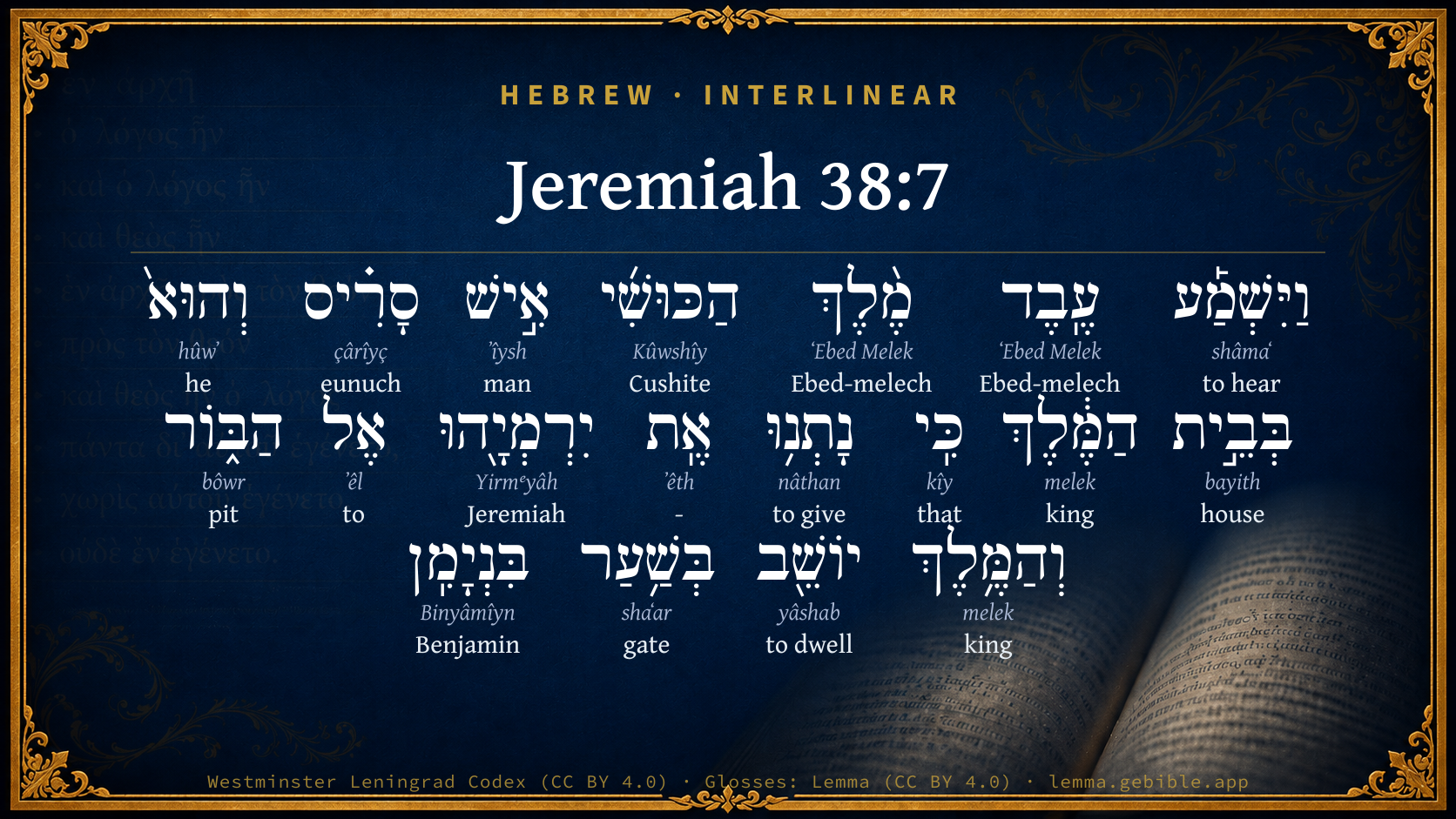
Jeremiah 38:7

Hebrew (Westminster Leningrad Codex) Jeremiah 38:7 appears in the Hebrew Old Testament. The text above is from the Westminster Leningrad Codex. Each word links to its Strong’s number, a concise gloss, and parsing drawn from the Open Scriptures Hebrew Bible morphology. Click any word for its full Brown-Driver-Briggs (BDB) entry.
Download image
Cite this verse

Jeremiah 38:7 (World English Bible). Public Domain. Lemma interlinear Bible study tool, https://lemma.gebible.app/v/jeremiah/38/7.

Show BibTeX & RIS
BibTeX
RIS
English Translation
Now when Ebedmelech the Ethiopian, a eunuch, who was in the king's house, heard that they had put Jeremiah in the dungeon (the king then sitting in the gate of Benjamin),
World English Bible · Public Domain
Highlights
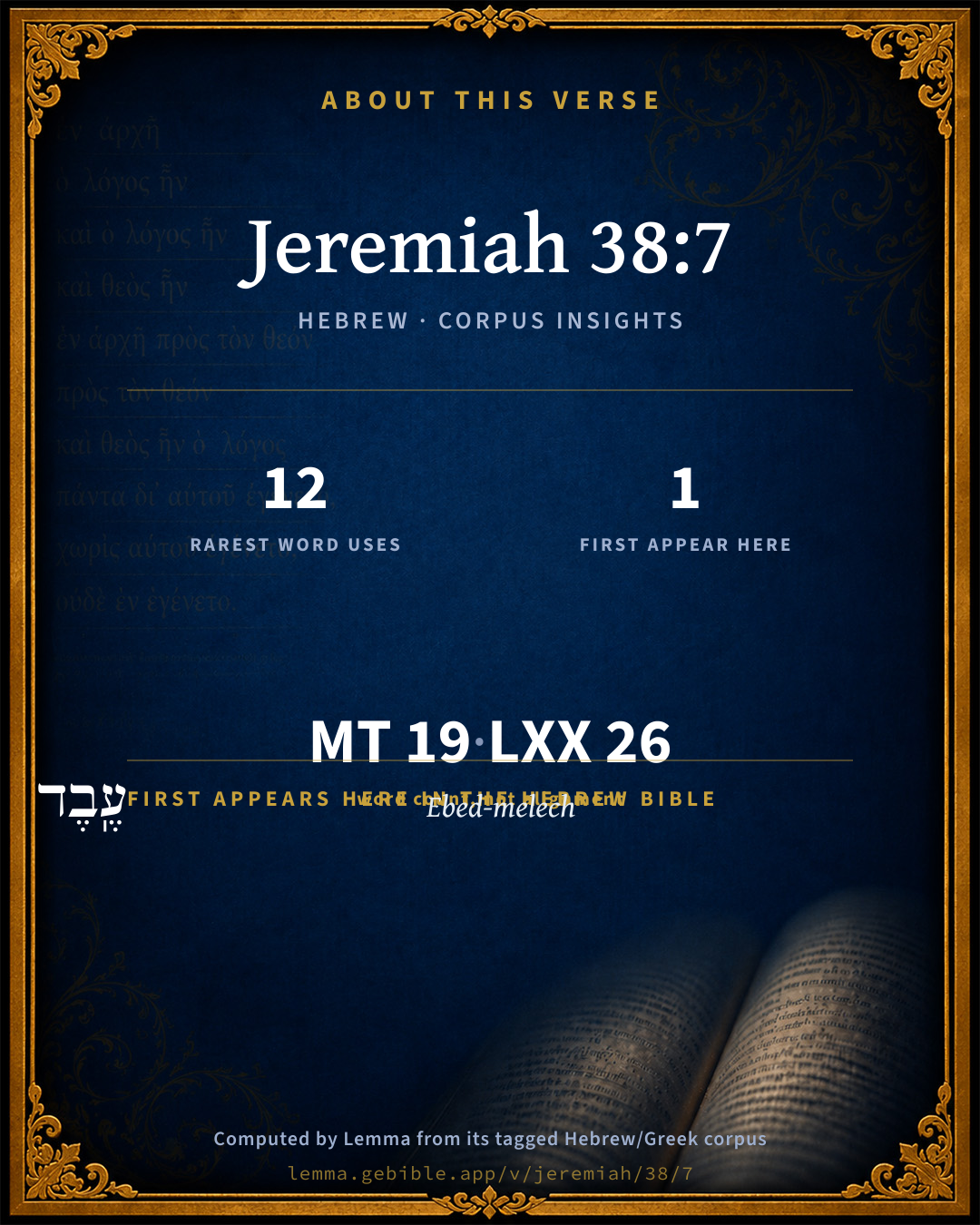
  • 1 first appearance in the Hebrew Bible
Full analysis ↓
Download a study sheet

One document with this verse’s original text, its word-by-word gloss line, the meaning frame, cross-references with their text, attributed commentary, and full source and license credits — printable, and it pastes into notes with its structure intact.

This verse Autodidact and up

Study sheet (.html) Plain text (.txt)

A passage Seminary Student

Up to 50 verses in one chapter. A passage sheet keeps up to 6 commentary sources and 12 cross-references per verse, in the order this page ranks them, and says so on the sheet whenever that leaves anything out. Ask for a single verse and you get the Autodidact verse sheet above.

Everything on this page stays free to read, with no account — the sheet is a download of what is already on screen, not access to it.

Want to remove ads? Support Godless Engineer
Compare translations 3

The same verse in 3 English versions, stacked beneath the original-language interlinear above. Click any original word for its lexicon entry.

Each is an independent rendering of the whole verse — the interlinear is not word-aligned to these translations.

Highlighted words mark where these versions differ — a whole-verse word diff, not a word-by-word alignment.

  • World English Bible Public Domain
    Now when Ebedmelech the Ethiopian, a eunuch, who was in the king's house, heard that they had put Jeremiah in the dungeon (the king then sitting in the gate of Benjamin),
  • King James Version Public Domain
    Now when Ebedmelech the Ethiopian, one of the eunuchs which was in the king's house, heard that they had put Jeremiah in the dungeon; the king then sitting in the gate of Benjamin;
  • unfoldingWord Literal Text CC BY-SA 4.0
    Now Ebed-Melek the Cushite was one of the eunuchs in the king’s house. He heard that they had placed Jeremiah in the cistern. Now the king was sitting at the Benjamin Gate.

unfoldingWord Literal Text — © unfoldingWord, licensed CC BY-SA 4.0. Word-aligned USFM3 via Door43 (git.door43.org/unfoldingWord/en_ult).

Versions to compare (up to 4)

3 of 4 selected

Show all 18 translations

Every available English version of this verse, each an independent rendering of the whole verse.

  • World English Bible Public Domain
    Now when Ebedmelech the Ethiopian, a eunuch, who was in the king's house, heard that they had put Jeremiah in the dungeon (the king then sitting in the gate of Benjamin),
  • Berean Standard Bible Public Domain
    Now Ebed-melech the Cushite, a court official in the royal palace, heard that Jeremiah had been put into the cistern. While the king was sitting at the Gate of Benjamin,
  • Majority Standard Bible Public Domain
    Now Ebed-melech the Cushite, a court official in the royal palace, heard that Jeremiah had been put into the cistern. While the king was sitting at the Gate of Benjamin,
  • King James Version Public Domain
    Now when Ebedmelech the Ethiopian, one of the eunuchs which was in the king's house, heard that they had put Jeremiah in the dungeon; the king then sitting in the gate of Benjamin;
  • American Standard Version (1901) Public Domain
    Now when Ebed-melech the Ethiopian, a eunuch, who was in the king's house, heard that they had put Jeremiah in the dungeon (the king then sitting in the gate of Benjamin,)
  • Revised Version (1885) Public Domain
    Now when Ebed-melech the Ethiopian, an eunuch, which was in the king’s house, heard that they had put Jeremiah in the dungeon; the king then sitting in the gate of Benjamin;
  • Geneva Bible (1599) Public Domain
    Now when Ebed-melech ye blacke More one of ye Eunuches, which was in the kings house, heard that they had put Ieremiah in the dungeon (then the King sate in the gate of Beniamin)
  • Douay-Rheims (1899) Public Domain
    Now Abdemelech the Ethiopian, an eunuch that was in the king's house, heard that they had put Jeremias in the dungeon: but the king was sitting in the gate of Benjamin.
  • Young's Literal Translation Public Domain
    And Ebed-Melech the Cushite, a eunuch who `is' in the king's house, heareth that they have put Jeremiah into the pit; and the king is sitting at the gate of Benjamin,
  • Literal Standard Version CC BY-SA 4.0
    And Ebed-Melech the Cushite, a eunuch who [is] in the king’s house, hears that they have put Jeremiah into the pit; and the king is sitting at the Gate of Benjamin,
  • Unlocked Literal Bible CC BY-SA 4.0
    Now Ebed-Melek the Cushite was one of the eunuchs in the king's house. He heard that they had placed Jeremiah in the cistern. Now the king was sitting at the Benjamin Gate.
  • unfoldingWord Literal Text CC BY-SA 4.0
    Now Ebed-Melek the Cushite was one of the eunuchs in the king’s house. He heard that they had placed Jeremiah in the cistern. Now the king was sitting at the Benjamin Gate.
  • Darby Bible Public Domain
    And Ebed-melech the Ethiopian, a eunuch who was in the king's house, heard that they had put Jeremiah in the dungeon -- now the king was sitting in the gate of Benjamin,
  • World Messianic Bible Public Domain
    Now when Ebedmelech the Ethiopian, a eunuch, who was in the king’s house, heard that they had put Jeremiah in the dungeon (the king was then sitting in Benjamin’s gate),
  • Webster's Bible Public Domain
    Now when Ebed-melech the Cushite, one of the eunuchs who was in the king's house, heard that they had put Jeremiah in the dungeon; the king then sitting in the gate of Benjamin;
  • Free Bible Version CC BY-SA 4.0
    Ebed-melech the Cushite, a royal official in the king's palace, found out that they had put Jeremiah in the cistern. The king was sitting at the Benjamin Gate,
  • Bible in Basic English Public Domain
    Now it came to the ears of Ebed-melech the Ethiopian, an unsexed servant in the king's house, that they had put Jeremiah into the water-hole; the king at that time being seated in the doorway of Benjamin:
  • JPS Tanakh (1917) Public Domain
    Now when Ebed-melech the Ethiopian, an officer, who was in the king's house, heard that they had put Jeremiah in the pit; the king then sitting in the gate of Benjamin;

Literal Standard Version (2020), Covenant Press — licensed CC BY-SA 4.0. Text via the HelloAO Bible API (eBible.org). Unlocked Literal Bible (unfoldingWord) — licensed CC BY-SA 4.0. Text via the HelloAO Bible API (eBible.org). unfoldingWord Literal Text — © unfoldingWord, licensed CC BY-SA 4.0. Word-aligned USFM3 via Door43 (git.door43.org/unfoldingWord/en_ult). Free Bible Version, Dr. Jonathan Gallagher — licensed CC BY-SA 4.0. Text via the HelloAO Bible API (eBible.org).

Word by word

More ways to search: Search by grammar → Find every occurrence → Compare this word →

Practice this passage: Drill this verse → Learn its vocabulary →

עֶֽבֶד
ʻEbed Melek
H5663
“Ebed-melech”
Noun, Proper
Part of Speech
Noun
Type
Proper
Full BDB Definition

Origin: from H5650 and H4428

TWOT: None

Ebed-melech = "servant of the king" - an Ethiopian eunuch in the service of king Zedekiah, through whose interference Jeremiah was released from prison
  1. וַיִּשְׁמַ֡ע shâmaʻ H8085 “and · to hear” Conjunction + Verb, Qal, Sequential Imperfect, 3rd Person, Masculine, Singular
  2. מֶ֨לֶךְ ʻEbed Melek H5663 “Ebed-melech” Noun, Proper
  3. הַכּוּשִׁ֜י Kûwshîy H3569 “the · Cushite” Particle, Definite Article + Noun, Gentilic, Masculine, Singular, Absolute
  4. אִ֣ישׁ ʼîysh H376 “man of” Noun, Common, Masculine, Singular, Construct
  5. סָרִ֗יס çârîyç H5631 “eunuch” Noun, Common, Masculine, Singular, Absolute
  6. וְהוּא֙ hûwʼ H1931 “and · he” Conjunction + Pronoun, Personal, 3rd Person, Masculine, Singular
  7. בְּבֵ֣ית bayith H1004 “in/at · house of” Preposition + Noun, Common, Masculine, Singular, Construct
  8. הַמֶּ֔לֶךְ melek H4428 “the · king” Particle, Definite Article + Noun, Common, Masculine, Singular, Absolute
  9. כִּֽי kîy H3588 “that” Conjunction
  10. נָתְנ֥וּ nâthan H5414 “to give” Verb, Qal, Perfect, 3rd Person, Common, Plural
  11. אֶֽת ʼêth H853 “-” Particle, Direct Object
  12. יִרְמְיָ֖הוּ Yirmᵉyâh H3414 “Jeremiah” Noun, Proper
  13. אֶל ʼêl H413 “to” Preposition
  14. הַבּ֑וֹר bôwr H953 “the · pit” Particle, Definite Article + Noun, Common, Masculine, Singular, Absolute
  15. וְהַמֶּ֥לֶךְ melek H4428 “and · the · king” Conjunction + Particle, Definite Article + Noun, Common, Masculine, Singular, Absolute
  16. יוֹשֵׁ֖ב yâshab H3427 “dwelling” Verb, Qal, Participle Active, Masculine, Singular, Absolute
  17. בְּשַׁ֥עַר shaʻar H8179 “in/at · gate of” Preposition + Noun, Common, Masculine, Singular, Construct
  18. בִּנְיָמִֽן Binyâmîyn H1144 “Benjamin” Noun, Proper

About this verse

These counts appear in no published source. They are computed here, from the morphology-tagged text and Lemma’s own curated glosses. What Lemma adds →

19
words
17
distinct lemmas
Prophets
section

Notable vocabulary

The rarest word here is עֶֽבֶד Ebed-melech H5663 — appearing just 12 times in the whole Hebrew Bible.

First appearance in Scripture

This word makes its first canonical appearance in the Hebrew Bible here:

  • עֶֽבֶד Ebed-melech H5663

Shared distinctive vocabulary

עֶֽבֶד Ebed-melech H5663 occurs in 6 verses of the Hebrew Bible. Also found in:

Grammatical profile

  • 3 verbs
  • 12 nouns
  • 1 pronoun
  • 1 preposition
  • 1 conjunction
  • 1 particle

Verb forms

  • וַיִּשְׁמַ֡ע Qal · Sequential Imperfect
  • נָתְנ֥וּ Qal · Perfect
  • יוֹשֵׁ֖ב Qal · Participle Active

Repetition

Words recur within this verse — often emphatic in Hebrew:

  • עֶֽבֶד Ebed-melech H5663 ×2
  • הַמֶּ֔לֶךְ king H4428 ×2

Hebrew & Septuagint length

In the original languages it is 19 Hebrew tokens and 26 Greek tokens — but the two are counted differently (Hebrew bundles its prefixes and suffixes into one token; the Greek is in lemma form), so that isn’t a like-for-like length.

Cross-references

15

Topical passages linked to Jeremiah 38:7 in the Treasury of Scripture Knowledge — connected by theme and wording, ordered by reader-vote popularity; previews shown in the World English Bible.

  • Amos 5:10 They hate him who reproves in the gate, And they abhor him who speaks blamelessly.
  • Deuteronomy 21:19 then shall his father and his mother lay hold on him, and bring him out to the elders of his city, and to the gate of his place;
  • Jeremiah 29:2 (after that Jeconiah the king, and the queen-mother, and the eunuchs, [and] the princes of Judah and Jerusalem, and the craftsmen, and the smiths, were departed from Jerusalem),
  • Jeremiah 37:13 When he was in the gate of Benjamin, a captain of the guard was there, whose name was Irijah, the son of Shelemiah, the son of Hananiah; and he laid hold on Jeremiah the prophet, saying, You are falling away to the Chaldeans.
  • Jeremiah 13:23 Can the Ethiopian change his skin, or the leopard his spots? then may you also do good, who are accustomed to do evil.
  • Jeremiah 39:16–18 Go, and speak to Ebedmelech the Ethiopian, saying, Thus says Yahweh of Hosts, the God of Israel: Behold, I will bring my words on this city for evil, and not for good; and they shall be accomplished before you in that day.
  • Matthew 8:11–12 I tell you that many will come from the east and the west, and will sit down with Abraham, Isaac, and Jacob in the Kingdom of Heaven,
  • Matthew 20:16 So the last will be first, and the first last. For many are called, but few are chosen."
  • Luke 10:30–36 Jesus answered, "A certain man was going down from Jerusalem to Jericho, and he fell among robbers, who both stripped him and beat him, and departed, leaving him half dead.
  • Luke 13:29–30 They will come from the east, west, north, and south, and will sit down in the Kingdom of God.
  • 2 Kings 24:15 He carried away Jehoiachin to Babylon; and the king's mother, and the king's wives, and his officers, and the chief men of the land, carried he into captivity from Jerusalem to Babylon.
  • Job 29:7–17 When I went forth to the city gate, When I prepared my seat in the street,
  • Psalms 68:31 Princes shall come out of Egypt. Ethiopia shall hurry to stretch out her hands to God.
  • Jeremiah 34:19 the princes of Judah, and the princes of Jerusalem, the eunuchs, and the priests, and all the people of the land, who passed between the parts of the calf;
  • Acts 8:27–39 He arose and went; and behold, there was a man of Ethiopia, a eunuch of great authority under Candace, queen of the Ethiopians, who was over all her treasure, who had come to Jerusalem to worship.

Cross-references courtesy of OpenBible.info (CC BY 4.0).

Hebrew and Greek witnesses Masoretic Hebrew ↔ Greek Septuagint

The same verse in the two great witnesses to the Old Testament, shown verse-for-verse.

These are two independent witnesses, not word-aligned to each other, and the Septuagint is shown in lemma (dictionary) form.

Hebrew Jeremiah 38:7 Masoretic · Westminster Leningrad Codex

וַיִּשְׁמַ֡ע עֶֽבֶד מֶ֨לֶךְ הַכּוּשִׁ֜י אִ֣ישׁ סָרִ֗יס וְהוּא֙ בְּבֵ֣ית הַמֶּ֔לֶךְ כִּֽי נָתְנ֥וּ אֶֽת יִרְמְיָ֖הוּ אֶל הַבּ֑וֹר וְהַמֶּ֥לֶךְ יוֹשֵׁ֖ב בְּשַׁ֥עַר בִּנְיָמִֽן

Now when Ebedmelech the Ethiopian, a eunuch, who was in the king's house, heard that they had put Jeremiah in the dungeon (the king then sitting in the gate of Benjamin),

World English Bible · Public Domain

Greek LXX Structure differs

In the Septuagint, Jeremiah is about an eighth shorter than the Hebrew and arranges its material differently — the Oracles Against the Nations (Hebrew chapters 46–51) appear in the middle of the Greek book, after 25:13. Because the chapter and verse boundaries do not line up, a verse-for-verse comparison with the Hebrew is not shown.

A verse-for-verse comparison isn’t shown here because the chapters and verses don’t line up. Switch to the LXX edition with the MT / LXX toggle above to read the Greek directly.

On this verse, Ellicott's Commentary for English Readers discusses the Septuagint’s reading. Read the note in Commentary ↓

Hebrew: Westminster Leningrad Codex (CC BY 4.0). Greek: Septuagint (public domain); English from a public-domain English Septuagint. How the Septuagint differs from the Hebrew →

Targum (Aramaic paraphrase)

1

The Targum is the ancient Jewish Aramaic paraphrase of the Hebrew Scriptures — an interpretive translation, not the Hebrew text itself. Onkelos (literal) and Pseudo-Jonathan (expansive) render the Torah, and Jonathan the Prophets. Coverage is partial: where no permissively-licensed English translation exists for a verse, only the Aramaic is shown. This is verse-level text, not a word-by-word alignment to the Hebrew.

  1. Targum Jonathan Prophets (Joshua–Malachi)
    וּשְׁמַע עַבְדָא דְמַלְכָּא צִדְקִיָה גְבַר רַב וְהוּא בְּבֵית מַלְכָּא אֲרֵי יְהָבוּ יַת יִרְמְיָה לְגוּבָא וּמַלְכָּא יָתֵיב בִּתְרַע שִׁבְטָא בִנְיָמִין:

    (no public-domain English translation for this verse)

    Targum Jonathan — Aramaic: “Mikraot Gedolot” (public domain). English: “Sefaria Community Translation” (CC0 1.0 (public-domain dedication)); “London "Chaldee Paraphrase," 1871” (public domain). Text via Sefaria.

Commentary

Notes on Jeremiah 38:7 from classic Christian and Jewish commentators (each source and its license shown beneath its notes). The classic Christian expositions comment on the surrounding passage and are grouped to its opening verse, so a note may address several verses; the Jewish commentaries on the Tanakh (Rashi and others) are per-verse, so they appear only where the commentator wrote on this verse.

Lemma curates 59 commentaries, every one of them public domain or Creative Commons licensed, each selected and text-cleaned for this edition rather than reprinted as found. About our sources →

Trapp's Complete Commentary

John Trapp

Jer 38:7 Now when Ebedmelech the Ethiopian, one of the eunuchs which was in the king’s house, heard that they had put Jeremiah in the dungeon; the king then sitting in the gate of Benjamin;

Ver. 7. Now when Ebedmelech the Ethiopian.] But a proselyte, and a religious prince; a stranger, but (as that good Samaritan in the Gospel) more merciful than any of the Jewish nation, who gloried in their privileges. See Rom 2:26-27.

One of the eunuchs.] And eunuchs, say the Rabbis, are ordinarily more cruel than other men; but so was not this Cushite. Piety is the fountain of all virtues whatsoever.

Which was in the king’s house.] As Obadiah was in Ahab’s, Nehemiah in Artaxerxes’s; some good people in Herod’s; {Luk 8:3} and Nero’s; {Php 4:22} Cromwell and Cranmer in Henry VIII’s.

The king then sitting in the gate of Benjamin.] Sitting in judgment, where Jeremiah’s enemies had once apprehended him for a fugitive, but durst not try it out with him, though Ebedmelech there entreated with the king for him in the presence of some of them, as it is probable.

John Trapp, A Commentary or Exposition upon All the Books of the Old and New Testament (1647–1656) — public domain. Text from a community e-Sword module.

The Biblical Illustrator

Joseph S. Exell

Jer_38:7-13

Ebed-melech the Ethiopian.

Ebed-melech the Ethiopian

A slave from the Soudan, an eunuch in the household of Zedekiah, King of Judah, is by the side of the great Jeremiah, a humble servant yet an efficient protector. The slave and the prophet in our thought abide together.

I. the circumstances which brought the two together and caused the strange conjunction. The prophet is cast into a dungeon, deep and loathsome. Into the slime of its unfloored depths he sinks, and there he lies. Left to die and rot in the dungeons mud! No. One mans voice is raised, one mans hand works. But no son of Israel is he; only a slave of the royal household, a heathen from a far-off land, with a black skin but a pure heart.

II. The deliverer. What his own name was we know not, for among the royal servants he was known only as Ebed-melech, the kings slave. Whether he was of the original Hamitic or of the invading Semitic stock we cannot conjecture, save that, from his position, there is an inherent probability that he was of the former. We are at liberty, then, to conceive of him as a black, though probably not a negro, torn from his home, either as a boy or youth, to meet the demands of the market at Meroe; and then, in the way of traffic, passed on through Egypt, till at last he passed into the palace of the King of Judah. We can next conceive of him, by the exercise of the qualities of intelligence, fidelity, and prudence, promoted to the important post of superintendent of the royal harem. He would thus come into contact with Jeremiah, who, as the last of the prophet statesmen of Judah (as he has been called), had for many years compelled for himself a place in the councils of the nation The simple nature of the Ethiopian, uncorrupted by the vices of palace life, would recognise the moral and spiritual elevation of the prophet, and would yield a homage and a love of which the heartless courtiers Who despised him were incapable. His position brought him into frequent intercourse with the king; perhaps gave him a free access to his presence. None could know better than he his weaknesses and his vices; hut he would also know, as most could not, that in his debased mind were certain possibilities of justice and generosity to which an appeal might be made. Hopeful or hopeless, the brave heathen resolves that appeal there shall he. And after a right honest and straightforward fashion he sets him to his task. Well done, slave! Bravely spoken, Soudanee! Was there another man in all Jerusalem man enough to have done thy work! I trow not. But it is an ill turn thou hast done for thyself! Where is thy prudence, man? Who is this Jeremiah for whom thou art pleading? The lost and almost the last advocate of a lost cause. Who are these men whom thou art arraigning? The magnates of the realm, in whose hands the king is but a feeble, though it may be a well-meaning puppet. What supports canst thou expect to secure? None, unless it be the secret friendship of a few frightened men, whose favour is nought. What enemies canst thou not fail to make? The princes of Judah, whose frown may be death. But fear not, thou kings slave! Chariots and horsemen are upon the hills round about thee. There is an unseen Friend whose favour is life; and there is an immortal Church to call thee blessed. The kings better nature is roused by the appeal. Rising for the moment above the unkingly fear of his nobles, he exercises his royal prerogative, and commissions Ebed-melech, to take a sufficient force and release the prophet from the dungeon. Speedily, tenderly, and joyfully it is done. The forethought displayed, the various precautions to secure the exhausted victim from further danger or discomfort, are minutely and gratefully detailed.

III. Thoughts which such an incident arouses in the mind. It would be easy to descant upon the moral lessons which the incident teaches, to make Ebed-melech the peg on which to hang edifying reflections. He might easily be made into a lay figure to do duty for the showing off of such thoughts as these: that God uses instruments selected from among the lowly as well as the lofty; that the faithful discharge of the offices of commonest humanity is noted, approved of, and will finally be owned by the God of providence; that in most unlikely places, among most unlikely classes, Gods servants, His because servants of righteousness and humanity, are to be found; that He has His hidden ones where the eye of man suspects not; and that the faith that God desires to see in men is that trust in Him and that supreme homage to the claims of charity and truth which will cause them to do right, and leave the issues to work themselves out as they may in subjection to His will. But I do not desire the man to he lost in the meditations. I want us to see men under the influence of motives that may he ours, to enter into the human feeling, to sympathise with the human surrender, and to behold in these that which God loves to behold in His creature-children. Jehovah says, Thy life shall be for a prey unto thee, because thou hast put thy trust in Me. A thought of comfort, quickening, and strength is here suggested; those who do right, follow charity, work humanely--not because these things will pay, but because they are what they are, leaving consequences to come as come they may--these are trusting God, these are His worshippers, even though they have never learned His name. (G. M. Grant, B. D.)

Deliverance from an unwonted quarter

Strange, too, was the quarter from which deliverance came to the prophet. Not from the company of priests to which he belonged; not from that of the prophets of which he was the greatest member of that age; not even from his brethren according to the flesh, but from an alien to the commonwealth of Israel--an Ethiopian, a son of the despised Ham. It is very curious and beautiful to find these Scriptures--Jewish though they be--studded over with bright examples of goodness from the nations around. One of its noblest prophecies is from the mouth of Balaam the Midianite. Deliverance came to its greatest prophet (so far as action goes) from Zarephath, which belongeth to Sidon, from a woman that was a widow. What Thomas Carlyle called the grandest thing in all literature is from Job, who probably was not of the seed of Abraham. And when we come to the New Testament, in a Roman soldier Christ found faith nobler than that of any in Israel, and in a Samaritan woman He found His first missionary. The Jew might stand aloof in proud isolation, but the Book he reverenced called nothing common or unclean. (The Quiver.)

Ebed-melech, the model of kindness

I. It is easy to show kindness. Some things are very hard to do. We know for how many years the Government of England, of our own country, and of other nations, have been trying to find the way to the North Pole. How much money has been spent, and how many valuable lives have been test in these attempts! And vet they have never succeeded. Getting to the North Pole is a very hard thing to do. Some things can only be done by those who have plenty of money. But it is very different with the work of showing kindness. There is nothing hard about this. We do not need much money to do it. The poor can show kindness, as well as the rich. Ebed-melech was a poor coloured man--the slave of King Zedekiah; yet he managed to show real kindness to the prophet Jeremiah. He wag the means of saving his life.

II. Kindness is useful. Ebed-melechs kindness was useful to Jeremiah, because it saved his life. He lived for years after this, and was the means of doing a great deal of good to the people of Israel who were living then. Jeremiah has been useful to the Church of God, ever since that day, by the prophecies which he wrote. And a large portion of those prophecies was written after the day in which Ebed-melech saved his life. And this shows us how great the usefulness was of Ebed-melechs kindness. And in learning to show kindness to others, there is no telling how much good we may do.

III. Kindness is profitable. God sent word to Ebed-melech, by Jeremiah, that when Jerusalem should be taken by the Assyrians, He would put it into their hearts to show kindness to him by sparing his life. And so it came to pass. (R. Newton, D. D.)

Put now these old cast clouts and rotten rags under thine arm-holes under the cords.

Gentleness in doing good

I. The example of Ebed-melech should be followed by those who wish to show real kindness to the poor. When poverty cometh as an armed man (Pro_6:11), blighting hope, and bringing wretchedness in his train, a heart must be harder than stone, which is not moved with compassion. To show kindness to the needy, at the right time, and in the best way, should be the study of those who would be followers of Jesus. Experience has shown that it is generally far better to put people in the way of getting employment, than to make them feel their dependence by directly relieving their wants.

II. A lesson for those who are anxious to rescue perishing sinners from going down to the pit. Harsh words are quite out of place, even to the most depraved; and we can hardly claim to be disciples of Him who will not break the bruised reed, nor quench the smoking flax (Isa_42:3), if we venture to speak them. It is far better to lower the silken cords of Divine love, and the soft cushions of the promises, and to address words of encouragement to those who are groping in darkness. He that winneth souls is wise (Pro_11:30). The word winneth is the important one. It suggests something besides labour and painstaking. Winning implies gentleness, and a sincere interest in the souls of others. No one will be made better by scolding, or sarcasm; but he who will imitate Ebed-melech, in his thoughtful tenderness, will be successful in his work.

III. The example of Ebed-melech deserves to be remembered by those who would bring others into the fold of Christs Church. Very little is ever accomplished for the Master by harsh and uncharitable controversy. (J. N. Norton, D. D.)

The captive rescued

Here we see tenderness and compassion. There is much in doing a kind action in a kind way. A charity may be so given as to wound the recipient; and a good deed, accompanied by kind words, is like a gem set in pure gold. Let us ever be careful that when we try to help others, we do our task with tenderness to the feelings and prejudices of those we would aid. But the events of old times were full of foreshadowings of the great central fact of the worlds redemption.

1. In Ebed-melech, therefore, we may behold a type of One who comes forth from the palace of the Great King to loose the captives chains. Our Saviour stoops down to help us. The cords of His love and compassion lift us up, and restore us to that service which is perfect liberty.

2. But again, in this narrative there is a very good illustration of the too often forgotten truth that in mans redemption he has his own part to do. If it was Ebed-melech who let down the cords, yet Jeremiah had to fix them under his arms to such a position that he might safely be drawn up. Work out your own salvation is the plain direction of the apostle.

3. Again, there seems to be a lesson of instruction in this point--that the rags and castaway fragments of garments were made useful in the way of making easier the deliverance of Jeremiah, things which were worthless in themselves used for a good and excellent purpose. So many things, at which men scoff, saying, How can they save souls? are, by Gods blessing, made of use.

4. Lastly, let us take Ebed-melech for an example. Can we not strive to rescue some soul! Cannot we, like the thirty servants of the king, aid in letting down the cords, or protect those who are doing so? We may at least lower down the cords of prayer and entreaty. (W. Hardman, LL. D.)

Ropes and rags

The story is an illustration of the way God saves men. Jeremiahs danger and deliverance were very real. In that dungeon he is, indeed, in an horrible pit. No hope of escape. No light, no firm standing, every prospect of death, and in no long time either. Would to God that we preachers could see the real danger to which sinners are exposed! Jeremiah was delivered, brought up out of the miry clay. But the prophets salvation was only a feeble picture of what Gods grace does for those who take hold on Jesus. He remained in the courts of the prison. Whom the Son makes free are free indeed. We who rest in Jesus may walk about the courts of the Kings palace.

I. Mark you, help always comes from above. Jeremiah found it so. It was useless to try to climb out of the dungeon, it was only to fall deeper into the mire. Salvation is of the Lord. You cannot save yourself. The effort will only exhaust you. Cry unto the Lord. Say, O Lord, deliver my soul. He is sure to hear your cry. Ebed-melech is only a very poor picture of Jesus. The Saviour does more than send down a rope. He comes Himself and lifts us up. Although Ebed-melech may be a very poor type of Jesus Christ, he is a very good picture of the style in which one man may help another.

II. He had sympathy. Now, sympathy is the mother of help.

III. Ebed-melech did not allow difficulty to deter him. Some men can work hard so long as there are no difficulties; opposition to them is like a hill on a jibbing horse; they must stop now: they did not look for this sort of thing, you know. Just so, the eunuch found it was not easy--it never is--to undo wrong. A stout heart to a stiff brae, is common sense as well as right. If you mean to help others, you will have to pull hard against the stream.

IV. Ebed-melech teaches us to spare the feelings of those we help. He lowered down the old rags and clouts he had gathered, and bade the prophet put them under his armpits, so as not to have them cut by the ropes. The rope of deliverance should not cut the flesh of those we save. This is not always thought of. We may wound men in helping them, and they may like the remedy less than the disease. We should think of the feelings, as well as the wants of those we help. Shall we not imitate Him of whom it is said, He will not break the bruised reed? When we take the rope, let us not forget the old rags as well.

V. Among the practical lessons of this story, there is the great truth that one man may set others going. Ebed-melech went to the king for help, and he gave him thirty helpers. In the thirteenth verse, we read, So they drew up Jeremiah. How many times this happen! Robert Raikes had no idea how many wheels his would set in motion. Muller of Bristol has many imitators, and thousands of orphans are fed and clothed that he will never know of. If you will only begin, others will follow you. Do not wait for others to start with you; be content to go alone. It was David Livingstone that set Stanley and Cameron to work, and the end of that lonely travellers work will be seen when a highway shall be there, and the ransomed of the Lord shall return with songs and everlasting joy upon their heads, and sorrow and sighing shall nee away; but if Livingstone had waited for others, he would have died, in comfort, it may be, but could not have had a grave in Westminster Abbey, nor have set in motion the plans which are sure to issue in Africas deliverance.

VI. Let, us learn the value of despised and cast-off things. The prudent chamberlain had seen under the treasury the old cast clouts, and old rotten rags. No one else saw any value in them, but he put them to a good use. What a number of things are cast aside, like these old rags! Do you see yonder woman in such dismay? She has been upstairs looking at some old dresses, and finds that the moth has been there before her, and they are useless. Would it not have been better to have given them to her poor relations, or to that widow who has such difficulty to find clothes for her little ones? Have you not old magazines that would gladden the heart of some of those intelligent paupers who never get any lively reading, or save from ennui some convalescent in the hospital? Look and see what you have under the treasury. (T. Champness.)

The tenderness of Ebed-melech

Negro though he was, Ebed-melech was a gentleman. He is not so bent on delivering the prophet that he cares not how it is done. He will not bruise the prophets skin in saving the prophets life. These old cast clouts and rotten rags do not present a very savoury picture; but the feeling that prompted their use is both pleasant and thoughtful. Many a good deed is spoilt by the manner of its doing. Some people pride themselves upon their roughness; they think it a sign of manliness. Their idea of manliness wants revision. Do such ever think of the meaning of the very name they claim--gentleman? Do such realise that it is not only manlike, but Godlike, to be gentle! Did not one of the psalmists exclaim, Thy gentleness hath made me great? Ebed-melechs deliverance of the prophet from the mire was a great deed, but the tenderness with which it was done makes it many times greater. (The Quiver.)

The Biblical Illustrator, edited by Joseph S. Exell (c. 1880s–1900s) — public domain. Text from a community e-Sword module.

Joseph Benson's Commentary

Jer 38:7-9. Now when Ebed-melech the Ethiopian — Or Cushite, as the Hebrew is. His country seems to be mentioned to let us know that this prophet of the Lord found more kindness from a stranger, who was a native heathen, than from his own countrymen; one of the eunuchs which was in the king’s house — That is, one of the court officers. It is probable that the princes had put Jeremiah into this miserable place privately, but by some means the report of what they had done providentially reached this officer’s ears. The king then sitting in the gate of Benjamin — Namely, to hear the complaints of the people, and to administer justice; the courts for that purpose being usually held in the gates of the city. Ebed-melech went forth and spake to the king — The zeal as well as courage of this good officer was very remarkable. He did not stay till the king returned to his house: but went to him as he was sitting in the gate administering justice, where doubtless he was not alone, but was probably attended by some of those very princes who had thrown Jeremiah into the dungeon: Ebed- melech, however, was not afraid of them, but complains openly to the king of their cruelty to Jeremiah, saying, My lord the king, these men have done evil in all that they have done to Jeremiah — They deal unjustly with him, for he had not deserved any punishment at all, and they deal barbarously with him, so as they used not to deal with the vilest malefactors. And he is like to die — Hebrew, וימת תחתיו, he will die upon the spot; for hunger, for there is no bread — That is, as some interpret the clause, “There was no need for those who desired his death to put him into so filthy and loathsome a place; since, if he had continued in the court of the prison, he must have died through the famine which threatens the city. The words, however, are more literally rendered, When there is no longer any bread in the city. Ebed-melech supposed with reason that when the bread failed, Jeremiah must perish with hunger in the dungeon; for he would be of course neglected, and not have it in his power to make those shifts for subsistence which persons at liberty might avail themselves of. Such was the compassion which the stranger had for the Lord’s prophet, whom his own countrymen would have destroyed! And God, who put these sentiments of pity and benevolence into Ebed-melech’s heart, afterward recompensed him by delivering him from death when the city was taken, Jer 39:15-16. But how remarkable it is, that in the whole city of Jerusalem no person was found, save this Ethiopian, to appear publicly, as the friend and advocate of the prophet in his distress! Thus is the justice of God vindicated in giving up this people into the hands of their enemies, when there was not a single person of their nation willing to hazard his life or character in the cause of God, to save the life of one who had been known among them for a true prophet between twenty and thirty years.

Joseph Benson's Commentary on the Old and New Testaments (1811–1818) — public domain. Text from a community e-Sword module.

Tyndale Open Study Notes

Tyndale Open Resources

38:7-8 the Ethiopian (cp. Luke 17:18; Acts 28:28): Jeremiah’s rescuer was not from Judah; he was a foreigner who dared to defy the other officials. He ran to the Benjamin Gate, where Jeremiah was first arrested (Jer 37:11-13), and rushed into the king’s presence without ceremony.

Tyndale Open Study Notes — © Tyndale Open Resources, licensed CC BY-SA 4.0. Text via the HelloAO Bible API.

Geneva Bible (1599)

Geneva Bible translators

Hebrew, Cushite, or Ethiopian.

To hear matters and give sentence.

Geneva Bible (1599) marginal notes — public domain. Text via Bolls.life.

Jamieson, Fausset & Brown

Robert Jamieson, A. R. Fausset & David Brown

Ebed-melech--The Hebrew designation given this Ethiopian, meaning "king's servant." Already, even at this early time, God wished to show what good reason there was for calling the Gentiles to salvation. An Ethiopian stranger saves the prophet whom his own countrymen, the Jews, tried to destroy. So the Gentiles believed in Christ whom the Jews crucified, and Ethiopians were among the earliest converts (Act 2:10, Act 2:41; Act 8:27-39). Ebed-melech probably was keeper of the royal harem, and so had private access to the king. The eunuchs over harems in the present day are mostly from Nubia or Abyssinia.

Jamieson, Fausset & Brown — Commentary Critical and Explanatory on the Whole Bible (1871) — public domain (CC PDM 1.0). Text via the HelloAO Bible API.

Adam Clarke's Commentary

Verse 7. Ebed-melech] The servant of the king, one of the eunuchs who belonged to the palace. Perhaps it should be read, "Now, a servant of the king, a Cushite, one of the eunuchs," &c.

The king then sitting in the gate of Benjamin] To give audience, and to administer justice. We have often seen that the gates of cities were the places of public judicature.

Adam Clarke's Commentary on the Bible (1810–1826) — public domain. Text from a community e-Sword/MySword module.

John Calvin's Commentaries

Jeremiah relates here how he was delivered from death; for he could not have lived long in the mire; partly, because he must have died through want; and partly, he must have been starved through cold and suffocated with the filth of the dungeon. But God rescued him in a wonderful manner through the aid of Ebedmelech, an Ethiopian. He was an alien, and this is expressly said, that we may know, that among the king’s counselors there was no one who resisted so great a wickedness. But there was one found, an Ethiopian, who came to the aid of God’s Prophet.

There is then implied here a comparison between an Ethiopian, an alien, and all the Jews, who professed themselves to be the holy seed of Abraham, who had been circumcised, and boasted loudly of God’s law and covenant; and yet there was not one among them, who would stretch forth his hand to the holy servant of God! It may be there were some who pitied him, but courage was wanting; so that no one dared to open his mouth, for it was a reproach to patronize the holy man. They, then, preferred the favor of the ungodly to their own duty. But there was an Ethiopian so courageous, that he dared to accuse all the king’s couriers and the other princes. There is, then, no doubt but that the Spirit by the mouth of the Ethiopian brought a perpetual disgrace on the king’s princes, who passed themselves as the children of Abraham, and boasted in high terms of God’s covenant. A similar case is represented by Christ in a parable, when he says that a Levite and a priest passed by a wounded man and disregarded him, but that help was brought to him by a Samaritan. (Luke 10:30-35.) His purpose, no doubt, was to condemn the Jews, even the Levites and the priests, for their barbarity in caring nothing for the life of a miserable man in his extremity. So also, in this place, the Ethiopian is set forth to us as an example, for he alone had the feeling of kindness and humanity, so as to bring help to the holy Prophet, and to rescue him, as it were, from immediate death and the grave: but we see all the king’s couriers either wholly torpid or influenced by the same spirit of rage and cruelty, as to be mortal enemies to the holy man, because he freely and openly declared to them the command of God.

And Jeremiah says that Ebed-melech heard, etc. We may hence conclude, that he was anxious about the safety of the holy Prophet, and that he had his friends who watched the proceedings. It is then added, that he was in the palace, but that the king was sitting in the gate of Benjamin; for kings were wont to administer justice in the gates, and to have there their tribunal; and it was there that the people held their regular assemblies. The king, then, was sitting in the gate of Benjamin But, in the meantime, his palace was a place of execution and the den of robbers. We hence see that the sloth of the king is here denoted, for he apparently performed the proper office of a king, but neglected the principal part of it, for he suffered a holy man to be east into a pit. As, then, he thus exposed the Prophet’s life to the will of the princes, it is evident that he was but an empty shadow, though he stood there as the judge of the people, and had there a sacred tribunal.

John Calvin's Commentaries (1540-1563) — public domain. Text from the Calvin Translation Society English edition (1840s-50s) via the Christian Classics Ethereal Library (ccel.org). Calvin's coverage is partial (roughly two-thirds of the Bible); uncommented books and verses are honest gaps, never fabricated. The 19th-century editor's footnotes and remarks are omitted so the notes are faithfully Calvin's own voice.

Ellicott's Commentary for English Readers

(7) Bbed-melech the Ethiopian.—The name signifies “servant of the king,” but the absence of the article in the Hebrew makes it probable that it had come to be used as a proper name, and so both the LXX. and Vulgate take it. The use of Ethiopian or Cushite slaves in the king’s household, probably as keeping guard over the harem, had been of some standing; perhaps even as early as the time of David, as in the case of Cushr (or the Cushite), in 2Sa_18:21. Then, as in other countries and times (Terent., Eunuch, i. 2), there was a fashion which led princes and men of wealth to think that eunuchs were part of their magnificence. The law of Moses, it may be noted, forbade such mutilation in the case of Israelites (Deu_23:1). In Psa_87:4, we find probably a record of the admission of such persons on the register of the citizens of Zion. Of the previous history of the Eunuch thus named we know nothing but he appears here as the favourite of the king, using his influence to protect the prophet. The Ethiopian descent of Jehudi (Jer_36:21) may probably have brought him into contact with an officer of the king’s household of the same race, and Ebed-melech’s feelings may have been drawn to the prophet by what he thus heard.

In the gate of Benjamin.—This was on the northern wall of the city, the most exposed to the attack of the invading army, and the king apparently had gone there either to direct the operations of the defence, or, perhaps, to prevent others from following, as they might think, Jeremiah’s example, and either deserting to the enemy or abandoning the defence of the city (Jer_37:13). Ebed-melech had accordingly to leave the palace, and went to seek the king at his post, in order to obtain an order of release in time to save the prophet’s life. He alone, as if inheriting the blessing of Isa_56:3-6, has the courage to appear as the friend of the persecuted.

A Bible Commentary for English Readers, edited by Charles John Ellicott (1878–1897) — public domain. Text from a community e-Sword module.

The Cambridge Bible for Schools and Colleges

gen. ed. J. J. S. Perowne

7. Ebed-melech the Ethiopian] a negro eunuch, attached to the court or harem after the Eastern custom. See on Jer_13:23.

the gate of Benjamin] See on ch. Jer_37:13.

7–13. See introd. summary to section.

The Cambridge Bible for Schools and Colleges (gen. ed. J. J. S. Perowne; Cambridge University Press, 1878–1918) — public domain. Text from a community e-Sword module.

John Gill's Exposition

Now when Ebedmelech the Ethiopian,.... The Targum renders it,

"a servant of King Zedekiah;''

which Jarchi, and other writers, following, make Zedekiah to be the Ethiopian; so called, because as an Ethiopian differs in his skin, so Zedekiah differed in his righteousness, from the rest of his generation; and this his servant, he, with others (r), takes to be Baruch the son of Neriah, but without any foundation; but, as Kimchi observes, with whom Abarbinel and Ben Melech agree, had this word "Ebedmelech" been an appellation, the usual article would have been prefixed before the word "king", as in the next clause; and somewhere or other his name would have been given; but it is a proper name, as Ahimelech, and Abimelech. A servant of the king he might be, and doubtless he was; and perhaps had this name given him when he became a proselyte; for such he seems to be, and a good man; who had a great regard to the prophet, because he was one; and had more piety and humanity in him, though an Ethiopian, than those who were Israelites by birth:

one of the eunuchs which was in the king's house; an officer at court; one of the gentlemen of the bedchamber. Josephus (s) says he was in great honour; so the Targum renders it,

"a great man;''

a man in high office, of great authority; taking it to be a name of office, as it sometimes is; though it may be understood, in a proper sense, of a castrated person; for such there were very commonly in kings' palaces, employed in one office or another, and especially in the bedchamber: now this man

heard that they had put Jeremiah in the dungeon; for though the princes did it with all possible secrecy, it was known at court, and came to the ears of this good man; and indeed the dungeon was not far from the court; and some have thought he might have heard the groans of Jeremiah in it; however, he came to the hearing of it, and was affected with the relation of his case, and determined to save him, if possible:

the king then sitting in the gate of Benjamin; the same in which the prophet was taken, Jer 37:13; here he sat to hear and try causes, courts of judicature being held in gates of cities; or to receive petitions; or rather it may be to consult about the present state of affairs, what was best to be done in defence of the city, and to annoy the besiegers; and it may be to have a view of the enemy's camp, and to sally out upon them; for that he was here in order to make his escape is not likely.

(r) Pirke Eliezer, c. 53. Shalshelet Hakabala, fol. 13. 1. (s) Antiqu. l. 10. c. 7. sect. 5.

John Gill's Exposition of the Whole Bible (1746–1763) — public domain (CC PDM 1.0). Text via the HelloAO Bible API.

Albert Barnes' Notes on the Bible

Ebed-melech - i. e., the king’s slave. By “Ethiopian” or Cushite is meant the Cushite of Africa, or negro. It seems (compare 2Ki 23:11) as if such eunuchs (or, chamberlains) took their names from the king, while the royal family and the princes generally bore names compounded with the appellations of the Deity.

Albert Barnes' Notes on the Bible (1834–1885) — public domain. Text from a community e-Sword/MySword module.

Haydock's Catholic Bible Commentary

Eunuch. Officer over 30, ver. 10. (Haydock) --- He was afterwards rewarded, chap. xxxix. 15. (Calmet) --- God moves some to pity the distressed, till he recompense their patience. (Worthington)

George Leo Haydock (1774–1849), Haydock's Catholic Family Bible and Commentary, 1859 edition — public domain. Excludes Psalms (Douay-Rheims chapter numbering differs from Protestant) and Deuterocanonical books (Catholic canon only).

Matthew Poole's English Annotations

Ebed-melech was unquestionably the name of the person, though some interpret it appellatively a servant of the king. It is particularly noted that he was an Ethiopian or a Cushite, to let us know that this prophet of the Lord found more kindness from a stranger, that was a native heathen, than from his own countrymen. Princes were wont to keep eunuchs in their houses in those countries, 2Ki 9:32; Dan 1:9; Act 8:27. It should seem the princes had privately put Jeremiah into this miserable place, but yet the noise of it came to Ebed-melech’s ear, who was attending in the court. The gates of the city were places where princes were wont to sit to execute justice, and to receive petitions, and give answers, 2Sa 19:8; Pr 31:23, &c.

Matthew Poole's English Annotations on the Holy Bible (1683–1685) — public domain. Text from a community e-Sword/MySword module.

Whedon's Commentary on the Bible

Daniel D. Whedon

7. Ebed-melech the Ethiopian — The import of the name is “servant of the king.” In 2Ki_23:11, another eunuch is called Nathan-melech — “gift of the king.” From such examples it would seem not improbable that it was not unusual for slaves to take their names from their masters. He was an Ethiopian, and so it was given to an Ethiopian to be a saviour of the prophet. As he is mentioned, we cannot but think of another Ethiopian, also a eunuch, who became the messenger of salvation to his own country, as related in Acts 8.

Daniel D. Whedon (gen. ed.), Commentary on the Old and New Testaments (1874–1909) — public domain. Text from a community e-Sword module.

The Pulpit Commentary

Ebed-melech the Ethiopian. The name means "the king"s slave." Ebers remarks that the eunuchs employed in the modern East are nearly all negroes, on whom the shameful operation has been performed by Copts in Upper Egypt. Zedekiah"s harem is referred to in vers. 22, 23.

Vers. 7-13. Ebed-Melech; or, unlooked for sympathy and help.

I ITS CIRCUMSTANCES. These were such as to impress the mind of the prophet. He was deliberately consigned by the princes of the people to the dungeon, and the king consented, so that there would appear to be no appeal. His heart must have failed him as he felt himself sinking in the mire. In a prison like that he was in imminent danger of being forgotten and starved. Apparently it was intended as an effectual means of "putting out of the way." And all this was due to what? Doing his duty. The very persons whom he sought to benefit either turned against or ignored him. The whole situation was desperate. It appeared as if no human help could save. It is just at such times that faith receives its confirming, ultimate lessons.

II ITS CHARACTER.

1. In itself. It Was:

(1) Thoughtful. It has been suggested that, as the dungeon was in the palace, "he came to the knowledge of it by hearing Jeremiah"s moans." This may or may not have been; but when he knew of the situation of the prophet he was concerned and full of sympathy. It is this spirit which true religion, and especially the gospel of Christ, ever fosters, and the world has need of it.

(2) Prompt. In a question like that of a few hours at the utmost, no delay had to be made if the prisoner was to be saved. As the king was "then sitting in the gate of Benjamin," he went out immediately and sought an audience. And he urged expedition. One of the finest recommendations of help is that it is given when it is needed. The case is taken up as if it were his own. How many philanthropies miss fire because they are kept too long without being carried into effect? Bis dat qui cito dat.

(3) Courageous. He went straight to the king, by whose order he must have known the thing had been done, and spoke with quick, nervous fearlessness and condemnation. There was not only feeling here, but principle. He was evidently careless as to the consequences to himself.

(4) Practical. Ebed-Melech meant that the thing should be done, and so he took the requisite steps to carry it out. Everything is thought Of and applied to the purpose. Even in the "old cast clouts" there is evidence of forethought and careful, if novel, application of means to ends.

2. In its origin. Ebed-Melech was:

(1) An alien. A negro, and not a Jew, and one from his office disqualified from participating in the benefits of the covenant. It is the more remarkable that none of Jeremiah"s countrymen interposed.

(2) A servant of a vicious king. The establishments of such princes are usually stamped with the same character, and their members are but the creatures of their masters. There is something doubly unlooked for, therefore, in such an advocate and friend. It is like a salutation from one of "Caesar"s household.

(3) It is also probable that he was one called out by the occasion. No mention of him is made either before or after.

III WHAT IT TEACHES.

1. True religion does not depend upon conventional forms. Not that these are therefore without value, but they are not of the essence of religion. It is Divine faith, with its outflowing charities and works, that alone can save man and glorify God. Rahab the harlot and Naaman the Syrian are but instances of many for really outside of the kingdom of God, but really within it. Let each ask, "Am I, who have received so much privilege, really a child of grace?

2. The kingdom of God is always stronger than it seems. As to Elijah the assurance," Yet I have left me seven, thousand, in Israel," so to Jeremiah is this experience. We are never justified in despairing of human nature if God be in his world.

3. Implicit trust in God as the only Saviour. The raising up of such a deliverer was so unique and unexpected as to call attention to it as a work of God, It was supernatural and special, and spoke of gracious intervention. He would not abandon his servant, nor will he any who put their trust in him. M.

Vers. 7-13. A friend in need.

I THE NATIONALITY OF EBED-MELECH. An Ethiopian. Jeremiah had asked in prophecy, "Can the Ethiopian change his skin?" from which question we may assume that Ethiopians were well known in Israel. One cannot but feel that here we have a sort of counterpart to that other Ethiopian eunuch of whom we read in the New Testament. The Ethiopian Ebed-Melech helps Jeremiah in his temporal need; Philip helps the servant of Queen Candace in his spiritual need. What a rebuke there is here to bigoted and frenzied patriotism! if, indeed, "patriotism" is the proper word to be used and not rather a spirit of blind nationality. Perhaps the very fact that Ebed-Melech was an alien helped him to see needs and duties, cruelty and injustice, which were hidden from the eyes of the natives. Even natives would be obliged to admit that Ebed-Melech could not be expected to look on the position with their traditionary eyes. Even so it was reserved for a Gentile to say at the Crucifixion, "Truly this was the Son of God.

II THE HUMANITY OF EBED-MELECH. That the eunuch should have pitied the prophet sunk in the dungeon mire may not seem at first a matter to be singled out for special notice. Why should a man be praised for humanity more than for honesty? We must, however, recollect the difference of times. Those who put Jeremiah in the dungeon thought it served him quite right. And yet if there is nothing extraordinary in the humanity of Ebed-Melech, there must be something exceptionally fiendish in the conduct of those who put the prophet in the dungeon; whereas, in point of fact, they were only doing a usual thing. What a long time it has taken to work the world up even to its present attainments in humanity and compassionate feeling! And still through all these centuries Ebed-Melech rebukes us for our too often thoughtlessness and forgetfulness with respect to human pain.

III THE COURAGE OF EBED-MELECH. He could not do a thing of this sort without making enemies and running into peril. The humane man has often to be a brave man, going into elements of danger for the sake of humanity, as a lifeboat crew must do, or a hand of explorers in a colliery accident. But there are also exercises of humanity which demand moral courage courage that will stand alone in protesting against cruelties and brutalities that have been accepted through long custom. If we are resolved to be consistent and thorough in our humanity, we must be prepared for ridicule and scorn. There are only too many who will check us in humane endeavours by calling them mere sentimentality and weakness.

IV THE INFLUENCE OF EBED-MELECH. His office tells us that he was a man about the court, and his action here tells us that he was a man who had influence with the king. What we see of his conduct here makes us feel that he had won his influence in a perfectly legitimate way. Thus at last the opportunity comes for making good use of it. Here is an example of how good a thing it is to cultivate influence with those in authority, if it can be done in a right way without flattery and servility. Men like kings need some one near them to speak the truth plainly and effectually.

V THE THOUGHTFULNESS OF EBED-MELECH. Something more is needed than the king"s permission to get Jeremiah out of the dungeon. Probably his stay in a miry, pestilential hole had made him very feeble. Ebed-Melech was evidently a man who could take in all that needed to be done in any difficulty. Just the sort of man who could free usefulness in things that were cast away as worn out and useless. "Useless" is only our ignorant way of naming things we cannot use. The humane man must be thoughtful as well as courageous. Y.

The Pulpit Commentary (1880–1919), ed. H.D.M. Spence-Jones & Joseph S. Exell — public domain. Text from a community e-Sword module.

unfoldingWord translationNotes

Door43 World Missions Community

Now Ebed-Melek

The word "now" is used here to mark a break in the main story line. Here the narrator starts to tell a new part of the story.

Ebed-Melek the Cushite

This is the name of a man from Cush. (See: How to Translate Names)

Now the king

Here the word "now" marks a break in the main story line where the narrator tells background information about what the king was doing. (See: Background Information)

sitting at the Benjamin Gate

King Zedekiah was probably hearing and judging legal cases. (See: Idiom)

Benjamin Gate

This is an entrance into the city of Jerusalem that people named after Benjamin, Jacob's son.

translationWords

Cush

eunuch

house

Benjamin

gate

lord

evil

prophet

unfoldingWord translationNotes — © Distant Shores Media and the Door43 World Missions Community, licensed CC BY-SA 4.0. Source: git.door43.org/Door43/en_tn.

Rashi

Rabbi Shlomo Yitzchaki (Rashi)

Ebed-melech Baruch the son of Neriah.

the Cushite Zedekiah. Just as a Cushite is different in his skin, so was Zedekiah different in his righteousness, from all his generation (Moed Katan 16b). And there is a Midrash that expounds “the Cushite,” as referring to Baruch (Sifrei ibid.).

an officer Heb. סריס, a great man.

Rashi on the Tanakh — English translations: “The Judaica Press complete Tanach with Rashi, translated by A. J. Rosenberg” (CC BY 4.0); “Pentateuch with Rashi's commentary by M. Rosenbaum and A.M. Silbermann, 1929-1934” (public domain); “The Metsudah Tanach series, Lakewood, N.J” (CC BY 4.0); and “The Book of Joshua, Metsudah Publications, 1997” (CC BY 4.0). Text via Sefaria.

Lesson kit

Teaching starters — assembled from the data on this page, not authored interpretation. Every prompt links to the verse data it draws on. Edit before teaching.

Jeremiah, in the Prophets, opens this verse with 19 words (17 distinct Hebrew lemmas). Its most distinctive word is ʻEbed Melek (“Ebed-melech”). A historical commentator’s framing appears above. Read the whole chapter for the surrounding context.

Discussion questions

  1. The word ʻEbed Melek carries the sense “Ebed-melech.” How does it shape the verse?
  2. This is the first place “Ebed-melech” appears in Scripture (first appears here). What does its debut here establish?
  3. How does Jeremiah 38:8, which shares the word «Ebed-melech», read alongside this verse?
  4. What does the repetition of “Ebed-melech” (2× in this one verse) do in this verse?
  5. The translations on this page render this verse differently — a whole-verse word diff, not a word-by-word alignment. What might account for the different wordings?
  6. «וַיִּשְׁמַ֡ע» is a Qal Sequential Imperfect verb. How does that grammatical form shape the action described?
  7. Compare how Trapp's Complete Commentary and The Biblical Illustrator read this verse. Where do they agree or differ?

Things to notice

Reading settings

Reading text

Shown beneath each verse's original-language words.

Old Testament
Old Testament edition

Read the OT as the Masoretic Hebrew (MT) or the Greek Septuagint (LXX).

English shown for the Greek Septuagint (in the Hebrew ↔ Greek comparison).

Comparing translations? Open the Compare panel on any verse page to stack up to four side by side.