
Jeremiah 26:9

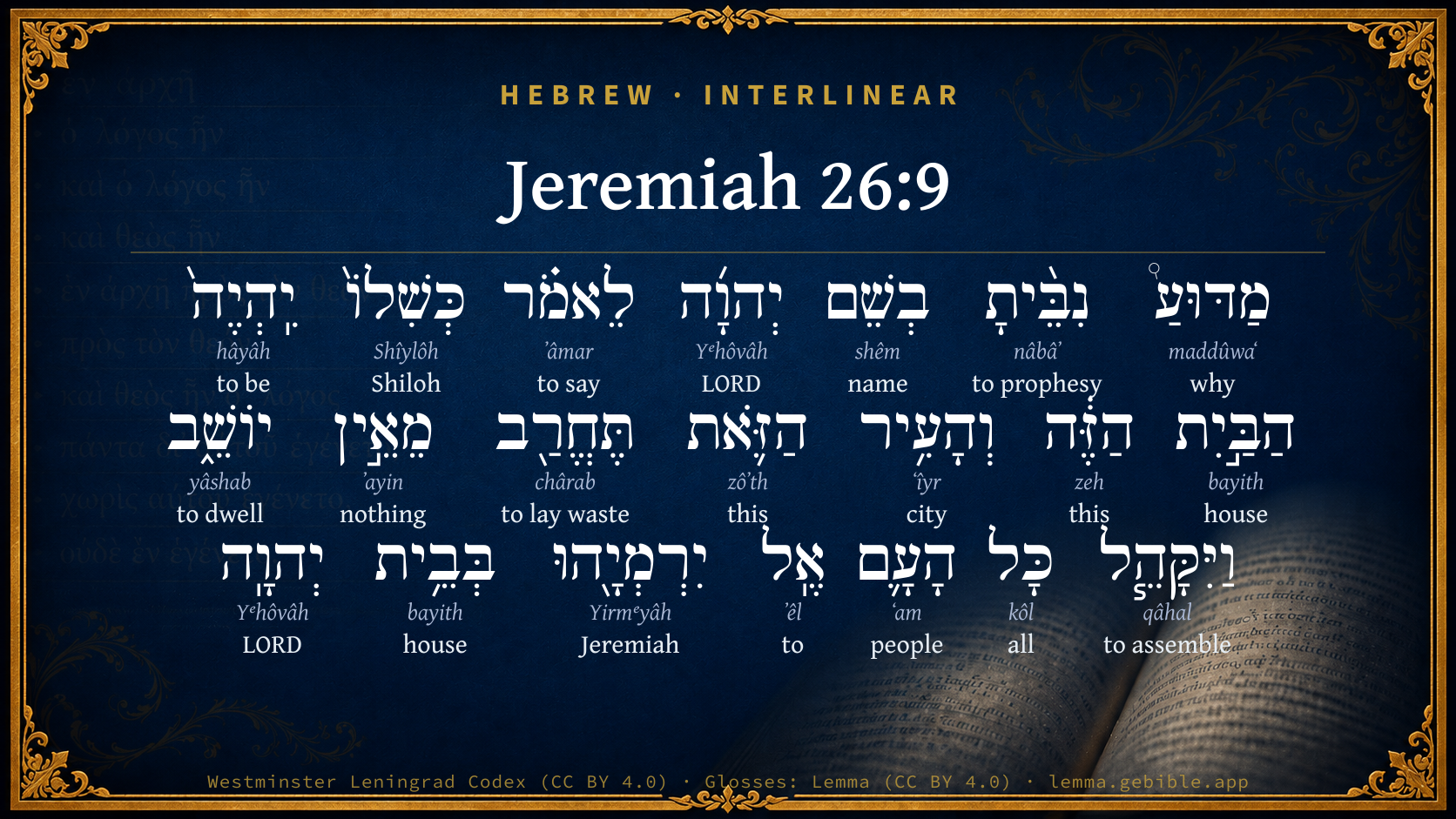
Hebrew (Westminster Leningrad Codex) Jeremiah 26:9 appears in the Hebrew Old Testament. The text above is from the Westminster Leningrad Codex. Each word links to its Strong’s number, a concise gloss, and parsing drawn from the Open Scriptures Hebrew Bible morphology. Click any word for its full Brown-Driver-Briggs (BDB) entry.
Download image
Cite this verse

Jeremiah 26:9 (World English Bible). Public Domain. Lemma interlinear Bible study tool, https://lemma.gebible.app/v/jeremiah/26/9.

Show BibTeX & RIS
BibTeX
RIS
English Translation
Why have you prophesied in the name of Yahweh, saying, This house shall be like Shiloh, and this city shall be desolate, without inhabitant? All the people were gathered to Jeremiah in the house of Yahweh.
World English Bible · Public Domain
Download a study sheet

One document with this verse’s original text, its word-by-word gloss line, the meaning frame, cross-references with their text, attributed commentary, and full source and license credits — printable, and it pastes into notes with its structure intact.

This verse Autodidact and up

Study sheet (.html) Plain text (.txt)

A passage Seminary Student

Up to 50 verses in one chapter. A passage sheet keeps up to 6 commentary sources and 12 cross-references per verse, in the order this page ranks them, and says so on the sheet whenever that leaves anything out. Ask for a single verse and you get the Autodidact verse sheet above.

Everything on this page stays free to read, with no account — the sheet is a download of what is already on screen, not access to it.

Want to remove ads? Support Godless Engineer
Compare translations 3

The same verse in 3 English versions, stacked beneath the original-language interlinear above. Click any original word for its lexicon entry.

Each is an independent rendering of the whole verse — the interlinear is not word-aligned to these translations.

Highlighted words mark where these versions differ — a whole-verse word diff, not a word-by-word alignment.

  • World English Bible Public Domain
    Why have you prophesied in the name of Yahweh, saying, This house shall be like Shiloh, and this city shall be desolate, without inhabitant? All the people were gathered to Jeremiah in the house of Yahweh.
  • King James Version Public Domain
    Why hast thou prophesied in the name of the LORD, saying, This house shall be like Shiloh, and this city shall be desolate without an inhabitant? And all the people were gathered against Jeremiah in the house of the LORD.
  • unfoldingWord Literal Text CC BY-SA 4.0
    Why have you prophesied in the name of Yahweh, saying, ‘Like Shiloh this house will be, and this city will be desolate without a dweller’?” And all the people gathered against Jeremiah in the house of Yahweh.

unfoldingWord Literal Text — © unfoldingWord, licensed CC BY-SA 4.0. Word-aligned USFM3 via Door43 (git.door43.org/unfoldingWord/en_ult).

Versions to compare (up to 4)

3 of 4 selected

Show all 18 translations

Every available English version of this verse, each an independent rendering of the whole verse.

  • World English Bible Public Domain
    Why have you prophesied in the name of Yahweh, saying, This house shall be like Shiloh, and this city shall be desolate, without inhabitant? All the people were gathered to Jeremiah in the house of Yahweh.
  • Berean Standard Bible Public Domain
    How dare you prophesy in the name of the LORD that this house will become like Shiloh and this city will be desolate and deserted!” And all the people assembled against Jeremiah in the house of the LORD.
  • Majority Standard Bible Public Domain
    How dare you prophesy in the name of the LORD that this house will become like Shiloh and this city will be desolate and deserted!” And all the people assembled against Jeremiah in the house of the LORD.
  • King James Version Public Domain
    Why hast thou prophesied in the name of the LORD, saying, This house shall be like Shiloh, and this city shall be desolate without an inhabitant? And all the people were gathered against Jeremiah in the house of the LORD.
  • American Standard Version (1901) Public Domain
    Why hast thou prophesied in the name of Jehovah, saying, This house shall be like Shiloh, and this city shall be desolate, without inhabitant? And all the people were gathered unto Jeremiah in the house of Jehovah.
  • Revised Version (1885) Public Domain
    Why hast thou prophesied in the name of the LORD, saying, This house shall be like Shiloh, and this city shall be desolate, without inhabitant? And all the people were gathered unto Jeremiah in the house of the LORD.
  • Geneva Bible (1599) Public Domain
    Why hast thou prophecied in the Name of the Lord, saying, This House shall be like Shiloh, and this citie shalbe desolate without an inhabitant? and all the people were gathered against Ieremiah in the House of the Lord.
  • Douay-Rheims (1899) Public Domain
    Why hath he prophesied in the name of the Lord, saying: This house shall be like Silo; and this city shall be made desolate, without an inhabitant? And all the people were gathered together against Jeremias in the house of the Lord.
  • Young's Literal Translation Public Domain
    Wherefore hast thou prophesied in the name of Jehovah, saying, `As Shiloh this house shall be, and this city is wasted, without inhabitant?' and all the people are assembled unto Jeremiah in the house of Jehovah.
  • Literal Standard Version CC BY-SA 4.0
    Why have you prophesied in the Name of YHWH, saying, This house will be as Shiloh, and this city is desolated, without inhabitant?” And all the people are assembled to Jeremiah in the house of YHWH.
  • Unlocked Literal Bible CC BY-SA 4.0
    Why have you prophesied in Yahweh's name and said that this house will become like Shiloh and this city will become desolate, with no inhabitant?” For all the people had formed a mob against Jeremiah in Yahweh's house.
  • unfoldingWord Literal Text CC BY-SA 4.0
    Why have you prophesied in the name of Yahweh, saying, ‘Like Shiloh this house will be, and this city will be desolate without a dweller’?” And all the people gathered against Jeremiah in the house of Yahweh.
  • Darby Bible Public Domain
    Why hast thou prophesied in the name of Jehovah, saying, This house shall be like Shiloh, and this city shall be desolate, without inhabitant? And all the people were gathered against Jeremiah in the house of Jehovah.
  • World Messianic Bible Public Domain
    Why have you prophesied in the LORD’s name, saying, ‘This house will be like Shiloh, and this city will be desolate, without inhabitant’?” All the people were crowded around Jeremiah in the LORD’s house.
  • Webster's Bible Public Domain
    Why hast thou prophesied in the name of the LORD, saying, This house shall be like Shiloh, and this city shall be desolate without an inhabitant? And all the people were gathered against Jeremiah, in the house of the LORD.
  • Free Bible Version CC BY-SA 4.0
    How dare you claim to speak in the Lord's name here in the Temple and declare that it will be destroyed like Shiloh, and that this city will be left empty and abandoned?” Everyone crowded around Jeremiah threatening him in the Lord's Temple.
  • Bible in Basic English Public Domain
    Why have you said in the name of the Lord, This house will be like Shiloh, and this land a waste with no one living in it? And all the people had come together to Jeremiah in the house of the Lord.
  • JPS Tanakh (1917) Public Domain
    Why hast thou prophesied in the name of the LORD, saying: This house shall be like Shiloh, and this city shall be desolate, without an inhabitant?' And all the people were gathered against Jeremiah in the house of the LORD.

Literal Standard Version (2020), Covenant Press — licensed CC BY-SA 4.0. Text via the HelloAO Bible API (eBible.org). Unlocked Literal Bible (unfoldingWord) — licensed CC BY-SA 4.0. Text via the HelloAO Bible API (eBible.org). unfoldingWord Literal Text — © unfoldingWord, licensed CC BY-SA 4.0. Word-aligned USFM3 via Door43 (git.door43.org/unfoldingWord/en_ult). Free Bible Version, Dr. Jonathan Gallagher — licensed CC BY-SA 4.0. Text via the HelloAO Bible API (eBible.org).

Word by word

More ways to search: Search by grammar → Find every occurrence → Compare this word →

Practice this passage: Drill this verse → Learn its vocabulary →

כְּשִׁלוֹ֙
Shîylôh
H7887
“like/as · Shiloh”
Preposition + Noun, Proper
Part of Speech
Preposition + Noun
Type
Proper
Full BDB Definition

Origin: from the same as H7886

TWOT: 2376

Shiloh = "place of rest" - a city in Ephraim and temporary home of the Ark of the Covenant and the Tabernacle, the place where Samuel grew up
  1. מַדּוּעַ֩ maddûwaʻ H4069 “why” Particle, Interrogative
  2. נִבֵּ֨יתָ nâbâʼ H5012 “to prophesy” Verb, Niphal, Perfect, 2nd Person, Masculine, Singular
  3. בְשֵׁם shêm H8034 “in/at · name of” Preposition + Noun, Common, Masculine, Singular, Construct
  4. יְהוָ֜ה Yᵉhôvâh H3068 “LORD” Noun, Proper
  5. לֵאמֹ֗ר ʼâmar H559 “to say” Preposition + Verb, Qal, Infinitive Construct
  6. יִֽהְיֶה֙ hâyâh H1961 “to be” Verb, Qal, Imperfect, 3rd Person, Masculine, Singular
  7. הַבַּ֣יִת bayith H1004 “the · house” Particle, Definite Article + Noun, Common, Masculine, Singular, Absolute
  8. הַזֶּ֔ה zeh H2088 “the · this” Particle, Definite Article + Pronoun, Demonstrative, Masculine, Singular
  9. וְהָעִ֥יר ʻîyr H5892 “and · the · city” Conjunction + Particle, Definite Article + Noun, Common, Feminine, Singular, Absolute
  10. הַזֹּ֛את zôʼth H2063 “the · this” Particle, Definite Article + Pronoun, Demonstrative, Feminine, Singular
  11. תֶּחֱרַ֖ב chârab H2717 “to lay waste” Verb, Qal, Imperfect, 3rd Person, Feminine, Singular
  12. מֵאֵ֣ין ʼayin H369 “from · nothing” Preposition + Particle, Negative
  13. יוֹשֵׁ֑ב yâshab H3427 “dwelling” Verb, Qal, Participle Active, Masculine, Singular, Absolute
  14. וַיִּקָּהֵ֧ל qâhal H6950 “and · to assemble” Conjunction + Verb, Niphal, Sequential Imperfect, 3rd Person, Masculine, Singular
  15. כָּל kôl H3605 “all of” Noun, Common, Masculine, Singular, Construct
  16. הָעָ֛ם ʻam H5971 “the · people” Particle, Definite Article + Noun, Common, Masculine, Singular, Absolute
  17. אֶֽל ʼêl H413 “to” Preposition
  18. יִרְמְיָ֖הוּ Yirmᵉyâh H3414 “Jeremiah” Noun, Proper
  19. בְּבֵ֥ית bayith H1004 “in/at · house of” Preposition + Noun, Common, Masculine, Singular, Construct
  20. יְהוָֽה Yᵉhôvâh H3068 “LORD” Noun, Proper

About this verse

These counts appear in no published source. They are computed here, from the morphology-tagged text and Lemma’s own curated glosses. What Lemma adds →

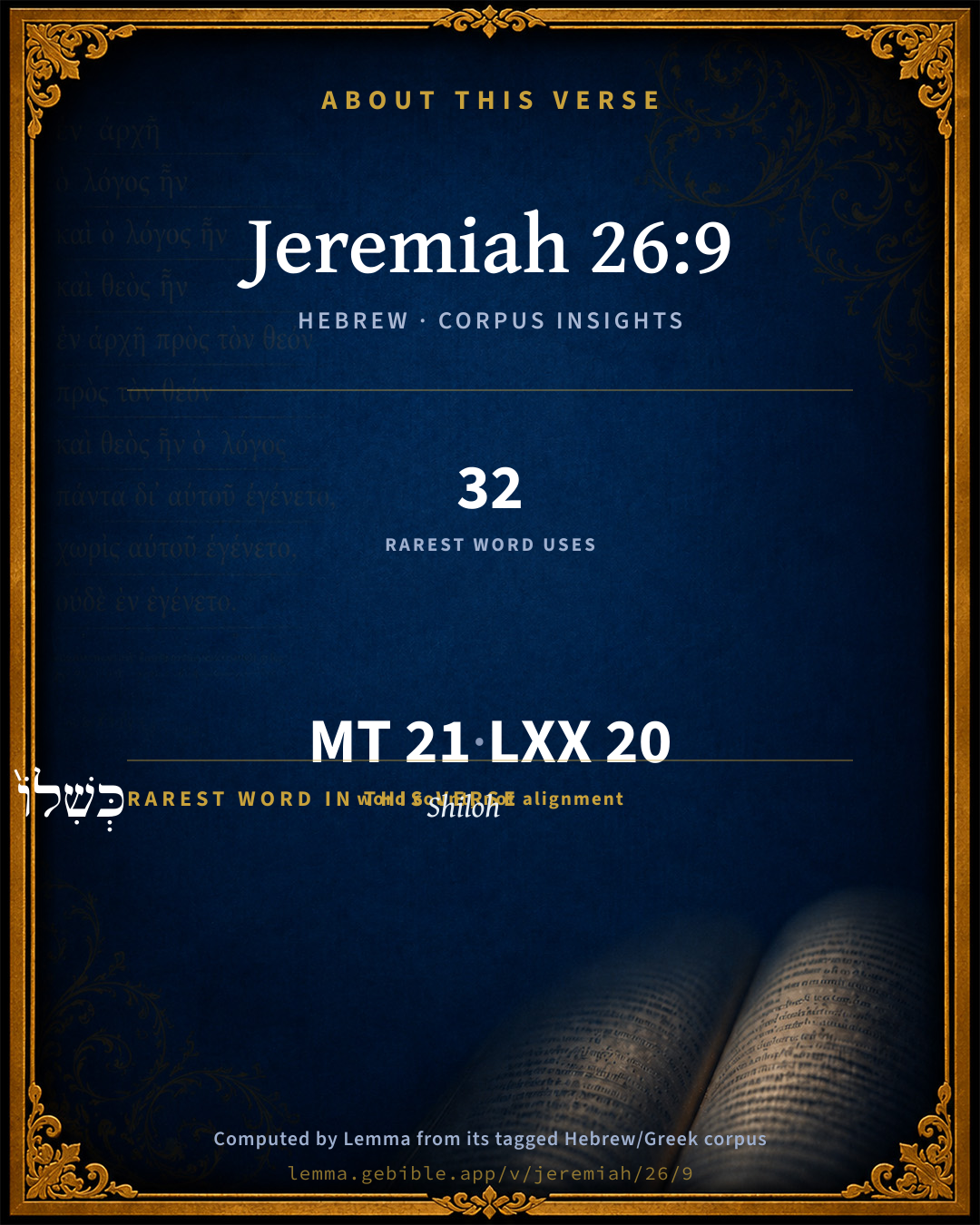
21
words
19
distinct lemmas
Prophets
section

Shared distinctive vocabulary

כְּשִׁלוֹ֙ Shiloh H7887 occurs in 30 verses of the Hebrew Bible. Also found in:

Grammatical profile

  • 6 verbs
  • 10 nouns
  • 2 pronouns
  • 1 preposition
  • 2 particles

Verb forms

  • נִבֵּ֨יתָ Niphal · Perfect
  • לֵאמֹ֗ר Qal · Infinitive Construct
  • יִֽהְיֶה֙ Qal · Imperfect
  • תֶּחֱרַ֖ב Qal · Imperfect
  • יוֹשֵׁ֑ב Qal · Participle Active
  • וַיִּקָּהֵ֧ל Niphal · Sequential Imperfect

Repetition

Words recur within this verse — often emphatic in Hebrew:

  • יְהוָ֜ה LORD H3068 ×2
  • הַבַּ֣יִת house H1004 ×2

Hebrew & Septuagint length

In the original languages it is 21 Hebrew tokens and 20 Greek tokens — but the two are counted differently (Hebrew bundles its prefixes and suffixes into one token; the Greek is in lemma form), so that isn’t a like-for-like length.

Cross-references

21

Topical passages linked to Jeremiah 26:9 in the Treasury of Scripture Knowledge — connected by theme and wording, ordered by reader-vote popularity; previews shown in the World English Bible.

  • 2 Chronicles 25:16 It happened, as he talked with him, that [the king] said to him, Have we made you of the king's counsel? Stop! Why should you be struck down? Then the prophet stopped, and said, I know that God has determined to destroy you, because you have done this, and have not listened to my counsel.
  • Isaiah 29:21 that make a man an offender in [his] cause, and lay a snare for him who reproves in the gate, and turn aside the just with a thing of nothing.
  • Isaiah 30:9–11 For it is a rebellious people, lying children, children who will not hear the law of Yahweh;
  • Jeremiah 9:11 I will make Jerusalem heaps, a dwelling-place of jackals; and I will make the cities of Judah a desolation, without inhabitant.
  • Amos 5:10 They hate him who reproves in the gate, And they abhor him who speaks blamelessly.
  • Amos 7:10–13 Then Amaziah the priest of Beth El sent to Jeroboam king of Israel, saying, "Amos has conspired against you in the midst of the house of Israel. The land is not able to bear all his words.
  • Micah 2:6 "Don't you prophesy!" They prophesy. "Don't prophesy about these things. Disgrace won't overtake us."
  • Matthew 21:23 When he had come into the temple, the chief priests and the elders of the people came to him as he was teaching, and said, "By what authority do you do these things? Who gave you this authority?"
  • Matthew 27:20 Now the chief priests and the elders persuaded the multitudes to ask for Barabbas, and destroy Jesus.
  • Mark 15:11 But the chief priests stirred up the multitude, that he should release Barabbas to them instead.
  • John 8:20 Jesus spoke these words in the treasury, as he taught in the temple. Yet no one arrested him, because his hour had not yet come.
  • John 8:59 Therefore they took up stones to throw at him, but Jesus was hidden, and went out of the temple, having gone through the midst of them, and so passed by.
  • Acts 4:17–19 But so that this spreads no further among the people, let's threaten them, that from now on they don't speak to anyone in this name."
  • Acts 6:14 For we have heard him say that this Jesus of Nazareth will destroy this place, and will change the customs which Moses delivered to us."
  • Acts 13:50 But the Jews stirred up the devout and prominent women and the chief men of the city, and stirred up a persecution against Paul and Barnabas, and threw them out of their borders.
  • Acts 16:19–22 But when her masters saw that the hope of their gain was gone, they seized Paul and Silas, and dragged them into the marketplace before the rulers.
  • Acts 17:5–8 But the unpersuaded Jews took along some wicked men from the marketplace, and gathering a crowd, set the city in an uproar. Assaulting the house of Jason, they sought to bring them out to the people.
  • Acts 19:24–32 For a certain man named Demetrius, a silversmith, who made silver shrines of Artemis, brought no little business to the craftsmen,
  • Acts 21:30 All the city was moved, and the people ran together. They seized Paul and dragged him out of the temple. Immediately the doors were shut.
  • Acts 5:28 saying, "Didn't we strictly charge you not to teach in this name? Behold, you have filled Jerusalem with your teaching, and intend to bring this man's blood on us."
  • Acts 22:22 They listened to him until he said that; then they lifted up their voice, and said, "Rid the earth of this fellow, for he isn't fit to live!"

Cross-references courtesy of OpenBible.info (CC BY 4.0).

Hebrew and Greek witnesses Masoretic Hebrew ↔ Greek Septuagint

The same verse in the two great witnesses to the Old Testament, shown verse-for-verse.

These are two independent witnesses, not word-aligned to each other, and the Septuagint is shown in lemma (dictionary) form.

Hebrew Jeremiah 26:9 Masoretic · Westminster Leningrad Codex

מַדּוּעַ֩ נִבֵּ֨יתָ בְשֵׁם יְהוָ֜ה לֵאמֹ֗ר כְּשִׁלוֹ֙ יִֽהְיֶה֙ הַבַּ֣יִת הַזֶּ֔ה וְהָעִ֥יר הַזֹּ֛את תֶּחֱרַ֖ב מֵאֵ֣ין יוֹשֵׁ֑ב וַיִּקָּהֵ֧ל כָּל הָעָ֛ם אֶֽל יִרְמְיָ֖הוּ בְּבֵ֥ית יְהוָֽה

Why have you prophesied in the name of Yahweh, saying, This house shall be like Shiloh, and this city shall be desolate, without inhabitant? All the people were gathered to Jeremiah in the house of Yahweh.

World English Bible · Public Domain

Greek LXX Structure differs

In the Septuagint, Jeremiah is about an eighth shorter than the Hebrew and arranges its material differently — the Oracles Against the Nations (Hebrew chapters 46–51) appear in the middle of the Greek book, after 25:13. Because the chapter and verse boundaries do not line up, a verse-for-verse comparison with the Hebrew is not shown.

A verse-for-verse comparison isn’t shown here because the chapters and verses don’t line up. Switch to the LXX edition with the MT / LXX toggle above to read the Greek directly.

Hebrew: Westminster Leningrad Codex (CC BY 4.0). Greek: Septuagint (public domain); English from a public-domain English Septuagint. How the Septuagint differs from the Hebrew →

Targum (Aramaic paraphrase)

1

The Targum is the ancient Jewish Aramaic paraphrase of the Hebrew Scriptures — an interpretive translation, not the Hebrew text itself. Onkelos (literal) and Pseudo-Jonathan (expansive) render the Torah, and Jonathan the Prophets. Coverage is partial: where no permissively-licensed English translation exists for a verse, only the Aramaic is shown. This is verse-level text, not a word-by-word alignment to the Hebrew.

  1. Targum Jonathan Prophets (Joshua–Malachi)
    מַדֵין אִתְנַבֵּיתָא בִּשְׁמָא דַייָ לְמֵימָר כְּשִׁלוֹ יְהֵי בֵיתָא הָדֵין וְקַרְתָּא הָדָא תֶּחֱרוֹב מִבְּלִי יָתֵיב וְאִתְכְּנֵישׁ כָּל עַמָא עַל יִרְמְיָה בְּבֵית מַקְדְשָׁא דַיָי:

    (no public-domain English translation for this verse)

    Targum Jonathan — Aramaic: “Mikraot Gedolot” (public domain). English: “Sefaria Community Translation” (CC0 1.0 (public-domain dedication)); “London "Chaldee Paraphrase," 1871” (public domain). Text via Sefaria.

Commentary

Notes on Jeremiah 26:9 from classic Christian and Jewish commentators (each source and its license shown beneath its notes). The classic Christian expositions comment on the surrounding passage and are grouped to its opening verse, so a note may address several verses; the Jewish commentaries on the Tanakh (Rashi and others) are per-verse, so they appear only where the commentator wrote on this verse.

Lemma curates 59 commentaries, every one of them public domain or Creative Commons licensed, each selected and text-cleaned for this edition rather than reprinted as found. About our sources →

Trapp's Complete Commentary

John Trapp

Jer 26:9 Why hast thou prophesied in the name of the LORD, saying, This house shall be like Shiloh, and this city shall be desolate without an inhabitant? And all the people were gathered against Jeremiah in the house of the LORD.

Ver. 9. Why hast thou prophesied in the name of the Lord?] Who doubtless hath not sent thee on this errand; but thou speakest it of thine own head, and shalt dearly answer it.

And all the people were gathered.] That many headed multitude, that neutrum modo, mas modo vulgus. See Jer 26:16.

John Trapp, A Commentary or Exposition upon All the Books of the Old and New Testament (1647–1656) — public domain. Text from a community e-Sword module.

Geneva Bible (1599)

Geneva Bible translators

Because of God’s promises to the Temple, Ps. 132:14, that he would forever remain there, the hypocrites thought this Temple could never perish, and therefore thought it blasphemy to speak against it, Matt. 26:61; Acts 6:13, not considering that this was meant of the Church, where God will remain forever.

Geneva Bible (1599) marginal notes — public domain. Text via Bolls.life.

John Calvin's Commentaries

Here is added the cause of Jeremiah’s condemnation, that he had dared to threaten with so much severity the holy city and the Temple. They did not inquire whether God had commanded this to be done, whether he had any just cause for doing so; but they took this principle as granted, that wrong was done to God when anything was alleged against the dignity of the Temple, and also that the city was sacred, and therefore nothing could be said against it without derogating from many and peculiar promises of God, since he had testified that it would be ever safe, because he dwelt in the midst of it. We hence see by what right, and under what pretense the priests and the prophets condemned Jeremiah.

And by saying, in the name of Jehovah, they no doubt accused him as a cheat, or a false pretender, because he had said that this had been commanded by God, for they considered such a thing impossible and preposterous. God had promised that Jerusalem would be his perpetual habitation; the words of Jeremiah were, “I will make this city like Shiloh.” God seemed in appearance to be inconsistent with himself, “This is my rest for ever,” “this shall be a desert.” We hence see that the priests and the prophets were not without some specious pretext for condemning Jeremiah. There is therefore some weight in what they said, “Dost thou not make God contrary to himself? for what thou denouncest in his name openly and directly conflicts with his promises; but God is ever consistent with himself; thou art therefore a cheat and a liar, and thus one of the false prophets, whom God suffers not in his Church.” And yet what they boasted was wholly frivolous; for God had not promised that the Temple should be perpetual in order to give license to the people to indulge in all manner of wickedness. It was not then God’s purpose to bind himself to ungodly men, that they might expose his name to open reproach. It is hence evident that the prophets and priests only dissembled, when they took as granted what ought to have been understood conditionally, that is, if they worshipped him in sincerity as he had commanded. For it was not right to separate two things which God had connected; he required piety and obedience from the people, and he also promised that he would be the guardian of the city, and that the Temple would be safe under his protection. But the Jews, having neither faith nor repentance, boasted of what had been said of the Temple, nay, they bragged, as we have seen elsewhere, and spoke false things; and hence the Prophet derided them by repeating three times,

“The Temple of Jehovah, the Temple of Jehovah, the Temple of Jehovah,” (Jeremiah 7:4)

as though he had said, — “This is your silly talk, you ever cry boastingly, ‘The Temple of God;’ but all this will avail you nothing.”

It then follows, that the people were assembled Here Jeremiah passes to another part of the narrative, for he reminded the princes and the king’s councillors that they were not without reason roused to go up to the Temple.

If the dispute had been between few, either Jeremiah would have been slain, or in some way intercepted, or it might have been that the princes would have circumvented the king and his councillors, and thus the holy man would have been privately crushed. But here he introduced these words, that the whole people were assembled against him. Hence it was that the report, reached the king’s court; and so the princes and councillors were commanded to come. In short, Jeremiah shews the reason why the princes came unto the Temple; it was because the city was everywhere in a commotion, when the report spread that something new and intolerable had been announced. The king therefore could not neglect this commotion; for it is a dangerous thing to allow a popular tumult to prevail. And therefore Jeremiah thus adds, —

John Calvin's Commentaries (1540-1563) — public domain. Text from the Calvin Translation Society English edition (1840s-50s) via the Christian Classics Ethereal Library (ccel.org). Calvin's coverage is partial (roughly two-thirds of the Bible); uncommented books and verses are honest gaps, never fabricated. The 19th-century editor's footnotes and remarks are omitted so the notes are faithfully Calvin's own voice.

Ellicott's Commentary for English Readers

(9) Why hast thou prophesied in the name of the Lord . . .?—The threat that the house in which they gloried should be as the old sanctuary of Ephraim, over whose fall they had exulted, was as the last drop that made the cup of wrath and bitterness run over. They had chanted their psalms, which told how that God “forsook the tabernacle of Shiloh, even the tent which He had pitched among men” (Psa_78:60). They could not bear to hear that a like fate was impending over them.

A Bible Commentary for English Readers, edited by Charles John Ellicott (1878–1897) — public domain. Text from a community e-Sword module.

John Gill's Exposition

Why hast thou prophesied in the name of the Lord,.... Made use of his name in declaring a falsehood, as they would have it; this was the crime: had he said what he thought fit to say in his own name, they suggest it would not have been so bad; but to vent his own imaginations in the name of the Lord, this they judged wicked and blasphemous, and deserving of death; especially since what he said was against their city and temple:

saying, this house shall be like Shiloh; forsaken and destroyed; that is, the temple:

and this city shall be desolate without an inhabitant? so they wrested his words; for this he did not say, only that it should be a curse to all the nations of the earth:

and all the people were gathered against Jeremiah in the house of the Lord; besides those that were in the temple that heard him, others, upon a rumour that he was apprehended by the priests, and prophets, and people in the temple, got together in a mob about him: or, they were "gathered to" (e) him; to hear what he had to say in his own defence; and it appears afterwards that they were on his side, Jer 26:16.

(e) "ad Jeremiam", Junius & Tremellius, Piscator, Cocceius, Schmidt.

John Gill's Exposition of the Whole Bible (1746–1763) — public domain (CC PDM 1.0). Text via the HelloAO Bible API.

Albert Barnes' Notes on the Bible

The charge against Jeremiah was that of prophesying falsely, for which the penalty was death Deu 18:20. They assumed that it was absolutely impossible that Jerusalem ever could become like Shiloh.

Against Jeremiah - unto Jeremiah. They regularly constituted themselves a congregation to take part in his trial.

Albert Barnes' Notes on the Bible (1834–1885) — public domain. Text from a community e-Sword/MySword module.

Matthew Poole's English Annotations

They charge him with being a false prophet, speaking false things in the name of God; their pretence seemeth to have been from the promises of God; such as that, Psa 132:13,14, For the Lord hath chosen Zion; he hath desired it for his habitation. This is my rest for ever: here will I dwell; for I have desired it. Which they interpreted into such a sense, as if they could not by their sin drive God away from them, and therefore Jeremiah must prophesy falsely against the will of God before revealed. This caused a seditious tumult of the people in the temple, which alarmed the civil magistrates.

Matthew Poole's English Annotations on the Holy Bible (1683–1685) — public domain. Text from a community e-Sword/MySword module.

Whedon's Commentary on the Bible

Daniel D. Whedon

9. Why hast thou prophesied — The charge was false prophesying, for which the penalty would be death. Deu_18:20.

Against Jeremiah — Rather, unto Jeremiah. They came about him for trial.

Daniel D. Whedon (gen. ed.), Commentary on the Old and New Testaments (1874–1909) — public domain. Text from a community e-Sword module.

The Pulpit Commentary

Were gathered against; rather, assembled themselves unto; i.e. constituted themselves into a legal qahal, or assembly (see on ver. 17).

The Pulpit Commentary (1880–1919), ed. H.D.M. Spence-Jones & Joseph S. Exell — public domain. Text from a community e-Sword module.

Lesson kit

Teaching starters — assembled from the data on this page, not authored interpretation. Every prompt links to the verse data it draws on. Edit before teaching.

Jeremiah, in the Prophets, opens this verse with 21 words (19 distinct Hebrew lemmas). Its most distinctive word is Shîylôh (“Shiloh”). A historical commentator’s framing appears above. Read the whole chapter for the surrounding context.

Discussion questions

  1. The word Shîylôh carries the sense “Shiloh.” How does it shape the verse?
  2. Joshua 18:1 shares the word «Shiloh» with this verse. How do the two illuminate each other?
  3. “LORD” occurs 2× in this one verse. What is the effect of the repetition?
  4. These translations render this verse differently; the difference is in the English rendering, not the original. What questions does that raise?
  5. The verb «נִבֵּ֨יתָ» is Niphal Perfect. How does its form color the action?
  6. Reading how Trapp's Complete Commentary and Geneva Bible (1599) read this verse, where do the two commentators agree and where do they part?

Things to notice

Reading settings

Reading text

Shown beneath each verse's original-language words.

Old Testament
Old Testament edition

Read the OT as the Masoretic Hebrew (MT) or the Greek Septuagint (LXX).

English shown for the Greek Septuagint (in the Hebrew ↔ Greek comparison).

Comparing translations? Open the Compare panel on any verse page to stack up to four side by side.