Jeremiah 40:2

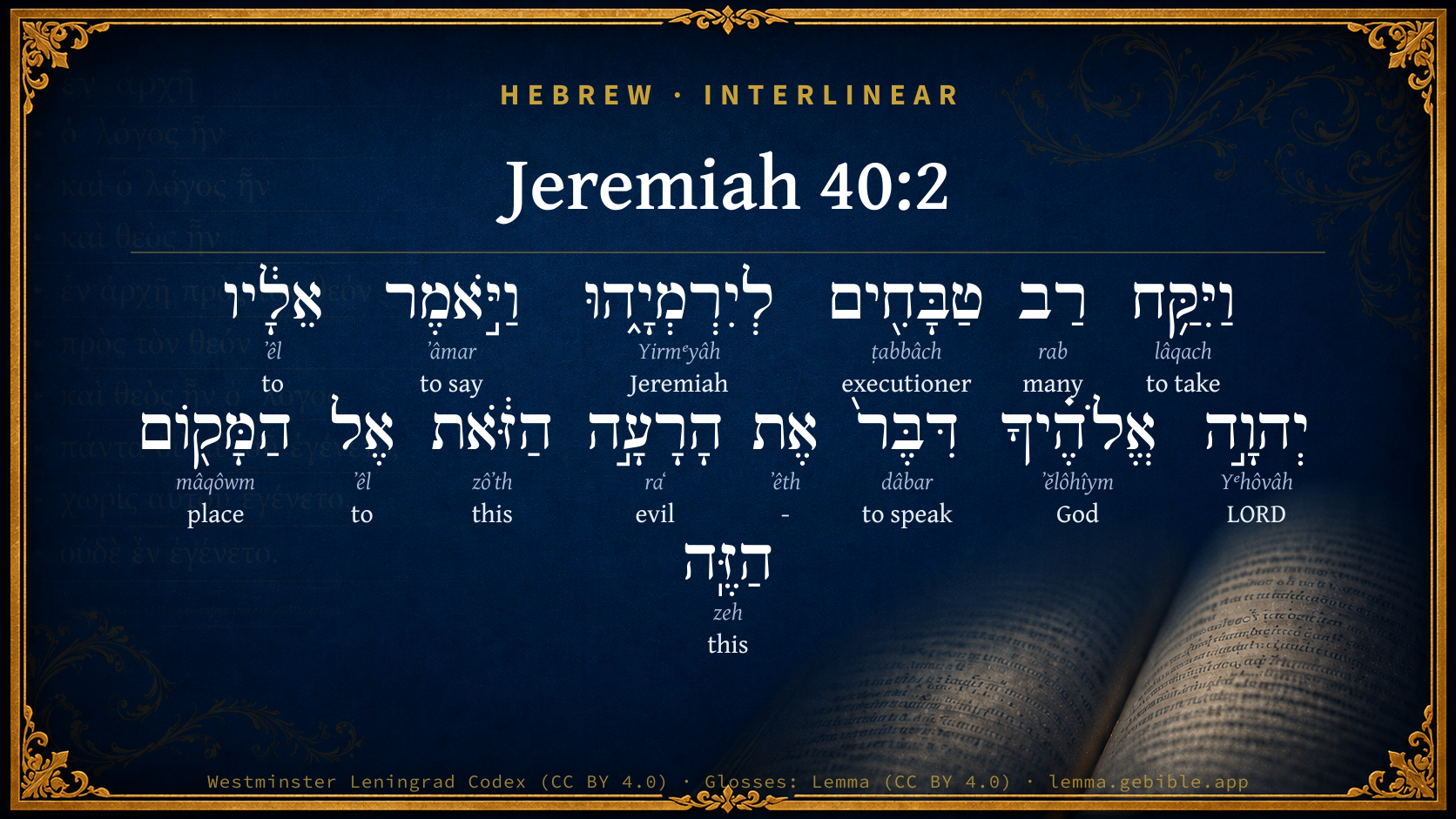
Hebrew (Westminster Leningrad Codex) Jeremiah 40:2 appears in the Hebrew Old Testament. The text above is from the Westminster Leningrad Codex. Each word links to its Strong’s number, a concise gloss, and parsing drawn from the Open Scriptures Hebrew Bible morphology. Click any word for its full Brown-Driver-Briggs (BDB) entry.
Download image
Cite this verse

Jeremiah 40:2 (World English Bible). Public Domain. Lemma interlinear Bible study tool, https://lemma.gebible.app/v/jeremiah/40/2.

Show BibTeX & RIS
BibTeX
RIS
English Translation
The captain of the guard took Jeremiah, and said to him, Yahweh your God pronounced this evil on this place;
World English Bible · Public Domain
Download a study sheet

One document with this verse’s original text, its word-by-word gloss line, the meaning frame, cross-references with their text, attributed commentary, and full source and license credits — printable, and it pastes into notes with its structure intact.

This verse Autodidact and up

Study sheet (.html) Plain text (.txt)

A passage Seminary Student

Up to 50 verses in one chapter. A passage sheet keeps up to 6 commentary sources and 12 cross-references per verse, in the order this page ranks them, and says so on the sheet whenever that leaves anything out. Ask for a single verse and you get the Autodidact verse sheet above.

Everything on this page stays free to read, with no account — the sheet is a download of what is already on screen, not access to it.

Want to remove ads? Support Godless Engineer
Compare translations 3

The same verse in 3 English versions, stacked beneath the original-language interlinear above. Click any original word for its lexicon entry.

Each is an independent rendering of the whole verse — the interlinear is not word-aligned to these translations.

Highlighted words mark where these versions differ — a whole-verse word diff, not a word-by-word alignment.

  • World English Bible Public Domain
    The captain of the guard took Jeremiah, and said to him, Yahweh your God pronounced this evil on this place;
  • King James Version Public Domain
    And the captain of the guard took Jeremiah, and said unto him, The LORD thy God hath pronounced this evil upon this place.
  • unfoldingWord Literal Text CC BY-SA 4.0
    The chief guard took Jeremiah and said to him, “Yahweh your God decreed this disaster for this place.

unfoldingWord Literal Text — © unfoldingWord, licensed CC BY-SA 4.0. Word-aligned USFM3 via Door43 (git.door43.org/unfoldingWord/en_ult).

Versions to compare (up to 4)

3 of 4 selected

Show all 18 translations

Every available English version of this verse, each an independent rendering of the whole verse.

  • World English Bible Public Domain
    The captain of the guard took Jeremiah, and said to him, Yahweh your God pronounced this evil on this place;
  • Berean Standard Bible Public Domain
    The captain of the guard found Jeremiah and said to him, “The LORD your God decreed this disaster on this place,
  • Majority Standard Bible Public Domain
    The captain of the guard found Jeremiah and said to him, “The LORD your God decreed this disaster on this place,
  • King James Version Public Domain
    And the captain of the guard took Jeremiah, and said unto him, The LORD thy God hath pronounced this evil upon this place.
  • American Standard Version (1901) Public Domain
    And the captain of the guard took Jeremiah, and said unto him, Jehovah thy God pronounced this evil upon this place;
  • Revised Version (1885) Public Domain
    And the captain of the guard took Jeremiah, and said unto him, the LORD thy God pronounced this evil upon this place:
  • Geneva Bible (1599) Public Domain
    And the chiefe stewarde tooke Ieremiah, and said vnto him, The Lord thy God hath pronounced this plague vpon this place.
  • Douay-Rheims (1899) Public Domain
    And the general of the army taking Jeremias, said to him: The Lord thy God hath pronounced this evil upon this place,
  • Young's Literal Translation Public Domain
    And the chief of the executioners taketh Jeremiah, and saith unto him, `Jehovah thy God hath spoken this evil concerning this place,
  • Literal Standard Version CC BY-SA 4.0
    And the chief of the executioners takes Jeremiah and says to him, “Your God YHWH has spoken this calamity concerning this place,
  • Unlocked Literal Bible CC BY-SA 4.0
    The chief guard took Jeremiah and said to him, “Yahweh your God decreed this disaster for this place.
  • unfoldingWord Literal Text CC BY-SA 4.0
    The chief guard took Jeremiah and said to him, “Yahweh your God decreed this disaster for this place.
  • Darby Bible Public Domain
    And the captain of the body-guard took Jeremiah, and said unto him, Jehovah thy God pronounced this evil upon this place,
  • World Messianic Bible Public Domain
    The captain of the guard took Jeremiah and said to him, “The LORD your God pronounced this evil on this place;
  • Webster's Bible Public Domain
    And the captain of the guard took Jeremiah, and said to him, The LORD thy God hath pronounced this evil upon this place.
  • Free Bible Version CC BY-SA 4.0
    When the commander of the guard found Jeremiah he told him, “The Lord your God announced that disaster would come to this place,
  • Bible in Basic English Public Domain
    And the captain of the armed men took Jeremiah and said to him, The Lord your God gave word of the evil which was to come on this place:
  • JPS Tanakh (1917) Public Domain
    And the captain of the guard took Jeremiah, and said unto him: 'The LORD thy God pronounced this evil upon this place;

Literal Standard Version (2020), Covenant Press — licensed CC BY-SA 4.0. Text via the HelloAO Bible API (eBible.org). Unlocked Literal Bible (unfoldingWord) — licensed CC BY-SA 4.0. Text via the HelloAO Bible API (eBible.org). unfoldingWord Literal Text — © unfoldingWord, licensed CC BY-SA 4.0. Word-aligned USFM3 via Door43 (git.door43.org/unfoldingWord/en_ult). Free Bible Version, Dr. Jonathan Gallagher — licensed CC BY-SA 4.0. Text via the HelloAO Bible API (eBible.org).

Word by word

More ways to search: Search by grammar → Find every occurrence → Compare this word →

Practice this passage: Drill this verse → Learn its vocabulary →

טַבָּחִ֖ים
ṭabbâch
H2876
“executioners”
Noun, Common, Masculine, Plural, Absolute
Part of Speech
Noun
Type
Common
Gender
Masculine
Number
Plural
State
Absolute
Full BDB Definition

Origin: from H2873

TWOT: 786c

executioner, cook, bodyguard, guardsman - cook (who also killed the animal for food) - guardsmen, bodyguard
  1. וַיִּקַּ֥ח lâqach H3947 “and · to take” Conjunction + Verb, Qal, Sequential Imperfect, 3rd Person, Masculine, Singular
  2. רַב rab H7227 “many of” Noun, Common, Masculine, Singular, Construct
  3. לְיִרְמְיָ֑הוּ Yirmᵉyâh H3414 “to/for · Jeremiah” Preposition + Noun, Proper
  4. וַיֹּ֣אמֶר ʼâmar H559 “and · to say” Conjunction + Verb, Qal, Sequential Imperfect, 3rd Person, Masculine, Singular
  5. אֵלָ֔יו ʼêl H413 “to · him” Preposition + Suffix, Personal, 3rd Person, Masculine, Singular
  6. יְהוָ֣ה Yᵉhôvâh H3068 “LORD” Noun, Proper
  7. אֱלֹהֶ֗יךָ ʼĕlôhîym H430 “God(s) · your” Noun, Common, Masculine, Plural, Construct + Suffix, Personal, 2nd Person, Masculine, Singular
  8. דִּבֶּר֙ dâbar H1696 “to speak” Verb, Piel, Perfect, 3rd Person, Masculine, Singular
  9. אֶת ʼêth H853 “-” Particle, Direct Object
  10. הָרָעָ֣ה raʻ H7451 “the · evil” Particle, Definite Article + Noun, Common, Feminine, Singular, Absolute
  11. הַזֹּ֔את zôʼth H2063 “the · this” Particle, Definite Article + Pronoun, Demonstrative, Feminine, Singular
  12. אֶל ʼêl H413 “to” Preposition
  13. הַמָּק֖וֹם mâqôwm H4725 “the · place” Particle, Definite Article + Noun, Common, Masculine, Singular, Absolute
  14. הַזֶּֽה zeh H2088 “the · this” Particle, Definite Article + Pronoun, Demonstrative, Masculine, Singular

About this verse

These counts appear in no published source. They are computed here, from the morphology-tagged text and Lemma’s own curated glosses. What Lemma adds →

15
words
14
distinct lemmas
Prophets
section

Shared distinctive vocabulary

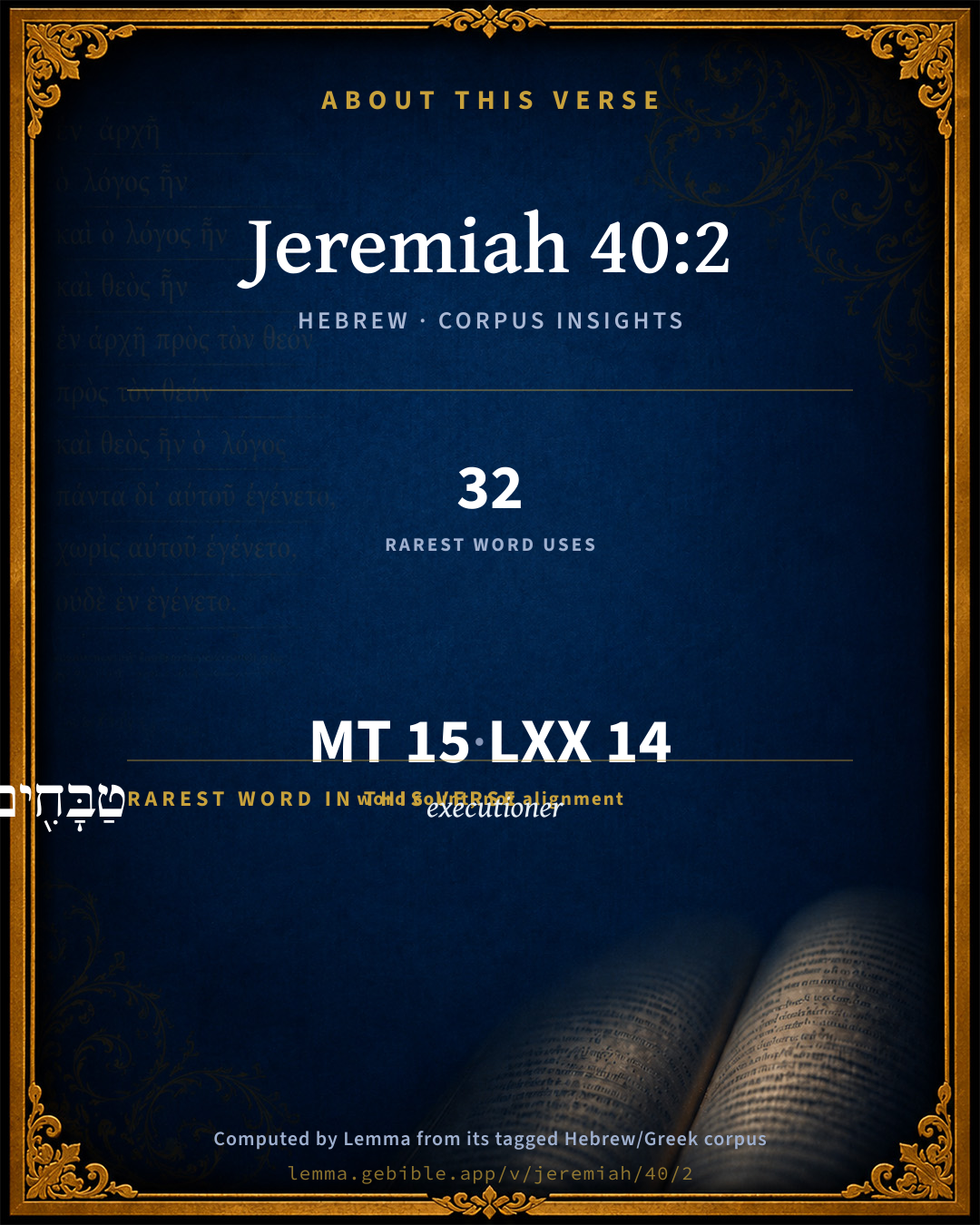
טַבָּחִ֖ים executioner H2876 occurs in 32 verses of the Hebrew Bible. Also found in:

Grammatical profile

  • 3 verbs
  • 7 nouns
  • 2 pronouns
  • 2 prepositions
  • 1 particle

Verb forms

  • וַיִּקַּ֥ח Qal · Sequential Imperfect
  • וַיֹּ֣אמֶר Qal · Sequential Imperfect
  • דִּבֶּר֙ Piel · Perfect

Repetition

A word recurs within this verse — often emphatic in Hebrew:

  • אֵלָ֔יו to H413 ×2

Hebrew & Septuagint length

In the original languages it is 15 Hebrew tokens and 14 Greek tokens — but the two are counted differently (Hebrew bundles its prefixes and suffixes into one token; the Greek is in lemma form), so that isn’t a like-for-like length.

Cross-references

5

Topical passages linked to Jeremiah 40:2 in the Treasury of Scripture Knowledge — connected by theme and wording, ordered by reader-vote popularity; previews shown in the World English Bible.

  • Deuteronomy 29:24–28 even all the nations shall say, Why has Yahweh done thus to this land? what means the heat of this great anger?
  • Jeremiah 22:8–9 Many nations shall pass by this city, and they shall say every man to his neighbor, Why has Yahweh done thus to this great city?
  • 1 Kings 9:8–9 Though this house is so high, yet shall everyone who passes by it be astonished, and shall hiss; and they shall say, Why has Yahweh done thus to this land, and to this house?
  • 2 Chronicles 7:20–22 then will I pluck them up by the roots out of my land which I have given them; and this house, which I have made holy for my name, will I cast out of my sight, and I will make it a proverb and a byword among all peoples.
  • Lamentations 2:15–17 All that pass by clap their hands at you; They hiss and wag their head at the daughter of Jerusalem, [saying], Is this the city that men called The perfection of beauty, The joy of the whole earth?

Cross-references courtesy of OpenBible.info (CC BY 4.0).

Hebrew and Greek witnesses Masoretic Hebrew ↔ Greek Septuagint

The same verse in the two great witnesses to the Old Testament, shown verse-for-verse.

These are two independent witnesses, not word-aligned to each other, and the Septuagint is shown in lemma (dictionary) form.

Hebrew Jeremiah 40:2 Masoretic · Westminster Leningrad Codex

וַיִּקַּ֥ח רַב טַבָּחִ֖ים לְיִרְמְיָ֑הוּ וַיֹּ֣אמֶר אֵלָ֔יו יְהוָ֣ה אֱלֹהֶ֗יךָ דִּבֶּר֙ אֶת הָרָעָ֣ה הַזֹּ֔את אֶל הַמָּק֖וֹם הַזֶּֽה

The captain of the guard took Jeremiah, and said to him, Yahweh your God pronounced this evil on this place;

World English Bible · Public Domain

Greek LXX Structure differs

In the Septuagint, Jeremiah is about an eighth shorter than the Hebrew and arranges its material differently — the Oracles Against the Nations (Hebrew chapters 46–51) appear in the middle of the Greek book, after 25:13. Because the chapter and verse boundaries do not line up, a verse-for-verse comparison with the Hebrew is not shown.

A verse-for-verse comparison isn’t shown here because the chapters and verses don’t line up. Switch to the LXX edition with the MT / LXX toggle above to read the Greek directly.

Hebrew: Westminster Leningrad Codex (CC BY 4.0). Greek: Septuagint (public domain); English from a public-domain English Septuagint. How the Septuagint differs from the Hebrew →

Targum (Aramaic paraphrase)

1

The Targum is the ancient Jewish Aramaic paraphrase of the Hebrew Scriptures — an interpretive translation, not the Hebrew text itself. Onkelos (literal) and Pseudo-Jonathan (expansive) render the Torah, and Jonathan the Prophets. Coverage is partial: where no permissively-licensed English translation exists for a verse, only the Aramaic is shown. This is verse-level text, not a word-by-word alignment to the Hebrew.

  1. Targum Jonathan Prophets (Joshua–Malachi)
    וּדְבַר רַב קָטוֹלַיָא לְיִרְמְיָהוּ וַאֲמַר לֵיהּ יְיָ אֱלָהָךְ גְזַר יַת בִּישְׁתָא הָדָא עַל אַתְרָא הָדֵין:

    (no public-domain English translation for this verse)

    Targum Jonathan — Aramaic: “Mikraot Gedolot” (public domain). English: “Sefaria Community Translation” (CC0 1.0 (public-domain dedication)); “London "Chaldee Paraphrase," 1871” (public domain). Text via Sefaria.

Commentary

Notes on Jeremiah 40:2 from classic Christian and Jewish commentators (each source and its license shown beneath its notes). The classic Christian expositions comment on the surrounding passage and are grouped to its opening verse, so a note may address several verses; the Jewish commentaries on the Tanakh (Rashi and others) are per-verse, so they appear only where the commentator wrote on this verse.

Lemma curates 59 commentaries, every one of them public domain or Creative Commons licensed, each selected and text-cleaned for this edition rather than reprinted as found. About our sources →

Trapp's Complete Commentary

John Trapp

Jer 40:2 And the captain of the guard took Jeremiah, and said unto him, The LORD thy God hath pronounced this evil upon this place.

Ver. 2. And the captain of the guard took Jeremiah.] Took him and loosed him, as he should have done before.

Saying, The Lord thy God hath pronounced this evil upon this place.] Oratio militaris, sed bene theologica. A strange speech to come out of such a man’s mouth. How could the captives present hear it, and not be affected with it? Thus Balaam’s ass sometimes rebuked his master’s madness, but to little good effect.

John Trapp, A Commentary or Exposition upon All the Books of the Old and New Testament (1647–1656) — public domain. Text from a community e-Sword module.

Joseph Benson's Commentary

Jer 40:2-4. The captain of the guard said, The Lord thy God hath pronounced this evil, &c. — Although each of the Gentile or heathen nations worshipped its peculiar god or gods, yet they did not reject or deny the gods of other nations; and therefore the captain of the guard speaks here to Jeremiah of Jehovah as his God, and the God of the Jews, and attributes all the calamities which had befallen this people to the indignation of this their God against them, because they had not obeyed and served him as they ought to have done. This seems a much more probable interpretation of Nebuzar-adan’s words than to understand them as expressive of his faith in the living and true God, of whom it is likely he knew little or nothing. And now, behold, I loose thee this day, &c. — This captain of the guard, like a faithful servant, remembers his princes’s orders about the prophet, and offers to him greater favour than to any of the other prisoners. With respect to them, he uses the power which conquest had given him over them, and they must go whither the king of Babylon pleased to send them; but he gives Jeremiah liberty to choose whether he would go along with him to Babylon, or stay in his own country, assuring him that if he would go to Babylon he would take particular care of him.

Joseph Benson's Commentary on the Old and New Testaments (1811–1818) — public domain. Text from a community e-Sword module.

Tyndale Open Study Notes

Tyndale Open Resources

40:2-3 The captain of the guard quoted the prediction of the Lord through Jeremiah that had now been fulfilled.

Tyndale Open Study Notes — © Tyndale Open Resources, licensed CC BY-SA 4.0. Text via the HelloAO Bible API.

Geneva Bible (1599)

Geneva Bible translators

From this second verse unto Jer. 42:7, it seemeth to be as a parenthesis, and separated matter: and there this story beginneth again, and this vision is declared what it was.

Geneva Bible (1599) marginal notes — public domain. Text via Bolls.life.

Jamieson, Fausset & Brown

Robert Jamieson, A. R. Fausset & David Brown

The Babylonians were in some measure aware, through Jeremiah's prophecies (Jer 39:11), that they were the instruments of God's wrath on His people.

Jamieson, Fausset & Brown — Commentary Critical and Explanatory on the Whole Bible (1871) — public domain (CC PDM 1.0). Text via the HelloAO Bible API.

Adam Clarke's Commentary

Verse 2. The Lord thy God hath pronounced] I know that thou art a true prophet, for what thou hast predicted from thy God is come to pass.

Adam Clarke's Commentary on the Bible (1810–1826) — public domain. Text from a community e-Sword/MySword module.

John Gill's Exposition

And the captain of the guard took Jeremiah,.... When he mustered his prisoners, to his great surprise he found the prophet among them, whom he took out from them, and set him free; though, before he dismissed him, he had the following conversation with him:

and said unto him, the Lord thy God hath pronounced this evil on this place; the city of Jerusalem; from whence the prophet and the rest of the captives were just brought, and which now lay in ruins; the houses burnt; the walls broken down; and the inhabitants spoiled and carried captive. This was the evil which the Lord, he says, had "decreed", as the Targum renders it; had purposed to bring upon it; and which he had declared and pronounced by the mouth of Jeremiah, whose Lord God he was, being his prophet, and a worshipper of him: this Nebuzaradan was apprized of by the Jews that deserted to the Chaldeans; and particularly, as is probable, by Gedaliah.

John Gill's Exposition of the Whole Bible (1746–1763) — public domain (CC PDM 1.0). Text via the HelloAO Bible API.

Whedon's Commentary on the Bible

Daniel D. Whedon

2. The captain… said unto him — This message is certainly a most remarkable one. The language is not heathen, but Jewish. Probably Nebuzaradan had become fully possessed of the substance of Jeremiah’s predictions, and had come to feel that they were really from God.

Daniel D. Whedon (gen. ed.), Commentary on the Old and New Testaments (1874–1909) — public domain. Text from a community e-Sword module.

The Pulpit Commentary

HOMILIES BY S. CONWAY Vers. 2, 3. The blind seeing, the seeing blind.

This heathen captain, who could not be expected to know the truth, who was, as it were, born blind as to the truth of God, sees clearly that truth, and declares it; whilst the people of Judah and Jerusalem, their kings, their priests, their nobles, all of whom regarded themselves as knowing the truth, who, as in Joh_9:41, said, "We see," are found to be completely blind as to that truth. Note herein

I HOW CLEAR WAS THE RECOGNITION OF GOD. He ascribes all to "the Lord thy God." He recognizes the prophet as sent of God (ver. 3), "According as he hath said" He traces their calamities to their true cause sin against God. He recognizes that Babylon and her troops are but ministers of God to do his will.

II THE PROBABLE SOURCES OF HIS KNOWLEDGE. Perhaps:

1. The general belief that each nation had its own deity.

2. Yet more, the prophecies of Jeremiah.

3. Also the strength of Jerusalem. Never, apart from the people"s sin, has such a fortress been overthrown.

4. The madness of the people. Quem deus vult perdere prius dementat. Only a God forsaken people could have thrown away their well being as these had done.

5. The judgments that came upon them.

III WHAT SUCH FACTS AS THESE the blind seeing, etc. REVEAL.

1. How clear the light of truth which God has given! Were it not so clear, such as this heathen would not see it.

2. How dense the darkness which persistent sin spreads over the soul! Hence the "seeing blind.

3. How awful the doom of those who seeing, see not! Cf. Matthew 11, "Woe unto thee, Chorazin," etc.! C.

HOMILIES BY D. YOUNG Vers. 2-6. Jeremiah a free agent.

We have here an expansion of vers. 13 and 14 of the previous chapter.

I ONE OF THE BEST THINGS A MAN CAN HAVE IS FULL INDIVIDUAL LIBERTY. The royal master of the captain of the guard was anxious to do the best he could for the prophet; and he seems to have understood fully that only the prophet could decide on this best. The captain of the guard, in all he says, is but the mouthpiece of the king. Very likely the captain, if he had been left to decide, would have said, "What better thing can happen to this man than go to Babylon with me?" and so, meaning well enough, he might have done ill. Good intentions are not enough in providing for others. We go rather by our notion of what they want than by what they really want; and thus we are disappointed in our efforts. There never can be anything wrong in giving a man the largest scope to settle his path for himself. We may easily become cramped as a result of the ignorant kindness of others.

II THERE WAS AN INCREASED RESPONSIBILITY FOR JEREMIAH. For a long time he had been in prison, and all he had to do was to endure captivity in a patient, trustful way. But now comes liberty, and in his case a peculiar responsibility. Few men, perhaps not even a single one, had the liberty enjoyed by him at this moment. Others had not been asked whether they would go to Babylon or stay. The conquerors settled all that. But Jeremiah has free choice, and he has to decide in very altered conditions of the land. Freedom brings human judgment into full strength and exercise.

III JEREMIAH WAS SURE TO DECIDE RIGHTLY. Why? Because the first thing he would look to was the will of Jehovah. What lesson had he been learning all through his prophetic life but this, that negligence of the will of Jehovah brought incalculable mischief? Here is the necessity for us to keep in a state of discernment with respect to the will of God. As a general rule, we do not need special intimations of the Divine will; right is seen to be right and wrong to be wrong. But there are also times when, as we need such special intimations, they are sure to be given. Y.

The Pulpit Commentary (1880–1919), ed. H.D.M. Spence-Jones & Joseph S. Exell — public domain. Text from a community e-Sword module.

Rashi

Rabbi Shlomo Yitzchaki (Rashi)

“The Lord your God spoke” Why are you troubled about them? Did you not prophesy to them and they did not hearken? As it is stated in Pesikta d’Rav Kahana (p. 113a).

Rashi on the Tanakh — English translations: “The Judaica Press complete Tanach with Rashi, translated by A. J. Rosenberg” (CC BY 4.0); “Pentateuch with Rashi's commentary by M. Rosenbaum and A.M. Silbermann, 1929-1934” (public domain); “The Metsudah Tanach series, Lakewood, N.J” (CC BY 4.0); and “The Book of Joshua, Metsudah Publications, 1997” (CC BY 4.0). Text via Sefaria.

Lesson kit

Teaching starters — assembled from the data on this page, not authored interpretation. Every prompt links to the verse data it draws on. Edit before teaching.

Jeremiah, in the Prophets, opens this verse with 15 words (14 distinct Hebrew lemmas). Its most distinctive word is ṭabbâch (“executioner”). A historical commentator’s framing appears above. Read the whole chapter for the surrounding context.

Discussion questions

  1. The word ṭabbâch carries the sense “executioner.” How does it shape the verse?
  2. How does Genesis 37:36, which shares the word «executioner», read alongside this verse?
  3. What does the repetition of “to” (2× in this one verse) do in this verse?
  4. These translations render this verse differently; the difference is in the English rendering, not the original. What questions does that raise?
  5. «וַיִּקַּ֥ח» is a Qal Sequential Imperfect verb. How does that grammatical form shape the action described?
  6. Compare how Trapp's Complete Commentary and Joseph Benson's Commentary read this verse. Where do they agree or differ?

Things to notice

Reading settings

Reading text

Shown beneath each verse's original-language words.

Old Testament
Old Testament edition

Read the OT as the Masoretic Hebrew (MT) or the Greek Septuagint (LXX).

English shown for the Greek Septuagint (in the Hebrew ↔ Greek comparison).

Comparing translations? Open the Compare panel on any verse page to stack up to four side by side.