2 Chronicles 36:12

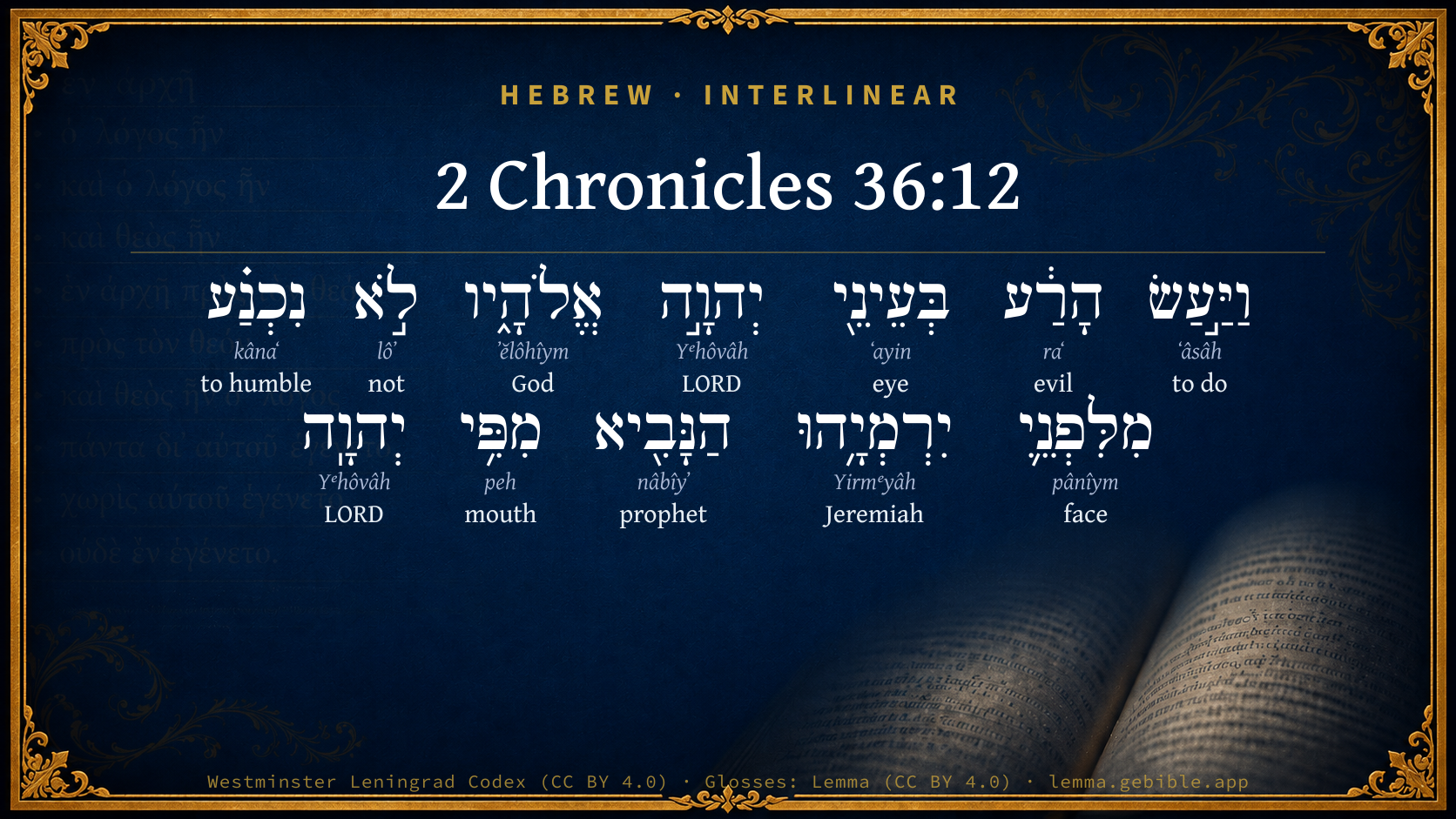
Hebrew (Westminster Leningrad Codex) 2 Chronicles 36:12 appears in the Hebrew Old Testament. The text above is from the Westminster Leningrad Codex. Each word links to its Strong’s number, a concise gloss, and parsing drawn from the Open Scriptures Hebrew Bible morphology. Click any word for its full Brown-Driver-Briggs (BDB) entry.
Download image
Cite this verse

2 Chronicles 36:12 (World English Bible). Public Domain. Lemma interlinear Bible study tool, https://lemma.gebible.app/v/2-chronicles/36/12.

Show BibTeX & RIS
BibTeX
RIS
English Translation
and he did that which was evil in the sight of Yahweh his God; he didn't humble himself before Jeremiah the prophet [speaking] from the mouth of Yahweh.
World English Bible · Public Domain
Download a study sheet

One document with this verse’s original text, its word-by-word gloss line, the meaning frame, cross-references with their text, attributed commentary, and full source and license credits — printable, and it pastes into notes with its structure intact.

This verse Autodidact and up

Study sheet (.html) Plain text (.txt)

A passage Seminary Student

Up to 50 verses in one chapter. A passage sheet keeps up to 6 commentary sources and 12 cross-references per verse, in the order this page ranks them, and says so on the sheet whenever that leaves anything out. Ask for a single verse and you get the Autodidact verse sheet above.

Everything on this page stays free to read, with no account — the sheet is a download of what is already on screen, not access to it.

Want to remove ads? Support Godless Engineer
Compare translations 3

The same verse in 3 English versions, stacked beneath the original-language interlinear above. Click any original word for its lexicon entry.

Each is an independent rendering of the whole verse — the interlinear is not word-aligned to these translations.

Highlighted words mark where these versions differ — a whole-verse word diff, not a word-by-word alignment.

  • World English Bible Public Domain
    and he did that which was evil in the sight of Yahweh his God; he didn't humble himself before Jeremiah the prophet [speaking] from the mouth of Yahweh.
  • King James Version Public Domain
    And he did that which was evil in the sight of the LORD his God, and humbled not himself before Jeremiah the prophet speaking from the mouth of the LORD.
  • unfoldingWord Literal Text CC BY-SA 4.0
    And he did what was evil in the eyes of Yahweh his God; he did not humble himself from before Jeremiah the prophet from the mouth of Yahweh.

unfoldingWord Literal Text — © unfoldingWord, licensed CC BY-SA 4.0. Word-aligned USFM3 via Door43 (git.door43.org/unfoldingWord/en_ult).

Versions to compare (up to 4)

3 of 4 selected

Show all 18 translations

Every available English version of this verse, each an independent rendering of the whole verse.

  • World English Bible Public Domain
    and he did that which was evil in the sight of Yahweh his God; he didn't humble himself before Jeremiah the prophet [speaking] from the mouth of Yahweh.
  • Berean Standard Bible Public Domain
    And he did evil in the sight of the LORD his God and did not humble himself before Jeremiah the prophet, who spoke for the LORD.
  • Majority Standard Bible Public Domain
    And he did evil in the sight of the LORD his God and did not humble himself before Jeremiah the prophet, who spoke for the LORD.
  • King James Version Public Domain
    And he did that which was evil in the sight of the LORD his God, and humbled not himself before Jeremiah the prophet speaking from the mouth of the LORD.
  • American Standard Version (1901) Public Domain
    and he did that which was evil in the sight of Jehovah his God; he humbled not himself before Jeremiah the prophet `speaking' from the mouth of Jehovah.
  • Revised Version (1885) Public Domain
    and he did that which was evil in the sight of the LORD his God; he humbled not himself before Jeremiah the prophet speaking from the mouth of the LORD.
  • Geneva Bible (1599) Public Domain
    And he did euill in the sight of the Lord his God, and humbled not himselfe before Ieremiah the Prophet at the commandement of the Lord,
  • Douay-Rheims (1899) Public Domain
    And he did evil in the eyes of the Lord his God, and did not reverence the face of Jeremias the prophet speaking to him from the mouth of the Lord.
  • Young's Literal Translation Public Domain
    and he doth the evil thing in the eyes of Jehovah his God, he hath not been humbled before Jeremiah the prophet `speaking' from the mouth of Jehovah;
  • Literal Standard Version CC BY-SA 4.0
    and he does evil in the eyes of his God YHWH, he has not been humbled before Jeremiah the prophet [speaking] from the mouth of YHWH;
  • Unlocked Literal Bible CC BY-SA 4.0
    He did what was evil in the sight of Yahweh his God. He did not humble himself before Jeremiah the prophet, who spoke from the mouth of Yahweh.
  • unfoldingWord Literal Text CC BY-SA 4.0
    And he did what was evil in the eyes of Yahweh his God; he did not humble himself from before Jeremiah the prophet from the mouth of Yahweh.
  • Darby Bible Public Domain
    And he did evil in the sight of Jehovah his God; he humbled not himself before the prophet Jeremiah speaking from the mouth of Jehovah.
  • World Messianic Bible Public Domain
    He did that which was evil in the LORD his God’s sight. He didn’t humble himself before Jeremiah the prophet speaking from the LORD’s mouth.
  • Webster's Bible Public Domain
    And he did that which was evil in the sight of the LORD his God, and humbled not himself before Jeremiah the prophet speaking from the mouth of the LORD.
  • Free Bible Version CC BY-SA 4.0
    He did evil in the sight of the Lord his God, and he refused to admit his pride when the prophet Jeremiah warned him directly from the Lord.
  • Bible in Basic English Public Domain
    He did evil in the eyes of the Lord, and did not make himself low before Jeremiah the prophet who gave him the word of the Lord.
  • JPS Tanakh (1917) Public Domain
    and he did that which was evil in the sight of the LORD his God; he humbled not himself before Jeremiah the prophet speaking from the mouth of the LORD.

Literal Standard Version (2020), Covenant Press — licensed CC BY-SA 4.0. Text via the HelloAO Bible API (eBible.org). Unlocked Literal Bible (unfoldingWord) — licensed CC BY-SA 4.0. Text via the HelloAO Bible API (eBible.org). unfoldingWord Literal Text — © unfoldingWord, licensed CC BY-SA 4.0. Word-aligned USFM3 via Door43 (git.door43.org/unfoldingWord/en_ult). Free Bible Version, Dr. Jonathan Gallagher — licensed CC BY-SA 4.0. Text via the HelloAO Bible API (eBible.org).

Word by word

More ways to search: Search by grammar → Find every occurrence → Compare this word →

Practice this passage: Drill this verse → Learn its vocabulary →

נִכְנַ֗ע
kânaʻ
H3665
“to humble”
Verb, Niphal, Perfect, 3rd Person, Masculine, Singular
Part of Speech
Verb
Stem
Niphal
Form
Perfect
Person
3rd Person
Gender
Masculine
Number
Singular
Full BDB Definition

Origin: a primitive root

TWOT: 1001

to be humble, be humbled, be subdued, be brought down, be low, be under, be brought into subjection - (Niphal) - to humble oneself - to be humbled, be subdued - (Hiphil) - to humble - to subdue
  1. וַיַּ֣עַשׂ ʻâsâh H6213 “and · to do” Conjunction + Verb, Qal, Sequential Imperfect, 3rd Person, Masculine, Singular
  2. הָרַ֔ע raʻ H7451 “the · evil” Particle, Definite Article + Adjective, Adjective, Masculine, Singular, Absolute
  3. בְּעֵינֵ֖י ʻayin H5869 “in/at · eyes of” Preposition + Noun, Common, Both, Dual, Construct
  4. יְהוָ֣ה Yᵉhôvâh H3068 “LORD” Noun, Proper
  5. אֱלֹהָ֑יו ʼĕlôhîym H430 “God(s) · his” Noun, Common, Masculine, Plural, Construct + Suffix, Personal, 3rd Person, Masculine, Singular
  6. לֹ֣א lôʼ H3808 “not” Particle, Negative
  7. מִלִּפְנֵ֛י pânîym H6440 “from · to/for · face(s) of” Preposition + Preposition + Noun, Common, Both, Plural, Construct
  8. יִרְמְיָ֥הוּ Yirmᵉyâh H3414 “Jeremiah” Noun, Proper
  9. הַנָּבִ֖יא nâbîyʼ H5030 “the · prophet” Particle, Definite Article + Noun, Common, Masculine, Singular, Absolute
  10. מִפִּ֥י peh H6310 “from · mouth of” Preposition + Noun, Common, Masculine, Singular, Construct
  11. יְהוָֽה Yᵉhôvâh H3068 “LORD” Noun, Proper

About this verse

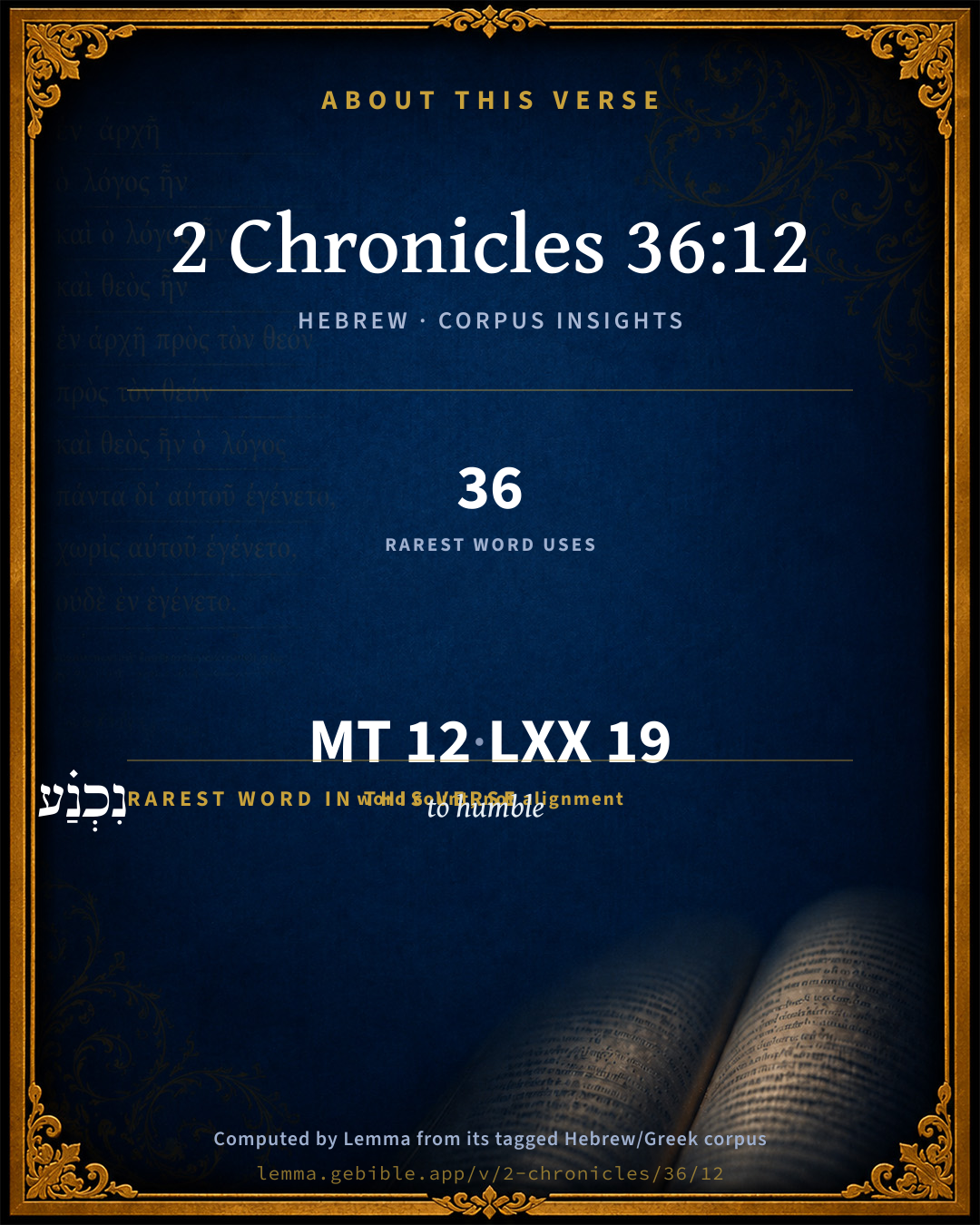
These counts appear in no published source. They are computed here, from the morphology-tagged text and Lemma’s own curated glosses. What Lemma adds →

12
words
11
distinct lemmas
Historical
section

Shared distinctive vocabulary

נִכְנַ֗ע to humble H3665 occurs in 32 verses of the Hebrew Bible. Also found in:

Grammatical profile

  • 2 verbs
  • 8 nouns
  • 1 adjective
  • 1 particle

Verb forms

  • וַיַּ֣עַשׂ Qal · Sequential Imperfect
  • נִכְנַ֗ע Niphal · Perfect

Repetition

A word recurs within this verse — often emphatic in Hebrew:

  • יְהוָ֣ה LORD H3068 ×2

Hebrew & Septuagint length

In English translation the verse runs 28 words from the Hebrew and 31 from the Septuagint (LXX English) — closely comparable.

A rough comparison of the two English renderings, which tokenize alike — not a word-level alignment.

Word counts can differ between the Hebrew and the Greek without any difference in meaning — e.g. the Hebrew direct-object marker אֵת has no separate Greek word, and Greek often adds the article ὁ.

In the original languages it is 12 Hebrew tokens and 19 Greek tokens — but the two are counted differently (Hebrew bundles its prefixes and suffixes into one token; the Greek is in lemma form), so that isn’t a like-for-like length.

Cross-references

14

Topical passages linked to 2 Chronicles 36:12 in the Treasury of Scripture Knowledge — connected by theme and wording, ordered by reader-vote popularity; previews shown in the World English Bible.

  • 2 Chronicles 33:23 He didn't humble himself before Yahweh, as Manasseh his father had humbled himself; but this same Amon trespassed more and more.
  • Jeremiah 37:2–21 But neither he, nor his servants, nor the people of the land, did listen to the words of Yahweh, which he spoke by the prophet Jeremiah.
  • Jeremiah 38:14–28 Then Zedekiah the king sent, and took Jeremiah the prophet to him into the third entry that is in the house of Yahweh: and the king said to Jeremiah, I will ask you a thing; hide nothing from me.
  • Exodus 10:3 Moses and Aaron went in to Pharaoh, and said to him, "This is what Yahweh, the God of the Hebrews, says: 'How long will you refuse to humble yourself before me? Let my people go, that they may serve me.
  • 2 Chronicles 32:26 Notwithstanding Hezekiah humbled himself for the pride of his heart, both he and the inhabitants of Jerusalem, so that the wrath of Yahweh didn't come on them in the days of Hezekiah.
  • 2 Chronicles 33:12 When he was in distress, he begged Yahweh his God, and humbled himself greatly before the God of his fathers.
  • 2 Chronicles 33:19 His prayer also, and how [God] was entreated of him, and all his sin and his trespass, and the places in which he built high places, and set up the Asherim and the engraved images, before he humbled himself: behold, they are written in the history of Hozai.
  • 2 Chronicles 35:22 Nevertheless Josiah would not turn his face from him, but disguised himself, that he might fight with him, and didn't listen to the words of Neco from the mouth of God, and came to fight in the valley of Megiddo.
  • Jeremiah 21:1–10 The word which came to Jeremiah from Yahweh, when king Zedekiah sent to him Pashhur the son of Malchijah, and Zephaniah the son of Maaseiah, the priest, saying,
  • Jeremiah 27:12–28:17 I spoke to Zedekiah king of Judah according to all these words, saying, Bring your necks under the yoke of the king of Babylon, and serve him and his people, and live.
  • Jeremiah 34:2–22 Thus says Yahweh, the God of Israel, Go, and speak to Zedekiah king of Judah, and tell him, Thus says Yahweh, Behold, I will give this city into the hand of the king of Babylon, and he shall burn it with fire:
  • Daniel 5:22–23 You his son, Belshazzar, have not humbled your heart, though you knew all this,
  • James 4:10 Humble yourselves in the sight of the Lord, and he will exalt you.
  • 1 Peter 5:6 Humble yourselves therefore under the mighty hand of God, that he may exalt you in due time;

Cross-references courtesy of OpenBible.info (CC BY 4.0).

Hebrew and Greek witnesses Masoretic Hebrew ↔ Greek Septuagint

The same verse in the two great witnesses to the Old Testament, shown verse-for-verse.

These are two independent witnesses, not word-aligned to each other, and the Septuagint is shown in lemma (dictionary) form.

Hebrew 2 Chronicles 36:12 Masoretic · Westminster Leningrad Codex

וַיַּ֣עַשׂ הָרַ֔ע בְּעֵינֵ֖י יְהוָ֣ה אֱלֹהָ֑יו לֹ֣א נִכְנַ֗ע מִלִּפְנֵ֛י יִרְמְיָ֥הוּ הַנָּבִ֖יא מִפִּ֥י יְהוָֽה

and he did that which was evil in the sight of Yahweh his God; he didn't humble himself before Jeremiah the prophet [speaking] from the mouth of Yahweh.

World English Bible · Public Domain

Greek LXX 2 Chronicles 36:12 Septuagint · lemma form

καί ποιέω ὁ πονηρός ἐνώπιον κύριος θεός αὐτός οὐ ἐντρέπω ἀπό πρόσωπον ἰερεμίας ὁ προφήτης καί ἐκ στόμα κύριος

And he did that which was evil in the sight of the Lord his God: he was not ashamed before the prophet Jeremias, nor because of the word of the Lord;

LXX2012 (modern English Septuagint) · Public Domain

Hebrew: Westminster Leningrad Codex (CC BY 4.0). Greek: Septuagint (public domain); English from LXX2012 (modern English Septuagint) (Public Domain). How the Septuagint differs from the Hebrew →

Commentary

Notes on 2 Chronicles 36:12 from classic Christian and Jewish commentators (each source and its license shown beneath its notes). The classic Christian expositions comment on the surrounding passage and are grouped to its opening verse, so a note may address several verses; the Jewish commentaries on the Tanakh (Rashi and others) are per-verse, so they appear only where the commentator wrote on this verse.

Lemma curates 59 commentaries, every one of them public domain or Creative Commons licensed, each selected and text-cleaned for this edition rather than reprinted as found. About our sources →

Joseph Benson's Commentary

2Ch 36:12. And humbled not himself — By repentance for his past errors and obedience to God’s express commands, which he would not yield to, through the pride of his heart, as is intimated by this phrase, and expressed Jer 38:19.

Joseph Benson's Commentary on the Old and New Testaments (1811–1818) — public domain. Text from a community e-Sword module.

Geneva Bible (1599)

Geneva Bible translators

1 Kings 24:17,19; Jer. 52:2

Geneva Bible (1599) marginal notes — public domain. Text via Bolls.life.

Adam Clarke's Commentary

Verse 12. Did that which was evil] Was there ever such a set of weak, infatuated men as the Jewish kings in general? They had the fullest evidence that they were only deputies to God Almighty, and that they could not expect to retain the throne any longer than they were faithful to their Lord; and yet with all this conviction they lived wickedly, and endeavoured to establish idolatry in the place of the worship of their Maker! After bearing with them long, the Divine mercy gave them up, as their case was utterly hopeless. They sinned till there was no remedy.

Adam Clarke's Commentary on the Bible (1810–1826) — public domain. Text from a community e-Sword/MySword module.

The Cambridge Bible for Schools and Colleges

gen. ed. J. J. S. Perowne

12. humbled not himself] Jeremiah consistently advised Zedekiah to submit to the Chaldeans; but the king partly through fear of his princes, partly through illusive hopes, could never bring himself to do this; cp. Jer_21:1-7; Jer_34:8-22; Jer_37:1-10; Jer_37:17; Jer_38:17-23.

The Cambridge Bible for Schools and Colleges (gen. ed. J. J. S. Perowne; Cambridge University Press, 1878–1918) — public domain. Text from a community e-Sword module.

Albert Barnes' Notes on the Bible

On Zedekiah’s character, see 2Ki 24:19 note.

Albert Barnes' Notes on the Bible (1834–1885) — public domain. Text from a community e-Sword/MySword module.

Matthew Poole's English Annotations

Humbled not himself by repentance for his past errors, and obedience to God’s express commands, which he would not yield to through the pride of his heart, as is intimated by this phrase, and expressed Jer 38:19.

Matthew Poole's English Annotations on the Holy Bible (1683–1685) — public domain. Text from a community e-Sword/MySword module.

The Pulpit Commentary

Humbled not himself before Jeremiah the prophet. Very numerous passages in the Book of Jeremiah (21-51.) illustrate both this clause and generally the feeble character and uncertain career of Zedekiah.

The Pulpit Commentary (1880–1919), ed. H.D.M. Spence-Jones & Joseph S. Exell — public domain. Text from a community e-Sword module.

Rashi

Rabbi Shlomo Yitzchaki (Rashi)

And he did that which was evil in the eyes of the Lord What is the evil? That he did not humble himself before Jeremiah the prophet, [who spoke] from the mouth of the Lord, as is explained in Jeremiah (38:17ff.): “And Jeremiah said to Zedekiah, ‘So said the Lord God of Hosts, the God of Israel: If you go out, etc.’...’I fear the Jews, etc.’” But aside from this sin, he did not sin except insofar as he did not obey the words of the prophet speaking from the mouth of the Lord, and that he transgressed Nebuchadnezzar’s oath. But he did not do “his abominations and that which was found in” Jehoiakim, i.e., the evil done by Jehoiakim. [This was heard] from Rabbi Eliezer the son of Rabbi Meshullam.

Rashi on the Tanakh — English translations: “The Judaica Press complete Tanach with Rashi, translated by A. J. Rosenberg” (CC BY 4.0); “Pentateuch with Rashi's commentary by M. Rosenbaum and A.M. Silbermann, 1929-1934” (public domain); “The Metsudah Tanach series, Lakewood, N.J” (CC BY 4.0); and “The Book of Joshua, Metsudah Publications, 1997” (CC BY 4.0). Text via Sefaria.

Lesson kit

Teaching starters — assembled from the data on this page, not authored interpretation. Every prompt links to the verse data it draws on. Edit before teaching.

2 Chronicles, in the Historical, opens this verse with 12 words (11 distinct Hebrew lemmas). Its most distinctive word is kânaʻ (“to humble”). A historical commentator’s framing appears above. Read the whole chapter for the surrounding context.

Discussion questions

  1. How does “to humble” (kânaʻ) shape what this verse is saying?
  2. Leviticus 26:41 shares the word «to humble» with this verse. How do the two illuminate each other?
  3. “LORD” occurs 2× in this one verse. What is the effect of the repetition?
  4. The translations on this page render this verse differently — a whole-verse word diff, not a word-by-word alignment. What might account for the different wordings?
  5. The verb «וַיַּ֣עַשׂ» is Qal Sequential Imperfect. How does its form color the action?
  6. Reading how Joseph Benson's Commentary and Geneva Bible (1599) read this verse, where do the two commentators agree and where do they part?

Things to notice

Reading settings

Reading text

Shown beneath each verse's original-language words.

Old Testament
Old Testament edition

Read the OT as the Masoretic Hebrew (MT) or the Greek Septuagint (LXX).

English shown for the Greek Septuagint (in the Hebrew ↔ Greek comparison).

Comparing translations? Open the Compare panel on any verse page to stack up to four side by side.