
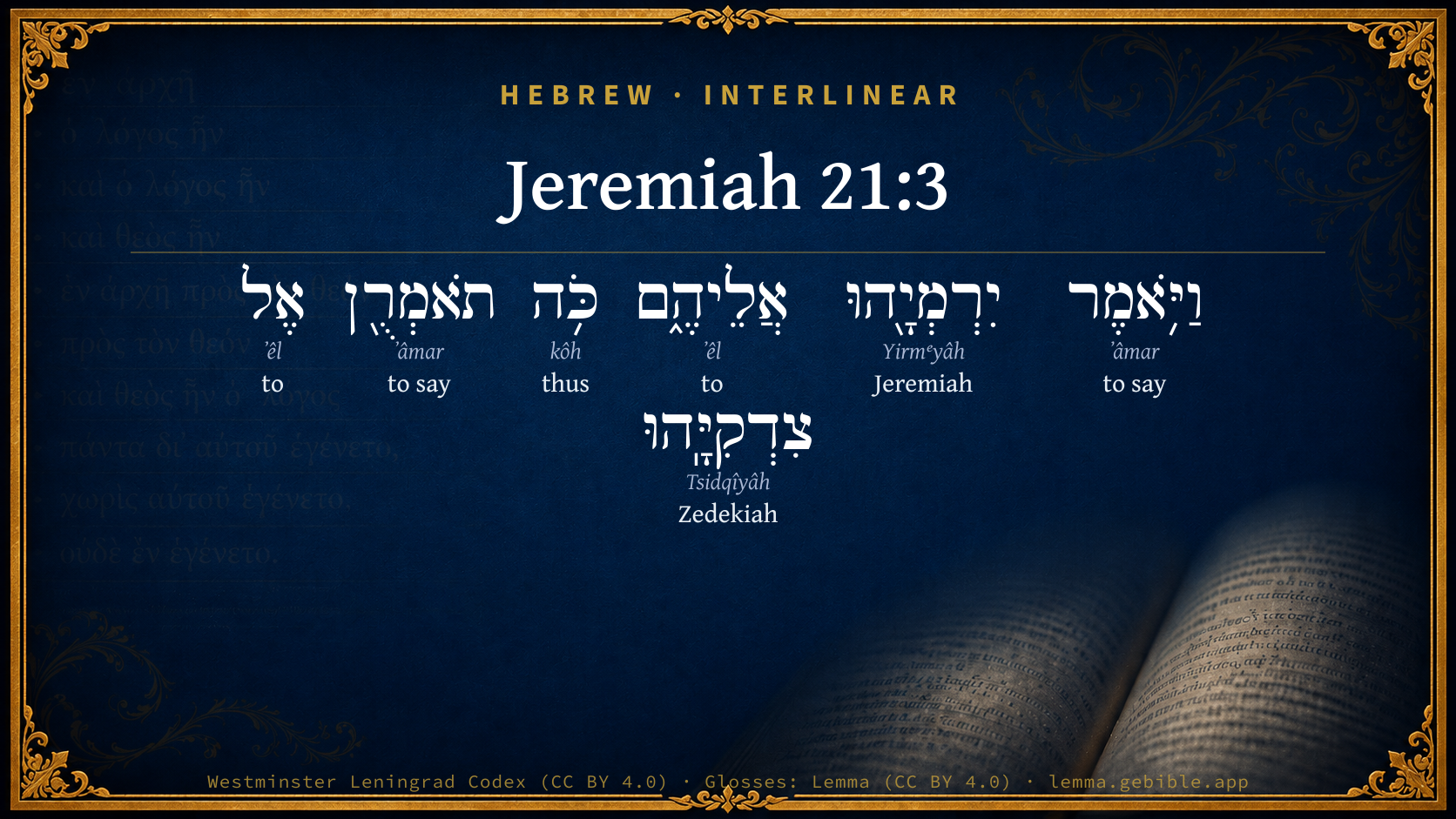
Jeremiah 21:3

Hebrew (Westminster Leningrad Codex) Jeremiah 21:3 appears in the Hebrew Old Testament. The text above is from the Westminster Leningrad Codex. Each word links to its Strong’s number, a concise gloss, and parsing drawn from the Open Scriptures Hebrew Bible morphology. Click any word for its full Brown-Driver-Briggs (BDB) entry.
Download image
Cite this verse

Jeremiah 21:3 (World English Bible). Public Domain. Lemma interlinear Bible study tool, https://lemma.gebible.app/v/jeremiah/21/3.

Show BibTeX & RIS
BibTeX
RIS
English Translation
Then said Jeremiah to them, Thus shall you tell Zedekiah:
World English Bible · Public Domain
Download a study sheet

One document with this verse’s original text, its word-by-word gloss line, the meaning frame, cross-references with their text, attributed commentary, and full source and license credits — printable, and it pastes into notes with its structure intact.

This verse Autodidact and up

Study sheet (.html) Plain text (.txt)

A passage Seminary Student

Up to 50 verses in one chapter. A passage sheet keeps up to 6 commentary sources and 12 cross-references per verse, in the order this page ranks them, and says so on the sheet whenever that leaves anything out. Ask for a single verse and you get the Autodidact verse sheet above.

Everything on this page stays free to read, with no account — the sheet is a download of what is already on screen, not access to it.

Want to remove ads? Support Godless Engineer
Compare translations 3

The same verse in 3 English versions, stacked beneath the original-language interlinear above. Click any original word for its lexicon entry.

Each is an independent rendering of the whole verse — the interlinear is not word-aligned to these translations.

Highlighted words mark where these versions differ — a whole-verse word diff, not a word-by-word alignment.

  • World English Bible Public Domain
    Then said Jeremiah to them, Thus shall you tell Zedekiah:
  • King James Version Public Domain
    Then said Jeremiah unto them, Thus shall ye say to Zedekiah:
  • unfoldingWord Literal Text CC BY-SA 4.0
    And Jeremiah said to them, “Thus you shall say to Zedekiah:

unfoldingWord Literal Text — © unfoldingWord, licensed CC BY-SA 4.0. Word-aligned USFM3 via Door43 (git.door43.org/unfoldingWord/en_ult).

Versions to compare (up to 4)

3 of 4 selected

Show all 18 translations

Every available English version of this verse, each an independent rendering of the whole verse.

  • World English Bible Public Domain
    Then said Jeremiah to them, Thus shall you tell Zedekiah:
  • Berean Standard Bible Public Domain
    But Jeremiah answered, “You are to tell Zedekiah that
  • Majority Standard Bible Public Domain
    But Jeremiah answered, “You are to tell Zedekiah that
  • King James Version Public Domain
    Then said Jeremiah unto them, Thus shall ye say to Zedekiah:
  • American Standard Version (1901) Public Domain
    Then said Jeremiah unto them, Thus shall ye say to Zedekiah:
  • Revised Version (1885) Public Domain
    Then said Jeremiah unto them, Thus shall ye say to Zedekiah:
  • Geneva Bible (1599) Public Domain
    Then said Ieremiah, Thus shall you say to Zedekiah,
  • Douay-Rheims (1899) Public Domain
    And Jeremias said to them: Thus shall you say to Sedecias:
  • Young's Literal Translation Public Domain
    And Jeremiah saith unto them, `Thus do ye say unto Zedekiah,
  • Literal Standard Version CC BY-SA 4.0
    And Jeremiah says to them, “Thus you say to Zedekiah,
  • Unlocked Literal Bible CC BY-SA 4.0
    So Jeremiah said to them, “This is what you must say to Zedekiah,
  • unfoldingWord Literal Text CC BY-SA 4.0
    And Jeremiah said to them, “Thus you shall say to Zedekiah:
  • Darby Bible Public Domain
    And Jeremiah said unto them, Thus shall ye say to Zedekiah:
  • World Messianic Bible Public Domain
    Then Jeremiah said to them, “Tell Zedekiah:
  • Webster's Bible Public Domain
    Then said Jeremiah to them, Thus shall ye say to Zedekiah:
  • Free Bible Version CC BY-SA 4.0
    But Jeremiah replied, “Tell Zedekiah this:
  • Bible in Basic English Public Domain
    Then Jeremiah said to them, This is what you are to say to Zedekiah:
  • JPS Tanakh (1917) Public Domain
    Then said Jeremiah unto them: Thus shall ye say to Zedekiah:

Literal Standard Version (2020), Covenant Press — licensed CC BY-SA 4.0. Text via the HelloAO Bible API (eBible.org). Unlocked Literal Bible (unfoldingWord) — licensed CC BY-SA 4.0. Text via the HelloAO Bible API (eBible.org). unfoldingWord Literal Text — © unfoldingWord, licensed CC BY-SA 4.0. Word-aligned USFM3 via Door43 (git.door43.org/unfoldingWord/en_ult). Free Bible Version, Dr. Jonathan Gallagher — licensed CC BY-SA 4.0. Text via the HelloAO Bible API (eBible.org).

Word by word

More ways to search: Search by grammar → Find every occurrence → Compare this word →

Practice this passage: Drill this verse → Learn its vocabulary →

צִדְקִיָּֽהוּ
Tsidqîyâh
H6667
“Zedekiah”
Noun, Proper
Part of Speech
Noun
Type
Proper
Full BDB Definition

Origin: from H6664 and H3050

TWOT: None

Zedekiah = "Jehovah is righteous" - the last king of Judah renamed from 'Mattaniah' by Nebuchadnezzar; son of Josiah by wife Hamutal; placed on the throne by Nebuchadnezzar when he carried his nephew Jehoiakim in captivity - false prophet at the court of king Ahab of the northern kingdom of Israel - son of Maaseiah, a false prophet in Babylon - son of Hananiah, one of the princes of Judah in the time of Jeremiah - a priest who sealed the covenant with Nehemiah - son of king Jehoiakim of Judah
  1. וַיֹּ֥אמֶר ʼâmar H559 “and · to say” Conjunction + Verb, Qal, Sequential Imperfect, 3rd Person, Masculine, Singular
  2. יִרְמְיָ֖הוּ Yirmᵉyâh H3414 “Jeremiah” Noun, Proper
  3. אֲלֵיהֶ֑ם ʼêl H413 “to · them” Preposition + Suffix, Personal, 3rd Person, Masculine, Plural
  4. כֹּ֥ה kôh H3541 “thus” Adverb
  5. תֹאמְרֻ֖ן ʼâmar H559 “to say” Verb, Qal, Imperfect, 2nd Person, Masculine, Plural + Suffix, n
  6. אֶל ʼêl H413 “to” Preposition

About this verse

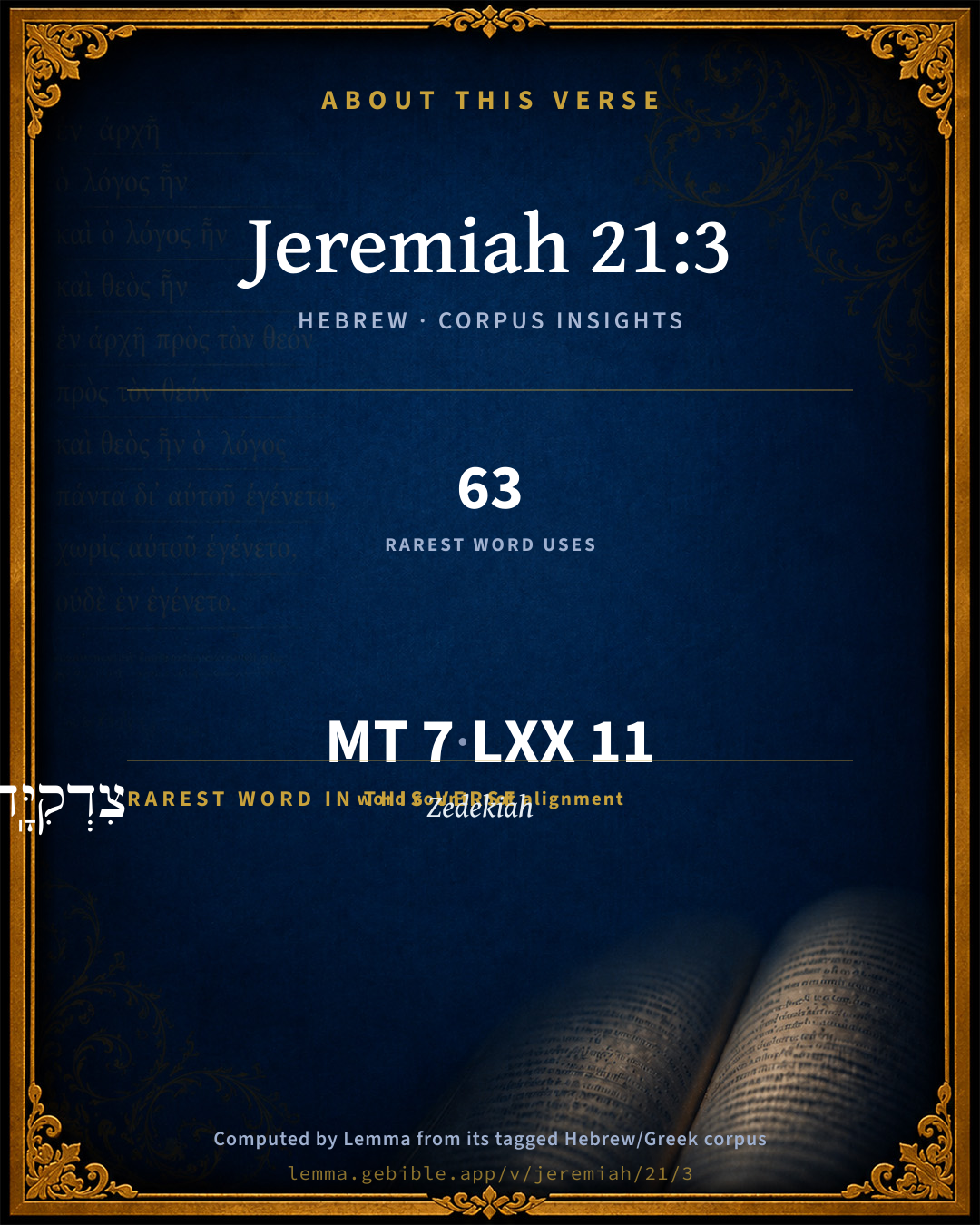
These counts appear in no published source. They are computed here, from the morphology-tagged text and Lemma’s own curated glosses. What Lemma adds →

7
words
5
distinct lemmas
Prophets
section

Grammatical profile

  • 2 verbs
  • 2 nouns
  • 2 prepositions
  • 1 adverb

Verb forms

  • וַיֹּ֥אמֶר Qal · Sequential Imperfect
  • תֹאמְרֻ֖ן Qal · Imperfect

Repetition

Words recur within this verse — often emphatic in Hebrew:

  • וַיֹּ֥אמֶר to say H559 ×2
  • אֲלֵיהֶ֑ם to H413 ×2

Hebrew & Septuagint length

In the original languages it is 7 Hebrew tokens and 11 Greek tokens — but the two are counted differently (Hebrew bundles its prefixes and suffixes into one token; the Greek is in lemma form), so that isn’t a like-for-like length.

Hebrew and Greek witnesses Masoretic Hebrew ↔ Greek Septuagint

The same verse in the two great witnesses to the Old Testament, shown verse-for-verse.

These are two independent witnesses, not word-aligned to each other, and the Septuagint is shown in lemma (dictionary) form.

Hebrew Jeremiah 21:3 Masoretic · Westminster Leningrad Codex

וַיֹּ֥אמֶר יִרְמְיָ֖הוּ אֲלֵיהֶ֑ם כֹּ֥ה תֹאמְרֻ֖ן אֶל צִדְקִיָּֽהוּ

Then said Jeremiah to them, Thus shall you tell Zedekiah:

World English Bible · Public Domain

Greek LXX Structure differs

In the Septuagint, Jeremiah is about an eighth shorter than the Hebrew and arranges its material differently — the Oracles Against the Nations (Hebrew chapters 46–51) appear in the middle of the Greek book, after 25:13. Because the chapter and verse boundaries do not line up, a verse-for-verse comparison with the Hebrew is not shown.

A verse-for-verse comparison isn’t shown here because the chapters and verses don’t line up. Switch to the LXX edition with the MT / LXX toggle above to read the Greek directly.

On this verse, Keil & Delitzsch discusses the Septuagint’s reading. Read the note in Commentary ↓

Hebrew: Westminster Leningrad Codex (CC BY 4.0). Greek: Septuagint (public domain); English from a public-domain English Septuagint. How the Septuagint differs from the Hebrew →

Targum (Aramaic paraphrase)

1

The Targum is the ancient Jewish Aramaic paraphrase of the Hebrew Scriptures — an interpretive translation, not the Hebrew text itself. Onkelos (literal) and Pseudo-Jonathan (expansive) render the Torah, and Jonathan the Prophets. Coverage is partial: where no permissively-licensed English translation exists for a verse, only the Aramaic is shown. This is verse-level text, not a word-by-word alignment to the Hebrew.

  1. Targum Jonathan Prophets (Joshua–Malachi)
    וַאֲמַר יִרְמְיָה לְהוֹן כְּדֵין תֵּימְרוּן לְצִדְקִיָה:

    (no public-domain English translation for this verse)

    Targum Jonathan — Aramaic: “Mikraot Gedolot” (public domain). English: “Sefaria Community Translation” (CC0 1.0 (public-domain dedication)); “London "Chaldee Paraphrase," 1871” (public domain). Text via Sefaria.

Commentary

Notes on Jeremiah 21:3 from classic Christian and Jewish commentators (each source and its license shown beneath its notes). The classic Christian expositions comment on the surrounding passage and are grouped to its opening verse, so a note may address several verses; the Jewish commentaries on the Tanakh (Rashi and others) are per-verse, so they appear only where the commentator wrote on this verse.

Lemma curates 59 commentaries, every one of them public domain or Creative Commons licensed, each selected and text-cleaned for this edition rather than reprinted as found. About our sources →

Trapp's Complete Commentary

John Trapp

Jer 21:3 Then said Jeremiah unto them, Thus shall ye say to Zedekiah:

Ver. 3. Then said Jeremiah unto them.] He answereth them modestly, and without insultation; but freely and boldly, as a man of a heroic spirit, and the messenger of the King of kings.

John Trapp, A Commentary or Exposition upon All the Books of the Old and New Testament (1647–1656) — public domain. Text from a community e-Sword module.

Keil & Delitzsch

C. F. Keil & F. Delitzsch

The Lord's reply through Jeremiah consists of three parts: a. The answer to the king's hope that the Lord will save Jerusalem from the Chaldeans (Jer 21:4-7); b. The counsel given to the people and the royal family as to how they may avert ruin (Jer 21:8-12); c. The prediction that Jerusalem will be punished for her sins (Jer 21:13 and Jer 21:14).

Jer 21:3-6

The answer. - Jer 21:3. "And Jeremiah said to them: Thus shall ye say to Zedekiah: Jer 21:4. Thus hath Jahveh the God of Israel said: Behold, I turn back the weapons of war that are in your hands, wherewith ye fight against the king of Babylon and the Chaldeans, which besiege you without the walls, and gather them together into the midst of this city. Jer 21:5. And I fight against you with outstretched hand and strong arm, and with anger and fury and great wrath, Jer 21:6. And smite the inhabitants of this city, both man and beast; of a great plague they shall die. Jer 21:7. And afterward, saith Jahveh, I will give Zedekiah the king of Judah, and his servants, and the people - namely, such as in this city are left of the plague, of the sword, and of the famine - into the hand of Nebuchadrezzar king of Babylon, and into the hand of their enemies, and into the hand of those that seek after their life, that he may smite them according to the sharpness of the sword, not spare them, neither have pity nor mercy." This answer is intended to disabuse the king and his servants of all hope of help from God. So far from saving them from the Chaldeans, God will fight against them, will drive back into the city its defenders that are still holding out without the walls against the enemy; consume the inhabitants by sword, pestilence, famine; deliver the king, with his servants and all that survive inside the lines of the besiegers, into the hand of the latter, and unsparingly cause them to be put to death. "I make the weapons of war turn back" is carried on and explained by "I gather them into the city." The sense is: I will bring it about that ye, who still fight without the walls against the beleaguerers, must turn back with your weapons and retreat into the city. "Without the walls" is not to be joined to מסב, because this is too remote, and מחוּץ is by usage locative, not ablative. It should go with "wherewith ye fight," etc.: wherewith ye fight without the walls against the beleaguering enemies. The siege had but just begun, so that the Jews were still trying to hinder the enemy from taking possession of stronger positions and from a closer blockade of the city. In this they will not succeed, but their weapons will be thrust back into the city.

Jer 21:7

The Lord will make known His almighty power not for the rescue but for the chastisement of Judah. The words "with outstretched hand and strong arm" are a standing figure for the miraculous manifestation of God's power at the release of Israel from Egypt, Deu 4:34; Deu 5:15; Deu 26:8. This power He will now exercise upon Israel, and execute the punishment threatened against apostasy at the renewal of the covenant by Moses in the land of Moab. The words גּדול...בּאף are from Deu 29:27. The inhabitants of Jerusalem are to perish during the siege by pestilence and disease, and the remainder, including the king and his servants, to be mercilessly massacred. "Great pestilence" alone is mentioned in Jer 21:6, but in Jer 21:7 there are sword and famine along with it. The ואת before הנּשׁארים seems superfluous and unsuitable, since besides the king, his servants and the people, there could be none others left. The lxx have therefore omitted it, and Hitz., Ew., Graf, and others propose to erase it. But the ו may be taken to be explicative: namely, such as are left, in which case ואת serves to extend the participial clause to all the persons before mentioned, while without the ואת the 'הנּשׁארים וגו could be referred only to העם. "Into the hand of their enemies" is rhetorically amplified by "into the hand of those that seek," etc., as in Jer 19:7, Jer 19:9; Jer 34:20, etc.; לפי חרב, according to the sharpness (or edge) of the sword, i.e., mercilessly (see on Gen 34:26; in Jer. only here), explained by "not spare them," etc., cf. Jer 13:14.

Jer 21:8-10

The counsel given to the people and royal family how to escape death. - Jer 21:8. "And unto the people thou shalt say: Thus hath Jahveh said: Behold, I set before you the way of life and the way of death. Jer 21:9. He that abideth in this city shall die by sword, by famine, and by pestilence; but he that goeth out and falleth to the Chaldeans that besiege you, he shall live, and have his soul for a prey. Jer 21:10. For I have set my face on this city for evil and not for good, saith Jahveh; into the hand of the king of Babylon shall it be given, who shall burn it with fire. Jer 21:11. And to the house of the king of Judah: Hear the word of Jahveh: Jer 21:12. House of David! thus hath Jahveh said: Hold judgment every morning, and save the despoiled out of the hand of the oppressor, lest my fury break forth as fire, and burn unquenchably, because of the evil of your doings." What the prophet is here to say to the people and the royal house is not directly addressed to the king's envoy, but is closely connected with the answer he was to give to the latter, and serves to strengthen the same. We need not be hampered by the assumption that Jeremiah, immediately after that answer, communicated this advice, so that it might be made known to the people and to the royal house. The counsel given in Jer 21:8-12 to the people was during the siege repeatedly given by Jeremiah both to the king and to the people, cf. Jer 38:1., Jer 38:17., and Jer 27:11., and many of the people acted by his advice, cf. Jer 38:19; Jer 39:9; Jer 52:15. But the defenders of the city, the authorities, saw therein treason, or at least a highly dangerous discouragement to those who were fighting, and accused the prophet as a traitor, Jer 38:4., cf. Jer 37:13. Still Jeremiah, holding his duty higher than his life, remained in the city, and gave as his opinion, under conviction attained to only by divine revelation, that all resistance is useless, since God has irrevocably decreed the destruction of Jerusalem as a punishment for their sins. The idea of Jer 21:7 is clothed in words taken from Deu 30:15, cf. Deu 11:26. ישׁב , Jer 21:9, as opposed to יצא, does not mean: to dwell, but: to sit still, abide. To fall to the Chaldeans, i.e., to go over to them, cf. Jer 37:14; Jer 39:9; Kg2 25:11; על is interchanged with אל, Jer 37:13; Jer 38:19; Jer 52:15. The Chet. יחיה is right, corresponding to ימוּת; the Keri וחיה is wrong. His life shall be to him for a prey, i.e., he shall carry it thence as a prey, i.e., preserve it. Jer 21:10 gives the reason for the advice given. For I have set my face, cf. Jer 44:11, recalls Amo 9:4, only there we have עיני for פּני, as in Jer 24:6. To set the face or eye on one means: to pay special heed to him, in good (cf. Jer 39:12) or in evil sense; hence the addition, "for evil," etc.

Jer 21:11-12

(Note: According to Hitz., Gr., and Ng., the passage Jer 21:11-14 stands in no inner connection with the foregoing, and may, from the contents of it, be seen to belong to an earlier period than that of the siege which took place under Zedekiah, namely, to the time of Jehoiakim, because, a. in the period of Jer 21:1. such an exhortation and conditional threatening must have been out of place after their destruction had been quite unconditionally foretold to Zedekiah and the people in Jer 21:4-7; b. the defiant tone conveyed in Jer 21:13 is inconsistent with the cringing despondency shown by Zedekiah in Jer 21:2; c. it is contrary to what we would expect to find the house of the king addressed separately after the king had been addressed in Jer 21:3, the king being himself comprehended in his "house." But these arguments, on which Hitz. builds ingenious hypotheses, are perfectly valueless. As to a, we have to remark: In Jer 21:4-7 unconditional destruction is foretold against neither king nor people; it is only said that the Chaldeans will capture the city - that the inhabitants will be smitten with pestilence, famine, and sword - and that the king, with his servants and those that are left, will be given into the hand of the king of Babylon, who will smite them unsparingly. But in Jer 21:12 the threatening is uttered against the king, that if he does not practise righteousness, the wrath of God will be kindled unquenchably, and, Jer 21:14, that Jerusalem is to be burnt with fire. In Jer 21:4-7 there is no word of the burning of the city; it is first threatened, Jer 21:10, against the people, after the choice has been given them of escaping utter destruction. How little the burning of Jerusalem is involved in Jer 21:4-7 may be seen from the history of the siege and capture of Jerusalem under Jehoiachin, on which occasion, too, the king, with his servants and the people, was given into the hand of the king of Babylon, while the city was permitted to stand, and the deported king remained in life, and was subsequently set free from his captivity by Evil-Merodach. But that Zedekiah, by hearkening to the word of the Lord, can alleviate his doom and save Jerusalem from destruction, this Jeremiah tells him yet later in very plain terms, Jer 38:17-23, cf. Jer 34:4. Lastly, the release of Hebrew man-servants and maid-servants, recounted in Jer 34:8., shows that even during the siege there were cases of an endeavour to turn and follow the law, and consequently that an exhortation to hold by the right could not have been regarded as wholly superfluous. - The other two arguments, b and c, are totally inconclusive. How the confidence of the inhabitants of Jerusalem in the strength of its fortifications (Jer 21:13) is contradictory of the fact related in Jer 21:2, does not appear. That Zedekiah should betake himself to the prophet, desiring him to entreat the help of God, is not a specimen of cringing despondency such as excludes all confidence in any earthly means of help. Nor are defiance and despondency mutually exclusive opposites in psychological experience, but states of mind that rapidly alternate. Finally, Ng. seems to have added the last argument (c) only because he had no great confidence in the two others, which had been dwelt on by Hitz. and Graf. Why should not Jeremiah have given the king another counsel for warding off the worst, over and above that conveyed in the answer to his question (Jer 21:4-7)? - These arguments have therefore not pith enough to throw any doubt on the connection between the two passages (Jer 21:8-10, and Jer 21:11, Jer 21:12) indicated by the manner in which "and to the house (וּלבית) of the king of Judah" points back to "and unto this people thou shalt say" (Jer 21:8), or to induce us to attribute the connection so indicated to the thoughtlessness of the editor.)

The kingly house, i.e., the king and his family, under which are here comprehended not merely women and children, but also the king's companions, his servants and councillors; they are counselled to hold judgment every morning. דּין משׁפּט = דּין דּין, Jer 5:28; Jer 22:16, or שׁפט, Lam 3:59; Kg1 3:28. לבּקר distributively, every morning, as Amo 4:4. To save the despoiled out of the hand of the oppressor means: to defend his just cause against the oppressor, to defend him from being despoiled; cf. Jer 22:3. The form of address; House of David, which is by a displacement awkwardly separated from שׁמעוּ, is meant to remind the kingly house of its origin, its ancestor David, who walked in the ways of the Lord. - The second half of the verse, "lest my fury," etc., runs like Jer 4:4.

Jer 21:13-14

The chastisement of Jerusalem. - Jer 21:13. "Behold, I am against thee, inhabitress of the valley, of the rock of the plain, saith Jahveh, ye who say: Who shall come down against us, and who shall come into our dwellings? Jer 21:14. And will visit you according to the fruit of your doings, saith Jahveh, and kindle a fire in her forest, that it may devour all her surroundings." This threatening is levelled against the citizens of Jerusalem, who vaunted the impregnableness of their city. The inhabitress of the valley is the daughter of Zion, the population of Jerusalem personified. The situation of the city is spoken of as עמק, ravine between mountains, in respect that Jerusalem was encircled by mountains of greater height (Psa 125:2); and as rock of the plain, i.e., the region regarded as a level from which Mount Zion, the seat of the kingdom, rose, equivalent to rock of the field, Jer 17:3. In the "rock" we think specially of Mount Zion, and in the "valley" of the so-called lower city. The two designations are chosen to indicate the strong situation of Jerusalem. On this the inhabitants pride themselves, who say: Who shall come down against us? יחת for ינחת, from נחת; cf. Ew. 139, c. Dwellings, cf. Jer 25:30, not cities or refuge or coverts of wild animals; מעון has not this force, but can at most acquire it from the context; see Del. on Psa 26:8. The strength of the city will not shield the inhabitants from the punishment with which God will visit them. "According to the fruit," etc., cf. Jer 17:10. I kindle fire in her forest. The city is a forest of houses, and the figure is to be explained by the simile in Jer 22:6, but was not suggested by מעון = lustra ferarum (Hitz.). All her surroundings, how much more then the city itself!

Keil & Delitzsch — Biblical Commentary on the Old Testament (1861–1891) — public domain (CC PDM 1.0). Text via the HelloAO Bible API. (Old Testament only.)

Tyndale Open Study Notes

Tyndale Open Resources

21:3-7 The Lord answered King Zedekiah’s messengers with a judicial decree (see study note on 2:2). Resisting the Babylonians would be useless because the Lord was fighting against Jerusalem.

Tyndale Open Study Notes — © Tyndale Open Resources, licensed CC BY-SA 4.0. Text via the HelloAO Bible API.

John Calvin's Commentaries

Now follows the answer of Jeremiah, say ye to Zedekiah, etc.; he did not go to the king himself, but by way of contempt delivered the message to be borne by the messengers. The Prophet no doubt did this designedly, and through the impulse of the Holy Spirit. He did not, indeed, proudly despise his king; but it was necessary for him by his magnanimity to cast down the pride of the king, so that he might know that he had to do with the living God, whom he had very insolently treated. Say ye to Zedekiah, Thus saith Jehovah, the God of Israel, etc. He adds the words, the God of Israel, that Zedekiah might know that the wonderful works, in reliance on which he still thought that their condition was safe, did not belong to him and the people; as though the Prophet had said, “Though God did not help thee and thy people, he would not yet be inconsistent with himself, or depart from his covenant; but he would remain ever the God of Israel, though he destroyed thee and all thy people.”

John Calvin's Commentaries (1540-1563) — public domain. Text from the Calvin Translation Society English edition (1840s-50s) via the Christian Classics Ethereal Library (ccel.org). Calvin's coverage is partial (roughly two-thirds of the Bible); uncommented books and verses are honest gaps, never fabricated. The 19th-century editor's footnotes and remarks are omitted so the notes are faithfully Calvin's own voice.

John Gill's Exposition

Then said Jeremiah unto them,.... The two priests, Pashur and Zephaniah, after he had sought the Lord, and knew his mind and will:

thus shall ye say to Zedekiah; by whom they were sent.

John Gill's Exposition of the Whole Bible (1746–1763) — public domain (CC PDM 1.0). Text via the HelloAO Bible API.

unfoldingWord translationNotes

Door43 World Missions Community

See

This tells the hearer to pay special attention to what follows.

turn back

Possible meanings are 1) to make useless or 2) to send back into the city.

the instruments of war that are in your hand

Possible meanings are 1) the instruments of war refers to the soldiers who carry them and "hand" represents control. AT: "the soldiers that you command" or 2) the instruments of war are literal weapons and "your hand" represent both the king and his soldiers. AT: "the weapons that you and your soldiers carry" (See: Metonymy and Synecdoche)

Chaldeans

This term here is another name for the Babylonians.

closing you in

"coming close to you"

I will gather them

Possible meanings are 1) Yahweh will allow the Babylonians to enter the city or 2) Yahweh will cause the Israelites to bring their weapons back into the center of the city.

Then I myself

This is emphatic and stresses that Yahweh is the one who will do this. (See: Reflexive Pronouns)

with a raised hand and a strong arm

Both of these phrases are idiomatic expressions that refer to great power. AT: "with very great power" (See: Idiom and Doublet)

with wrath, fury, and great anger

These words all mean basically the same thing. Together they emphasize the great intensity of his anger. AT: "with extremely great anger" (See: Doublet)

translationWords

God

Israel

turn

hand

Chaldea

raise

wrath

anger

unfoldingWord translationNotes — © Distant Shores Media and the Door43 World Missions Community, licensed CC BY-SA 4.0. Source: git.door43.org/Door43/en_tn.

Lesson kit

Teaching starters — assembled from the data on this page, not authored interpretation. Every prompt links to the verse data it draws on. Edit before teaching.

Jeremiah, in the Prophets, opens this verse with 7 words (5 distinct Hebrew lemmas). Its most distinctive word is Tsidqîyâh (“Zedekiah”). A historical commentator’s framing appears above. Read the whole chapter for the surrounding context.

Discussion questions

  1. How does “Zedekiah” (Tsidqîyâh) shape what this verse is saying?
  2. What does the repetition of “to say” (2× in this one verse) do in this verse?
  3. The translations on this page render this verse differently — a whole-verse word diff, not a word-by-word alignment. What might account for the different wordings?
  4. «וַיֹּ֥אמֶר» is a Qal Sequential Imperfect verb. How does that grammatical form shape the action described?
  5. Compare how Trapp's Complete Commentary and Keil & Delitzsch read this verse. Where do they agree or differ?

Things to notice

Reading settings

Reading text

Shown beneath each verse's original-language words.

Old Testament
Old Testament edition

Read the OT as the Masoretic Hebrew (MT) or the Greek Septuagint (LXX).

English shown for the Greek Septuagint (in the Hebrew ↔ Greek comparison).

Comparing translations? Open the Compare panel on any verse page to stack up to four side by side.