
Jeremiah 38:10

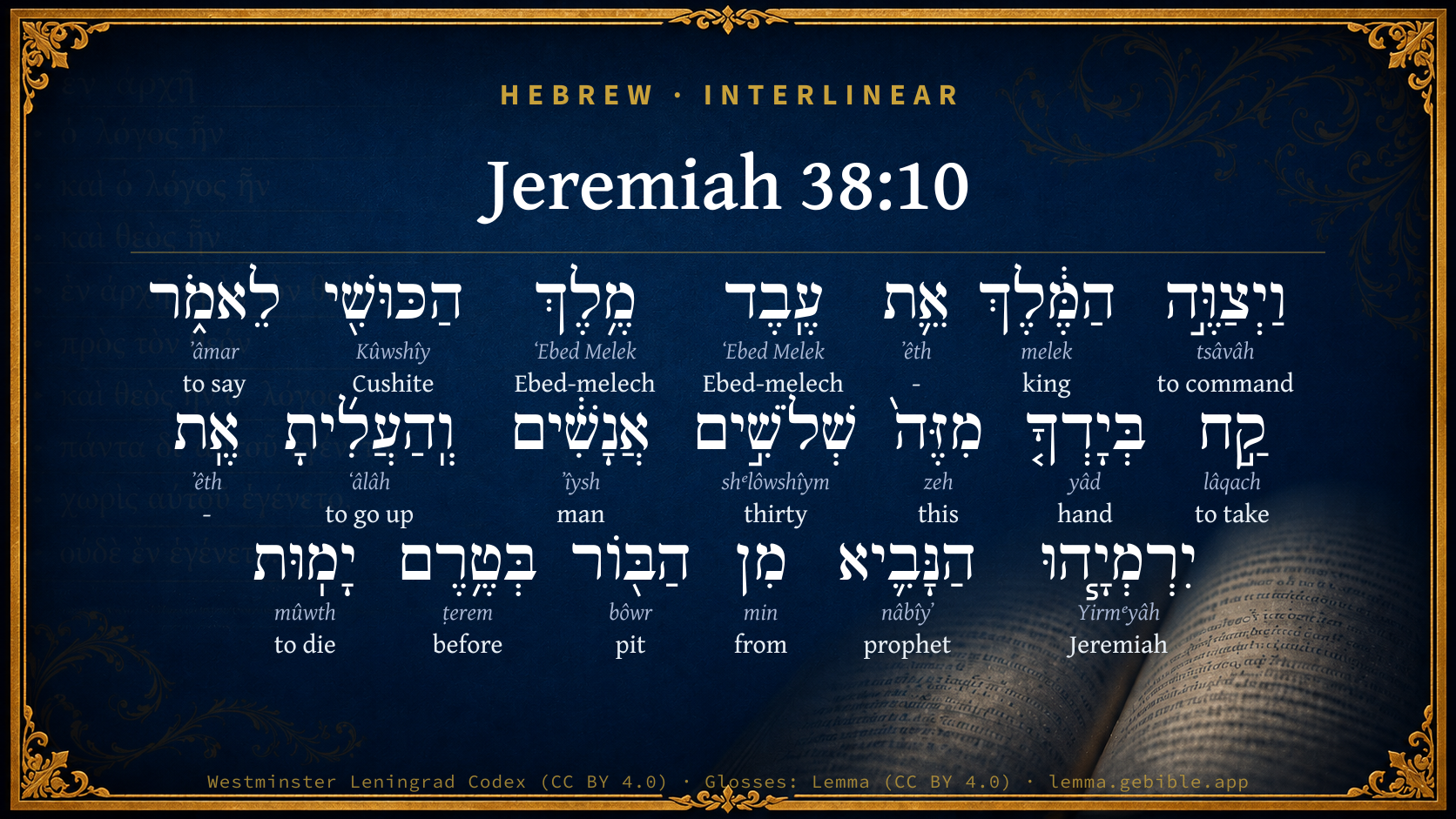
Hebrew (Westminster Leningrad Codex) Jeremiah 38:10 appears in the Hebrew Old Testament. The text above is from the Westminster Leningrad Codex. Each word links to its Strong’s number, a concise gloss, and parsing drawn from the Open Scriptures Hebrew Bible morphology. Click any word for its full Brown-Driver-Briggs (BDB) entry.
Download image
Cite this verse

Jeremiah 38:10 (World English Bible). Public Domain. Lemma interlinear Bible study tool, https://lemma.gebible.app/v/jeremiah/38/10.

Show BibTeX & RIS
BibTeX
RIS
English Translation
Then the king commanded Ebedmelech the Ethiopian, saying, Take from hence thirty men with you, and take up Jeremiah the prophet out of the dungeon, before he die.
World English Bible · Public Domain
Download a study sheet

One document with this verse’s original text, its word-by-word gloss line, the meaning frame, cross-references with their text, attributed commentary, and full source and license credits — printable, and it pastes into notes with its structure intact.

This verse Autodidact and up

Study sheet (.html) Plain text (.txt)

A passage Seminary Student

Up to 50 verses in one chapter. A passage sheet keeps up to 6 commentary sources and 12 cross-references per verse, in the order this page ranks them, and says so on the sheet whenever that leaves anything out. Ask for a single verse and you get the Autodidact verse sheet above.

Everything on this page stays free to read, with no account — the sheet is a download of what is already on screen, not access to it.

Want to remove ads? Support Godless Engineer
Compare translations 3

The same verse in 3 English versions, stacked beneath the original-language interlinear above. Click any original word for its lexicon entry.

Each is an independent rendering of the whole verse — the interlinear is not word-aligned to these translations.

Highlighted words mark where these versions differ — a whole-verse word diff, not a word-by-word alignment.

  • World English Bible Public Domain
    Then the king commanded Ebedmelech the Ethiopian, saying, Take from hence thirty men with you, and take up Jeremiah the prophet out of the dungeon, before he die.
  • King James Version Public Domain
    Then the king commanded Ebedmelech the Ethiopian, saying, Take from hence thirty men with thee, and take up Jeremiah the prophet out of the dungeon, before he die.
  • unfoldingWord Literal Text CC BY-SA 4.0
    Then the king gave a command to Ebed-Melek the Cushite. He said, “Take command of thirty men from here and take Jeremiah the prophet out of the cistern before he dies.”

unfoldingWord Literal Text — © unfoldingWord, licensed CC BY-SA 4.0. Word-aligned USFM3 via Door43 (git.door43.org/unfoldingWord/en_ult).

Versions to compare (up to 4)

3 of 4 selected

Show all 18 translations

Every available English version of this verse, each an independent rendering of the whole verse.

  • World English Bible Public Domain
    Then the king commanded Ebedmelech the Ethiopian, saying, Take from hence thirty men with you, and take up Jeremiah the prophet out of the dungeon, before he die.
  • Berean Standard Bible Public Domain
    So the king commanded Ebed-melech the Cushite, “Take thirty men from here with you and pull Jeremiah the prophet out of the cistern before he dies.”
  • Majority Standard Bible Public Domain
    So the king commanded Ebed-melech the Cushite, “Take thirty men from here with you and pull Jeremiah the prophet out of the cistern before he dies.”
  • King James Version Public Domain
    Then the king commanded Ebedmelech the Ethiopian, saying, Take from hence thirty men with thee, and take up Jeremiah the prophet out of the dungeon, before he die.
  • American Standard Version (1901) Public Domain
    Then the king commanded Ebed-melech the Ethiopian, saying, Take from hence thirty men with thee, and take up Jeremiah the prophet out of the dungeon, before he die.
  • Revised Version (1885) Public Domain
    Then the king commanded Ebed-melech the Ethiopian, saying, Take from hence thirty men with thee, and take up Jeremiah the prophet out of the dungeon, before he die.
  • Geneva Bible (1599) Public Domain
    Then the King commanded Ebed-melech the blacke More, saying, Take from hence thirtie men with thee, and take Ieremiah the Prophet out of the dungeon before he dye.
  • Douay-Rheims (1899) Public Domain
    Then the king commanded Abdemelech the Ethiopian, saying: Take from hence thirty men with thee, end draw up Jeremias the prophet out of the dungeon, before he die.
  • Young's Literal Translation Public Domain
    And the king commandeth Ebed-Melech the Cushite, saying, `Take with thee from this thirty men, and thou hast brought up Jeremiah the prophet from the pit, before he dieth.'
  • Literal Standard Version CC BY-SA 4.0
    And the king commands Ebed-Melech the Cushite, saying, “Take with you thirty men from here, and you have brought up Jeremiah the prophet from the pit, before he dies.”
  • Unlocked Literal Bible CC BY-SA 4.0
    Then the king gave a command to Ebed-Melek the Cushite. He said, “Take command of thirty men from here and take Jeremiah the prophet out of the cistern before he dies.”
  • unfoldingWord Literal Text CC BY-SA 4.0
    Then the king gave a command to Ebed-Melek the Cushite. He said, “Take command of thirty men from here and take Jeremiah the prophet out of the cistern before he dies.”
  • Darby Bible Public Domain
    And the king commanded Ebed-melech the Ethiopian, saying, Take from hence thirty men with thee, and take up Jeremiah the prophet out of the dungeon, before he die.
  • World Messianic Bible Public Domain
    Then the king commanded Ebedmelech the Ethiopian, saying, “Take from here thirty men with you, and take up Jeremiah the prophet out of the dungeon, before he dies.”
  • Webster's Bible Public Domain
    Then the king commanded Ebed-melech the Cushite, saying, Take from hence thirty men with thee, and take up Jeremiah the prophet out of the dungeon, before he dieth.
  • Free Bible Version CC BY-SA 4.0
    So the king gave the order to Ebed-melech the Cushite, “Take thirty men with you and go and pull Jeremiah the prophet out of the cistern before he dies.”
  • Bible in Basic English Public Domain
    Then the king gave orders to Ebed-melech the Ethiopian, saying, Take with you three men from here and get Jeremiah out of the water-hole before death overtakes him.
  • JPS Tanakh (1917) Public Domain
    Then the king commanded Ebed-melech the Ethiopian, saying: 'Take from hence thirty men with thee, and take up Jeremiah the prophet out of the pit, before he die.'

Literal Standard Version (2020), Covenant Press — licensed CC BY-SA 4.0. Text via the HelloAO Bible API (eBible.org). Unlocked Literal Bible (unfoldingWord) — licensed CC BY-SA 4.0. Text via the HelloAO Bible API (eBible.org). unfoldingWord Literal Text — © unfoldingWord, licensed CC BY-SA 4.0. Word-aligned USFM3 via Door43 (git.door43.org/unfoldingWord/en_ult). Free Bible Version, Dr. Jonathan Gallagher — licensed CC BY-SA 4.0. Text via the HelloAO Bible API (eBible.org).

Word by word

More ways to search: Search by grammar → Find every occurrence → Compare this word →

Practice this passage: Drill this verse → Learn its vocabulary →

עֶֽבֶד
ʻEbed Melek
H5663
“Ebed-melech”
Noun, Proper
Part of Speech
Noun
Type
Proper
Full BDB Definition

Origin: from H5650 and H4428

TWOT: None

Ebed-melech = "servant of the king" - an Ethiopian eunuch in the service of king Zedekiah, through whose interference Jeremiah was released from prison
  1. וַיְצַוֶּ֣ה tsâvâh H6680 “and · to command” Conjunction + Verb, Piel, Sequential Imperfect, 3rd Person, Masculine, Singular
  2. הַמֶּ֔לֶךְ melek H4428 “the · king” Particle, Definite Article + Noun, Common, Masculine, Singular, Absolute
  3. אֵ֛ת ʼêth H853 “-” Particle, Direct Object
  4. מֶ֥לֶךְ ʻEbed Melek H5663 “Ebed-melech” Noun, Proper
  5. הַכּוּשִׁ֖י Kûwshîy H3569 “the · Cushite” Particle, Definite Article + Noun, Gentilic, Masculine, Singular, Absolute
  6. לֵאמֹ֑ר ʼâmar H559 “to say” Preposition + Verb, Qal, Infinitive Construct
  7. קַ֣ח lâqach H3947 “take” Verb, Qal, Imperative, 2nd Person, Masculine, Singular
  8. בְּיָדְךָ֤ yâd H3027 “in/at · hand · your” Preposition + Noun, Common, Both, Singular, Construct + Suffix, Personal, 2nd Person, Masculine, Singular
  9. מִזֶּה֙ zeh H2088 “from · this” Preposition + Pronoun, Demonstrative, Masculine, Singular
  10. שְׁלֹשִׁ֣ים shᵉlôwshîym H7970 “thirty” Adjective, Cardinal number, Both, Plural, Absolute
  11. אֲנָשִׁ֔ים ʼîysh H376 “men” Noun, Common, Masculine, Plural, Absolute
  12. וְֽהַעֲלִ֜יתָ ʻâlâh H5927 “and · to go up” Conjunction + Verb, Hiphil, Sequential Perfect, 2nd Person, Masculine, Singular
  13. אֶֽת ʼêth H853 “-” Particle, Direct Object
  14. יִרְמְיָ֧הוּ Yirmᵉyâh H3414 “Jeremiah” Noun, Proper
  15. הַנָּבִ֛יא nâbîyʼ H5030 “the · prophet” Particle, Definite Article + Noun, Common, Masculine, Singular, Absolute
  16. מִן min H4480 “from” Preposition
  17. הַבּ֖וֹר bôwr H953 “the · pit” Particle, Definite Article + Noun, Common, Masculine, Singular, Absolute
  18. בְּטֶ֥רֶם ṭerem H2962 “in/at · before” Preposition + Adverb
  19. יָמֽוּת mûwth H4191 “to die” Verb, Qal, Imperfect, 3rd Person, Masculine, Singular

About this verse

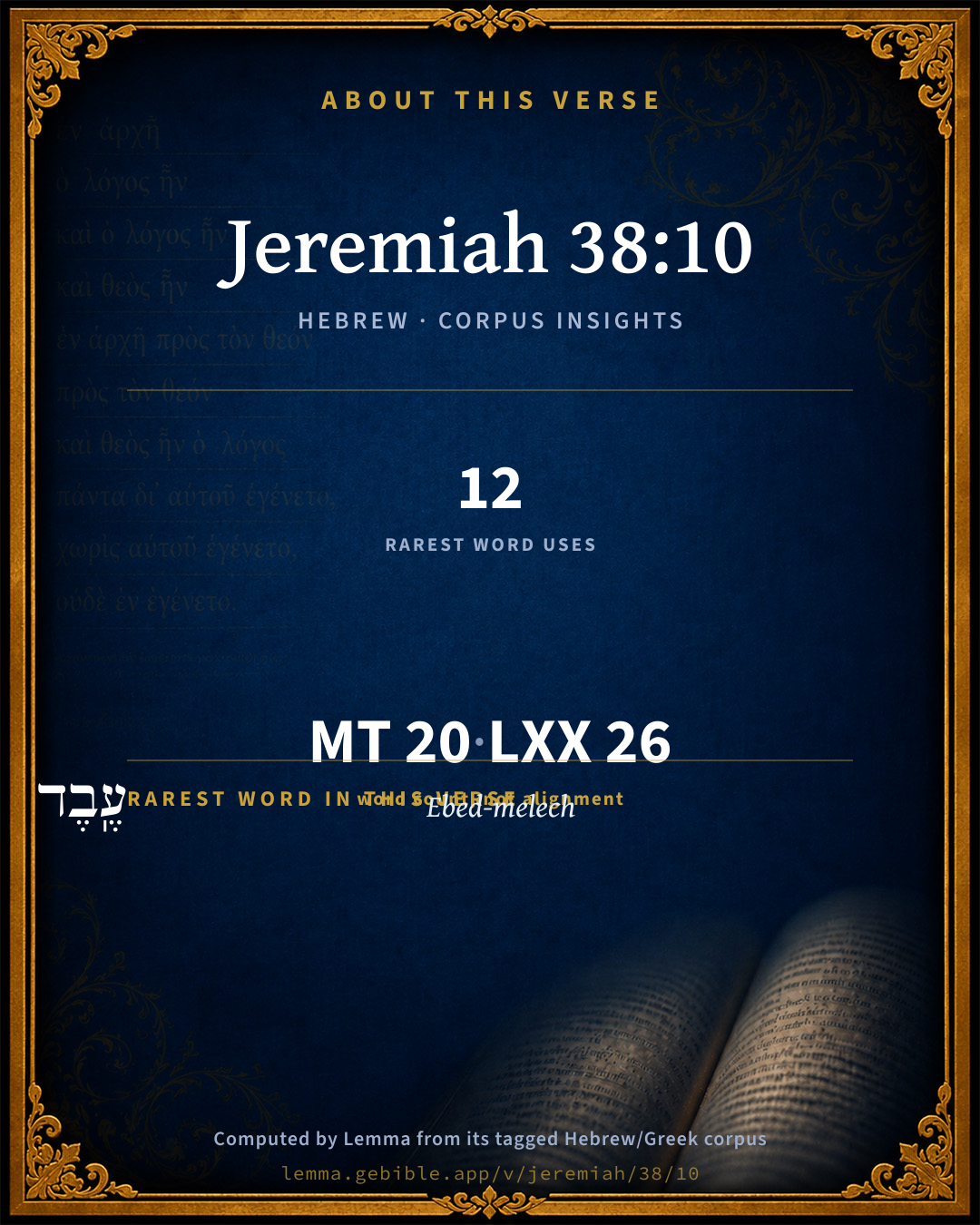
These counts appear in no published source. They are computed here, from the morphology-tagged text and Lemma’s own curated glosses. What Lemma adds →

20
words
18
distinct lemmas
Prophets
section

Notable vocabulary

The rarest word here is עֶֽבֶד Ebed-melech H5663 — appearing just 12 times in the whole Hebrew Bible.

Shared distinctive vocabulary

עֶֽבֶד Ebed-melech H5663 occurs in 6 verses of the Hebrew Bible. Also found in:

Grammatical profile

  • 5 verbs
  • 9 nouns
  • 1 adjective
  • 1 pronoun
  • 1 preposition
  • 1 adverb
  • 2 particles

Verb forms

  • וַיְצַוֶּ֣ה Piel · Sequential Imperfect
  • לֵאמֹ֑ר Qal · Infinitive Construct
  • קַ֣ח Qal · Imperative
  • וְֽהַעֲלִ֜יתָ Hiphil · Sequential Perfect
  • יָמֽוּת Qal · Imperfect

Repetition

A word recurs within this verse — often emphatic in Hebrew:

  • עֶֽבֶד Ebed-melech H5663 ×2

Hebrew & Septuagint length

In the original languages it is 20 Hebrew tokens and 26 Greek tokens — but the two are counted differently (Hebrew bundles its prefixes and suffixes into one token; the Greek is in lemma form), so that isn’t a like-for-like length.

Cross-references

4

Topical passages linked to Jeremiah 38:10 in the Treasury of Scripture Knowledge — connected by theme and wording, ordered by reader-vote popularity; previews shown in the World English Bible.

  • Esther 5:2 It was so, when the king saw Esther the queen standing in the court, that she obtained favor in his sight; and the king held out to Esther the golden scepter that was in his hand. So Esther drew near, and touched the top of the scepter.
  • Esther 8:7 Then the king Ahasuerus said to Esther the queen and to Mordecai the Jew, See, I have given Esther the house of Haman, and him they have hanged on the gallows, because he laid his hand on the Jews.
  • Psalms 75:10 I will cut off all the horns of the wicked, But the horns of the righteous shall be lifted up.
  • Proverbs 21:1 The king's heart is in Yahweh's hand like the watercourses. He turns it wherever he desires.

Cross-references courtesy of OpenBible.info (CC BY 4.0).

Hebrew and Greek witnesses Masoretic Hebrew ↔ Greek Septuagint

The same verse in the two great witnesses to the Old Testament, shown verse-for-verse.

These are two independent witnesses, not word-aligned to each other, and the Septuagint is shown in lemma (dictionary) form.

Hebrew Jeremiah 38:10 Masoretic · Westminster Leningrad Codex

וַיְצַוֶּ֣ה הַמֶּ֔לֶךְ אֵ֛ת עֶֽבֶד מֶ֥לֶךְ הַכּוּשִׁ֖י לֵאמֹ֑ר קַ֣ח בְּיָדְךָ֤ מִזֶּה֙ שְׁלֹשִׁ֣ים אֲנָשִׁ֔ים וְֽהַעֲלִ֜יתָ אֶֽת יִרְמְיָ֧הוּ הַנָּבִ֛יא מִן הַבּ֖וֹר בְּטֶ֥רֶם יָמֽוּת

Then the king commanded Ebedmelech the Ethiopian, saying, Take from hence thirty men with you, and take up Jeremiah the prophet out of the dungeon, before he die.

World English Bible · Public Domain

Greek LXX Structure differs

In the Septuagint, Jeremiah is about an eighth shorter than the Hebrew and arranges its material differently — the Oracles Against the Nations (Hebrew chapters 46–51) appear in the middle of the Greek book, after 25:13. Because the chapter and verse boundaries do not line up, a verse-for-verse comparison with the Hebrew is not shown.

A verse-for-verse comparison isn’t shown here because the chapters and verses don’t line up. Switch to the LXX edition with the MT / LXX toggle above to read the Greek directly.

Hebrew: Westminster Leningrad Codex (CC BY 4.0). Greek: Septuagint (public domain); English from a public-domain English Septuagint. How the Septuagint differs from the Hebrew →

Targum (Aramaic paraphrase)

1

The Targum is the ancient Jewish Aramaic paraphrase of the Hebrew Scriptures — an interpretive translation, not the Hebrew text itself. Onkelos (literal) and Pseudo-Jonathan (expansive) render the Torah, and Jonathan the Prophets. Coverage is partial: where no permissively-licensed English translation exists for a verse, only the Aramaic is shown. This is verse-level text, not a word-by-word alignment to the Hebrew.

  1. Targum Jonathan Prophets (Joshua–Malachi)
    וּפַקֵיד מַלְכָּא יַת עַבְדָא דְמַלְכָּא צִדְקִיָה לְמֵימָר דְבַר עִמָךְ מִכָּא תְּלָתִין גַבְרִין וְתַסֵיק יַת יִרְמְיָה נְבִיָא מִן גוּבָא עַד לָא יְמוּת:

    (no public-domain English translation for this verse)

    Targum Jonathan — Aramaic: “Mikraot Gedolot” (public domain). English: “Sefaria Community Translation” (CC0 1.0 (public-domain dedication)); “London "Chaldee Paraphrase," 1871” (public domain). Text via Sefaria.

Commentary

Notes on Jeremiah 38:10 from classic Christian and Jewish commentators (each source and its license shown beneath its notes). The classic Christian expositions comment on the surrounding passage and are grouped to its opening verse, so a note may address several verses; the Jewish commentaries on the Tanakh (Rashi and others) are per-verse, so they appear only where the commentator wrote on this verse.

Lemma curates 59 commentaries, every one of them public domain or Creative Commons licensed, each selected and text-cleaned for this edition rather than reprinted as found. About our sources →

Trapp's Complete Commentary

John Trapp

Jer 38:10 Then the king commanded Ebedmelech the Ethiopian, saying, Take from hence thirty men with thee, and take up Jeremiah the prophet out of the dungeon, before he die.

Ver. 10. Then the king commanded Ebedmelech.] A sweet providence of God thus to incline the heart of this effeminate, cruel, inconstant, and impious king, to hearken to the motion, and to give order for the prophet’s deliverance from that desperate and deadly danger. A good encouragement also to men to appear in a good cause, and to act vigorously for God, notwithstanding they are alone, and have to encounter with divers difficulties.

Take from hence thirty men with thee.] Four or fewer might have done it; but perhaps the princes with their forces might have endeavoured to hinder them, but that they saw them so strong.

John Trapp, A Commentary or Exposition upon All the Books of the Old and New Testament (1647–1656) — public domain. Text from a community e-Sword module.

Joseph Benson's Commentary

Jer 38:10-13. Then the king commanded, &c. — The king, who a little while ago durst do nothing against the princes, has now his heart wonderfully and suddenly changed, and will have Jeremiah released in defiance of them; ordering no fewer than thirty men, and those probably of the life-guard, to be employed in fetching him out of the dungeon, lest the princes should raise a party to oppose it. So Ebed-melech took the men — He lost no time, but immediately went about this good work, and used as much tenderness as despatch in accomplishing it; going into the king’s house and fetching thence old soft rags and pieces of cloth, to be put under the prophet’s arm-holes, to prevent the cords, wherewith he was to be drawn up, from hurting him. This circumstance, trivial as it may appear, is here particularly noticed and recorded to the honour of this pious Gentile; for God is not unrighteous to forget any work or labour of love which is shown to his people or ministers; no, nor any circumstance thereof, Heb 6:10. Observe, reader, those that are in distress should not only be relieved, but relieved with compassion and marks of respect, all which things will be remembered, and will be found to a good account, in the day of final recompense.

Joseph Benson's Commentary on the Old and New Testaments (1811–1818) — public domain. Text from a community e-Sword module.

Tyndale Open Study Notes

Tyndale Open Resources

38:10 The rescue party included thirty . . . men, perhaps indicating that Zedekiah felt the need to keep his officials from attacking it.

Tyndale Open Study Notes — © Tyndale Open Resources, licensed CC BY-SA 4.0. Text via the HelloAO Bible API.

Geneva Bible (1599)

Geneva Bible translators

Hebrew, under thine hand.

Geneva Bible (1599) marginal notes — public domain. Text via Bolls.life.

Jamieson, Fausset & Brown

Robert Jamieson, A. R. Fausset & David Brown

with thee--Hebrew, "in thine hand," that is, at "thy disposal" (Sa1 16:2). "From hence," that is, from the gate of Benjamin where the king was sitting (Jer 38:7).

thirty men--not merely to draw up Jeremiah, but to guard Ebed-melech against any opposition on the part of the princes (Jer 38:1-4), in executing the king's command. Ebed-melech was rewarded for his faith, love, and courage, exhibited at a time when he might well fear the wrath of the princes, to which even the king had to yield (Jer 39:16-18).

Jamieson, Fausset & Brown — Commentary Critical and Explanatory on the Whole Bible (1871) — public domain (CC PDM 1.0). Text via the HelloAO Bible API.

Adam Clarke's Commentary

Verse 10. Take from hence thirty men] The king was determined that he should be rescued by force, if the princes opposed.

Adam Clarke's Commentary on the Bible (1810–1826) — public domain. Text from a community e-Sword/MySword module.

John Calvin's Commentaries

We here see, what I have already said, that; the Prophet’s deliverance was wholly from above. The king, smitten with fear, had lately given over the holy Prophet to the cruelty of his princes; and had confessed that he had no longer any authority: “for it is not the king,” he said, “who now governs you.” As, then, the king had not dared resolutely to contend against his princes:, how was it, that he now ventured to extricate Jeremiah from the pit? We hence see that the king’s mind had been changed; because he was lately so stunned with fear, that he dared not to plead the cause of the holy man; but now he commands the Ethiopian to take him out from the pit It then appears that this was over-ruled by a divine power.

But let us hence learn to be courageous, when necessity requires, though there may not be a hope of a favorable issue. Ebedmelech might have thought within himself that his attempt would be in vain, however strenuously he might have pleaded for Jeremiah. He might, then, have thus relinquished that purpose which he had so boldly undertaken; for thus they who are over-wise are often led, as it were, into inertness: “What can you effect? thou art but one, and they are many; and then the thing is done. If the king himself has been forced to yield to their fury, and thou being a private individual, with what. confidence can you resist them? and further, a tumult will be raised, and thou wilt perish in it; and in the meantime they will perhaps stone with stones that unhappy man, whom thou seekest to help.” All these things might have occurred to Ebedmelech, and thus he might have desisted. But we see that he rested in confidence on God’s favor. Let us, then, remembering his example, hope beyond hope, when God requires us to do a thing, that is, when faith, the obligation of duty, demands anything from us, and which may be done, if we close our eyes to all obstacles and go on in our work; for events are in God’s hands alone, and they will be such as he pleases. In the meantime it is simply our duty to proceed in our course, though we may think that our labors will be in vain and without any fruit. Ebedmelech happily succeeded, and how? because he performed the part of a pious and upright man. Thus God will extend his hand to us; whatever difficulties may meet us, we shall overcome them all by his power and aid.

Then the king commanded Ebedmelech the Ethiopian, Take hence thirty men with thee and extricate Jeremiah from the well Ebedmelech might even then have relinquished his undertaking; for he might not have been able with thirty men to overcome so great a power; for all the king’s counselors had united together, and no doubt they had enlisted many others. We thus see that Ebedmelech did not rely on human aid, but that being strengthened by invincible confidence he undertook this office, so that he dared to draw Jeremiah out of the pit. It hence follows —

John Calvin's Commentaries (1540-1563) — public domain. Text from the Calvin Translation Society English edition (1840s-50s) via the Christian Classics Ethereal Library (ccel.org). Calvin's coverage is partial (roughly two-thirds of the Bible); uncommented books and verses are honest gaps, never fabricated. The 19th-century editor's footnotes and remarks are omitted so the notes are faithfully Calvin's own voice.

Ellicott's Commentary for English Readers

(10) Take from hence thirty men.—The number seems a large one for the purpose, especially when we consider that the men were sent from a post from which they could ill be spared, but the king may have wished to guard against resistance on the part of the princes. Hitzig, however, conjectures that “three men” was the original reading of the Hebrew text.

A Bible Commentary for English Readers, edited by Charles John Ellicott (1878–1897) — public domain. Text from a community e-Sword module.

The Cambridge Bible for Schools and Colleges

gen. ed. J. J. S. Perowne

10. thirty men] The construction of the Heb. numeral is irregular, and we should read three, as under the circumstances a more likely number for this duty.

The Cambridge Bible for Schools and Colleges (gen. ed. J. J. S. Perowne; Cambridge University Press, 1878–1918) — public domain. Text from a community e-Sword module.

John Gill's Exposition

Then the king commanded Ebedmelech the Ethiopian,.... Being affected with the case of the prophet; and repenting of the leave he had given the princes to do with him as they pleased, gave orders as follows:

saying, take from hence thirty men with thee; from the place where the king was, the gate of Benjamin; where very probably at this time was a garrison of soldiers, thirty of which were ordered to be taken; or these were to be taken out of the king's bodyguard, he had here with him. Josephus (w) calls them thirty of the king's servants, such as were about the king's person, or belonged to his household; and so the Syriac version of Jer 38:11 says that Ebedmelech took with him men of the king's household; but why thirty of them, when three or four might be thought sufficient to take up a single man out of a dungeon? Abarbinel thinks the dungeon was very deep, and Jeremiah, ah old man, could not be got out but with great labour and difficulty. Jarchi and Kimchi say, the men were so weakened with the famine, that so many were necessary to draw out one man; but the true reason seems rather to be, that should the princes, whom the king might suspect, or any other, attempt to hinder this order being put in execution, there might be a sufficient force to assist in it, and repel those that might oppose it:

and take up Jeremiah the prophet out of the dungeon before he die; the king speaks honourably of Jeremiah, giving him his title as a prophet, and expresses great concern for him; and orders them to hasten the taking him up, lest he should die before, which he suggests would give him great concern.

(w) Antiqu. l. 10. c. 7. sect. 5.

John Gill's Exposition of the Whole Bible (1746–1763) — public domain (CC PDM 1.0). Text via the HelloAO Bible API.

Albert Barnes' Notes on the Bible

Thirty men - So large a number suggests that Zedekiah expected some resistance. (Some read “three” men.)

Albert Barnes' Notes on the Bible (1834–1885) — public domain. Text from a community e-Sword/MySword module.

Matthew Poole's English Annotations

There are several guesses why the king commandeth Ebed-melech to take

thirty men for the doing of that for which three or four were sufficient. I think they judge best who think it was to guard him against any opposition. Things were now in a great disorder, the city being upon the matter taken, and the king himself was much in the government of his princes, and, as may easily be judged by what went before, and what we shall hereafter meet with, could not rule them, but was in some fear of them, and he did not know but some of the most boisterous of them might oppose the execution of this command of his. This king in his whole story seemeth to have been of a much better humour than his predecessors, and to have had a kindness for the prophet, though he suffered himself to be miserably overruled by his courtiers, who were of a much fiercer temper, and worse affected to the prophet.

Matthew Poole's English Annotations on the Holy Bible (1683–1685) — public domain. Text from a community e-Sword/MySword module.

Whedon's Commentary on the Bible

Daniel D. Whedon

10. Thirty men — This great number has been a difficulty to many, and such bold and free critics as Ewald have conjectured an emendation of the text, substituting three for thirty. They support this by the fact that the word for “men” is plural in the original, whereas the ordinary Hebrew usage is to use the singular form of the noun with all numerals above ten.

But, a) This rule of Hebrew syntax, though general, is not invariable. There are many instances in which, when the numeral precedes, the plural form of the noun is used. b) And we know too little to object to the number thirty. They were not necessarily fighting men, nor does it follow that so many were actually needed to execute the order; but so many were given to make sure of the execution of the order.

Daniel D. Whedon (gen. ed.), Commentary on the Old and New Testaments (1874–1909) — public domain. Text from a community e-Sword module.

The Pulpit Commentary

Thirty men. Why so many were sent is not clear. Are we to suppose that the princes would resist Jeremiah"s release? But "the king is not he," etc. (ver. 5). Is it not a scribe"s error for "three" (so Ewald, Hitzig, and Graf)?

The Pulpit Commentary (1880–1919), ed. H.D.M. Spence-Jones & Joseph S. Exell — public domain. Text from a community e-Sword module.

John Wesley's Explanatory Notes

Thirty men - Probably the king commanded Ebed-melech to take thirty men to guard him against any opposition.

John Wesley, Explanatory Notes Upon the Whole Bible (1754–1765) — public domain. Text via the GEBible commentary corpus.

unfoldingWord translationNotes

Door43 World Missions Community

thirty men

"30 men" (See: Numbers)

let them down by ropes

"used ropes to lower them down"

translationWords

king

command

unfoldingWord translationNotes — © Distant Shores Media and the Door43 World Missions Community, licensed CC BY-SA 4.0. Source: git.door43.org/Door43/en_tn.

Rashi

Rabbi Shlomo Yitzchaki (Rashi)

thirty men Since they were weakened by the famine, all of them were required.

Rashi on the Tanakh — English translations: “The Judaica Press complete Tanach with Rashi, translated by A. J. Rosenberg” (CC BY 4.0); “Pentateuch with Rashi's commentary by M. Rosenbaum and A.M. Silbermann, 1929-1934” (public domain); “The Metsudah Tanach series, Lakewood, N.J” (CC BY 4.0); and “The Book of Joshua, Metsudah Publications, 1997” (CC BY 4.0). Text via Sefaria.

Lesson kit

Teaching starters — assembled from the data on this page, not authored interpretation. Every prompt links to the verse data it draws on. Edit before teaching.

Jeremiah, in the Prophets, opens this verse with 20 words (18 distinct Hebrew lemmas). Its most distinctive word is ʻEbed Melek (“Ebed-melech”). A historical commentator’s framing appears above. Read the whole chapter for the surrounding context.

Discussion questions

  1. How does “Ebed-melech” (ʻEbed Melek) shape what this verse is saying?
  2. How does Jeremiah 38:7, which shares the word «Ebed-melech», read alongside this verse?
  3. What does the repetition of “Ebed-melech” (2× in this one verse) do in this verse?
  4. These translations render this verse differently; the difference is in the English rendering, not the original. What questions does that raise?
  5. «וַיְצַוֶּ֣ה» is a Piel Sequential Imperfect verb. How does that grammatical form shape the action described?
  6. Compare how Trapp's Complete Commentary and Joseph Benson's Commentary read this verse. Where do they agree or differ?

Things to notice

Reading settings

Reading text

Shown beneath each verse's original-language words.

Old Testament
Old Testament edition

Read the OT as the Masoretic Hebrew (MT) or the Greek Septuagint (LXX).

English shown for the Greek Septuagint (in the Hebrew ↔ Greek comparison).

Comparing translations? Open the Compare panel on any verse page to stack up to four side by side.