
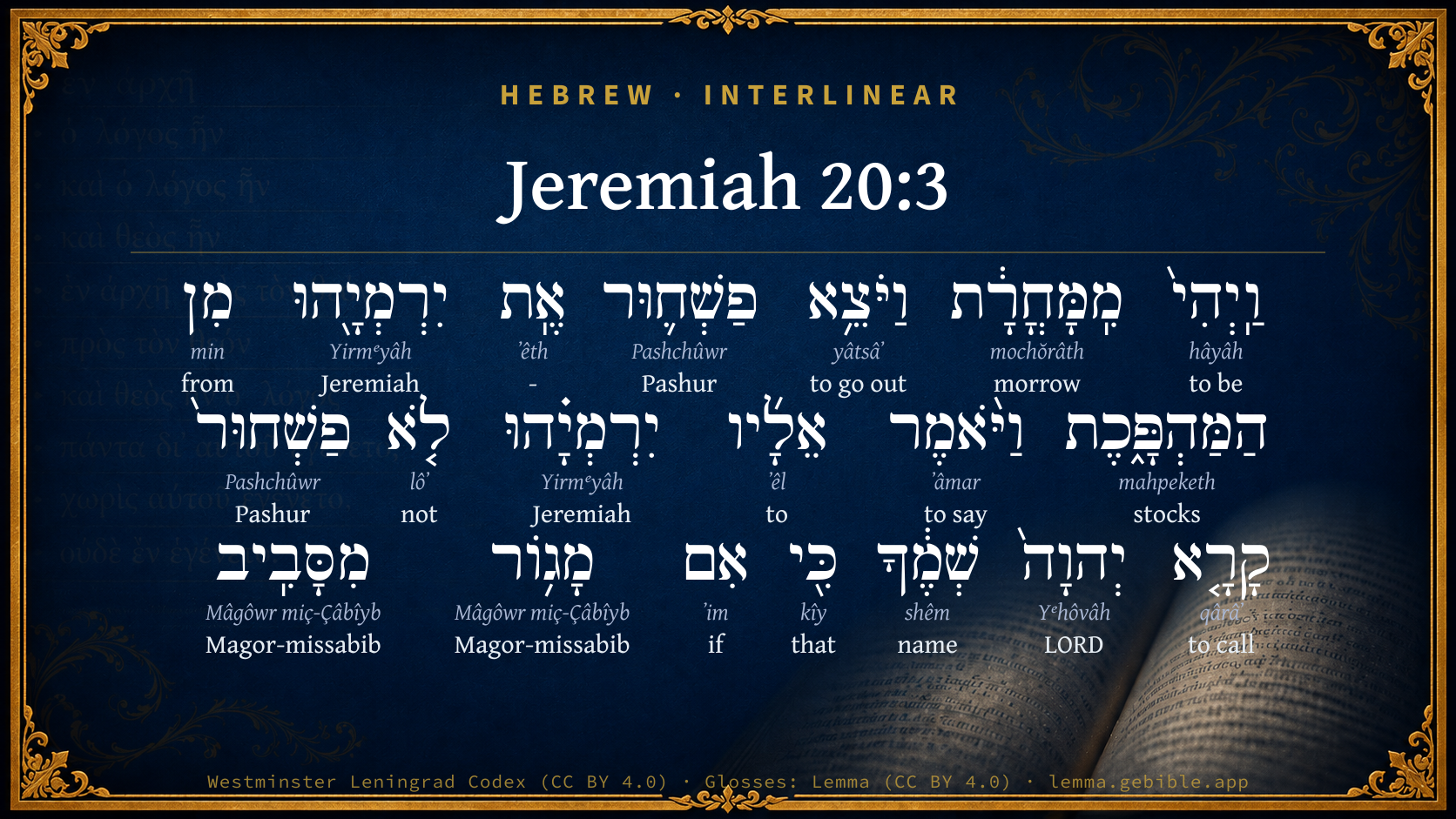
Jeremiah 20:3

Hebrew (Westminster Leningrad Codex) Jeremiah 20:3 appears in the Hebrew Old Testament. The text above is from the Westminster Leningrad Codex. Each word links to its Strong’s number, a concise gloss, and parsing drawn from the Open Scriptures Hebrew Bible morphology. Click any word for its full Brown-Driver-Briggs (BDB) entry.
Download image
Cite this verse

Jeremiah 20:3 (World English Bible). Public Domain. Lemma interlinear Bible study tool, https://lemma.gebible.app/v/jeremiah/20/3.

Show BibTeX & RIS
BibTeX
RIS
English Translation
It happened on the next day, that Pashhur brought forth Jeremiah out of the stocks. Then said Jeremiah to him, Yahweh has not called your name Pashhur, but Magormissabib.
World English Bible · Public Domain
Highlights
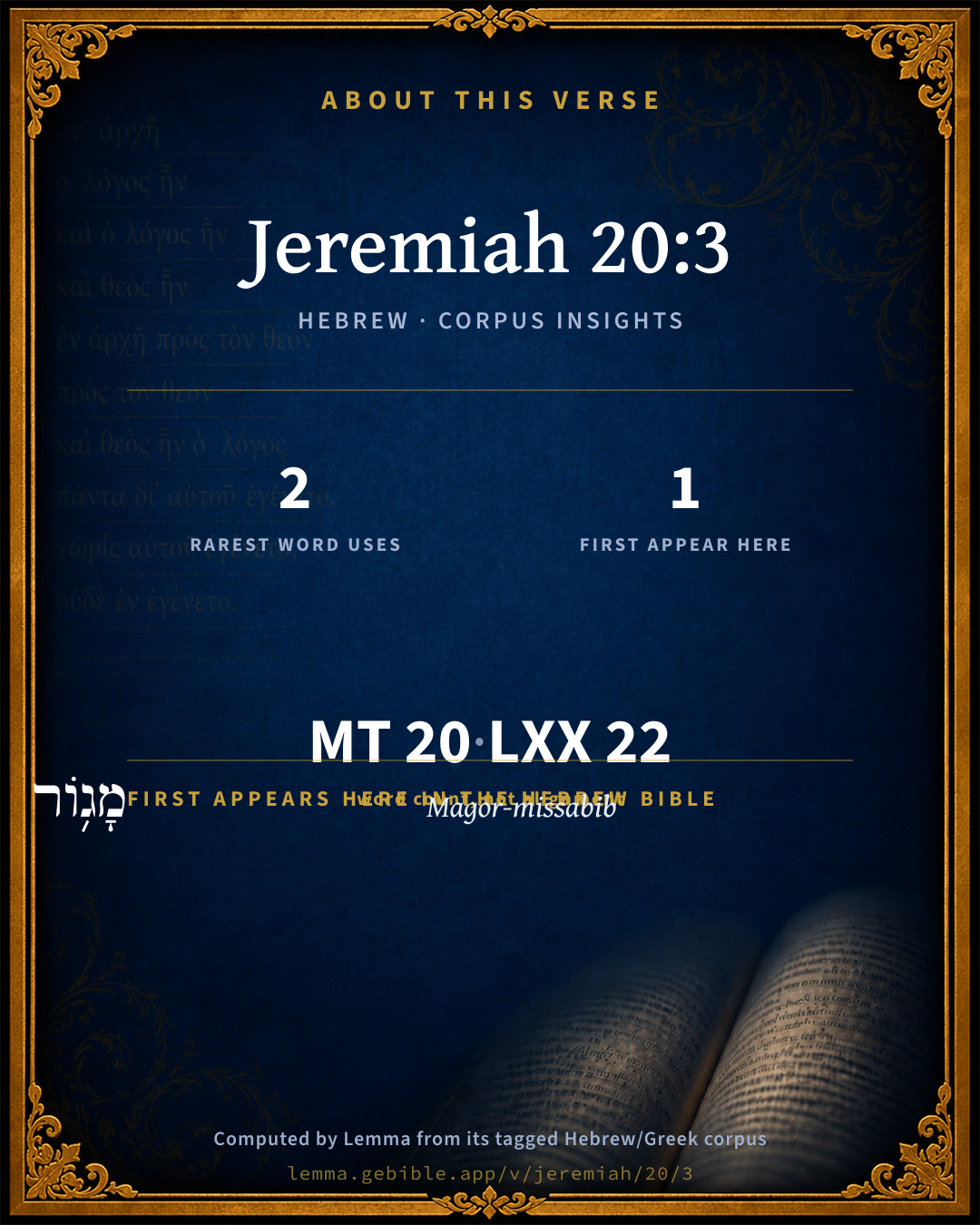
  • 1 first appearance in the Hebrew Bible
Full analysis ↓
Download a study sheet

One document with this verse’s original text, its word-by-word gloss line, the meaning frame, cross-references with their text, attributed commentary, and full source and license credits — printable, and it pastes into notes with its structure intact.

This verse Autodidact and up

Study sheet (.html) Plain text (.txt)

A passage Seminary Student

Up to 50 verses in one chapter. A passage sheet keeps up to 6 commentary sources and 12 cross-references per verse, in the order this page ranks them, and says so on the sheet whenever that leaves anything out. Ask for a single verse and you get the Autodidact verse sheet above.

Everything on this page stays free to read, with no account — the sheet is a download of what is already on screen, not access to it.

Want to remove ads? Support Godless Engineer
Compare translations 3

The same verse in 3 English versions, stacked beneath the original-language interlinear above. Click any original word for its lexicon entry.

Each is an independent rendering of the whole verse — the interlinear is not word-aligned to these translations.

Highlighted words mark where these versions differ — a whole-verse word diff, not a word-by-word alignment.

  • World English Bible Public Domain
    It happened on the next day, that Pashhur brought forth Jeremiah out of the stocks. Then said Jeremiah to him, Yahweh has not called your name Pashhur, but Magormissabib.
  • King James Version Public Domain
    And it came to pass on the morrow, that Pashur brought forth Jeremiah out of the stocks. Then said Jeremiah unto him, The LORD hath not called thy name Pashur, but Magormissabib.
  • unfoldingWord Literal Text CC BY-SA 4.0
    And it happened on the next day that Pashhur brought Jeremiah out from the stocks. And Jeremiah said to him, “Yahweh has not called your name Pashhur, but rather Magor-Missabib.

unfoldingWord Literal Text — © unfoldingWord, licensed CC BY-SA 4.0. Word-aligned USFM3 via Door43 (git.door43.org/unfoldingWord/en_ult).

Versions to compare (up to 4)

3 of 4 selected

Show all 18 translations

Every available English version of this verse, each an independent rendering of the whole verse.

  • World English Bible Public Domain
    It happened on the next day, that Pashhur brought forth Jeremiah out of the stocks. Then said Jeremiah to him, Yahweh has not called your name Pashhur, but Magormissabib.
  • Berean Standard Bible Public Domain
    The next day, when Pashhur released Jeremiah from the stocks, Jeremiah said to him, “The LORD does not call you Pashhur, but Magor-missabib.
  • Majority Standard Bible Public Domain
    The next day, when Pashhur released Jeremiah from the stocks, Jeremiah said to him, “The LORD does not call you Pashhur, but Magor-missabib.
  • King James Version Public Domain
    And it came to pass on the morrow, that Pashur brought forth Jeremiah out of the stocks. Then said Jeremiah unto him, The LORD hath not called thy name Pashur, but Magormissabib.
  • American Standard Version (1901) Public Domain
    And it came to pass on the morrow, that Pashhur brought forth Jeremiah out of the stocks. Then said Jeremiah unto him, Jehovah hath not called thy name Pashhur, but Magor-missabib.
  • Revised Version (1885) Public Domain
    And it came to pass on the morrow, that Pashhur brought forth Jeremiah out of the stocks. Then said Jeremiah unto him, The LORD hath not called thy name Pashhur, but Magor-missabib.
  • Geneva Bible (1599) Public Domain
    And on the morning, Pashur brought Ieremiah out of the stockes. Then said Ieremiah vnto him, The Lord hath not called thy name Pashur, but Magor-missabib.
  • Douay-Rheims (1899) Public Domain
    And when it was light the next day, Phassur brought Jeremias out of the stocks. And Jeremias said to him: The Lord hath not called thy name Phassur, but fear on every side.
  • Young's Literal Translation Public Domain
    and it cometh to pass on the morrow, that Pashhur bringeth out Jeremiah from the stocks, and Jeremiah saith unto him, `Not Pashhur hath Jehovah called thy name, but -- Magor-Missabib.
  • Literal Standard Version CC BY-SA 4.0
    And it comes to pass on the next day, that Pashhur brings Jeremiah out from the stocks, and Jeremiah says to him, “YHWH has not called your name Pashhur, but Terror on Every Side.
  • Unlocked Literal Bible CC BY-SA 4.0
    It happened on the next day that Pashhur brought Jeremiah out of the stocks. Then Jeremiah said to him, “Yahweh has not called your name Pashhur, but you are Magor Missabib.
  • unfoldingWord Literal Text CC BY-SA 4.0
    And it happened on the next day that Pashhur brought Jeremiah out from the stocks. And Jeremiah said to him, “Yahweh has not called your name Pashhur, but rather Magor-Missabib.
  • Darby Bible Public Domain
    And it came to pass the next day, that Pashur brought forth Jeremiah out of the stocks; and Jeremiah said unto him, Jehovah hath not called thy name Pashur, but Magor-missabib.
  • World Messianic Bible Public Domain
    On the next day, Pashhur released Jeremiah out of the stocks. Then Jeremiah said to him, “The LORD has not called your name Pashhur, but Magormissabib.
  • Webster's Bible Public Domain
    And it came to pass on the morrow, that Pashur brought forth Jeremiah out of the stocks. Then said Jeremiah to him, The LORD hath not called thy name Pashur, but Magor-missabib.
  • Free Bible Version CC BY-SA 4.0
    The following day, when Pashhur had Jeremiah released from the stocks, Jeremiah told him, “The Lord doesn't call you Pashhur (tear in pieces), but Magor-missabib (terror is everywhere).
  • Bible in Basic English Public Domain
    Then on the day after, Pashhur let Jeremiah loose. Then Jeremiah said to him, The Lord has given you the name of Magor-missabib (Cause-of-fear-on-every-side), not Pashhur.
  • JPS Tanakh (1917) Public Domain
    And it came to pass on the morrow, that Pashhur brought forth Jeremiah out of the stocks. Then said Jeremiah unto him: 'The LORD hath not called thy name Pashhur, but Magormissabib.

Literal Standard Version (2020), Covenant Press — licensed CC BY-SA 4.0. Text via the HelloAO Bible API (eBible.org). Unlocked Literal Bible (unfoldingWord) — licensed CC BY-SA 4.0. Text via the HelloAO Bible API (eBible.org). unfoldingWord Literal Text — © unfoldingWord, licensed CC BY-SA 4.0. Word-aligned USFM3 via Door43 (git.door43.org/unfoldingWord/en_ult). Free Bible Version, Dr. Jonathan Gallagher — licensed CC BY-SA 4.0. Text via the HelloAO Bible API (eBible.org).

Word by word

More ways to search: Search by grammar → Find every occurrence → Compare this word →

Practice this passage: Drill this verse → Learn its vocabulary →

מָג֥וֹר
Mâgôwr miç-Çâbîyb
H4036
“Magor-missabib”
Noun, Common, Masculine, Singular, Absolute
Part of Speech
Noun
Type
Common
Gender
Masculine
Number
Singular
State
Absolute
Full BDB Definition

Origin: from H4032 and H5439 with the preposition inserted

TWOT: None

Magor-missabib = "terror on every side" - the name given Pashur the priest by Jeremiah when Pashur smote him and put him in the stocks for prophesying against the idolatry of Jerusalem
  1. וַֽיְהִי֙ hâyâh H1961 “and · to be” Conjunction + Verb, Qal, Sequential Imperfect, 3rd Person, Masculine, Singular
  2. מִֽמָּחֳרָ֔ת mochŏrâth H4283 “from · morrow” Preposition + Noun, Common, Feminine, Singular, Absolute
  3. וַיֹּצֵ֥א yâtsâʼ H3318 “and · to go out” Conjunction + Verb, Hiphil, Sequential Imperfect, 3rd Person, Masculine, Singular
  4. פַשְׁח֛וּר Pashchûwr H6583 “Pashur” Noun, Proper
  5. אֶֽת ʼêth H853 “-” Particle, Direct Object
  6. יִרְמְיָ֖הוּ Yirmᵉyâh H3414 “Jeremiah” Noun, Proper
  7. מִן min H4480 “from” Preposition
  8. הַמַּהְפָּ֑כֶת mahpeketh H4115 “the · stocks” Particle, Definite Article + Noun, Common, Feminine, Singular, Absolute
  9. וַיֹּ֨אמֶר ʼâmar H559 “and · to say” Conjunction + Verb, Qal, Sequential Imperfect, 3rd Person, Masculine, Singular
  10. אֵלָ֜יו ʼêl H413 “to · him” Preposition + Suffix, Personal, 3rd Person, Masculine, Singular
  11. יִרְמְיָ֗הוּ Yirmᵉyâh H3414 “Jeremiah” Noun, Proper
  12. לֹ֤א lôʼ H3808 “not” Particle, Negative
  13. פַשְׁחוּר֙ Pashchûwr H6583 “Pashur” Noun, Proper
  14. קָרָ֤א qârâʼ H7121 “to call” Verb, Qal, Perfect, 3rd Person, Masculine, Singular
  15. יְהוָה֙ Yᵉhôvâh H3068 “LORD” Noun, Proper
  16. שְׁמֶ֔ךָ shêm H8034 “name · your” Noun, Common, Masculine, Singular, Construct + Suffix, Personal, 2nd Person, Masculine, Singular
  17. כִּ֖י kîy H3588 “that” Conjunction
  18. אִם ʼim H518 “if” Conjunction
  19. מִסָּבִֽיב Mâgôwr miç-Çâbîyb H4036 “from · Magor-missabib” Preposition + Adverb

About this verse

These counts appear in no published source. They are computed here, from the morphology-tagged text and Lemma’s own curated glosses. What Lemma adds →

20
words
17
distinct lemmas
Prophets
section

Notable vocabulary

The rarest word here is מָג֥וֹר Magor-missabib H4036 — appearing just 2 times in the whole Hebrew Bible.

First appearance in Scripture

This word makes its first canonical appearance in the Hebrew Bible here:

  • מָג֥וֹר Magor-missabib H4036

Grammatical profile

  • 4 verbs
  • 9 nouns
  • 2 prepositions
  • 2 conjunctions
  • 1 adverb
  • 2 particles

Verb forms

  • וַֽיְהִי֙ Qal · Sequential Imperfect
  • וַיֹּצֵ֥א Hiphil · Sequential Imperfect
  • וַיֹּ֨אמֶר Qal · Sequential Imperfect
  • קָרָ֤א Qal · Perfect

Repetition

Words recur within this verse — often emphatic in Hebrew:

  • פַשְׁח֛וּר Pashur H6583 ×2
  • יִרְמְיָ֖הוּ Jeremiah H3414 ×2
  • מָג֥וֹר Magor-missabib H4036 ×2

Hebrew & Septuagint length

In the original languages it is 20 Hebrew tokens and 22 Greek tokens — but the two are counted differently (Hebrew bundles its prefixes and suffixes into one token; the Greek is in lemma form), so that isn’t a like-for-like length.

Cross-references

17

Topical passages linked to Jeremiah 20:3 in the Treasury of Scripture Knowledge — connected by theme and wording, ordered by reader-vote popularity; previews shown in the World English Bible.

  • Jeremiah 20:10 For I have heard the defaming of many, terror on every side. Denounce, and we will denounce him, [say] all my familiar friends, those who watch for my fall; peradventure he will be persuaded, and we shall prevail against him, and we shall take our revenge on him.
  • Psalms 31:13 For I have heard the slander of many, terror on every side, While they conspire together against me, They plot to take away my life.
  • Jeremiah 46:5 Why have I seen it? they are dismayed and are turned backward; and their mighty ones are beaten down, and have fled apace, and don't look back: terror is on every side, says Yahweh.
  • Lamentations 2:22 You have called, as in the day of a solemn assembly, my terrors on every side; There was none that escaped or remained in the day of Yahweh's anger: Those that I have dandled and brought up has my enemy consumed.
  • Isaiah 8:3 I went to the prophetess; and she conceived, and bore a son. Then said Yahweh to me, Call his name Maher Shalal Hash Baz.
  • Jeremiah 6:25 Don't go forth into the field, nor walk by the way; for the sword of the enemy, [and] terror, are on every side.
  • Genesis 17:5 Neither will your name any more be called Abram, but your name will be Abraham; for the father of a multitude of nations have I made you.
  • Genesis 17:15 God said to Abraham, "As for Sarai your wife, you shall not call her name Sarai, but her name will be Sarah.
  • Genesis 32:28 He said, "Your name will no longer be called 'Jacob,' but, 'Israel,' for you have fought with God and with men, and have prevailed."
  • Jeremiah 7:32 Therefore, behold, the days come, says Yahweh, that it shall no more be called Topheth, nor The valley of the son of Hinnom, but The valley of Slaughter: for they shall bury in Topheth, until there be no place [to bury].
  • Jeremiah 19:2 and go forth to the valley of the son of Hinnom, which is by the entry of the gate Harsith, and proclaim there the words that I shall tell you;
  • Jeremiah 19:6 therefore, behold, the days come, says Yahweh, that this place shall no more be called Topheth, nor The valley of the son of Hinnom, but The valley of Slaughter.
  • Jeremiah 29:29 Zephaniah the priest read this letter in the ears of Jeremiah the prophet.
  • Hosea 1:4–9 Yahweh said to him, "Call his name Jezreel; for yet a little while, and I will avenge the blood of Jezreel on the house of Jehu, and will cause the kingdom of the house of Israel to cease.
  • Acts 4:5–7 It happened in the morning, that their rulers, elders, and scribes were gathered together in Jerusalem.
  • Acts 16:30 and brought them out and said, "Sirs, what must I do to be saved?"
  • Acts 16:35–39 But when it was day, the magistrates sent the sergeants, saying, "Let those men go."

Cross-references courtesy of OpenBible.info (CC BY 4.0).

Hebrew and Greek witnesses Masoretic Hebrew ↔ Greek Septuagint

The same verse in the two great witnesses to the Old Testament, shown verse-for-verse.

These are two independent witnesses, not word-aligned to each other, and the Septuagint is shown in lemma (dictionary) form.

Hebrew Jeremiah 20:3 Masoretic · Westminster Leningrad Codex

וַֽיְהִי֙ מִֽמָּחֳרָ֔ת וַיֹּצֵ֥א פַשְׁח֛וּר אֶֽת יִרְמְיָ֖הוּ מִן הַמַּהְפָּ֑כֶת וַיֹּ֨אמֶר אֵלָ֜יו יִרְמְיָ֗הוּ לֹ֤א פַשְׁחוּר֙ קָרָ֤א יְהוָה֙ שְׁמֶ֔ךָ כִּ֖י אִם מָג֥וֹר מִסָּבִֽיב

It happened on the next day, that Pashhur brought forth Jeremiah out of the stocks. Then said Jeremiah to him, Yahweh has not called your name Pashhur, but Magormissabib.

World English Bible · Public Domain

Greek LXX Structure differs

In the Septuagint, Jeremiah is about an eighth shorter than the Hebrew and arranges its material differently — the Oracles Against the Nations (Hebrew chapters 46–51) appear in the middle of the Greek book, after 25:13. Because the chapter and verse boundaries do not line up, a verse-for-verse comparison with the Hebrew is not shown.

A verse-for-verse comparison isn’t shown here because the chapters and verses don’t line up. Switch to the LXX edition with the MT / LXX toggle above to read the Greek directly.

On this verse, The Cambridge Bible for Schools and Colleges discusses the Septuagint’s reading. Read the note in Commentary ↓

Hebrew: Westminster Leningrad Codex (CC BY 4.0). Greek: Septuagint (public domain); English from a public-domain English Septuagint. How the Septuagint differs from the Hebrew →

Targum (Aramaic paraphrase)

1

The Targum is the ancient Jewish Aramaic paraphrase of the Hebrew Scriptures — an interpretive translation, not the Hebrew text itself. Onkelos (literal) and Pseudo-Jonathan (expansive) render the Torah, and Jonathan the Prophets. Coverage is partial: where no permissively-licensed English translation exists for a verse, only the Aramaic is shown. This is verse-level text, not a word-by-word alignment to the Hebrew.

  1. Targum Jonathan Prophets (Joshua–Malachi)
    וַהֲוָה בְּיוֹמָא דְבַתְרוֹהִי וְאַפֵּיק פַשְׁחוּר יַת יִרְמְיָה מִן כֵּיפְתָא וַאֲמַר לֵיהּ יִרְמְיָה לָא פַשְׁחוּר רַבִּי יְיָ שְׁמָךְ אֱלָהֵין יִתְכַּנְשׁוּן עֲלָךְ דְקָטְלִין בְּחַרְבָּא מִסְחוֹר סְחוֹר:

    (no public-domain English translation for this verse)

    Targum Jonathan — Aramaic: “Mikraot Gedolot” (public domain). English: “Sefaria Community Translation” (CC0 1.0 (public-domain dedication)); “London "Chaldee Paraphrase," 1871” (public domain). Text via Sefaria.

Commentary

Notes on Jeremiah 20:3 from classic Christian and Jewish commentators (each source and its license shown beneath its notes). The classic Christian expositions comment on the surrounding passage and are grouped to its opening verse, so a note may address several verses; the Jewish commentaries on the Tanakh (Rashi and others) are per-verse, so they appear only where the commentator wrote on this verse.

Lemma curates 59 commentaries, every one of them public domain or Creative Commons licensed, each selected and text-cleaned for this edition rather than reprinted as found. About our sources →

Trapp's Complete Commentary

John Trapp

Jer 20:3 And it came to pass on the morrow, that Pashur brought forth Jeremiah out of the stocks. Then said Jeremiah unto him, The LORD hath not called thy name Pashur, but Magormissabib.

Ver. 3. Pashur brought forth Jeremiah.] To be judged, say some; but why then did he first smite him? An officer should retain the majesty of the law, and not do anything passionately. To set him at liberty, say others; as perceiving that the "word of God could not be bound," nor a prophet’s mouth stopped by a prison, as Pashur also shall well perceive ere Jeremiah hath done with him. Bonner said to Hawkes the martyr, A faggot will make you believe the sacrament of the altar. He answered, No, no, a point for your faggot; God will meet with you one day. {a} So true is that of the poet,

“ Pressa sub ingenti ceu pondere palms virescit,

Sub cruce sic florent debita corda Deo. ”

The Lord hath not called thy name Pashur.] That is, black mouth, as some {b} derive it; or diffusing paleness, as others; but on the contrary. {c}

Magormissabib,] i.e., Terror round about, or, Fear on every side; a proverbial form of speech, denoting extreme consternation of spirit and greatest distress. Such as befell Tullus Hostilius, King of Rome, who had for his gods Payor and Pallor. Dignissimus sane qui deos suos semper haberet praesentes, saith Lactantius wittily; i.e., great pity but this man should ever have had his gods at hand, since he was so fond of them. Our Richard III and Charles IX of France, a pair of bloody princes, were Magormissabibs in their generations, as terrible at length to themselves as they had been formerly to others; and therefore could never endure to be awakened in the night without music or some like diversion. {d}

{a} Acts and Mon.

{b} Junius.

{c} q.d., Non Augustus, sed augustus; non nobilis, sed mobilis futurus es. Non tumor sed timer.

{d} Daniel; Thuan.

John Trapp, A Commentary or Exposition upon All the Books of the Old and New Testament (1647–1656) — public domain. Text from a community e-Sword module.

Joseph Benson's Commentary

Jer 20:3-5. Jeremiah said, The Lord hath not called — Rather, doth not call thy name Pashur; but Magor-missabib — That is, Terror on every side, or, Terror to all around, as the name is explained in the next verse. God’s giving him this name: signifies his changing the circumstances or condition of the person so named, agreeably to the meaning of the name given him, or that he would render him such as he called him. So when God called Abram by the new name of Abraham, he assigns the reason, “For a father of many nations have I made thee,” Gen 17:5. I will deliver all the strength of this city — All its wealth, the word חסן, here used, being frequently translated treasures: see Pro 15:6; Eze 22:25. It may also include whatever strengthened and defended it, especially the men of war; and all the labours thereof — Or, all the workmanship thereof; that is, all the fruit of the people’s labours; all their fine buildings, or whatever its artificers had erected with labour and cost; and all the precious things thereof — Whatever was valuable in the eyes of the greatest persons among them; will I give into the hands of their enemies — The Babylonians shall spoil and make a prey of them all.

Joseph Benson's Commentary on the Old and New Testaments (1811–1818) — public domain. Text from a community e-Sword module.

Tyndale Open Study Notes

Tyndale Open Resources

20:3 The Man Who Lives in Terror: Cp. 46:5; Ps 31:13.

Tyndale Open Study Notes — © Tyndale Open Resources, licensed CC BY-SA 4.0. Text via the HelloAO Bible API.

Geneva Bible (1599)

Geneva Bible translators

Or, fear round about.

Geneva Bible (1599) marginal notes — public domain. Text via Bolls.life.

Jamieson, Fausset & Brown

Robert Jamieson, A. R. Fausset & David Brown

Pashur--compounded of two roots, meaning "largeness (and so 'security') on every side"; in antithesis to Magor-missabib, "terror round about" (Jer 20:10; Jer 6:25; Jer 46:5; Jer 49:29; Psa 31:13).

Jamieson, Fausset & Brown — Commentary Critical and Explanatory on the Whole Bible (1871) — public domain (CC PDM 1.0). Text via the HelloAO Bible API.

Adam Clarke's Commentary

Verse 3. The Lord hath not called thy name Pashur] Security on all sides. This name thou hast had, but not by Divine appointment.

But Magor-missabib - Fear on every side. This name hath God given thee; because, in the course of his providence, thou shalt be placed in the circumstances signified by it: thou shalt be a terror to thyself.

Adam Clarke's Commentary on the Bible (1810–1826) — public domain. Text from a community e-Sword/MySword module.

John Calvin's Commentaries

No doubt Pashur called other priests to examine the case. It was, indeed, a specious pretense, for he seemed as though he did not wish to condemn the holy Prophet hastily, or without hearing his defense. But Jeremiah only says briefly that he was brought out of prison: we at the same time gather that he was not dismissed, for he was summoned before Pashur to give a reason for his prophecy.

But here the Prophet shews that he was not cast down or disheartened, though he had been most contemptuously treated; he bore patiently the buffetings and stripes he had received, and also his incarceration. We know that such outrages are so bitter to ingenuous minds, that they can hardly sustain them. But Jeremiah teaches us, by his own example, that our constancy and firmness ought not to be weakened though the whole world loaded or almost overwhelmed us with reproaches. We ought, then, to understand that courage of mind ought not to fail or be weakened in God’s servants, however wickedly and contumeliously they may be treated by the world. For Jeremiah, when he came out of prison, spoke more boldly than before; nor was he beyond the reach of danger. Courage increases when one obtains the victory, and he can then safely and securely insult his enemies; but Jeremiah was yet a captive, though he had been brought out of prison, and he might have been afterwards cast there again and treated more cruelly than before. But neither the wrong he had received, nor the fear of new contumely, deterred him from denouncing God’s judgment on the ungodly priest. Such magnanimity becomes all God’s servants, so that they ought not to feel shame, nor grow soft, nor be disheartened, when the world treats them with indignity and reproach; nor ought they to fear any dangers, but advance courageously in the discharge of their office.

It must in the second place be noticed, — that God’s Prophet here closes his eyes to the splendor of the priestly office, which otherwise might have hindered him to denounce God’s judgment,. And this ought to be carefully observed; for we know the ungodly he hid under masks, as the case is in the present day with the Pope and all his filthy clergy: for what do they allege but the name of Catholic Church and perpetual priesthood and apostolical dignity? Doubtless, Pashur was of the priestly order; but what the Papacy is, the Scripture neither mentions nor teaches, except that it condemns it as altogether filthy and abominable. And the Levitical priesthood, as I have said, was founded on God’s Law; and yet Jeremiah, guided by the command of God, hesitated not severely to reprove the priest and to treat him as he deserved. It is, therefore, then only that we tightly and faithfully discharge the prophetic office, when we shew no respect of persons, and disregard those external masks by which the ungodly deceive the simple, and are haughty towards God while they falsely pretend his name.

Now he says, Jehovah has called thy name not Pashur, but terror on every side Some render the words, “Because there will be terror to thee on every side;” but incorrectly, for in the next verse a reason is given which explains what the Prophet means. Jeremiah no doubt had a regard to the meaning of the word Pashur, otherwise it would have been unmeaning and even foolish to say, “Thy name shall be called not Pashur, but terror on every side.” Interpreters have expounded the word Pashur as meaning an increasing prince, or one who extends power, deriving it from פשה, peshe, to increase, and transitively, to extend; and they add to it the word שר, sher, which means a prince; and so they render it, a prince extending power, or a prince who increases. But as there is some doubt as to the points, I know not whether this etymology can be maintained. I am more inclined to derive the word from פשח, peshech, to cut or break. It is indeed but once found in this sense in Scripture, but often in the Chaldee language. However this may be, it is taken in this sense once by Jeremiah in the third Chapter of Lamentations. And hence by a metaphor it means to open; and א, aleph, may be deemed quiescent in the second word, so that it means one who breaks or opens the light. The words which follow — “terror on every side” — induce and compel me to give this interpretation. He does not say that he would be a terror on every side; but that terrors surrounded him, מסביב, mesabib, so that there was no escape. As then the name of Pashur was honorable, signifying to open light, he mentions this, (it is indeed a metaphor, by which breaking means opening:) as then he had this name, which means to bring forth light, Jeremiah says, “Thou shalt be called a terror on every side;” that is, a terror that so surrounds all that no escape is possible. We see that the contrast is most suitable between the opening of light and that terror which spread on every side, so that there is no opening and no escape; and the explanation follows:

John Calvin's Commentaries (1540-1563) — public domain. Text from the Calvin Translation Society English edition (1840s-50s) via the Christian Classics Ethereal Library (ccel.org). Calvin's coverage is partial (roughly two-thirds of the Bible); uncommented books and verses are honest gaps, never fabricated. The 19th-century editor's footnotes and remarks are omitted so the notes are faithfully Calvin's own voice.

Ellicott's Commentary for English Readers

(3) Magor-missabib.—The words are a quotation from Psa_31:13, and are rightly rendered, “Fear is round about;” they had already been used by the prophet in Jer_6:25. We may venture to think that the Psalm had been his comfort in those night-watches of suffering, and that he now uttered the words which described the bitterness of the Psalmist’s sorrow, as at last feeling sure that they belonged to his persecutor rather than to himself. It is scarcely necessary to seek a special significance in the name of Pashur as contrasted with this new nomen et omen; but Hebrew scholars, according to various, and it must be owned, conjectural etymologies, have found in it the ideas of wide-spread joy, “joy round about,” or else of freedom and deliverance. The prophet repeats the combination in Jer_46:5; Jer_49:29; Lam_2:22, and it had evidently become a kind of “burden” in both senses of the word, weighing on the prophet’s thoughts and finding frequent utterance. The word that stands for “fear” is a rare one, and outside the passages now referred to is found only in Isa_31:9.

A Bible Commentary for English Readers, edited by Charles John Ellicott (1878–1897) — public domain. Text from a community e-Sword module.

The Cambridge Bible for Schools and Colleges

gen. ed. J. J. S. Perowne

3. Magor-missabib] meaning, terror on every side. The LXX wrongly render, foreigner, obtaining this sense from the fact that the Hebrew roots for terror and sojourn in a foreign country are identical in form. The name is to be significant of his fate, which doubtless was to go into exile with Jehoiachin, as well as of the consternation of himself and his friends at the failure of their policy of reliance on Egypt against Chaldaea. For the expression cp. Jer_20:10, Jer_6:25, Jer_46:5, Jer_49:29; Lam_2:22, and for the protest on the part of the prophet cp. Isa_22:15 ff.; Amo_7:10 ff; Act_16:37.

The Cambridge Bible for Schools and Colleges (gen. ed. J. J. S. Perowne; Cambridge University Press, 1878–1918) — public domain. Text from a community e-Sword module.

John Gill's Exposition

And it came to pass on the morrow,.... After the prophet was put into the stocks; so that he was there all night:

that Pashur brought forth Jeremiah out of the stocks; either to bring him before the priests, or the sanhedrim, to be examined; or in order to dismiss him, being either admonished by his friends, or convicted in his own conscience that he had done a wrong thing;

then said Jeremiah unto him; when he had brought him out, not being at all intimidated by him, and having a word from the Lord for him:

the Lord hath not called thy name Pashur; which, according to Jerom, signifies "blackness of mouth"; and, according to others, "diffusing paleness"; one that terrified others, and made their faces look pale; but now it should be otherwise, and he himself should be filled with terror, and have paleness of thee: but, according to a late etymologist, it signifies one abounding or "increased in liberty" (x), who in a little time would become a captive; for it is not suggested hereby that he should no more be called by this name, but that he should be in a condition which would not answer to it, but to another, as follows:

but Magormissabib; or, "fear round about"; signifying that terrors should be all around him, and he in the utmost fright and consternation. The Septuagint version renders it "one removing"; changing from place to place; that is, going into captivity; a stranger and wanderer, as the Syriac version. The Targum is,

"but there shall be gathered together against thee those that kill with the sword round about;''

meaning the Chaldeans, which would make him a "Magormissabib".

(x) "abundantiam", & liberum sonat", Hiller. Onomast. Sacr. p. 302. Paschchur, "auctus libertate", ib. p. 904.

John Gill's Exposition of the Whole Bible (1746–1763) — public domain (CC PDM 1.0). Text via the HelloAO Bible API.

Albert Barnes' Notes on the Bible

Magor-missabib - See Jer 6:25 note. Jeremiah uses it no less than five times, having probably adopted it as his watchword from Psa 31:13.

Albert Barnes' Notes on the Bible (1834–1885) — public domain. Text from a community e-Sword/MySword module.

Haydock's Catholic Bible Commentary

Phassur. This name signifies, increase and principality; and therefore is here changed to Magor-Missabib, or "fear on every side," to denote the evils that should come upon him in punishment of his opposing the word of God. (Challoner) --- Aquila renders Posseur, "a stranger," and St. Jerome, "blackness of visage." (Haydock) --- It may also mean, "one who causes paleness." (Calmet) --- Mogur may signify "fear or distress." Septuagint and Syriac, "an exile." (Haydock) --- He deserved to be thus treated, ver. 6. (Calmet) --- He would be terrified by many enemies. (Worthington)

George Leo Haydock (1774–1849), Haydock's Catholic Family Bible and Commentary, 1859 edition — public domain. Excludes Psalms (Douay-Rheims chapter numbering differs from Protestant) and Deuterocanonical books (Catholic canon only).

Matthew Poole's English Annotations

Possibly by this time the mad-brained priest thought he had done more than he could justify by law, for if he were a false prophet, the judgment of him belonged not to him, but to the sanhedrim; he had nothing to do to smite him. Possibly he brought him forth in order to his bringing him before the sanhedrim; but it doth not appear that he did so, though Jeremiah’s following words to him might reasonably be thought provocative enough, if he had designed any formal charge against him. He had it seemeth no more to say to Jeremiah, but Jeremiah (to whom God had appeared in the prison that night, while he was separated from communion with men, and revealed to him what end this hot-headed priest should come to) had something to say to him. God’s meaning was, not that he should by men be no longer called Pashur, (for doubtless after this he was called by the same name he had before,) but his state and condition should not answer the name Pashur, which signifies, as some say, a noble, flourishing priest; or, as others, one who by his authority maketh others to tremble; but

Magor-missabib, that is, fear and terror on all sides.

Matthew Poole's English Annotations on the Holy Bible (1683–1685) — public domain. Text from a community e-Sword/MySword module.

Whedon's Commentary on the Bible

Daniel D. Whedon

3. Pashur — All is uncertain as to the etymology, and so the meaning, of this name. As it is set over against the one which follows, it is probably opposite to it in sense, but just how we do not know.

Magor-missabib — Fear round about, as the margin correctly translates. It seems to have originated from Psa_31:13. It is a rather common phrase with Jeremiah, being used besides in Jer_6:25; Jer_20:10; Jer_46:5; Jer_49:29; and in Lam_2:22. The general significance of this phrase has been indicated, but its precise application is less evident. Probably it is used to intimate that the course adopted and carried out under his instigation would involve in calamity not only himself but all those about him.

Daniel D. Whedon (gen. ed.), Commentary on the Old and New Testaments (1874–1909) — public domain. Text from a community e-Sword module.

The Pulpit Commentary

Symbolic change of name. Not... Pashur, but Magormissabib; i.e. terror on every side. There is probably no allusion to the (by no means obvious) etymology of Pashur. Jeremiah simply means to say that Pashur would one day become an object of general horror (see on ver. 10).

Vers. 3-6. Magor-Missabib; or, the fate of a false prophet.

The person hero mentioned cannot with certainty be identified. He will the better serve as a type and representative of his kind. There is no age or country that has not had its Pashur.

I THE INFLUENCE HE EXERCISED.

1. Its character. Absolute and despotic. At the suggestion of his own evil heart. Capable of destroying civil rights and character itself. The whole civil and sacred machinery of the laud was at his disposal. The public trusted him. The state of things condemned by Jeremiah it was his immediate interest to support, and in turn he could rely upon official support. He identifies himself with the ruling party and becomes its representative and mouthpiece. Vested rights, traditional religion, etc., are his watchwords, because he owes everything to them.

2. How it was acquired. Family connection son of Immer the priest." Not by striving to reform abuses, but by fostering and upholding the status quo. He who was so oblivious to the wrongs of which the prophet spoke could not have been scrupulous as to the means by which he rose to position and influence. Oriental corruption and intrigue had doubtless had their part in securing his elevation. ("Pashur" probably means "extension," "pride," "eminence.")

3. How it was employed. Hastily, on the passionate impulse of the moment. Without regard to the essential justice of the case. And when the error is discovered no true repentance or effort at amends is visible. Cf. the time-serving policy of Agrippa. (Act_26:32)

II THE CHARACTER AND DESTINY HE EARNED. By making himself the champion of apostle Judah, and insulting the prophet of God, he is sentenced to the same fate, but in a peculiar and aggravated degree.

1. It would be his fortune to be looked upon as the representative and embodiment of the system of falsehood which had ruined his country. He who prophesied falsely will be justly punished by such an association. Instead of saying, "It was Moloch or Astarte that deceived us," the victims of the common disaster, will say, was the prophet of these false gods who led us astray." How readily does personal influence acquire such a representative character! There are many evil forces and influences at work in society, the state, the Church, etc., which would cease to exist were it not for their accidental connection with some personage who becomes their advocate or their bulwark.

2. His character and influence would be exposed. The assurances he had given would one by one be falsified by the fulfillments of Jeremiah"s predictions. Instead of being honored and looked up to, he would become a loathing and a byword. He would outlive his credit, his self-esteem, and his happiness. Shunned by others, he would be unable to trust himself. Each fresh catastrophe would deepen his disgrace and remorse. A "terror round about" would be the name he would earn.

3. His exemption from immediate destruction would but enhance his punishment. Like the criminal obliged to stand in the dock and hear all the counts of his indictment made good by the evidence of witnesses, he should outlive the first effects of the national ruin, see all his statements falsified, bear the reproach of his own wicked lies, and yet linger on when life had ceased to be desirable. There is a grotesqueness about this punishment that would make it ludicrous were it not so sad and awful. A more severe punishment could hardly be conceived. And yet it is not more than Pashur deserved. Would that our modern "prophets of lies" could be compelled to witness the consequences of their advice and example! A modified degree of this experience has, indeed, been the sentence inflicted upon many a good man. But Christ takes up the entail of sin and breaks it. We may do better than to stand by and see the evil consequences of former folly; it is for us to strive to rectify them. So the past may be retrieved and the evil days redeemed by those who have been servants of sin "turning many to righteousness. M.

The Pulpit Commentary (1880–1919), ed. H.D.M. Spence-Jones & Joseph S. Exell — public domain. Text from a community e-Sword module.

John Wesley's Explanatory Notes

Not called - God's meaning was, not that he should by men be no longer called Pashur, but that his condition should not answer that name Pashur, which signifies, a flourishing priest; but Magor- missabib, that is, fear and terror on all sides.

John Wesley, Explanatory Notes Upon the Whole Bible (1754–1765) — public domain. Text via the GEBible commentary corpus.

Scofield Reference Notes

C. I. Scofield

Magormissabib

i.e. Terror on every side.

The Scofield Reference Bible (1917 edition), notes by C. I. Scofield — public domain. Text from a community e-Sword module.

unfoldingWord translationNotes

Door43 World Missions Community

It happened

This phrase is used here to mark where the action starts. If your language has a way for doing this, you could consider using it here.

you are Magor Missabib

This name means "terror on every side" or "surrounded by terror." (See: How to Translate Names)

Look,

This word adds emphasis to what is said next. AT: "Pay attention to what I am about to tell you."

they will fall by the sword of their enemies

The idiom "fall by the sword" means that they will die in battle. This can be stated in active form. AT: "their enemies will kill them with swords" or "their enemies will kill them in battle" (See: Idiom and Active or Passive)

your eyes will see it

Here the word "eyes" represents Pashhur. AT: "you will see it" (See: Synecdoche)

I will give all of Judah into the hand of the king of Babylon

Here the word "hand" refers to power. AT: "I will enable the king of Babylon to conquer all of Judah" (See: Metonymy)

translationWords

Yahweh

call

name

horror

love

sword

adversary

kingdom of Judah

hand

king

Babylon

captive

unfoldingWord translationNotes — © Distant Shores Media and the Door43 World Missions Community, licensed CC BY-SA 4.0. Source: git.door43.org/Door43/en_tn.

Rashi

Rabbi Shlomo Yitzchaki (Rashi)

Magor Terror.

Not Passhur did the Lord call your name, etc. Your name was not called Pashhur except for this matter, that is to say: פָֹשַח ֹשָחוֹר, cut off and black like “a tree that was cut off (נִפְֹשַח)” (Shevi’ith 4:6, Orlah 1:5). Also (Lam. 3:11), “And He cut me off (וַיִפַֹשְחֵנִי).” And so he said to him, Not Pashhur did He call your name, for the expression of Pashhur means a great man and the son of nobles, Pashhur. ‘Pash’ denotes expansion and ‘hur’ nobility. But for this reason your name was called Pashhur, Pashah shahor. ‘Pashah’ means ‘cut off,’ and ‘shahor’ means ‘black.’ Another explanation. ‘Pashah sehor.’ Many will be around you to slay you. Now according to this explanation, מָגוֹר is an expression of gathering, like (Ezekiel 21:17) “Gathered (מְגוּרֵי) to the sword.”

Rashi on the Tanakh — English translations: “The Judaica Press complete Tanach with Rashi, translated by A. J. Rosenberg” (CC BY 4.0); “Pentateuch with Rashi's commentary by M. Rosenbaum and A.M. Silbermann, 1929-1934” (public domain); “The Metsudah Tanach series, Lakewood, N.J” (CC BY 4.0); and “The Book of Joshua, Metsudah Publications, 1997” (CC BY 4.0). Text via Sefaria.

Lesson kit

Teaching starters — assembled from the data on this page, not authored interpretation. Every prompt links to the verse data it draws on. Edit before teaching.

Jeremiah, in the Prophets, opens this verse with 20 words (17 distinct Hebrew lemmas). Its most distinctive word is Mâgôwr miç-Çâbîyb (“Magor-missabib”). A historical commentator’s framing appears above. Read the whole chapter for the surrounding context.

Discussion questions

  1. What does “Magor-missabib” (Mâgôwr miç-Çâbîyb) contribute to the verse as a whole?
  2. The word “Magor-missabib” first appears here in Scripture. What is being introduced at this debut?
  3. Jeremiah 20:10 shares this passage’s theme. How do the two illuminate each other?
  4. “Pashur” occurs 2× in this one verse. What is the effect of the repetition?
  5. These translations render this verse differently. What is at stake in choosing one wording over another?
  6. The verb «וַֽיְהִי֙» is Qal Sequential Imperfect. How does its form color the action?
  7. Reading how Trapp's Complete Commentary and Joseph Benson's Commentary read this verse, where do the two commentators agree and where do they part?

Things to notice

Reading settings

Reading text

Shown beneath each verse's original-language words.

Old Testament
Old Testament edition

Read the OT as the Masoretic Hebrew (MT) or the Greek Septuagint (LXX).

English shown for the Greek Septuagint (in the Hebrew ↔ Greek comparison).

Comparing translations? Open the Compare panel on any verse page to stack up to four side by side.