Jeremiah 37:2

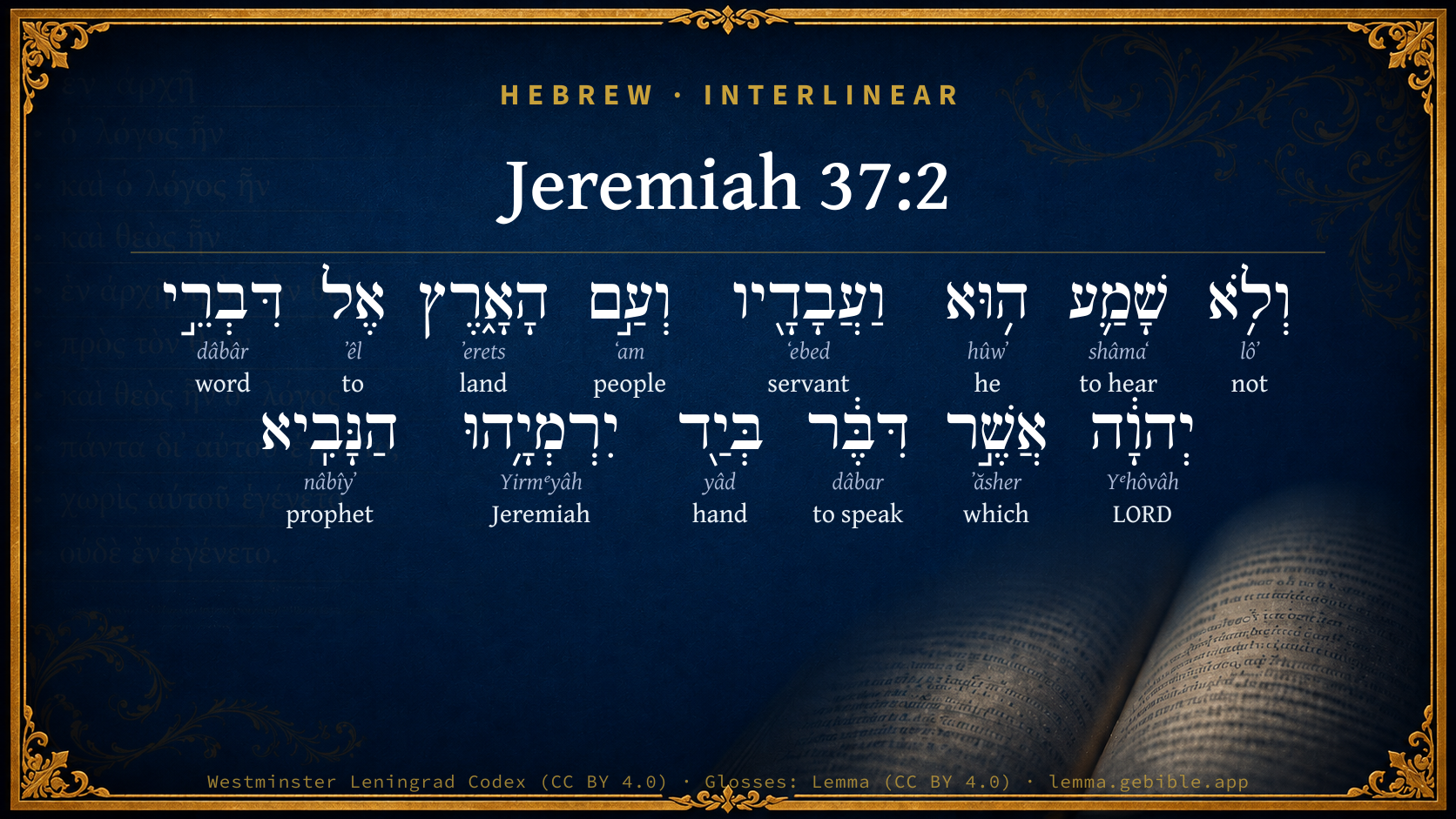
Hebrew (Westminster Leningrad Codex) Jeremiah 37:2 appears in the Hebrew Old Testament. The text above is from the Westminster Leningrad Codex. Each word links to its Strong’s number, a concise gloss, and parsing drawn from the Open Scriptures Hebrew Bible morphology. Click any word for its full Brown-Driver-Briggs (BDB) entry.
Download image
Cite this verse

Jeremiah 37:2 (World English Bible). Public Domain. Lemma interlinear Bible study tool, https://lemma.gebible.app/v/jeremiah/37/2.

Show BibTeX & RIS
BibTeX
RIS
English Translation
But neither he, nor his servants, nor the people of the land, did listen to the words of Yahweh, which he spoke by the prophet Jeremiah.
World English Bible · Public Domain
Download a study sheet

One document with this verse’s original text, its word-by-word gloss line, the meaning frame, cross-references with their text, attributed commentary, and full source and license credits — printable, and it pastes into notes with its structure intact.

This verse Autodidact and up

Study sheet (.html) Plain text (.txt)

A passage Seminary Student

Up to 50 verses in one chapter. A passage sheet keeps up to 6 commentary sources and 12 cross-references per verse, in the order this page ranks them, and says so on the sheet whenever that leaves anything out. Ask for a single verse and you get the Autodidact verse sheet above.

Everything on this page stays free to read, with no account — the sheet is a download of what is already on screen, not access to it.

Want to remove ads? Support Godless Engineer
Compare translations 3

The same verse in 3 English versions, stacked beneath the original-language interlinear above. Click any original word for its lexicon entry.

Each is an independent rendering of the whole verse — the interlinear is not word-aligned to these translations.

Highlighted words mark where these versions differ — a whole-verse word diff, not a word-by-word alignment.

  • World English Bible Public Domain
    But neither he, nor his servants, nor the people of the land, did listen to the words of Yahweh, which he spoke by the prophet Jeremiah.
  • King James Version Public Domain
    But neither he, nor his servants, nor the people of the land, did hearken unto the words of the LORD, which he spake by the prophet Jeremiah.
  • unfoldingWord Literal Text CC BY-SA 4.0
    But Zedekiah, his servants, and the people of the land did not listen to the words of Yahweh that he proclaimed by the hand of Jeremiah the prophet.

unfoldingWord Literal Text — © unfoldingWord, licensed CC BY-SA 4.0. Word-aligned USFM3 via Door43 (git.door43.org/unfoldingWord/en_ult).

Versions to compare (up to 4)

3 of 4 selected

Show all 18 translations

Every available English version of this verse, each an independent rendering of the whole verse.

  • World English Bible Public Domain
    But neither he, nor his servants, nor the people of the land, did listen to the words of Yahweh, which he spoke by the prophet Jeremiah.
  • Berean Standard Bible Public Domain
    But he and his officers and the people of the land refused to obey the words that the LORD had spoken through Jeremiah the prophet.
  • Majority Standard Bible Public Domain
    But he and his officers and the people of the land refused to obey the words that the LORD had spoken through Jeremiah the prophet.
  • King James Version Public Domain
    But neither he, nor his servants, nor the people of the land, did hearken unto the words of the LORD, which he spake by the prophet Jeremiah.
  • American Standard Version (1901) Public Domain
    But neither he, nor his servants, nor the people of the land, did hearken unto the words of Jehovah, which he spake by the prophet Jeremiah.
  • Revised Version (1885) Public Domain
    But neither he, nor his servants, nor the people of the land, did hearken unto the words of the LORD, which he spake by the prophet Jeremiah.
  • Geneva Bible (1599) Public Domain
    But neither he, nor his seruants, nor the people of the land would obey the wordes of the Lord, which he spake by the ministerie of the Prophet Ieremiah.
  • Douay-Rheims (1899) Public Domain
    But neither he, nor his servants, nor the people of the land did obey the words of the Lord, that he spoke in the hand of Jeremias the prophet.
  • Young's Literal Translation Public Domain
    and he hath not hearkened, he, and his servants, and the people of the land, unto the words of Jehovah, that He spake by the hand of Jeremiah the prophet.
  • Literal Standard Version CC BY-SA 4.0
    and he has not listened—he, and his servants, and the people of the land—to the words of YHWH that He spoke by the hand of Jeremiah the prophet.
  • Unlocked Literal Bible CC BY-SA 4.0
    But Zedekiah, his servants, and the people of the land did not listen to the words of Yahweh that he proclaimed by the hand of Jeremiah the prophet.
  • unfoldingWord Literal Text CC BY-SA 4.0
    But Zedekiah, his servants, and the people of the land did not listen to the words of Yahweh that he proclaimed by the hand of Jeremiah the prophet.
  • Darby Bible Public Domain
    And neither he, nor his servants, nor the people of the land, hearkened unto the words of Jehovah, which he had spoken through the prophet Jeremiah.
  • World Messianic Bible Public Domain
    But neither he, nor his servants, nor the people of the land, listened to the LORD’s words, which he spoke by the prophet Jeremiah.
  • Webster's Bible Public Domain
    But neither he, nor his servants, nor the people of the land, hearkened to the words of the LORD, which he spoke by the prophet Jeremiah.
  • Free Bible Version CC BY-SA 4.0
    But Zedekiah and his officers and everyone else in the country refused to obey what the Lord had said through Jeremiah the prophet.
  • Bible in Basic English Public Domain
    But he and his servants and the people of the land did not give ear to the words of the Lord which he said by Jeremiah the prophet.
  • JPS Tanakh (1917) Public Domain
    But neither he, nor his servants, nor the people of the land, did hearken unto the words of the LORD, which He spoke by the prophet Jeremiah.

Literal Standard Version (2020), Covenant Press — licensed CC BY-SA 4.0. Text via the HelloAO Bible API (eBible.org). Unlocked Literal Bible (unfoldingWord) — licensed CC BY-SA 4.0. Text via the HelloAO Bible API (eBible.org). unfoldingWord Literal Text — © unfoldingWord, licensed CC BY-SA 4.0. Word-aligned USFM3 via Door43 (git.door43.org/unfoldingWord/en_ult). Free Bible Version, Dr. Jonathan Gallagher — licensed CC BY-SA 4.0. Text via the HelloAO Bible API (eBible.org).

Word by word

More ways to search: Search by grammar → Find every occurrence → Compare this word →

Practice this passage: Drill this verse → Learn its vocabulary →

יִרְמְיָ֥הוּ
Yirmᵉyâh
H3414
“Jeremiah”
Noun, Proper
Part of Speech
Noun
Type
Proper
Full BDB Definition

Origin: from H7311 and H3050

TWOT: None

Jeremiah = "whom Jehovah has appointed" - the major prophet, son of Hilkiah of the priestly family in Anathoth; author of the prophetic book bearing his name - a man of Libnah and father of Hamutal the wife of king Josiah - a Gadite who joined David at Ziklag - a Manassehite, one of the mighty men of valour of the Transjordanic half tribe of Manasseh - a Gadite and warrior of David - a warrior of David - a priest who joined Nehemiah in the covenant ceremony - a priest also in the time of Nehemiah; maybe same as 7 - father of Jaazaniah the Rechabites
  1. וְלֹ֥א lôʼ H3808 “and · not” Conjunction + Particle, Negative
  2. שָׁמַ֛ע shâmaʻ H8085 “to hear” Verb, Qal, Perfect, 3rd Person, Masculine, Singular
  3. ה֥וּא hûwʼ H1931 “he” Pronoun, Personal, 3rd Person, Masculine, Singular
  4. וַעֲבָדָ֖יו ʻebed H5650 “and · servants · his” Conjunction + Noun, Common, Masculine, Plural, Construct + Suffix, Personal, 3rd Person, Masculine, Singular
  5. וְעַ֣ם ʻam H5971 “and · people of” Conjunction + Noun, Common, Masculine, Singular, Construct
  6. הָאָ֑רֶץ ʼerets H776 “the · land” Particle, Definite Article + Noun, Common, Both, Singular, Absolute
  7. אֶל ʼêl H413 “to” Preposition
  8. דִּבְרֵ֣י dâbâr H1697 “words of” Noun, Common, Masculine, Plural, Construct
  9. יְהוָ֔ה Yᵉhôvâh H3068 “LORD” Noun, Proper
  10. אֲשֶׁ֣ר ʼăsher H834 “which” Particle, Relative
  11. דִּבֶּ֔ר dâbar H1696 “to speak” Verb, Piel, Perfect, 3rd Person, Masculine, Singular
  12. בְּיַ֖ד yâd H3027 “in/at · hand of” Preposition + Noun, Common, Both, Singular, Construct
  13. הַנָּבִֽיא nâbîyʼ H5030 “the · prophet” Particle, Definite Article + Noun, Common, Masculine, Singular, Absolute

About this verse

These counts appear in no published source. They are computed here, from the morphology-tagged text and Lemma’s own curated glosses. What Lemma adds →

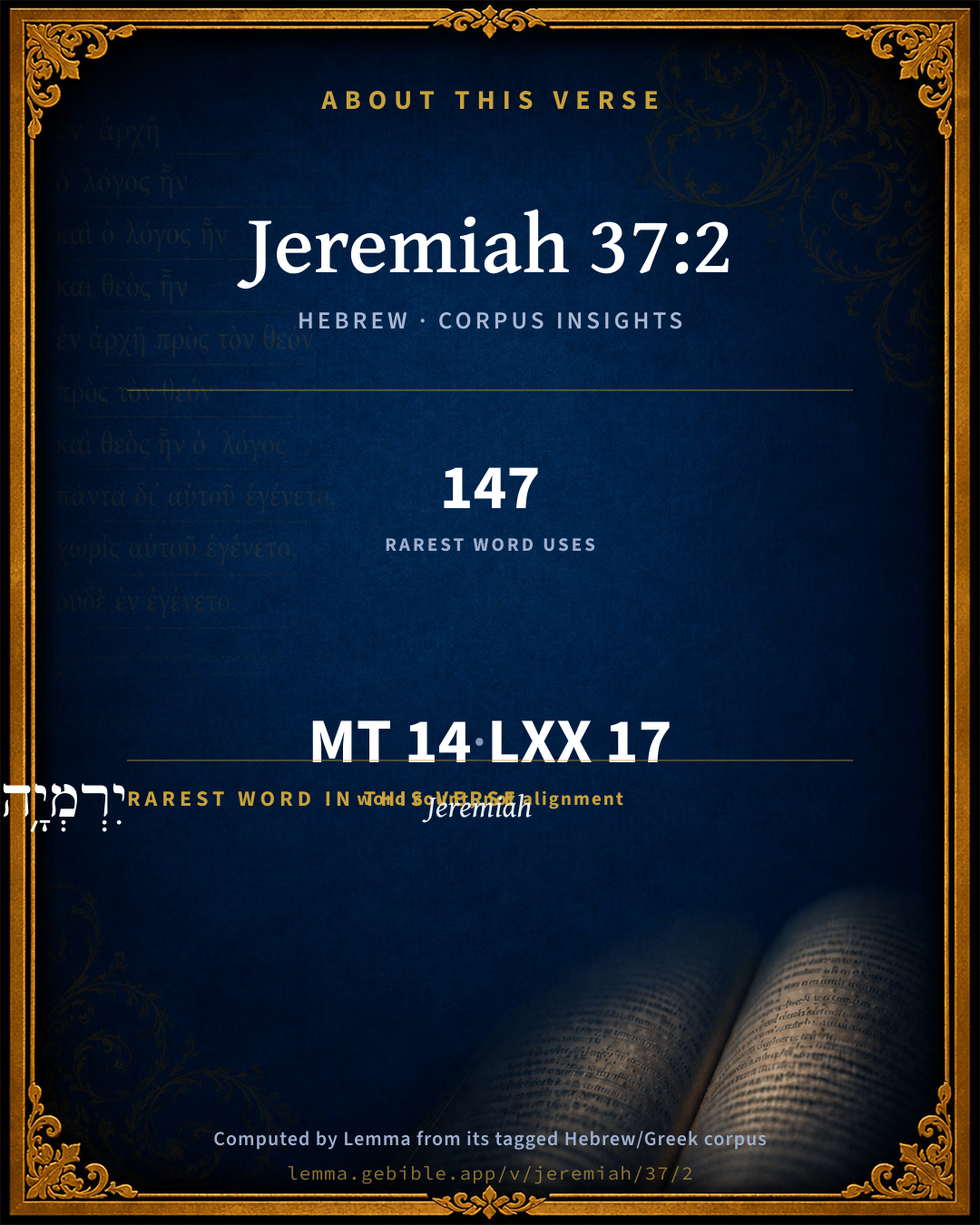
14
words
14
distinct lemmas
Prophets
section

Grammatical profile

  • 2 verbs
  • 8 nouns
  • 1 pronoun
  • 1 preposition
  • 2 particles

Verb forms

  • שָׁמַ֛ע Qal · Perfect
  • דִּבֶּ֔ר Piel · Perfect

Hebrew & Septuagint length

In the original languages it is 14 Hebrew tokens and 17 Greek tokens — but the two are counted differently (Hebrew bundles its prefixes and suffixes into one token; the Greek is in lemma form), so that isn’t a like-for-like length.

Cross-references

13

Topical passages linked to Jeremiah 37:2 in the Treasury of Scripture Knowledge — connected by theme and wording, ordered by reader-vote popularity; previews shown in the World English Bible.

  • 2 Kings 24:19–20 He did that which was evil in the sight of Yahweh, according to all that Jehoiakim had done.
  • 2 Chronicles 36:12–16 and he did that which was evil in the sight of Yahweh his God; he didn't humble himself before Jeremiah the prophet [speaking] from the mouth of Yahweh.
  • Proverbs 29:12 If a ruler listens to lies, All of his officials are wicked.
  • 1 Thessalonians 4:8 Therefore he who rejects doesn't reject man, but God, who has also given his Holy Spirit to you.
  • Exodus 4:13 He said, "Oh, Lord, please send someone else."
  • Leviticus 8:36 Aaron and his sons did all the things which Yahweh commanded by Moses.
  • 2 Samuel 10:2 David said, I will show kindness to Hanun the son of Nahash, as his father shown kindness to me. So David sent by his servants to comfort him concerning his father. David's servants came into the land of the children of Ammon.
  • 2 Samuel 12:25 and he sent by the hand of Nathan the prophet; and he named him Jedidiah, for Yahweh's sake.
  • 1 Kings 14:18 All Israel buried him, and mourned for him, according to the word of Yahweh, which he spoke by his servant Ahijah the prophet.
  • 1 Kings 16:7 Moreover by the prophet Jehu the son of Hanani came the word of Yahweh against Baasha, and against his house, both because of all the evil that he did in the sight of Yahweh, to provoke him to anger with the work of his hands, in being like the house of Jeroboam, and because he struck him.
  • Proverbs 26:6 One who sends a message by the hand of a fool Is cutting off feet and drinking violence.
  • Ezekiel 21:25 You, deadly wounded wicked one, the prince of Israel, whose day is come, in the time of the iniquity of the end,
  • Hosea 12:10 I have also spoken to the prophets, And I have multiplied visions; And by the ministry of the prophets I have used parables.

Cross-references courtesy of OpenBible.info (CC BY 4.0).

Hebrew and Greek witnesses Masoretic Hebrew ↔ Greek Septuagint

The same verse in the two great witnesses to the Old Testament, shown verse-for-verse.

These are two independent witnesses, not word-aligned to each other, and the Septuagint is shown in lemma (dictionary) form.

Hebrew Jeremiah 37:2 Masoretic · Westminster Leningrad Codex

וְלֹ֥א שָׁמַ֛ע ה֥וּא וַעֲבָדָ֖יו וְעַ֣ם הָאָ֑רֶץ אֶל דִּבְרֵ֣י יְהוָ֔ה אֲשֶׁ֣ר דִּבֶּ֔ר בְּיַ֖ד יִרְמְיָ֥הוּ הַנָּבִֽיא

But neither he, nor his servants, nor the people of the land, did listen to the words of Yahweh, which he spoke by the prophet Jeremiah.

World English Bible · Public Domain

Greek LXX Structure differs

In the Septuagint, Jeremiah is about an eighth shorter than the Hebrew and arranges its material differently — the Oracles Against the Nations (Hebrew chapters 46–51) appear in the middle of the Greek book, after 25:13. Because the chapter and verse boundaries do not line up, a verse-for-verse comparison with the Hebrew is not shown.

A verse-for-verse comparison isn’t shown here because the chapters and verses don’t line up. Switch to the LXX edition with the MT / LXX toggle above to read the Greek directly.

Hebrew: Westminster Leningrad Codex (CC BY 4.0). Greek: Septuagint (public domain); English from a public-domain English Septuagint. How the Septuagint differs from the Hebrew →

Targum (Aramaic paraphrase)

1

The Targum is the ancient Jewish Aramaic paraphrase of the Hebrew Scriptures — an interpretive translation, not the Hebrew text itself. Onkelos (literal) and Pseudo-Jonathan (expansive) render the Torah, and Jonathan the Prophets. Coverage is partial: where no permissively-licensed English translation exists for a verse, only the Aramaic is shown. This is verse-level text, not a word-by-word alignment to the Hebrew.

  1. Targum Jonathan Prophets (Joshua–Malachi)
    וְלָא קַבֵּיל הוּא וְעַבְדוֹהִי וְעַמָא דְאַרְעָא לְפִתְגָמָא דַייָ דְמַלֵיל בְּיַד יִרְמְיָה נְבִיָא:

    (no public-domain English translation for this verse)

    Targum Jonathan — Aramaic: “Mikraot Gedolot” (public domain). English: “Sefaria Community Translation” (CC0 1.0 (public-domain dedication)); “London "Chaldee Paraphrase," 1871” (public domain). Text via Sefaria.

Commentary

Notes on Jeremiah 37:2 from classic Christian and Jewish commentators (each source and its license shown beneath its notes). The classic Christian expositions comment on the surrounding passage and are grouped to its opening verse, so a note may address several verses; the Jewish commentaries on the Tanakh (Rashi and others) are per-verse, so they appear only where the commentator wrote on this verse.

Lemma curates 59 commentaries, every one of them public domain or Creative Commons licensed, each selected and text-cleaned for this edition rather than reprinted as found. About our sources →

Trapp's Complete Commentary

John Trapp

Jer 37:2 But neither he, nor his servants, nor the people of the land, did hearken unto the words of the LORD, which he spake by the prophet Jeremiah.

Ver. 2. But neither he nor his servants did hearken.] And this was their undoing - scil., that they humbled not themselves before this holy prophet, speaking unto them from the mouth of the Lord. {2Ch 36:12}

John Trapp, A Commentary or Exposition upon All the Books of the Old and New Testament (1647–1656) — public domain. Text from a community e-Sword module.

Geneva Bible (1599)

Geneva Bible translators

Hebrew, hand.

Geneva Bible (1599) marginal notes — public domain. Text via Bolls.life.

Jamieson, Fausset & Brown

Robert Jamieson, A. R. Fausset & David Brown

Amazing stupidity, that they were not admonished by the punishment of Jeconiah [CALVIN], (Ch2 36:12, Ch2 36:14)!

Jamieson, Fausset & Brown — Commentary Critical and Explanatory on the Whole Bible (1871) — public domain (CC PDM 1.0). Text via the HelloAO Bible API.

Ellicott's Commentary for English Readers

(2) But neither he, nor his servants . . .—The verse gives a general survey of the character of Zedekiah’s reign preparatory to the actual history that follows, which falls towards its close, probably in the seventh or eighth year of his reign. It will be noted that the “servants” here, as in Jer_36:24, are the personal attendants of the king, his courtiers, as distinct from the “princes” of Judah and the “people of the land,” that is, the great body of unofficial laymen.

A Bible Commentary for English Readers, edited by Charles John Ellicott (1878–1897) — public domain. Text from a community e-Sword module.

John Gill's Exposition

But neither he, nor his servants, nor the people of the land,.... The king, his courtiers and subjects the royal family, nobility, and common people; they were all degenerate and corrupt. Jarchi observes, that Jehoiakim was wicked, and his people righteous; and that Zedekiah was righteous, and his people wicked but he seems to found his character on that single action of taking Jeremiah out of prison; whereas, according to this account, king and people were all wicked: for neither one or other

did hearken unto the words of the Lord, which he spake by Jeremiah the prophet; neither those which were spoken in the former nor in the latter part of his reign, concerning the destruction of the city by the Chaldeans. This short count is given to show how just it was to give up such a prince and people to ruin.

John Gill's Exposition of the Whole Bible (1746–1763) — public domain (CC PDM 1.0). Text via the HelloAO Bible API.

Matthew Poole's English Annotations

This Zedekiah was little better than Jehoiakim; he seemeth by his story to be of a little better temper, not so cruel and bloody; but he no more regarded God’s word by his prophet than Jehoiakim had done.

Matthew Poole's English Annotations on the Holy Bible (1683–1685) — public domain. Text from a community e-Sword/MySword module.

Whedon's Commentary on the Bible

Daniel D. Whedon

2. Neither he, nor… did hearken — “Amazing stupidity that they were not warned by the punishment of Jeconiah.” (Calvin.)

Daniel D. Whedon (gen. ed.), Commentary on the Old and New Testaments (1874–1909) — public domain. Text from a community e-Sword module.

The Pulpit Commentary

HOMILIES BY A.F. MUIR Vers. 2, 3. Vide Jer_21:1, 2 M.

HOMILIES BY S. CONWAY Vers. 2-4. "Give us of your oil.

Here we have King Zedekiah, his servants, and his people, asking the prayers of the prophet of God, whose word of counsel and warning they had all along despised. The verses remind us of the parable of the ten virgins; for, as there, the foolish say unto the wise, "Give us of your oil; for our lamps are gone out," so here the foolish king and people entreat the aid of the wise servant of God when, as the midnight cry came to those virgins, so the dread judgment of God came to them. "Pray now unto the Lord our God for us," say they who had refused to listen when he spoke to them from the Lord their God. Note

I HOW GRIEVOUSLY WICKED THE PEOPLE HAD BEEN. (Cf. ver. 2) It was with them as with the family of the rich man told of in Luke 16. He, being in torments, thought of his five brethren who were all of them living in sin. There, as here, there were none righteous. And so with Sodom and Gomorrah.

II YET HOW VERY ANXIOUS THEY WERE FOR THE PROPHET"S PRAYERS. Ver. 3, "Pray now," etc. Reasons of this were:

1. They had waked up to the conviction that the prophet"s message was true.

2. They were in sore peril, and knew not how to help themselves.

3. They knew that the prophet had power with God.

4. They felt they could not go to God in prayer themselves. How much of the asking for the prayers of God"s ministers on the part of those who are on their death bed is owing to like causes!

III HOW USELESS SUCH PRAYERS ARE. Did the prayer of Dives do any good? or of the five foolish virgins? or those of the prophet, for we may suppose that he did pray? Now, the reasons of their uselessness are such as these:

1. To have granted them would have defeated God"s purpose in regard to his people. That purpose was to purify them, to separate them from their sins. But they did not wish when they asked these prayers to be severed from sin, only to be relieved of trouble. But such desire could not be granted; therefore God held them down to the consequences of their sin.

2. Their request was an insult to God. Such men are well described in Mrs. H.W.B. Stowe"s book, "Uncle Tom"s Cabin," where one of them, Haley, is thus spoken to by a comrade: "After all, what"s the odds between me and you? "Tain"t that you care one bit more or have a bit more feelin"; it"s clean, sheer, dog meanness, wanting to cheat the devil and save your own skin, Don"t I see through it? And your "gettin" religion," as you call it, arter all, is too p"isin mean for any crittur; run up a bill with the devil all your life, and then sneak out when pay time comes! Boh!" Is there not a vast amount of this meanness? Its despicableness is only equaled by its uselessness.

3. It would make God the minister of sin.

CONCLUSION. Learn, unless there be true repentance, neither our own prayers nor those of other people, though they be the greatest saints of God, will avail us anything. Even coming to Christ apart from repentance will fail us. "The sacrifices of God are a broken spirit," etc. C.

The Pulpit Commentary (1880–1919), ed. H.D.M. Spence-Jones & Joseph S. Exell — public domain. Text from a community e-Sword module.

Lesson kit

Teaching starters — assembled from the data on this page, not authored interpretation. Every prompt links to the verse data it draws on. Edit before teaching.

Jeremiah, in the Prophets, opens this verse with 14 words (14 distinct Hebrew lemmas). Its most distinctive word is Yirmᵉyâh (“Jeremiah”). A historical commentator’s framing appears above. Read the whole chapter for the surrounding context.

Discussion questions

  1. How does “Jeremiah” (Yirmᵉyâh) shape what this verse is saying?
  2. How does 2 Kings 24:19–20, which shares this passage’s theme, read alongside this verse?
  3. These translations render this verse differently; the difference is in the English rendering, not the original. What questions does that raise?
  4. «שָׁמַ֛ע» is a Qal Perfect verb. How does that grammatical form shape the action described?
  5. Compare how Trapp's Complete Commentary and Geneva Bible (1599) read this verse. Where do they agree or differ?

Things to notice

Reading settings

Reading text

Shown beneath each verse's original-language words.

Old Testament
Old Testament edition

Read the OT as the Masoretic Hebrew (MT) or the Greek Septuagint (LXX).

English shown for the Greek Septuagint (in the Hebrew ↔ Greek comparison).

Comparing translations? Open the Compare panel on any verse page to stack up to four side by side.