Jeremiah 26:7

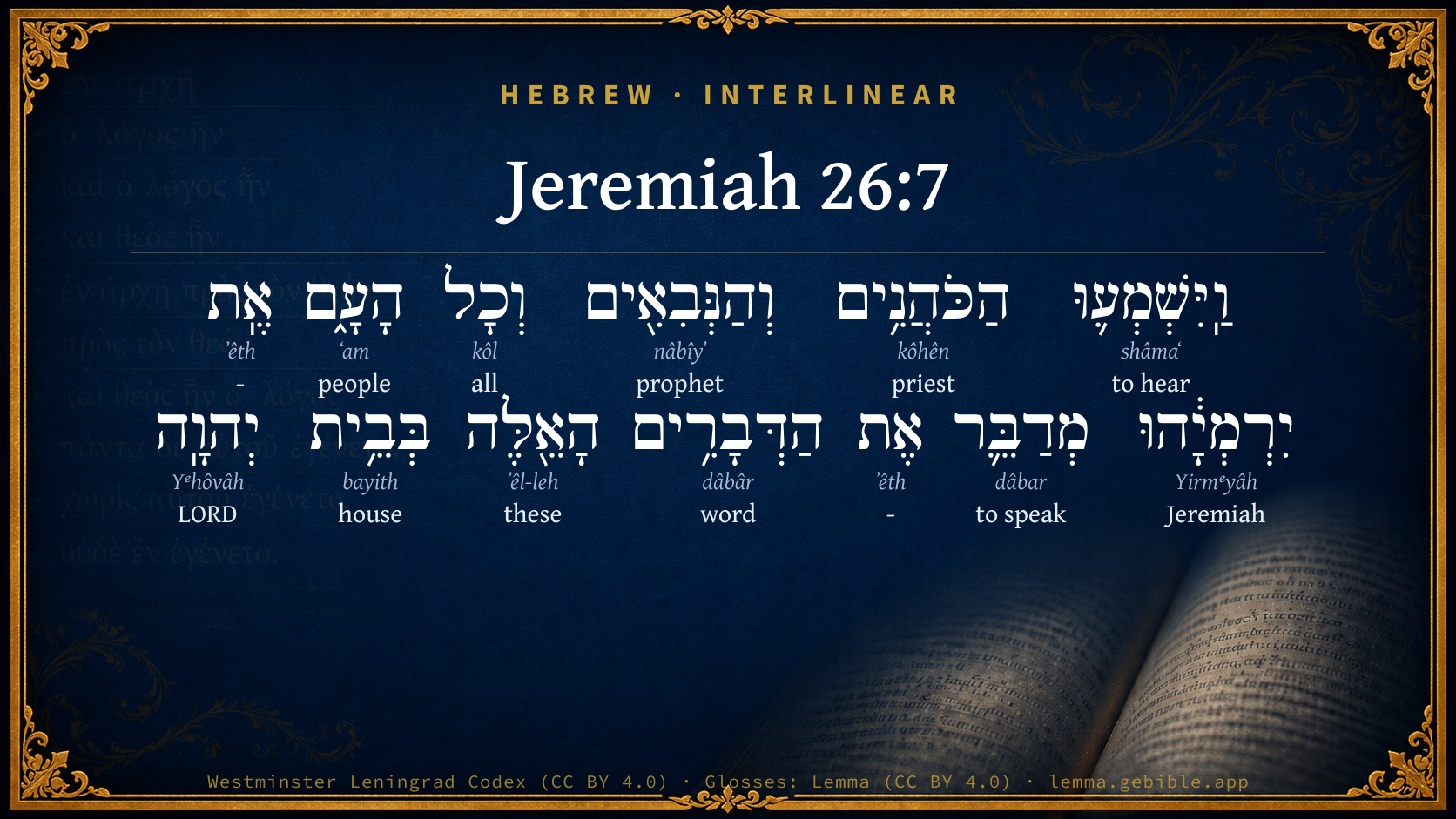
Hebrew (Westminster Leningrad Codex) Jeremiah 26:7 appears in the Hebrew Old Testament. The text above is from the Westminster Leningrad Codex. Each word links to its Strong’s number, a concise gloss, and parsing drawn from the Open Scriptures Hebrew Bible morphology. Click any word for its full Brown-Driver-Briggs (BDB) entry.
Download image
Cite this verse

Jeremiah 26:7 (World English Bible). Public Domain. Lemma interlinear Bible study tool, https://lemma.gebible.app/v/jeremiah/26/7.

Show BibTeX & RIS
BibTeX
RIS
English Translation
The priests and the prophets and all the people heard Jeremiah speaking these words in the house of Yahweh.
World English Bible · Public Domain
Download a study sheet

One document with this verse’s original text, its word-by-word gloss line, the meaning frame, cross-references with their text, attributed commentary, and full source and license credits — printable, and it pastes into notes with its structure intact.

This verse Autodidact and up

Study sheet (.html) Plain text (.txt)

A passage Seminary Student

Up to 50 verses in one chapter. A passage sheet keeps up to 6 commentary sources and 12 cross-references per verse, in the order this page ranks them, and says so on the sheet whenever that leaves anything out. Ask for a single verse and you get the Autodidact verse sheet above.

Everything on this page stays free to read, with no account — the sheet is a download of what is already on screen, not access to it.

Want to remove ads? Support Godless Engineer
Compare translations 3

The same verse in 3 English versions, stacked beneath the original-language interlinear above. Click any original word for its lexicon entry.

Each is an independent rendering of the whole verse — the interlinear is not word-aligned to these translations.

Highlighted words mark where these versions differ — a whole-verse word diff, not a word-by-word alignment.

  • World English Bible Public Domain
    The priests and the prophets and all the people heard Jeremiah speaking these words in the house of Yahweh.
  • King James Version Public Domain
    So the priests and the prophets and all the people heard Jeremiah speaking these words in the house of the LORD.
  • unfoldingWord Literal Text CC BY-SA 4.0
    And the priests and the prophets and all the people heard Jeremiah speaking these words in the house of Yahweh.

unfoldingWord Literal Text — © unfoldingWord, licensed CC BY-SA 4.0. Word-aligned USFM3 via Door43 (git.door43.org/unfoldingWord/en_ult).

Versions to compare (up to 4)

3 of 4 selected

Show all 18 translations

Every available English version of this verse, each an independent rendering of the whole verse.

  • World English Bible Public Domain
    The priests and the prophets and all the people heard Jeremiah speaking these words in the house of Yahweh.
  • Berean Standard Bible Public Domain
    Now the priests and prophets and all the people heard Jeremiah speaking these words in the house of the LORD,
  • Majority Standard Bible Public Domain
    Now the priests and prophets and all the people heard Jeremiah speaking these words in the house of the LORD,
  • King James Version Public Domain
    So the priests and the prophets and all the people heard Jeremiah speaking these words in the house of the LORD.
  • American Standard Version (1901) Public Domain
    And the priests and the prophets and all the people heard Jeremiah speaking these words in the house of Jehovah.
  • Revised Version (1885) Public Domain
    And the priests and the prophets and all the people heard Jeremiah speaking these words in the house of the LORD.
  • Geneva Bible (1599) Public Domain
    So the Priestes, and the Prophets, and all the people heard Ieremiah speaking these wordes in the House of the Lord.
  • Douay-Rheims (1899) Public Domain
    And the priests, and the prophets, and all the people heard Jeremias speaking these words in the house of the Lord.
  • Young's Literal Translation Public Domain
    And the priests, and the prophets, and all the people, hear Jeremiah speaking these words in the house of Jehovah,
  • Literal Standard Version CC BY-SA 4.0
    And the priests, and the prophets, and all the people, hear Jeremiah speaking these words in the house of YHWH,
  • Unlocked Literal Bible CC BY-SA 4.0
    The priests, the prophets, and all the people heard Jeremiah announcing these words in Yahweh's house.
  • unfoldingWord Literal Text CC BY-SA 4.0
    And the priests and the prophets and all the people heard Jeremiah speaking these words in the house of Yahweh.
  • Darby Bible Public Domain
    And the priests and the prophets and all the people heard Jeremiah speaking these words in the house of Jehovah.
  • World Messianic Bible Public Domain
    The priests and the prophets and all the people heard Jeremiah speaking these words in the LORD’s house.
  • Webster's Bible Public Domain
    So the priests and the prophets, and all the people heard Jeremiah speaking these words in the house of the LORD.
  • Free Bible Version CC BY-SA 4.0
    The priests and prophets and all the people heard Jeremiah deliver this message in the Lord's Temple.
  • Bible in Basic English Public Domain
    And in the hearing of the priests and the prophets and all the people, Jeremiah said these words in the house of the Lord.
  • JPS Tanakh (1917) Public Domain
    So the priests and the prophets and all the people heard Jeremiah speaking these words in the house of the LORD.

Literal Standard Version (2020), Covenant Press — licensed CC BY-SA 4.0. Text via the HelloAO Bible API (eBible.org). Unlocked Literal Bible (unfoldingWord) — licensed CC BY-SA 4.0. Text via the HelloAO Bible API (eBible.org). unfoldingWord Literal Text — © unfoldingWord, licensed CC BY-SA 4.0. Word-aligned USFM3 via Door43 (git.door43.org/unfoldingWord/en_ult). Free Bible Version, Dr. Jonathan Gallagher — licensed CC BY-SA 4.0. Text via the HelloAO Bible API (eBible.org).

Word by word

More ways to search: Search by grammar → Find every occurrence → Compare this word →

Practice this passage: Drill this verse → Learn its vocabulary →

יִרְמְיָ֔הוּ
Yirmᵉyâh
H3414
“Jeremiah”
Noun, Proper
Part of Speech
Noun
Type
Proper
Full BDB Definition

Origin: from H7311 and H3050

TWOT: None

Jeremiah = "whom Jehovah has appointed" - the major prophet, son of Hilkiah of the priestly family in Anathoth; author of the prophetic book bearing his name - a man of Libnah and father of Hamutal the wife of king Josiah - a Gadite who joined David at Ziklag - a Manassehite, one of the mighty men of valour of the Transjordanic half tribe of Manasseh - a Gadite and warrior of David - a warrior of David - a priest who joined Nehemiah in the covenant ceremony - a priest also in the time of Nehemiah; maybe same as 7 - father of Jaazaniah the Rechabites
  1. וַֽיִּשְׁמְע֛וּ shâmaʻ H8085 “and · to hear” Conjunction + Verb, Qal, Sequential Imperfect, 3rd Person, Masculine, Plural
  2. הַכֹּהֲנִ֥ים kôhên H3548 “the · priests” Particle, Definite Article + Noun, Common, Masculine, Plural, Absolute
  3. וְהַנְּבִאִ֖ים nâbîyʼ H5030 “and · the · prophets” Conjunction + Particle, Definite Article + Noun, Common, Masculine, Plural, Absolute
  4. וְכָל kôl H3605 “and · all of” Conjunction + Noun, Common, Masculine, Singular, Construct
  5. הָעָ֑ם ʻam H5971 “the · people” Particle, Definite Article + Noun, Common, Masculine, Singular, Absolute
  6. אֶֽת ʼêth H853 “-” Particle, Direct Object
  7. מְדַבֵּ֛ר dâbar H1696 “speaking” Verb, Piel, Participle Active, Masculine, Singular, Absolute
  8. אֶת ʼêth H853 “-” Particle, Direct Object
  9. הַדְּבָרִ֥ים dâbâr H1697 “the · words” Particle, Definite Article + Noun, Common, Masculine, Plural, Absolute
  10. הָאֵ֖לֶּה ʼêl-leh H428 “the · these” Particle, Definite Article + Pronoun, Demonstrative, Common, Plural
  11. בְּבֵ֥ית bayith H1004 “in/at · house of” Preposition + Noun, Common, Masculine, Singular, Construct
  12. יְהוָֽה Yᵉhôvâh H3068 “LORD” Noun, Proper

About this verse

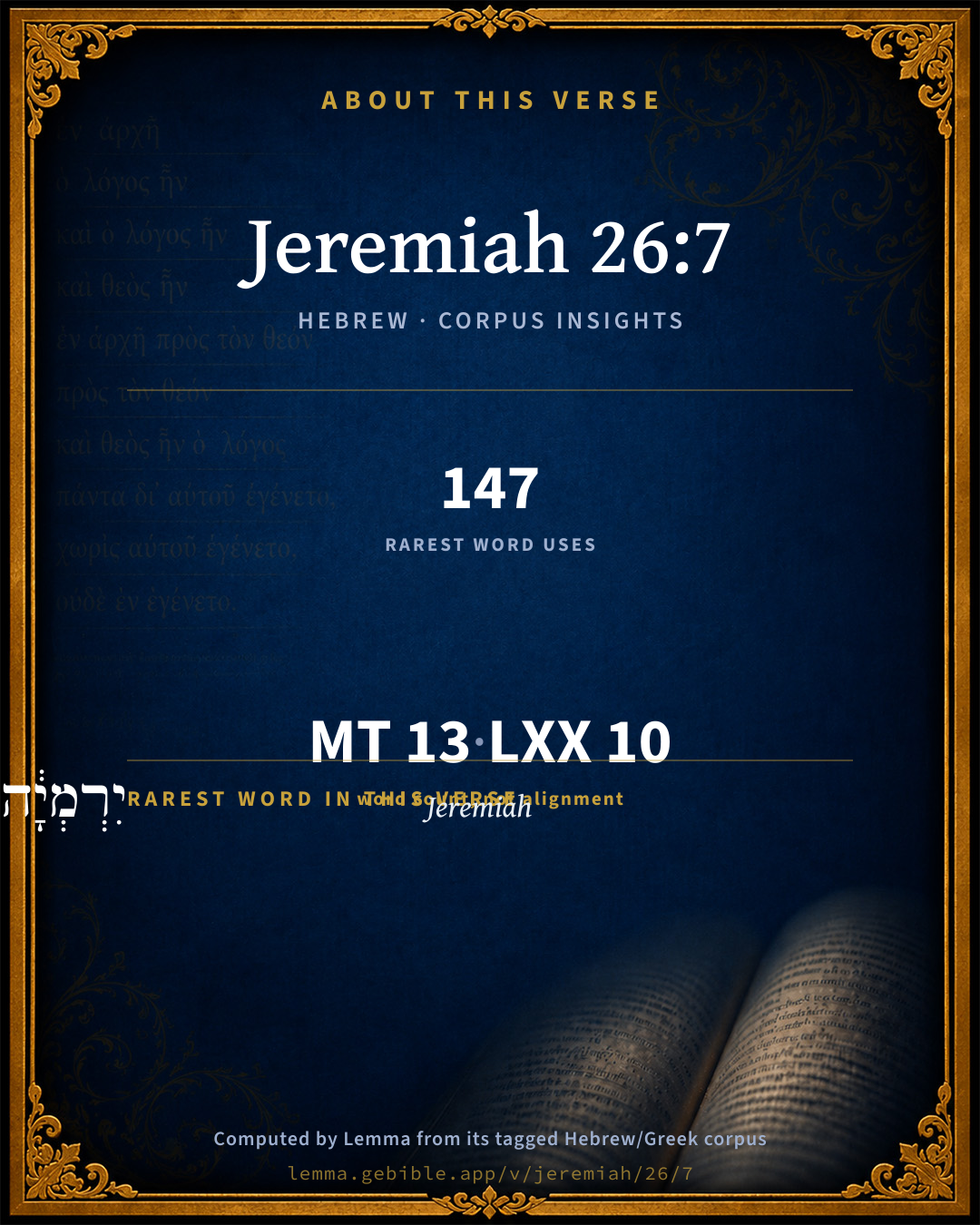
These counts appear in no published source. They are computed here, from the morphology-tagged text and Lemma’s own curated glosses. What Lemma adds →

13
words
12
distinct lemmas
Prophets
section

Grammatical profile

  • 2 verbs
  • 8 nouns
  • 1 pronoun
  • 2 particles

Verb forms

  • וַֽיִּשְׁמְע֛וּ Qal · Sequential Imperfect
  • מְדַבֵּ֛ר Piel · Participle Active

Hebrew & Septuagint length

In the original languages it is 13 Hebrew tokens and 10 Greek tokens — but the two are counted differently (Hebrew bundles its prefixes and suffixes into one token; the Greek is in lemma form), so that isn’t a like-for-like length.

Cross-references

8

Topical passages linked to Jeremiah 26:7 in the Treasury of Scripture Knowledge — connected by theme and wording, ordered by reader-vote popularity; previews shown in the World English Bible.

  • Jeremiah 5:31 the prophets prophesy falsely, and the priests bear rule by their means; and my people love to have it so: and what will you do in the end of it?
  • Micah 3:11 Her leaders judge for bribes, And her priests teach for a price, And her prophets of it tell forturnes for money: Yet they lean on Yahweh, and say, Isn't Yahweh in the midst of us? No disaster will come on us.
  • Jeremiah 23:11–15 for both prophet and priest are profane; yes, in my house have I found their wickedness, says Yahweh.
  • Ezekiel 22:25–26 There is a conspiracy of her prophets in the midst of it, like a roaring lion ravening the prey: they have devoured souls; they take treasure and precious things; they have made her widows many in the midst of it.
  • Zephaniah 3:4 Her prophets are arrogant and treacherous people. Her priests have profaned the sanctuary. They have done violence to the law.
  • Matthew 21:15 But when the chief priests and the scribes saw the wonderful things that he did, and the children who were crying in the temple and saying, "Hosanna to the son of David!" they were indignant,
  • Acts 4:1–6 As they spoke to the people, the priests and the captain of the temple and the Sadducees came to them,
  • Acts 5:17 But the high priest rose up, and all those who were with him (which is the sect of the Sadducees), and they were filled with jealousy,

Cross-references courtesy of OpenBible.info (CC BY 4.0).

Hebrew and Greek witnesses Masoretic Hebrew ↔ Greek Septuagint

The same verse in the two great witnesses to the Old Testament, shown verse-for-verse.

These are two independent witnesses, not word-aligned to each other, and the Septuagint is shown in lemma (dictionary) form.

Hebrew Jeremiah 26:7 Masoretic · Westminster Leningrad Codex

וַֽיִּשְׁמְע֛וּ הַכֹּהֲנִ֥ים וְהַנְּבִאִ֖ים וְכָל הָעָ֑ם אֶֽת יִרְמְיָ֔הוּ מְדַבֵּ֛ר אֶת הַדְּבָרִ֥ים הָאֵ֖לֶּה בְּבֵ֥ית יְהוָֽה

The priests and the prophets and all the people heard Jeremiah speaking these words in the house of Yahweh.

World English Bible · Public Domain

Greek LXX Structure differs

In the Septuagint, Jeremiah is about an eighth shorter than the Hebrew and arranges its material differently — the Oracles Against the Nations (Hebrew chapters 46–51) appear in the middle of the Greek book, after 25:13. Because the chapter and verse boundaries do not line up, a verse-for-verse comparison with the Hebrew is not shown.

A verse-for-verse comparison isn’t shown here because the chapters and verses don’t line up. Switch to the LXX edition with the MT / LXX toggle above to read the Greek directly.

On this verse, The Cambridge Bible for Schools and Colleges discusses the Septuagint’s reading. Read the note in Commentary ↓

Hebrew: Westminster Leningrad Codex (CC BY 4.0). Greek: Septuagint (public domain); English from a public-domain English Septuagint. How the Septuagint differs from the Hebrew →

Targum (Aramaic paraphrase)

1

The Targum is the ancient Jewish Aramaic paraphrase of the Hebrew Scriptures — an interpretive translation, not the Hebrew text itself. Onkelos (literal) and Pseudo-Jonathan (expansive) render the Torah, and Jonathan the Prophets. Coverage is partial: where no permissively-licensed English translation exists for a verse, only the Aramaic is shown. This is verse-level text, not a word-by-word alignment to the Hebrew.

  1. Targum Jonathan Prophets (Joshua–Malachi)
    וּשְׁמָעוּ כַּהֲנַיָא וְסַפְרַיָא וְכָל עַמָא דְיִרְמְיָה מִתְנַבֵּי יַת פִּתְגָמַיָא הָאִלֵין בְּבֵית מַקְדְשָׁא דַיָי:

    (no public-domain English translation for this verse)

    Targum Jonathan — Aramaic: “Mikraot Gedolot” (public domain). English: “Sefaria Community Translation” (CC0 1.0 (public-domain dedication)); “London "Chaldee Paraphrase," 1871” (public domain). Text via Sefaria.

Commentary

Notes on Jeremiah 26:7 from classic Christian and Jewish commentators (each source and its license shown beneath its notes). The classic Christian expositions comment on the surrounding passage and are grouped to its opening verse, so a note may address several verses; the Jewish commentaries on the Tanakh (Rashi and others) are per-verse, so they appear only where the commentator wrote on this verse.

Lemma curates 59 commentaries, every one of them public domain or Creative Commons licensed, each selected and text-cleaned for this edition rather than reprinted as found. About our sources →

Matthew Henry's Commentary

One would have hoped that such a sermon as that in the foregoing verses, so plain and practical, so rational and pathetic, and delivered in God's name, would work upon even this people, especially meeting them now at their devotions, and would prevail with them to repent and reform; but, instead of awakening their convictions, it did but exasperate their corruptions, as appears by this account of the effect of it.

I. Jeremiah is charged with it as a crime that he had preached such a sermon, and is apprehended for it as a criminal. The priests, and false prophets, and people, heard him speak these words, Jer 26:7. They had patience, it seems, to hear him out, did not disturb him when he was preaching, nor give him any interruption till he had made an end of speaking all that the Lord commanded him to speak, Jer 26:8. So far they dealt more fairly with him than some of the persecutors of God's ministers have done; they let him say all he had to say, and yet perhaps with a bad design, in hopes to have something worse yet to lay to his charge; but, having no worse, this shall suffice to ground an indictment upon: He hath said, This house shall be like Shiloh, Jer 26:9. See how unfair they are in representing his words. He had said, in God's name, If you will not hearken to me, then will I make this house like Shiloh; but they leave out God's hand in the desolation (I will make it so) and their own hand in it in not hearkening to the voice of God, and charge it upon him that he blasphemed this holy place, the crime charged both on our Lord Jesus and on Stephen: He said, This house shall be like Shiloh. Well might he complain, as David does (Psa 56:5), Every day they wrest my words; and we must not think it strange if we, and what we say and do, be thus misrepresented. When the accusation was so weakly grounded, no marvel that the sentence passed upon it was unjust: Thou shalt surely die. What he had said agreed with what God had said when he took possession of the temple (Kg1 9:6-8), If you shall at all turn from following after me, then this house shall be abandoned; and yet he is condemned to die for saying it. It is not out of any concern for the honour of the temple that they appear thus warm, but because they are resolved not to part with their sins, in which they flatter themselves with a conceit that the temple of the Lord will protect them; therefore, right or wrong, Thou shalt surely die. This outcry of the priests and prophets raised the mob, and all the people were gathered together against Jeremiah in a popular tumult, ready to pull him to pieces, were gathered about him (so some read it); they flocked together, some crying one thing and some another. The people that were at first present were hot against him (v. 8), but their clamours drew more together, only to see what the matter was.

II. He is arraigned and indicted for it before the highest court of judicature they had. Here, 1. The princes of Judah were his judges, Jer 26:10. Those that filled the thrones of judgment, the thrones of the house of David, the elders of Israel, they, hearing of this tumult in the temple, came up from the king's house, where they usually sat near the court, to the house of the Lord, to enquire into this matter, and to see that nothing was done disorderly. They sat down in the entry of the new gate of the Lord's house, and held a court, as it were, by a special commission of Oyer and Terminer. 2. The priests and prophets were his prosecutors and accusers, and were violently set against him. They appealed to the princes, and to all the people, to the court and the jury, whether this man were not worthy to die, Jer 26:11. The corrupt priests and counterfeit prophets have always been the most bitter enemies of the prophets of the Lord; they had ends of their own to serve, which they thought such preaching as this would be an obstruction to. When Jeremiah prophesied in the house of the king concerning the fall of the royal family (Jer 22:1, etc.), the court, though very corrupt, bore it patiently, and we do not find that they persecuted him for it; but when he comes into the house of the Lord, and touches the copyhold of the priests, and contradicts the lies and flatteries of the false prophets, then he is adjudged worthy to die. For the prophets prophesied falsely, and the priests bore rule by their means, Jer 5:31. Observe, When Jeremiah is indicted before the princes the stress of his accusation is laid upon what he said concerning the city, because they thought the princes would be most concerned about that. But concerning the words spoken they appeal to the people, "You have heard what he hath said; let it be given in evidence."

III. Jeremiah makes his defence before the princes and the people. He does not go about to deny the words, nor to diminish aught from them; what he has said he will stand to, though it cost him his life; he owns that he had prophesied against this house and this city, but, 1. He asserts that he did this by good authority, not maliciously nor seditiously, not out of any ill-will to his country nor any disaffection to the government in church or state, but, The Lord sent me to prophesy thus: so he begins his apology (Jer 26:12), and so he concludes it, for this is that which he resolves to abide by as sufficient to bear him out (Jer 26:15): Of a truth the Lord hath sent me unto you, to speak all these words. As long as ministers keep closely to the instructions they have from heaven they need not fear the opposition they may meet with from hell or earth. He pleads that he is but a messenger, and, if he faithfully deliver his message, he must bear no blame; but he is a messenger from the Lord, to whom they were accountable as well as he, and therefore might demand regard. If he speak but what God appointed him to speak, he is under the divine protection, and whatever affront they offer to the ambassador will be resented by the Prince that sent him. 2. He shows them that he did it with a good design, and that it was their fault if they did not make a good use of it. It was said, not by way of fatal sentence, but of fair warning; if they would take the warning, they might prevent the execution of the sentence, Jer 26:13. Shall I take it ill of a man that tells me of my danger, while I have an opportunity of avoiding it, and not rather return him thanks for it, as the greatest kindness he could do me? "I have indeed (says Jeremiah) prophesied against this city; but, if you will now amend your ways and your doings, the threatened ruin shall be prevented, which was the thing I aimed at in giving you the warning." Those are very unjust who complain of ministers for preaching hell and damnation, when it is only to keep them from that place of torment and to bring them to heaven and salvation. 3. He therefore warns them of their danger if they proceed against him (Jer 26:14): "As for me, the matter is not great what become of me; behold, I am in your hand; you know I am; I neither have any power, nor can make any interest, to oppose you, nor is it so much my concern to save my own life: do with me as seems meet unto you; if I be led to the slaughter, it shall be as a lamb." Note, It becomes God's ministers, that are warm in preaching, to be calm in suffering and to behave submissively to the powers that are over them, though they be persecuting powers. But, for themselves, he tells them that it is at their peril if they put him to death: You shall surely bring innocent blood upon yourselves, Jer 26:15. They might think that killing the prophet would help to defeat the prophecy, but they would prove wretchedly deceived; it would but add to their guilt and aggravate their ruin. Their own consciences could not but tell them that, if Jeremiah was (as certainly he was) sent of God to bring them this message, it was at their utmost peril if they treated him for it as a malefactor. Those that persecute God's ministers hurt not them so much as themselves.

Matthew Henry's Commentary on the Whole Bible (1708–1710) — public domain (CC PDM 1.0). Text via the HelloAO Bible API.

Trapp's Complete Commentary

John Trapp

Jer 26:7 So the priests and the prophets and all the people heard Jeremiah speaking these words in the house of the LORD.

Ver. 7. So the priests and the prophets.] Like unto these prophets were the scribes and the lawyers in Christ’s time. {a}

{a} Verbum Domini parit crucem. The word of God brought forth the cross. - Oecol.

John Trapp, A Commentary or Exposition upon All the Books of the Old and New Testament (1647–1656) — public domain. Text from a community e-Sword module.

Joseph Benson's Commentary

Jer 26:7. So the priests and the prophets — Namely, the false prophets; they who pretended to be prophets, though they had received no divine commission. And all the people — Who were present at that time; heard Jeremiah, &c., in the house of the Lord — That is, “In the court before the Lord’s house. The outer courts, being holy ground, and dedicated to God’s worship, are called by the name of the temple. So the treasury, where Christ preached, is called the temple, (Joh 8:20,) though it stood in the outer court of it. And St. Paul is said to have entered into the temple, Act 21:26, &c.; that is, into the court of the temple, and the Jews to have laid hold on him there.” — Lowth.

Joseph Benson's Commentary on the Old and New Testaments (1811–1818) — public domain. Text from a community e-Sword module.

Tyndale Open Study Notes

Tyndale Open Resources

26:7-9 The crowd at the Temple wanted to kill Jeremiah for blasphemy because he had spoken against the Temple. This charge carried the death penalty (Lev 24:16). The prophet’s opponents argued that the Lord’s holy Temple could not possibly be destroyed. The priests and prophets had accepted the pagan idea that temples were indestructible because deities dwelt within them.

Tyndale Open Study Notes — © Tyndale Open Resources, licensed CC BY-SA 4.0. Text via the HelloAO Bible API.

John Calvin's Commentaries

Here the Prophet recites what happened to him, after he had declared God’s message, and faithfully warned the people by adding threatenings, as God had commanded him. He says first that he was heard; which is not to be deemed as commendatory, as though the priests and prophets patiently heard what he taught; for there was no teachable spirit in them, nor did they come prepared to learn, but they had long indulged themselves in perverseness, so that Jeremiah was become to them an avowed enemy; and they also audaciously opposed all his threatenings. But though they were not ashamed to reject what the Prophet said, they yet observed a certain form, as it is usual with hypocrites, for they are more exact than necessary, as they say, in what is formal, but what is really important they neglect. We may hence observe, that the priests and prophets deserved no praise, because they restrained themselves, as though they deferred their judgment until the cause was known, but as the whole people were present, they for a time shewed themselves moderate; it was yet a reigned moderation, for their hearts were full of impiety and contempt of God, as it became really manifest.

But it must be observed that he says that the priests and prophets hearkened As to the priests, it is no wonder that he calls them so, though they were in every way wicked, for it was an hereditary honor. But it is strange that he mentions the prophets. At the same time we must know, that Jeremiah thus calls those who boasted that they were sent from above. In the twenty-third chapter he at large reproves them; and in many other places he condemns their impudence in falsely assuming the authority of God. He then allowed them an honorable title, but esteemed it as nothing; as we may do at this day, who without harm may call by way of ridicule those prelates, bishops, or pastors, who under the Papacy seek to be deemed so, provided we at the same time strip them of their masks. But these lay hold on the title, and thus seek to suppress the truth of God, as though to be called a bishop were of more weight than if an angel was to come down from heaven. And yet were an angel to descend from heaven, he ought to be counted by us as a devil, if he brought forward such filthy and execrable blasphemies, as we see the world is at this day polluted with by these unprincipled men. This passage then, and the like, ought to be borne in mind, for they shew that titles are not sufficient, except those who bear them really shew that they are such as their calling imports. Thus, then, Jeremiah was called a Prophet, and also those impostors were called prophets whose only religion it was to corrupt and pervert the doctrine of the Law, but they were so called with regard to the people. It is in the meantime necessary, wisely to distinguish between prophets or teachers, as also the Apostle reminds us, we ought to inquire whether their spirit is from God or not. (1 John 4:1.)

John Calvin's Commentaries (1540-1563) — public domain. Text from the Calvin Translation Society English edition (1840s-50s) via the Christian Classics Ethereal Library (ccel.org). Calvin's coverage is partial (roughly two-thirds of the Bible); uncommented books and verses are honest gaps, never fabricated. The 19th-century editor's footnotes and remarks are omitted so the notes are faithfully Calvin's own voice.

Ellicott's Commentary for English Readers

(7) The priests and the prophets.—The mention of the latter is significant. Jeremiah had to separate himself from both the orders to which he belonged, in the one case, by birth, in the other, by a special vocation. His bitterest foes were found among those who claimed to speak as he did, in the name of the Lord, but who tuned their voice according to the time, and prophesied deceits. See Notes on Jer_23:9-40.

A Bible Commentary for English Readers, edited by Charles John Ellicott (1878–1897) — public domain. Text from a community e-Sword module.

The Cambridge Bible for Schools and Colleges

gen. ed. J. J. S. Perowne

7. prophets] The LXX, in order to make the sense clearer, render the Hebrew here, as in Jer_26:8; Jer_26:11; Jer_26:16, “false prophets.”

7–16. See introd. summary to ch.

The Cambridge Bible for Schools and Colleges (gen. ed. J. J. S. Perowne; Cambridge University Press, 1878–1918) — public domain. Text from a community e-Sword module.

John Gill's Exposition

So the priests, and the prophets, and all the people,.... As it was in the temple, in one of the courts of it, that Jeremiah was, and said the above things, it is no wonder to hear of the "priests", since they were there about their work and service; the "prophets" were the false prophets, as the Septuagint and Arabic versions expressly call them; and "all the people" were all the males out of the several cities of Judah, who were come up to the temple on the account of the feast; see Jer 26:2; now these

heard Jeremiah speaking these words in the house of the Lord; in the temple; in the court of Israel; they heard him out, and did not interrupt him while he was speaking; and having heard him, they were angry with him, and were witnesses against him; they did not hear him so as to obey his words, receive his instructions, and follow, his directions; but they heard him with indignation, and were determined to prosecute him unto death.

John Gill's Exposition of the Whole Bible (1746–1763) — public domain (CC PDM 1.0). Text via the HelloAO Bible API.

Matthew Poole's English Annotations

All the people present at that time heard the prophet, who, according to the command of God, came into the court of the Lord’s house, and discharged his office, speaking these words.

Matthew Poole's English Annotations on the Holy Bible (1683–1685) — public domain. Text from a community e-Sword/MySword module.

Whedon's Commentary on the Bible

Daniel D. Whedon

7. The priests and the prophets — Indicating, in no doubtful manner, how effectually Jeremiah had succeeded in arresting public attention.

Daniel D. Whedon (gen. ed.), Commentary on the Old and New Testaments (1874–1909) — public domain. Text from a community e-Sword module.

The Pulpit Commentary

Vers. 7-11. To all devout Jews this prediction of the destruction of the temple must have been startling; but to those who placed their confidence in the mere exist once of a consecrated building, (Jer_7:4) it was like a blow aimed at their very life. Besides, were not the majority of the prophets of Jehovah of entirely another way of thinking? Did they not promise peace? And what could justify Jeremiah in announcing not merely war, but the downfall of the Divine habitation itself? Hence no sooner had the prophet concluded his discourse, than he was arrested, accused, and condemned to death.

The Pulpit Commentary (1880–1919), ed. H.D.M. Spence-Jones & Joseph S. Exell — public domain. Text from a community e-Sword module.

unfoldingWord translationNotes

Door43 World Missions Community

Yahweh's house

the temple

all the people seized him and said, "You will certainly die!

Possible meanings are 1) The people chose to believe the lie of false peace and did not want to be confronted with the truth, or 2) the people believed the other prophets proclaiming peace and saw Jeremiah as a false prophet who should be stoned for leading the people astray.

Why have you prophesied ... inhabitant?

This rebuke can be translated as a statement. AT: "You should not have prophesied ... inhabitant." (See: Rhetorical Question)

translationWords

priest

people group

Jeremiah

house of God

die

name

desolate

unfoldingWord translationNotes — © Distant Shores Media and the Door43 World Missions Community, licensed CC BY-SA 4.0. Source: git.door43.org/Door43/en_tn.

Lesson kit

Teaching starters — assembled from the data on this page, not authored interpretation. Every prompt links to the verse data it draws on. Edit before teaching.

Jeremiah, in the Prophets, opens this verse with 13 words (12 distinct Hebrew lemmas). Its most distinctive word is Yirmᵉyâh (“Jeremiah”). A historical commentator’s framing appears above. Read the whole chapter for the surrounding context.

Discussion questions

  1. The word Yirmᵉyâh carries the sense “Jeremiah.” How does it shape the verse?
  2. Jeremiah 5:31 shares this passage’s theme. How do the two illuminate each other?
  3. These translations render this verse differently; the difference is in the English rendering, not the original. What questions does that raise?
  4. The verb «וַֽיִּשְׁמְע֛וּ» is Qal Sequential Imperfect. How does its form color the action?
  5. Reading how Matthew Henry's Commentary and Trapp's Complete Commentary read this verse, where do the two commentators agree and where do they part?

Things to notice

Reading settings

Reading text

Shown beneath each verse's original-language words.

Old Testament
Old Testament edition

Read the OT as the Masoretic Hebrew (MT) or the Greek Septuagint (LXX).

English shown for the Greek Septuagint (in the Hebrew ↔ Greek comparison).

Comparing translations? Open the Compare panel on any verse page to stack up to four side by side.