
Jeremiah 28:6

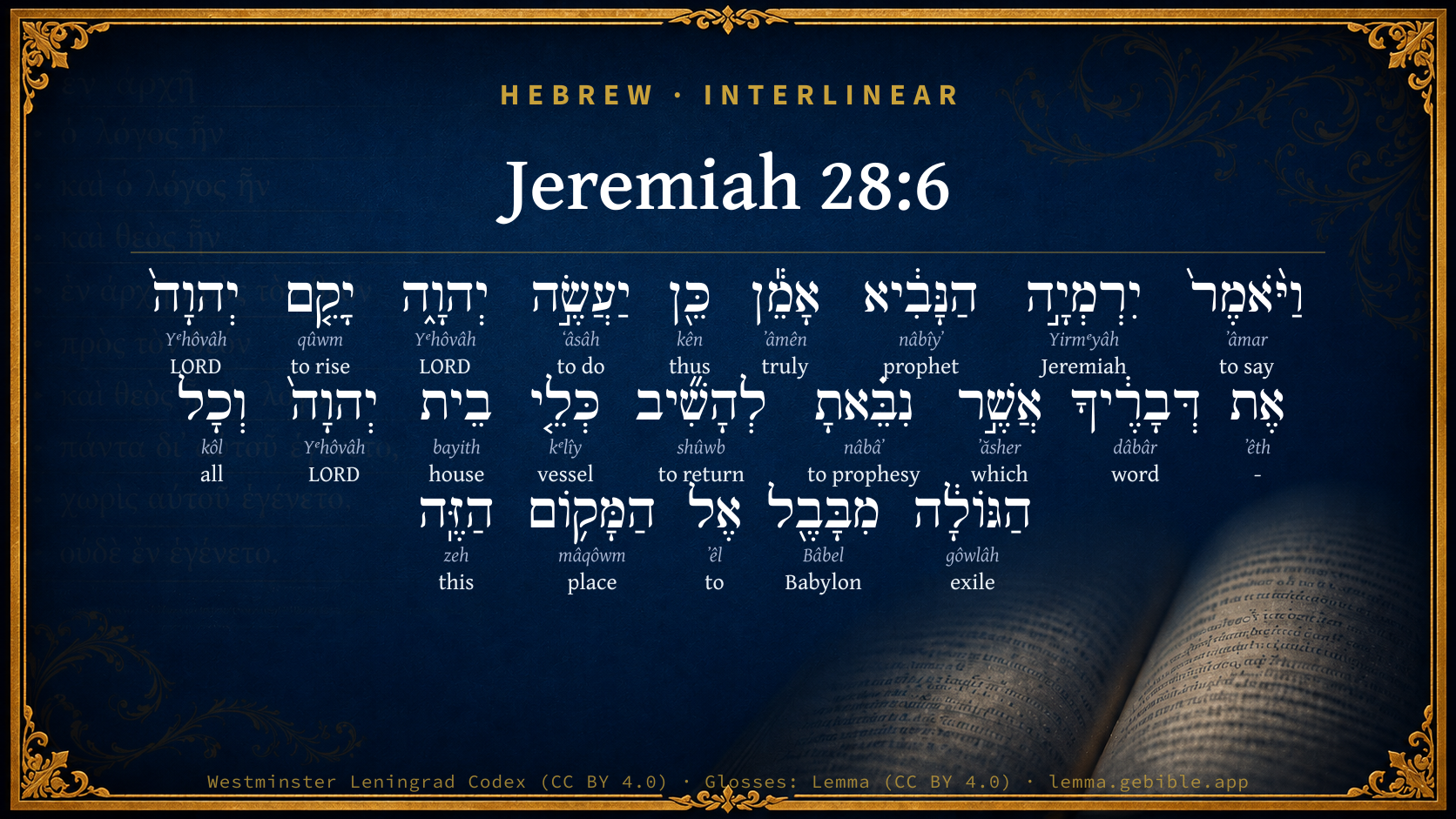
Hebrew (Westminster Leningrad Codex) Jeremiah 28:6 appears in the Hebrew Old Testament. The text above is from the Westminster Leningrad Codex. Each word links to its Strong’s number, a concise gloss, and parsing drawn from the Open Scriptures Hebrew Bible morphology. Click any word for its full Brown-Driver-Briggs (BDB) entry.
Download image
Cite this verse

Jeremiah 28:6 (World English Bible). Public Domain. Lemma interlinear Bible study tool, https://lemma.gebible.app/v/jeremiah/28/6.

Show BibTeX & RIS
BibTeX
RIS
English Translation
even the prophet Jeremiah said, Amen: Yahweh do so; Yahweh perform your words which you have prophesied, to bring again the vessels of Yahweh's house, and all them of the captivity, from Babylon to this place.
World English Bible · Public Domain
Download a study sheet

One document with this verse’s original text, its word-by-word gloss line, the meaning frame, cross-references with their text, attributed commentary, and full source and license credits — printable, and it pastes into notes with its structure intact.

This verse Autodidact and up

Study sheet (.html) Plain text (.txt)

A passage Seminary Student

Up to 50 verses in one chapter. A passage sheet keeps up to 6 commentary sources and 12 cross-references per verse, in the order this page ranks them, and says so on the sheet whenever that leaves anything out. Ask for a single verse and you get the Autodidact verse sheet above.

Everything on this page stays free to read, with no account — the sheet is a download of what is already on screen, not access to it.

Want to remove ads? Support Godless Engineer
Compare translations 3

The same verse in 3 English versions, stacked beneath the original-language interlinear above. Click any original word for its lexicon entry.

Each is an independent rendering of the whole verse — the interlinear is not word-aligned to these translations.

Highlighted words mark where these versions differ — a whole-verse word diff, not a word-by-word alignment.

  • World English Bible Public Domain
    even the prophet Jeremiah said, Amen: Yahweh do so; Yahweh perform your words which you have prophesied, to bring again the vessels of Yahweh's house, and all them of the captivity, from Babylon to this place.
  • King James Version Public Domain
    Even the prophet Jeremiah said, Amen: the LORD do so: the LORD perform thy words which thou hast prophesied, to bring again the vessels of the LORD's house, and all that is carried away captive, from Babylon into this place.
  • unfoldingWord Literal Text CC BY-SA 4.0
    And Jeremiah the prophet said, “Amen! Thus may Yahweh do! May Yahweh establish your words that you prophesied, to bring back the vessels of the house of Yahweh and all the exiles from Babylon to this place.

unfoldingWord Literal Text — © unfoldingWord, licensed CC BY-SA 4.0. Word-aligned USFM3 via Door43 (git.door43.org/unfoldingWord/en_ult).

Versions to compare (up to 4)

3 of 4 selected

Show all 18 translations

Every available English version of this verse, each an independent rendering of the whole verse.

  • World English Bible Public Domain
    even the prophet Jeremiah said, Amen: Yahweh do so; Yahweh perform your words which you have prophesied, to bring again the vessels of Yahweh's house, and all them of the captivity, from Babylon to this place.
  • Berean Standard Bible Public Domain
    “Amen!” Jeremiah said. “May the LORD do so! May the LORD fulfill the words you have prophesied, and may He restore the articles of His house and all the exiles back to this place from Babylon.
  • Majority Standard Bible Public Domain
    “Amen!” Jeremiah said. “May the LORD do so! May the LORD fulfill the words you have prophesied, and may He restore the articles of His house and all the exiles back to this place from Babylon.
  • King James Version Public Domain
    Even the prophet Jeremiah said, Amen: the LORD do so: the LORD perform thy words which thou hast prophesied, to bring again the vessels of the LORD's house, and all that is carried away captive, from Babylon into this place.
  • American Standard Version (1901) Public Domain
    even the prophet Jeremiah said, Amen: Jehovah do so; Jehovah perform thy words which thou hast prophesied, to bring again the vessels of Jehovah's house, and all them of the captivity, from Babylon unto this place.
  • Revised Version (1885) Public Domain
    even the prophet Jeremiah said, Amen: the LORD do so: the LORD perform thy words which thou hast prophesied, to bring again the vessels of the LORD’S house, and all them of the captivity, from Babylon unto this place.
  • Geneva Bible (1599) Public Domain
    Euen the Prophet Ieremiah sayde, So bee it: the Lord so doe, the Lord confirme thy words which thou hast prophecied to restore the vessels of the Lordes House, and al that is caried captiue, from Babel, into this place.
  • Douay-Rheims (1899) Public Domain
    And Jeremias the prophet said: Amen, the Lord do so: the Lord perform thy words, which thou hast prophesied: that the vessels may be brought again into the house of the Lord, and all the captives may return out of Babylon to this place.
  • Young's Literal Translation Public Domain
    Yea, Jeremiah the prophet saith, `Amen! so may Jehovah do; Jehovah establish thy words that thou hast prophesied, to bring back the vessels of the house of Jehovah and all the removal from Babylon, unto this place.
  • Literal Standard Version CC BY-SA 4.0
    indeed, Jeremiah the prophet says, “Amen! So may YHWH do; YHWH establish your words that you have prophesied, to bring back the vessels of the house of YHWH and all the expulsion from Babylon, to this place.
  • Unlocked Literal Bible CC BY-SA 4.0
    Jeremiah the prophet said, “May Yahweh do this! May Yahweh confirm the words that you prophesied and bring back to this place the objects belonging to Yahweh's house, and all the captives from Babylon.
  • unfoldingWord Literal Text CC BY-SA 4.0
    And Jeremiah the prophet said, “Amen! Thus may Yahweh do! May Yahweh establish your words that you prophesied, to bring back the vessels of the house of Yahweh and all the exiles from Babylon to this place.
  • Darby Bible Public Domain
    And the prophet Jeremiah said, Amen, may Jehovah do so! may Jehovah perform thy words which thou hast prophesied, to bring again from Babylon, into this place, the vessels of Jehovah's house, and all them of the captivity!
  • World Messianic Bible Public Domain
    even the prophet Jeremiah said, “Amen! May the LORD do so. May the LORD perform your words which you have prophesied, to bring again the vessels of the LORD’s house, and all those who are captives, from Babylon to this place.
  • Webster's Bible Public Domain
    Even the prophet Jeremiah said, Amen: the LORD do so: the LORD perform thy words which thou hast prophesied, to bring again the vessels of the LORD'S house, and all that is carried away captive, from Babylon into this place.
  • Free Bible Version CC BY-SA 4.0
    “Amen!” said Jeremiah. “I wish the Lord would do just that! I wish the Lord would fulfill your prophetic words and bring back the Temple objects and all the exiles back to Jerusalem from Babylon.
  • Bible in Basic English Public Domain
    The prophet Jeremiah said, So be it: may the Lord do so: may the Lord give effect to the words which you have said, and let the vessels of the Lord's house, and all the people who have been taken away, come back from Babylon to this place.
  • JPS Tanakh (1917) Public Domain
    even the prophet Jeremiah said: 'Amen! the LORD do so! the LORD perform thy words which thou hast prophesied, to bring back the vessels of the LORD'S house, and all them that are carried away captive, from Babylon unto this place!

Literal Standard Version (2020), Covenant Press — licensed CC BY-SA 4.0. Text via the HelloAO Bible API (eBible.org). Unlocked Literal Bible (unfoldingWord) — licensed CC BY-SA 4.0. Text via the HelloAO Bible API (eBible.org). unfoldingWord Literal Text — © unfoldingWord, licensed CC BY-SA 4.0. Word-aligned USFM3 via Door43 (git.door43.org/unfoldingWord/en_ult). Free Bible Version, Dr. Jonathan Gallagher — licensed CC BY-SA 4.0. Text via the HelloAO Bible API (eBible.org).

Word by word

More ways to search: Search by grammar → Find every occurrence → Compare this word →

Practice this passage: Drill this verse → Learn its vocabulary →

אָמֵ֕ן
ʼâmên
H543
“truly”
Adverb
Part of Speech
Adverb
Full BDB Definition

Origin: from H539

TWOT: 116b

verily, truly, amen, so be it
  1. וַיֹּ֨אמֶר֙ ʼâmar H559 “and · to say” Conjunction + Verb, Qal, Sequential Imperfect, 3rd Person, Masculine, Singular
  2. יִרְמְיָ֣ה Yirmᵉyâh H3414 “Jeremiah” Noun, Proper
  3. הַנָּבִ֔יא nâbîyʼ H5030 “the · prophet” Particle, Definite Article + Noun, Common, Masculine, Singular, Absolute
  4. כֵּ֖ן kên H3651 “thus” Particle, Demonstrative
  5. יַעֲשֶׂ֣ה ʻâsâh H6213 “to do” Verb, Qal, Imperfect, 3rd Person, Masculine, Singular
  6. יְהוָ֑ה Yᵉhôvâh H3068 “LORD” Noun, Proper
  7. יָקֵ֤ם qûwm H6965 “to rise” Verb, Hiphil, Jussive, 3rd Person, Masculine, Singular
  8. יְהוָה֙ Yᵉhôvâh H3068 “LORD” Noun, Proper
  9. אֶת ʼêth H853 “-” Particle, Direct Object
  10. דְּבָרֶ֔יךָ dâbâr H1697 “words · your” Noun, Common, Masculine, Plural, Construct + Suffix, Personal, 2nd Person, Masculine, Singular
  11. אֲשֶׁ֣ר ʼăsher H834 “which” Particle, Relative
  12. נִבֵּ֗אתָ nâbâʼ H5012 “to prophesy” Verb, Niphal, Perfect, 2nd Person, Masculine, Singular
  13. לְהָשִׁ֞יב shûwb H7725 “to return” Preposition + Verb, Hiphil, Infinitive Construct
  14. כְּלֵ֤י kᵉlîy H3627 “vessels of” Noun, Common, Masculine, Plural, Construct
  15. בֵית bayith H1004 “house of” Noun, Common, Masculine, Singular, Construct
  16. יְהוָה֙ Yᵉhôvâh H3068 “LORD” Noun, Proper
  17. וְכָל kôl H3605 “and · all of” Conjunction + Noun, Common, Masculine, Singular, Construct
  18. הַגּוֹלָ֔ה gôwlâh H1473 “the · exile” Particle, Definite Article + Noun, Common, Feminine, Singular, Absolute
  19. מִבָּבֶ֖ל Bâbel H894 “from · Babylon” Preposition + Noun, Proper
  20. אֶל ʼêl H413 “to” Preposition
  21. הַמָּק֥וֹם mâqôwm H4725 “the · place” Particle, Definite Article + Noun, Common, Masculine, Singular, Absolute
  22. הַזֶּֽה zeh H2088 “the · this” Particle, Definite Article + Pronoun, Demonstrative, Masculine, Singular

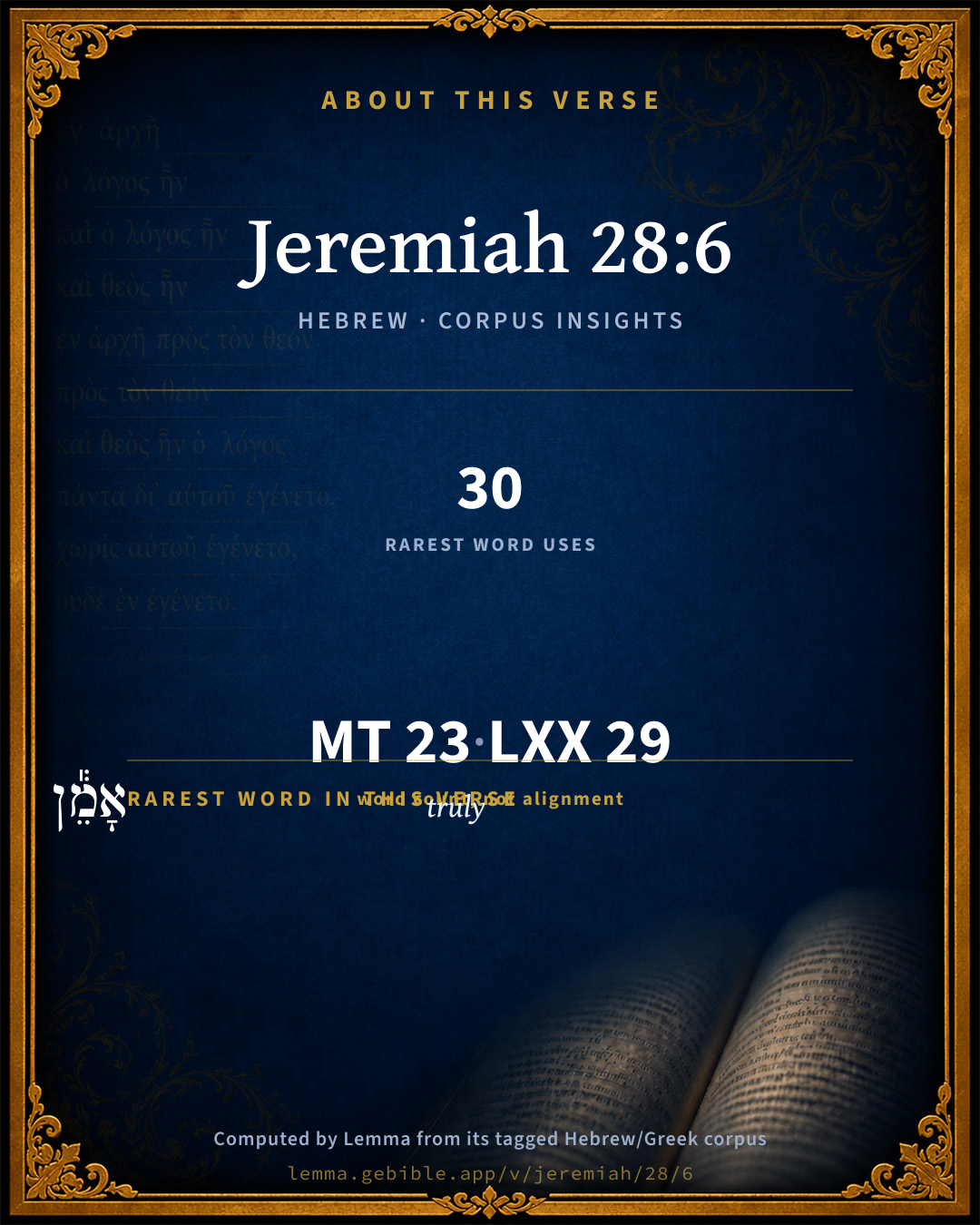
About this verse

These counts appear in no published source. They are computed here, from the morphology-tagged text and Lemma’s own curated glosses. What Lemma adds →

23
words
21
distinct lemmas
Prophets
section

Shared distinctive vocabulary

אָמֵ֕ן truly H543 occurs in 24 verses of the Hebrew Bible. Also found in:

Grammatical profile

  • 5 verbs
  • 12 nouns
  • 1 pronoun
  • 1 preposition
  • 1 adverb
  • 3 particles

Verb forms

  • וַיֹּ֨אמֶר֙ Qal · Sequential Imperfect
  • יַעֲשֶׂ֣ה Qal · Imperfect
  • יָקֵ֤ם Hiphil · Jussive
  • נִבֵּ֗אתָ Niphal · Perfect
  • לְהָשִׁ֞יב Hiphil · Infinitive Construct

Repetition

A word recurs within this verse — often emphatic in Hebrew:

  • יְהוָ֑ה LORD H3068 ×3

Hebrew & Septuagint length

In the original languages it is 23 Hebrew tokens and 29 Greek tokens — but the two are counted differently (Hebrew bundles its prefixes and suffixes into one token; the Greek is in lemma form), so that isn’t a like-for-like length.

Cross-references

21

Topical passages linked to Jeremiah 28:6 in the Treasury of Scripture Knowledge — connected by theme and wording, ordered by reader-vote popularity; previews shown in the World English Bible.

  • 1 Kings 1:36 Benaiah the son of Jehoiada answered the king, and said, Amen: Yahweh, the God of my lord the king, say so [too].
  • Psalms 41:13 Blessed be Yahweh, the God of Israel, From everlasting and to everlasting! Amen and amen.
  • Jeremiah 11:5 that I may establish the oath which I swore to your fathers, to give them a land flowing with milk and honey, as at this day. Then answered I, and said, Amen, Yahweh.
  • Numbers 5:22 and this water that brings a curse will go into your bowels, and make your body swell, and your thigh fall away.' The woman shall say, 'Amen, Amen.'
  • Deuteronomy 27:15–26 Cursed be the man who makes an engraved or molten image, an abomination to Yahweh, the work of the hands of the craftsman, and sets it up in secret. All the people shall answer and say, Amen.
  • 1 Chronicles 16:36 Blessed be Yahweh, the God of Israel, From everlasting even to everlasting. All the people said, Amen, and praised Yahweh.
  • Psalms 72:19 Blessed be his glorious name forever! Let the whole earth be filled with his glory! Amen and amen.
  • Psalms 89:52 Blessed be Yahweh forevermore. Amen, and Amen.
  • Psalms 106:48 Blessed be Yahweh, the God of Israel, From everlasting even to everlasting! Let all the people say, "Amen." Praise Yah!
  • Jeremiah 17:16 As for me, I have not hurried from being a shepherd after you; neither have I desired the woeful day; you know: that which came out of my lips was before your face.
  • Jeremiah 18:20 Shall evil be recompensed for good? for they have dug a pit for my soul. Remember how I stood before you to speak good for them, to turn away your wrath from them.
  • Jeremiah 28:3 Within two full years will I bring again into this place all the vessels of Yahweh's house, that Nebuchadnezzar king of Babylon took away from this place, and carried to Babylon:
  • Matthew 6:13 Bring us not into temptation, but deliver us from the evil one. For yours is the Kingdom, the power, and the glory forever. Amen.'
  • Matthew 28:20 teaching them to observe all things that I commanded you. Behold, I am with you always, even to the end of the age." Amen.
  • 1 Corinthians 14:16 Otherwise if you bless with the spirit, how will he who fills the place of the unlearned say the "Amen" at your giving of thanks, seeing he doesn't know what you say?
  • 2 Corinthians 1:20 For however many are the promises of God, in him is the "Yes." Therefore also through him is the "Amen," to the glory of God through us.
  • Revelation 1:18 and the Living one. I was dead, and behold, I am alive forevermore. Amen. I have the keys of Death and of Hades.
  • Revelation 3:14 "To the angel of the assembly in Laodicea write: "The Amen, the Faithful and True Witness, the Head of God's creation, says these things:
  • Revelation 5:14 The four living creatures said, "Amen!" The elders fell down and worshiped.
  • Revelation 19:4 The twenty-four elders and the four living creatures fell down and worshiped God who sits on the throne, saying, "Amen! Hallelujah!"
  • Revelation 22:20–21 He who testifies these things says, "Yes, I come quickly." Amen! Yes, come, Lord Jesus.

Cross-references courtesy of OpenBible.info (CC BY 4.0).

Hebrew and Greek witnesses Masoretic Hebrew ↔ Greek Septuagint

The same verse in the two great witnesses to the Old Testament, shown verse-for-verse.

These are two independent witnesses, not word-aligned to each other, and the Septuagint is shown in lemma (dictionary) form.

Hebrew Jeremiah 28:6 Masoretic · Westminster Leningrad Codex

וַיֹּ֨אמֶר֙ יִרְמְיָ֣ה הַנָּבִ֔יא אָמֵ֕ן כֵּ֖ן יַעֲשֶׂ֣ה יְהוָ֑ה יָקֵ֤ם יְהוָה֙ אֶת דְּבָרֶ֔יךָ אֲשֶׁ֣ר נִבֵּ֗אתָ לְהָשִׁ֞יב כְּלֵ֤י בֵית יְהוָה֙ וְכָל הַגּוֹלָ֔ה מִבָּבֶ֖ל אֶל הַמָּק֥וֹם הַזֶּֽה

even the prophet Jeremiah said, Amen: Yahweh do so; Yahweh perform your words which you have prophesied, to bring again the vessels of Yahweh's house, and all them of the captivity, from Babylon to this place.

World English Bible · Public Domain

Greek LXX Structure differs

In the Septuagint, Jeremiah is about an eighth shorter than the Hebrew and arranges its material differently — the Oracles Against the Nations (Hebrew chapters 46–51) appear in the middle of the Greek book, after 25:13. Because the chapter and verse boundaries do not line up, a verse-for-verse comparison with the Hebrew is not shown.

A verse-for-verse comparison isn’t shown here because the chapters and verses don’t line up. Switch to the LXX edition with the MT / LXX toggle above to read the Greek directly.

Hebrew: Westminster Leningrad Codex (CC BY 4.0). Greek: Septuagint (public domain); English from a public-domain English Septuagint. How the Septuagint differs from the Hebrew →

Targum (Aramaic paraphrase)

1

The Targum is the ancient Jewish Aramaic paraphrase of the Hebrew Scriptures — an interpretive translation, not the Hebrew text itself. Onkelos (literal) and Pseudo-Jonathan (expansive) render the Torah, and Jonathan the Prophets. Coverage is partial: where no permissively-licensed English translation exists for a verse, only the Aramaic is shown. This is verse-level text, not a word-by-word alignment to the Hebrew.

  1. Targum Jonathan Prophets (Joshua–Malachi)
    וַאֲמַר יִרְמִיָה נְבִיָא אָמֵן כֵּן יְהֵי רַעֲוָא מִן קֳדָם יְיָ יְקַיֵם יְיָ יַת פִּתְגָמָךְ דְאִתְנַבֵּיתָא לַאֲתָבָא מָנָא בֵּית מַקְדְשָׁא דַייָ וְכָל גַלְוָתָא מִבָּבֶל לְאַתְרָא הָדֵין:

    (no public-domain English translation for this verse)

    Targum Jonathan — Aramaic: “Mikraot Gedolot” (public domain). English: “Sefaria Community Translation” (CC0 1.0 (public-domain dedication)); “London "Chaldee Paraphrase," 1871” (public domain). Text via Sefaria.

Commentary

Notes on Jeremiah 28:6 from classic Christian and Jewish commentators (each source and its license shown beneath its notes). The classic Christian expositions comment on the surrounding passage and are grouped to its opening verse, so a note may address several verses; the Jewish commentaries on the Tanakh (Rashi and others) are per-verse, so they appear only where the commentator wrote on this verse.

Lemma curates 59 commentaries, every one of them public domain or Creative Commons licensed, each selected and text-cleaned for this edition rather than reprinted as found. About our sources →

Trapp's Complete Commentary

John Trapp

Jer 28:6 Even the prophet Jeremiah said, Amen: the LORD do so: the LORD perform thy words which thou hast prophesied, to bring again the vessels of the LORD’S house, and all that is carried away captive, from Babylon into this place.

Ver. 6. Amen, the Lord so do,] q.d., I wish it may be so as thou sayest with all my heart, if God be so pleased. But I know that this is magis optabile quam opinabile, rather to be wished than hoped for. I could wish, for my poor countrymen’s sake, to be found a false prophet, but I see little likelihood of it.

John Trapp, A Commentary or Exposition upon All the Books of the Old and New Testament (1647–1656) — public domain. Text from a community e-Sword module.

Geneva Bible (1599)

Geneva Bible translators

That is, I would wish the same for God’s honor, and wealth of my people, but he hath appointed the contrary.

Geneva Bible (1599) marginal notes — public domain. Text via Bolls.life.

Jamieson, Fausset & Brown

Robert Jamieson, A. R. Fausset & David Brown

Amen--Jeremiah prays for the people, though constrained to prophesy against them (Kg1 1:36). The event was the appointed test between contradictory predictions (Deu 18:21-22). "Would that what you say were true!" I prefer the safety of my country even to my own estimation. The prophets had no pleasure in announcing God's judgment, but did so as a matter of stern duty, not thereby divesting themselves of their natural feelings of sorrow for their country's woe. Compare Exo 32:32; Rom 9:3, as instances of how God's servants, intent only on the glory of God and the salvation of the country, forgot self and uttered wishes in a state of feeling transported out of themselves. So Jeremiah wished not to diminish aught from the word of God, though as a Jew he uttered the wish for his people [CALVIN].

Jamieson, Fausset & Brown — Commentary Critical and Explanatory on the Whole Bible (1871) — public domain (CC PDM 1.0). Text via the HelloAO Bible API.

Adam Clarke's Commentary

Verse 6. Amen; the Lord do so] O that it might be according to thy word! May the people find this to be true!

Adam Clarke's Commentary on the Bible (1810–1826) — public domain. Text from a community e-Sword/MySword module.

John Calvin's Commentaries

We began in the last Lecture to explain the answer of Jeremiah, when he said to Hananiah, “May God confirm thy words, and may the vessels of the Temple be restored to this place and return together with the captive people.” We briefly stated what is now necessary again to repeat, that there were two feelings in the Prophets apparently contrary, and yet they were compatible with one another. Whatever God had commanded them they boldly declared, and thus they forgot their own nation when they announced anything of an adverse kind. Hence, when the Prophets threatened the people, and said that war or famine was near at hand, they doubtless were so endued with a heroic greatness of mind, that dismissing a regard for the people, they proceeded in the performance of their office; they thus strenuously executed whatever God had commanded them. But they did not wholly put off every humane feeling, but condoled with the miseries of the people; and though they denounced on them destruction, yet they could not but receive sorrow from their own prophecies. There was, therefore, no inconsistency in Jeremiah in wishing the restoration of the vessels of the Temple and the return of the exiles, while yet he ever continued in the same mind, as we shall hereafter see.

If any one objects and says that this could not have been the case, for then Jeremiah must have been a vain and false prophet; the answer to this is, that the prophets had no recourse to refined reasoning, when they were carried away by a vehement zeal; for we see that Moses wished to be blotted out of the book of life, and that Paul expressed a similar wish, even that he might be an anathema from Christ for his brethren. (Exodus 32:32; Romans 9:3.) Had any one distinctly asked Moses, Do you wish to perish and to be cut off from the hope of salvation? his answer, no doubt, would have been, that nothing was less in his mind than to cast away the immutable favor of God; but when his mind was wholly fixed on God’s glory, which would have been exposed to all kinds of reproaches, had the people been destroyed in the Desert, and when he felt another thing, a solicitude for the salvation of his own nation, he was at the time forgetful of himself, and being carried away as it were beyond himself, he said, “Rather blot me out of the book of life,” and the ease of Paul was similar. And the same view we ought to take of Jeremiah, when he, in effect, said, I would I were a false prophet, and that thou hast predicted to the people what by the event may be found to be true.” But Jeremiah did not intend to take away even the least thing from God’s word; he only expressed a wish, and surrendered to God the care for the other, the credit and the authority of his prophecy, he did not, then, engage for this, as though he ought to have made it good, if the event did not by chance correspond with his prophecy; but he left the care of this with God, and thus, without any difficulty, he prayed for the liberation and return of the people. But it now follows —

John Calvin's Commentaries (1540-1563) — public domain. Text from the Calvin Translation Society English edition (1840s-50s) via the Christian Classics Ethereal Library (ccel.org). Calvin's coverage is partial (roughly two-thirds of the Bible); uncommented books and verses are honest gaps, never fabricated. The 19th-century editor's footnotes and remarks are omitted so the notes are faithfully Calvin's own voice.

Ellicott's Commentary for English Readers

(6) Amen, the Lord do so.—It is impossible to mistake the tone of keen, incisive irony with which the words were spoken. The speaker could, without falsehood, echo the wish as far as it was a wish, but he knew that it was a wish for the impossible. The whole condition of things would have to be altered before there could be the slightest prospect of its fulfilment. It was not wise to pray for that which was obviously out of the lines of God’s normal methods of working in history, and against His purpose, as uttered by His prophets.

A Bible Commentary for English Readers, edited by Charles John Ellicott (1878–1897) — public domain. Text from a community e-Sword module.

John Gill's Exposition

Even the prophet Jeremiah said, Amen,.... Or, "so be it"; he wished it might be so as Hananiah had said, if it was the will of God; as a prophet he knew it could not be; as an Israelite, out of respect to his country, he wished it might be; or, however, he wished that they would repent of their sins, that the evil he had threatened them with might not come upon them, and the good that Hananiah had prophesied might be fulfilled:

the Lord do so: the Lord perform the words which thou hast prophesied; such a hearty regard had he for his country, that, were it the Lord's pleasure to do this, he could be content to be accounted a false prophet, and Hananiah the true one; it was very desirable to him to have this prophecy confirmed and fulfilled by the Lord. The Jews (p) have a saying, that whoever deals hypocritically with his friend, at last falls into his hand, or the hands of his son, or son's son; and so they suppose Jeremiah acted hypocritically with Hananiah, and therefore fell into the hands of the son of his son's son, Jer 37:13; but he rather spoke ironically, as some think:

to bring again the vessels of the Lord's house, and all that is carried away captive, to Babylon into this place; as a priest, this must be very desirable to Jeremiah, the Jews observe, since he would be a gainer by it; being a priest, he should eat of the holy things; when Hananiah, being a Gibeonite, would be a hewer of wood and a drawer of water to him.

(p) T. Bab. Sotah, fol. 41. 2. &, 42. 1.

John Gill's Exposition of the Whole Bible (1746–1763) — public domain (CC PDM 1.0). Text via the HelloAO Bible API.

Albert Barnes' Notes on the Bible

Jeremiah’s own wishes concurred with Hananiah’s prediction, but asserts that that prediction was at variance with the language of the older prophets.

Jer 28:9

Then shall the prophet ... - Or, “shall be known as the prophet whom the Lord hath truly sent.”

Albert Barnes' Notes on the Bible (1834–1885) — public domain. Text from a community e-Sword/MySword module.

Haydock's Catholic Bible Commentary

Do. Hebrew also, "will do." He speaks ironically; or shews that he wishes not the misfortune of his countrymen. (Calmet) --- He approves of the good thing, but warns his people that is is falsely promised. (Worthington)

George Leo Haydock (1774–1849), Haydock's Catholic Family Bible and Commentary, 1859 edition — public domain. Excludes Psalms (Douay-Rheims chapter numbering differs from Protestant) and Deuterocanonical books (Catholic canon only).

Matthew Poole's English Annotations

The true prophet Jeremiah speaks to this false prophet with as much boldness as he had spoke to him with impudence, and in the same presence of the priests and of the people, but with a preface of great charity and modesty.

Amen, saith he; which particle is used in holy writ, either as a particle of assertion, as it is most ordinarily used both in this single form, and doubled by our Saviour in the gospel; or as a particle of wishing and praying, upon which account it is used in the Lord’s prayer, though there it signifieth more than here, viz. a faith or belief that God will grant the petitions, as well as a desire that he would grant them; here it signifieth no more than the latter, and is expounded by the next words: nor indeed doth it, or can it here, signify so much as an absolute hearty desire, for Jeremiah could not heartily pray for that which God had told him he would not do. Jeremiah therefore must be understood here, either to have spoken only as a man, testifying the kindness he had for his country; then the sense is, If it be the will of God, or may it be the will of God; I wish what thou hast said might come to pass: or else in sensu composito: q.d. The Lord give unto this people a heart to reform and amend their ways, that the words which thou hast spoken may come to pass.

Matthew Poole's English Annotations on the Holy Bible (1683–1685) — public domain. Text from a community e-Sword/MySword module.

Rashi

Rabbi Shlomo Yitzchaki (Rashi)

may...do Fasse in French.

May...fulfill An expression of prayer. (These three lines up to “and he brought him to the prison” were not arranged by the author.) Amen! So may the Lord do, etc.Amen! The scholars of Aggadah say: So did he say to him: If only your words were fulfilled! I gain and you lose. I am a priest, and I eat the food hallowed in the name of Heaven if the Temple remains standing. But you are a Gibeonite, as it is written [here], “who was from Gibeon.” And you will be a slave to me, chopping wood and drawing water (Pesikta Rabbathi 27:4, Yalkut Shimoni ad loc.). But Moreh Zedek who did not explain, adopted the reason of our Sages (Sotah 41b) who learned from here that whoever flatters a wicked man will ultimately fall into his hands or into the hands of his son or into the hands of his son’s son, for Irijah, the son of Shelemiah, the son of Hananiah seized him and brought him to prison.

Rashi on the Tanakh — English translations: “The Judaica Press complete Tanach with Rashi, translated by A. J. Rosenberg” (CC BY 4.0); “Pentateuch with Rashi's commentary by M. Rosenbaum and A.M. Silbermann, 1929-1934” (public domain); “The Metsudah Tanach series, Lakewood, N.J” (CC BY 4.0); and “The Book of Joshua, Metsudah Publications, 1997” (CC BY 4.0). Text via Sefaria.

Lesson kit

Teaching starters — assembled from the data on this page, not authored interpretation. Every prompt links to the verse data it draws on. Edit before teaching.

Jeremiah, in the Prophets, opens this verse with 23 words (21 distinct Hebrew lemmas). Its most distinctive word is ʼâmên (“truly”). A historical commentator’s framing appears above. Read the whole chapter for the surrounding context.

Discussion questions

  1. What does “truly” (ʼâmên) contribute to the verse as a whole?
  2. How does Numbers 5:22, which shares the word «truly», read alongside this verse?
  3. What does the repetition of “LORD” (3× in this one verse) do in this verse?
  4. These translations render this verse differently. What is at stake in choosing one wording over another?
  5. «וַיֹּ֨אמֶר֙» is a Qal Sequential Imperfect verb. How does that grammatical form shape the action described?
  6. Compare how Trapp's Complete Commentary and Geneva Bible (1599) read this verse. Where do they agree or differ?

Things to notice

Reading settings

Reading text

Shown beneath each verse's original-language words.

Old Testament
Old Testament edition

Read the OT as the Masoretic Hebrew (MT) or the Greek Septuagint (LXX).

English shown for the Greek Septuagint (in the Hebrew ↔ Greek comparison).

Comparing translations? Open the Compare panel on any verse page to stack up to four side by side.