
Jeremiah 28:11

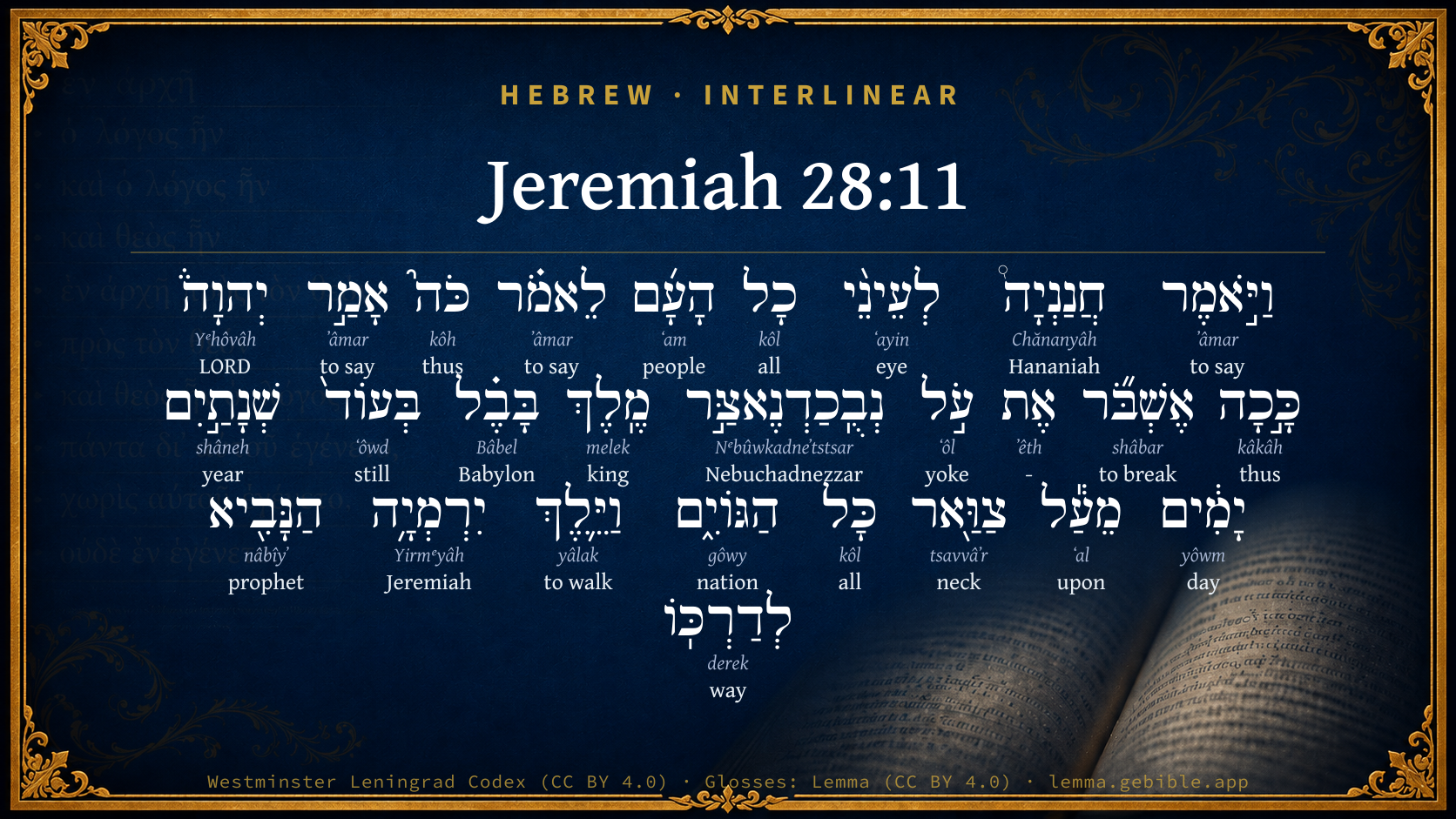
Hebrew (Westminster Leningrad Codex) Jeremiah 28:11 appears in the Hebrew Old Testament. The text above is from the Westminster Leningrad Codex. Each word links to its Strong’s number, a concise gloss, and parsing drawn from the Open Scriptures Hebrew Bible morphology. Click any word for its full Brown-Driver-Briggs (BDB) entry.
Download image
Cite this verse

Jeremiah 28:11 (World English Bible). Public Domain. Lemma interlinear Bible study tool, https://lemma.gebible.app/v/jeremiah/28/11.

Show BibTeX & RIS
BibTeX
RIS
English Translation
Hananiah spoke in the presence of all the people, saying, Thus says Yahweh: Even so will I break the yoke of Nebuchadnezzar king of Babylon within two full years from off the neck of all the nations. The prophet Jeremiah went his way.
World English Bible · Public Domain
Download a study sheet

One document with this verse’s original text, its word-by-word gloss line, the meaning frame, cross-references with their text, attributed commentary, and full source and license credits — printable, and it pastes into notes with its structure intact.

This verse Autodidact and up

Study sheet (.html) Plain text (.txt)

A passage Seminary Student

Up to 50 verses in one chapter. A passage sheet keeps up to 6 commentary sources and 12 cross-references per verse, in the order this page ranks them, and says so on the sheet whenever that leaves anything out. Ask for a single verse and you get the Autodidact verse sheet above.

Everything on this page stays free to read, with no account — the sheet is a download of what is already on screen, not access to it.

Want to remove ads? Support Godless Engineer
Compare translations 3

The same verse in 3 English versions, stacked beneath the original-language interlinear above. Click any original word for its lexicon entry.

Each is an independent rendering of the whole verse — the interlinear is not word-aligned to these translations.

Highlighted words mark where these versions differ — a whole-verse word diff, not a word-by-word alignment.

  • World English Bible Public Domain
    Hananiah spoke in the presence of all the people, saying, Thus says Yahweh: Even so will I break the yoke of Nebuchadnezzar king of Babylon within two full years from off the neck of all the nations. The prophet Jeremiah went his way.
  • King James Version Public Domain
    And Hananiah spake in the presence of all the people, saying, Thus saith the LORD; Even so will I break the yoke of Nebuchadnezzar king of Babylon from the neck of all nations within the space of two full years. And the prophet Jeremiah went his way.
  • unfoldingWord Literal Text CC BY-SA 4.0
    And Hananiah said to the eyes of all the people, saying, “Thus says Yahweh: ‘Like this I will break the yoke of Nebuchadnezzar king of Babylon within two more years of days from upon the neck of all the nations.’” And Jeremiah the prophet went on his way.

unfoldingWord Literal Text — © unfoldingWord, licensed CC BY-SA 4.0. Word-aligned USFM3 via Door43 (git.door43.org/unfoldingWord/en_ult).

Versions to compare (up to 4)

3 of 4 selected

Show all 18 translations

Every available English version of this verse, each an independent rendering of the whole verse.

  • World English Bible Public Domain
    Hananiah spoke in the presence of all the people, saying, Thus says Yahweh: Even so will I break the yoke of Nebuchadnezzar king of Babylon within two full years from off the neck of all the nations. The prophet Jeremiah went his way.
  • Berean Standard Bible Public Domain
    And in the presence of all the people Hananiah proclaimed, “This is what the LORD says: ‘In this way, within two years I will break the yoke of Nebuchadnezzar king of Babylon off the neck of all the nations.’” At this, Jeremiah the prophet went on his way.
  • Majority Standard Bible Public Domain
    And in the presence of all the people Hananiah proclaimed, “This is what the LORD says: ‘In this way, within two years I will break the yoke of Nebuchadnezzar king of Babylon off the neck of all the nations.’” At this, Jeremiah the prophet went on his way.
  • King James Version Public Domain
    And Hananiah spake in the presence of all the people, saying, Thus saith the LORD; Even so will I break the yoke of Nebuchadnezzar king of Babylon from the neck of all nations within the space of two full years. And the prophet Jeremiah went his way.
  • American Standard Version (1901) Public Domain
    And Hananiah spake in the presence of all the people, saying, Thus saith Jehovah: Even so will I break the yoke of Nebuchadnezzar king of Babylon within two full years from off the neck of all the nations. And the prophet Jeremiah went his way.
  • Revised Version (1885) Public Domain
    And Hananiah spake in the presence of all the people, saying, Thus saith the LORD: Even so will I break the yoke of Nebuchadnezzar king of Babylon within two full years from off the neck of all the nations. And the prophet Jeremiah went his way.
  • Geneva Bible (1599) Public Domain
    And Hananiah spake in the presence of all the people, saying, Thus saith the Lord, Euen so will I breake the yoke of Nebuchad-nezzar King of Babel, from the necke of al nations within the space of two yeres: and the Prophet Ieremiah went his way.
  • Douay-Rheims (1899) Public Domain
    And Hananias spoke in the presence of all the people, saying: Thus saith the Lord: Even so will I break the yoke of Nabuchodonosor the king of Babylon after two full years from off the neck of all the nations.
  • Young's Literal Translation Public Domain
    And Hananiah speaketh before the eyes of all the people, saying, `Thus said Jehovah, Thus I break the yoke of Nebuchadnezzar king of Babylon, within two years of days, from off the neck of all the nations;' and Jeremiah the prophet goeth on his way.
  • Literal Standard Version CC BY-SA 4.0
    and Hananiah speaks before the eyes of all the people, saying, “Thus said YHWH: Thus I break the yoke of Nebuchadnezzar king of Babylon, within two years of days, from off the neck of all the nations”; and Jeremiah the prophet goes on his way.
  • Unlocked Literal Bible CC BY-SA 4.0
    Then Hananiah spoke in front of all the people and said, “Yahweh says this: Just like this, within two years I will break from off the neck of every nation the yoke imposed by Nebuchadnezzar king of Babylon.” Then Jeremiah the prophet went on his way.
  • unfoldingWord Literal Text CC BY-SA 4.0
    And Hananiah said to the eyes of all the people, saying, “Thus says Yahweh: ‘Like this I will break the yoke of Nebuchadnezzar king of Babylon within two more years of days from upon the neck of all the nations.’” And Jeremiah the prophet went on his way.
  • Darby Bible Public Domain
    And Hananiah spoke in the presence of all the people, saying, Thus saith Jehovah: So will I break the yoke of Nebuchadnezzar the king of Babylon within two full years from off the neck of all the nations. And the prophet Jeremiah went his way.
  • World Messianic Bible Public Domain
    Hananiah spoke in the presence of all the people, saying, “The LORD says: ‘Even so I will break the yoke of Nebuchadnezzar king of Babylon from off the neck of all the nations within two full years.’” Then the prophet Jeremiah went his way.
  • Webster's Bible Public Domain
    And Hananiah spoke in the presence of all the people, saying, Thus saith the LORD; Even so will I break the yoke of Nebuchadnezzar king of Babylon from the neck of all nations within the space of two full years. And the prophet Jeremiah went his way.
  • Free Bible Version CC BY-SA 4.0
    Hananiah announced in front of everyone, “This is what the Lord says: Just like this, before two years have passed I will break the yoke of Nebuchadnezzar king of Babylon from the neck of all the nations.” Jeremiah the prophet left.
  • Bible in Basic English Public Domain
    And before all the people Hananiah said, The Lord has said, Even so will I let the yoke of the king of Babylon be broken off the necks of all the nations in the space of two years. Then the prophet Jeremiah went away.
  • JPS Tanakh (1917) Public Domain
    And Hananiah spoke in the presence of all the people, saying: 'Thus saith the LORD: Even so will I break the yoke of Nebuchadnezzar king of Babylon from off the neck of all the nations within two full years.' And the prophet Jeremiah went his way.

Literal Standard Version (2020), Covenant Press — licensed CC BY-SA 4.0. Text via the HelloAO Bible API (eBible.org). Unlocked Literal Bible (unfoldingWord) — licensed CC BY-SA 4.0. Text via the HelloAO Bible API (eBible.org). unfoldingWord Literal Text — © unfoldingWord, licensed CC BY-SA 4.0. Word-aligned USFM3 via Door43 (git.door43.org/unfoldingWord/en_ult). Free Bible Version, Dr. Jonathan Gallagher — licensed CC BY-SA 4.0. Text via the HelloAO Bible API (eBible.org).

Word by word

More ways to search: Search by grammar → Find every occurrence → Compare this word →

Practice this passage: Drill this verse → Learn its vocabulary →

חֲנַנְיָה֩
Chănanyâh
H2608
“Hananiah”
Noun, Proper
Part of Speech
Noun
Type
Proper
Full BDB Definition

Origin: from H2603 and H3050

TWOT: None

Hananiah = "God has favoured" - one of the 14 sons of Heman and chief of the 16th course - a general in the army of King Uzziah - father of Zedekiah in the time of Jehoiakim - son of Azur, a Benjamite of Gibeon and a false prophet in the reign of Zedekiah king of Judah - grandfather of Irijah, the captain of the ward at the gate of Benjamin who arrested Jeremiah on the charge of deserting to the Chaldeans - a head of a Benjamite house - son of Zerubbabel from whom Christ derived His descent also called 'Joanna' by Luke - one of the sons of Bebai who returned with Ezra from Babylon - a priest, one of the makers of the sacred ointments and incense, who built a portion of the wall of Jerusalem in the days of Nehemiah - head of the priestly course of Jeremiah in the days of Joiakim - ruler of the palace at Jerusalem under Nehemiah and also, along with Hanani, the Tirshatha's brother, entrusted with the arrangements of guarding the gates of Jerusalem - Two post exilic Israelites
  1. וַיֹּ֣אמֶר ʼâmar H559 “and · to say” Conjunction + Verb, Qal, Sequential Imperfect, 3rd Person, Masculine, Singular
  2. לְעֵינֵ֨י ʻayin H5869 “to/for · eyes of” Preposition + Noun, Common, Both, Dual, Construct
  3. כָל kôl H3605 “all of” Noun, Common, Masculine, Singular, Construct
  4. הָעָ֜ם ʻam H5971 “the · people” Particle, Definite Article + Noun, Common, Masculine, Singular, Absolute
  5. לֵאמֹ֗ר ʼâmar H559 “to say” Preposition + Verb, Qal, Infinitive Construct
  6. כֹּה֮ kôh H3541 “thus” Adverb
  7. אָמַ֣ר ʼâmar H559 “to say” Verb, Qal, Perfect, 3rd Person, Masculine, Singular
  8. יְהוָה֒ Yᵉhôvâh H3068 “LORD” Noun, Proper
  9. כָּ֣כָה kâkâh H3602 “thus” Adverb
  10. אֶשְׁבֹּ֞ר shâbar H7665 “to break” Verb, Qal, Imperfect, 1st Person, Common, Singular
  11. אֶת ʼêth H853 “-” Particle, Direct Object
  12. עֹ֣ל ʻôl H5923 “yoke of” Noun, Common, Masculine, Singular, Construct
  13. נְבֻֽכַדְנֶאצַּ֣ר Nᵉbûwkadneʼtstsar H5019 “Nebuchadnezzar” Noun, Proper
  14. מֶֽלֶךְ melek H4428 “king of” Noun, Common, Masculine, Singular, Construct
  15. בָּבֶ֗ל Bâbel H894 “Babylon” Noun, Proper
  16. בְּעוֹד֙ ʻôwd H5750 “in/at · still” Preposition + Adverb
  17. שְׁנָתַ֣יִם shâneh H8141 “years” Noun, Common, Feminine, Dual, Absolute
  18. יָמִ֔ים yôwm H3117 “days” Noun, Common, Masculine, Plural, Absolute
  19. מֵעַ֕ל ʻal H5921 “from · upon” Preposition + Preposition
  20. צַוַּ֖אר tsavvâʼr H6677 “neck of” Noun, Common, Masculine, Singular, Construct
  21. כָּל kôl H3605 “all of” Noun, Common, Masculine, Singular, Construct
  22. הַגּוֹיִ֑ם gôwy H1471 “the · nations” Particle, Definite Article + Noun, Common, Masculine, Plural, Absolute
  23. וַיֵּ֛לֶךְ yâlak H3212 “and · to walk” Conjunction + Verb, Qal, Sequential Imperfect, 3rd Person, Masculine, Singular
  24. יִרְמְיָ֥ה Yirmᵉyâh H3414 “Jeremiah” Noun, Proper
  25. הַנָּבִ֖יא nâbîyʼ H5030 “the · prophet” Particle, Definite Article + Noun, Common, Masculine, Singular, Absolute
  26. לְדַרְכּֽוֹ derek H1870 “to/for · way · his” Preposition + Noun, Common, Both, Singular, Construct + Suffix, Personal, 3rd Person, Masculine, Singular

About this verse

These counts appear in no published source. They are computed here, from the morphology-tagged text and Lemma’s own curated glosses. What Lemma adds →

27
words
24
distinct lemmas
Prophets
section

Shared distinctive vocabulary

חֲנַנְיָה֩ Hananiah H2608 occurs in 28 verses of the Hebrew Bible. Also found in:

Grammatical profile

  • 5 verbs
  • 17 nouns
  • 1 preposition
  • 3 adverbs
  • 1 particle

Verb forms

  • וַיֹּ֣אמֶר Qal · Sequential Imperfect
  • לֵאמֹ֗ר Qal · Infinitive Construct
  • אָמַ֣ר Qal · Perfect
  • אֶשְׁבֹּ֞ר Qal · Imperfect
  • וַיֵּ֛לֶךְ Qal · Sequential Imperfect

Repetition

Words recur within this verse — often emphatic in Hebrew:

  • וַיֹּ֣אמֶר to say H559 ×3
  • כָל all H3605 ×2

Hebrew & Septuagint length

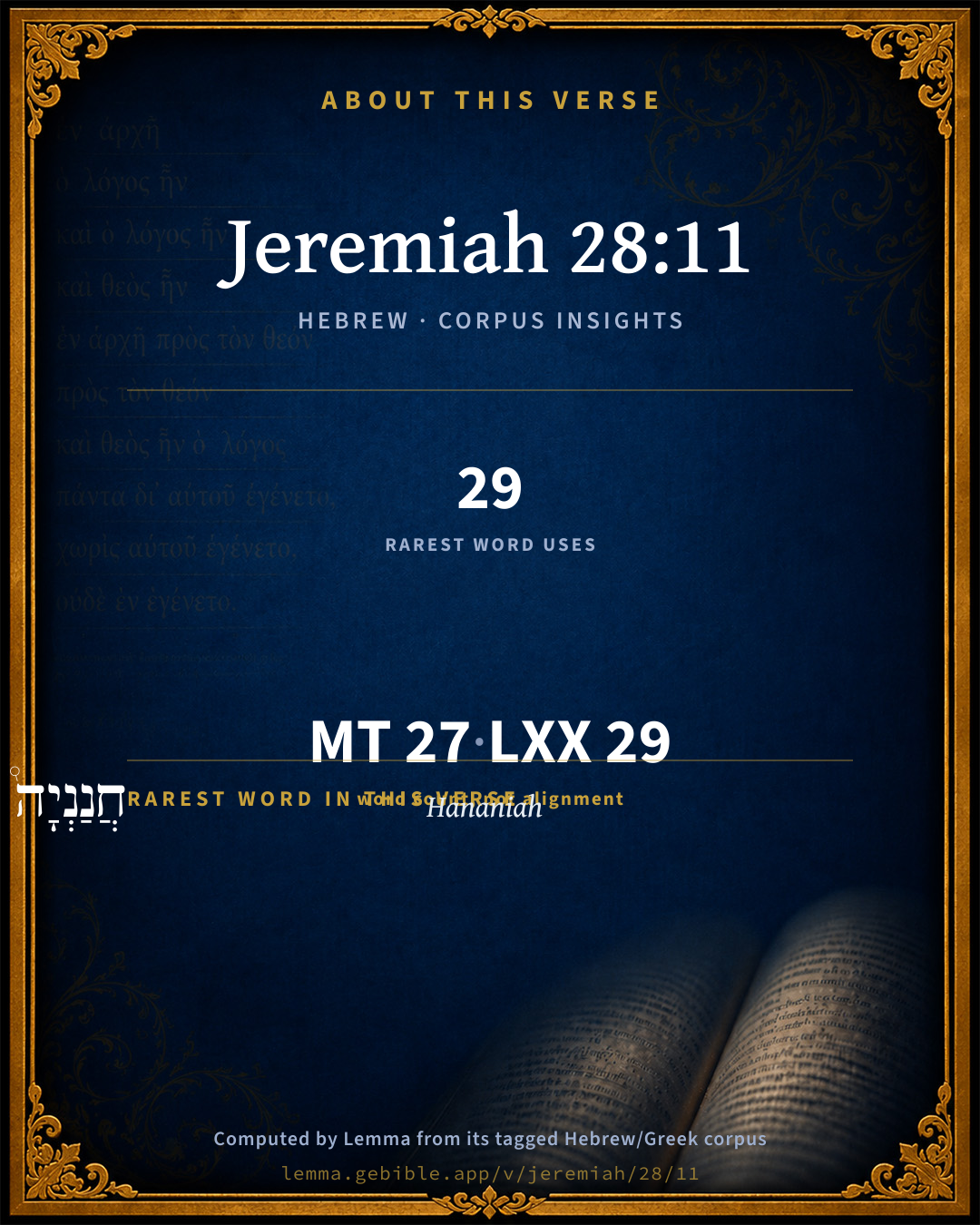
In the original languages it is 27 Hebrew tokens and 29 Greek tokens — but the two are counted differently (Hebrew bundles its prefixes and suffixes into one token; the Greek is in lemma form), so that isn’t a like-for-like length.

Cross-references

11

Topical passages linked to Jeremiah 28:11 in the Treasury of Scripture Knowledge — connected by theme and wording, ordered by reader-vote popularity; previews shown in the World English Bible.

  • 2 Chronicles 18:22–23 Now therefore, behold, Yahweh has put a lying spirit in the mouth of these your prophets; and Yahweh has spoken evil concerning you.
  • Proverbs 14:7 Stay away from a foolish man, For you won't find knowledge on his lips.
  • 1 Kings 22:11–12 Zedekiah the son of Chenaanah made him horns of iron, and said, Thus says Yahweh, With these shall you push the Syrians, until they be consumed.
  • Jeremiah 14:14 Then Yahweh said to me, The prophets prophesy lies in my name; I didn't send them, neither have I commanded them, neither spoke I to them: they prophesy to you a lying vision, and divination, and a thing of nothing, and the deceit of their own heart.
  • Jeremiah 27:2–12 Thus says Yahweh to me: Make you bonds and bars, and put them on your neck;
  • Jeremiah 29:9 For they prophesy falsely to you in my name: I have not sent them, says Yahweh.
  • 1 Kings 13:18 He said to him, I also am a prophet as you are; and an angel spoke to me by the word of Yahweh, saying, Bring him back with you into your house, that he may eat bread and drink water. [But] he lied to him.
  • 1 Kings 22:6 Then the king of Israel gathered the prophets together, about four hundred men, and said to them, Shall I go against Ramoth-gilead to battle, or shall I forbear? They said, Go up; for the Lord will deliver it into the hand of the king.
  • 2 Chronicles 18:10 Zedekiah the son of Chenaanah made him horns of iron, and said, Thus says Yahweh, With these shall you push the Syrians, until they be consumed.
  • Jeremiah 23:17 They say continually to those who despise me, Yahweh has said, You shall have peace; and to everyone who walks in the stubbornness of his own heart they say, No evil shall come on you.
  • Jeremiah 28:2–4 Thus speaks Yahweh of Hosts, the God of Israel, saying, I have broken the yoke of the king of Babylon.

Cross-references courtesy of OpenBible.info (CC BY 4.0).

Hebrew and Greek witnesses Masoretic Hebrew ↔ Greek Septuagint

The same verse in the two great witnesses to the Old Testament, shown verse-for-verse.

These are two independent witnesses, not word-aligned to each other, and the Septuagint is shown in lemma (dictionary) form.

Hebrew Jeremiah 28:11 Masoretic · Westminster Leningrad Codex

וַיֹּ֣אמֶר חֲנַנְיָה֩ לְעֵינֵ֨י כָל הָעָ֜ם לֵאמֹ֗ר כֹּה֮ אָמַ֣ר יְהוָה֒ כָּ֣כָה אֶשְׁבֹּ֞ר אֶת עֹ֣ל נְבֻֽכַדְנֶאצַּ֣ר מֶֽלֶךְ בָּבֶ֗ל בְּעוֹד֙ שְׁנָתַ֣יִם יָמִ֔ים מֵעַ֕ל צַוַּ֖אר כָּל הַגּוֹיִ֑ם וַיֵּ֛לֶךְ יִרְמְיָ֥ה הַנָּבִ֖יא לְדַרְכּֽוֹ

Hananiah spoke in the presence of all the people, saying, Thus says Yahweh: Even so will I break the yoke of Nebuchadnezzar king of Babylon within two full years from off the neck of all the nations. The prophet Jeremiah went his way.

World English Bible · Public Domain

Greek LXX Structure differs

In the Septuagint, Jeremiah is about an eighth shorter than the Hebrew and arranges its material differently — the Oracles Against the Nations (Hebrew chapters 46–51) appear in the middle of the Greek book, after 25:13. Because the chapter and verse boundaries do not line up, a verse-for-verse comparison with the Hebrew is not shown.

A verse-for-verse comparison isn’t shown here because the chapters and verses don’t line up. Switch to the LXX edition with the MT / LXX toggle above to read the Greek directly.

Hebrew: Westminster Leningrad Codex (CC BY 4.0). Greek: Septuagint (public domain); English from a public-domain English Septuagint. How the Septuagint differs from the Hebrew →

Targum (Aramaic paraphrase)

1

The Targum is the ancient Jewish Aramaic paraphrase of the Hebrew Scriptures — an interpretive translation, not the Hebrew text itself. Onkelos (literal) and Pseudo-Jonathan (expansive) render the Torah, and Jonathan the Prophets. Coverage is partial: where no permissively-licensed English translation exists for a verse, only the Aramaic is shown. This is verse-level text, not a word-by-word alignment to the Hebrew.

  1. Targum Jonathan Prophets (Joshua–Malachi)
    וַאֲמַר חֲנַנְיָה לְעֵינֵי כָל עַמָא לְמֵימַר כִּדְנַן אֲמַר יְיָ כְּדֵין אִתְּבַר יַת נִיר נְבוּכַדְנֶאצַר מַלְכָּא דְבָבֶל בְּסוֹף תַּרְתֵּין שְׁנִין מֵעַל צַוַר כָּל עַמְמַיָא וַאֲזֵל יִרְמְיָה נְבִיָא לְאוֹרְחֵיהּ:

    (no public-domain English translation for this verse)

    Targum Jonathan — Aramaic: “Mikraot Gedolot” (public domain). English: “Sefaria Community Translation” (CC0 1.0 (public-domain dedication)); “London "Chaldee Paraphrase," 1871” (public domain). Text via Sefaria.

Commentary

Notes on Jeremiah 28:11 from classic Christian and Jewish commentators (each source and its license shown beneath its notes). The classic Christian expositions comment on the surrounding passage and are grouped to its opening verse, so a note may address several verses; the Jewish commentaries on the Tanakh (Rashi and others) are per-verse, so they appear only where the commentator wrote on this verse.

Lemma curates 59 commentaries, every one of them public domain or Creative Commons licensed, each selected and text-cleaned for this edition rather than reprinted as found. About our sources →

Trapp's Complete Commentary

John Trapp

Jer 28:11 And Hananiah spake in the presence of all the people, saying, Thus saith the LORD; Even so will I break the yoke of Nebuchadnezzar king of Babylon from the neck of all nations within the space of two full years. And the prophet Jeremiah went his way.

Ver. 11. And Hananiah spake in the presence of all the people.] This was prophet like indeed, first to teach by a sign, and then to show the sense of it. But what maketh a parable in a fool’s mouth? {Pro 26:7} Excellent speech becometh not a fool. {Pro 17:7} The people of Rome sware to Carbo that they would not believe him though he sware; so should this people have dealt by Hananiah.

And the prophet went his way.] As weary and sorry to hear and see such gross illusions: haud dubium factus ridicule omni populo praesenti; { a} being well laughed at, no doubt, by the seduced people. But he had been well inured to bear their buffooneries; besides that, the bird in his bosom sang sweetly, Conscia mens recti famae mendacia ridet. He went his way, saith one, as shunning contention, and providing for edification, which is not attained to by brawling and bitterness.

{a} Oecolamp.

John Trapp, A Commentary or Exposition upon All the Books of the Old and New Testament (1647–1656) — public domain. Text from a community e-Sword module.

The Biblical Illustrator

Joseph S. Exell

Jer_28:11

And the prophet Jeremiah went his way.

Self in service

(with Jer_26:14):--We couple these passages together, because they lead our minds to the same important thought, namely, the laying aside of self by the servants of the Lord. Hananiah takes the yoke from off Jeremiah s neck, and breaks it, and so discredits him and his prophecy in the presence of the people. And the prophet Jeremiah went his way. He left it to God to vindicate His own honour, which He did very soon--very terribly. Before the princes also, in chap. 26., he tells out uncompromisingly all the truth of God; he knew that he did so at the peril of his life. As for me,--he was not insensible to personal suffering, still himself he was as nothing--behold I am in your hand, do with me as seemeth meet unto you. By this complete abnegation of self on the part of the prophet, we are led to consider some matters connected with self in our service. There is a young period in the Christians life, when we are deceived by not seeing self at all; when we have no dread of it; when we never even suspect its existence. At this time, we mistake its energies for spiritual life, and often seek to carry out what is really the Lords work, in the powers and energies of the flesh, i.e. self. There is a period farther on, when we detect self partially. The Spirit of God has led us onward in our education, and raised our standard, making us watchful and distrustful of self to some degree. Then comes a yet more advanced stage, when we see self to such an extent as to make us dread it greatly when we see it ever intrusive, ever substituting motives low and mean for what should be holy and high; and we wage war with this self, fully determined to put it down. There is also yet a more advanced state, when we have attained such a knowledge of the power of self that, while we war with, and repress it, we have come to know that here we shall never have done with it, and look forward to full deliverance only when we reach that land where there is perfect freedom.

I. The wrong operations of self in service. Much that we do may be done from the action of mere natural feelings--there may be nothing of God in it at all A man may be gratifying only his own natural energy in all that seems so earnest and true. And when we allow self to influence us, we shall be subjected to disturbing influences. Self-love will be easily wounded in the rough contact with opposers of the truth. And our judgment will be warped. It is very hard to be calm, and judicial, when under the influence of strong personal feelings, and where personal interests are concerned. Self will also drive us on too far. We shall not know when to go our way. We need not go far to detect some of the evil effects which flow from this wrong operation of self in service. It gives the enemy occasion to blaspheme. Satan continually attempts to confound persons and principles; men will look at the imperfect way in which we have manifested the principle, and not at the principle itself. Our infirmities become mixed up with the cause of God, and so far as they can, bring it into disrepute. And thus that saying becomes true--religion suffers more from her friends than her enemies.

II. The expulsion of self from service. How can this be done? In the most favourable of cases only by degrees. But what is a man to do?

1. He must seek for enlightenment on this subject from the Holy Spirit.

2. Let him seek for a more perfect sympathy with Christ. If we have this, we shall become assimilated with Him--we shall grow like Him; His mind will transfuse itself into our mind--and the principles, on which He acted, will become ours.

3. And then the seeking for a true knowledge of our own insignificance is very important in putting down self. We both think and act sometimes as though we were the first cause; and not only the first cause, but the final object also--as if all were to be by us, and for us--the axe thinks that it is doing all the work, and is independent of the one that heweth therewith. The very learning our insignificance will be helpful; and, when we have learned it in some degree, it will keep us, in proportion as the lesson has been learned, to our proper place. (P. B. Power, M. A.)

The Biblical Illustrator, edited by Joseph S. Exell (c. 1880s–1900s) — public domain. Text from a community e-Sword module.

Jamieson, Fausset & Brown

Robert Jamieson, A. R. Fausset & David Brown

neck of all nations--opposed to Jer 27:7.

Jamieson, Fausset & Brown — Commentary Critical and Explanatory on the Whole Bible (1871) — public domain (CC PDM 1.0). Text via the HelloAO Bible API.

John Calvin's Commentaries

We must also notice how craftily this impostor insinuated himself; for he seemed to imitate the true prophets of God, for he set a sign before the people, and then added a doctrine. The Papists have their empty signs, but they only delight the eyes, while yet they have no care nor concern for the ears. But Hananiah came still nearer to God’s servants, so that he might deceive even those who were not stupid. What, indeed, could we desire more in this man than that he should set forth a sign? He also added the name of God and declared what was his purpose, in this manner will I break the yoke of Nebuchadnezzar: nor did he speak in his own name, but assumed the person of God, Thus saith Jehovah, I will break the yoke of Nebuchadnezzar.

But as we have elsewhere said, this preposterous imitation of the devil ought not to disturb pious minds; for God ever supplies his own people with the spirit of discernment, provided they humbly pray to him. And therefore whenever Jeremiah repeated the word prophet, which he conceded to Hananiah, as he assumed it himself, for whenever he spoke of Hananiah, he honored him with this name, even that he was a prophet, — the holy man was not ignorant what an occasion of offense it was, when a prophet, who is so acknowledged in the Church of God, is yet the minister of Satan, a liar and an impostor. But his object was to warn us in due time, lest novelty should frighten us when any boasts of the title of a prophet. So the Papists brag that they are prelates and bishops, and boast that they are the successors of the Apostles: but the devil is their chief, who calls himself the Vicar of Christ on the earth. Then Jeremiah designedly called Hananiah so many times a prophet, so that our faith, when any such thing happens to us, may not fail, as though some new thing had taken place. I cannot to-day finish the last part of the verse.

John Calvin's Commentaries (1540-1563) — public domain. Text from the Calvin Translation Society English edition (1840s-50s) via the Christian Classics Ethereal Library (ccel.org). Calvin's coverage is partial (roughly two-thirds of the Bible); uncommented books and verses are honest gaps, never fabricated. The 19th-century editor's footnotes and remarks are omitted so the notes are faithfully Calvin's own voice.

The Cambridge Bible for Schools and Colleges

gen. ed. J. J. S. Perowne

11. And the prophet … went his way] Co., maintaining that Jeremiah could not under the circumstances have been silent, rejects these words but Du. rightly pleads for their retention as entirely consonant with the dignity and nobility of Jeremiah’s character. Co. considers them as inserted by a later hand and suggested by “go and tell” of Jer_28:13.

The Cambridge Bible for Schools and Colleges (gen. ed. J. J. S. Perowne; Cambridge University Press, 1878–1918) — public domain. Text from a community e-Sword module.

John Gill's Exposition

And Hananiah spoke in the presence of all the people,.... Explaining to them his meaning, in taking the yoke, and breaking it:

saying, thus saith the Lord; wickedly making use of the Lord's name, to give countenance to his words and actions:

even so will I break the yoke of Nebuchadnezzar king of Babylon from the neck of all nations, within the space of two full years; the time he had fixed for the bringing back of the vessels of the sanctuary, Jer 28:3;

and the prophet Jeremiah went his way; showing thereby his dissent from him, and his dislike and detestation of his lies and blasphemies; patiently bearing his affronts and insolence; and prudently withdrawing to prevent riots and tumults; returning no answer till he had received one from the Lord himself, which he quickly had.

John Gill's Exposition of the Whole Bible (1746–1763) — public domain (CC PDM 1.0). Text via the HelloAO Bible API.

Matthew Poole's English Annotations

As God hath his sacraments to confirm the truth of his word, of which his ministers are the stewards and administrators; so the devil hath his sacraments, of which his prophets are the administrators. God by his prophet Jeremiah had revealed his will as to the king of Babylon’s success against many nations, and bringing them into his servitude; as a sacrament or sign of this, he had commanded Jeremiah to put on a yoke with bonds. Hananiah, the false prophet, cometh in the name of God, and declares the contrary, that within two years God would break the yoke of the king of Babylon, and free the nations in subjection to him; and as a sacrament or sign to gain credit to this falsehood, he plucks off Jeremiah’s yoke, and breaks it, and expounds himself that God should so break the king of Babylon’s yoke from the neck of all nations, and pretends he had a commission from God to say this. Jeremiah, not able to endure to hear such lies, goeth away in testimony of his dissent from him, and adherence to what he had said.

Matthew Poole's English Annotations on the Holy Bible (1683–1685) — public domain. Text from a community e-Sword/MySword module.

Lesson kit

Teaching starters — assembled from the data on this page, not authored interpretation. Every prompt links to the verse data it draws on. Edit before teaching.

Jeremiah, in the Prophets, opens this verse with 27 words (24 distinct Hebrew lemmas). Its most distinctive word is Chănanyâh (“Hananiah”). A historical commentator’s framing appears above. Read the whole chapter for the surrounding context.

Discussion questions

  1. The word Chănanyâh carries the sense “Hananiah.” How does it shape the verse?
  2. How does 1 Chronicles 3:19, which shares the word «Hananiah», read alongside this verse?
  3. What does the repetition of “to say” (3× in this one verse) do in this verse?
  4. The translations on this page render this verse differently — a whole-verse word diff, not a word-by-word alignment. What might account for the different wordings?
  5. «וַיֹּ֣אמֶר» is a Qal Sequential Imperfect verb. How does that grammatical form shape the action described?
  6. Compare how Trapp's Complete Commentary and The Biblical Illustrator read this verse. Where do they agree or differ?

Things to notice

Reading settings

Reading text

Shown beneath each verse's original-language words.

Old Testament
Old Testament edition

Read the OT as the Masoretic Hebrew (MT) or the Greek Septuagint (LXX).

English shown for the Greek Septuagint (in the Hebrew ↔ Greek comparison).

Comparing translations? Open the Compare panel on any verse page to stack up to four side by side.