
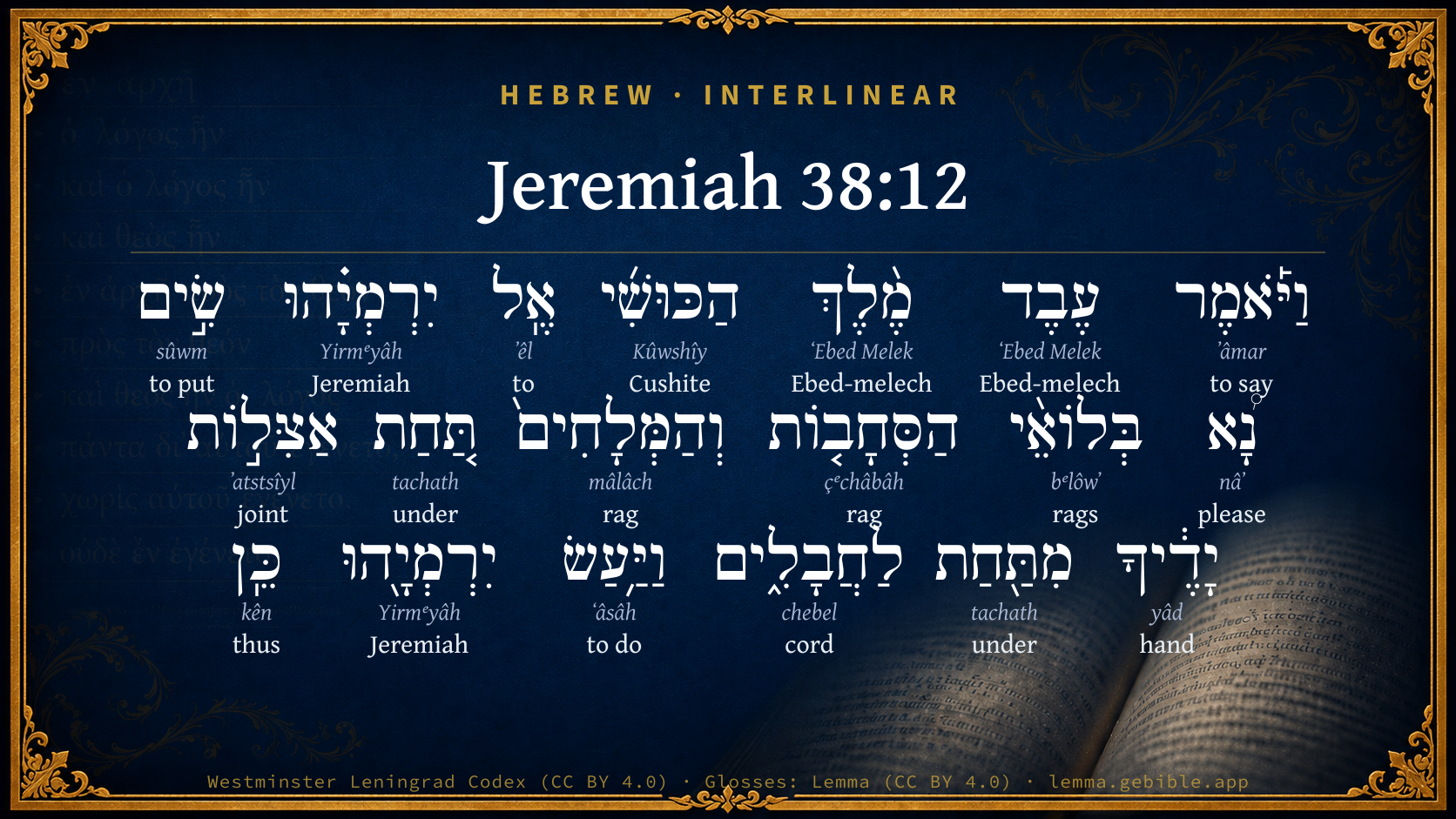
Jeremiah 38:12

Hebrew (Westminster Leningrad Codex) Jeremiah 38:12 appears in the Hebrew Old Testament. The text above is from the Westminster Leningrad Codex. Each word links to its Strong’s number, a concise gloss, and parsing drawn from the Open Scriptures Hebrew Bible morphology. Click any word for its full Brown-Driver-Briggs (BDB) entry.
Download image
Cite this verse

Jeremiah 38:12 (World English Bible). Public Domain. Lemma interlinear Bible study tool, https://lemma.gebible.app/v/jeremiah/38/12.

Show BibTeX & RIS
BibTeX
RIS
English Translation
Ebedmelech the Ethiopian said to Jeremiah, Put now these rags and worn-out garments under your armholes under the cords. Jeremiah did so.
World English Bible · Public Domain
Highlights
  • 1 first appearance in the Hebrew Bible
Full analysis ↓
Download a study sheet

One document with this verse’s original text, its word-by-word gloss line, the meaning frame, cross-references with their text, attributed commentary, and full source and license credits — printable, and it pastes into notes with its structure intact.

This verse Autodidact and up

Study sheet (.html) Plain text (.txt)

A passage Seminary Student

Up to 50 verses in one chapter. A passage sheet keeps up to 6 commentary sources and 12 cross-references per verse, in the order this page ranks them, and says so on the sheet whenever that leaves anything out. Ask for a single verse and you get the Autodidact verse sheet above.

Everything on this page stays free to read, with no account — the sheet is a download of what is already on screen, not access to it.

Want to remove ads? Support Godless Engineer
Compare translations 3

The same verse in 3 English versions, stacked beneath the original-language interlinear above. Click any original word for its lexicon entry.

Each is an independent rendering of the whole verse — the interlinear is not word-aligned to these translations.

Highlighted words mark where these versions differ — a whole-verse word diff, not a word-by-word alignment.

  • World English Bible Public Domain
    Ebedmelech the Ethiopian said to Jeremiah, Put now these rags and worn-out garments under your armholes under the cords. Jeremiah did so.
  • King James Version Public Domain
    And Ebedmelech the Ethiopian said unto Jeremiah, Put now these old cast clouts and rotten rags under thine armholes under the cords. And Jeremiah did so.
  • unfoldingWord Literal Text CC BY-SA 4.0
    Ebed-Melek the Cushite said to Jeremiah, “Put the rags and worn-out clothing under your arms and on top of the ropes.” So Jeremiah did so.

unfoldingWord Literal Text — © unfoldingWord, licensed CC BY-SA 4.0. Word-aligned USFM3 via Door43 (git.door43.org/unfoldingWord/en_ult).

Versions to compare (up to 4)

3 of 4 selected

Show all 18 translations

Every available English version of this verse, each an independent rendering of the whole verse.

  • World English Bible Public Domain
    Ebedmelech the Ethiopian said to Jeremiah, Put now these rags and worn-out garments under your armholes under the cords. Jeremiah did so.
  • Berean Standard Bible Public Domain
    Ebed-melech the Cushite cried out to Jeremiah, “Put these worn-out rags and clothes under your arms to pad the ropes.” Jeremiah did so,
  • Majority Standard Bible Public Domain
    Ebed-melech the Cushite cried out to Jeremiah, “Put these worn-out rags and clothes under your arms to pad the ropes.” Jeremiah did so,
  • King James Version Public Domain
    And Ebedmelech the Ethiopian said unto Jeremiah, Put now these old cast clouts and rotten rags under thine armholes under the cords. And Jeremiah did so.
  • American Standard Version (1901) Public Domain
    And Ebed-melech the Ethiopian said unto Jeremiah, Put now these rags and worn-out garments under thine armholes under the cords. And Jeremiah did so.
  • Revised Version (1885) Public Domain
    And Ebed-melech the Ethiopian said unto Jeremiah, Put now these old cast clouts and rotten rags under thine armholes under the cords. And Jeremiah did so.
  • Geneva Bible (1599) Public Domain
    And Ebed-melech the blacke More sayde vnto Ieremiah, Put now these olde rotten ragges and worne, vnder thine arme holes, betweene the coards. And Ieremiah did so.
  • Douay-Rheims (1899) Public Domain
    And Abdemelech the Ethiopian said to Jeremias: Put these old rags and these rent and rotten things under thy arms, and upon the cords: and Jeremias did so.
  • Young's Literal Translation Public Domain
    And Ebed-Melech the Cushite saith unto Jeremiah, `Put, I pray thee, the worn-out clouts and rags under thine arm-holes, at the place of the cords,' and Jeremiah doth so,
  • Literal Standard Version CC BY-SA 4.0
    And Ebed-Melech the Cushite says to Jeremiah, “Now put the worn-out pieces of cloth and rags under your arms, at the place of the cords,” and Jeremiah does so,
  • Unlocked Literal Bible CC BY-SA 4.0
    Ebed-Melek the Cushite said to Jeremiah, “Put the rags and worn-out clothing under your arms and on top of the ropes.” So Jeremiah did so.
  • unfoldingWord Literal Text CC BY-SA 4.0
    Ebed-Melek the Cushite said to Jeremiah, “Put the rags and worn-out clothing under your arms and on top of the ropes.” So Jeremiah did so.
  • Darby Bible Public Domain
    And Ebed-melech the Ethiopian said to Jeremiah, Put, I pray, [these] old shreds and rags under thine armholes under the cords. And Jeremiah did so.
  • World Messianic Bible Public Domain
    Ebedmelech the Ethiopian said to Jeremiah, “Now put these rags and worn-out garments under your armpits under the cords.” Jeremiah did so.
  • Webster's Bible Public Domain
    And Ebed-melech the Cushite said to Jeremiah, Put now these old cast clouts and decayed rags under thy arm-holes under the cords. And Jeremiah did so.
  • Free Bible Version CC BY-SA 4.0
    Ebed-melech the Cushite called down to Jeremiah, “Put these rags and old clothes under your arms to protect you from the ropes.” Jeremiah did so,
  • Bible in Basic English Public Domain
    And Ebed-melech the Ethiopian said to Jeremiah, Put these bits of old cloth under your arms under the cords. And Jeremiah did so.
  • JPS Tanakh (1917) Public Domain
    And Ebed-melech the Ethiopian said unto Jeremiah: 'Put now these worn clouts and rags under thine armholes under the cords.' And Jeremiah did so.

Literal Standard Version (2020), Covenant Press — licensed CC BY-SA 4.0. Text via the HelloAO Bible API (eBible.org). Unlocked Literal Bible (unfoldingWord) — licensed CC BY-SA 4.0. Text via the HelloAO Bible API (eBible.org). unfoldingWord Literal Text — © unfoldingWord, licensed CC BY-SA 4.0. Word-aligned USFM3 via Door43 (git.door43.org/unfoldingWord/en_ult). Free Bible Version, Dr. Jonathan Gallagher — licensed CC BY-SA 4.0. Text via the HelloAO Bible API (eBible.org).

Word by word

More ways to search: Search by grammar → Find every occurrence → Compare this word →

Practice this passage: Drill this verse → Learn its vocabulary →

וְהַמְּלָחִים֙
mâlâch
H4418
“and · the · rags”
Conjunction + Particle, Definite Article + Noun, Common, Masculine, Plural, Absolute
Part of Speech
Conjunction + Particle + Noun
Type
Common
Gender
Masculine
Number
Plural
State
Absolute
Full BDB Definition

Origin: from H4414 in its original sense

TWOT: 1196a

rag
  1. וַיֹּ֡אמֶר ʼâmar H559 “and · to say” Conjunction + Verb, Qal, Sequential Imperfect, 3rd Person, Masculine, Singular
  2. עֶבֶד ʻEbed Melek H5663 “Ebed-melech” Noun, Proper
  3. מֶ֨לֶךְ ʻEbed Melek H5663 “Ebed-melech” Noun, Proper
  4. הַכּוּשִׁ֜י Kûwshîy H3569 “the · Cushite” Particle, Definite Article + Noun, Gentilic, Masculine, Singular, Absolute
  5. אֶֽל ʼêl H413 “to” Preposition
  6. יִרְמְיָ֗הוּ Yirmᵉyâh H3414 “Jeremiah” Noun, Proper
  7. שִׂ֣ים sûwm H7760 “put” Verb, Qal, Imperative, 2nd Person, Masculine, Singular
  8. נָ֠א nâʼ H4994 “please” Particle, Exhortation
  9. בְּלוֹאֵ֨י bᵉlôwʼ H1094 “rags of” Noun, Common, Masculine, Plural, Construct
  10. הַסְּחָב֤וֹת çᵉchâbâh H5499 “the · rags” Particle, Definite Article + Noun, Common, Feminine, Plural, Absolute
  11. תַּ֚חַת tachath H8478 “under” Preposition
  12. אַצִּל֣וֹת ʼatstsîyl H679 “joints of” Noun, Common, Feminine, Plural, Construct
  13. יָדֶ֔יךָ yâd H3027 “hands · your” Noun, Common, Both, Dual, Construct + Suffix, Personal, 2nd Person, Masculine, Singular
  14. מִתַּ֖חַת tachath H8478 “from · under” Preposition + Preposition
  15. לַחֲבָלִ֑ים chebel H2256 “to/for · cords” Preposition + Noun, Common, Both, Plural, Absolute
  16. וַיַּ֥עַשׂ ʻâsâh H6213 “and · to do” Conjunction + Verb, Qal, Sequential Imperfect, 3rd Person, Masculine, Singular
  17. יִרְמְיָ֖הוּ Yirmᵉyâh H3414 “Jeremiah” Noun, Proper
  18. כֵּֽן kên H3651 “thus” Particle, Demonstrative

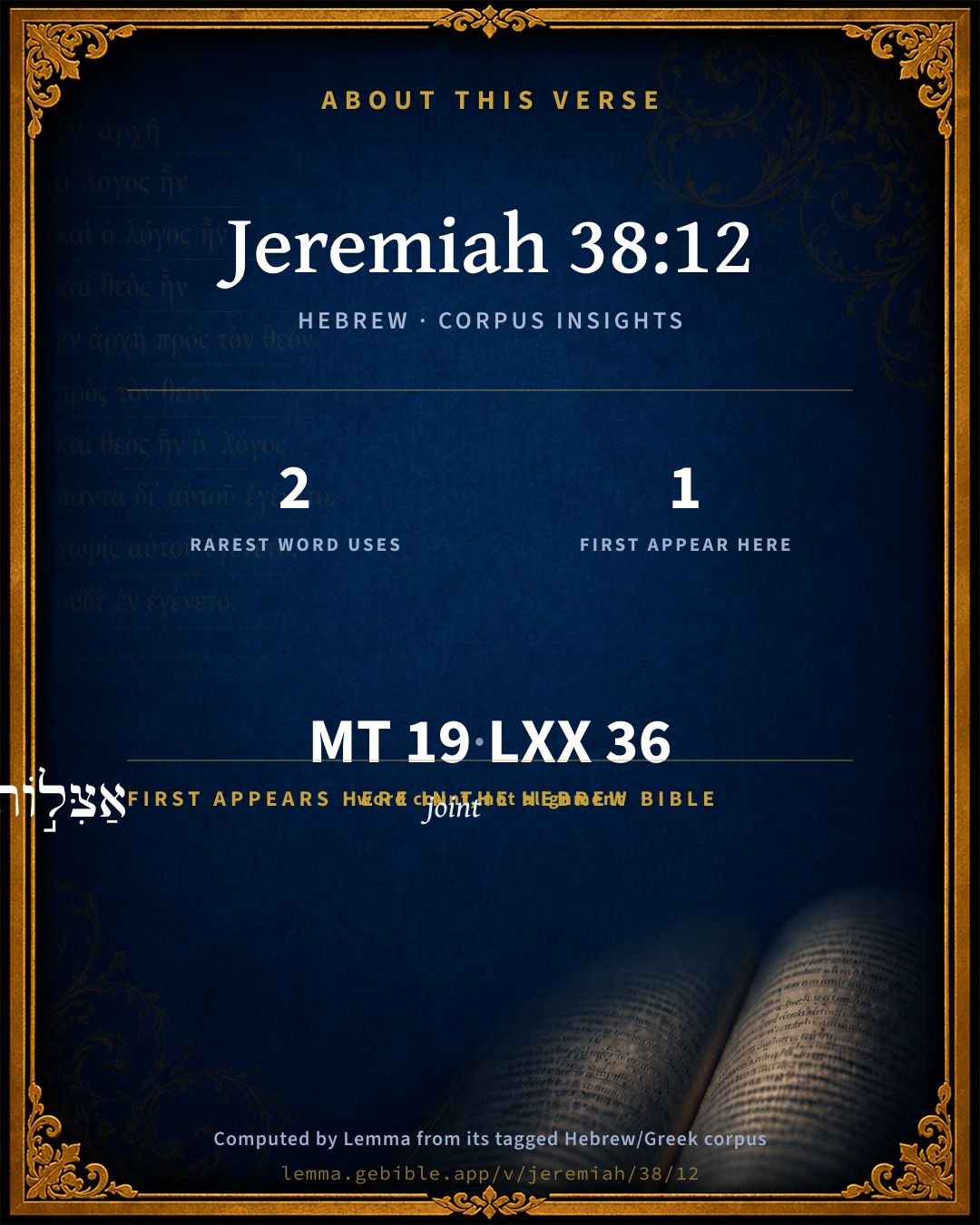
About this verse

These counts appear in no published source. They are computed here, from the morphology-tagged text and Lemma’s own curated glosses. What Lemma adds →

19
words
16
distinct lemmas
Prophets
section

Notable vocabulary

The rarest word here is וְהַמְּלָחִים֙ rag H4418 — appearing just 2 times in the whole Hebrew Bible.

First appearance in Scripture

This word makes its first canonical appearance in the Hebrew Bible here:

  • אַצִּל֣וֹת joint H679

Shared distinctive vocabulary

וְהַמְּלָחִים֙ rag H4418 occurs in 2 verses of the Hebrew Bible. Also found in:

Grammatical profile

  • 3 verbs
  • 11 nouns
  • 3 prepositions
  • 2 particles

Verb forms

  • וַיֹּ֡אמֶר Qal · Sequential Imperfect
  • שִׂ֣ים Qal · Imperative
  • וַיַּ֥עַשׂ Qal · Sequential Imperfect

Repetition

Words recur within this verse — often emphatic in Hebrew:

  • עֶבֶד Ebed-melech H5663 ×2
  • יִרְמְיָ֗הוּ Jeremiah H3414 ×2
  • תַּ֚חַת under H8478 ×2

Hebrew & Septuagint length

In the original languages it is 19 Hebrew tokens and 36 Greek tokens — but the two are counted differently (Hebrew bundles its prefixes and suffixes into one token; the Greek is in lemma form), so that isn’t a like-for-like length.

Cross-references

3

Topical passages linked to Jeremiah 38:12 in the Treasury of Scripture Knowledge — connected by theme and wording, ordered by reader-vote popularity; previews shown in the World English Bible.

  • Romans 12:10 In love of the brothers be tenderly affectionate one to another; in honor preferring one another;
  • Ephesians 4:32 And be kind to one another, tenderhearted, forgiving each other, just as God also in Christ forgave you.
  • Romans 12:15 Rejoice with those who rejoice. Weep with those who weep.

Cross-references courtesy of OpenBible.info (CC BY 4.0).

Hebrew and Greek witnesses Masoretic Hebrew ↔ Greek Septuagint

The same verse in the two great witnesses to the Old Testament, shown verse-for-verse.

These are two independent witnesses, not word-aligned to each other, and the Septuagint is shown in lemma (dictionary) form.

Hebrew Jeremiah 38:12 Masoretic · Westminster Leningrad Codex

וַיֹּ֡אמֶר עֶבֶד מֶ֨לֶךְ הַכּוּשִׁ֜י אֶֽל יִרְמְיָ֗הוּ שִׂ֣ים נָ֠א בְּלוֹאֵ֨י הַסְּחָב֤וֹת וְהַמְּלָחִים֙ תַּ֚חַת אַצִּל֣וֹת יָדֶ֔יךָ מִתַּ֖חַת לַחֲבָלִ֑ים וַיַּ֥עַשׂ יִרְמְיָ֖הוּ כֵּֽן

Ebedmelech the Ethiopian said to Jeremiah, Put now these rags and worn-out garments under your armholes under the cords. Jeremiah did so.

World English Bible · Public Domain

Greek LXX Structure differs

In the Septuagint, Jeremiah is about an eighth shorter than the Hebrew and arranges its material differently — the Oracles Against the Nations (Hebrew chapters 46–51) appear in the middle of the Greek book, after 25:13. Because the chapter and verse boundaries do not line up, a verse-for-verse comparison with the Hebrew is not shown.

A verse-for-verse comparison isn’t shown here because the chapters and verses don’t line up. Switch to the LXX edition with the MT / LXX toggle above to read the Greek directly.

Hebrew: Westminster Leningrad Codex (CC BY 4.0). Greek: Septuagint (public domain); English from a public-domain English Septuagint. How the Septuagint differs from the Hebrew →

Targum (Aramaic paraphrase)

1

The Targum is the ancient Jewish Aramaic paraphrase of the Hebrew Scriptures — an interpretive translation, not the Hebrew text itself. Onkelos (literal) and Pseudo-Jonathan (expansive) render the Torah, and Jonathan the Prophets. Coverage is partial: where no permissively-licensed English translation exists for a verse, only the Aramaic is shown. This is verse-level text, not a word-by-word alignment to the Hebrew.

  1. Targum Jonathan Prophets (Joshua–Malachi)
    וַאֲמַר עַבְדָא דְמַלְכָּא צִדְקִיָה לְיִרְמְיָה שַׁוֵי כְעַן בְּלָאֵי טַפְסָן וְשַׁחְקָן תְּחוֹת (מַדְבְּקֵי) יְדָךְ מִלְרַע לַאֲטוּנַיָא וַעֲבַד יִרְמְיָה כֵּן:

    (no public-domain English translation for this verse)

    Targum Jonathan — Aramaic: “Mikraot Gedolot” (public domain). English: “Sefaria Community Translation” (CC0 1.0 (public-domain dedication)); “London "Chaldee Paraphrase," 1871” (public domain). Text via Sefaria.

Commentary

Notes on Jeremiah 38:12 from classic Christian and Jewish commentators (each source and its license shown beneath its notes). The classic Christian expositions comment on the surrounding passage and are grouped to its opening verse, so a note may address several verses; the Jewish commentaries on the Tanakh (Rashi and others) are per-verse, so they appear only where the commentator wrote on this verse.

Lemma curates 59 commentaries, every one of them public domain or Creative Commons licensed, each selected and text-cleaned for this edition rather than reprinted as found. About our sources →

Trapp's Complete Commentary

John Trapp

Jer 38:12 And Ebedmelech the Ethiopian said unto Jeremiah, Put now [these] old cast clouts and rotten rags under thine armholes under the cords. And Jeremiah did so.

Ver. 12. Put now these cast clouts.] Hence some gather that the prophet was put into this loathsome hole naked, or very ill clad at least. The fathers allegorise this story to set forth the vocaation of the Gentiles and the rejection of the Jews.

John Trapp, A Commentary or Exposition upon All the Books of the Old and New Testament (1647–1656) — public domain. Text from a community e-Sword module.

John Calvin's Commentaries

We find the same words here as before, Put now the old tatters, dragged or torn and rotten, under the pits of thy hands underneath the cords. This is an improper mode of speaking in Latin, but not in Hebrew. Then it is, “Put them under thine armpits underneath the cords.” This was to be done, lest the Prophet should receive any hurt; for he was to be drawn up by the cords, and he was fixed in the mud: and this could not have been done without lacerating his skin and injuring his armpits, for that part, we know, is tender. Then Ebedmelech ordered the Prophet to take these old tatters and to put them under the cords, so that he might be drawn up by the men with the least injury. This was the advice of Ebedmeleeh, and Jeremiah did as he was bidden.

God thus delivered his Prophet in a wonderful manner from death: but we hence see how miserable was his condition; for the Prophet could not have otherwise escaped than by using these worn-out and rotten tatters and by being drawn up by cords. There is no doubt but that he had thought of the difficulty; for he had been there now some time; and he was not so strong that he could trust to his own arms, and he knew that his hands were not strong enough to hold fast the cords. But he doubtless east all his cares on God and his providence. Though then he does but briefly tell us that he did as he was bidden, he yet has left us to consider how much confidence he had, when he immediately obeyed, and did not decline what he might have justly feared, that he was feeble and weak; nor did he know whether his hands were strong enough to hold the cords, nor how the cords were to be applied to his shoulders. He therefore did what Ebedmelech had told him, for he knew that the advice came from God. It afterwards follows —

John Calvin's Commentaries (1540-1563) — public domain. Text from the Calvin Translation Society English edition (1840s-50s) via the Christian Classics Ethereal Library (ccel.org). Calvin's coverage is partial (roughly two-thirds of the Bible); uncommented books and verses are honest gaps, never fabricated. The 19th-century editor's footnotes and remarks are omitted so the notes are faithfully Calvin's own voice.

John Gill's Exposition

And Ebedmelech the Ethiopian said unto Jeremiah,.... Being come to the dungeon, and at the mouth of it, he addressed him in a very humane and friendly manner, and directed him how to make use of the rags he let down for his ease and benefit:

put now these old cast clouts and rotten rags under thine arm holes under the cords; the cords were first put under his arm holes to draw him up with, and then these clouts and rags were put under the cords; lest they should cut into his flesh, at least hurt him, and give him pain, the whole weight of his body resting on them; and perhaps these parts had received some hurt when he was let down into the dungeon with cords, when they were not so careful of him; and therefore needed some soft rags the more to be put under them at this time; all which shows what an affection this man had for the prophet and holy tender he was of him:

and Jeremiah did so; he put the rags between the cords and his arm holes.

John Gill's Exposition of the Whole Bible (1746–1763) — public domain (CC PDM 1.0). Text via the HelloAO Bible API.

Haydock's Catholic Bible Commentary

Arms. He was probably naked. (Sanctius)

George Leo Haydock (1774–1849), Haydock's Catholic Family Bible and Commentary, 1859 edition — public domain. Excludes Psalms (Douay-Rheims chapter numbering differs from Protestant) and Deuterocanonical books (Catholic canon only).

Whedon's Commentary on the Bible

Daniel D. Whedon

12. Thine armholes — Literally, the joints of thy hands. The same word is used in Eze_13:18. Here the meaning is manifestly “armholes,” and from this we may come to the true sense in Eze_13:18.

Daniel D. Whedon (gen. ed.), Commentary on the Old and New Testaments (1874–1909) — public domain. Text from a community e-Sword module.

unfoldingWord translationNotes

Door43 World Missions Community

under your arms and on top of the ropes

"between your arms and the ropes"

they pulled Jeremiah

Here the word "they" refers to some of the thirty men who were with Ebed-Melech.

the courtyard of the guard

This was an open area attached to the king's palace that was surrounded by buildings and in which they kept prisoners. See how you translated this in Jeremiah 32:2.

translationWords

court

unfoldingWord translationNotes — © Distant Shores Media and the Door43 World Missions Community, licensed CC BY-SA 4.0. Source: git.door43.org/Door43/en_tn.

Rashi

Rabbi Shlomo Yitzchaki (Rashi)

and the rags Heb. והמלחים, an expression of decay. Cf. “shall vanish (נמלחוּ) like smoke” (Isa. 51: 6).

under your armpits So that the ropes should not harm you.

armpits Heb. אצילות, aisseles in French.

Rashi on the Tanakh — English translations: “The Judaica Press complete Tanach with Rashi, translated by A. J. Rosenberg” (CC BY 4.0); “Pentateuch with Rashi's commentary by M. Rosenbaum and A.M. Silbermann, 1929-1934” (public domain); “The Metsudah Tanach series, Lakewood, N.J” (CC BY 4.0); and “The Book of Joshua, Metsudah Publications, 1997” (CC BY 4.0). Text via Sefaria.

Lesson kit

Teaching starters — assembled from the data on this page, not authored interpretation. Every prompt links to the verse data it draws on. Edit before teaching.

Jeremiah, in the Prophets, opens this verse with 19 words (16 distinct Hebrew lemmas). Its most distinctive word is mâlâch (“rag”). A historical commentator’s framing appears above. Read the whole chapter for the surrounding context.

Discussion questions

  1. How does “rag” (mâlâch) shape what this verse is saying?
  2. This is the first place “joint” appears in Scripture (first appears here). What does its debut here establish?
  3. How does Jeremiah 38:11, which shares the word «rag», read alongside this verse?
  4. What does the repetition of “Ebed-melech” (2× in this one verse) do in this verse?
  5. These translations render this verse differently; the difference is in the English rendering, not the original. What questions does that raise?
  6. «וַיֹּ֡אמֶר» is a Qal Sequential Imperfect verb. How does that grammatical form shape the action described?
  7. Compare how Trapp's Complete Commentary and John Calvin's Commentaries read this verse. Where do they agree or differ?

Things to notice

Reading settings

Reading text

Shown beneath each verse's original-language words.

Old Testament
Old Testament edition

Read the OT as the Masoretic Hebrew (MT) or the Greek Septuagint (LXX).

English shown for the Greek Septuagint (in the Hebrew ↔ Greek comparison).

Comparing translations? Open the Compare panel on any verse page to stack up to four side by side.