
Nehemiah 10:3

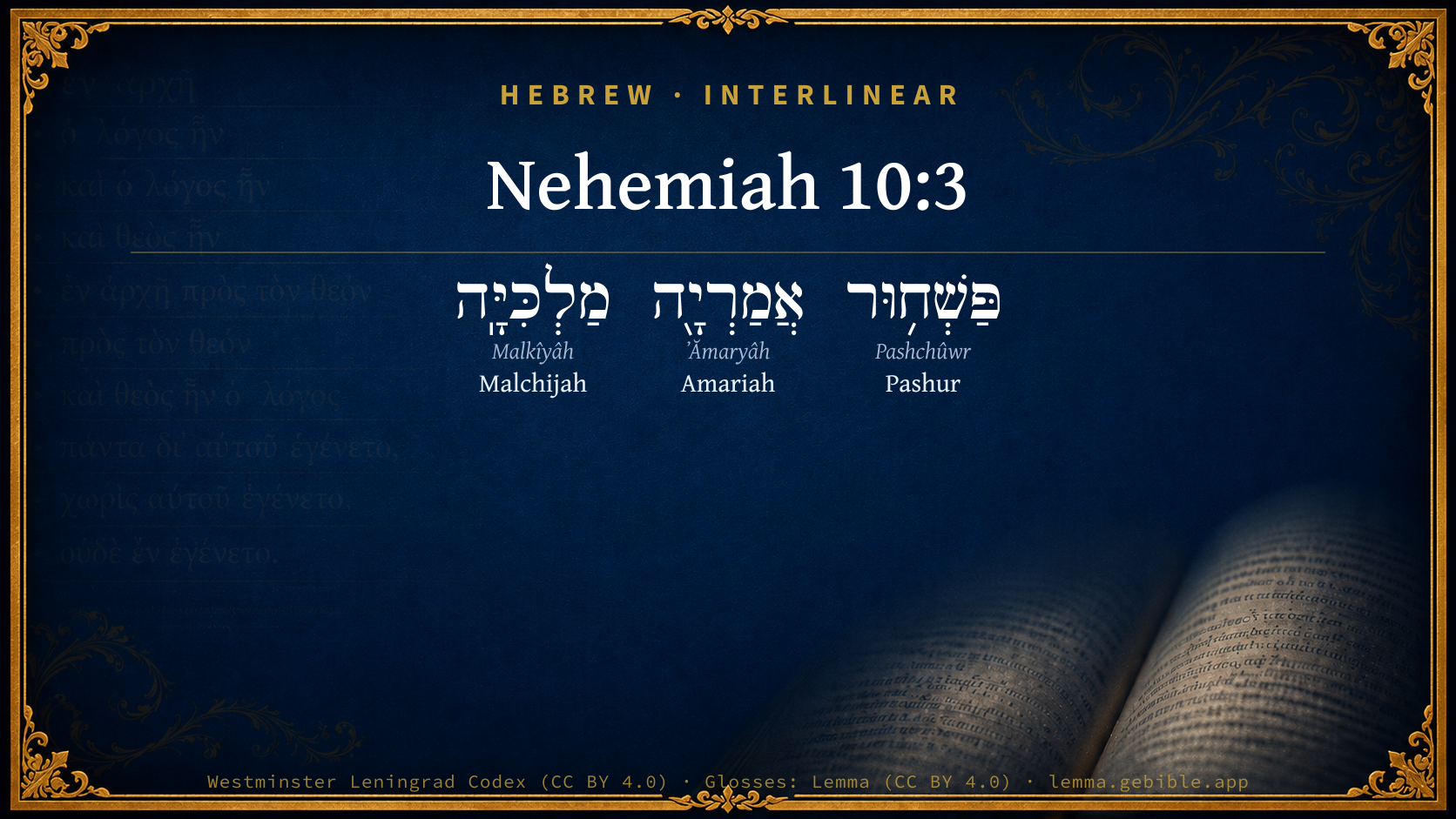
Hebrew (Westminster Leningrad Codex) Nehemiah 10:3 appears in the Hebrew Old Testament. The text above is from the Westminster Leningrad Codex. Each word links to its Strong’s number, a concise gloss, and parsing drawn from the Open Scriptures Hebrew Bible morphology. Click any word for its full Brown-Driver-Briggs (BDB) entry.
Download image
Cite this verse

Nehemiah 10:3 (World English Bible). Public Domain. Lemma interlinear Bible study tool, https://lemma.gebible.app/v/nehemiah/10/3.

Show BibTeX & RIS
BibTeX
RIS
English Translation
Pashhur, Amariah, Malchijah,
World English Bible · Public Domain
Download a study sheet

One document with this verse’s original text, its word-by-word gloss line, the meaning frame, cross-references with their text, attributed commentary, and full source and license credits — printable, and it pastes into notes with its structure intact.

This verse Autodidact and up

Study sheet (.html) Plain text (.txt)

A passage Seminary Student

Up to 50 verses in one chapter. A passage sheet keeps up to 6 commentary sources and 12 cross-references per verse, in the order this page ranks them, and says so on the sheet whenever that leaves anything out. Ask for a single verse and you get the Autodidact verse sheet above.

Everything on this page stays free to read, with no account — the sheet is a download of what is already on screen, not access to it.

Want to remove ads? Support Godless Engineer
Compare translations 3

The same verse in 3 English versions, stacked beneath the original-language interlinear above. Click any original word for its lexicon entry.

Each is an independent rendering of the whole verse — the interlinear is not word-aligned to these translations.

Highlighted words mark where these versions differ — a whole-verse word diff, not a word-by-word alignment.

  • World English Bible Public Domain
    Pashhur, Amariah, Malchijah,
  • King James Version Public Domain
    Pashur, Amariah, Malchijah,
  • unfoldingWord Literal Text CC BY-SA 4.0
    Pashhur, Amariah, Malkijah,

unfoldingWord Literal Text — © unfoldingWord, licensed CC BY-SA 4.0. Word-aligned USFM3 via Door43 (git.door43.org/unfoldingWord/en_ult).

Versions to compare (up to 4)

3 of 4 selected

Show all 18 translations

Every available English version of this verse, each an independent rendering of the whole verse.

  • World English Bible Public Domain
    Pashhur, Amariah, Malchijah,
  • Berean Standard Bible Public Domain
    Pashhur, Amariah, Malchijah,
  • Majority Standard Bible Public Domain
    Pashhur, Amariah, Malchijah,
  • King James Version Public Domain
    Pashur, Amariah, Malchijah,
  • American Standard Version (1901) Public Domain
    Pashhur, Amariah, Malchijah,
  • Revised Version (1885) Public Domain
    Pashhur, Amariah, Malchijah;
  • Geneva Bible (1599) Public Domain
    Pashur, Amariah, Malchiah,
  • Douay-Rheims (1899) Public Domain
    Pheshur, Amarias, Melchias,
  • Young's Literal Translation Public Domain
    Pashhur, Amariah, Malchijah,
  • Literal Standard Version CC BY-SA 4.0
    Pashhur, Amariah, Malchijah,
  • Unlocked Literal Bible CC BY-SA 4.0
    Pashhur, Amariah, Malchijah,
  • unfoldingWord Literal Text CC BY-SA 4.0
    Pashhur, Amariah, Malkijah,
  • Darby Bible Public Domain
    Pashhur, Amariah, Malchijah,
  • World Messianic Bible Public Domain
    Pashhur, Amariah, Malchijah,
  • Webster's Bible Public Domain
    Pashur, Amariah, Malchijah,
  • Free Bible Version CC BY-SA 4.0
    Pashhur, Amariah, Malchijah,
  • Bible in Basic English Public Domain
    Pashhur, Amariah, Malchijah,
  • JPS Tanakh (1917) Public Domain
    (10-4) Pashhur, Amariah, Malchijah;

Literal Standard Version (2020), Covenant Press — licensed CC BY-SA 4.0. Text via the HelloAO Bible API (eBible.org). Unlocked Literal Bible (unfoldingWord) — licensed CC BY-SA 4.0. Text via the HelloAO Bible API (eBible.org). unfoldingWord Literal Text — © unfoldingWord, licensed CC BY-SA 4.0. Word-aligned USFM3 via Door43 (git.door43.org/unfoldingWord/en_ult). Free Bible Version, Dr. Jonathan Gallagher — licensed CC BY-SA 4.0. Text via the HelloAO Bible API (eBible.org).

Word by word

More ways to search: Search by grammar → Find every occurrence → Compare this word →

Practice this passage: Drill this verse → Learn its vocabulary →

פַּשְׁח֥וּר
Pashchûwr
H6583
“Pashur”
Noun, Proper
Part of Speech
Noun
Type
Proper
Full BDB Definition

Origin: probably from H6582

TWOT: None

Pashur = "freedom" - a priest, son of Malchiah and one of the chief princes in the reign of king Zedekiah of Judah - a priest, son of Immer, chief governor of the temple, and the one who struck and then put the prophet Jeremiah into the stocks in the reign of king Jehoiakim of Judah - son of Malchijah, father of Zechariah, and ancestor of Adaiah who did the work of the temple in the time of Nehemiah. Probably same as 1 - father of Gedaliah; probably the same as 1 - head of a family of returned exiles
  1. אֲמַרְיָ֖ה ʼĂmaryâh H568 “Amariah” Noun, Proper
  2. מַלְכִּיָּֽה Malkîyâh H4441 “Malchijah” Noun, Proper

About this verse

These counts appear in no published source. They are computed here, from the morphology-tagged text and Lemma’s own curated glosses. What Lemma adds →

3
words
3
distinct lemmas
Historical
section

Notable vocabulary

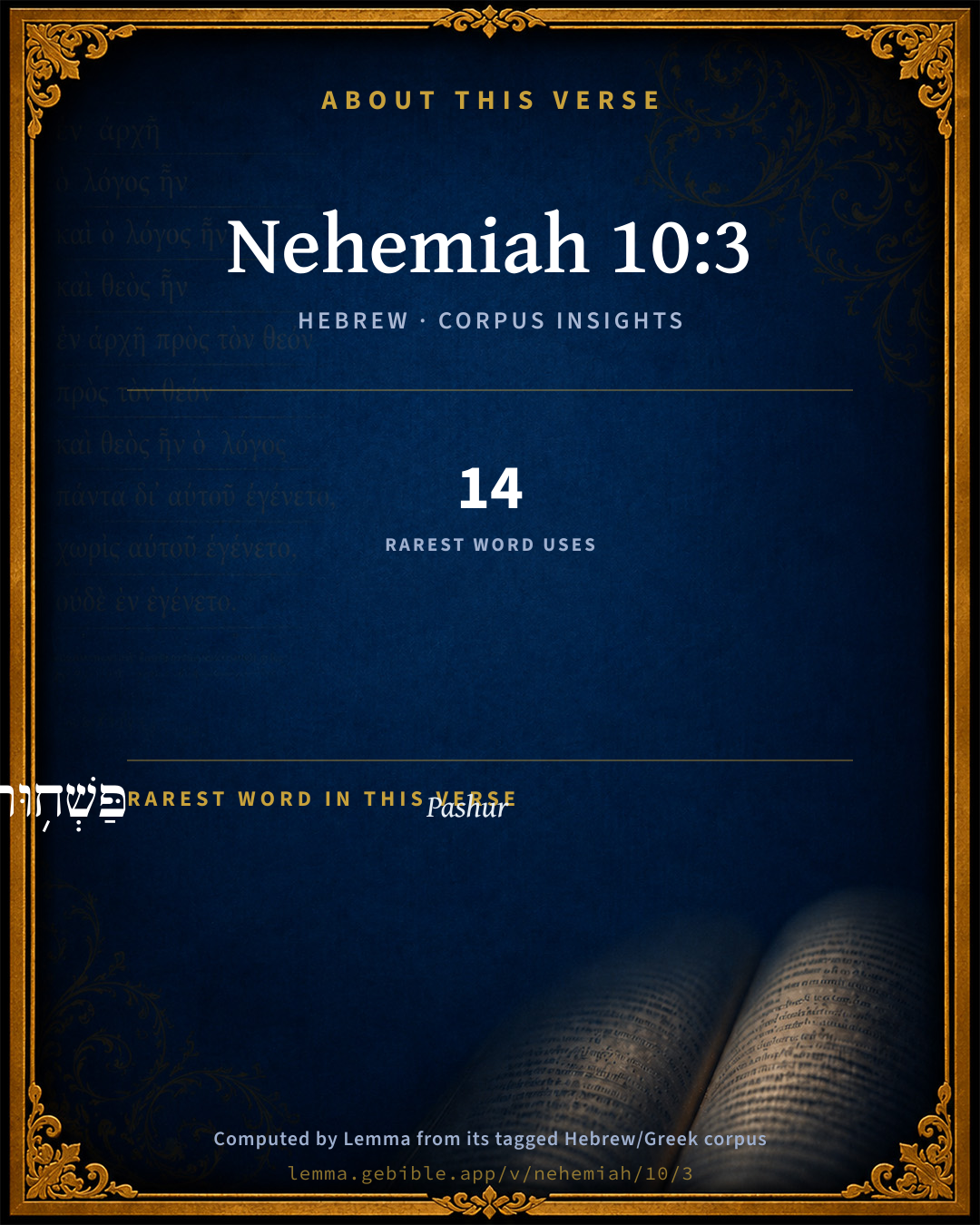
The rarest word here is פַּשְׁח֥וּר Pashur H6583 — appearing just 14 times in the whole Hebrew Bible.

Shared distinctive vocabulary

פַּשְׁח֥וּר Pashur H6583 occurs in 12 verses of the Hebrew Bible. Also found in:

Grammatical profile

  • 3 nouns

Cross-references

5

Topical passages linked to Nehemiah 10:3 in the Treasury of Scripture Knowledge — connected by theme and wording, ordered by reader-vote popularity; previews shown in the World English Bible.

  • Nehemiah 3:11 Malchijah the son of Harim, and Hasshub the son of Pahath-moab, repaired another portion, and the tower of the furnaces.
  • Nehemiah 8:4 Ezra the scribe stood on a pulpit of wood, which they had made for the purpose; and beside him stood Mattithiah, and Shema, and Anaiah, and Uriah, and Hilkiah, and Maaseiah, on his right hand; and on his left hand, Pedaiah, and Mishael, and Malchijah, and Hashum, and Hashbaddanah, Zechariah, [and] Meshullam.
  • Nehemiah 11:12 and their brothers who did the work of the house, eight hundred twenty-two; and Adaiah the son of Jeroham, the son of Pelaliah, the son of Amzi, the son of Zechariah, the son of Pashhur, the son of Malchijah,
  • Nehemiah 12:2 Amariah, Malluch, Hattush,
  • Nehemiah 12:13 of Ezra, Meshullam; of Amariah, Jehohanan;

Cross-references courtesy of OpenBible.info (CC BY 4.0).

Hebrew and Greek witnesses Masoretic Hebrew ↔ Greek Septuagint

The same verse in the two great witnesses to the Old Testament, shown verse-for-verse.

These are two independent witnesses, not word-aligned to each other, and the Septuagint is shown in lemma (dictionary) form.

Hebrew Nehemiah 10:3 Masoretic · Westminster Leningrad Codex

פַּשְׁח֥וּר אֲמַרְיָ֖ה מַלְכִּיָּֽה

Pashhur, Amariah, Malchijah,

World English Bible · Public Domain

Greek LXX Structure differs

The Septuagint has no separate book of Nehemiah. Its Greek text is the second half of Esdras B (2 Esdras), chapters 11–23; Ezra is the first half (1–10).

A verse-for-verse comparison isn’t shown here because the chapters and verses don’t line up. Switch to the LXX edition with the MT / LXX toggle above to read the Greek directly.

Hebrew: Westminster Leningrad Codex (CC BY 4.0). Greek: Septuagint (public domain); English from a public-domain English Septuagint. How the Septuagint differs from the Hebrew →

Commentary

Notes on Nehemiah 10:3 from classic Christian and Jewish commentators (each source and its license shown beneath its notes). The classic Christian expositions comment on the surrounding passage and are grouped to its opening verse, so a note may address several verses; the Jewish commentaries on the Tanakh (Rashi and others) are per-verse, so they appear only where the commentator wrote on this verse.

Lemma curates 59 commentaries, every one of them public domain or Creative Commons licensed, each selected and text-cleaned for this edition rather than reprinted as found. About our sources →

The Cambridge Bible for Schools and Colleges

gen. ed. J. J. S. Perowne

3–8, Priests: 9–13, Levites: 14–28, Chiefs of the people

The 21 names here given are those of the priestly houses. The list of Neh_12:1-3 agrees with it in 16 names. The number 21 is peculiar; in chap. 12 the number is larger by one. In Ezra 2, Nehemiah 7, only four priestly houses are recorded, viz. Jedaiah, Immer, Pashur and Harim, as having returned with Zerubbabel. Pashur is mentioned in Neh_10:3; Harim in Neh_10:5. The other priestly families had either developed themselves out of these first four, or had arrived from time to time from Babylon.

That 21 and not 24 are recorded, is noteworthy. Various conjectures have been hazarded, e.g. that names have dropped out from the text, or that three of the priestly tribes refused to sign the document, or that the complete list of priestly houses has not yet been reorganised.

Seraiah’s name is given first. To his family belonged both Eliashib the high-priest and Ezra the scribe. The absence of their names does not therefore deserve the importance which some commentators have given to it. A single signature for the whole house may have been affixed by Eliashib or by Ezra or by some other distinguished person of the same house. We have no reason to look for the names of individual priests among the names of the priestly houses.

The Cambridge Bible for Schools and Colleges (gen. ed. J. J. S. Perowne; Cambridge University Press, 1878–1918) — public domain. Text from a community e-Sword module.

Lesson kit

Teaching starters — assembled from the data on this page, not authored interpretation. Every prompt links to the verse data it draws on. Edit before teaching.

Nehemiah, in the Historical, opens this verse with 3 words (3 distinct Hebrew lemmas). Its most distinctive word is Pashchûwr (“Pashur”). Read the whole chapter for the surrounding context.

Discussion questions

  1. What does “Pashur” (Pashchûwr) contribute to the verse as a whole?
  2. How does 1 Chronicles 9:12, which shares the word «Pashur», read alongside this verse?
  3. The translations on this page render this verse differently — a whole-verse word diff, not a word-by-word alignment. What might account for the different wordings?

Things to notice

Reading settings

Reading text

Shown beneath each verse's original-language words.

Old Testament
Old Testament edition

Read the OT as the Masoretic Hebrew (MT) or the Greek Septuagint (LXX).

English shown for the Greek Septuagint (in the Hebrew ↔ Greek comparison).

Comparing translations? Open the Compare panel on any verse page to stack up to four side by side.