
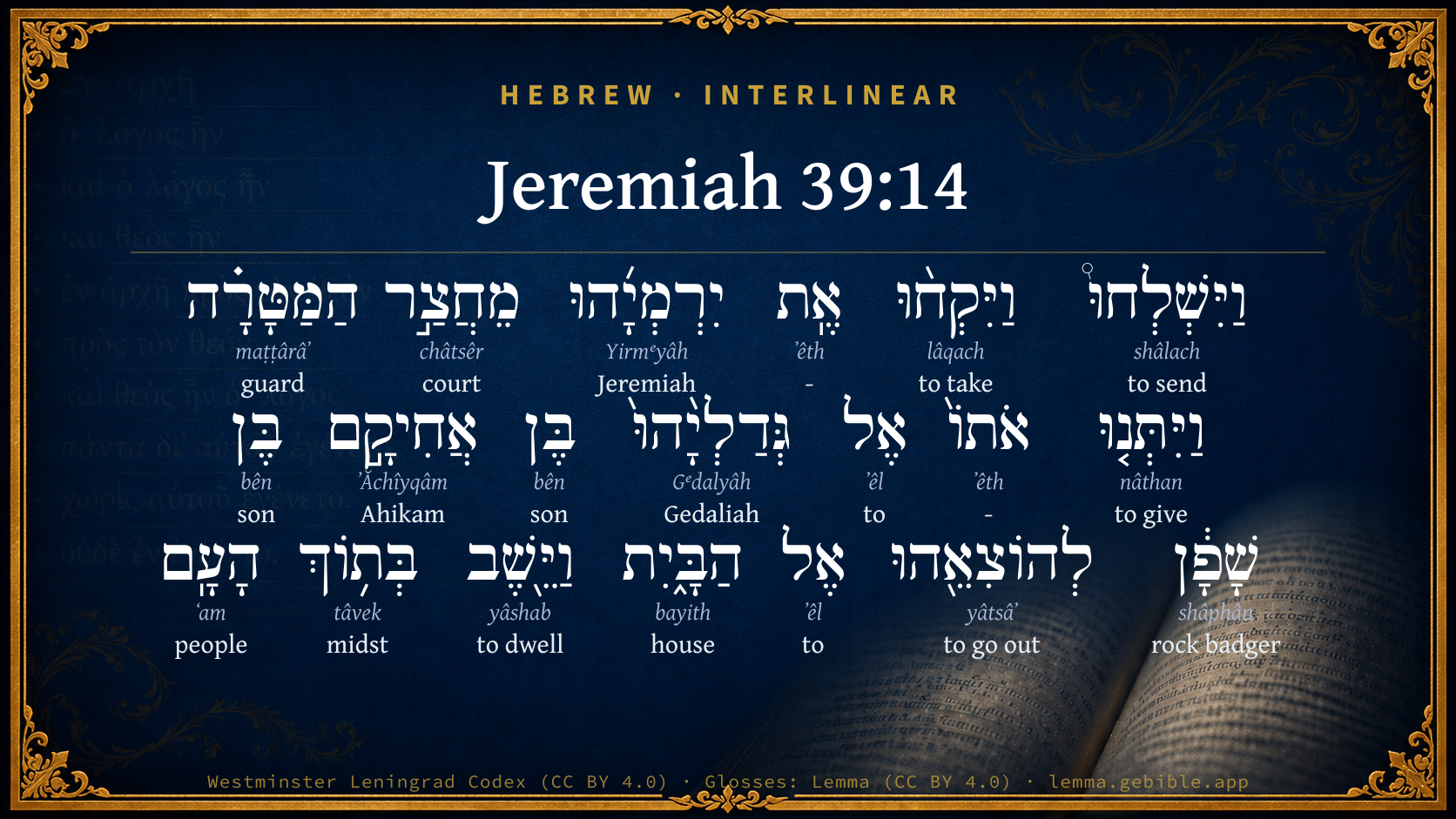
Jeremiah 39:14

Hebrew (Westminster Leningrad Codex) Jeremiah 39:14 appears in the Hebrew Old Testament. The text above is from the Westminster Leningrad Codex. Each word links to its Strong’s number, a concise gloss, and parsing drawn from the Open Scriptures Hebrew Bible morphology. Click any word for its full Brown-Driver-Briggs (BDB) entry.
Download image
Cite this verse

Jeremiah 39:14 (World English Bible). Public Domain. Lemma interlinear Bible study tool, https://lemma.gebible.app/v/jeremiah/39/14.

Show BibTeX & RIS
BibTeX
RIS
English Translation
they sent, and took Jeremiah out of the court of the guard, and committed him to Gedaliah the son of Ahikam, the son of Shaphan, that he should carry him home: so he lived among the people.
World English Bible · Public Domain
Download a study sheet

One document with this verse’s original text, its word-by-word gloss line, the meaning frame, cross-references with their text, attributed commentary, and full source and license credits — printable, and it pastes into notes with its structure intact.

This verse Autodidact and up

Study sheet (.html) Plain text (.txt)

A passage Seminary Student

Up to 50 verses in one chapter. A passage sheet keeps up to 6 commentary sources and 12 cross-references per verse, in the order this page ranks them, and says so on the sheet whenever that leaves anything out. Ask for a single verse and you get the Autodidact verse sheet above.

Everything on this page stays free to read, with no account — the sheet is a download of what is already on screen, not access to it.

Want to remove ads? Support Godless Engineer
Compare translations 3

The same verse in 3 English versions, stacked beneath the original-language interlinear above. Click any original word for its lexicon entry.

Each is an independent rendering of the whole verse — the interlinear is not word-aligned to these translations.

Highlighted words mark where these versions differ — a whole-verse word diff, not a word-by-word alignment.

  • World English Bible Public Domain
    they sent, and took Jeremiah out of the court of the guard, and committed him to Gedaliah the son of Ahikam, the son of Shaphan, that he should carry him home: so he lived among the people.
  • King James Version Public Domain
    Even they sent, and took Jeremiah out of the court of the prison, and committed him unto Gedaliah the son of Ahikam the son of Shaphan, that he should carry him home: so he dwelt among the people.
  • unfoldingWord Literal Text CC BY-SA 4.0
    Their men took Jeremiah from the courtyard of the guard and entrusted him to Gedaliah son of Ahikam son of Shaphan, to take him home, so Jeremiah stayed among the people.

unfoldingWord Literal Text — © unfoldingWord, licensed CC BY-SA 4.0. Word-aligned USFM3 via Door43 (git.door43.org/unfoldingWord/en_ult).

Versions to compare (up to 4)

3 of 4 selected

Show all 18 translations

Every available English version of this verse, each an independent rendering of the whole verse.

  • World English Bible Public Domain
    they sent, and took Jeremiah out of the court of the guard, and committed him to Gedaliah the son of Ahikam, the son of Shaphan, that he should carry him home: so he lived among the people.
  • Berean Standard Bible Public Domain
    had Jeremiah brought from the courtyard of the guard, and they turned him over to Gedaliah son of Ahikam, the son of Shaphan, to take him home. So Jeremiah remained among his own people.
  • Majority Standard Bible Public Domain
    had Jeremiah brought from the courtyard of the guard, and they turned him over to Gedaliah son of Ahikam, the son of Shaphan, to take him home. So Jeremiah remained among his own people.
  • King James Version Public Domain
    Even they sent, and took Jeremiah out of the court of the prison, and committed him unto Gedaliah the son of Ahikam the son of Shaphan, that he should carry him home: so he dwelt among the people.
  • American Standard Version (1901) Public Domain
    they sent, and took Jeremiah out of the court of the guard, and committed him unto Gedaliah the son of Ahikam, the son of Shaphan, that he should carry him home: so he dwelt among the people.
  • Revised Version (1885) Public Domain
    they sent, and took Jeremiah out of the court of the guard, and committed him unto Gedaliah the son of Ahikam, the son of Shaphan, that he should carry him home: so he dwelt among the people.
  • Geneva Bible (1599) Public Domain
    Euen they sent, and tooke Ieremiah out of the court of the prison, and committed him vnto Gedaliah the sonne of Ahikam the sonne of Shaphan, that he should cary him home: so he dwelt among the people.
  • Douay-Rheims (1899) Public Domain
    Sent, and took Jeremias out of the court of the prison, and committed him to Codolias the son of Ahicam the son of Saphan, that he might go home, and dwell among the people.
  • Young's Literal Translation Public Domain
    yea, they send and take Jeremiah out of the court of the prison, and give him unto Gedaliah son of Ahikam, son of Shaphan, to carry him home, and he dwelleth in the midst of the people.
  • Literal Standard Version CC BY-SA 4.0
    indeed, they send and take Jeremiah out of the court of the prison, and give him to Gedaliah son of Ahikam, son of Shaphan, to carry him home, and he dwells in the midst of the people.
  • Unlocked Literal Bible CC BY-SA 4.0
    Their men took Jeremiah from the courtyard of the guard and entrusted him to Gedaliah son of Ahikam son of Shaphan, to take him home, so Jeremiah stayed among the people.
  • unfoldingWord Literal Text CC BY-SA 4.0
    Their men took Jeremiah from the courtyard of the guard and entrusted him to Gedaliah son of Ahikam son of Shaphan, to take him home, so Jeremiah stayed among the people.
  • Darby Bible Public Domain
    even they sent, and took Jeremiah out of the court of the guard and committed him to Gedaliah the son of Ahikam the son of Shaphan, that he should conduct him away home. And he dwelt among the people.
  • World Messianic Bible Public Domain
    sent and took Jeremiah out of the court of the guard, and committed him to Gedaliah the son of Ahikam, the son of Shaphan, that he should bring him home. So he lived among the people.
  • Webster's Bible Public Domain
    Even they sent, and took Jeremiah out of the court of the prison, and committed him to Gedaliah the son of Ahikam the son of Shaphan, that he should carry him home: so he dwelt among the people.
  • Free Bible Version CC BY-SA 4.0
    took Jeremiah from the guard's courtyard, and they handed him over to Gedaliah son of Ahikam, the son of Shaphan, to take him home. Jeremiah stayed there with his own people.
  • Bible in Basic English Public Domain
    And they sent and took Jeremiah out of the place of the watchmen, and gave him into the care of Gedaliah, the son of Ahikam, the son of Shaphan, to take him to his house: so he was living among the people.
  • JPS Tanakh (1917) Public Domain
    they sent, and took Jeremiah out of the court of the guard, and committed him unto Gedaliah the son of Ahikam, the son of Shaphan, that he should carry him home; so he dwelt among the people.

Literal Standard Version (2020), Covenant Press — licensed CC BY-SA 4.0. Text via the HelloAO Bible API (eBible.org). Unlocked Literal Bible (unfoldingWord) — licensed CC BY-SA 4.0. Text via the HelloAO Bible API (eBible.org). unfoldingWord Literal Text — © unfoldingWord, licensed CC BY-SA 4.0. Word-aligned USFM3 via Door43 (git.door43.org/unfoldingWord/en_ult). Free Bible Version, Dr. Jonathan Gallagher — licensed CC BY-SA 4.0. Text via the HelloAO Bible API (eBible.org).

Word by word

More ways to search: Search by grammar → Find every occurrence → Compare this word →

Practice this passage: Drill this verse → Learn its vocabulary →

הַמַּטָּרָ֗ה
maṭṭârâʼ
H4307
“the · guard”
Particle, Definite Article + Noun, Common, Feminine, Singular, Absolute
Part of Speech
Particle + Noun
Type
Common
Gender
Feminine
Number
Singular
State
Absolute
Full BDB Definition

Origin: from H5201

TWOT: 1356a

guard, ward, prison, mark, target - guard, ward, prison - target, mark (figuratively of chastisement)
  1. וַיִּשְׁלְחוּ֩ shâlach H7971 “and · to send” Conjunction + Verb, Qal, Sequential Imperfect, 3rd Person, Masculine, Plural
  2. וַיִּקְח֨וּ lâqach H3947 “and · to take” Conjunction + Verb, Qal, Sequential Imperfect, 3rd Person, Masculine, Plural
  3. אֶֽת ʼêth H853 “-” Particle, Direct Object
  4. יִרְמְיָ֜הוּ Yirmᵉyâh H3414 “Jeremiah” Noun, Proper
  5. מֵחֲצַ֣ר châtsêr H2691 “from · court of” Preposition + Noun, Common, Both, Singular, Construct
  6. וַיִּתְּנ֤וּ nâthan H5414 “and · to give” Conjunction + Verb, Qal, Sequential Imperfect, 3rd Person, Masculine, Plural
  7. אֹתוֹ֙ ʼêth H853 “- · him” Particle, Direct Object + Suffix, Personal, 3rd Person, Masculine, Singular
  8. אֶל ʼêl H413 “to” Preposition
  9. גְּדַלְיָ֨הוּ֙ Gᵉdalyâh H1436 “Gedaliah” Noun, Proper
  10. בֶּן bên H1121 “son of” Noun, Common, Masculine, Singular, Construct
  11. אֲחִיקָ֣ם ʼĂchîyqâm H296 “Ahikam” Noun, Proper
  12. בֶּן bên H1121 “son of” Noun, Common, Masculine, Singular, Construct
  13. שָׁפָ֔ן shâphân H8227 “rock badger” Noun, Proper
  14. לְהוֹצִאֵ֖הוּ yâtsâʼ H3318 “to go out · him” Preposition + Verb, Hiphil, Infinitive Construct + Suffix, Personal, 3rd Person, Masculine, Singular
  15. אֶל ʼêl H413 “to” Preposition
  16. הַבָּ֑יִת bayith H1004 “the · house” Particle, Definite Article + Noun, Common, Masculine, Singular, Absolute
  17. וַיֵּ֖שֶׁב yâshab H3427 “and · to dwell” Conjunction + Verb, Qal, Sequential Imperfect, 3rd Person, Masculine, Singular
  18. בְּת֥וֹךְ tâvek H8432 “in/at · midst of” Preposition + Noun, Common, Masculine, Singular, Construct
  19. הָעָֽם ʻam H5971 “the · people” Particle, Definite Article + Noun, Common, Masculine, Singular, Absolute

About this verse

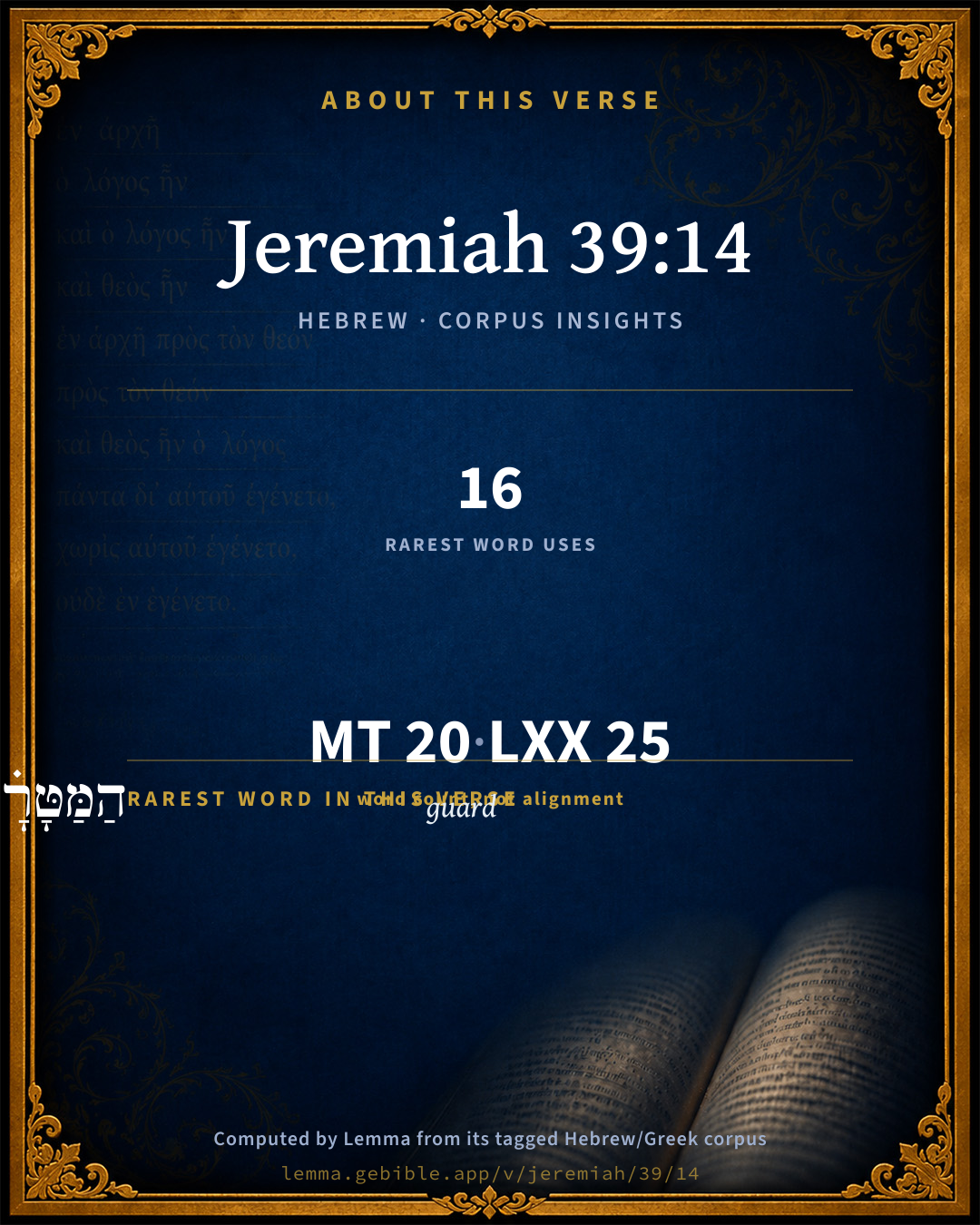
These counts appear in no published source. They are computed here, from the morphology-tagged text and Lemma’s own curated glosses. What Lemma adds →

20
words
17
distinct lemmas
Prophets
section

Notable vocabulary

The rarest word here is הַמַּטָּרָ֗ה guard H4307 — appearing just 16 times in the whole Hebrew Bible.

Shared distinctive vocabulary

הַמַּטָּרָ֗ה guard H4307 occurs in 15 verses of the Hebrew Bible. Also found in:

Grammatical profile

  • 5 verbs
  • 11 nouns
  • 2 prepositions
  • 2 particles

Verb forms

  • וַיִּשְׁלְחוּ֩ Qal · Sequential Imperfect
  • וַיִּקְח֨וּ Qal · Sequential Imperfect
  • וַיִּתְּנ֤וּ Qal · Sequential Imperfect
  • לְהוֹצִאֵ֖הוּ Hiphil · Infinitive Construct
  • וַיֵּ֖שֶׁב Qal · Sequential Imperfect

Repetition

Words recur within this verse — often emphatic in Hebrew:

Hebrew & Septuagint length

In the original languages it is 20 Hebrew tokens and 25 Greek tokens — but the two are counted differently (Hebrew bundles its prefixes and suffixes into one token; the Greek is in lemma form), so that isn’t a like-for-like length.

Cross-references

9

Topical passages linked to Jeremiah 39:14 in the Treasury of Scripture Knowledge — connected by theme and wording, ordered by reader-vote popularity; previews shown in the World English Bible.

  • Jeremiah 38:28 So Jeremiah abode in the court of the guard until the day that Jerusalem was taken.
  • 2 Kings 22:12 The king commanded Hilkiah the priest, and Ahikam the son of Shaphan, and Achbor the son of Micaiah, and Shaphan the scribe, and Asaiah the king's servant, saying,
  • 2 Kings 25:22–25 As for the people who were left in the land of Judah, whom Nebuchadnezzar king of Babylon had left, even over them he made Gedaliah the son of Ahikam, the son of Shaphan, governor.
  • Jeremiah 26:24 But the hand of Ahikam the son of Shaphan was with Jeremiah, that they should not give him into the hand of the people to put him to death.
  • Psalms 105:19 Until the time that his word happened, And Yahweh's word proved him true.
  • Jeremiah 37:21 Then Zedekiah the king commanded, and they committed Jeremiah into the court of the guard; and they gave him daily a loaf of bread out of the bakers' street, until all the bread in the city was spent. Thus Jeremiah remained in the court of the guard.
  • Jeremiah 38:13 So they drew up Jeremiah with the cords, and took him up out of the dungeon: and Jeremiah remained in the court of the guard.
  • Jeremiah 39:15 Now the word of Yahweh came to Jeremiah, while he was shut up in the court of the guard, saying,
  • Jeremiah 40:1–41:3 The word which came to Jeremiah from Yahweh, after that Nebuzaradan the captain of the guard had let him go from Ramah, when he had taken him being bound in chains among all the captives of Jerusalem and Judah, who were carried away captive to Babylon.

Cross-references courtesy of OpenBible.info (CC BY 4.0).

Hebrew and Greek witnesses Masoretic Hebrew ↔ Greek Septuagint

The same verse in the two great witnesses to the Old Testament, shown verse-for-verse.

These are two independent witnesses, not word-aligned to each other, and the Septuagint is shown in lemma (dictionary) form.

Hebrew Jeremiah 39:14 Masoretic · Westminster Leningrad Codex

וַיִּשְׁלְחוּ֩ וַיִּקְח֨וּ אֶֽת יִרְמְיָ֜הוּ מֵחֲצַ֣ר הַמַּטָּרָ֗ה וַיִּתְּנ֤וּ אֹתוֹ֙ אֶל גְּדַלְיָ֨הוּ֙ בֶּן אֲחִיקָ֣ם בֶּן שָׁפָ֔ן לְהוֹצִאֵ֖הוּ אֶל הַבָּ֑יִת וַיֵּ֖שֶׁב בְּת֥וֹךְ הָעָֽם

they sent, and took Jeremiah out of the court of the guard, and committed him to Gedaliah the son of Ahikam, the son of Shaphan, that he should carry him home: so he lived among the people.

World English Bible · Public Domain

Greek LXX Structure differs

In the Septuagint, Jeremiah is about an eighth shorter than the Hebrew and arranges its material differently — the Oracles Against the Nations (Hebrew chapters 46–51) appear in the middle of the Greek book, after 25:13. Because the chapter and verse boundaries do not line up, a verse-for-verse comparison with the Hebrew is not shown.

A verse-for-verse comparison isn’t shown here because the chapters and verses don’t line up. Switch to the LXX edition with the MT / LXX toggle above to read the Greek directly.

Hebrew: Westminster Leningrad Codex (CC BY 4.0). Greek: Septuagint (public domain); English from a public-domain English Septuagint. How the Septuagint differs from the Hebrew →

Targum (Aramaic paraphrase)

1

The Targum is the ancient Jewish Aramaic paraphrase of the Hebrew Scriptures — an interpretive translation, not the Hebrew text itself. Onkelos (literal) and Pseudo-Jonathan (expansive) render the Torah, and Jonathan the Prophets. Coverage is partial: where no permissively-licensed English translation exists for a verse, only the Aramaic is shown. This is verse-level text, not a word-by-word alignment to the Hebrew.

  1. Targum Jonathan Prophets (Joshua–Malachi)
    וּשְׁלָחוּ וּדְבָרוּ יַת יִרְמְיָהוּ מִדָרַת בֵּית אֲסִירַיָא וִיהָבוּ יָתֵיהּ לִגְדַלְיָה בַּר אֲחִיקָם בַּר שָׁפָן לְאַפָּקוּתֵיהּ לְבֵיתָא וִיתֵיב בְּגוֹ עַמָא:

    (no public-domain English translation for this verse)

    Targum Jonathan — Aramaic: “Mikraot Gedolot” (public domain). English: “Sefaria Community Translation” (CC0 1.0 (public-domain dedication)); “London "Chaldee Paraphrase," 1871” (public domain). Text via Sefaria.

Commentary

Notes on Jeremiah 39:14 from classic Christian and Jewish commentators (each source and its license shown beneath its notes). The classic Christian expositions comment on the surrounding passage and are grouped to its opening verse, so a note may address several verses; the Jewish commentaries on the Tanakh (Rashi and others) are per-verse, so they appear only where the commentator wrote on this verse.

Lemma curates 59 commentaries, every one of them public domain or Creative Commons licensed, each selected and text-cleaned for this edition rather than reprinted as found. About our sources →

Trapp's Complete Commentary

John Trapp

Jer 39:14 Even they sent, and took Jeremiah out of the court of the prison, and committed him unto Gedaliah the son of Ahikam the son of Shaphan, that he should carry him home: so he dwelt among the people.

Ver. 14. They sent and took Jeremiah.] But why did they not also loose him from his bonds? {Jer 40:1}

And committed him unto Gedaliah.] Who being a chieftain among the Jews, fell to the Chaldees (as it may seem) before the city was taken, according to Jeremiah’s counsel, and is now set over the land, and hath the prophet Jeremiah committed to his care.

The son of Ahikam.] Who had rescued the prophet. {Jer 26:24} {See Trapp on "Jer 26:24"}

John Trapp, A Commentary or Exposition upon All the Books of the Old and New Testament (1647–1656) — public domain. Text from a community e-Sword module.

Geneva Bible (1599)

Geneva Bible translators

Whom the King of Babel had now appointed governor over the rest of the Jews that he left behind.

Geneva Bible (1599) marginal notes — public domain. Text via Bolls.life.

Jamieson, Fausset & Brown

Robert Jamieson, A. R. Fausset & David Brown

Gedaliah--son of Ahikam, the former supporter of Jeremiah (Jer 26:24). Gedaliah was the chief of the deserters to the Chaldeans, and was set over the remnant in Judea as one likely to remain faithful to Nebuchadnezzar. His residence was at Mizpah (Jer 40:5).

home--the house of Gedaliah, wherein Jeremiah might remain as in a safe asylum. As in Jer 40:1 Jeremiah is represented as "bound in chains" when he came to Ramah among the captives to be carried to Babylon, this release of Jeremiah is thought by MAURER to be distinct from that in Jer 40:5-6. But he seems first to have been released from the court of the prison and to have been taken to Ramah, still in chains, and then committed in freedom to Gedaliah.

dwelt among the people--that is, was made free.

Jamieson, Fausset & Brown — Commentary Critical and Explanatory on the Whole Bible (1871) — public domain (CC PDM 1.0). Text via the HelloAO Bible API.

John Calvin's Commentaries

Here Jeremiah completes what we began yesterday to expound, even that by the command of King Nebuchadnezzar he was delivered from prison. But we have said, that though that heathen king had regard to his own interest, yet his mind was ruled by the secret power of God, who thus designed to rescue his servant from death; for God is wont thus to work even by the ungodly, who have another thing in view. It is not always by a voluntary act that men serve God, for many execute what God has decreed when they have no intention of doing so: and he so turns and drives them here and there, that they are constrained, willing or unwilling, to obey his authority. Thus, then, it was that Nebuchadnezzar liberated Jeremiah.

And yet the Prophet fully believed that he did not owe his life to King Nebuchadnezzar, but that he had been in a wonderful manner preserved by God’s favor; and to shew this is the design of the whole narrative.

He says, that the king had sent all-the leaders of the Chaldean army to take him out of the court of the prison, and that he was then delivered to the care of Gedaliah, not that he might be watched as usual, but because the princes knew that the people had entertained hatred towards the holy Prophet, and therefore wished him to be preserved safe from all violence. This then was the reason why they committed him to the keeping of Gedaliah, who, as we shall hereafter see, was in favor with the Chaldeans and highly esteemed.

He adds in the last place, that he dwelt in the midst of the people: by which expression is set forth complete liberty, as we say in our language, aller et venir. He then says that he was in the midst of the people, because he had been before shut up in prison. It now follows —

John Calvin's Commentaries (1540-1563) — public domain. Text from the Calvin Translation Society English edition (1840s-50s) via the Christian Classics Ethereal Library (ccel.org). Calvin's coverage is partial (roughly two-thirds of the Bible); uncommented books and verses are honest gaps, never fabricated. The 19th-century editor's footnotes and remarks are omitted so the notes are faithfully Calvin's own voice.

Ellicott's Commentary for English Readers

(14) Out of the court of the prison.—There is a slight apparent discrepancy between this statement and that in Jer_40:1, that the prophet was set free at Ramah. It seems likely that, at first, he was sent back to the prison where he had been found, till he could be placed under the protection of Gedaliah.

Gedaliah the son of Ahikam the son of Shaphan.—The reason of the choice lies almost on the surface. Gedaliah was the representative of a house which for three generations had been true to the prophets who spoke in the name of the Lord. Shaphan had been the king’s scribe in the early years of Josiah, and had taken an active part in the restoration of the Temple (2Ki_22:3-7). He was the first to read the newly-found lost copy of the Law, which we identify with the Book of Deuteronomy (2Ki_22:8-14), and his son Ahikam acted with him. The latter protected Jeremiah in the reign of Jehoiakim (Jer_26:24). His brother Gemariah gave the prophet the use of his chamber in the Temple (Jer_36:10), and tried to turn aside the king’s wrath (Jer_36:25). And now the son of Ahikam appears as the prophet’s friend and protector.

A Bible Commentary for English Readers, edited by Charles John Ellicott (1878–1897) — public domain. Text from a community e-Sword module.

The Cambridge Bible for Schools and Colleges

gen. ed. J. J. S. Perowne

14. Gedaliah] See on Jer_26:24.

home] to the house, apparently meaning to the prophet’s own dwelling.

dwelt] i.e. was no longer in confinement.

The Cambridge Bible for Schools and Colleges (gen. ed. J. J. S. Perowne; Cambridge University Press, 1878–1918) — public domain. Text from a community e-Sword module.

John Gill's Exposition

Even they sent and took Jeremiah out of the court of the prison,.... Where he was, when Jerusalem was taken, Jer 38:28; and where he remained until this order came:

and committed him unto Gedaliah the son of Ahikam the son of Shaphan; the father of this person seems to be the same who saved Jeremiah from being delivered into the hand of the people, to be put to death by them, in Jehoiakim's reign, Jer 26:24; and he himself was doubtless a prince of Judah, that deserted to the Chaldeans during the siege, and was in esteem with them, and appointed a governor over those that were left in the land: now what is here recorded was not done immediately after Jeremiah was taken out of the court of the prison; for however it was, whether through the multiplicity of business, or the neglect of inferior officers, who did not attend to the charge the captain of the guard gave them concerning Jeremiah; though he was taken out of prison, he was bound in chains, and carried among the captives to Ramah; where, very probably, Nebuzaradan, looking over his prisoners, to his great surprise finds the prophet among them; when he released him, and, after some discourse with him, sent him to Gedaliah; see Jer 40:1;

that he should carry him home; or, "to the house" (o); either to the house of Gedaliah, as Kimchi; or rather to the house of Jeremiah in Anathoth:

so he dwelt among the people; that were left in the land, being at full liberty.

(o) "in domum", Schmidt; "ad domum", Pagninus, Montanus.

John Gill's Exposition of the Whole Bible (1746–1763) — public domain (CC PDM 1.0). Text via the HelloAO Bible API.

Albert Barnes' Notes on the Bible

Jeremiah was to be taken out of the court of the watch, and placed in the palace close by.

He dwelt among the people - i. e., he was no longer in custody, but master of his own actions.

Albert Barnes' Notes on the Bible (1834–1885) — public domain. Text from a community e-Sword/MySword module.

Haydock's Catholic Bible Commentary

Godolias. The Jews say he had gone over to assist the Chaldeans. (Tirinus)

George Leo Haydock (1774–1849), Haydock's Catholic Family Bible and Commentary, 1859 edition — public domain. Excludes Psalms (Douay-Rheims chapter numbering differs from Protestant) and Deuterocanonical books (Catholic canon only).

Matthew Poole's English Annotations

The king of Babylon’s officers were very religious to their prince’s order, and take the prophet out of prison. For the latter part of the 14th verse, it seems but an anticipation of what we shall find related more fully and particularly Jer 40.; or else so ought to be translated yet, as appeareth from the first verse of the next chapter, from whence it is plain that the prophet was also bound in chains amongst them that were carried away captive, and not discharged until he came at Ramah, which probably might be in that hurry of affairs; though the princes at first freed him from prison, the under officers not so diligently observing their special charge relating to Jeremiah, the neglect of which the captain of the guard observing when he came as far as Ramah, himself took care in it, as we shall find, Jer 40; after which, upon his choice, he was committed to Gedaliah the son of Ahikam, whom the king of Babylon made governor over the country.

Matthew Poole's English Annotations on the Holy Bible (1683–1685) — public domain. Text from a community e-Sword/MySword module.

Whedon's Commentary on the Bible

Daniel D. Whedon

14. Out of the court of the prison — From this account we should not doubt that Jeremiah was liberated at Jerusalem, but the following chapter makes it entirely certain that Ramah was the scene of his release. The explanation is, that the first gives the matter with great brevity, while the latter gives it in detail. It would appear that at the time of the capture of the city the male inhabitants who had not borne arms were carried to Ramah, as prisoners, and Jeremiah among them. In this summary account no mention is made of this, but he is spoken of as though he were still in the court of the prison.

Carry him home — Literally, into the house. What house can only be conjectured. Hitzig says, the temple; Graf, the king’s house; Keil, the official residence of Gedaliah, the governor. This last is satisfactory, and explains why the pronoun is omitted. If it had been his private residence we should certainly expect to see the pronoun.

Daniel D. Whedon (gen. ed.), Commentary on the Old and New Testaments (1874–1909) — public domain. Text from a community e-Sword module.

The Pulpit Commentary

Gedaliah, whose father had already befriended the prophet on a serious occasion, (Jer_26:24) and who, according to Jer_40:5, had been appointed (though himself a Jew) Babylonian "governor over the cities of Judah," is directed to carry him (Jeremiah) home, or rather, into the house; obviously some house close by is meant either Gedaliah"s temporary dwelling or the royal palace. This statement conflicts (see introduction) with that in Jer_40:1-5, but only as to the time when Jeremiah was liberated. The latter narrative being more explicit, deserves the preference. Thus Jeremiah dwelt among the people; i.e. could go in and out at his pleasure.

"So he dwelt among the people.

In how many respects was Jeremiah a type of Christ! And just in these points was he an example to the spiritual worker and the Christian preacher.

I THE POSITION OF THE TRUE PASTOR.

1. How miserably anomalous a pastor without a flock, or living at a distance from them! There is something wrong with one or other when they remain apart. Only now and then, and for brief periods, can solitude be the place of duty.

2. The cure of souls can only be followed successfully by constant intercourse with them. The experience, sympathy, and moral influence acquired by the minister in the midst of his flock will stand him in good stead in directing him as to what to teach, and preparing for it a favourable reception.

II THE SPIRIT OF THE TRUE PASTOR.

1. Absence of ambition. The promises of the Chaldeans were much more brilliant than the future that was likely to lie before him in Palestine. It was not comfort, worldly emolument, or personal advancement that he sought. Like Moses, he chose "rather to suffer affliction with the people of God, that, to enjoy the pleasures of sin for a season". (Heb_11:25)

2. Sympathy with the miseries and spiritual needs of men. The interests of the Divine kingdom would be better served by his remaining at home. Here was work ready to his hand, and he dare not leave it. The servant of God has "to preach as a dying man to dying men.

3. True patriotism. What intense affection he had for the land of his fathers! This was at the very core of the religion of the ancient Jew. All the promises of God and realizations of his kingdom on earth seemed to be associated with the Holy Land. This sentiment has been universalized and made more personal by the Spirit of Jesus. "Our kind" must have our constant care and prayers. "The enthusiasm for humanity" must support and inspire the spiritual worker. M.

The Pulpit Commentary (1880–1919), ed. H.D.M. Spence-Jones & Joseph S. Exell — public domain. Text from a community e-Sword module.

Rashi

Rabbi Shlomo Yitzchaki (Rashi)

to Gedaliah the son of Ahikam who defected to the Chaldeans in compliance with Jeremiah’s orders, and when the city was taken, he appointed him governor over those remaining there.

Rashi on the Tanakh — English translations: “The Judaica Press complete Tanach with Rashi, translated by A. J. Rosenberg” (CC BY 4.0); “Pentateuch with Rashi's commentary by M. Rosenbaum and A.M. Silbermann, 1929-1934” (public domain); “The Metsudah Tanach series, Lakewood, N.J” (CC BY 4.0); and “The Book of Joshua, Metsudah Publications, 1997” (CC BY 4.0). Text via Sefaria.

Lesson kit

Teaching starters — assembled from the data on this page, not authored interpretation. Every prompt links to the verse data it draws on. Edit before teaching.

Jeremiah, in the Prophets, opens this verse with 20 words (17 distinct Hebrew lemmas). Its most distinctive word is maṭṭârâʼ (“guard”). A historical commentator’s framing appears above. Read the whole chapter for the surrounding context.

Discussion questions

  1. The word maṭṭârâʼ carries the sense “guard.” How does it shape the verse?
  2. 1 Samuel 20:20 shares the word «guard» with this verse. How do the two illuminate each other?
  3. “son” occurs 2× in this one verse. What is the effect of the repetition?
  4. These translations render this verse differently; the difference is in the English rendering, not the original. What questions does that raise?
  5. The verb «וַיִּשְׁלְחוּ֩» is Qal Sequential Imperfect. How does its form color the action?
  6. Reading how Trapp's Complete Commentary and Geneva Bible (1599) read this verse, where do the two commentators agree and where do they part?

Things to notice

Reading settings

Reading text

Shown beneath each verse's original-language words.

Old Testament
Old Testament edition

Read the OT as the Masoretic Hebrew (MT) or the Greek Septuagint (LXX).

English shown for the Greek Septuagint (in the Hebrew ↔ Greek comparison).

Comparing translations? Open the Compare panel on any verse page to stack up to four side by side.