
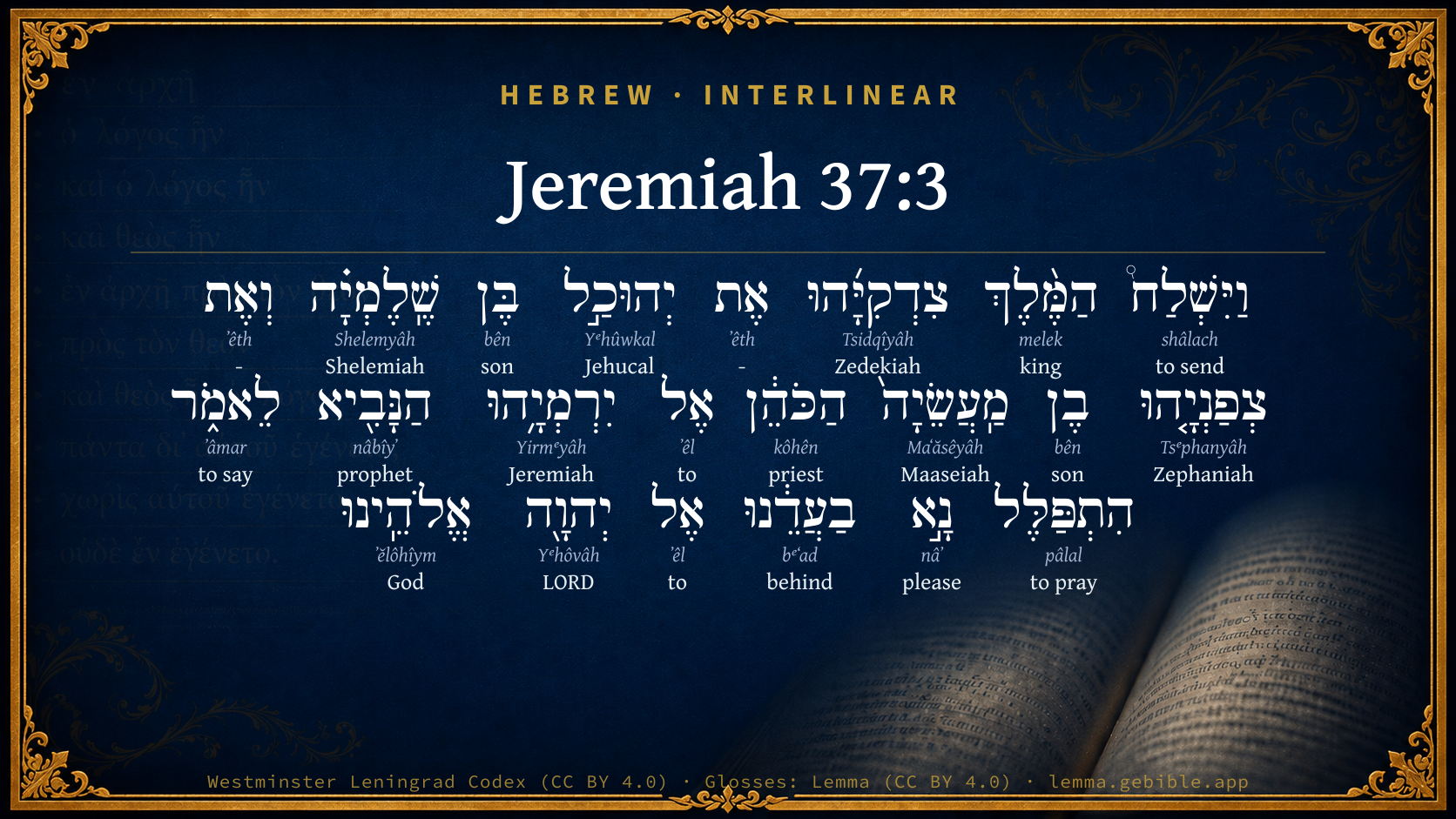
Jeremiah 37:3

Hebrew (Westminster Leningrad Codex) Jeremiah 37:3 appears in the Hebrew Old Testament. The text above is from the Westminster Leningrad Codex. Each word links to its Strong’s number, a concise gloss, and parsing drawn from the Open Scriptures Hebrew Bible morphology. Click any word for its full Brown-Driver-Briggs (BDB) entry.
Download image
Cite this verse

Jeremiah 37:3 (World English Bible). Public Domain. Lemma interlinear Bible study tool, https://lemma.gebible.app/v/jeremiah/37/3.

Show BibTeX & RIS
BibTeX
RIS
English Translation
Zedekiah the king sent Jehucal the son of Shelemiah, and Zephaniah the son of Maaseiah, the priest, to the prophet Jeremiah, saying, Pray now to Yahweh our God for us.
World English Bible · Public Domain
Highlights
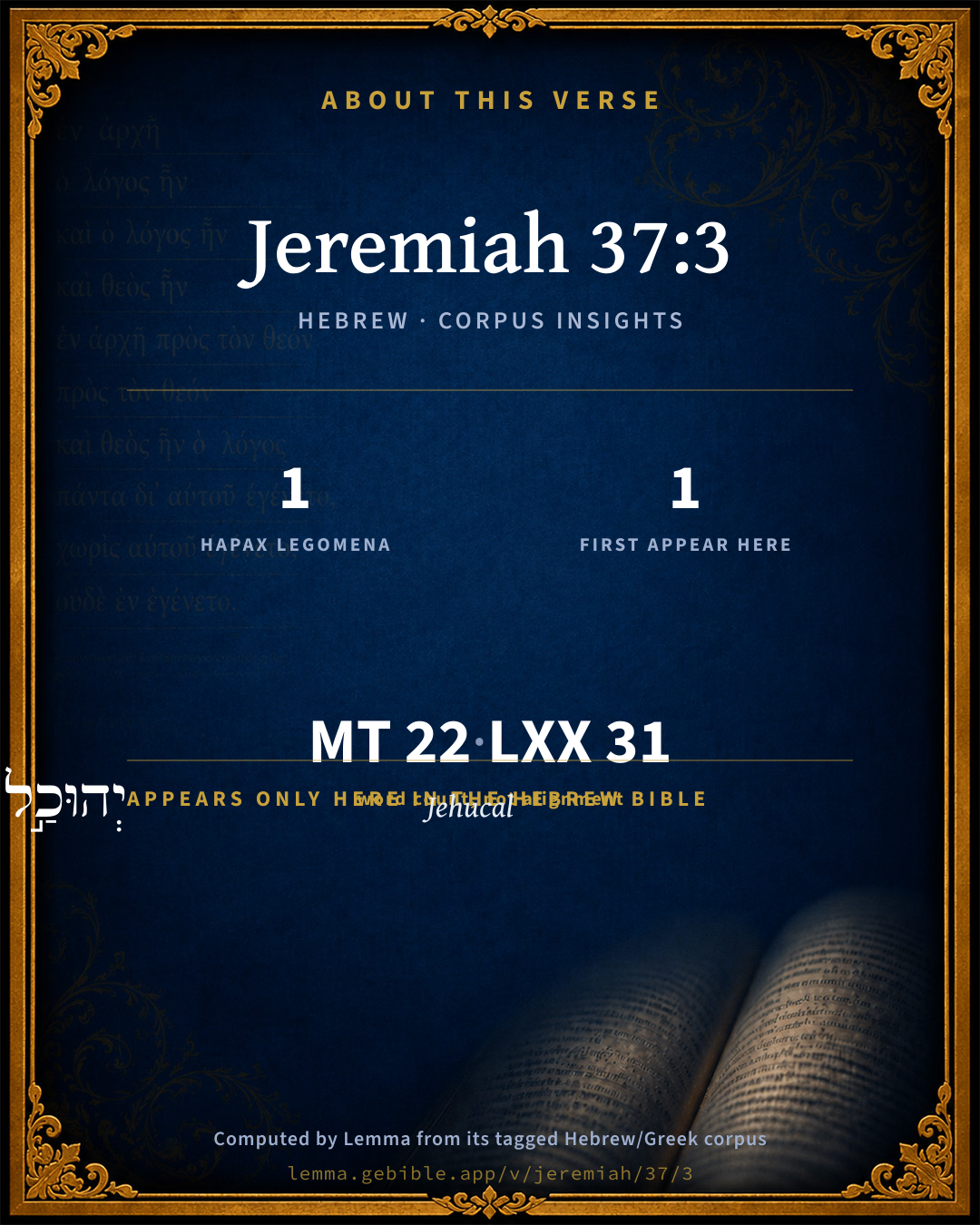
  • 1 hapax legomenon — only here in the Hebrew Bible
  • 1 first appearance in the Hebrew Bible
Full analysis ↓
Download a study sheet

One document with this verse’s original text, its word-by-word gloss line, the meaning frame, cross-references with their text, attributed commentary, and full source and license credits — printable, and it pastes into notes with its structure intact.

This verse Autodidact and up

Study sheet (.html) Plain text (.txt)

A passage Seminary Student

Up to 50 verses in one chapter. A passage sheet keeps up to 6 commentary sources and 12 cross-references per verse, in the order this page ranks them, and says so on the sheet whenever that leaves anything out. Ask for a single verse and you get the Autodidact verse sheet above.

Everything on this page stays free to read, with no account — the sheet is a download of what is already on screen, not access to it.

Want to remove ads? Support Godless Engineer
Compare translations 3

The same verse in 3 English versions, stacked beneath the original-language interlinear above. Click any original word for its lexicon entry.

Each is an independent rendering of the whole verse — the interlinear is not word-aligned to these translations.

Highlighted words mark where these versions differ — a whole-verse word diff, not a word-by-word alignment.

  • World English Bible Public Domain
    Zedekiah the king sent Jehucal the son of Shelemiah, and Zephaniah the son of Maaseiah, the priest, to the prophet Jeremiah, saying, Pray now to Yahweh our God for us.
  • King James Version Public Domain
    And Zedekiah the king sent Jehucal the son of Shelemiah and Zephaniah the son of Maaseiah the priest to the prophet Jeremiah, saying, Pray now unto the LORD our God for us.
  • unfoldingWord Literal Text CC BY-SA 4.0
    So King Zedekiah, Jehucal son of Shelemiah, and Zephaniah son of Maaseiah the priest sent a message to Jeremiah the prophet. They said, “Pray on our behalf to Yahweh our God.”

unfoldingWord Literal Text — © unfoldingWord, licensed CC BY-SA 4.0. Word-aligned USFM3 via Door43 (git.door43.org/unfoldingWord/en_ult).

Versions to compare (up to 4)

3 of 4 selected

Show all 18 translations

Every available English version of this verse, each an independent rendering of the whole verse.

  • World English Bible Public Domain
    Zedekiah the king sent Jehucal the son of Shelemiah, and Zephaniah the son of Maaseiah, the priest, to the prophet Jeremiah, saying, Pray now to Yahweh our God for us.
  • Berean Standard Bible Public Domain
    Yet King Zedekiah sent Jehucal son of Shelemiah and Zephaniah the priest, the son of Maaseiah, to Jeremiah the prophet with the message, “Please pray to the LORD our God for us!”
  • Majority Standard Bible Public Domain
    Yet King Zedekiah sent Jehucal son of Shelemiah and Zephaniah the priest, the son of Maaseiah, to Jeremiah the prophet with the message, “Please pray to the LORD our God for us!”
  • King James Version Public Domain
    And Zedekiah the king sent Jehucal the son of Shelemiah and Zephaniah the son of Maaseiah the priest to the prophet Jeremiah, saying, Pray now unto the LORD our God for us.
  • American Standard Version (1901) Public Domain
    And Zedekiah the king sent Jehucal the son of Shelemiah, and Zephaniah the son of Maaseiah, the priest, to the prophet Jeremiah, saying, Pray now unto Jehovah our God for us.
  • Revised Version (1885) Public Domain
    And Zedekiah the king sent Jehucal the son of Shelemiah, and Zephaniah the son of Maaseiah the priest, to the prophet Jeremiah, saying, Pray now unto the LORD our God for us.
  • Geneva Bible (1599) Public Domain
    And Zedekiah the King sent Iehucal the sonne of Shelemiah, and Zephaniah the sonne of Maaseiah the Priest to the Prophet Ieremiah, saying, Pray now vnto the Lord our God for vs.
  • Douay-Rheims (1899) Public Domain
    And king Sedecias sent Juchal the son of Selemias, and Sophonias the son of Maasias the priest to Jeremias the prophet, saying: Pray to the Lord our God for us.
  • Young's Literal Translation Public Domain
    And Zedekiah the king sendeth Jehucal son of Shelemiah, and Zephaniah son of Maaseiah the priest, unto Jeremiah the prophet, saying, `Pray, we beseech thee, for us unto Jehovah our God.'
  • Literal Standard Version CC BY-SA 4.0
    And Zedekiah the king sends Jehucal son of Shelemiah, and Zephaniah son of Maaseiah the priest, to Jeremiah the prophet, saying, “Pray, we implore you, for us to our God YHWH.”
  • Unlocked Literal Bible CC BY-SA 4.0
    So King Zedekiah, Jehukal son of Shelemiah, and Zephaniah son of Maaseiah the priest sent a message to Jeremiah the prophet. They said, “Pray on our behalf to Yahweh our God.”
  • unfoldingWord Literal Text CC BY-SA 4.0
    So King Zedekiah, Jehucal son of Shelemiah, and Zephaniah son of Maaseiah the priest sent a message to Jeremiah the prophet. They said, “Pray on our behalf to Yahweh our God.”
  • Darby Bible Public Domain
    And Zedekiah the king sent Jehucal the son of Shelemiah, and Zephaniah the son of Maaseiah the priest to the prophet Jeremiah, saying, Pray now unto Jehovah our God for us.
  • World Messianic Bible Public Domain
    Zedekiah the king sent Jehucal the son of Shelemiah and Zephaniah the son of Maaseiah, the priest, to the prophet Jeremiah, saying, “Pray now to the LORD our God for us.”
  • Webster's Bible Public Domain
    And Zedekiah the king sent Jehucal the son of Shelemiah and Zephaniah the son of Maaseiah the priest to the prophet Jeremiah, saying, Pray now to the LORD our God for us.
  • Free Bible Version CC BY-SA 4.0
    However, King Zedekiah sent Jehucal son of Shelemiah and Zephaniah the priest, son of Maaseiah, to Jeremiah the prophet with the message, “Please pray to the Lord our God for us!”
  • Bible in Basic English Public Domain
    And Zedekiah the king sent Jehucal, the son of Shelemiah, and Zephaniah, the son of Maaseiah the priest, to the prophet Jeremiah, saying, Make prayer now to the Lord our God for us.
  • JPS Tanakh (1917) Public Domain
    And Zedekiah the king sent Jehucal the son of Shelemiah, and Zephaniah the son of Maaseiah the priest, to the prophet Jeremiah, saying: 'Pray now unto the LORD our God for us.'

Literal Standard Version (2020), Covenant Press — licensed CC BY-SA 4.0. Text via the HelloAO Bible API (eBible.org). Unlocked Literal Bible (unfoldingWord) — licensed CC BY-SA 4.0. Text via the HelloAO Bible API (eBible.org). unfoldingWord Literal Text — © unfoldingWord, licensed CC BY-SA 4.0. Word-aligned USFM3 via Door43 (git.door43.org/unfoldingWord/en_ult). Free Bible Version, Dr. Jonathan Gallagher — licensed CC BY-SA 4.0. Text via the HelloAO Bible API (eBible.org).

Word by word

More ways to search: Search by grammar → Find every occurrence → Compare this word →

Practice this passage: Drill this verse → Learn its vocabulary →

יְהוּכַ֣ל
Yᵉhûwkal
H3081
“Jehucal”
Noun, Proper
Part of Speech
Noun
Type
Proper
Full BDB Definition

Origin: from H3201

TWOT: None

Jehucal = "Jehovah is able" - a son of Shelemiah and a servant of king Zedekiah whom he sent to Jeremiah to entreat his prayers and advice
  1. וַיִּשְׁלַח֩ shâlach H7971 “and · to send” Conjunction + Verb, Qal, Sequential Imperfect, 3rd Person, Masculine, Singular
  2. הַמֶּ֨לֶךְ melek H4428 “the · king” Particle, Definite Article + Noun, Common, Masculine, Singular, Absolute
  3. צִדְקִיָּ֜הוּ Tsidqîyâh H6667 “Zedekiah” Noun, Proper
  4. אֶת ʼêth H853 “-” Particle, Direct Object
  5. בֶּן bên H1121 “son of” Noun, Common, Masculine, Singular, Construct
  6. שֶֽׁלֶמְיָ֗ה Shelemyâh H8018 “Shelemiah” Noun, Proper
  7. וְאֶת ʼêth H853 “and · -” Conjunction + Particle, Direct Object
  8. צְפַנְיָ֤הוּ Tsᵉphanyâh H6846 “Zephaniah” Noun, Proper
  9. בֶן bên H1121 “son of” Noun, Common, Masculine, Singular, Construct
  10. מַֽעֲשֵׂיָה֙ Maʻăsêyâh H4641 “Maaseiah” Noun, Proper
  11. הַכֹּהֵ֔ן kôhên H3548 “the · priest” Particle, Definite Article + Noun, Common, Masculine, Singular, Absolute
  12. אֶל ʼêl H413 “to” Preposition
  13. יִרְמְיָ֥הוּ Yirmᵉyâh H3414 “Jeremiah” Noun, Proper
  14. הַנָּבִ֖יא nâbîyʼ H5030 “the · prophet” Particle, Definite Article + Noun, Common, Masculine, Singular, Absolute
  15. לֵאמֹ֑ר ʼâmar H559 “to say” Preposition + Verb, Qal, Infinitive Construct
  16. הִתְפַּלֶּל pâlal H6419 “pray” Verb, Hithpael, Imperative, 2nd Person, Masculine, Singular
  17. נָ֣א nâʼ H4994 “please” Particle, Exhortation
  18. בַעֲדֵ֔נוּ bᵉʻad H1157 “behind · us” Preposition + Suffix, Personal, 1st Person, Common, Plural
  19. אֶל ʼêl H413 “to” Preposition
  20. יְהוָ֖ה Yᵉhôvâh H3068 “LORD” Noun, Proper
  21. אֱלֹהֵֽינוּ ʼĕlôhîym H430 “God(s) · our” Noun, Common, Masculine, Plural, Construct + Suffix, Personal, 1st Person, Common, Plural

About this verse

These counts appear in no published source. They are computed here, from the morphology-tagged text and Lemma’s own curated glosses. What Lemma adds →

22
words
19
distinct lemmas
Prophets
section

Notable vocabulary

1 hapax legomenon — a word that appears only here in the entire Hebrew Bible:

  • יְהוּכַ֣ל Jehucal H3081

First appearance in Scripture

This word makes its first canonical appearance in the Hebrew Bible here:

  • יְהוּכַ֣ל Jehucal H3081

Shared distinctive vocabulary

שֶֽׁלֶמְיָ֗ה Shelemiah H8018 occurs in 10 verses of the Hebrew Bible. Also found in:

Grammatical profile

  • 3 verbs
  • 13 nouns
  • 3 prepositions
  • 3 particles

Verb forms

  • וַיִּשְׁלַח֩ Qal · Sequential Imperfect
  • לֵאמֹ֑ר Qal · Infinitive Construct
  • הִתְפַּלֶּל Hithpael · Imperative

Repetition

Words recur within this verse — often emphatic in Hebrew:

Hebrew & Septuagint length

In the original languages it is 22 Hebrew tokens and 31 Greek tokens — but the two are counted differently (Hebrew bundles its prefixes and suffixes into one token; the Greek is in lemma form), so that isn’t a like-for-like length.

Cross-references

16

Topical passages linked to Jeremiah 37:3 in the Treasury of Scripture Knowledge — connected by theme and wording, ordered by reader-vote popularity; previews shown in the World English Bible.

  • Jeremiah 21:1–2 The word which came to Jeremiah from Yahweh, when king Zedekiah sent to him Pashhur the son of Malchijah, and Zephaniah the son of Maaseiah, the priest, saying,
  • 1 Kings 13:6 The king answered the man of God, Entreat now the favor of Yahweh your God, and pray for me, that my hand may be restored me again. The man of God entreated Yahweh, and the king's hand was restored him again, and became as it was before.
  • Jeremiah 2:27 who tell a stock, You are my father; and to a stone, You have brought me forth: for they have turned their back to me, and not their face; but in the time of their trouble they will say, Arise, and save us.
  • Jeremiah 29:25 Thus speaks Yahweh of Hosts, the God of Israel, saying, Because you have sent letters in your own name to all the people who are at Jerusalem, and to Zephaniah the son of Maaseiah, the priest, and to all the priests, saying,
  • Jeremiah 42:2–4 and said to Jeremiah the prophet, Let, we pray you, our supplication be presented before you, and pray for us to Yahweh your God, even for all this remnant; for we are left but a few of many, as your eyes do see us:
  • Jeremiah 42:20 For you have dealt deceitfully against your own souls; for you sent me to Yahweh your God, saying, Pray for us to Yahweh our God; and according to all that Yahweh our God shall say, so declare to us, and we will do it:
  • Jeremiah 52:24 The captain of the guard took Seraiah the chief priest, and Zephaniah the second priest, and the three keepers of the threshold:
  • Exodus 8:8 Then Pharaoh called for Moses and Aaron, and said, "Entreat Yahweh, that he take away the frogs from me, and from my people; and I will let the people go, that they may sacrifice to Yahweh."
  • Exodus 8:28 Pharaoh said, "I will let you go, that you may sacrifice to Yahweh your God in the wilderness, only you shall not go very far away. Pray for me."
  • Exodus 9:28 Pray to Yahweh; for there has been enough of mighty thunderings and hail. I will let you go, and you shall stay no longer."
  • Exodus 10:17 Now therefore please forgive my sin again, and pray to Yahweh your God, that he may also take away from me this death."
  • Numbers 21:7 The people came to Moses, and said, We have sinned, because we have spoken against Yahweh, and against you; pray to Yahweh, that he take away the serpents from us. Moses prayed for the people.
  • 1 Samuel 12:19 All the people said to Samuel, Pray for your servants to Yahweh your God, that we not die; for we have added to all our sins [this] evil, to ask us a king.
  • Jeremiah 29:21 Thus says Yahweh of Hosts, the God of Israel, concerning Ahab the son of Kolaiah, and concerning Zedekiah the son of Maaseiah, who prophesy a lie to you in my name: Behold, I will deliver them into the hand of Nebuchadrezzar king of Babylon; and he shall kill them before your eyes;
  • Jeremiah 38:1 Shephatiah the son of Mattan, and Gedaliah the son of Pashhur, and Jucal the son of Shelemiah, and Pashhur the son of Malchijah, heard the words that Jeremiah spoke to all the people, saying,
  • Acts 8:24 Simon answered, "Pray for me to the Lord, that none of the things which you have spoken happen to me."

Cross-references courtesy of OpenBible.info (CC BY 4.0).

Hebrew and Greek witnesses Masoretic Hebrew ↔ Greek Septuagint

The same verse in the two great witnesses to the Old Testament, shown verse-for-verse.

These are two independent witnesses, not word-aligned to each other, and the Septuagint is shown in lemma (dictionary) form.

Hebrew Jeremiah 37:3 Masoretic · Westminster Leningrad Codex

וַיִּשְׁלַח֩ הַמֶּ֨לֶךְ צִדְקִיָּ֜הוּ אֶת יְהוּכַ֣ל בֶּן שֶֽׁלֶמְיָ֗ה וְאֶת צְפַנְיָ֤הוּ בֶן מַֽעֲשֵׂיָה֙ הַכֹּהֵ֔ן אֶל יִרְמְיָ֥הוּ הַנָּבִ֖יא לֵאמֹ֑ר הִתְפַּלֶּל נָ֣א בַעֲדֵ֔נוּ אֶל יְהוָ֖ה אֱלֹהֵֽינוּ

Zedekiah the king sent Jehucal the son of Shelemiah, and Zephaniah the son of Maaseiah, the priest, to the prophet Jeremiah, saying, Pray now to Yahweh our God for us.

World English Bible · Public Domain

Greek LXX Structure differs

In the Septuagint, Jeremiah is about an eighth shorter than the Hebrew and arranges its material differently — the Oracles Against the Nations (Hebrew chapters 46–51) appear in the middle of the Greek book, after 25:13. Because the chapter and verse boundaries do not line up, a verse-for-verse comparison with the Hebrew is not shown.

A verse-for-verse comparison isn’t shown here because the chapters and verses don’t line up. Switch to the LXX edition with the MT / LXX toggle above to read the Greek directly.

Hebrew: Westminster Leningrad Codex (CC BY 4.0). Greek: Septuagint (public domain); English from a public-domain English Septuagint. How the Septuagint differs from the Hebrew →

Targum (Aramaic paraphrase)

1

The Targum is the ancient Jewish Aramaic paraphrase of the Hebrew Scriptures — an interpretive translation, not the Hebrew text itself. Onkelos (literal) and Pseudo-Jonathan (expansive) render the Torah, and Jonathan the Prophets. Coverage is partial: where no permissively-licensed English translation exists for a verse, only the Aramaic is shown. This is verse-level text, not a word-by-word alignment to the Hebrew.

  1. Targum Jonathan Prophets (Joshua–Malachi)
    וּשְׁלַח מַלְכָּא צִדְקִיָהוּ יַת יְהוּכַל בַּר שֶׁלֶמְיָה וְיַת צְפַנְיָה בַּר מַעֲשֵׂיָה כַּהֲנָא לְוַת יִרְמְיָה נְבִיָא לְמֵימָר צַלִי כְעַן עֲלָנָא קֳדָם יְיָ אֱלָהָנָא:

    (no public-domain English translation for this verse)

    Targum Jonathan — Aramaic: “Mikraot Gedolot” (public domain). English: “Sefaria Community Translation” (CC0 1.0 (public-domain dedication)); “London "Chaldee Paraphrase," 1871” (public domain). Text via Sefaria.

Commentary

Notes on Jeremiah 37:3 from classic Christian and Jewish commentators (each source and its license shown beneath its notes). The classic Christian expositions comment on the surrounding passage and are grouped to its opening verse, so a note may address several verses; the Jewish commentaries on the Tanakh (Rashi and others) are per-verse, so they appear only where the commentator wrote on this verse.

Lemma curates 59 commentaries, every one of them public domain or Creative Commons licensed, each selected and text-cleaned for this edition rather than reprinted as found. About our sources →

Jamieson, Fausset & Brown

Robert Jamieson, A. R. Fausset & David Brown

Zedekiah . . . sent--fearing lest, in the event of the Chaldeans overcoming Pharaoh-hophra, they should return to besiege Jerusalem. See on Jer 21:1; that chapter chronologically comes in between the thirty-seventh and thirty-eighth chapter. The message of the king to Jeremiah here in the thirty-seventh chapter is, however, somewhat earlier than that in the twenty-first chapter; here it is while the issue between the Chaldeans and Pharaoh was undecided; there it is when, after the repulse of Pharaoh, the Chaldeans were again advancing against Jerusalem; hence, while Zephaniah is named in both embassies, Jehucal accompanies him here, Pashur there. But, as Pashur and Jehucal are both mentioned in Jer 38:1-2, as hearing Jeremiah's reply, which is identical with that in Jer 21:9, it is probable the two messages followed one another at a short interval; that in this Jer 37:3, and the answer, Jer 37:7-10, being the earlier of the two.

Zephaniah--an abettor of rebellion against God (Jer 29:25), though less virulent than many (Jer 29:29), punished accordingly (Jer 52:24-27).

Jamieson, Fausset & Brown — Commentary Critical and Explanatory on the Whole Bible (1871) — public domain (CC PDM 1.0). Text via the HelloAO Bible API.

Trapp's Complete Commentary

John Trapp

Jer 37:3 And Zedekiah the king sent Jehucal the son of Shelemiah and Zephaniah the son of Maaseiah the priest to the prophet Jeremiah, saying, Pray now unto the LORD our God for us.

Ver. 3. Pray now unto the Lord our God for us.] This king would seem to have some more goodness in him than his brother and predecessor Jehoiakim; but he played the hypocrite exceedingly, as in other things, so in this, that he begged the prophet’s prayers, but would not obey his preaching. The like did Pharaoh, Saul, Simon Magus, &c. Hezekiah sent to the prophet Isaiah for prayers, but withal he humbled himself and lived holily, which Zedekiah did not.

John Trapp, A Commentary or Exposition upon All the Books of the Old and New Testament (1647–1656) — public domain. Text from a community e-Sword module.

Joseph Benson's Commentary

Jer 37:3-5. Zedekiah sent Jehucal the son of Shelemiah — This man came in the place of Pashur, who, together with Zephaniah, brought the former message from Zedekiah; saying, Pray now unto the Lord our God for us — Wicked men of all ranks are desirous, in their distresses, of the prayers of those whose counsels and admonitions they never regard while they are in prosperity, which is a plain evidence of their acting contrary to the convictions of their own consciences. Now Jeremiah came in and went out among the people — That is, he was not yet put in prison as he afterward was: see Jer 37:15; Jer 32:2. Jerusalem also, for the present, was at liberty, for Pharaoh’s army was come forth out of Egypt, &c. — “Zedekiah, contrary to the oath that he had given to Nebuchadnezzar, made an alliance with the king of Egypt, and contracted with him for assistance against the king of Babylon; whereupon the king of Egypt sent an army to his relief: see Eze 17:15; which obliged the Chaldeans to raise the siege of Jerusalem, that they might go and fight this army.” — Lowth. During this time, it seems, it was that Zedekiah sent to desire the prophet to pray for them.

Joseph Benson's Commentary on the Old and New Testaments (1811–1818) — public domain. Text from a community e-Sword module.

Tyndale Open Study Notes

Tyndale Open Resources

37:3-4 In asking for prayer, Zedekiah apparently hoped that Jeremiah’s petitions would magically defeat the enemy (see 14:7-9 and corresponding study note).

Tyndale Open Study Notes — © Tyndale Open Resources, licensed CC BY-SA 4.0. Text via the HelloAO Bible API.

Geneva Bible (1599)

Geneva Bible translators

Because he was afraid of the Chaldeans that came against him.

Geneva Bible (1599) marginal notes — public domain. Text via Bolls.life.

Adam Clarke's Commentary

Verse 3. Zedekiah - to the prophet Jeremiah] He was willing to hear a message from the Lord, provided it were according to his own mind. He did not fully trust in his own prophets.

Adam Clarke's Commentary on the Bible (1810–1826) — public domain. Text from a community e-Sword/MySword module.

John Calvin's Commentaries

Jeremiah had briefly explained what was the state of the city and the land, that though they had been already severely chastised by God’s scourges, they yet remained obstinate in their wickedness. He now adds, that messengers were sent to him by King Zedekiah, when danger arose from the Chaldeans; and it is probable that this message came to Jeremiah when the siege was raised, or if the siege still continued, it was at a time when the Jews, no doubt, flattered themselves with the hope of receiving some aid, while yet they saw that the power of the king of Babylon was very great. For though they hoped for some help from the Egyptians, they were yet perplexed, and fear constrained the king to send messengers to the Prophet Jeremiah. But it appears from the answer that the Egyptians were already in arms, and had also come out for the purpose of raising the siege, and driving the Chaldeans from Judea. We hence see that the king was, in a measure, elated with vain confidence, seeing that the Egyptians were coming with a strong army to assist him, and yet he was full of anxiety, as the ungodly must ever be: while they seek to confirm themselves in a state of security, they are still tossed here and there, for God’s judgment is upon them. They are fearful, though they try to shake off fear. Hence Zedekiah, though he thought that he should soon be freed from all danger, yet could not wholly divest himself of anxiety, and therefore sent to Jeremiah: for the ungodly are wont to seek God, but not in earnest; they wish to discharge the outward duty, but they bring neither faith nor repentance, by which alone access to God is opened.

John Calvin's Commentaries (1540-1563) — public domain. Text from the Calvin Translation Society English edition (1840s-50s) via the Christian Classics Ethereal Library (ccel.org). Calvin's coverage is partial (roughly two-thirds of the Bible); uncommented books and verses are honest gaps, never fabricated. The 19th-century editor's footnotes and remarks are omitted so the notes are faithfully Calvin's own voice.

Ellicott's Commentary for English Readers

(3) And Zedekiah the king sent Jehucal . . .—The time and, probably, occasion of the mission is given in Jer_37:5. The Chaldæans had raised the siege of Jerusalem on hearing of the approach of the Egyptian army under Pharaoh-Hophra, the Apries of Herodotus (Herod. ii. 161-169. Eze_17:15, Eze_29:1-16, Ezekiel 30-32.), and the king seems to have thought that an opportunity presented itself for asserting his independence, and wished to gain the sanction and the prayers of the prophet for this policy. Of the two officers who are here named, Jehucal appears as accusing the prophets in Jer_38:1, Zephaniah in Jer_21:1; Jer_29:25. They clearly belonged to the anti-Chaldæan party, and were therefore, for the most part, openly hostile to the prophet. Their application to him was either simply an official act in obedience to the king’s commands, or sprang from the hope, as before in Jer_21:1, that they might, by a show of religious zeal for Jehovah, win him over to their cause. The stress which they lay on his praying to “the Lord our God” indicates the latter alternative as probable.

A Bible Commentary for English Readers, edited by Charles John Ellicott (1878–1897) — public domain. Text from a community e-Sword module.

The Cambridge Bible for Schools and Colleges

gen. ed. J. J. S. Perowne

3. And Zedekiah the king sent] This mission took place later than that related in ch. Jer_21:1, which was sent when Nebuchadnezzar’s army was approaching Jerusalem. In this case on the contrary the siege had begun and had been raised, and the hopes of the people were excited in consequence.

Jehucal] In ch. Jer_38:4 he (“Jucal”) proposes that Jeremiah should be put to death.

Zephaniah] See chs. Jer_21:1, Jer_29:25.

The Cambridge Bible for Schools and Colleges (gen. ed. J. J. S. Perowne; Cambridge University Press, 1878–1918) — public domain. Text from a community e-Sword module.

John Gill's Exposition

And Zedekiah the king sent Jehucal the son of Shelemiah, and Zephaniah the son of Maaseiah the priest,.... That is, Zephaniah the priest, as the accents shaw; though his father Maaseiah was doubtless a priest too; according to the Syriac version, both Jehucal, called Jucal, Jer 38:1; and Zephaniah, were priests; since it reads in the plural number, "priests": these the king sent as messengers

to the Prophet Jeremiah, saying, pray now unto the Lord our God for us. This message was sent either upon the rumour of the Chaldeans coming against Jerusalem, as some think; or rather when it had departed from the city, and was gone to meet the army of the king of Egypt; so that this petition to the prophet was to pray that the king of Egypt alight get the victory over the Chaldean army, and that that might not return unto them. Thus wicked men will desire the prayers of good men in times of distress, when their words, their cautions, admonitions, exhortations, and prayers too, are despised by them at another time.

John Gill's Exposition of the Whole Bible (1746–1763) — public domain (CC PDM 1.0). Text via the HelloAO Bible API.

Albert Barnes' Notes on the Bible

This embassy is not to be confounded with that Jer 21:1 which took place when Nebuchadnezzar was just marching upon Jerusalem; this was in the brief interval of hope occasioned by the approach of an Egyptian army to raise the siege. The Jews were elated by this temporary relief, and miserably abused it Jer 34:11. Zedekiah seems to some extent to have shared their hopes, and to have expected that the prophet would intercede for the city as successfully as Isaiah had done Isa 37:6. Jehucal was a member of the warlike party Jer 38:1, as also was the deputy high priest Zephaniah, but otherwise he was well affected to Jeremiah.

Albert Barnes' Notes on the Bible (1834–1885) — public domain. Text from a community e-Sword/MySword module.

Haydock's Catholic Bible Commentary

Pray, or consult. He wished to know whether the Chaldeans would return. (Calmet) --- He feared, yet ill-treated the prophet, as Herod did John the Baptist. (Worthington)

George Leo Haydock (1774–1849), Haydock's Catholic Family Bible and Commentary, 1859 edition — public domain. Excludes Psalms (Douay-Rheims chapter numbering differs from Protestant) and Deuterocanonical books (Catholic canon only).

Matthew Poole's English Annotations

This was apparently in the time of the siege; for, Jer 37:5, we read of Pharaoh’s army being come to relieve the besieged, whether it was before the Babylonians were departed, or no, is uncertain; but it is plain, if they were departed, the king was afraid they would come back again. That which is most observable for us from hence is this, that wicked men of all ranks are desirous of the prayers of those ministers in their distresses, whose counsels and admonitions they never regard while they are in a time of prosperity; which is an evidence of their acting contrary to the convictions of their consciences, in obedience to their lusts, in their contempt of their instructions and admonitions. When affliction hath cooled their lusts, then their consciences can be heard in dictating their duty to them.

Matthew Poole's English Annotations on the Holy Bible (1683–1685) — public domain. Text from a community e-Sword/MySword module.

Whedon's Commentary on the Bible

Daniel D. Whedon

3. Zedekiah… sent — This is not the same incident that is given in chap.

Jer_21:9. That took place when the Chaldeans were first approaching Jerusalem — this in the interval of hope produced by the approach of the Egyptian army to raise the siege. But this was before Jeremiah was imprisoned.

Daniel D. Whedon (gen. ed.), Commentary on the Old and New Testaments (1874–1909) — public domain. Text from a community e-Sword module.

The Pulpit Commentary

And Zedekiah the king sent. This was Zedekiah"s second embassy to Jeremiah. His request on the former occasion bad been for a prophecy; on the present it was for an "effectual fervent prayer," such as Hezekiah"s embassy asked of Isaiah. (Isa_37:6) But the issue was to be very different from that in the case of Sennacherib"s invasion! Jehucal. The same man appears in Jer 38:l, among those who brought about the imprisonment of Jeremiah. Zephaniah. The high priest"s deputy, mentioned again in Jer_21:1 Jer_29:25 Jer_52:24.

HOMILIES BY D. YOUNG Ver. 3. A request for intercession.

A request of this kind has always to be looked at through the character of the man who prefers it. It makes all the difference whether it be the utterance of grovelling superstition or of enlightened piety. It is a long way from this request of Zedekiah to the request of Paul: "Brethren, pray for us." Let us try to estimate

I THE NOTION ZEDEKIAH HAD OF GOD. A notion evidently altogether detached from any considerations of character; we are told in ver. 2 that Zedediah did not hearken to the words of the Lord through his prophet Jeremiah, and we could infer as much from the request here addressed to the prophet. Zedekiah looked upon Jehovah pretty much as he did upon the deities of surrounding nations. The notion was that the immense power of these deities could be turned in any direction desired, if only they were sufficiently propitiated. Now, if Zedekiah had cared to attend to the volume of prophecy, he would have seen very clearly that he who comes to God must believe that he is a God who will not pass over the misgovernment, the cruelty, the injustice, of human kings. And so when we come to God our prayers will have reality just in proportion as they show a distinct understanding of the character of God.

II THE NOTION ZEDEKIAH HAD OF PRAYER. Had he indeed any notion at all? Did he mean anything more than that Jeremiah should go and do whatever he thought necessary and effectual? Intercessory prayer can be of little use to those who do not pray for themselves. Zedekiah wanted a certain end, namely, that by help of Egypt he should repel the Chaldeans. And he looked upon Jehovah as being a sort of heavenly Pharaoh. And just as he had sent, doubtless, one ambassador to ask for Pharaoh"s help, so now he wants to make Jeremiah an ambassador to Jehovah. This was all very foolish, ignorant, and presumptuous on Zedekiah"s part; but what better are we when we make up our prayers of petitions for things that we desire without stopping to consider that no petition is worth anything unless it not merely accords with the will of God, but even springs from that will? The use of prayer is that God may serve us according to his estimate of our needs, not according to our estimate.

III THE NOTION ZEDEKIAH HAD OF THE PROPHET. He had a superstitious feeling that Jeremiah could do something for him he could not do for himself. We see here the secret of the power of priestcraft. We see how it was that false prophets got such a hold. We see how it is that priestcraft and spiritual dictation still prevail. The great bulk of men will not do the right thing towards God, they will not repent and crucify self, but a deep necessity impels them to do something, and so they seek to other men. Zedekiah was making an altogether wrong use of the prophet. His duty was to obey the prophet"s messages, then he would not have needed to ask Jeremiah to pray for him. And let all people understand with respect to ministers of religion, that they exist to teach and help in a brotherly way; hut that also they are frail and fallible, and possess no mystic virtue to make their prayers more efficacious than the prayers of other people. Intercessory prayer is the duty, the privilege, the power, of every Christian. Y.

The Pulpit Commentary (1880–1919), ed. H.D.M. Spence-Jones & Joseph S. Exell — public domain. Text from a community e-Sword module.

unfoldingWord translationNotes

Door43 World Missions Community

Jehukal

man's name (See: How to Translate Names)

Shelemiah

See how you translated this man's name in Jeremiah 36:14. (See: How to Translate Names)

Zephaniah son of Maaseiah the priest

See how you translated these men's names in Jeremiah 21:1.

on our behalf

"for us" or "for our sake." The word "our" refers to King Zedekiah and the rest of the people of Judah.

Now

This word is used here to mark a break in the main story line. The narrator tells background information about what Jeremiah had been doing before Zedekiah sent the message. (See: Background Information)

Jeremiah was coming and going among the people

Here "coming and going" is an idiom that means he was free to move about. AT: "Jeremiah was able to go wherever he wanted with everybody else" (See: Idiom)

for he had not yet been put in prison

This can be translated in active form. AT: "because no one had put him in prison" (See: Active or Passive)

came out

"had set out"

besieging

See how you translated this in Jeremiah 32:2.

translationWords

king

Zedekiah

Zephaniah

priest

send

Jeremiah

prophet

pray

Yahweh

God

prison

Pharaoh

Egypt

Chaldea

Jerusalem

unfoldingWord translationNotes — © Distant Shores Media and the Door43 World Missions Community, licensed CC BY-SA 4.0. Source: git.door43.org/Door43/en_tn.

Lesson kit

Teaching starters — assembled from the data on this page, not authored interpretation. Every prompt links to the verse data it draws on. Edit before teaching.

Jeremiah, in the Prophets, opens this verse with 22 words (19 distinct Hebrew lemmas). Its most distinctive word is Yᵉhûwkal (“Jehucal”). A historical commentator’s framing appears above. Read the whole chapter for the surrounding context.

Discussion questions

  1. How does “Jehucal” (Yᵉhûwkal) shape what this verse is saying?
  2. This verse holds 1 word here found nowhere else in the Hebrew Bible. What might the rare word draw attention to?
  3. The word “Jehucal” first appears here in Scripture. What is being introduced at this debut?
  4. 1 Chronicles 26:14 shares the word «Shelemiah» with this verse. How do the two illuminate each other?
  5. “son” occurs 2× in this one verse. What is the effect of the repetition?
  6. These translations render this verse differently; the difference is in the English rendering, not the original. What questions does that raise?
  7. The verb «וַיִּשְׁלַח֩» is Qal Sequential Imperfect. How does its form color the action?
  8. Reading how Jamieson, Fausset & Brown and Trapp's Complete Commentary read this verse, where do the two commentators agree and where do they part?

Things to notice

  • 1 word in this verse appears nowhere else in the Hebrew Bible.
  • 1 word makes its first canonical appearance in Scripture here.
  • This verse counts 22 Hebrew ↔ 31 Greek words.
  • These translations choose different wording for 8 words in this verse.
  • “son” occurs 2× in this single verse.

Reading settings

Reading text

Shown beneath each verse's original-language words.

Old Testament
Old Testament edition

Read the OT as the Masoretic Hebrew (MT) or the Greek Septuagint (LXX).

English shown for the Greek Septuagint (in the Hebrew ↔ Greek comparison).

Comparing translations? Open the Compare panel on any verse page to stack up to four side by side.