
Jeremiah 51:64

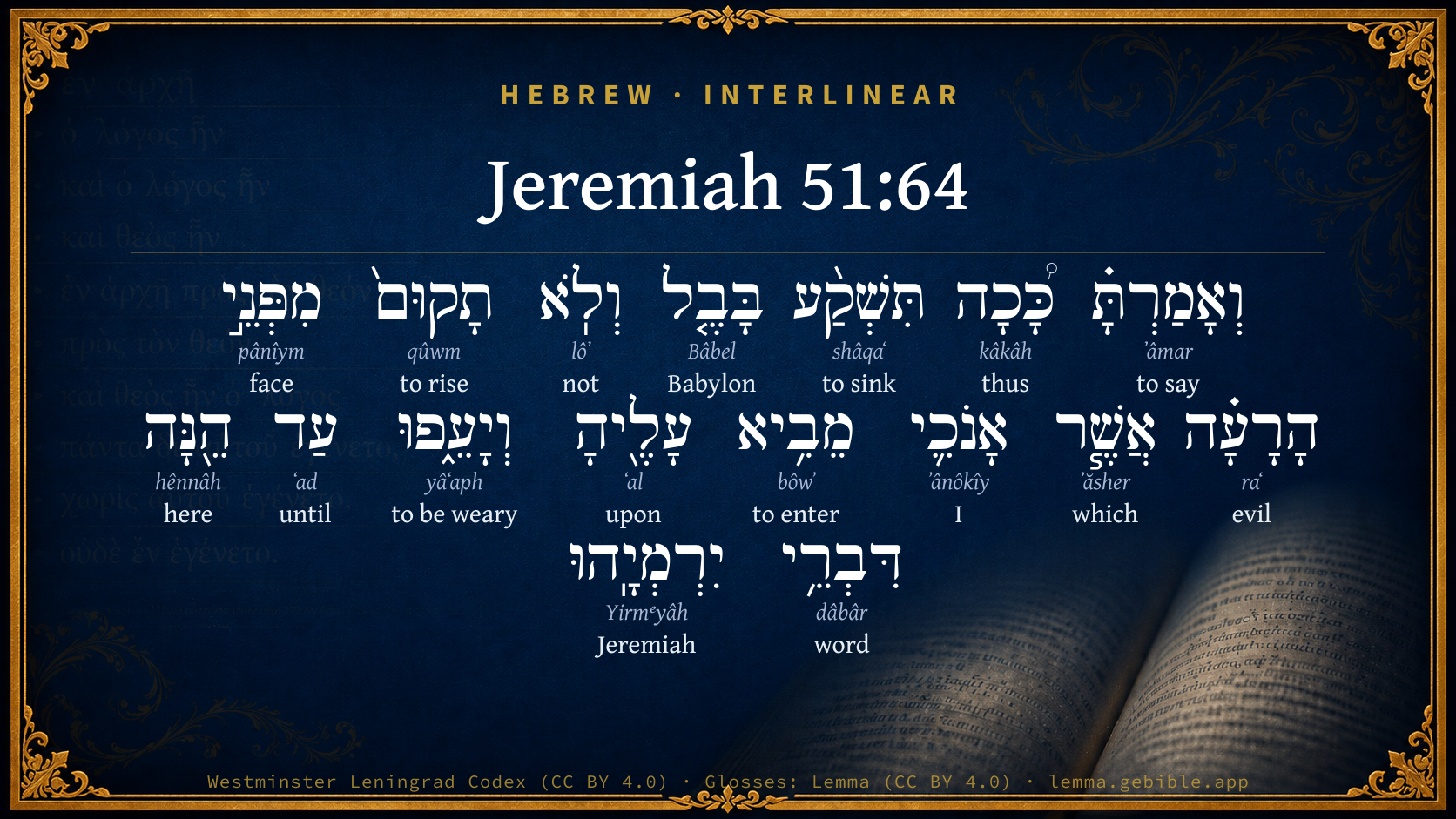
Hebrew (Westminster Leningrad Codex) Jeremiah 51:64 appears in the Hebrew Old Testament. The text above is from the Westminster Leningrad Codex. Each word links to its Strong’s number, a concise gloss, and parsing drawn from the Open Scriptures Hebrew Bible morphology. Click any word for its full Brown-Driver-Briggs (BDB) entry.
Download image
Cite this verse

Jeremiah 51:64 (World English Bible). Public Domain. Lemma interlinear Bible study tool, https://lemma.gebible.app/v/jeremiah/51/64.

Show BibTeX & RIS
BibTeX
RIS
English Translation
and you shall say, Thus shall Babylon sink, and shall not rise again because of the evil that I will bring on her; and they shall be weary. Thus far are the words of Jeremiah.
World English Bible · Public Domain
Download a study sheet

One document with this verse’s original text, its word-by-word gloss line, the meaning frame, cross-references with their text, attributed commentary, and full source and license credits — printable, and it pastes into notes with its structure intact.

This verse Autodidact and up

Study sheet (.html) Plain text (.txt)

A passage Seminary Student

Up to 50 verses in one chapter. A passage sheet keeps up to 6 commentary sources and 12 cross-references per verse, in the order this page ranks them, and says so on the sheet whenever that leaves anything out. Ask for a single verse and you get the Autodidact verse sheet above.

Everything on this page stays free to read, with no account — the sheet is a download of what is already on screen, not access to it.

Want to remove ads? Support Godless Engineer
Compare translations 3

The same verse in 3 English versions, stacked beneath the original-language interlinear above. Click any original word for its lexicon entry.

Each is an independent rendering of the whole verse — the interlinear is not word-aligned to these translations.

Highlighted words mark where these versions differ — a whole-verse word diff, not a word-by-word alignment.

  • World English Bible Public Domain
    and you shall say, Thus shall Babylon sink, and shall not rise again because of the evil that I will bring on her; and they shall be weary. Thus far are the words of Jeremiah.
  • King James Version Public Domain
    And thou shalt say, Thus shall Babylon sink, and shall not rise from the evil that I will bring upon her: and they shall be weary. Thus far are the words of Jeremiah.
  • unfoldingWord Literal Text CC BY-SA 4.0
    Say, ‘Babylon will sink like this. It will not arise because of the disaster that I am sending against it, and they will fall.’” Jeremiah’s words end here.

unfoldingWord Literal Text — © unfoldingWord, licensed CC BY-SA 4.0. Word-aligned USFM3 via Door43 (git.door43.org/unfoldingWord/en_ult).

Versions to compare (up to 4)

3 of 4 selected

Show all 18 translations

Every available English version of this verse, each an independent rendering of the whole verse.

  • World English Bible Public Domain
    and you shall say, Thus shall Babylon sink, and shall not rise again because of the evil that I will bring on her; and they shall be weary. Thus far are the words of Jeremiah.
  • Berean Standard Bible Public Domain
    Then you are to say, ‘In the same way Babylon will sink and never rise again, because of the disaster I will bring upon her. And her people will grow weary.’” Here end the words of Jeremiah.
  • Majority Standard Bible Public Domain
    Then you are to say, ‘In the same way Babylon will sink and never rise again, because of the disaster I will bring upon her. And her people will grow weary.’” Here end the words of Jeremiah.
  • King James Version Public Domain
    And thou shalt say, Thus shall Babylon sink, and shall not rise from the evil that I will bring upon her: and they shall be weary. Thus far are the words of Jeremiah.
  • American Standard Version (1901) Public Domain
    and thou shalt say, Thus shall Babylon sink, and shall not rise again because of the evil that I will bring upon her; and they shall be weary. Thus far are the words of Jeremiah.
  • Revised Version (1885) Public Domain
    and thou shalt say, Thus shall Babylon sink, and shall not rise again because of the evil that I will bring upon her: and they shall be weary. Thus far are the words of Jeremiah.
  • Geneva Bible (1599) Public Domain
    And shalt say, Thus shall Babel be drowned, and shall not rise from the euil, that I will bring vpon her: and they shall be weary. Thus farre are the wordes of Ieremiah.
  • Douay-Rheims (1899) Public Domain
    And thou shalt say: Thus shall Babylon sink, and she shall not rise up from the affliction that I will bring upon her, and she shall be utterly destroyed. Thus far are the words of Jeremias.
  • Young's Literal Translation Public Domain
    and said, Thus sink doth Babylon, and it doth not arise, because of the evil that I am bringing in against it, and they have been weary.' Hitherto `are' words of Jeremiah.
  • Literal Standard Version CC BY-SA 4.0
    and said, Thus Babylon sinks, and she does not arise, because of the calamity that I am bringing in against it, and they have been weary.” Until now [are the] words of Jeremiah.
  • Unlocked Literal Bible CC BY-SA 4.0
    Say, 'Babylon will sink like this. It will not arise because of the disaster that I am sending against it, and they will fall.'” Jeremiah's words end here.
  • unfoldingWord Literal Text CC BY-SA 4.0
    Say, ‘Babylon will sink like this. It will not arise because of the disaster that I am sending against it, and they will fall.’” Jeremiah’s words end here.
  • Darby Bible Public Domain
    and shalt say, Thus shall Babylon sink, and shall not rise, because of the evil that I will bring upon it: and they shall be weary. Thus far the words of Jeremiah.
  • World Messianic Bible Public Domain
    Then you shall say, ‘Thus will Babylon sink, and will not rise again because of the evil that I will bring on her; and they will be weary.’” Thus far are the words of Jeremiah.
  • Webster's Bible Public Domain
    And thou shalt say, Thus shall Babylon sink, and shall not rise from the evil that I will bring upon her: and they shall be weary. Thus far are the words of Jeremiah.
  • Free Bible Version CC BY-SA 4.0
    Then say, ‘This is how Babylon will sink and won't ever rise again, because of the disaster I'm bringing down on her. Her people will grow tired.’” This is the end of Jeremiah's messages.
  • Bible in Basic English Public Domain
    And you are to say, So Babylon will go down, never to be lifted up again, because of the evil which I will send on her: and weariness will overcome them. So far, these are the words of Jeremiah.
  • JPS Tanakh (1917) Public Domain
    and thou shalt say: Thus shall Babylon sink, and shall not rise again because of the evil that I will bring upon her; and they shall be weary.' Thus far are the words of Jeremiah.

Literal Standard Version (2020), Covenant Press — licensed CC BY-SA 4.0. Text via the HelloAO Bible API (eBible.org). Unlocked Literal Bible (unfoldingWord) — licensed CC BY-SA 4.0. Text via the HelloAO Bible API (eBible.org). unfoldingWord Literal Text — © unfoldingWord, licensed CC BY-SA 4.0. Word-aligned USFM3 via Door43 (git.door43.org/unfoldingWord/en_ult). Free Bible Version, Dr. Jonathan Gallagher — licensed CC BY-SA 4.0. Text via the HelloAO Bible API (eBible.org).

Word by word

More ways to search: Search by grammar → Find every occurrence → Compare this word →

Practice this passage: Drill this verse → Learn its vocabulary →

תִּשְׁקַ֨ע
shâqaʻ
H8257
“to sink”
Verb, Qal, Imperfect, 3rd Person, Feminine, Singular
Part of Speech
Verb
Stem
Qal
Form
Imperfect
Person
3rd Person
Gender
Feminine
Number
Singular
Full BDB Definition

Origin: a primitive root

TWOT: 2456

to sink, sink down, subside - (Qal) to sink - (Niphal) to sink, collapse - (Hiphil) to sink down, cause to settle
  1. וְאָמַרְתָּ֗ ʼâmar H559 “and · to say” Conjunction + Verb, Qal, Sequential Perfect, 2nd Person, Masculine, Singular
  2. כָּ֠כָה kâkâh H3602 “thus” Adverb
  3. בָּבֶ֤ל Bâbel H894 “Babylon” Noun, Proper
  4. וְלֹֽא lôʼ H3808 “and · not” Conjunction + Particle, Negative
  5. תָקוּם֙ qûwm H6965 “to rise” Verb, Qal, Imperfect, 3rd Person, Feminine, Singular
  6. מִפְּנֵ֣י pânîym H6440 “from · face(s) of” Preposition + Noun, Common, Both, Plural, Construct
  7. הָרָעָ֗ה raʻ H7451 “the · evil” Particle, Definite Article + Noun, Common, Feminine, Singular, Absolute
  8. אֲשֶׁ֧ר ʼăsher H834 “which” Particle, Relative
  9. אָנֹכִ֛י ʼânôkîy H595 “I” Pronoun, Personal, 1st Person, Common, Singular
  10. מֵבִ֥יא bôwʼ H935 “entering” Verb, Hiphil, Participle Active, Masculine, Singular, Absolute
  11. עָלֶ֖יהָ ʻal H5921 “upon · her” Preposition + Suffix, Personal, 3rd Person, Feminine, Singular
  12. וְיָעֵ֑פוּ yâʻaph H3286 “and · to be weary” Conjunction + Verb, Qal, Sequential Perfect, 3rd Person, Common, Plural
  13. עַד ʻad H5704 “until” Preposition
  14. הֵ֖נָּה hênnâh H2008 “here” Adverb
  15. דִּבְרֵ֥י dâbâr H1697 “words of” Noun, Common, Masculine, Plural, Construct
  16. יִרְמְיָֽהוּ Yirmᵉyâh H3414 “Jeremiah” Noun, Proper

About this verse

These counts appear in no published source. They are computed here, from the morphology-tagged text and Lemma’s own curated glosses. What Lemma adds →

17
words
17
distinct lemmas
Prophets
section

Notable vocabulary

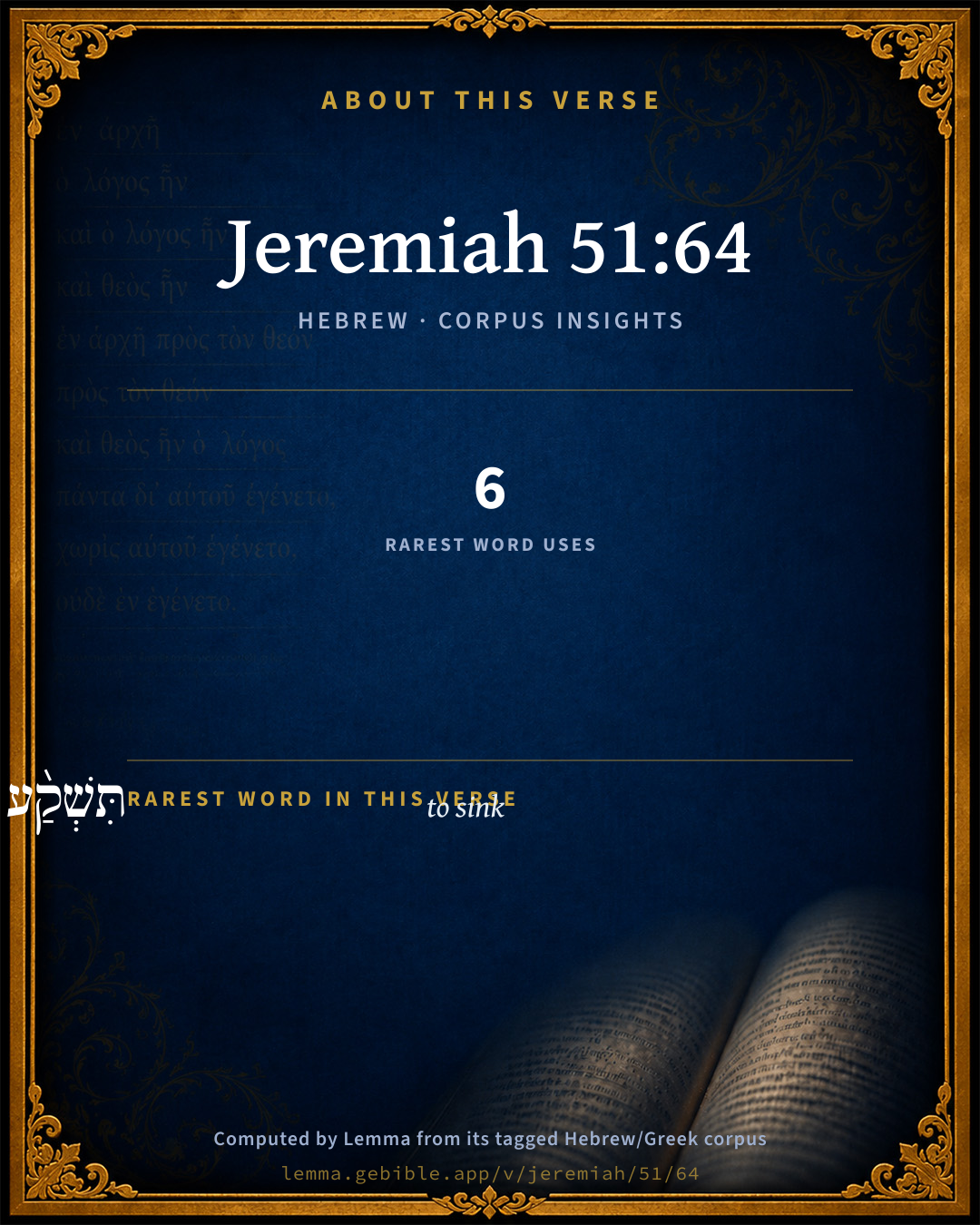
The rarest word here is תִּשְׁקַ֨ע to sink H8257 — appearing just 6 times in the whole Hebrew Bible.

Shared distinctive vocabulary

תִּשְׁקַ֨ע to sink H8257 occurs in 6 verses of the Hebrew Bible. Also found in:

Grammatical profile

  • 5 verbs
  • 5 nouns
  • 1 pronoun
  • 2 prepositions
  • 2 adverbs
  • 2 particles

Verb forms

  • וְאָמַרְתָּ֗ Qal · Sequential Perfect
  • תִּשְׁקַ֨ע Qal · Imperfect
  • תָקוּם֙ Qal · Imperfect
  • מֵבִ֥יא Hiphil · Participle Active
  • וְיָעֵ֑פוּ Qal · Sequential Perfect

Cross-references

11

Topical passages linked to Jeremiah 51:64 in the Treasury of Scripture Knowledge — connected by theme and wording, ordered by reader-vote popularity; previews shown in the World English Bible.

  • Jeremiah 51:58 Thus says Yahweh of hosts: The broad walls of Babylon shall be utterly overthrown, and her high gates shall be burned with fire; and the peoples shall labor for vanity, and the nations for the fire; and they shall be weary.
  • Job 31:40 Let briars grow instead of wheat, And stinkweed instead of barley." The words of Job are ended.
  • Psalms 72:20 This ends the prayers by David, the son of Jesse.
  • Nahum 1:8–9 But with an overflowing flood, he will make a full end of her place, and will pursue his enemies into darkness.
  • Revelation 18:21 A mighty angel took up a stone like a great millstone and cast it into the sea, saying, "Thus with violence will Babylon, the great city, be thrown down, and will be found no more at all.
  • Psalms 76:12 He will cut off the spirit of princes. He is feared by the kings of the earth.
  • Jeremiah 25:27 You shall tell them, Thus says Yahweh of Hosts, the God of Israel: Drink you, and be drunken, and spew, and fall, and rise no more, because of the sword which I will send among you.
  • Jeremiah 51:42 The sea is come up on Babylon; she is covered with the multitude of the waves of it.
  • Habakkuk 2:13 Behold, isn't it of Yahweh of Hosts that the peoples labor for the fire, and the nations weary themselves for vanity?
  • Revelation 14:8 Another, a second angel, followed, saying, "Babylon the great has fallen, which has made all the nations to drink of the wine of the wrath of her sexual immorality."
  • Revelation 18:2 He cried with a mighty voice, saying, "Fallen, fallen is Babylon the great, and she has become a habitation of demons, a prison of every unclean spirit, and a prison of every unclean and hateful bird!

Cross-references courtesy of OpenBible.info (CC BY 4.0).

Hebrew and Greek witnesses Masoretic Hebrew ↔ Greek Septuagint

The same verse in the two great witnesses to the Old Testament, shown verse-for-verse.

These are two independent witnesses, not word-aligned to each other, and the Septuagint is shown in lemma (dictionary) form.

Hebrew Jeremiah 51:64 Masoretic · Westminster Leningrad Codex

וְאָמַרְתָּ֗ כָּ֠כָה תִּשְׁקַ֨ע בָּבֶ֤ל וְלֹֽא תָקוּם֙ מִפְּנֵ֣י הָרָעָ֗ה אֲשֶׁ֧ר אָנֹכִ֛י מֵבִ֥יא עָלֶ֖יהָ וְיָעֵ֑פוּ עַד הֵ֖נָּה דִּבְרֵ֥י יִרְמְיָֽהוּ

and you shall say, Thus shall Babylon sink, and shall not rise again because of the evil that I will bring on her; and they shall be weary. Thus far are the words of Jeremiah.

World English Bible · Public Domain

Greek LXX Structure differs

In the Septuagint, Jeremiah is about an eighth shorter than the Hebrew and arranges its material differently — the Oracles Against the Nations (Hebrew chapters 46–51) appear in the middle of the Greek book, after 25:13. Because the chapter and verse boundaries do not line up, a verse-for-verse comparison with the Hebrew is not shown.

A verse-for-verse comparison isn’t shown here because the chapters and verses don’t line up. Switch to the LXX edition with the MT / LXX toggle above to read the Greek directly.

On this verse, Jamieson, Fausset & Brown discusses the Septuagint’s reading. Read the note in Commentary ↓

Hebrew: Westminster Leningrad Codex (CC BY 4.0). Greek: Septuagint (public domain); English from a public-domain English Septuagint. How the Septuagint differs from the Hebrew →

Targum (Aramaic paraphrase)

1

The Targum is the ancient Jewish Aramaic paraphrase of the Hebrew Scriptures — an interpretive translation, not the Hebrew text itself. Onkelos (literal) and Pseudo-Jonathan (expansive) render the Torah, and Jonathan the Prophets. Coverage is partial: where no permissively-licensed English translation exists for a verse, only the Aramaic is shown. This is verse-level text, not a word-by-word alignment to the Hebrew.

  1. Targum Jonathan Prophets (Joshua–Malachi)
    וְתֵימַר כְּדֵין תִּשְׁתְּקַע בָּבֶל וְלָא תְקוּם מִן קֳדָם בִּישְׁתָא דִי אֲנָא מַיְתֵי עֲלָהּ וְיִשְׁתַּלְהוֹן עַד הָכָא נְבוּאַת פִּתְגָמֵי יִרְמְיָהוּ:

    (no public-domain English translation for this verse)

    Targum Jonathan — Aramaic: “Mikraot Gedolot” (public domain). English: “Sefaria Community Translation” (CC0 1.0 (public-domain dedication)); “London "Chaldee Paraphrase," 1871” (public domain). Text via Sefaria.

Commentary

Notes on Jeremiah 51:64 from classic Christian and Jewish commentators (each source and its license shown beneath its notes). The classic Christian expositions comment on the surrounding passage and are grouped to its opening verse, so a note may address several verses; the Jewish commentaries on the Tanakh (Rashi and others) are per-verse, so they appear only where the commentator wrote on this verse.

Lemma curates 59 commentaries, every one of them public domain or Creative Commons licensed, each selected and text-cleaned for this edition rather than reprinted as found. About our sources →

Jamieson, Fausset & Brown

Robert Jamieson, A. R. Fausset & David Brown

they shall be weary--The Babylonians shall be worn out, so as not to be able to recover their strength.

Thus far . . . Jeremiah--Hence it is to be inferred that the last chapter is not included in Jeremiah's writings but was added by some inspired man, mainly at 2Ki. 24:18-25:30 to explain and confirm what precedes [CALVIN].

(See on Jer 51:64). Jeremiah, having already (thirty-ninth and fortieth chapters) given the history in the proper place, was not likely to repeat it here. Its canonical authority as inspired is shown by its being in the Septuagint version. It contains the capture and burning of Jerusalem, &c., Zedekiah's punishment, and the better treatment of Jehoiachin under Evil-merodach, down to his death. These last events were probably subsequent to Jeremiah's time.

Next: Jeremiah Chapter 52

Jamieson, Fausset & Brown — Commentary Critical and Explanatory on the Whole Bible (1871) — public domain (CC PDM 1.0). Text via the HelloAO Bible API.

Trapp's Complete Commentary

John Trapp

Jer 51:64 And thou shalt say, Thus shall Babylon sink, and shall not rise from the evil that I will bring upon her: and they shall be weary. Thus far [are] the words of Jeremiah.

Ver. 64. Thus shall Babylon sink.] Ceremonies are to little purpose unless they have divine expositions annexed unto them.

And they shall be weary.] That seek either to save it or to restore it.

Thus far the words of Jeremiah,] sc., Concerning Babylon. See the like concerning Moab. {Jer 48:47}

John Trapp, A Commentary or Exposition upon All the Books of the Old and New Testament (1647–1656) — public domain. Text from a community e-Sword module.

Geneva Bible (1599)

Geneva Bible translators

They shall not be able to resist, but shall labor in vain.

Geneva Bible (1599) marginal notes — public domain. Text via Bolls.life.

Adam Clarke's Commentary

Verse 64. Thus shall Babylon sink, c.] This is the emblem of its overthrow and irretrievable ruin. See Re 18:21, where we find that this is an emblem of the total ruin of mystical Babylon.

Herodotus relates a similar action of the Phocoeans, who, having resolved to leave their country, and never return to it again, μυδρον σιδηρεον κατεπονωσαν, και ωμοσαν μη πριν ες Φωκαιην ἡξειν, πριν η τον μυδρον τουτον αναφηναι· "threw a mass of iron into the sea, and swore that they would never return to Phocaea till that iron mass should rise and swim on the top." The story is this: The Phocaeans, being besieged by Harpagus, general of the Persians, demanded one day's truce to deliberate on the propositions he had made to them relative to their surrendering their city and begged that in the mean while he would take off his army from the walls. Harpagus having consented, they carried their wives, children, and their most valuable effects, aboard their ships; then, throwing a mass of iron into the sea, bound themselves by an oath never to return till that iron should rise to the top and swim. See Herodotus, lib. i. c. 165.

Horace refers to this in his epode Ad Populum Romanum, Epode xvi. ver. 25: -

Sed juremus in haec: simul imis saxa renarint

Vadis levata, ne redire sit nefas.

"As the Phocaeans oft for freedom bled,

At length with imprecated curses fled."

FRANCIS.

Thus far are the words of Jeremiah.] It appears that the following chapter is not the work of this prophet: it is not his style. The author of it writes Jehoiachin; Jeremiah writes him always Jeconiah, or Coniah. It is merely historical, and is very similar to 2Kg 24:18-25. The author, whoever he was, relates the capture of Jerusalem, the fate of Zedekiah, the pillage and burning of the city and the temple. He mentions also certain persons of distinction who were slain by the Chaldeans. He mentions the number of the captives that were carried to Babylon at three different times; and concludes with the deliverance of King Jehoiachin from prison in Babylon, in which he had been for thirty-seven years. It is very likely that the whole chapter has been compiled from some chronicle of that time, or it was designed as a preface to the Book of the Lamentations; and would stand with great propriety before it, as it contains the facts on which that inimitable poem is built. Were it allowable, I would remove it to that place.

Adam Clarke's Commentary on the Bible (1810–1826) — public domain. Text from a community e-Sword/MySword module.

John Calvin's Commentaries

The Conclusion follows, Thus far the words of Jeremiah We have said that the prophets, after having spoken in the Temple, or to the people, afterwards collected brief summaries, and that these contained the principal things: from these the prophetic books were made up. For Jeremiah did not write the volume as we have it at this day, except the chapters; and it appears evident that it was not written in the order in which he spoke. The order of time is not, then, everywhere observed; but the scribes were careful in this respect, that they collected the summaries affixed to the doors of the Temple; and so they added this conclusion, Thus far the words of Jeremiah But this, in my view, is not to be confined to the prophecies respecting the fall of Babylon; for I doubt not but that the scribe who had collected all his prophecies, added these words, that he had thus far transcribed the words of Jeremiah.

We hence conclude that the last chapter is not included in the prophetic book of Jeremiah, but that it contains history only as far as was necessary to understand what is here taught: for it appears evident that many parts of the prophecy could not be understood without the knowledge of this history. As to the book of Lamentations, we know that it was a work distinct from the prophecies of Jeremiah: there is, then, no wonder that it has been added, Thus far the words of Jeremiah

John Calvin's Commentaries (1540-1563) — public domain. Text from the Calvin Translation Society English edition (1840s-50s) via the Christian Classics Ethereal Library (ccel.org). Calvin's coverage is partial (roughly two-thirds of the Bible); uncommented books and verses are honest gaps, never fabricated. The 19th-century editor's footnotes and remarks are omitted so the notes are faithfully Calvin's own voice.

Ellicott's Commentary for English Readers

(64) They shall be weary.—The words are identical with those that had closed the great prophecy in Jer_51:58. What was meant was probably that Seraiah was to repeat the last words of the prediction, and, as they passed his lips, was to fling the roll into the river. That submersion was typical of the end of the futile labour and weariness of the men of the doomed city.

Thus far are the words of Jeremiah.—The words are clearly of the nature of what we should call an editorial note by the compiler of Jeremiah’s prophecies, Baruch or another. He is careful to inform his readers that the narrative that follows in Jeremiah 52 was not written by Jeremiah.

A Bible Commentary for English Readers, edited by Charles John Ellicott (1878–1897) — public domain. Text from a community e-Sword module.

The Cambridge Bible for Schools and Colleges

gen. ed. J. J. S. Perowne

64. upon her: and they shall be weary] The mg. (rightly) puts a full stop after “upon her” and a colon after “they shall be weary.” These latter words (one word in the Heb.) doubtless (so Gi., Co. and others) were taken, probably by accident, from Jer_51:58, when, on the addition of this short section by the compiler, the words “Thus far … Jeremiah” were transferred to this later v. This last sentence is meant to mark off ch. 52, as taken for the most part from 2 Kings.

The Cambridge Bible for Schools and Colleges (gen. ed. J. J. S. Perowne; Cambridge University Press, 1878–1918) — public domain. Text from a community e-Sword module.

Haydock's Catholic Bible Commentary

Sink. The angel did the like; (Apocalypse xviii. 21.; Calmet) and the Phoceans, leaving their country, swore that they would return no more till a piece of red hot iron, which they threw into the sea, should swim. (Herodotus i. 165.) --- Thus, &c., was added by the compiler. Septuagint omit the sentence, as what relates to Babylon is place [in] chap. xxviii. in their copies. (Calmet) --- Yet Grabe puts it in a different character. (Haydock) --- Jeremias wrote a great deal, after the 4th year of Sedecias, ver. 59. (Calmet) --- He here finished his predictions against Babylon. (Worthington) --- This does not mean that he did not write the next chapter, (Menochius) as Cappel allows, (Houbigant) though this may still be doubted. (Haydock)

George Leo Haydock (1774–1849), Haydock's Catholic Family Bible and Commentary, 1859 edition — public domain. Excludes Psalms (Douay-Rheims chapter numbering differs from Protestant) and Deuterocanonical books (Catholic canon only).

Matthew Poole's English Annotations

It hath been often said that Euphrates was that great river which ran by the walls of Babylon; into this Seraiah is commanded by Jeremiah to throw this roll of prophecy against Babylon, symbolically to teach the Jews, that according to the tenor of his prophecy the time should come, after some years, when Babylon should be destroyed never to rise again to any great view or degree of splendour, no more than that roll with the stone tied to it should rise from the bottom of Euphrates.

And they shall be weary; some read, though they weary themselves, that is, do what they can, or, (as it is here,) and they shall be weary with that weight of judgment which shall be upon them.

Thus far are the words of Jeremiah: either the words of Jeremiah relating to Babylon reach thus far, or all the words of Jeremiah remaining on sacred record (for it is thought that the next chapter was rather penned by some other holy man); or (which seemeth the best) the prophetical words of Jeremiah, for the matter of the next chapter is historical, and the Book of Lamentations is not prophetical, as to the main of it, though there be in it three or four prophetical passages, Lam 4:21,22, &c.

Matthew Poole's English Annotations on the Holy Bible (1683–1685) — public domain. Text from a community e-Sword/MySword module.

Whedon's Commentary on the Bible

Daniel D. Whedon

64. Thus far are the words of Jeremiah — This implies that the following chapter does not belong to this body of prophecy, but constitutes an historical appendix added by another hand. “It is an instance of the scrupulous care taken by the Jews of the sacred writings committed to their keeping.” — Speaker’s Commentary.

Daniel D. Whedon (gen. ed.), Commentary on the Old and New Testaments (1874–1909) — public domain. Text from a community e-Sword module.

The Pulpit Commentary

And they shall be weary. Accidentally repeated from ver. 59 (see introduction to ch. 1). Thus far, etc. Proving that the Book of Jeremiah once ended with Jer 51.

The weariness of sin.

"They shall be weary." With these sad words the Prophet Jeremiah closes his book. The shadows are over it all, nor are they in the least lifted where we most love to see them lifted at the end. They are spoken of the inhabitants of Babylon, and repeat what was said in ver. 58. They suggest the themeThe weariness of sin.

I WEARINESS IS ALWAYS PAIN. It may be of the body, and then exhaustion and fatigue render exertion any longer only so much torture. Or of the mind. The brain becomes dazed, bewildered, incapable of effort. Or of the heart that which is caused by disappointment, ingratitude, unfulfilled desire, hopelessness. Or that of the soul, which is the weariness told of here. But in all cases it is full of pain.

II WEARINESS IS A UNIVERSAL EXPERIENCE. The child of God is often weary. Such are exhorted not to be "weary in well doing," the exhortation implying the more than possibility of such weariness being experienced. And our Saviour knew this weariness never of, but often in, his work. In a world like this there are causes enough for such weariness to lay hold on the servants of God. But if they know weariness, yet more do the children of this world; for

III THE WORST WEARINESS IS THAT OF SIN. For a while the enjoyment which springs from sin may so intoxicate and dazzle the wrong doer that he will laugh at the idea of weariness, and declare that his is the alone path of pleasure and good. But after a while that ceases, and then comes satiety and weariness.

1. The causes of this are:

(1) Negative. In serving sin we have not those great aids to endurance and restoration of strength which are ever present to the child of God. The servant of sin has no high and noble motive, no worthy motive at all, in what he does. The motives of affection, of duty, of gratitude, of love, which sustain so mightily the mind of the Christian, these are all lacking in the servant of sin. Good hope also cheers the child of God; but what harvest can the sinner expect to reap? It is such as he dares not, and therefore will not, contemplate. The communion of the Spirit of God that Spirit who "giveth songs in the night," is present to the Christian, and in the deepest distress enables him to rejoice. But nought of this can the ungodly know in their hard work and service. Drawing near to God is another aid of the child of God. For"We may kneel and cast our load, E"en while we pray, upon our God, Then rise with lightened cheer; Sure that the Father, who is nigh To hear the famished ravens cry, Will hear in that we fear.

This most real help the ungodly never know.

(2) But there are positive causes of weariness in the service of sin. Jesus said, "Weep not for me, but weep for yourselves and for your children." His cup of woe was bitter, but theirs would be more bitter still. Now, the positive causes of the weariness of sin are such as these. The powerlessness of sin to minister pleasure continually. The goadings of conscience, which will not be silent. God"s judgments so full of pain, so inevitable, so irremediable, as these on Babylon. The hopelessness of sin"s outlook nothing but a fearful looking for of judgment.

1. The effects of this weariness are seen in such as Saul and Judas, and in the myriad others who have sought, in self-destruction or by wild plunging into yet deeper sins, to escape that weariness which tracks their footsteps continually. Well might Paul ask, "What profit had ye in those things whereof ye are now ashamed?" Who would begin a career that ends in such a way? What an argument such facts furnish for seeking, if haply we may find it:

2. The cure of all such weariness! The child of God knows it well. The ungodly may know it too if they will. It consists in submission to that Lord who says to all such, "Come unto me all ye that are weary and heavy laden," etc. There alone is the cure. C.

The Pulpit Commentary (1880–1919), ed. H.D.M. Spence-Jones & Joseph S. Exell — public domain. Text from a community e-Sword module.

John Wesley's Explanatory Notes

Weary - With that weight of judgment which shall be upon them. The words - The prophetical words of Jeremiah; for the matter of the next chapter is historical, and the book of Lam. is not prophetical.

John Wesley, Explanatory Notes Upon the Whole Bible (1754–1765) — public domain. Text via the GEBible commentary corpus.

Lesson kit

Teaching starters — assembled from the data on this page, not authored interpretation. Every prompt links to the verse data it draws on. Edit before teaching.

Jeremiah, in the Prophets, opens this verse with 17 words (17 distinct Hebrew lemmas). Its most distinctive word is shâqaʻ (“to sink”). A historical commentator’s framing appears above. Read the whole chapter for the surrounding context.

Discussion questions

  1. The word shâqaʻ carries the sense “to sink.” How does it shape the verse?
  2. How does Numbers 11:2, which shares the word «to sink», read alongside this verse?
  3. These translations render this verse differently; the difference is in the English rendering, not the original. What questions does that raise?
  4. «וְאָמַרְתָּ֗» is a Qal Sequential Perfect verb. How does that grammatical form shape the action described?
  5. Compare how Jamieson, Fausset & Brown and Trapp's Complete Commentary read this verse. Where do they agree or differ?

Things to notice

Reading settings

Reading text

Shown beneath each verse's original-language words.

Old Testament
Old Testament edition

Read the OT as the Masoretic Hebrew (MT) or the Greek Septuagint (LXX).

English shown for the Greek Septuagint (in the Hebrew ↔ Greek comparison).

Comparing translations? Open the Compare panel on any verse page to stack up to four side by side.