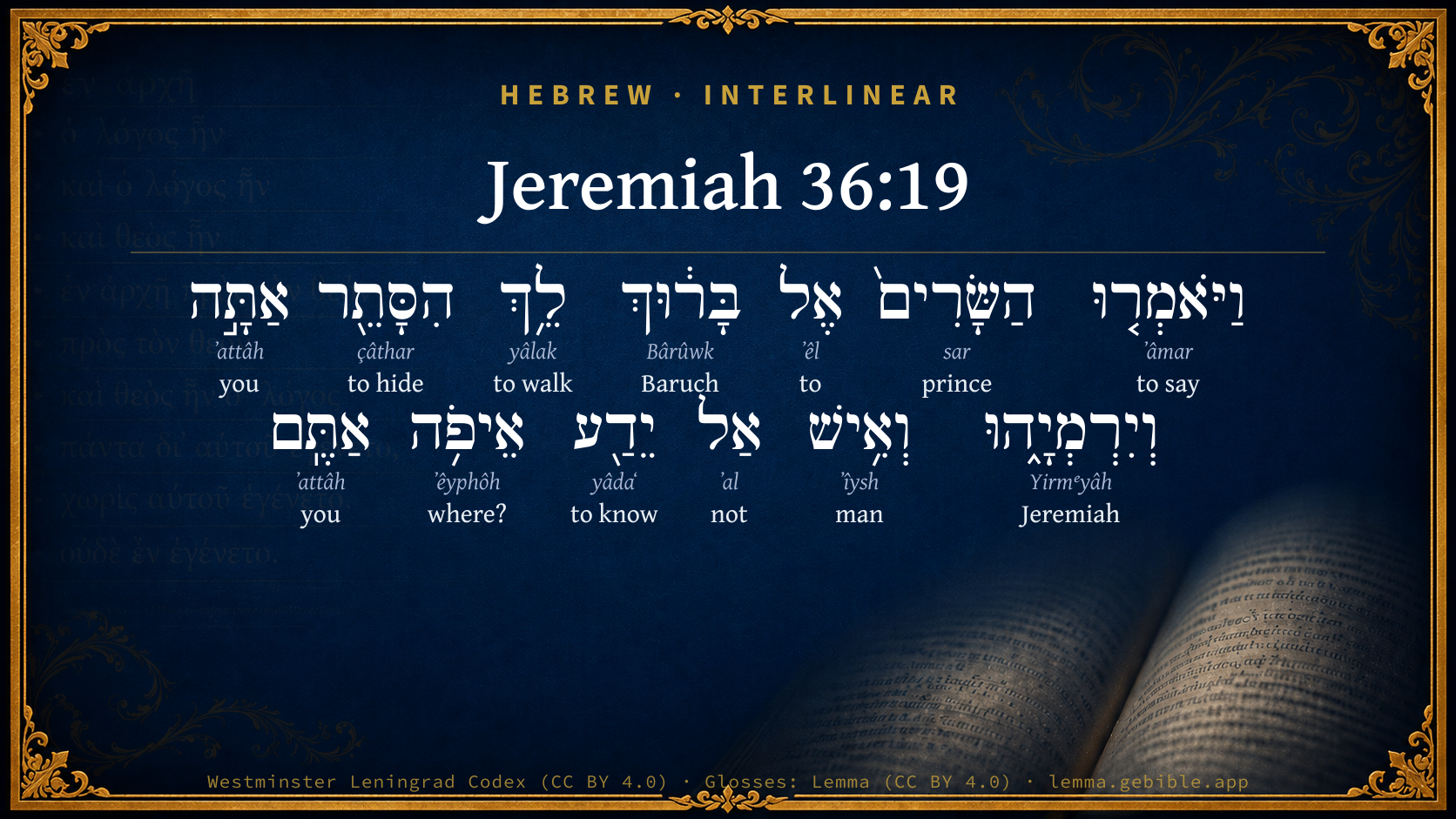
Jeremiah 36:19

Hebrew (Westminster Leningrad Codex) Jeremiah 36:19 appears in the Hebrew Old Testament. The text above is from the Westminster Leningrad Codex. Each word links to its Strong’s number, a concise gloss, and parsing drawn from the Open Scriptures Hebrew Bible morphology. Click any word for its full Brown-Driver-Briggs (BDB) entry.
Download image
Cite this verse

Jeremiah 36:19 (World English Bible). Public Domain. Lemma interlinear Bible study tool, https://lemma.gebible.app/v/jeremiah/36/19.

Show BibTeX & RIS
BibTeX
RIS
English Translation
Then said the princes to Baruch, Go, hide you, you and Jeremiah; and let no man know where you are.
World English Bible · Public Domain
Download a study sheet

One document with this verse’s original text, its word-by-word gloss line, the meaning frame, cross-references with their text, attributed commentary, and full source and license credits — printable, and it pastes into notes with its structure intact.

This verse Autodidact and up

Study sheet (.html) Plain text (.txt)

A passage Seminary Student

Up to 50 verses in one chapter. A passage sheet keeps up to 6 commentary sources and 12 cross-references per verse, in the order this page ranks them, and says so on the sheet whenever that leaves anything out. Ask for a single verse and you get the Autodidact verse sheet above.

Everything on this page stays free to read, with no account — the sheet is a download of what is already on screen, not access to it.

Want to remove ads? Support Godless Engineer
Compare translations 3

The same verse in 3 English versions, stacked beneath the original-language interlinear above. Click any original word for its lexicon entry.

Each is an independent rendering of the whole verse — the interlinear is not word-aligned to these translations.

Highlighted words mark where these versions differ — a whole-verse word diff, not a word-by-word alignment.

  • World English Bible Public Domain
    Then said the princes to Baruch, Go, hide you, you and Jeremiah; and let no man know where you are.
  • King James Version Public Domain
    Then said the princes unto Baruch, Go, hide thee, thou and Jeremiah; and let no man know where ye be.
  • unfoldingWord Literal Text CC BY-SA 4.0
    Then the officials said to Baruch, “Go, hide yourself, and Jeremiah, too. Do not let anyone know where you are.”

unfoldingWord Literal Text — © unfoldingWord, licensed CC BY-SA 4.0. Word-aligned USFM3 via Door43 (git.door43.org/unfoldingWord/en_ult).

Versions to compare (up to 4)

3 of 4 selected

Show all 18 translations

Every available English version of this verse, each an independent rendering of the whole verse.

  • World English Bible Public Domain
    Then said the princes to Baruch, Go, hide you, you and Jeremiah; and let no man know where you are.
  • Berean Standard Bible Public Domain
    Then the officials said to Baruch, “You and Jeremiah must hide yourselves and tell no one where you are.”
  • Majority Standard Bible Public Domain
    Then the officials said to Baruch, “You and Jeremiah must hide yourselves and tell no one where you are.”
  • King James Version Public Domain
    Then said the princes unto Baruch, Go, hide thee, thou and Jeremiah; and let no man know where ye be.
  • American Standard Version (1901) Public Domain
    Then said the princes unto Baruch, Go, hide thee, thou and Jeremiah; and let no man know where ye are.
  • Revised Version (1885) Public Domain
    Then said the princes unto Baruch, Go, hide thee, thou and Jeremiah; and let no man know where ye be.
  • Geneva Bible (1599) Public Domain
    Then saide the princes vnto Baruch, Goe, hide thee, thou and Ieremiah, and let no man knowe where ye be.
  • Douay-Rheims (1899) Public Domain
    And the princes said to Baruch: Go, and hide thee, both thou and Jeremias, and let no man know where you are.
  • Young's Literal Translation Public Domain
    And the heads say unto Baruch, `Go, be hidden, thou and Jeremiah, and let no one know where ye `are'.'
  • Literal Standard Version CC BY-SA 4.0
    And the heads say to Baruch, “Go, be hidden, you and Jeremiah, and let no one know where you [are].”
  • Unlocked Literal Bible CC BY-SA 4.0
    Then the officials said to Baruch, “Go, hide yourself, and Jeremiah, too. Do not let anyone know where you are.”
  • unfoldingWord Literal Text CC BY-SA 4.0
    Then the officials said to Baruch, “Go, hide yourself, and Jeremiah, too. Do not let anyone know where you are.”
  • Darby Bible Public Domain
    And the princes said unto Baruch, Go, hide thee, thou and Jeremiah; that none may know where ye are.
  • World Messianic Bible Public Domain
    Then the princes said to Baruch, “You and Jeremiah go hide. Don’t let anyone know where you are.”
  • Webster's Bible Public Domain
    Then said the princes to Baruch, Go, hide thyself, thou and Jeremiah; and let no man know where ye are.
  • Free Bible Version CC BY-SA 4.0
    The officials told Baruch, “You and Jeremiah are going to have to hide. Don't tell anyone where you are.”
  • Bible in Basic English Public Domain
    Then the rulers said to Baruch, Go and put yourself in a safe place, you and Jeremiah, and let no man have knowledge of where you are.
  • JPS Tanakh (1917) Public Domain
    Then said the princes unto Baruch: 'Go, hide thee, thou and Jeremiah, and let no man know where ye are.'

Literal Standard Version (2020), Covenant Press — licensed CC BY-SA 4.0. Text via the HelloAO Bible API (eBible.org). Unlocked Literal Bible (unfoldingWord) — licensed CC BY-SA 4.0. Text via the HelloAO Bible API (eBible.org). unfoldingWord Literal Text — © unfoldingWord, licensed CC BY-SA 4.0. Word-aligned USFM3 via Door43 (git.door43.org/unfoldingWord/en_ult). Free Bible Version, Dr. Jonathan Gallagher — licensed CC BY-SA 4.0. Text via the HelloAO Bible API (eBible.org).

Word by word

More ways to search: Search by grammar → Find every occurrence → Compare this word →

Practice this passage: Drill this verse → Learn its vocabulary →

אֵיפֹ֥ה
ʼêyphôh
H375
“where?”
Particle, Interrogative
Part of Speech
Particle
Type
Interrogative
Full BDB Definition

Origin: from H335 and H6311

TWOT: 75h

where? - what kind?
  1. וַיֹּאמְר֤וּ ʼâmar H559 “and · to say” Conjunction + Verb, Qal, Sequential Imperfect, 3rd Person, Masculine, Plural
  2. הַשָּׂרִים֙ sar H8269 “the · princes” Particle, Definite Article + Noun, Common, Masculine, Plural, Absolute
  3. אֶל ʼêl H413 “to” Preposition
  4. בָּר֔וּךְ Bârûwk H1263 “Baruch” Noun, Proper
  5. לֵ֥ךְ yâlak H3212 “walk” Verb, Qal, Imperative, 2nd Person, Masculine, Singular
  6. הִסָּתֵ֖ר çâthar H5641 “hide” Verb, Niphal, Imperative, 2nd Person, Masculine, Singular
  7. אַתָּ֣ה ʼattâh H859 “you” Pronoun, Personal, 2nd Person, Masculine, Singular
  8. וְיִרְמְיָ֑הוּ Yirmᵉyâh H3414 “and · Jeremiah” Conjunction + Noun, Proper
  9. וְאִ֥ישׁ ʼîysh H376 “and · man” Conjunction + Noun, Common, Masculine, Singular, Absolute
  10. אַל ʼal H408 “not” Particle, Negative
  11. יֵדַ֖ע yâdaʻ H3045 “to know” Verb, Qal, Jussive, 3rd Person, Masculine, Singular
  12. אַתֶּֽם ʼattâh H859 “you” Pronoun, Personal, 2nd Person, Masculine, Plural

About this verse

These counts appear in no published source. They are computed here, from the morphology-tagged text and Lemma’s own curated glosses. What Lemma adds →

13
words
12
distinct lemmas
Prophets
section

Notable vocabulary

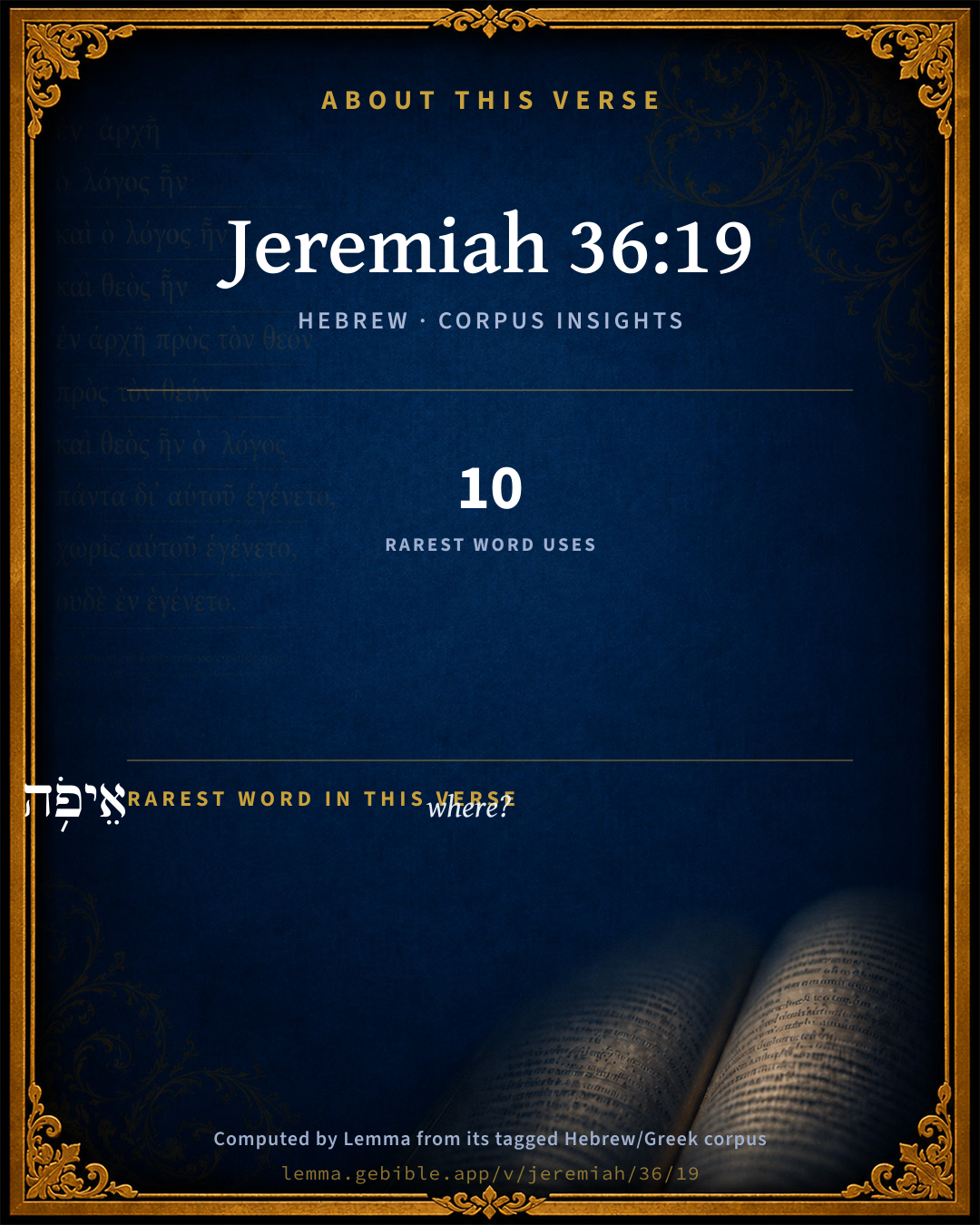
The rarest word here is אֵיפֹ֥ה where? H375 — appearing just 10 times in the whole Hebrew Bible.

Shared distinctive vocabulary

אֵיפֹ֥ה where? H375 occurs in 10 verses of the Hebrew Bible. Also found in:

Grammatical profile

  • 4 verbs
  • 4 nouns
  • 2 pronouns
  • 1 preposition
  • 2 particles

Verb forms

  • וַיֹּאמְר֤וּ Qal · Sequential Imperfect
  • לֵ֥ךְ Qal · Imperative
  • הִסָּתֵ֖ר Niphal · Imperative
  • יֵדַ֖ע Qal · Jussive

Repetition

A word recurs within this verse — often emphatic in Hebrew:

  • אַתָּ֣ה you H859 ×2

Cross-references

11

Topical passages linked to Jeremiah 36:19 in the Treasury of Scripture Knowledge — connected by theme and wording, ordered by reader-vote popularity; previews shown in the World English Bible.

  • 1 Kings 17:3 Get you hence, and turn you eastward, and hide yourself by the brook Cherith, that is before the Jordan.
  • 1 Kings 18:4 for it was so, when Jezebel cut off the prophets of Yahweh, that Obadiah took one hundred prophets, and hid them by fifty in a cave, and fed them with bread and water.)
  • 1 Kings 18:10 As Yahweh your God lives, there is no nation or kingdom, where my lord has not sent to seek you: and when they said, He is not here, he took an oath of the kingdom and nation, that they didn't find you.
  • Jeremiah 26:20–24 There was also a man who prophesied in the name of Yahweh, Uriah the son of Shemaiah of Kiriath Jearim; and he prophesied against this city and against this land according to all the words of Jeremiah:
  • Jeremiah 36:26 The king commanded Jerahmeel the king's son, and Seraiah the son of Azriel, and Shelemiah the son of Abdeel, to take Baruch the scribe and Jeremiah the prophet; but Yahweh hid them.
  • 2 Chronicles 25:15 Therefore the anger of Yahweh was kindled against Amaziah, and he sent to him a prophet, who said to him, Why have you sought after the gods of the people, which have not delivered their own people out of your hand?
  • Proverbs 28:12 When the righteous triumph, there is great glory; But when the wicked rise, men hide themselves.
  • Amos 7:12 Amaziah also said to Amos, "You seer, go, flee away into the land of Judah, and there eat bread, and prophesy there:
  • Luke 13:31 On that same day, some Pharisees came, saying to him, "Get out of here, and go away, for Herod wants to kill you."
  • Acts 5:40 They agreed with him. Summoning the apostles, they beat them and charged them not to speak in the name of Jesus, and let them go.
  • Acts 23:16–22 But Paul's sister's son heard of their lying in wait, and he came and entered into the barracks and told Paul.

Cross-references courtesy of OpenBible.info (CC BY 4.0).

Hebrew and Greek witnesses Masoretic Hebrew ↔ Greek Septuagint

The same verse in the two great witnesses to the Old Testament, shown verse-for-verse.

These are two independent witnesses, not word-aligned to each other, and the Septuagint is shown in lemma (dictionary) form.

Hebrew Jeremiah 36:19 Masoretic · Westminster Leningrad Codex

וַיֹּאמְר֤וּ הַשָּׂרִים֙ אֶל בָּר֔וּךְ לֵ֥ךְ הִסָּתֵ֖ר אַתָּ֣ה וְיִרְמְיָ֑הוּ וְאִ֥ישׁ אַל יֵדַ֖ע אֵיפֹ֥ה אַתֶּֽם

Then said the princes to Baruch, Go, hide you, you and Jeremiah; and let no man know where you are.

World English Bible · Public Domain

Greek LXX Structure differs

In the Septuagint, Jeremiah is about an eighth shorter than the Hebrew and arranges its material differently — the Oracles Against the Nations (Hebrew chapters 46–51) appear in the middle of the Greek book, after 25:13. Because the chapter and verse boundaries do not line up, a verse-for-verse comparison with the Hebrew is not shown.

A verse-for-verse comparison isn’t shown here because the chapters and verses don’t line up. Switch to the LXX edition with the MT / LXX toggle above to read the Greek directly.

Hebrew: Westminster Leningrad Codex (CC BY 4.0). Greek: Septuagint (public domain); English from a public-domain English Septuagint. How the Septuagint differs from the Hebrew →

Targum (Aramaic paraphrase)

1

The Targum is the ancient Jewish Aramaic paraphrase of the Hebrew Scriptures — an interpretive translation, not the Hebrew text itself. Onkelos (literal) and Pseudo-Jonathan (expansive) render the Torah, and Jonathan the Prophets. Coverage is partial: where no permissively-licensed English translation exists for a verse, only the Aramaic is shown. This is verse-level text, not a word-by-word alignment to the Hebrew.

  1. Targum Jonathan Prophets (Joshua–Malachi)
    וַאֲמַרוּ רַבְרְבַיָא לְבָרוּךְ אֱזֵיל אִטַמַר אַתְּ וְיִרְמְיָה וֶאֱנַשׁ לָא יְדַע אֵיכָא אַתּוּן:

    (no public-domain English translation for this verse)

    Targum Jonathan — Aramaic: “Mikraot Gedolot” (public domain). English: “Sefaria Community Translation” (CC0 1.0 (public-domain dedication)); “London "Chaldee Paraphrase," 1871” (public domain). Text via Sefaria.

Commentary

Notes on Jeremiah 36:19 from classic Christian and Jewish commentators (each source and its license shown beneath its notes). The classic Christian expositions comment on the surrounding passage and are grouped to its opening verse, so a note may address several verses; the Jewish commentaries on the Tanakh (Rashi and others) are per-verse, so they appear only where the commentator wrote on this verse.

Lemma curates 59 commentaries, every one of them public domain or Creative Commons licensed, each selected and text-cleaned for this edition rather than reprinted as found. About our sources →

Trapp's Complete Commentary

John Trapp

Jer 36:19 Then said the princes unto Baruch, Go, hide thee, thou and Jeremiah; and let no man know where ye be.

Ver. 19. Go hide thee, thou and Jeremiah.] This was well, but not all. They draw not Baruch before the king to answer what he had done; but why do they not take him to the king with his roll, and plead both for it and him too? Had they been true patriots and hearty friends to the truth, they would have done so; but they knew that this wicked king could not endure the prophets, {Jer 26:21; Jer 36:26} and one of their company had been the king’s agent in bringing Uriah the prophet out of Egypt to be butchered by him. {Jer 26:22}

John Trapp, A Commentary or Exposition upon All the Books of the Old and New Testament (1647–1656) — public domain. Text from a community e-Sword module.

Lange's Commentary on the Holy Scriptures

3. THE READING BEFORE THE KING

Jer_36:19-26

19Then said the princes unto Baruch, Go, hide thee, thou and Jeremiah; and let 20no man know where ye be. And they went in to the king, into the court, but they laid up9 the roll in the chamber of Elishama the scribe, and told all the words in 21the ears of the king. So the king sent Jehudi to fetch the roll: and he took it out of Elishama the scribe’s chamber. And Jehudi read it in the ears of the king, 22and in the ears of all the princes which stood beside [before] the king. Now the king sat in the winter house, in the ninth month; and there was a fire on the hearth, 23burning before him [the pot10 kindled before him]. And it came to pass, that when Jehudi had read three or four leaves [columns], he cut it with the penknife, and cast it into the fire that was on the hearth [in the pot], until all the roll was con- 24sumed in the fire that was on the hearth [in the pot]. Yet they were not afraid, nor rent their garments, the king nor any of his servants that heard all these words. 25Nevertheless11 [And even though] Elnathan and Delaiah and Gemariah had made intercession to [prayed] the king that he would not burn the roll: but [yet] he 26would not hear them. But the king commanded Jerahmeel, the son of Hammelech [the king], and Seraiah, the son of Azriel, and Shelemaiah, the son of Abdeel, to take [fetch] Baruch the scribe and Jeremiah the prophet: but the Lord [Jehovah] hid them.

EXEGETICAL AND CRITICAL

The princes command Baruch, together with Jeremiah, to hide themselves (Jer_36:19). Thereupon they give the king personally notice of what has occurred (Jer_36:20). The king has the roll brought, read, cut and thrown into the fire, notwithstanding the intercession of three princes (Jer_36:21-25). He also wishes Baruch and Jeremiah to be taken into custody, but the Lord had hid them (Jer_36:26).

Jer_36:19-20. Then said … ears of the king. It is noteworthy that under the despotic and ungodly Jehoiakim the princes were friendly to Jeremiah, while under the weak but kindly-disposed Zedekiah they were hostile to him. The reason for this may be partly the outward circumstances, partly the personality of the king. Under Jehoiakim the danger was not so near, and Jeremiah’s continual exhortation to submit did not make so much the impression of treachery and of a laming influence (Jer_38:4). Add to this, that Jehoiakim’s annoyance provoked opposition, as Zedekiah’s weakness did insolence.—The proper dwelling-house of the king (doubtless identical with the winter house) stood in a court of its own, “which, regarded from the entrance, formed the hinder court of the whole citadel” (Keil on 1Ki_7:8).—They did not take the roll with them, in order as much as in them lay, to withdraw it from the eyes and fury of the despotic king. If the king himself had it fetched, they were not responsible for what he did with it.

Jer_36:21-24. So the king … these words.—Beside the king. The king sat on the floor, those who were standing were therefore above him. Comp. Gen_18:8; Jdg_3:19; 2Sa_20:11.—On the winter-house (Amo_3:15) and the fire-pot comp. Winer, R.-W.-B. s. v. Häuser, near the end. [“In common parlance, the lower apartments are simply el beit—the house; the upper is the ’alliyeh, which is the summer-house. Every respectable dwelling has both, and they are familiarly called beit shetawy and beit seify—winter and summer house. If these are on the same story, then the external and airy apartment is the summer house, and that for winter is the interior or more sheltered room.” Thomson, The Land and the Book, I. p. 478.—“The Orientals still use pots made of burnt earthenware for warming, instead of fire-places. These pots have the form of a large pitcher, and are usually placed in a hollow place in the middle of the room. When the fire is out, a frame like a table is put over them, and is covered with a carpet, and thus the warmth is kept in them. See also Niebuhr and Tavernier in Winer, R.- W.-B. 1., 468; Stanley, Lect. 536–538.” Wordsworth.—S. R. A.].—The ninth month corresponds nearly to our December. It was therefore the cold and rainy season of the year.

Jer_36:23. And it came to pass, etc. It is unequivocally evident from the words “until all the roll was consumed” that the book did not consist of many leaves, but only of one roll. The roll must also have been written on one side only or the whole could not have been read. That Jehudi did read the whole is evident (1) from the imperfect יִקְרָעְהָ. If Jehudi, after reading some sections, had cut them off and at the same time thrown them with the rest into the fire, we should have had the perfect.—It would then be a matter of indifference whether Jehudi threw the rest into the fire entire or after successive abscissions, for the latter is in itself a perfectly unessential circumstance. It is only of account if the successive reading was connected with it. Only in the latter case is the imperfect, expressing repetition in the past, in place (compare remarks on יִקְרָא, Jer_36:18).—(2) From the words “till all the roll was consumed” and the preceding words. Had Jehudi thrown all at once into the coals, it could at most be said that they looked on and waited till the entire roll was burned up. But as it is said, that Jehudi cut and threw into the fire till the whole roll was consumed, there must evidently have been a repeated cutting and throwing. Such a course, however, presupposes also a successive reading of the whole, for if he did not wish to read it, why should he not throw it all at once into the fire. With this also agrees the prefix כְּ before קְרֹא, which designates the coincidence (comp. Gen_18:1; Gen_39:18; Deu_16:6; 1Ki_1:21), and accordingly in repeated actions must assume the meaning of “as often as.” How Graf can deny this, is as inconceivable as the assertion, that the successive reading and cutting would be unnatural or indeed trifling. As to the first, the tenor was interesting and exciting enough to render the king desirous of knowing the whole; as to the second, it was the subservient Jehudi who would not wait till the end, to execute punishment on the hateful book. If the דְלָתוֹת were not single leaves, they were columns, the lines of which ran parallel with the margin of the roll. The expression doors, which occurs nowhere else in this sense, is easily explained by the square shape of the columns, which were probably also enclosed in lines. Jehudi’s cutting the roll with his penknife, and not tearing it with his hands, is explained by the character of the material. Even if it were a papyrus roll, cutting was to be preferred to tearing, because in this latter way he would be sure to injure the next columns. It is, moreover, questionable whether they would have burned a leather or parchment roll.—Rent their garments. On this custom comp. Winer, R.-W.-B., Art. Trauer. By the servants of the king who “heard all these words,” are here evidently to be understood those who heard them here for the first time, not those who had already heard them in the secretary’s office. Their petition shows the respect which they entertained for the words of the Lord.

Jer_36:25-26. And even though … hid them.—Jerahmeel, the king’s son. As according to 2Ki_23:36, Jehoiakim came to the throne when twenty-five, and was then in the fifth year of his reign, at most thirty years of age, he could not have had a grown-up son, such as this Jerahmeel must have been. “Son of the king” is, therefore, here a prince royal. Comp. Jer_38:6 with Jer_41:1; Dan_1:3.—Who Seraiah, the son of Azriel, Shelemiah, the son of Abdeel were, we do not know, but the messengers, judging from the rank of the first, appear to have been very respectable. Jehoiakim thus at least honored the prophet of the Lord, sending men of the highest rank to apprehend him. According to Jer_36:19 the kindly-disposed princes commanded Jeremiah and Baruch to hide themselves. They had obeyed. We are now informed that the Lord Himself had guided them in the choice of a hiding-place, and thus guarded against their discovery.

HOMILETICAL AND PRACTICAL

1. On Jer_36:2. The object of the writing was not only that “litera scripta manet” (Cramer: “the mouth speaks only to those who are present, but the pen to the absent; the mouth speaks only to the present hours and times, the pen many hundred years afterwards also.” Comp. Exo_34:27; Deu_10:4-5; Deu_17:18; Isa_30:8; Hab_2:2), but also to collect all the single lightning strokes into one grand prophetic tempest. Moreover, it is a matter of course that the written word was of special use, not only to posterity, but also to the contemporaries in so far as it rendered possible continued study, repeated quiet contemplation, and careful comparison. Jeremiah certainly prevented no one from taking copies of his book.

2. On Jer_36:4. Did Jeremiah hold such a relation to the Spirit of God as Baruch to Jeremiah when dictating? Then it was a matter of indifference to whom the dictation was made. Then a Saul would do as well as a Samuel, if he could only write. The best writer would be the most chosen instrument. There was no mingling of the individuality of the prophet except in the MS., and that is lost to us with the original. All prophetic writings must have the same type as to form and purport, which, as is well known, is so little the case that according to the saying of Buffon, le stylec’est l’homme, the portrait of a prophet might almost be drawn from his style.

3. On Jer_36:5. “God’s word is not bound; 2Ti_2:9. Paul for example wrote his most beautiful epistles from prison, as those to the Galatians, the Ephesians, the Philippians, the Colossians, to Philemon, and the second to Timothy.” Cramer.

4. On Jer_36:14. “It is a good state of things when rulers ask for God’s Word, and cannot be answered or helped promptly and quickly enough to the fulfilment of their purpose. So it was a joy to Paul that he could tell Agrippa what the Lord had done for his soul, and his heart yearned after Agrippa, Festus and all those around them.” Zinzendorf.

5. On Jer_36:16. “When a true servant of God gets his superiors so far that they hear him, he may surely not doubt, that he will also bring them to obedience. It is then not his, but the Lord’s affair.” Zinzendorf.

6. On Jer_36:23. “The higher the enemies of God are, the more dangerous; the greater, the more bitterly opposed to the work of the Lord, and the general patience with respect to the wickedness and unrighteousness of men, has certainly given something special to the δόξαις. Procul a Jove procul a fulmine.” Zinzendorf.

7. On Jer_36:23. “Locus maxime principalis in præsenti hoc textu est de combustione sacrorum librorum, quale fatum illi experti sunt non tantum Jeremiah 36, verum etiam 1Ma_1:59 sub Antiocho Epiphane; nec non tempore Diocleliani, qui et ipse multa bibliorum sacrorum exemplaria undiquaque conquisita comburi jussit; quorum vestigiis insistere non dubitarunt Pontifices romani et præsertim Leo X. qui anno 1520 binos legatos emisit ad Fridericum Sapienlem, postulantes ab ipso, ut libros Lutheri combureret … Quid hodie Jesuitæ de librorum combustione, qui a Lutheranis eduntur, sentiant, peculiari scripto Gretserus aperuit, quod de hoc argumento consarcinavit de jure et more prohibendi, expurgandi et abolendi libros hæreticos et noxios. Ingolst. 1603, 40).” Förster.

8. On Jer_36:25. “When John’s head was in question, Herod did not understand how he could resist his magnates. When Daniel is to go into the lions’ den, Darius has not the heart to refuse his princes. When Jeremiah is to be delivered up, Zedekiah says with great modesty to his princes: the king can do nothing against you’ (Jer_38:5). But when anything evil is to be done, the rulers can insist on having their own way. Here we have an instance: he hearkened not unto them.” Zinzendorf.

9. On Jer_36:26. “Dominus eos abscondidisse dicilur, quaratione olim Eliam (1 Reg. xvii. 2 sqq. et xvii. 12), nec non Elisæum (2 Reg. vi.), itemque Athanasium et Augustinum et nostro tempore Lutherum abscondidit.” Förster.

10. On Jer_36:27. [“Here is a sublime specimen of the triumph of God’s Word, when repressed by the power, and burnt by the rage of this world, whether it be in the suppression of the Scriptures, or in preventing their circulation, or in casting copies of them into the fire, or in the imprisonment and martyrdom of God’s preachers. That Word rises more gloriously out of all its persecutions.” Wordsworth.—S. R. A.]

HOMILETICAL AND PRACTICAL

1. On Jer_36:2-3. Sermon at a Bible Society Anniversary. The blessing of the written word. 1. That which it has in common with the spoken word (Jer_36:3): preparation of the heart for the reception of salvation. 2. That which it brings in distinction from the written Word: (a) it is present for every one: (b) it is present at every time and at every place: (c) it is present in all its parts (comparison).

2. On Jer_36:21-32. The majesty of the Word. 1. The power, which the word exercises. 2. The independence, which it maintains. 3. The self-verification which it continually effects. Sermons in Berlin by Fr. Wilh. Krummacher. Berlin, 1849.

3. On Jer_36:24. [“The guilt of indifference to the divine threatenings. It involves: 1, contempt of God; 2, unbelief, making God a liar; 3, extreme hardness of heart.” Payson.—S. R. A.]

Footnotes:

[9]Jer_36:20.—On חִפְקִדוּ comp. Jer_37:21; Jer_40:7.

[10]Jer_36:22.—וְאֵת ואת־האח is not here=and indeed with. It is an emphasizing of the subject, which we might paraphrase by “and as to,” but which the Hebrews express by the accusative. Comp. 2Ki_6:5 Ewald, § 277, d; Gesen., § 117, 2.

[11]Jer_36:25.—Observe the paratactic construction, since וְנַם according to the connection belongs to לֹא שָׁמַע. Comp. Naegelsb. Gr., 2, 111, 1 Anm.

Lange's Commentary on the Holy Scriptures (Critical, Doctrinal, and Homiletical), ed. John Peter Lange, English translation edited by Philip Schaff (1864–1880) — public domain. Text from a community e-Sword module.

Tyndale Open Study Notes

Tyndale Open Resources

36:19-20 The officials showed their respect for Jeremiah and Baruch by advising that they should both hide; they showed their respect for the Lord’s messages by placing the scroll in safekeeping while they went to inform the king.

Tyndale Open Study Notes — © Tyndale Open Resources, licensed CC BY-SA 4.0. Text via the HelloAO Bible API.

Geneva Bible (1599)

Geneva Bible translators

They that were godly among the princes gave this counsel, by whose means it is like that Jeremiah was delivered: for they knew the rage of the king and of the wicked to be such, that they could not escape without danger of their lives.

Geneva Bible (1599) marginal notes — public domain. Text via Bolls.life.

Jamieson, Fausset & Brown

Robert Jamieson, A. R. Fausset & David Brown

Showing that they were not altogether without better feelings (compare Jer 36:16, Jer 36:25).

Jamieson, Fausset & Brown — Commentary Critical and Explanatory on the Whole Bible (1871) — public domain (CC PDM 1.0). Text via the HelloAO Bible API.

Adam Clarke's Commentary

Verse 19. Go, hide thee, thou and Jeremiah] They saw that the king would be displeased, and most probably seek their lives; and as they believed the prophecy was from God, they wished to save both the prophet and his scribe; but they were obliged to inform the king of what they had heard.

Adam Clarke's Commentary on the Bible (1810–1826) — public domain. Text from a community e-Sword/MySword module.

John Calvin's Commentaries

We see that these courtly princes changed, when they perceived that it was indeed God’s hand, and yet they remained in a state of insensibility. God often thus terrifies profane men, and yet they return to their own indifference. They seemed, indeed, to be for a moment awakened, and seriously to acknowledge God’s judgment; but these thoughts presently vanished away. It thus happened, that they allowed that God had spoken, but it was, as it were, to the deaf, for it was in vain, as we shall shortly see.

Then the king’s counsellors derived no benefit; but they were not cruel, for they wished the Prophet to be hidden, lest the king should deal severely with him. We see many such men at this day who are not influenced by divine truth. They nod, indeed, as asses who move their ears; for they confess with their mouths that what is propounded to them is true and right; but as I have said, they either close their eyes, or at least do not attend, so as to know that it is God who speaks. It appears that such were the king’s counsellors, of whom the Spirit of God has declared what we shall presently see. They then counselled Baruch to hide himself, and also Jeremiah to do the same; for they saw that there was danger to them, except they took themselves to flight. It afterwards follows, —

John Calvin's Commentaries (1540-1563) — public domain. Text from the Calvin Translation Society English edition (1840s-50s) via the Christian Classics Ethereal Library (ccel.org). Calvin's coverage is partial (roughly two-thirds of the Bible); uncommented books and verses are honest gaps, never fabricated. The 19th-century editor's footnotes and remarks are omitted so the notes are faithfully Calvin's own voice.

The Cambridge Bible for Schools and Colleges

gen. ed. J. J. S. Perowne

19. Go, hide thee, thou and Jeremiah] See on Jer_36:5. The princes doubtless had before their minds the fate of Uriah (Jer_26:23). The so-called “Grotto of Jeremiah” near the “Quarries of Solomon” outside the Damascus Gate has been conjectured, owing to its traditional association with his name, to have been their hiding-place. See Pal. Explor. F. Quart. Statement, Jan. 1912, p. 27.

The Cambridge Bible for Schools and Colleges (gen. ed. J. J. S. Perowne; Cambridge University Press, 1878–1918) — public domain. Text from a community e-Sword module.

John Gill's Exposition

Then said the princes unto Baruch,.... Being satisfied with his answer:

go hide thee, thou and Jeremiah, and let no man know where ye be. Some of these princes at least seem to be good men, and believed what was read to them, and had a value for the prophet and his scribe, and were concerned for their welfare; and knowing the furious temper of the king, and his little regard to the prophets; and fearing he would resent what had been so publicly read to the people, provided against the worst; and in point of prudence advised Baruch and his master to abscond, and not let anyone know, no, not their nearest friends, where they were, lest they should be betrayed; nor did they, the princes, desire to know themselves. Jeremiah might be in prison, as some have thought, at the first reading of the roll, which was in the fourth year of Jehoiakim, and be at liberty now, which was in the fifth year; see Jer 36:1.

John Gill's Exposition of the Whole Bible (1746–1763) — public domain (CC PDM 1.0). Text via the HelloAO Bible API.

Haydock's Catholic Bible Commentary

CHAPTER XXXVI.

Are. Thus they provide for the safety of the prophets, and perform their duty to the king.

George Leo Haydock (1774–1849), Haydock's Catholic Family Bible and Commentary, 1859 edition — public domain. Excludes Psalms (Douay-Rheims chapter numbering differs from Protestant) and Deuterocanonical books (Catholic canon only).

Matthew Poole's English Annotations

This speaketh these princes to have been men of a much gentler temper and better disposition than those who succeeded them in Zedekiah’s time; they were not willing that any harm should come to the prophet, nor to Baruch, and knew the fierce temper of Jehoiakim, and therefore advised Baruch that both he and the prophet should hide. themselves.

Matthew Poole's English Annotations on the Holy Bible (1683–1685) — public domain. Text from a community e-Sword/MySword module.

Kretzmann's Popular Commentary

Paul E. Kretzmann

The Roll Destroyed and Rewritten

v. 19. Then said the princes unto Baruch, Go, hide thee, thou and Jeremiah; and let no man know where ye be. The reading had made a deep impression upon them, but they had an instinctive feeling that Jeremiah and Baruch were in danger of their lives on account of the message which they proclaimed, especially since a report of the happening had to be made to the king.

v. 20. And they went in to the king, into the court, the great hall or throne-room, but they laid up the roll in the chamber of Elishama, the scribe, leaving it in his office for safe-keeping, and told all the words in the ears of the king.

v. 21. So the king sent Jehudi, who seems to have been the court messenger, to fetch the roll; and he took it out of Elishama the scribe’s chamber. And Jehudi read it in the ears of the king and in the ears of all the princes which stood beside the king, literally, "over the king"; for, since they were standing in his presence, their heads were higher than his.

v. 22. Now, the king sat in the winter-house, in one of the inner and sheltered rooms of the palace, where also the great hall was situated, in the ninth month, corresponding roughly to our December; and there was a fire on the hearth burning before him, a brazen vessel with glowing charcoal such as are used in the Orient.

v. 23. And it came to pass that, when Jehudi had read three or four leaves, he cut it with the penknife, the writer’s knife with which the reed or style used for writing was pointed from time to time, and cast it into the fire that was on the hearth, until all the roll was consumed in the fire that was on the hearth. The king had become so enraged on account of the passage which he had heard that he could not contain himself, but laid blasphemous hands upon the sacred roll, slashing it right and left and destroying it completely.

v. 24. Yet they were not afraid, they were not terrified by the Lord’s threats, nor rent their garments, as they should have done in grief and mourning over their sins and the Lord’s impending punishment upon them, neither the king, nor any of his servants that heard all these words.

v. 25. Nevertheless, Einathan and Delaiah and Gemariah, three, at least, of the king’s counselors, had made intercession to the king that he would not burn the roll, but he would not hear them, he was deaf to all remonstrances.

v. 26. But the king commanded Jerahmeel, the son of Hammelech, and Seraiah, the son of Azriel, and Shele-miah, the son of Abdeel, to take Baruch, the scribe, and Jeremiah, the prophet, that is, to arrest them; but the Lord hid them, He did not permit the searchers to find their hiding-place.

v. 27. Then the word of the Lord came to Jeremiah, after that the king had burned the roll and the words which Baruch wrote at the mouth of Jeremiah, saying,

v. 28. Take thee again another roll, a new strip of parchment, and write in it all the former words that were in the first roll, which Jehoiakim, the king of Judah, hath burned.

v. 29. And thou shalt say to Jehoiakim, king of Judah, Thus saith the Lord, Thou hast burned this roll, saying, Why hast thou written therein, saying, The king of Babylon shall certainly come and destroy this land and shall cause to cease from thence man and beast? The king had evidently given vent to his anger in exclamations of this kind when he destroyed the roll.

v. 30. Therefore, thus saith the Lord of Jehoiakim, king of Judah, He shall have none to sit upon the throne of David, for his son Jehoiachin was nothing but a vassal of the foreign emperor and could in no sense call the kingdom his own; and his dead body shall be cast out in the day to the heat and in the night to the frost, namely, in the hardships attending his exile.

v. 31. And I will punish him and his seed and his servants for their iniquity, for by following the king they placed themselves in the same condemnation with him; and I will bring upon them and upon the inhabitants of Jerusalem and upon the men of Judah all the evil that I have pronounced against them; but they hearkened not.

v. 32. Then took Jeremiah another roll and gave it to Baruch, the scribe, the son of Neriah, who wrote therein from the mouth of Jeremiah all the words of the book which Jehoiakim, king of Judah, had burned in the fire; and there were added besides unto them many like words; for Jeremiah had received other inspired messages, and the Lord took this opportunity of embodying them all in the book which was to be preserved as a testimony against the disobedient nation and its king.

Paul E. Kretzmann, Popular Commentary of the Bible (1921–1924) — public domain. Text from a community e-Sword module.

Lesson kit

Teaching starters — assembled from the data on this page, not authored interpretation. Every prompt links to the verse data it draws on. Edit before teaching.

Jeremiah, in the Prophets, opens this verse with 13 words (12 distinct Hebrew lemmas). Its most distinctive word is ʼêyphôh (“where?”). A historical commentator’s framing appears above. Read the whole chapter for the surrounding context.

Discussion questions

  1. The word ʼêyphôh carries the sense “where?.” How does it shape the verse?
  2. Genesis 37:16 shares the word «where?» with this verse. How do the two illuminate each other?
  3. “you” occurs 2× in this one verse. What is the effect of the repetition?
  4. These translations render this verse differently; the difference is in the English rendering, not the original. What questions does that raise?
  5. The verb «וַיֹּאמְר֤וּ» is Qal Sequential Imperfect. How does its form color the action?
  6. Reading how Trapp's Complete Commentary and Lange's Commentary on the Holy Scriptures read this verse, where do the two commentators agree and where do they part?

Things to notice

Reading settings

Reading text

Shown beneath each verse's original-language words.

Old Testament
Old Testament edition

Read the OT as the Masoretic Hebrew (MT) or the Greek Septuagint (LXX).

English shown for the Greek Septuagint (in the Hebrew ↔ Greek comparison).

Comparing translations? Open the Compare panel on any verse page to stack up to four side by side.