
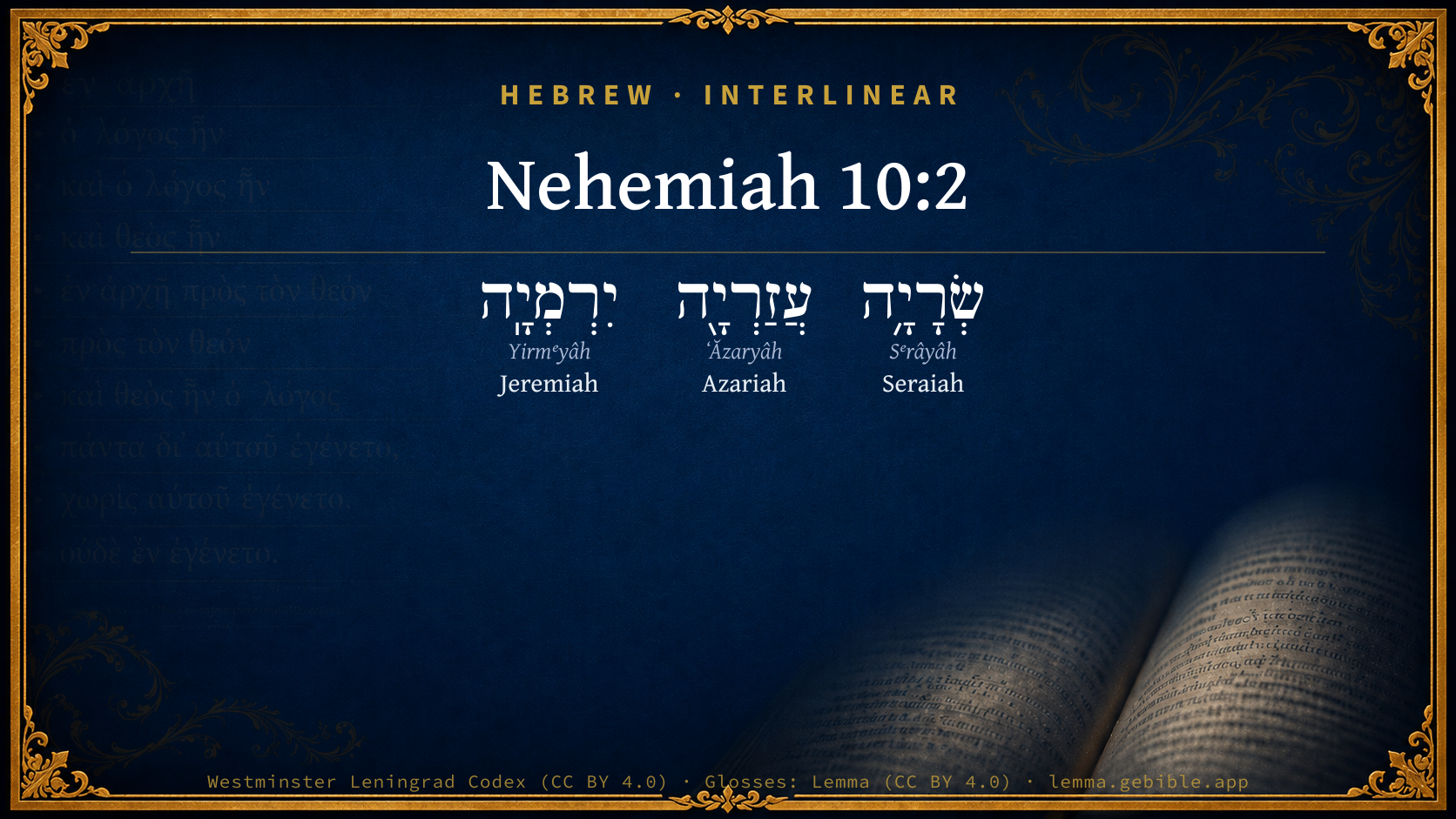
Nehemiah 10:2

Hebrew (Westminster Leningrad Codex) Nehemiah 10:2 appears in the Hebrew Old Testament. The text above is from the Westminster Leningrad Codex. Each word links to its Strong’s number, a concise gloss, and parsing drawn from the Open Scriptures Hebrew Bible morphology. Click any word for its full Brown-Driver-Briggs (BDB) entry.
Download image
Cite this verse

Nehemiah 10:2 (World English Bible). Public Domain. Lemma interlinear Bible study tool, https://lemma.gebible.app/v/nehemiah/10/2.

Show BibTeX & RIS
BibTeX
RIS
English Translation
Seraiah, Azariah, Jeremiah,
World English Bible · Public Domain
Download a study sheet

One document with this verse’s original text, its word-by-word gloss line, the meaning frame, cross-references with their text, attributed commentary, and full source and license credits — printable, and it pastes into notes with its structure intact.

This verse Autodidact and up

Study sheet (.html) Plain text (.txt)

A passage Seminary Student

Up to 50 verses in one chapter. A passage sheet keeps up to 6 commentary sources and 12 cross-references per verse, in the order this page ranks them, and says so on the sheet whenever that leaves anything out. Ask for a single verse and you get the Autodidact verse sheet above.

Everything on this page stays free to read, with no account — the sheet is a download of what is already on screen, not access to it.

Want to remove ads? Support Godless Engineer
Compare translations 3

The same verse in 3 English versions, stacked beneath the original-language interlinear above. Click any original word for its lexicon entry.

Each is an independent rendering of the whole verse — the interlinear is not word-aligned to these translations.

Highlighted words mark where these versions differ — a whole-verse word diff, not a word-by-word alignment.

  • World English Bible Public Domain
    Seraiah, Azariah, Jeremiah,
  • King James Version Public Domain
    Seraiah, Azariah, Jeremiah,
  • unfoldingWord Literal Text CC BY-SA 4.0
    Seraiah, Azariah, Jeremiah,

unfoldingWord Literal Text — © unfoldingWord, licensed CC BY-SA 4.0. Word-aligned USFM3 via Door43 (git.door43.org/unfoldingWord/en_ult).

Versions to compare (up to 4)

3 of 4 selected

Show all 18 translations

Every available English version of this verse, each an independent rendering of the whole verse.

  • World English Bible Public Domain
    Seraiah, Azariah, Jeremiah,
  • Berean Standard Bible Public Domain
    Seraiah, Azariah, Jeremiah,
  • Majority Standard Bible Public Domain
    Seraiah, Azariah, Jeremiah,
  • King James Version Public Domain
    Seraiah, Azariah, Jeremiah,
  • American Standard Version (1901) Public Domain
    Seraiah, Azariah, Jeremiah,
  • Revised Version (1885) Public Domain
    Seraiah, Azariah, Jeremiah;
  • Geneva Bible (1599) Public Domain
    Seraiah, Azariah, Ieremiah,
  • Douay-Rheims (1899) Public Domain
    Saraias, Azarias, Jeremias,
  • Young's Literal Translation Public Domain
    Seraiah, Azariah, Jeremiah,
  • Literal Standard Version CC BY-SA 4.0
    Seraiah, Azariah, Jeremiah,
  • Unlocked Literal Bible CC BY-SA 4.0
    Seraiah, Azariah, Jeremiah,
  • unfoldingWord Literal Text CC BY-SA 4.0
    Seraiah, Azariah, Jeremiah,
  • Darby Bible Public Domain
    -- Seraiah, Azariah, Jeremiah,
  • World Messianic Bible Public Domain
    Seraiah, Azariah, Jeremiah,
  • Webster's Bible Public Domain
    Seraiah, Azariah, Jeremiah,
  • Free Bible Version CC BY-SA 4.0
    Zedekiah, Seraiah, Azariah, Jeremiah,
  • Bible in Basic English Public Domain
    Seraiah, Azariah, Jeremiah,
  • JPS Tanakh (1917) Public Domain
    (10-3) Seraiah, Azariah, Jeremiah;

Literal Standard Version (2020), Covenant Press — licensed CC BY-SA 4.0. Text via the HelloAO Bible API (eBible.org). Unlocked Literal Bible (unfoldingWord) — licensed CC BY-SA 4.0. Text via the HelloAO Bible API (eBible.org). unfoldingWord Literal Text — © unfoldingWord, licensed CC BY-SA 4.0. Word-aligned USFM3 via Door43 (git.door43.org/unfoldingWord/en_ult). Free Bible Version, Dr. Jonathan Gallagher — licensed CC BY-SA 4.0. Text via the HelloAO Bible API (eBible.org).

Word by word

More ways to search: Search by grammar → Find every occurrence → Compare this word →

Practice this passage: Drill this verse → Learn its vocabulary →

שְׂרָיָ֥ה
Sᵉrâyâh
H8304
“Seraiah”
Noun, Proper
Part of Speech
Noun
Type
Proper
Full BDB Definition

Origin: from H8280 and H3050

TWOT: None

Seraiah = "Jehovah is ruler" - the scribe or secretary of David - son of Azariah, father of Jehozadak, and the chief priest in the reign of king Zedekiah of Judah and at the time of the capture of Jerusalem - son of Tanhumeth the Netophathite and one of the men who went to Gedaliah, the governor over Judah appointed by Nebuchadnezzar, and gave their oath to serve the king of Babylon - a Judaite, son of Kenaz, brother of Othniel, and father of Joab - a Simeonite, father of Josibiah and grandfather of Jehu - a people of the province who returned from exile with Zerubbabel - maybe the same as 10 - son of Azariah and father of Ezra the priest and scribe - a priest who sealed the covenant with Nehemiah - a priest, son of Hilkiah in the time of Nehemiah - a priest or Levite who returned from exile with Zerubbabel - probably a priest and the head of a family of priests after - son of Meraiah and messenger sent by the prophet Jeremiah to Babylon with a book of his writings - son of Azriel and one of the 3 men commanded by king Jehoiakim of Judah to seize Jeremiah and Baruch
  1. עֲזַרְיָ֖ה ʻĂzaryâh H5838 “Azariah” Noun, Proper
  2. יִרְמְיָֽה Yirmᵉyâh H3414 “Jeremiah” Noun, Proper

About this verse

These counts appear in no published source. They are computed here, from the morphology-tagged text and Lemma’s own curated glosses. What Lemma adds →

3
words
3
distinct lemmas
Historical
section

Notable vocabulary

The rarest word here is שְׂרָיָ֥ה Seraiah H8304 — appearing just 20 times in the whole Hebrew Bible.

Shared distinctive vocabulary

שְׂרָיָ֥ה Seraiah H8304 occurs in 18 verses of the Hebrew Bible. Also found in:

Grammatical profile

  • 3 nouns

Cross-references

4

Topical passages linked to Nehemiah 10:2 in the Treasury of Scripture Knowledge — connected by theme and wording, ordered by reader-vote popularity; previews shown in the World English Bible.

  • Nehemiah 3:23 After them repaired Benjamin and Hasshub over against their house. After them repaired Azariah the son of Maaseiah the son of Ananiah beside his own house.
  • Nehemiah 11:11 Seraiah the son of Hilkiah, the son of Meshullam, the son of Zadok, the son of Meraioth, the son of Ahitub, the ruler of the house of God,
  • Nehemiah 12:1 Now these are the priests and the Levites who went up with Zerubbabel the son of Shealtiel, and Jeshua: Seraiah, Jeremiah, Ezra,
  • Nehemiah 12:33–34 and Azariah, Ezra, and Meshullam,

Cross-references courtesy of OpenBible.info (CC BY 4.0).

Hebrew and Greek witnesses Masoretic Hebrew ↔ Greek Septuagint

The same verse in the two great witnesses to the Old Testament, shown verse-for-verse.

These are two independent witnesses, not word-aligned to each other, and the Septuagint is shown in lemma (dictionary) form.

Hebrew Nehemiah 10:2 Masoretic · Westminster Leningrad Codex

שְׂרָיָ֥ה עֲזַרְיָ֖ה יִרְמְיָֽה

Seraiah, Azariah, Jeremiah,

World English Bible · Public Domain

Greek LXX Structure differs

The Septuagint has no separate book of Nehemiah. Its Greek text is the second half of Esdras B (2 Esdras), chapters 11–23; Ezra is the first half (1–10).

A verse-for-verse comparison isn’t shown here because the chapters and verses don’t line up. Switch to the LXX edition with the MT / LXX toggle above to read the Greek directly.

Hebrew: Westminster Leningrad Codex (CC BY 4.0). Greek: Septuagint (public domain); English from a public-domain English Septuagint. How the Septuagint differs from the Hebrew →

Commentary

Notes on Nehemiah 10:2 from classic Christian and Jewish commentators (each source and its license shown beneath its notes). The classic Christian expositions comment on the surrounding passage and are grouped to its opening verse, so a note may address several verses; the Jewish commentaries on the Tanakh (Rashi and others) are per-verse, so they appear only where the commentator wrote on this verse.

Lemma curates 59 commentaries, every one of them public domain or Creative Commons licensed, each selected and text-cleaned for this edition rather than reprinted as found. About our sources →

Ellicott's Commentary for English Readers

(2) Seraiah.—The family name of the high-priestly house to which Ezra and Eliashib belonged, one of whom—probably Ezra—affixed its seal.

A Bible Commentary for English Readers, edited by Charles John Ellicott (1878–1897) — public domain. Text from a community e-Sword module.

Albert Barnes' Notes on the Bible

The names are not personal, but designate families. The seal of the high-priestly house of Seraiah was probably appended either by Ezra or Eliashib, both of whom belonged to it.

Albert Barnes' Notes on the Bible (1834–1885) — public domain. Text from a community e-Sword/MySword module.

Whedon's Commentary on the Bible

Daniel D. Whedon

2. Seraiah is called in Neh_11:11, “the ruler of the house of God,” and Keil supposes he signed the document in place of the high priest. Azariah is probably a clerical error, or corruption of Ezra. Compare the list in Neh_12:1-7.

Daniel D. Whedon (gen. ed.), Commentary on the Old and New Testaments (1874–1909) — public domain. Text from a community e-Sword module.

The Pulpit Commentary

Vers. 2-8. The heads of the priestly houses attached their seals next; and among these the high-priestly house of Seraiah had, very properly, the precedence. The other names of this list recur for the most part in Neh_12:1-6, where they designate "priests" (i.e. priestly houses) which went up with Zerubbabel." Eliashib, the high priest of the time, probably appended the seal of the house of Seraiah.

The Pulpit Commentary (1880–1919), ed. H.D.M. Spence-Jones & Joseph S. Exell — public domain. Text from a community e-Sword module.

Keil & Delitzsch

C. F. Keil & F. Delitzsch

At the head of the signatures stood Nehemiah the Tirshatha, as governor of the country, and Zidkijah, a high official, of whom nothing further is known, perhaps (after the analogy of Ezr 4:9, Ezr 4:17) secretary to the governor. Then follow (in vv. 3-9) twenty-one names, with the addition: these, the priests. Of these twenty-one names, fifteen occur in Neh 12:2-7 as chiefs of the priests who came up with Joshua and Zerubbabel from Babylon, and in Neh 12:11-20 as heads of priestly houses. Hence it is obvious that all the twenty-one names are those of heads of priestly classes, who signed the agreement in the names of the houses and families of their respective classes. Seraiah is probably the prince of the house of God dwelling at Jerusalem, mentioned Neh 11:11, who signed in place of the high priest. For further remarks on the orders of priests and their heads, see Neh 12:1.

Keil & Delitzsch — Biblical Commentary on the Old Testament (1861–1891) — public domain (CC PDM 1.0). Text via the HelloAO Bible API. (Old Testament only.)

Rashi

Rabbi Shlomo Yitzchaki (Rashi)

And signed thereon He now proceeds to enumerate the signatories on the testimonial document of the acceptance of the commandments.

Nehemiah Hattirshatha It is one name, and this is what I explained (Ezra 2:63) that [the name] Hattirshatha refers to Nehemiah. And why was he called Hattirshatha? Because the Sages permitted him to drink wine of gentiles, because he was the butler of the king.

Rashi on the Tanakh — English translations: “The Judaica Press complete Tanach with Rashi, translated by A. J. Rosenberg” (CC BY 4.0); “Pentateuch with Rashi's commentary by M. Rosenbaum and A.M. Silbermann, 1929-1934” (public domain); “The Metsudah Tanach series, Lakewood, N.J” (CC BY 4.0); and “The Book of Joshua, Metsudah Publications, 1997” (CC BY 4.0). Text via Sefaria.

Lesson kit

Teaching starters — assembled from the data on this page, not authored interpretation. Every prompt links to the verse data it draws on. Edit before teaching.

Nehemiah, in the Historical, opens this verse with 3 words (3 distinct Hebrew lemmas). Its most distinctive word is Sᵉrâyâh (“Seraiah”). A historical commentator’s framing appears above. Read the whole chapter for the surrounding context.

Discussion questions

  1. How does “Seraiah” (Sᵉrâyâh) shape what this verse is saying?
  2. 2 Samuel 8:17 shares the word «Seraiah» with this verse. How do the two illuminate each other?
  3. Reading how Ellicott's Commentary for English Readers and Albert Barnes' Notes on the Bible read this verse, where do the two commentators agree and where do they part?

Reading settings

Reading text

Shown beneath each verse's original-language words.

Old Testament
Old Testament edition

Read the OT as the Masoretic Hebrew (MT) or the Greek Septuagint (LXX).

English shown for the Greek Septuagint (in the Hebrew ↔ Greek comparison).

Comparing translations? Open the Compare panel on any verse page to stack up to four side by side.