Jeremiah 25:2

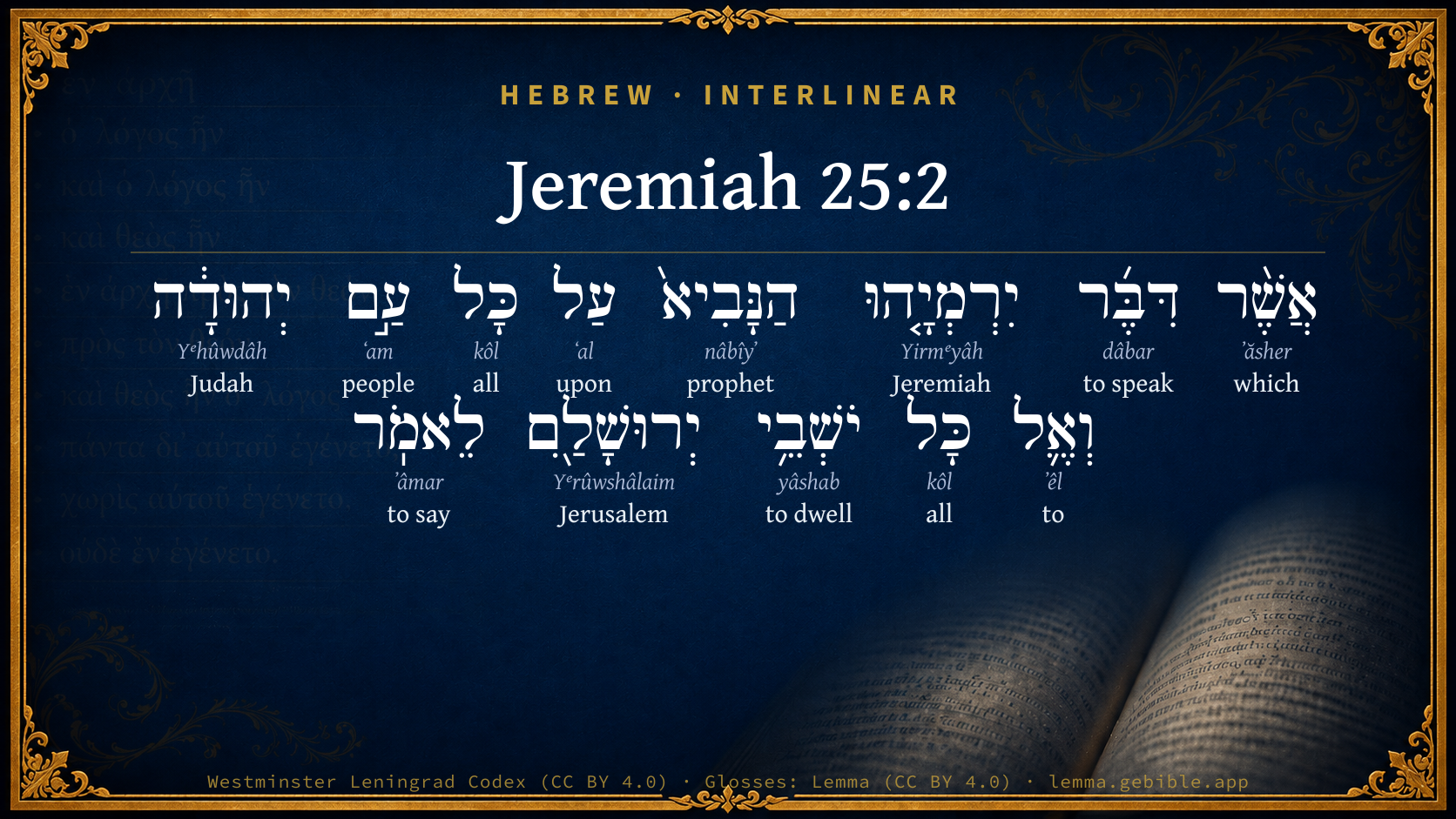
Hebrew (Westminster Leningrad Codex) Jeremiah 25:2 appears in the Hebrew Old Testament. The text above is from the Westminster Leningrad Codex. Each word links to its Strong’s number, a concise gloss, and parsing drawn from the Open Scriptures Hebrew Bible morphology. Click any word for its full Brown-Driver-Briggs (BDB) entry.
Download image
Cite this verse

Jeremiah 25:2 (World English Bible). Public Domain. Lemma interlinear Bible study tool, https://lemma.gebible.app/v/jeremiah/25/2.

Show BibTeX & RIS
BibTeX
RIS
English Translation
which Jeremiah the prophet spoke to all the people of Judah, and to all the inhabitants of Jerusalem, saying:
World English Bible · Public Domain
Download a study sheet

One document with this verse’s original text, its word-by-word gloss line, the meaning frame, cross-references with their text, attributed commentary, and full source and license credits — printable, and it pastes into notes with its structure intact.

This verse Autodidact and up

Study sheet (.html) Plain text (.txt)

A passage Seminary Student

Up to 50 verses in one chapter. A passage sheet keeps up to 6 commentary sources and 12 cross-references per verse, in the order this page ranks them, and says so on the sheet whenever that leaves anything out. Ask for a single verse and you get the Autodidact verse sheet above.

Everything on this page stays free to read, with no account — the sheet is a download of what is already on screen, not access to it.

Want to remove ads? Support Godless Engineer
Compare translations 3

The same verse in 3 English versions, stacked beneath the original-language interlinear above. Click any original word for its lexicon entry.

Each is an independent rendering of the whole verse — the interlinear is not word-aligned to these translations.

Highlighted words mark where these versions differ — a whole-verse word diff, not a word-by-word alignment.

  • World English Bible Public Domain
    which Jeremiah the prophet spoke to all the people of Judah, and to all the inhabitants of Jerusalem, saying:
  • King James Version Public Domain
    The which Jeremiah the prophet spake unto all the people of Judah, and to all the inhabitants of Jerusalem, saying,
  • unfoldingWord Literal Text CC BY-SA 4.0
    which Jeremiah the prophet spoke to all of the people of Judah and to all of the dwellers of Jerusalem, saying,

unfoldingWord Literal Text — © unfoldingWord, licensed CC BY-SA 4.0. Word-aligned USFM3 via Door43 (git.door43.org/unfoldingWord/en_ult).

Versions to compare (up to 4)

3 of 4 selected

Show all 18 translations

Every available English version of this verse, each an independent rendering of the whole verse.

  • World English Bible Public Domain
    which Jeremiah the prophet spoke to all the people of Judah, and to all the inhabitants of Jerusalem, saying:
  • Berean Standard Bible Public Domain
    So the prophet Jeremiah spoke to all the people of Judah and all the residents of Jerusalem as follows:
  • Majority Standard Bible Public Domain
    So the prophet Jeremiah spoke to all the people of Judah and all the residents of Jerusalem as follows:
  • King James Version Public Domain
    The which Jeremiah the prophet spake unto all the people of Judah, and to all the inhabitants of Jerusalem, saying,
  • American Standard Version (1901) Public Domain
    which Jeremiah the prophet spake unto all the people of Judah, and to all the inhabitants of Jerusalem, saying:
  • Revised Version (1885) Public Domain
    the which Jeremiah the prophet spake unto all the people of Judah, and to all the inhabitants of Jerusalem, saying:
  • Geneva Bible (1599) Public Domain
    The which Ieremiah the Prophet spake vnto all the people of Iudah, and to all the inhabitants of Ierusalem, saying,
  • Douay-Rheims (1899) Public Domain
    Which Jeremias the prophet spoke to all the people of Juda, and to all the inhabitants of Jerusalem, saying:
  • Young's Literal Translation Public Domain
    Which Jeremiah the prophet hath spoken concerning all the people of Judah, even unto all the inhabitants of Jerusalem, saying:
  • Literal Standard Version CC BY-SA 4.0
    Which Jeremiah the prophet has spoken concerning all the people of Judah, even to all the inhabitants of Jerusalem, saying,
  • Unlocked Literal Bible CC BY-SA 4.0
    Jeremiah the prophet proclaimed this to all the people of Judah and all the inhabitants of Jerusalem.
  • unfoldingWord Literal Text CC BY-SA 4.0
    which Jeremiah the prophet spoke to all of the people of Judah and to all of the dwellers of Jerusalem, saying,
  • Darby Bible Public Domain
    which Jeremiah the prophet spoke unto all the people of Judah and to all the inhabitants of Jerusalem, saying:
  • World Messianic Bible Public Domain
    which Jeremiah the prophet spoke to all the people of Judah, and to all the inhabitants of Jerusalem:
  • Webster's Bible Public Domain
    Which Jeremiah the prophet spoke to all the people of Judah, and to all the inhabitants of Jerusalem, saying,
  • Free Bible Version CC BY-SA 4.0
    So the prophet Jeremiah went and spoke to all the people of Judah and all the people living in Jerusalem, telling them:
  • Bible in Basic English Public Domain
    This word Jeremiah gave out to all the people of Judah and to those living in Jerusalem, saying,
  • JPS Tanakh (1917) Public Domain
    which Jeremiah the prophet spoke unto all the people of Judah, and to all the inhabitants of Jerusalem, saying:

Literal Standard Version (2020), Covenant Press — licensed CC BY-SA 4.0. Text via the HelloAO Bible API (eBible.org). Unlocked Literal Bible (unfoldingWord) — licensed CC BY-SA 4.0. Text via the HelloAO Bible API (eBible.org). unfoldingWord Literal Text — © unfoldingWord, licensed CC BY-SA 4.0. Word-aligned USFM3 via Door43 (git.door43.org/unfoldingWord/en_ult). Free Bible Version, Dr. Jonathan Gallagher — licensed CC BY-SA 4.0. Text via the HelloAO Bible API (eBible.org).

Word by word

More ways to search: Search by grammar → Find every occurrence → Compare this word →

Practice this passage: Drill this verse → Learn its vocabulary →

יִרְמְיָ֤הוּ
Yirmᵉyâh
H3414
“Jeremiah”
Noun, Proper
Part of Speech
Noun
Type
Proper
Full BDB Definition

Origin: from H7311 and H3050

TWOT: None

Jeremiah = "whom Jehovah has appointed" - the major prophet, son of Hilkiah of the priestly family in Anathoth; author of the prophetic book bearing his name - a man of Libnah and father of Hamutal the wife of king Josiah - a Gadite who joined David at Ziklag - a Manassehite, one of the mighty men of valour of the Transjordanic half tribe of Manasseh - a Gadite and warrior of David - a warrior of David - a priest who joined Nehemiah in the covenant ceremony - a priest also in the time of Nehemiah; maybe same as 7 - father of Jaazaniah the Rechabites
  1. אֲשֶׁ֨ר ʼăsher H834 “which” Particle, Relative
  2. דִּבֶּ֜ר dâbar H1696 “to speak” Verb, Piel, Perfect, 3rd Person, Masculine, Singular
  3. הַנָּבִיא֙ nâbîyʼ H5030 “the · prophet” Particle, Definite Article + Noun, Common, Masculine, Singular, Absolute
  4. עַל ʻal H5921 “upon” Preposition
  5. כָּל kôl H3605 “all of” Noun, Common, Masculine, Singular, Construct
  6. עַ֣ם ʻam H5971 “people of” Noun, Common, Masculine, Singular, Construct
  7. יְהוּדָ֔ה Yᵉhûwdâh H3063 “Judah” Noun, Proper
  8. וְאֶ֛ל ʼêl H413 “and · to” Conjunction + Preposition
  9. כָּל kôl H3605 “all of” Noun, Common, Masculine, Singular, Construct
  10. יֹשְׁבֵ֥י yâshab H3427 “dwelling” Verb, Qal, Participle Active, Masculine, Plural, Construct
  11. יְרוּשָׁלִַ֖ם Yᵉrûwshâlaim H3389 “Jerusalem” Noun, Proper
  12. לֵאמֹֽר ʼâmar H559 “to say” Preposition + Verb, Qal, Infinitive Construct

About this verse

These counts appear in no published source. They are computed here, from the morphology-tagged text and Lemma’s own curated glosses. What Lemma adds →

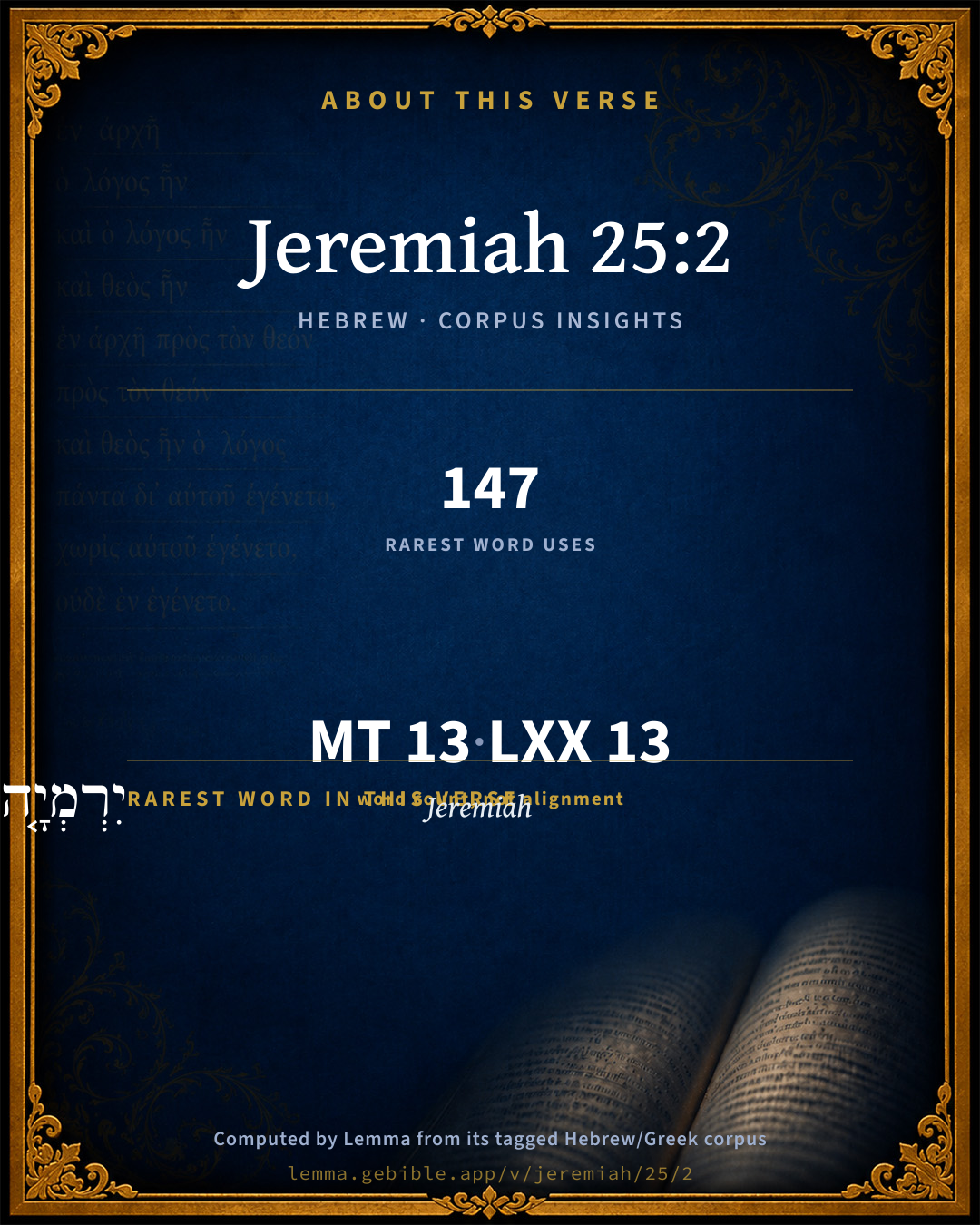
13
words
12
distinct lemmas
Prophets
section

Grammatical profile

  • 3 verbs
  • 7 nouns
  • 2 prepositions
  • 1 particle

Verb forms

  • דִּבֶּ֜ר Piel · Perfect
  • יֹשְׁבֵ֥י Qal · Participle Active
  • לֵאמֹֽר Qal · Infinitive Construct

Repetition

A word recurs within this verse — often emphatic in Hebrew:

Hebrew & Septuagint length

In the original languages it is 13 Hebrew tokens and 13 Greek tokens — but the two are counted differently (Hebrew bundles its prefixes and suffixes into one token; the Greek is in lemma form), so that isn’t a like-for-like length.

Cross-references

7

Topical passages linked to Jeremiah 25:2 in the Treasury of Scripture Knowledge — connected by theme and wording, ordered by reader-vote popularity; previews shown in the World English Bible.

  • Jeremiah 18:11 Now therefore, speak to the men of Judah, and to the inhabitants of Jerusalem, saying, Thus says Yahweh: Behold, I frame evil against you, and devise a device against you: return you now everyone from his evil way, and amend your ways and your doings.
  • Psalms 49:1–2 Hear this, all you peoples. Listen, all you inhabitants of the world,
  • Jeremiah 19:14–15 Then came Jeremiah from Topheth, where Yahweh had sent him to prophesy; and he stood in the court of Yahweh's house, and said to all the people:
  • Jeremiah 26:2 Thus says Yahweh: Stand in the court of Yahweh's house, and speak to all the cities of Judah, which come to worship in Yahweh's house, all the words that I command you to speak to them; don't diminish a word.
  • Jeremiah 35:13 Thus says Yahweh of Hosts, the God of Israel: Go, and tell the men of Judah and the inhabitants of Jerusalem, Will you not receive instruction to listen to my words? says Yahweh.
  • Jeremiah 38:1–2 Shephatiah the son of Mattan, and Gedaliah the son of Pashhur, and Jucal the son of Shelemiah, and Pashhur the son of Malchijah, heard the words that Jeremiah spoke to all the people, saying,
  • Mark 7:14–15 He called all the multitude to himself, and said to them, "Hear me, all of you, and understand.

Cross-references courtesy of OpenBible.info (CC BY 4.0).

Hebrew and Greek witnesses Masoretic Hebrew ↔ Greek Septuagint

The same verse in the two great witnesses to the Old Testament, shown verse-for-verse.

These are two independent witnesses, not word-aligned to each other, and the Septuagint is shown in lemma (dictionary) form.

Hebrew Jeremiah 25:2 Masoretic · Westminster Leningrad Codex

אֲשֶׁ֨ר דִּבֶּ֜ר יִרְמְיָ֤הוּ הַנָּבִיא֙ עַל כָּל עַ֣ם יְהוּדָ֔ה וְאֶ֛ל כָּל יֹשְׁבֵ֥י יְרוּשָׁלִַ֖ם לֵאמֹֽר

which Jeremiah the prophet spoke to all the people of Judah, and to all the inhabitants of Jerusalem, saying:

World English Bible · Public Domain

Greek LXX Structure differs

In the Septuagint, Jeremiah is about an eighth shorter than the Hebrew and arranges its material differently — the Oracles Against the Nations (Hebrew chapters 46–51) appear in the middle of the Greek book, after 25:13. Because the chapter and verse boundaries do not line up, a verse-for-verse comparison with the Hebrew is not shown.

A verse-for-verse comparison isn’t shown here because the chapters and verses don’t line up. Switch to the LXX edition with the MT / LXX toggle above to read the Greek directly.

Hebrew: Westminster Leningrad Codex (CC BY 4.0). Greek: Septuagint (public domain); English from a public-domain English Septuagint. How the Septuagint differs from the Hebrew →

Targum (Aramaic paraphrase)

1

The Targum is the ancient Jewish Aramaic paraphrase of the Hebrew Scriptures — an interpretive translation, not the Hebrew text itself. Onkelos (literal) and Pseudo-Jonathan (expansive) render the Torah, and Jonathan the Prophets. Coverage is partial: where no permissively-licensed English translation exists for a verse, only the Aramaic is shown. This is verse-level text, not a word-by-word alignment to the Hebrew.

  1. Targum Jonathan Prophets (Joshua–Malachi)
    דְאִתְנַבֵּי יִרְמְיָה נְבִיָא עַל כָּל עַמָא דְבֵית יְהוּדָה וְעַל כָּל יַתְבֵי יְרוּשְׁלֵם לְמֵימָר:

    (no public-domain English translation for this verse)

    Targum Jonathan — Aramaic: “Mikraot Gedolot” (public domain). English: “Sefaria Community Translation” (CC0 1.0 (public-domain dedication)); “London "Chaldee Paraphrase," 1871” (public domain). Text via Sefaria.

Commentary

Notes on Jeremiah 25:2 from classic Christian and Jewish commentators (each source and its license shown beneath its notes). The classic Christian expositions comment on the surrounding passage and are grouped to its opening verse, so a note may address several verses; the Jewish commentaries on the Tanakh (Rashi and others) are per-verse, so they appear only where the commentator wrote on this verse.

Lemma curates 59 commentaries, every one of them public domain or Creative Commons licensed, each selected and text-cleaned for this edition rather than reprinted as found. About our sources →

Trapp's Complete Commentary

John Trapp

Jer 25:2 The which Jeremiah the prophet spake unto all the people of Judah, and to all the inhabitants of Jerusalem, saying,

Ver. 2. Unto all the people of Judah.] The circumstances both of time when, and of persons to whom, is thus set down, for the reason given on Jer 25:1.

John Trapp, A Commentary or Exposition upon All the Books of the Old and New Testament (1647–1656) — public domain. Text from a community e-Sword module.

Joseph Benson's Commentary

Jer 25:2-3. Which Jeremiah spake to all the people of Judah — That is, the word which he spake concerned them all, and he spake it to as many of them as he met with in any public assembly at Jerusalem or elsewhere. From the thirteenth year of Josiah — In which year, as we read, Jer 1:2, Jeremiah began to prophesy; Josiah reigned thirty-one years, 2Ki 22:1; so that, taking in the thirteenth year, he prophesied nineteen years during the life of Josiah, to which the four years of Jehoiakim’s reign being added, make the number twenty-three. These twenty-three years, says the prophet, I have been a preacher to you, and I have not been negligent in my work, but, like men that rise early in the morning to despatch their business, I have been attentive and laborious in the discharge of my prophetic office.

Joseph Benson's Commentary on the Old and New Testaments (1811–1818) — public domain. Text from a community e-Sword module.

John Calvin's Commentaries

He shews more clearly in this verse what he had just said, — that he was not taught from above, that he might suppress what he had heard, but that he might proclaim it as from the mouth of God; and hence he gives himself the honorable title of a Prophet, as though he had said, that he came furnished with the indubitable commands of God, and was at the same time honored with the office of a Prophet; and he came thus, that no one might dare despise his doctrine. Now follows his sermon, —

John Calvin's Commentaries (1540-1563) — public domain. Text from the Calvin Translation Society English edition (1840s-50s) via the Christian Classics Ethereal Library (ccel.org). Calvin's coverage is partial (roughly two-thirds of the Bible); uncommented books and verses are honest gaps, never fabricated. The 19th-century editor's footnotes and remarks are omitted so the notes are faithfully Calvin's own voice.

The Cambridge Bible for Schools and Colleges

gen. ed. J. J. S. Perowne

2. spake unto all the people] The events of ch. 36 (see Jer_25:26 there) had not yet occurred. Jeremiah was still at liberty.

The Cambridge Bible for Schools and Colleges (gen. ed. J. J. S. Perowne; Cambridge University Press, 1878–1918) — public domain. Text from a community e-Sword module.

John Gill's Exposition

The which Jeremiah the prophet spake unto all the people of Judah,.... Perhaps at one of the three feasts, at which all the males appeared in Jerusalem; for it cannot be thought that he went up and down throughout all parts of the land to deliver this prophecy, but to as many of them as he found in Jerusalem in any place, at any time; and none so likely as what is mentioned:

and to all the inhabitants of Jerusalem: to whom he had an opportunity of speaking frequently:

saying; as follows:

John Gill's Exposition of the Whole Bible (1746–1763) — public domain (CC PDM 1.0). Text via the HelloAO Bible API.

Matthew Poole's English Annotations

That is, the word concerned them all, and he spake it to so many of them as he met with in any public assembly at Jerusalem or elsewhere.

Matthew Poole's English Annotations on the Holy Bible (1683–1685) — public domain. Text from a community e-Sword/MySword module.

Lesson kit

Teaching starters — assembled from the data on this page, not authored interpretation. Every prompt links to the verse data it draws on. Edit before teaching.

Jeremiah, in the Prophets, opens this verse with 13 words (12 distinct Hebrew lemmas). Its most distinctive word is Yirmᵉyâh (“Jeremiah”). A historical commentator’s framing appears above. Read the whole chapter for the surrounding context.

Discussion questions

  1. What does “Jeremiah” (Yirmᵉyâh) contribute to the verse as a whole?
  2. Jeremiah 18:11 shares this passage’s theme. How do the two illuminate each other?
  3. “all” occurs 2× in this one verse. What is the effect of the repetition?
  4. The translations on this page render this verse differently — a whole-verse word diff, not a word-by-word alignment. What might account for the different wordings?
  5. The verb «דִּבֶּ֜ר» is Piel Perfect. How does its form color the action?
  6. Reading how Trapp's Complete Commentary and Joseph Benson's Commentary read this verse, where do the two commentators agree and where do they part?

Things to notice

Reading settings

Reading text

Shown beneath each verse's original-language words.

Old Testament
Old Testament edition

Read the OT as the Masoretic Hebrew (MT) or the Greek Septuagint (LXX).

English shown for the Greek Septuagint (in the Hebrew ↔ Greek comparison).

Comparing translations? Open the Compare panel on any verse page to stack up to four side by side.