Jeremiah 19:14

Hebrew (Westminster Leningrad Codex) Jeremiah 19:14 appears in the Hebrew Old Testament. The text above is from the Westminster Leningrad Codex. Each word links to its Strong’s number, a concise gloss, and parsing drawn from the Open Scriptures Hebrew Bible morphology. Click any word for its full Brown-Driver-Briggs (BDB) entry.
Download image
Cite this verse

Jeremiah 19:14 (World English Bible). Public Domain. Lemma interlinear Bible study tool, https://lemma.gebible.app/v/jeremiah/19/14.

Show BibTeX & RIS
BibTeX
RIS
English Translation
Then came Jeremiah from Topheth, where Yahweh had sent him to prophesy; and he stood in the court of Yahweh's house, and said to all the people:
World English Bible · Public Domain
Download a study sheet

One document with this verse’s original text, its word-by-word gloss line, the meaning frame, cross-references with their text, attributed commentary, and full source and license credits — printable, and it pastes into notes with its structure intact.

This verse Autodidact and up

Study sheet (.html) Plain text (.txt)

A passage Seminary Student

Up to 50 verses in one chapter. A passage sheet keeps up to 6 commentary sources and 12 cross-references per verse, in the order this page ranks them, and says so on the sheet whenever that leaves anything out. Ask for a single verse and you get the Autodidact verse sheet above.

Everything on this page stays free to read, with no account — the sheet is a download of what is already on screen, not access to it.

Want to remove ads? Support Godless Engineer
Compare translations 3

The same verse in 3 English versions, stacked beneath the original-language interlinear above. Click any original word for its lexicon entry.

Each is an independent rendering of the whole verse — the interlinear is not word-aligned to these translations.

Highlighted words mark where these versions differ — a whole-verse word diff, not a word-by-word alignment.

  • World English Bible Public Domain
    Then came Jeremiah from Topheth, where Yahweh had sent him to prophesy; and he stood in the court of Yahweh's house, and said to all the people:
  • King James Version Public Domain
    Then came Jeremiah from Tophet, whither the LORD had sent him to prophesy; and he stood in the court of the LORD's house; and said to all the people,
  • unfoldingWord Literal Text CC BY-SA 4.0
    And Jeremiah came from Topheth, where Yahweh had sent him there to prophesy, and he stood in the courtyard of the house of Yahweh and said to all the people:

unfoldingWord Literal Text — © unfoldingWord, licensed CC BY-SA 4.0. Word-aligned USFM3 via Door43 (git.door43.org/unfoldingWord/en_ult).

Versions to compare (up to 4)

3 of 4 selected

Show all 18 translations

Every available English version of this verse, each an independent rendering of the whole verse.

  • World English Bible Public Domain
    Then came Jeremiah from Topheth, where Yahweh had sent him to prophesy; and he stood in the court of Yahweh's house, and said to all the people:
  • Berean Standard Bible Public Domain
    Then Jeremiah returned from Topheth, where the LORD had sent him to prophesy, and he stood in the courtyard of the house of the LORD and proclaimed to all the people,
  • Majority Standard Bible Public Domain
    Then Jeremiah returned from Topheth, where the LORD had sent him to prophesy, and he stood in the courtyard of the house of the LORD and proclaimed to all the people,
  • King James Version Public Domain
    Then came Jeremiah from Tophet, whither the LORD had sent him to prophesy; and he stood in the court of the LORD's house; and said to all the people,
  • American Standard Version (1901) Public Domain
    Then came Jeremiah from Topheth, whither Jehovah had sent him to prophesy; and he stood in the court of Jehovah's house, and said to all the people:
  • Revised Version (1885) Public Domain
    Then came Jeremiah from Topheth, whither the LORD had sent him to prophesy; and he stood in the court of the LORD’S house, and said to all the people:
  • Geneva Bible (1599) Public Domain
    Then came Ieremiah from Topheth, where the Lord had sent him to prophecie, and he stood in the court of the Lordes house, and sayde to all the people,
  • Douay-Rheims (1899) Public Domain
    Then Jeremias came from Topheth, whither the Lord had sent him to prophecy, and he stood in the court of the house of the Lord, and said to all people:
  • Young's Literal Translation Public Domain
    And Jeremiah cometh in from Tophet, whither Jehovah had sent him to prophesy, and he standeth in the court of the house of Jehovah, and he saith unto all the people:
  • Literal Standard Version CC BY-SA 4.0
    And Jeremiah comes in from Tophet, to where YHWH had sent him to prophesy, and he stands in the court of the house of YHWH, and he says to all the people:
  • Unlocked Literal Bible CC BY-SA 4.0
    Then Jeremiah went from Topheth, where Yahweh had sent him to prophesy. He stood in the courtyard of Yahweh's house and he said to all the people,
  • unfoldingWord Literal Text CC BY-SA 4.0
    And Jeremiah came from Topheth, where Yahweh had sent him there to prophesy, and he stood in the courtyard of the house of Yahweh and said to all the people:
  • Darby Bible Public Domain
    And Jeremiah came from Topheth, whither Jehovah had sent him to prophesy; and he stood in the court of Jehovah's house, and said to all the people,
  • World Messianic Bible Public Domain
    Then Jeremiah came from Topheth, where the LORD had sent him to prophesy, and he stood in the court of the LORD’s house, and said to all the people:
  • Webster's Bible Public Domain
    Then came Jeremiah from Tophet, whither the LORD had sent him to prophesy; and he stood in the court of the LORD'S house; and said to all the people,
  • Free Bible Version CC BY-SA 4.0
    Jeremiah returned from Topheth, where the Lord had sent him to deliver this message. He went and stood in the court of the Lord's Temple and announced to everyone,
  • Bible in Basic English Public Domain
    Then Jeremiah came from Topheth, where the Lord had sent him to give the prophet's word; and he took his place in the open square of the Lord's house, and said to all the people,
  • JPS Tanakh (1917) Public Domain
    Then came Jeremiah from Topheth, whither the LORD had sent him to prophesy; and he stood in the court of the LORD'S house, and said to all the people:

Literal Standard Version (2020), Covenant Press — licensed CC BY-SA 4.0. Text via the HelloAO Bible API (eBible.org). Unlocked Literal Bible (unfoldingWord) — licensed CC BY-SA 4.0. Text via the HelloAO Bible API (eBible.org). unfoldingWord Literal Text — © unfoldingWord, licensed CC BY-SA 4.0. Word-aligned USFM3 via Door43 (git.door43.org/unfoldingWord/en_ult). Free Bible Version, Dr. Jonathan Gallagher — licensed CC BY-SA 4.0. Text via the HelloAO Bible API (eBible.org).

Word by word

More ways to search: Search by grammar → Find every occurrence → Compare this word →

Practice this passage: Drill this verse → Learn its vocabulary →

מֵֽהַתֹּ֔פֶת
Tôpheth
H8612
“from · the · Tophet”
Preposition + Particle, Definite Article + Noun, Proper
Part of Speech
Preposition + Particle + Noun
Type
Proper
Full BDB Definition

Origin: the same as H8611

TWOT: 2539

Tophet or Topheth = "place of fire"
  1. וַיָּבֹ֤א bôwʼ H935 “and · to enter” Conjunction + Verb, Qal, Sequential Imperfect, 3rd Person, Masculine, Singular
  2. יִרְמְיָ֨הוּ֙ Yirmᵉyâh H3414 “Jeremiah” Noun, Proper
  3. אֲשֶׁ֨ר ʼăsher H834 “which” Particle, Relative
  4. שְׁלָח֧וֹ shâlach H7971 “to send · him” Verb, Qal, Perfect, 3rd Person, Masculine, Singular + Suffix, Personal, 3rd Person, Masculine, Singular
  5. יְהוָ֛ה Yᵉhôvâh H3068 “LORD” Noun, Proper
  6. שָׁ֖ם shâm H8033 “there” Adverb
  7. לְהִנָּבֵ֑א nâbâʼ H5012 “to prophesy” Preposition + Verb, Niphal, Infinitive Construct
  8. וַֽיַּעֲמֹד֙ ʻâmad H5975 “and · to stand” Conjunction + Verb, Qal, Sequential Imperfect, 3rd Person, Masculine, Singular
  9. בַּחֲצַ֣ר châtsêr H2691 “in/at · court of” Preposition + Noun, Common, Both, Singular, Construct
  10. בֵּית bayith H1004 “house of” Noun, Common, Masculine, Singular, Construct
  11. יְהוָ֔ה Yᵉhôvâh H3068 “LORD” Noun, Proper
  12. וַיֹּ֖אמֶר ʼâmar H559 “and · to say” Conjunction + Verb, Qal, Sequential Imperfect, 3rd Person, Masculine, Singular
  13. אֶל ʼêl H413 “to” Preposition
  14. כָּל kôl H3605 “all of” Noun, Common, Masculine, Singular, Construct
  15. הָעָֽם ʻam H5971 “the · people” Particle, Definite Article + Noun, Common, Masculine, Singular, Absolute

About this verse

These counts appear in no published source. They are computed here, from the morphology-tagged text and Lemma’s own curated glosses. What Lemma adds →

16
words
15
distinct lemmas
Prophets
section

Notable vocabulary

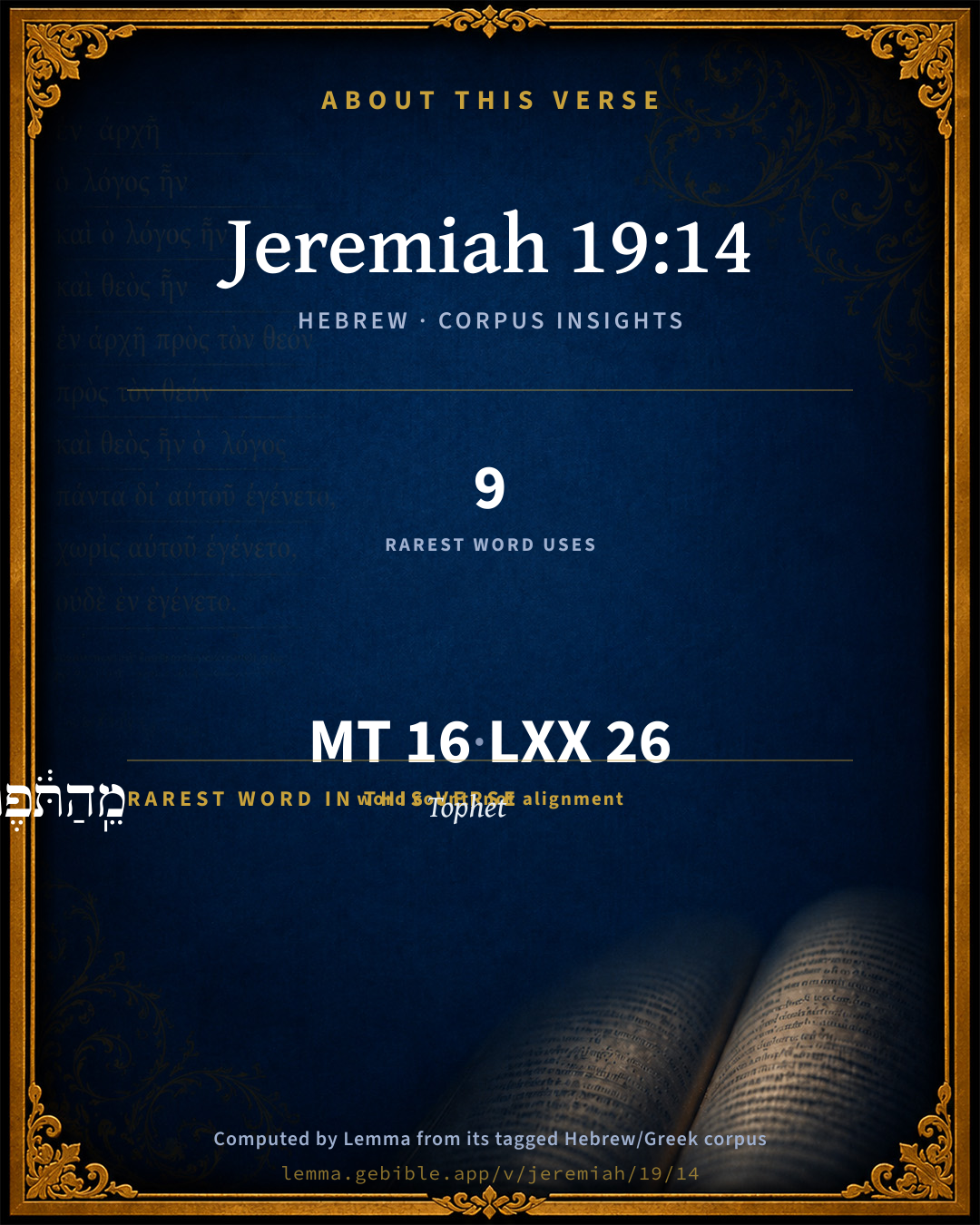
The rarest word here is מֵֽהַתֹּ֔פֶת Tophet H8612 — appearing just 9 times in the whole Hebrew Bible.

Shared distinctive vocabulary

מֵֽהַתֹּ֔פֶת Tophet H8612 occurs in 8 verses of the Hebrew Bible. Also found in:

Grammatical profile

  • 5 verbs
  • 8 nouns
  • 1 preposition
  • 1 adverb
  • 1 particle

Verb forms

  • וַיָּבֹ֤א Qal · Sequential Imperfect
  • שְׁלָח֧וֹ Qal · Perfect
  • לְהִנָּבֵ֑א Niphal · Infinitive Construct
  • וַֽיַּעֲמֹד֙ Qal · Sequential Imperfect
  • וַיֹּ֖אמֶר Qal · Sequential Imperfect

Repetition

A word recurs within this verse — often emphatic in Hebrew:

  • יְהוָ֛ה LORD H3068 ×2

Hebrew & Septuagint length

In the original languages it is 16 Hebrew tokens and 26 Greek tokens — but the two are counted differently (Hebrew bundles its prefixes and suffixes into one token; the Greek is in lemma form), so that isn’t a like-for-like length.

Cross-references

7

Topical passages linked to Jeremiah 19:14 in the Treasury of Scripture Knowledge — connected by theme and wording, ordered by reader-vote popularity; previews shown in the World English Bible.

  • Jeremiah 26:2 Thus says Yahweh: Stand in the court of Yahweh's house, and speak to all the cities of Judah, which come to worship in Yahweh's house, all the words that I command you to speak to them; don't diminish a word.
  • 2 Chronicles 20:5 Jehoshaphat stood in the assembly of Judah and Jerusalem, in the house of Yahweh, before the new court;
  • Jeremiah 19:2–3 and go forth to the valley of the son of Hinnom, which is by the entry of the gate Harsith, and proclaim there the words that I shall tell you;
  • 2 Chronicles 24:20–21 The Spirit of God came on Zechariah the son of Jehoiada the priest; and he stood above the people, and said to them, Thus says God, Why disobey you the commandments of Yahweh, so that you can't prosper? because you have forsaken Yahweh, he has also forsaken you.
  • Jeremiah 17:19 Thus said Yahweh to me: Go, and stand in the gate of the children of the people, through which the kings of Judah come in, and by which they go out, and in all the gates of Jerusalem;
  • Luke 21:37–38 Every day Jesus was teaching in the temple, and every night he would go out and spend the night on the mountain that is called Olivet.
  • Acts 5:20 "Go stand and speak in the temple to the people all the words of this life."

Cross-references courtesy of OpenBible.info (CC BY 4.0).

Hebrew and Greek witnesses Masoretic Hebrew ↔ Greek Septuagint

The same verse in the two great witnesses to the Old Testament, shown verse-for-verse.

These are two independent witnesses, not word-aligned to each other, and the Septuagint is shown in lemma (dictionary) form.

Hebrew Jeremiah 19:14 Masoretic · Westminster Leningrad Codex

וַיָּבֹ֤א יִרְמְיָ֨הוּ֙ מֵֽהַתֹּ֔פֶת אֲשֶׁ֨ר שְׁלָח֧וֹ יְהוָ֛ה שָׁ֖ם לְהִנָּבֵ֑א וַֽיַּעֲמֹד֙ בַּחֲצַ֣ר בֵּית יְהוָ֔ה וַיֹּ֖אמֶר אֶל כָּל הָעָֽם

Then came Jeremiah from Topheth, where Yahweh had sent him to prophesy; and he stood in the court of Yahweh's house, and said to all the people:

World English Bible · Public Domain

Greek LXX Structure differs

In the Septuagint, Jeremiah is about an eighth shorter than the Hebrew and arranges its material differently — the Oracles Against the Nations (Hebrew chapters 46–51) appear in the middle of the Greek book, after 25:13. Because the chapter and verse boundaries do not line up, a verse-for-verse comparison with the Hebrew is not shown.

A verse-for-verse comparison isn’t shown here because the chapters and verses don’t line up. Switch to the LXX edition with the MT / LXX toggle above to read the Greek directly.

Hebrew: Westminster Leningrad Codex (CC BY 4.0). Greek: Septuagint (public domain); English from a public-domain English Septuagint. How the Septuagint differs from the Hebrew →

Targum (Aramaic paraphrase)

1

The Targum is the ancient Jewish Aramaic paraphrase of the Hebrew Scriptures — an interpretive translation, not the Hebrew text itself. Onkelos (literal) and Pseudo-Jonathan (expansive) render the Torah, and Jonathan the Prophets. Coverage is partial: where no permissively-licensed English translation exists for a verse, only the Aramaic is shown. This is verse-level text, not a word-by-word alignment to the Hebrew.

  1. Targum Jonathan Prophets (Joshua–Malachi)
    וַאֲתָא יִרְמְיָה מִתּוֹפֶת דִשְׁלָחֵיהּ יְיָ תַּמָן לְאִתְנַבְּאָה וְקָם בְּדָרַת בֵּית מַקְדְשָׁא דַייָ וַאֲמַר לְכָל עַמָא:

    (no public-domain English translation for this verse)

    Targum Jonathan — Aramaic: “Mikraot Gedolot” (public domain). English: “Sefaria Community Translation” (CC0 1.0 (public-domain dedication)); “London "Chaldee Paraphrase," 1871” (public domain). Text via Sefaria.

Commentary

Notes on Jeremiah 19:14 from classic Christian and Jewish commentators (each source and its license shown beneath its notes). The classic Christian expositions comment on the surrounding passage and are grouped to its opening verse, so a note may address several verses; the Jewish commentaries on the Tanakh (Rashi and others) are per-verse, so they appear only where the commentator wrote on this verse.

Lemma curates 59 commentaries, every one of them public domain or Creative Commons licensed, each selected and text-cleaned for this edition rather than reprinted as found. About our sources →

Trapp's Complete Commentary

John Trapp

Jer 19:14 Then came Jeremiah from Tophet, whither the LORD had sent him to prophesy; and he stood in the court of the LORD’S house; and said to all the people,

Ver. 14. And he stood in the court of the Lord’s house.] A place of greatest concourse of people; and where he might meet with many hearers. Here he spread his net, that he might catch some souls; dilated his discourse at Tophet, whereof we have here but the short notes; minding them of their sin and punishment. And surely this prophet should be so much the more regarded by us, for that he so freely and fully delivered the divine messages, omitting no part thereof, either for fear or favour. Ambrose bade Augustine read the prophet Isaiah diligently, for the confirmation of his faith. We may all very profitably read the prophet Jeremiah, who is full of incitation to repentance and new obedience.

John Trapp, A Commentary or Exposition upon All the Books of the Old and New Testament (1647–1656) — public domain. Text from a community e-Sword module.

Joseph Benson's Commentary

Jer 19:14-15. He stood in the court of the Lord’s house — The great court, called the outer court, Eze 46:21, supposed to be the same with the new court, mentioned 2Ch 20:5, as having been built since Solomon’s time. And said to all the people — Confirming, and probably repeating to them, who had not heard it, what he had said to the ancients in the valley of Tophet. Thus saith the Lord of hosts — Who is well able to make his words good, I will bring upon this city, and upon all her towns — All the cities of Judah and Benjamin are meant which acknowledged Jerusalem for their metropolis, and were subordinate to her. All the evil that I have pronounced against it — As if he had said, Flatter not yourselves with a conceit that God will be better to you than his word. Whatever you may suppose to the contrary, the execution of the divine threatening will fully answer the prediction, and the former will be found, by experience, to be as terrible as the latter represents it to be; because they have hardened their necks — And would not bend them to the yoke of God’s commands; and would not hear his words — Would not heed and yield obedience to them.

Joseph Benson's Commentary on the Old and New Testaments (1811–1818) — public domain. Text from a community e-Sword module.

Keil & Delitzsch

C. F. Keil & F. Delitzsch

The Prophet Jeremiah and the Temple-Warden Pashur. - Jer 19:14. When Jeremiah, having performed the divine command, returned from Tophet to the city, he went into the court of the house of God and spoke to the people assembled there, v. 15: "Thus hath said Jahveh of hosts, the God of Israel: Behold, I bring upon this city, and all its cities, all the evil that I have pronounced against it, because they stiffened their necks not to hear my words." "All the people" is the people present in the court of the temple as distinguished from the men who had accompanied Jeremiah into the valley of Benhinnom (Jer 19:10). מבי, the א having dropped off, as in Jer 39:16; Kg1 21:21, Kg1 21:29; Sa2 5:2, and often. "All its cities" are the towns that belonged to Jerusalem, were subject to it (Jer 34:1); in other words, the cities of Judah, Jer 1:15; Jer 9:10, etc. All the evil that I have pronounced against it, not merely in the valley of Benhinnom (Jer 19:3-13), but generally up till this time, by the mouth of Jeremiah. If we limit the reference of this view to the prophecy in Tophet, we must assume, with Ng., that Jeremiah repeated the substance of it here; and besides, that prophecy is not in keeping with "all its cities," inasmuch as it (Jer 19:3-13) deals with Jerusalem alone. Apparently Jeremiah must have said more than is written in the verse, and described the evil somewhat more closely; so that the new matter spoken by him here consists in the "Behold I bring," etc., i.e., in his forewarning them of the speedy fulfilment of the threatenings against Jerusalem and Judah, as was the case with the prophecy in the valley of Benhinnom, which also, Jer 19:3, begins with הנני מביא. On "they stiffened their necks," etc., cf. Jer 17:23; Jer 7:26.

Keil & Delitzsch — Biblical Commentary on the Old Testament (1861–1891) — public domain (CC PDM 1.0). Text via the HelloAO Bible API. (Old Testament only.)

Lange's Commentary on the Holy Scriptures

2. THE OPPOSITION AND PUNISHMENT OF PASHUR

Jer_19:14 to Jer_20:6

14Then came Jeremiah [back] from Tophet, whither the Lord [Jehovah] had sent him to prophesy; and he stood in the court of the Lord’s [Jehovah’s] house; and 15said to all the people, Thus saith the Lord of hosts [Jehovah Zebaoth], the God of Israel: Behold, I will bring upon this city and upon all her towns all the evil that I have pronounced against it, because they have hardened their necks, that they might not hear my words.

1XX. Now Pashur, the son of Immer the priest, who was also chief governor10 in the house of the Lord, heard [that] Jeremiah prophesied [prophesy] these things. 2Then Pashur smote Jeremiah the prophet, and put him in the stocks [prison] that were [was] in the high gate of Benjamin, [the Benjamin-gate, the upper] which was 3by [in] the house of the Lord [Jehovah]. And it came to pass on the morrow that Pashur brought forth Jeremiah out of the stocks [prison]. Then said Jeremiah unto him, The Lord [Jehovah] hath not called thy name Pashur, but Magor-missabib, 4[“Terror round about”]. For thus saith the Lord [Jehovah], Behold, I will make thee [give thee up] a [to] terror to [for] thyself and to [for] all thy friends: and they shall fall by the sword of their enemies and thine eyes shall behold it: and I will give all Judah into the hand of the king of Babylon, and he shall carry them5captive into Babylon, and shall slay them with the sword. Moreover I will deliver all the strength [store]11 of this city, and all the labours [gains] thereof, and all the precious things thereof, and all the treasures of the kings of Judah will I give into the hand of their enemies, which shall spoil them, and take them, and carry them to6Babylon. And thou, Pashur, and all that dwell in thine house shall go into captivity: and thou shalt come to Babylon, and there thou shalt die, and shalt be buried there, thou, and all thy friends, to whom thou hast prophesied lies.

EXEGETICAL AND CRITICAL

The prophet betakes himself back from Tophet into the temple, and probably repeats there his predictions of calamity (Jer_19:14-15). For this he is struck by Pashur, the governor of the temple, and committed to prison for the night (Jer_20:1-2). Released from this confinement in the morning, Jeremiah announces to Pashur that the Lord has changed his name to Magor-missabib, for he will be given up, a prey to the torments of mortal anguish, his friends shall be slain before his eyes, Judah carried away to Babylon, all its treasures plundered; he himself shall survive all this, and die and be buried in Babylon, the prophet of lies in the midst of those whom he has deceived (Jer_19:4-6).

Jer_19:14-15. Then came Jeremiah … my words. As these words are closely connected with the previous context וַיָבֹא, Jer_19:14, corresponds to יָצָאתָ. In antithesis to יָצָא however בוֹא has always the meaning of return. Comp. Num_27:17; Deu_28:6; 1Ch_11:2; Psa_121:8; Psa_126:6.

Jer_19:15. Thus saith, etc. It is incredible that Jeremiah spoke only these few words in the temple. He would then have said nothing new, and have given no motive to the evidently increased anger of the temple-governor. We must therefore refer all that I have pronounced specially to the words spoken in Tophet, and assume a repetition of these words, in order that the reference might be understood.—I will bring. Comp. 2Sa_5:2; Mic_1:15, etc. Olsh., § 38, c.; § 208, d.—All her towns. Comp. Jos_10:37; Jos_10:39; Jos_13:17; Jer_34:1; Zec_7:7.—Hardened, etc. Comp. Jer_17:23; Jer_7:26.—That they might not hear. Comp. Jer_16:12; Jer_18:10; Jer_42:13.

Jer_20:1-6. Now Pashurheard … prophesied lies. According to Ezr_2:38; Ezr_10:22; Neh_7:41, there was a course of priests of the name Pashur. Not of this, however, but of the course named as that of Immer in these passages (comp. 1Ch_24:14) was the Pashur of the text. He is not mentioned elsewhere. For though the name frequently occurs (Jer_21:1; Jer_38:1; 1Ch_9:12; Neh_10:3; Neh_11:12), none of the individuals designated by it can be regarded as identical with this Pashur. It is at most possible that the father of Gedaliah mentioned in Jer_38:1 may be the same. Comp. Hitzig. ad loc.—Chief governor. The expression involves that there were several overseers (comp. Joseph. Antiqq., X. 8, 5). Without doubt the temple-watch (comp. Winer, R.-W.-B, Art., Tempel at the end) was under the orders of the “governor.” From a comparison of Jer_29:25-26, with Jer_52:24, it seems that the temple-governor took the second rank to the high-priest. As the head of the temple-police, Pashur now puts Jeremiah into the מַהְכֶּכֶת. The expression occurs besides only in Jer_29:26; 2Ch_16:10. It is without doubt a contrivance for shutting up in כ crooked position (στρεβλωτήριον. Symm. ποδοστράβη). Comp. Act_16:24.—Gate of Benjamin, etc. From Jer_37:13; Jer_38:7, it is evident that there was a city-gate which led into the territory of the tribe of Benjamin, and was therefore called the gate of Benjamin. The one mentioned in the text is expressly distinguished from this as a temple-gate. The same name intimates identity of cause. We must then look for this temple-gate also in the direction of Benjamin, i.e., to the north. The upper gate corresponds to the upper court, forming one of the entrances to it. Whether this upper gate of Benjamin is the same with the new gate, leading to the upper court (Jer_36:10; Jer_26:10) which, according to 2Ki_15:35, was built by Jotham, is questionable. Comp. Eze_8:3; Eze_14:5; Eze_9:2.—Not called Pashur, Jer_20:3. The signification of the name Pashur is very obscure. Most commentators derive the word from the Arabic pasaha=amplius fuit, and סְחוֹרcircumcirca. Hence Fuerst: extension—around. Others from בּושׁ, Lev_13:5; Lev_13:7, and חור, Josh. 29:22, as though “the widely extended authority of the man, making all pale” (comp. Neumann), were indicated. Ewald renders Joy (כַּשׁ or כָּשׁ from כִּשׁ, Mal. 3:20) around (as though חוֹר were pronounced חוֹל). Meier: Spirit of the free (כַּשׁ as in Job_35:15=extension, high spirit, pride;חוֹר=חוּרthe noble, the free). Hitzig and Graf cannot dispute that Jeremiah had the etymology, obscure as it is to us, in view, for how otherwise can we explain the choice of the name which he gave to the priest? It is certainly natural that Pashur should have some meaning opposed to that of the name Magor-missabib. It is noteworthy that the explanation afterwards given in Jer_20:4, sqq., corresponds exactly to this name, in so far as Pashur seems to be always surrounded by terrors, but never himself brought to extremity, for he is to die and be buried in Babylon (Jer_20:6). In this sense the words thine eyes shall see, are especially important. For by these the position of a man is designated, who is not himself reached by the most terrible calamity, but is compelled continually to behold how this comes upon others, and therefore does not escape the torture of anxiety. I would therefore neither render לִךָthee, after נתֶנְךָ as distributive (Jer_19:13), nor would I allow it to depend on the latter, but on מָגוֹר, terror:I give thee up to fear for thyself and thy friends. This is to be the specific punishment of Pashur, that he is not visited by death itself, but by the constant fear of death.—To whom thou hast prophesied lies. From these concluding words we learn that Pashur was active, not merely as a priest, but also as prophet. But his prophetic office was assumed and false; and his behaviour toward Jeremiah may, in part at least, be thus accounted for.

DOCTRINAL AND ETHICAL

1. On Jer_18:2. “What is the prophet of God to learn in the house of the potter? How shall this be his Bible or his school? But God chooses the foolish things to confound human wisdom (1Co_1:27).” Cramer. [“An orator would never choose such an instance for the purpose of making an impression on his audience; still less for the purpose of exhibiting his own skill and liveliness. It must be for business, not for amusement, that such a process is observed.”—“What we want in every occupation is some means of preserving the continuity of our thoughts, some resistance to the influences which are continually distracting and dissipating them. But it is especially the student of the events of his own time, of the laws which regulate them, of the issues which are to proceed from them, who has need to be reminded that he is not studying a number of loose disconnected phenomena, but is tracing a principle under different aspects and through different manifestations. A sensible illustration, if we would condescend to avail ourselves of it, would often save us from much vagueness and unreality, as well as from hasty and unsatisfactory conclusions.” Maurice.—S. R. A.]

2. On Jer_18:6 sqq. Omne simile claudicat. Man is not clay, though he is made of clay (Gen_2:7). Consequently in Jer_20:8; Jer_20:10 the moral conditions are mentioned, which by virtue of his personality and freedom must be fulfilled on the part of man, in order that the divine transformation to good or bad may take place. If the clay is spoiled on the wheel, it cannot help it. It is probably only the potter’s fault. Nothing then is here symbolized but the omnipotence of God, by virtue of which He can in any given case suppress whole kingdoms and nations, and transform them with the same ease and rapidity as the potter rolls up the spoiled vessel into a ball of clay, and immediately gives it a new form. It would be well for all to convince themselves, by witnessing the process, of the wonderful ease with which the potter forms the clay on the wheel.

3. On Jer_18:6-10. “Cogitet unusquisque peccata sua, et modo illa emendet, cum tempus est. Sit fructuosus dolor, non sit sterilis pœnitudo. Tanquam hoc dicit Deus, ecce indicavi sententiam, sed nondum protuli. Prœdixi non fixi. Quid times, quia dixi? Si mutaveris, mutatur. Nam scriptum est, quod pœniteat Deum. Numquid quomodo hominem sic pœnitet Deum? Nam dictum est: si pœnituerit vos de peccatis vestris, pœnitebit me de omnibus malis, quæ facturus eram vobis. Numquid quasi errantem pœnitet Deum? Sed pœnitentia dicitur in Deo mutatio sententiæ. Non est iniqua, sed justa. Quare justa? Mutatus est reus, mutavit judex sententiam. Noli terreri. Sententia mutata est, non justitia. Justitia integra manet, quia mutato debet parcere, quia justus est. Quomodo pertinaci non parcit, sic mutato parcit.” Augustin, Sermo 109. De Tem ad medium.

4. On Jer_18:6-10. “Comminationes Dei non intelligendæ sunt absolute, sed cum exceptione pœnitentiæ et conditione impœnitentiæ. Promissiones itidem non sunt absolute sed circumscriptæ cum conditione obedientiæ, tum exceptione crucis. God stipulates everywhere for the cross.” Comp. Deuteronomy 28. Förster.

5. On Jer_18:6-10. “Præscientia et prædictio Dei non injicit absolutam eventus necessitatem rebus præscitis ac prædictis.” Förster.

6. On Jer_18:8. “O felix pœnitentium humilitas! Quam potens es apud omnipotentem.” Bernard of Clairvaux.

[On Jer_18:8-10. “I apprehend that we shall learn some day that the call to individual repentance, and the promise of individual reformation, has been feeble at one time, productive of turbulent, violent, transitory effects at another, because it has not been part of a call to national repentance, because it has not been connected with a promise of national reformation. We may appeal to men by the terrors of a future state; we may use all the machinery of revivalists to awaken them to a concern for their souls; we may produce in that way a class of religious men who pursue an object which other men do not pursue (scarcely a lass selfish, often not a less outward object):—who leave the world to take its own course;—who, when they mingle in it, as in time they must do for the sake of business and gain, adopt again its own maxims, and become less righteous than other men in common affairs, because they consider religion too fine a thing to be brought from the clouds to the earth, while yet they do not recognise a lower principle as binding on them. But we must speak again the ancient language, that God has made a covenant with the nation, and that all citizens are subjects of an unseen and righteous King, if we would have a hearty, inward repentance, which will really bring us back to God; which will turn the hearts of the fathers to the children, and of the children to the fathers; which will go down to the roots of our life, changing it from a self-seeking life into a life of humility and love and cheerful obedience; which will bear fruit upwards, giving nobleness to our policy and literature and art, to the daily routine of what we shall no more dare to call our secular existence.” Maurice.—S. R. A.]

7. On Jer_18:10. “God writes as it were a reflection in our heart of that which we have to furnish to Him. For God is disposed towards us as we are disposed towards Him. If we do well, He does well to us; if we love Him, He loves us in return; if we forsake Him, He for sakes us. Psa_18:26.” Cramer. [“Sin is the great mischief maker between God and a people; it forfeits the benefits of His promises, and spoils the success of their prayers. It defeats His kind intentions concerning them (Hos_7:1), and baffles their pleasing expectations from Him. It ruins their comforts, prolongs their grievances, brings them into straits, and retards their deliverances. Isa_49:1-2.” Henry—S. R. A.]

8. On Jer_18:12. “Freedom of the Spirit! Who will allow himself to be brought into bondage by the gloomy words of that singular man, Jeremiah? Every one must be able to live according to his own way of thinking.” Diedrich, The prophet Jeremiah and Ezekiel briefly expounded. 1863, S. 59.—This is the watchword of impiety in all times. If in truth everyone bears the divinity within him, then it is justified. But since every man bears within him only a θεϊόντι, a divine germ or spark, a point of connection for the objectively divine, and at the same time a point of connection for the diabolical, it is a hellish deception when one supposes he must follow his ingenium. For the question is, whether the voice from within is the voice of God or the voice of the devil. Here it is necessary to try ourselves and to open an entrance to the divine sun of life, so that the divine life-germ in us may be strengthened, and enabled to maintain its true authority.

9. On Jer_18:14. On the summits of the high mountains, even in tropical countries, the snow does not entirely melt, and therefore the mighty cool springs at their feet never dry up. With those men only does the pure white snow of divine knowledge and godly fear never melt, whose heads are elevated above the steam and vapor of earthly cares and passions, into the pure clear air of heaven. And they it is, from whose bodies flow streams of living water (Joh_7:38).

10. On Jer_18:18. Consult the treatise of Luther: How a minister should behave when his office is despised?

11. On Jer_18:18. (Come and let us smite him with the tongue, etc.). “It is indeed uncertain whether this is said by the preachers or by the whole people; but this is certain, that such actions are performed daily by those teachers, who know no other way of stopping the mouth of a servant of Jesus. ‘And not give heed to any of his words.’ This is au pis aller. If we can do him no harm, we will stop our ears, and he shall not convince us.” Zinzendorf.

12. On Jer_18:19. (Give heed to me, O Lord). “This takes place in two ways. A teacher is looked at by the eye which is as flames of fire. He is also guided by the same eye, which looks on all lands, to strengthen those whose hearts are towards the Lord. No child can rest more securely in the cradle, while the nurse is looking for any fly that might disturb it, than a servant of the Lord can, to whom God gives heed.” Zinzendorf.

13. On Jer_18:20. “It is a pleasing remembrance, when a teacher considers that he has been able to avert divine judgments from his people. It is also an undeniable duty. The spirit of Job, Moses, Jeremiah, Ezra, Nehemiah, Paul in this respect is the true spirit of Jesus Christ. He is a miserable shepherd who can give up his sheep and look on with dry eyes, while the fold is being devastated. Not to mention that teachers are now-a-days, by the salaries which they receive from their congregations, brought into the relation of servitude, and besides the regular obligation of the head are laid under indebtedness, as hospitals and other institutions, to pray for their founders. They give themselves the name of intercessors and thus bind themselves anew to this otherwise universal duty of all teachers.” Zinzendorf. But when the servant of God receives “odium pro labore, persecutio pro intercessione,” this is “the world’s gratitude and gratuity.” Förster.

14. On Jer_18:21-23. With regard to this prayer against his enemies Calvin remarks, “this vehemence, as it was dictated by the Holy Spirit, is not to be condemned, nor ought it to be made an example of, for it was peculiar to the Prophet to know that they were reprobates.” For the prophet, he says, was (1) “endued with the spirit of wisdom and judgment, and (2) zeal also for God’s glory so ruled in his heart, that the feelings of the flesh were wholly subdued, or at least brought under subjection; and farther, he pleaded not a private cause.—As all these things fall not to our lot, we ought not indiscriminately to imitate Jeremiah in this prayer: for that would then apply to us which Christ said to His disciples, ‘Ye know not what spirit governs you (Luk_9:55).’ ” In general the older Comm. agree in this. Oecolampadius says tersely: “Subscribit sententiæ divinæ.” Förster also says that originally such a prayer is not allowed, but that to the prophet, who by the divine inspiration was certain of the “obstinata et plane insanabilis malitia” of his hearers, it was permitted as “singulare et extraordinarium aliquid.” The Hirschberger Bibel also explains the words as a consignment to the divine judgment, since God Himself has several times refused to hear prayer in their behalf (Jer_14:13-14), and they themselves could not endure it (Jer_20:18). Vide Neumann II. S. 15.—Seb. Schmidt says plainly, “Licet hominibus impiis et persecutoribus imprecari malum, modo ejusmodi imprecationes non fiant ex privata vindicta, et conditionatæ sint ad constantem eorum impietatem. Nisi enim ejusmodi imprecationes etiam piis essent licitæ, propheta non imprecatus esset persecutoribus gravissimam pœnam hanc.” I believe that it is above all to be observed that Jeremiah does not announce these words (Jer_20:18-18) as the word of Jehovah. It is a prayer to the Lord, like Jer_20:7-18. That which was remarked on Jer_20:14-18, on the Old Testament character of the prayer, applies here also and in a higher degree. For here as there we may set a good share of the harshness to the account of the rhetoric. The standard of judgment may be found in Mat_5:43. Many ancient Comm. ex. gr. Jerome, who regard the suffering prophet as a type of the suffering Saviour, point out the contrast between this prayer of Jeremiah’s against his enemies and the prayer of Christ for His enemies (Luk_23:34). The only parallel adduced from the New Testament is 2Ti_4:4. But there it is ἀποδώσει (according to the correct reading of Tischendorf) not ἀποδώῃ (Text. Rec., Knapp).

15. On Jer_19:1. “If man were only a Platonic αὐτάνθρωπος, and did not dwell in the flesh, but were pure spirit and soul, as the Schwenkfelder dreamed a man might be, he would not need such visible signs.—But because man consists of body and soul, God uses, together with the Holy Ghost, the word and Sacrament and other signs.” Cramer.

16. On Jer_19:6-9. Μεγάλων ἀδικημάτων μεγάλαι εἰσὶ τιμωρίαι παρὰ τὸν θεόν. Herodotus. Vide Förster, S. 106.

17. On Jer_19:10-11. What is more easily broken in pieces than an earthen vessel? Equally easy is it for the hand of the Almighty to break in pieces the kingdoms of men. And if He spared not the kingdom of Judah, whose king was a son of David and the people the chosen nation, shall He spare the kingdoms of the heathen, none of which can point to any prophecy in its behalf, like that which we read in 2Sa_7:16? Comp. Dan_2:21; Dan_4:14; Dan_4:22; Dan_4:29; Dan_5:21; Sir_10:4; Sir_10:8; Sir_10:10; Sir_10:14.

18. On Jer_19:11-13. This prophecy was not completely fulfilled by the destruction of Jerusalem by Nebuchadnezzar. For Jerusalem was restored after this destruction. The second destruction, by the Romans, must then be regarded as the definitive fulfillment. Comp. Jerome ad loc.—Tophet was used by the inhabitants of Jerusalem for idolatrous purposes. In consequence, the fires of Tophet set Jerusalem on fire, and again the corpses which filled Jerusalem extended even to Tophet, and by reciprocal calamity Tophet became like Jerusalem and Jerusalem like Tophet.

19. On Jer_20:1-2. “ Ἡρώων τέκνα πήματα. Honores mutant mores.” Förster. “Quod hic fuit tormentum, illic erit ornamentum.” Augustin.

20. On Jer_20:3-6. “Mark, who is the stronger here: Pashur or Jeremiah? For 1. Jeremiah overcomes his sufferings by patience, 2. He is firm in opposition to his enemy and does not allow himself to be terrified by his tyranny, but rebukes him to his face for his sins and lies.” Cramer.

21. On Jer_20:3-6. Pashur’s punishment consists in this, that he will participate in the terrible affliction and be a witness of it, without being able to die.—He is a type of the wandering Jew.

22. On Jer_20:7-12. The prophet could say with a good conscience that he had not pressed into this office. It was his greatest comfort that the Lord had persuaded and overpowered him, when resisting, and that afterwards the fire within kindled by the Lord compelled him to speak. Thus he at last becomes so joyful, that in the midst of his sufferings he sings a hymn on his deliverance.

Lord Jesus, for Thy work divine,

The glory is not ours, but Thine;

Therefore we pray Thee stand by those,

Who calmly on Thy word repose.

23. On Jer_20:14-18. “When the saints stumble this serves to us; 1. for doctrine: we see that no man is justified by his own merits; 2. for ἔλεγχος, i. e. for the refutation of those, who suppose that there are ἀναμάρτητοι; 3. for ἐπανόρθωσις, if we follow Ambrose, who called to the emperor Theodosius: ‘Si Davidem imitatus es peccantem, imitare etiam pœnitentem;’ 4. for παιδεία, that he who stands take heed that he do not fall; 5. for παρηγορία, that he who has fallen may after their pattern rise again.” Förster.

24. On Jer_20:17-18. “The question is, Does a man do right in wishing himself dead? Answer: He who from impatience wishes himself dead like Job, Elijah, Jonah, Tobias, and here Jeremiah, does wrong, and this is a piece of carnal impatience. But when we think of the wicked world and the dangerous times in which we live and on the other hand of the future joy and glory, and therefore desire with Simeon and Paul to be released, we are not to be blamed.” Cramer.

HOMILETICAL AND PRACTICAL

1. The 18th homily of Origen has for its text Jer_18:1-16 and Jer_20:1-7. The 19th has Jer_20:7-12.

2. On Jer_18:1-11. Comfort and warning, implied in the fact that the threatenings and promises of the Lord are given only conditionally: 1. The comfort consists in this, that the threatened calamities may be averted by timely repentance. 2. The warning in this, that the promises may be annulled by apostasy.

3. On Jer_18:7-10. Comp. the Homiletical on Jer_17:5-8.

4. On Jer_18:7-11. “How we should be moved by God’s judgments and goodness: that each, 1. Should turn from his wickedness; 2. should reform his heart and life.” Kapff, Passion, Easter and Revival Sermons. 1866.

5. [On Jer_18:12. “The sin, danger and unreasonableness of despair. The devil’s chief artifices are to produce either false security and presumption or despair. Despair Isaiah 1. sinful, (a) in itself, (b) because it is the parent of other sins, as is seen in the cases of Cain, Saul, and Judges 2. It is dangerous. 3. It is groundless, because (a) we still enjoy life and the means of grace, (b) of the long-suffering character of God, (c) of the universality of the scheme of redemption, (d) of the person, character and invitations of Christ, (e) of many instances of final salvation.” Payson.—S. R. A.]

6. On Jer_18:18-20. Text for a Sermon on the Anniversary of the Reformation. Opposition of the office which has apparent authority to that which has true authority; 1. The basis of the opposition: the assertion of the infallibility of the former office. 2. The mode of the opposition; (a) in not being willing to hear, (b) in the attempt to destroy the latter by violence. 3. The result of the opposition is nugatory, for (a) the Lord hears the voice of the opposers to judge them, (b) He gives heed to His servants to protect them.

7. On Jer_20:7-13. The trial and comfort of a true minister of the Word; 1. The trial: (a) scorn and derision; (b) actual persecution. 2. The comfort: (a) the Lord put him in office and maintains him in it; (b) that the Lord will interpose for His servants and. thus, (1) help His cause to victory, and (2) save their persons.

Footnotes:

[10]Jer_19:1.—והוא־פקיד נניד. The construction is like אֵל נִבּוֹר ,דֶשֶׁא עֵשֶׂב, Comp. Naegelsb. Gr., §§ 72 and 66.

[11]Jer_19:5.—הֹסֶז—copia, store. Comp. Pro_15:6; Pro_27:24; Isa_33:6; Eze_22:25.

Lange's Commentary on the Holy Scriptures (Critical, Doctrinal, and Homiletical), ed. John Peter Lange, English translation edited by Philip Schaff (1864–1880) — public domain. Text from a community e-Sword module.

Tyndale Open Study Notes

Tyndale Open Resources

19:14-15 Jeremiah concluded his message at the Temple of the Lord, where the common people could hear him.

Tyndale Open Study Notes — © Tyndale Open Resources, licensed CC BY-SA 4.0. Text via the HelloAO Bible API.

Jamieson, Fausset & Brown

Robert Jamieson, A. R. Fausset & David Brown

court of the Lord's house--near Tophet; the largest court, under the open air, where was the greatest crowd (Ch2 20:5).

Jamieson, Fausset & Brown — Commentary Critical and Explanatory on the Whole Bible (1871) — public domain (CC PDM 1.0). Text via the HelloAO Bible API.

Adam Clarke's Commentary

Verse 14. Then came Jeremiah from Tophet] He had probably gone to the valley of Hinnom, and there repeated the discourse which he had a little before delivered to the chief priests and elders.

Adam Clarke's Commentary on the Bible (1810–1826) — public domain. Text from a community e-Sword/MySword module.

John Calvin's Commentaries

Jeremiah had been led to the very place, when he foretold the punishment, which was nigh at hand, on account of the superstitions of Tophet or of the valley of Hinnom. That his doctrine might be more efficacious, God intended that he should preach before the very altar and in the very valley, then well known for ungodly and false modes of worship. He says now that he went to the Temple and delivered there the same message. We hence learn how great must have been the stupidity and indifference of the people, for the repetition of the prophecy was not unnecessary. For as God knew that the Jews were extremely tardy and slow, he caused them to be warned twice by his servant, and in two different places.

Jeremiah, it is said, returned from Tophet, where God had sent him to prophesy; which last words were added, that we may not suppose that he without reason preached in the valley of Hinnom. God then commanded Jeremiah to denounce there, as it were in the very place, on the Jews their own destruction. And he stood, it is added, in the court of Jehovah’s house. As it was not lawful for the people to enter into the Temple, they usually assembled in the court, which was a part of the Temple. Then Jeremiah stood there; for he had to speak, not to a few, or in a corner, but to the whole people, and to make them witnesses of his prophecy. But we read here nothing new; for, as it has been stated, he was bidden to declare twice the same thing — the approaching calamity; and he was so bidden, because the Jews were so hardened, that they could not easily be moved. That he connects other cities with Jerusalem is not to be wondered at; he thereby intimates, that the whole land was guilty before God, and that therefore desolation was near at hand, as to all the towns and cities; as though he had said, “God will not spare Jerusalem, though it has been hitherto his sanctuary; but as lesser cities are not innocent, they shall also feel the hand of God together with Jerusalem.”

John Calvin's Commentaries (1540-1563) — public domain. Text from the Calvin Translation Society English edition (1840s-50s) via the Christian Classics Ethereal Library (ccel.org). Calvin's coverage is partial (roughly two-thirds of the Bible); uncommented books and verses are honest gaps, never fabricated. The 19th-century editor's footnotes and remarks are omitted so the notes are faithfully Calvin's own voice.

Ellicott's Commentary for English Readers

(14) He stood in the court of the Lord’s house.—The acted sermon had been preached in Tophet, in the valley of Ben-Hinnom, in the presence of a few chosen representatives of priests and people. It is followed by one addressed to the whole assembled congregation, announcing the same doom.

A Bible Commentary for English Readers, edited by Charles John Ellicott (1878–1897) — public domain. Text from a community e-Sword module.

The Cambridge Bible for Schools and Colleges

gen. ed. J. J. S. Perowne

14. Jeremiah has now returned from the fulfilment of his commission.

The Cambridge Bible for Schools and Colleges (gen. ed. J. J. S. Perowne; Cambridge University Press, 1878–1918) — public domain. Text from a community e-Sword module.

John Gill's Exposition

Thus saith the Lord of hosts, the God of Israel,.... See Gill on Jer 19:3;

behold, I will bring upon this city, and upon all her towns: the city of Jerusalem, and all the cities and towns near it, even all the cities and towns in Judea; of which Jerusalem was the metropolis, and therefore called hers:

all the evil that I have pronounced against it; or decreed against it, as the Targum; all that he had purposed, and all that he had threatened, or spoke of by the Prophet Jeremiah, or any other of his prophets; for whatever he has said he will do, and whatsoever he has solved upon, and declared he will do, he assuredly brings to pass:

because they have hardened their necks, that they might not hear my words; they turned their backs upon him, pulled away the shoulder, stopped their ears that they might not hear what was said by the prophets from the Lord; they neither inclined their ears to hearken to, nor bowed their necks to receive the yoke of his precepts; but, on the contrary, were, as was their general character, a stiffnecked people, and uncircumcised in heart and ears, obstinate and disobedient; and this was the cause of their ruin, by which it appeared to be just and righteous.

Next: Jeremiah Chapter 20

John Gill's Exposition of the Whole Bible (1746–1763) — public domain (CC PDM 1.0). Text via the HelloAO Bible API.

Albert Barnes' Notes on the Bible

Since it was this repetition of the prophecy in the temple which so greatly irritated Pashur, these two verses ought to be joined to the next chapter.

Albert Barnes' Notes on the Bible (1834–1885) — public domain. Text from a community e-Sword/MySword module.

Haydock's Catholic Bible Commentary

People. Many still resorted to the temple. (Calmet)

George Leo Haydock (1774–1849), Haydock's Catholic Family Bible and Commentary, 1859 edition — public domain. Excludes Psalms (Douay-Rheims chapter numbering differs from Protestant) and Deuterocanonical books (Catholic canon only).

Matthew Poole's English Annotations

Jeremiah had now despatched the errand upon which God had sent him to Tophet; coming back by God’s direction, he stands in the court, which was common to all people, where the most might hear.

Matthew Poole's English Annotations on the Holy Bible (1683–1685) — public domain. Text from a community e-Sword/MySword module.

Whedon's Commentary on the Bible

Daniel D. Whedon

14, 15. These verses belong with the following chapter.

Daniel D. Whedon (gen. ed.), Commentary on the Old and New Testaments (1874–1909) — public domain. Text from a community e-Sword module.

The Pulpit Commentary

Vers. 14, 15. Here begins a fresh section of the narrative. Jeremiah has executed his commission, and now proceeds to the temple, where he repeats before the assembled people his announcement of the awful judgment.

Vers. 14, 15. The warning confirmed.

The warning of the discourse in the valley of Hinnom is confirmed by a repetition of it under more ordinary circumstances.

I THE CIRCUMSTANCES OF THE CONFIRMATION OF THE WARNING.

1. It was repealed. The scribe must bring from his treasury things old as well as things new. Men need "line upon line." Unpopular truths must not only be revealed once for all, they must be impressed upon people until they are accepted.

2. It was repeated in the temple. The horrible associations of Tophet were wanting there. All was decorum, order, propriety. Yet the message was not the less true there than in a more congenial place. Terrible truths must be uttered in face of the religious respectability of our Church worship. Such outward correctness should not make us forget the true condition of men"s hearts, which is apparent enough in the darker scenes of life, in the Tophets of iniquity. We are tempted to be deceived by the appearance of religions assemblies into a blindness to the greatness of sin which is visible enough in common life.

3. It was repeated in the ears of all the people. The leaders were first selected to hear the warning (ver. 1). But it was not confined to them. The people generally were guilty. They had quietly acquiesced in the wickedness of their great men. Nay, they had furthered, them, in it, (Jer_5:31) had followed their example, and become guilty" of similar crimes. They, too, must not expect to escape in the hour of judgment.

II THE FORM IN WHICH THE WARNING WAS CONFIRMED.

1. It was epitomized. Truth needs to be broken up into detail that it may be clearly understood and vividly conceived by the imagination. But it is possible to lose ourselves in details and miss the drift of the sum of them. Hence the advantage of broad, sweeping enunciations of principle.

2. It was repeated as a prediction of real facts. The warning was not to be regarded as an empty threat, nor as the indication of a danger that might be evaded. "I will bring... the evil that I have pronounced," etc. It is both weak and cruel to threaten without the intention of executing the threat weak, for the hollowness of the alarm is soon discovered by experience, and then it is impotent; cruel, for why create distress about a mere "bogey" danger? God is merciful, but firm. His threats are conditional, but, while the conditions subsist, the execution is as certain as any event that depends on the uniform laws of nature.

3. It was repeated without diminution. All the evil pronounced will fall on all the towns. The effect of stern warnings fades with the lapse of time. We are tempted to think that things will not be so very bad as at first seemed likely, and to take comfort from such reflections. But danger is not lessened by our growing indifference to it.

4. It was strengthened by an appeal to the increasing necessity for it. "Because they have hardened their necks, that they might not hear my words." A deep consciousness of guilt makes the just punishment of it seem inevitable. Willful persistence in wickedness after warning can only increase the guilt and make the punishment the more certain and the more severe.

Ver. 14 Jer 20:6The sin and punishment of Pashur.

This man is to be distinguished from him of the same name mentioned in Jer_21:1. The Pashur mentioned here was a priest, and one holding high office in the temple. After Jeremiah had delivered his discourse at Tophet, he seems to have returned to the city and temple, and then to have spoken in substance the same predictions of woe. Whereupon Pashur, with less patience than these who heard the prophet and had seen his symbolic declaration of the coming ruin when he broke the earthen bottle at Tophet, falls upon him and smites him, and tortured him by putting him in what is called the stocks (see Exposition). Thus

I HE CRUELLY PERSECUTED THE PROPHET OF GOD. It was sad that any one should do this. But yet more that it should be the act of a priest of God, and holding high position amongst the priests. What hope can there be of the people when their appointed leaders and those to whom they are wont to look up for instruction and example in what is good thus prostitute their office? Thus the wicked husbandmen beat" the servants who were sent to them. (Mat_20:3-5) And it was the same order that ever opposed, and yet more fiercely, our Lord himself. The sanctity and authority attaching to the priest"s office have ever been fatal to the integrity of unworthy holders of the office, and have caused that amongst the most infamous of mankind not a few priests should be found. But

II HE FAILED TO SECURE THE END HE HAD IN VIEW. Jeremiah was not silenced, but goaded, as it were, to declare yet more terrible judgments in which Pashur himself should be awfully involved. (cf. Paul, "God shall smite thee," etc., Act_23:3) The stout heart of a true servant of God is an anvil on which many hammers may fiercely smite, but it will wear them out long before they wear it out. Saul of Tarsus found that the persecution he had done so much to further in connection with Stephen only made matters worse. The blood of the martyrs is the seed of the Church. And the reason is that a faith for which men are willing to die convinces all beholders that it must be exceedingly precious and well founded, and inspires them with an irresistible desire to know and possess it for themselves, or at least to know what it is.

III HE BROUGHT DOWN ON HIMSELF SORE JUDGMENT. Jeremiah declares to him that the Lord has changed his name to Magor-Missabib, for he will be given up a prey to the torments of mortal anguish, his friends shall be slain before his eyes, Judah carried away to Babylon, all its treasures plundered; he himself shall witness all this and die and be buried in Babylon, There thou, and all thy friends, to whom thou hast prophesied lies." Thus, look where he would, he should see nothing but terror. Above the anger of God; beneath a dishonored grave; around calamity and woe on all near and dear to him, and of which he had been largely the procuring cause; within a conscience tormenting him day and night. It was an awful doom. "Let persecutors read it and tremble; tremble to repentance before they be made to tremble to their ruin. C.

The Pulpit Commentary (1880–1919), ed. H.D.M. Spence-Jones & Joseph S. Exell — public domain. Text from a community e-Sword module.

John Wesley's Explanatory Notes

Then - Jeremiah had now dispatched the errand upon which God had sent him to Tophet, coming back by God's direction, he stands in the court, which was common to all people, where the most might hear.

John Wesley, Explanatory Notes Upon the Whole Bible (1754–1765) — public domain. Text via the GEBible commentary corpus.

unfoldingWord translationNotes

Door43 World Missions Community

Yahweh of hosts ... says this

Jeremiah often uses these words to introduce an important message from Yahweh. See how you translated this in Jeremiah 6:6.

See

"Look" or "Listen" or "Pay attention to what I am about to tell you"

stiffened their neck and refused to listen

These two phrases both speak of the people being stubborn. In the first phrase, Yahweh speaks of the people being stubborn as if they had made their necks stiff. AT: "stubbornly refused to listen" (See: Parallelism)

translationWords

Jeremiah

send

prophet

court

house of God

God

Israel

preach

stiff-necked

word

unfoldingWord translationNotes — © Distant Shores Media and the Door43 World Missions Community, licensed CC BY-SA 4.0. Source: git.door43.org/Door43/en_tn.

Lesson kit

Teaching starters — assembled from the data on this page, not authored interpretation. Every prompt links to the verse data it draws on. Edit before teaching.

Jeremiah, in the Prophets, opens this verse with 16 words (15 distinct Hebrew lemmas). Its most distinctive word is Tôpheth (“Tophet”). A historical commentator’s framing appears above. Read the whole chapter for the surrounding context.

Discussion questions

  1. The word Tôpheth carries the sense “Tophet.” How does it shape the verse?
  2. 2 Kings 23:10 shares the word «Tophet» with this verse. How do the two illuminate each other?
  3. “LORD” occurs 2× in this one verse. What is the effect of the repetition?
  4. These translations render this verse differently; the difference is in the English rendering, not the original. What questions does that raise?
  5. The verb «וַיָּבֹ֤א» is Qal Sequential Imperfect. How does its form color the action?
  6. Reading how Trapp's Complete Commentary and Joseph Benson's Commentary read this verse, where do the two commentators agree and where do they part?

Things to notice

Reading settings

Reading text

Shown beneath each verse's original-language words.

Old Testament
Old Testament edition

Read the OT as the Masoretic Hebrew (MT) or the Greek Septuagint (LXX).

English shown for the Greek Septuagint (in the Hebrew ↔ Greek comparison).

Comparing translations? Open the Compare panel on any verse page to stack up to four side by side.