Jeremiah 34:6

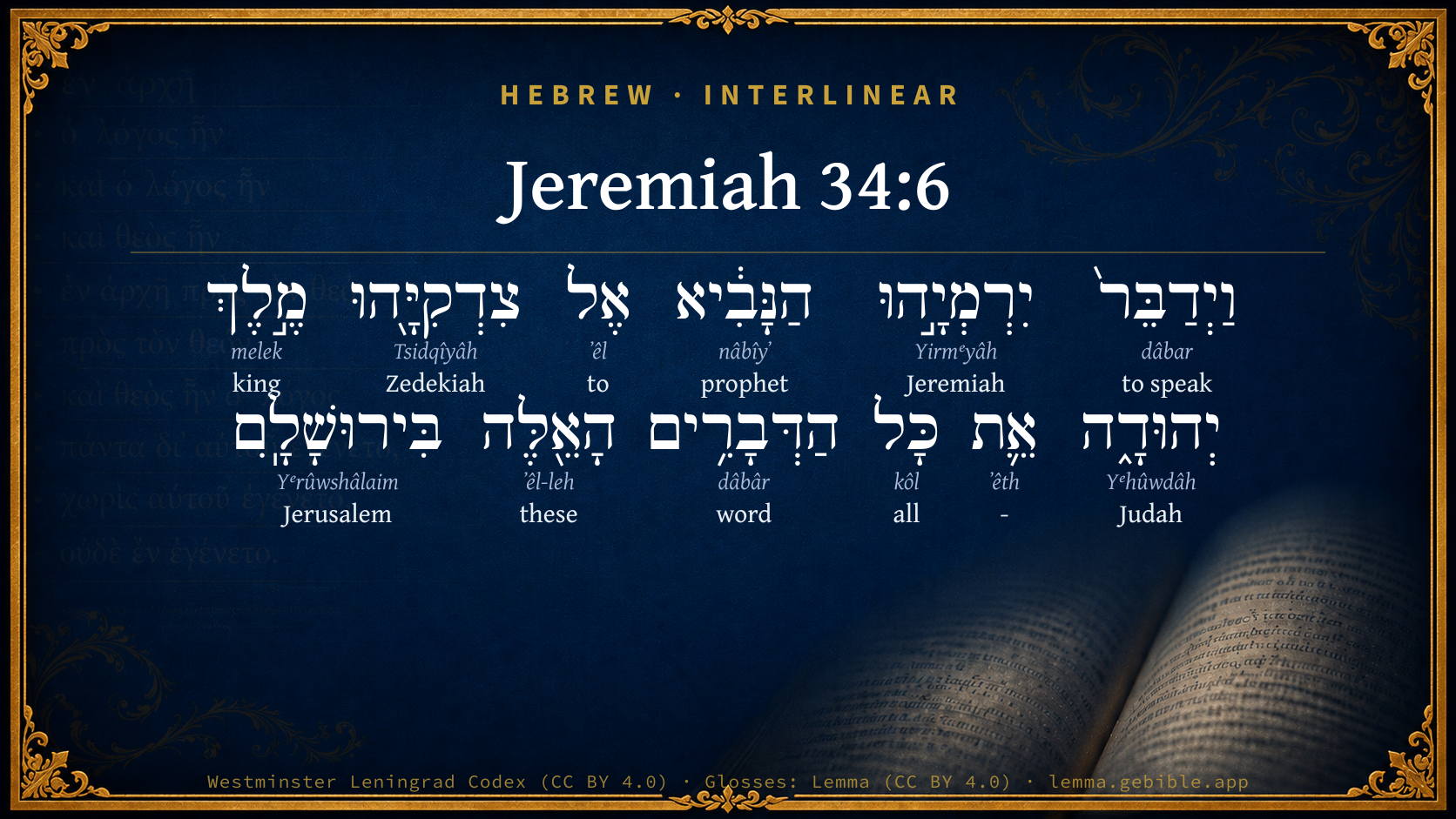
Hebrew (Westminster Leningrad Codex) Jeremiah 34:6 appears in the Hebrew Old Testament. The text above is from the Westminster Leningrad Codex. Each word links to its Strong’s number, a concise gloss, and parsing drawn from the Open Scriptures Hebrew Bible morphology. Click any word for its full Brown-Driver-Briggs (BDB) entry.
Download image
Cite this verse

Jeremiah 34:6 (World English Bible). Public Domain. Lemma interlinear Bible study tool, https://lemma.gebible.app/v/jeremiah/34/6.

Show BibTeX & RIS
BibTeX
RIS
English Translation
Then Jeremiah the prophet spoke all these words to Zedekiah king of Judah in Jerusalem,
World English Bible · Public Domain
Download a study sheet

One document with this verse’s original text, its word-by-word gloss line, the meaning frame, cross-references with their text, attributed commentary, and full source and license credits — printable, and it pastes into notes with its structure intact.

This verse Autodidact and up

Study sheet (.html) Plain text (.txt)

A passage Seminary Student

Up to 50 verses in one chapter. A passage sheet keeps up to 6 commentary sources and 12 cross-references per verse, in the order this page ranks them, and says so on the sheet whenever that leaves anything out. Ask for a single verse and you get the Autodidact verse sheet above.

Everything on this page stays free to read, with no account — the sheet is a download of what is already on screen, not access to it.

Want to remove ads? Support Godless Engineer
Compare translations 3

The same verse in 3 English versions, stacked beneath the original-language interlinear above. Click any original word for its lexicon entry.

Each is an independent rendering of the whole verse — the interlinear is not word-aligned to these translations.

Highlighted words mark where these versions differ — a whole-verse word diff, not a word-by-word alignment.

  • World English Bible Public Domain
    Then Jeremiah the prophet spoke all these words to Zedekiah king of Judah in Jerusalem,
  • King James Version Public Domain
    Then Jeremiah the prophet spake all these words unto Zedekiah king of Judah in Jerusalem,
  • unfoldingWord Literal Text CC BY-SA 4.0
    So Jeremiah the prophet proclaimed to Zedekiah king of Judah all these words in Jerusalem.

unfoldingWord Literal Text — © unfoldingWord, licensed CC BY-SA 4.0. Word-aligned USFM3 via Door43 (git.door43.org/unfoldingWord/en_ult).

Versions to compare (up to 4)

3 of 4 selected

Show all 18 translations

Every available English version of this verse, each an independent rendering of the whole verse.

  • World English Bible Public Domain
    Then Jeremiah the prophet spoke all these words to Zedekiah king of Judah in Jerusalem,
  • Berean Standard Bible Public Domain
    In Jerusalem, then, Jeremiah the prophet relayed all these words to Zedekiah king of Judah
  • Majority Standard Bible Public Domain
    In Jerusalem, then, Jeremiah the prophet relayed all these words to Zedekiah king of Judah
  • King James Version Public Domain
    Then Jeremiah the prophet spake all these words unto Zedekiah king of Judah in Jerusalem,
  • American Standard Version (1901) Public Domain
    Then Jeremiah the prophet spake all these words unto Zedekiah king of Judah in Jerusalem,
  • Revised Version (1885) Public Domain
    Then Jeremiah the prophet spake all these words unto Zedekiah king of Judah in Jerusalem,
  • Geneva Bible (1599) Public Domain
    Then Ieremiah the Prophet spake all these words vnto Zedekiah King of Iudah in Ierusalem,
  • Douay-Rheims (1899) Public Domain
    And Jeremias the prophet spoke all these words to Sedecias the king of Juda in Jerusalem.
  • Young's Literal Translation Public Domain
    And Jeremiah the prophet speaketh unto Zedekiah king of Judah all these words in Jerusalem,
  • Literal Standard Version CC BY-SA 4.0
    And Jeremiah the prophet speaks all these words to Zedekiah king of Judah in Jerusalem,
  • Unlocked Literal Bible CC BY-SA 4.0
    So Jeremiah the prophet proclaimed to Zedekiah king of Judah all these words in Jerusalem.
  • unfoldingWord Literal Text CC BY-SA 4.0
    So Jeremiah the prophet proclaimed to Zedekiah king of Judah all these words in Jerusalem.
  • Darby Bible Public Domain
    And the prophet Jeremiah spoke all these words unto Zedekiah king of Judah, in Jerusalem.
  • World Messianic Bible Public Domain
    Then Jeremiah the prophet spoke all these words to Zedekiah king of Judah in Jerusalem,
  • Webster's Bible Public Domain
    Then Jeremiah the prophet spoke all these words to Zedekiah king of Judah in Jerusalem,
  • Free Bible Version CC BY-SA 4.0
    Jeremiah the prophet told Zedekiah king of Judah all this there in Jerusalem.
  • Bible in Basic English Public Domain
    Then Jeremiah the prophet said all these things to Zedekiah, king of Judah, in Jerusalem,
  • JPS Tanakh (1917) Public Domain
    Then Jeremiah the prophet spoke all these words unto Zedekiah king of Judah in Jerusalem,

Literal Standard Version (2020), Covenant Press — licensed CC BY-SA 4.0. Text via the HelloAO Bible API (eBible.org). Unlocked Literal Bible (unfoldingWord) — licensed CC BY-SA 4.0. Text via the HelloAO Bible API (eBible.org). unfoldingWord Literal Text — © unfoldingWord, licensed CC BY-SA 4.0. Word-aligned USFM3 via Door43 (git.door43.org/unfoldingWord/en_ult). Free Bible Version, Dr. Jonathan Gallagher — licensed CC BY-SA 4.0. Text via the HelloAO Bible API (eBible.org).

Word by word

More ways to search: Search by grammar → Find every occurrence → Compare this word →

Practice this passage: Drill this verse → Learn its vocabulary →

צִדְקִיָּ֖הוּ
Tsidqîyâh
H6667
“Zedekiah”
Noun, Proper
Part of Speech
Noun
Type
Proper
Full BDB Definition

Origin: from H6664 and H3050

TWOT: None

Zedekiah = "Jehovah is righteous" - the last king of Judah renamed from 'Mattaniah' by Nebuchadnezzar; son of Josiah by wife Hamutal; placed on the throne by Nebuchadnezzar when he carried his nephew Jehoiakim in captivity - false prophet at the court of king Ahab of the northern kingdom of Israel - son of Maaseiah, a false prophet in Babylon - son of Hananiah, one of the princes of Judah in the time of Jeremiah - a priest who sealed the covenant with Nehemiah - son of king Jehoiakim of Judah
  1. וַיְדַבֵּר֙ dâbar H1696 “and · to speak” Conjunction + Verb, Piel, Sequential Imperfect, 3rd Person, Masculine, Singular
  2. יִרְמְיָ֣הוּ Yirmᵉyâh H3414 “Jeremiah” Noun, Proper
  3. הַנָּבִ֔יא nâbîyʼ H5030 “the · prophet” Particle, Definite Article + Noun, Common, Masculine, Singular, Absolute
  4. אֶל ʼêl H413 “to” Preposition
  5. מֶ֣לֶךְ melek H4428 “king of” Noun, Common, Masculine, Singular, Construct
  6. יְהוּדָ֑ה Yᵉhûwdâh H3063 “Judah” Noun, Proper
  7. אֵ֛ת ʼêth H853 “-” Particle, Direct Object
  8. כָּל kôl H3605 “all of” Noun, Common, Masculine, Singular, Construct
  9. הַדְּבָרִ֥ים dâbâr H1697 “the · words” Particle, Definite Article + Noun, Common, Masculine, Plural, Absolute
  10. הָאֵ֖לֶּה ʼêl-leh H428 “the · these” Particle, Definite Article + Pronoun, Demonstrative, Common, Plural
  11. בִּירוּשָׁלִָֽם Yᵉrûwshâlaim H3389 “in/at · Jerusalem” Preposition + Noun, Proper

About this verse

These counts appear in no published source. They are computed here, from the morphology-tagged text and Lemma’s own curated glosses. What Lemma adds →

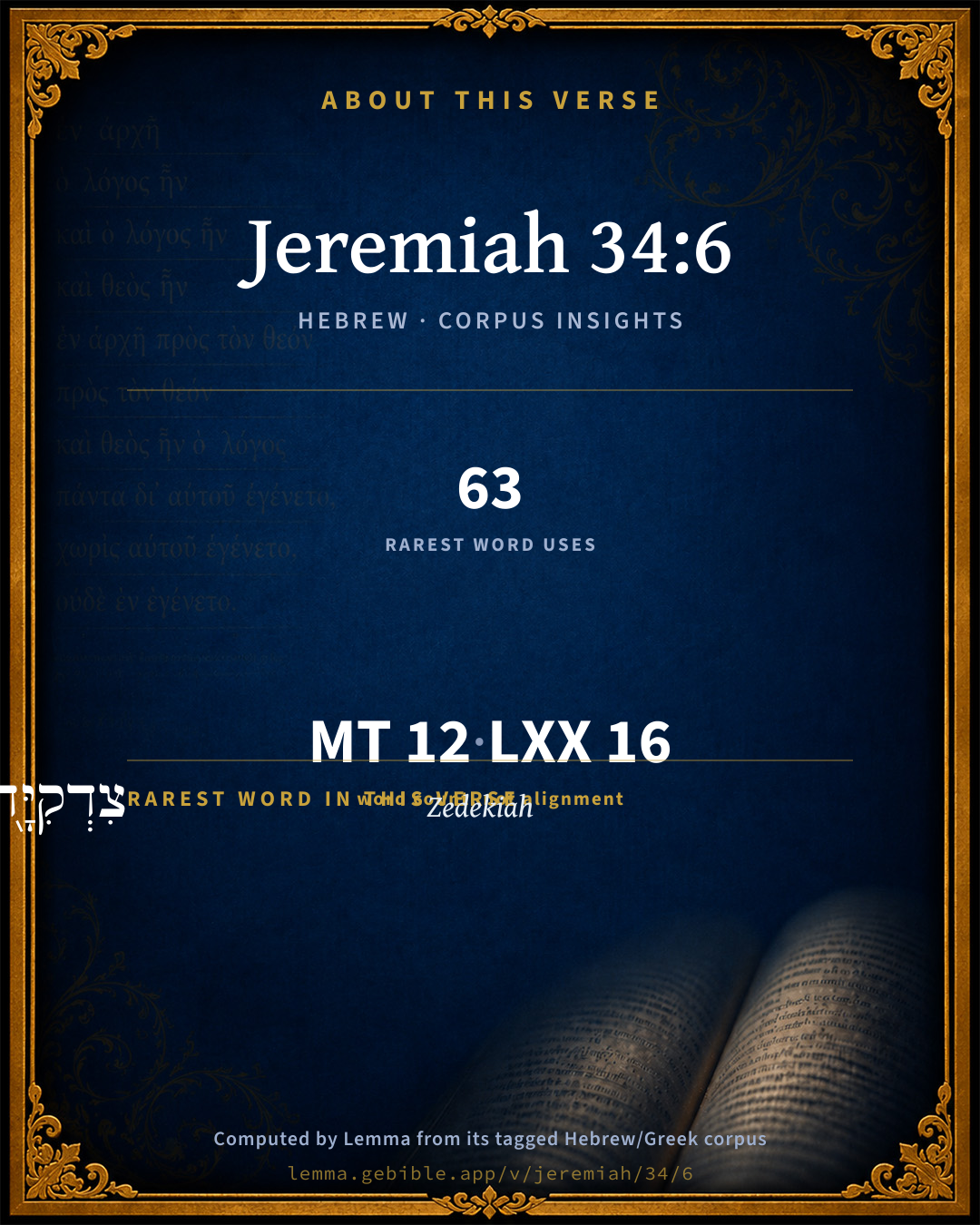
12
words
12
distinct lemmas
Prophets
section

Grammatical profile

  • 1 verb
  • 8 nouns
  • 1 pronoun
  • 1 preposition
  • 1 particle

Verb forms

  • וַיְדַבֵּר֙ Piel · Sequential Imperfect

Hebrew & Septuagint length

In the original languages it is 12 Hebrew tokens and 16 Greek tokens — but the two are counted differently (Hebrew bundles its prefixes and suffixes into one token; the Greek is in lemma form), so that isn’t a like-for-like length.

Cross-references

8

Topical passages linked to Jeremiah 34:6 in the Treasury of Scripture Knowledge — connected by theme and wording, ordered by reader-vote popularity; previews shown in the World English Bible.

  • 1 Samuel 3:18 Samuel told him every whit, and hid nothing from him. He said, It is Yahweh: let him do what seems him good.
  • 1 Samuel 15:16–24 Then Samuel said to Saul, Stay, and I will tell you what Yahweh has said to me this night. He said to him, Say on.
  • 2 Samuel 12:7–12 Nathan said to David, "You are the man. This is what Yahweh, the God of Israel, says: 'I anointed you king over Israel, and I delivered you out of the hand of Saul.
  • 1 Kings 21:19 You shall speak to him, saying, Thus says Yahweh, Have you killed and also taken possession? You shall speak to him, saying, Thus says Yahweh, In the place where dogs licked the blood of Naboth shall dogs lick your blood, even yours.
  • 1 Kings 22:14 Micaiah said, As Yahweh lives, what Yahweh says to me, that will I speak.
  • Ezekiel 2:7 You shall speak my words to them, whether they will hear, or whether they will forbear; for they are most rebellious.
  • Matthew 14:4 For John said to him, "It is not lawful for you to have her."
  • Acts 20:27 for I didn't shrink from declaring to you the whole counsel of God.

Cross-references courtesy of OpenBible.info (CC BY 4.0).

Hebrew and Greek witnesses Masoretic Hebrew ↔ Greek Septuagint

The same verse in the two great witnesses to the Old Testament, shown verse-for-verse.

These are two independent witnesses, not word-aligned to each other, and the Septuagint is shown in lemma (dictionary) form.

Hebrew Jeremiah 34:6 Masoretic · Westminster Leningrad Codex

וַיְדַבֵּר֙ יִרְמְיָ֣הוּ הַנָּבִ֔יא אֶל צִדְקִיָּ֖הוּ מֶ֣לֶךְ יְהוּדָ֑ה אֵ֛ת כָּל הַדְּבָרִ֥ים הָאֵ֖לֶּה בִּירוּשָׁלִָֽם

Then Jeremiah the prophet spoke all these words to Zedekiah king of Judah in Jerusalem,

World English Bible · Public Domain

Greek LXX Structure differs

In the Septuagint, Jeremiah is about an eighth shorter than the Hebrew and arranges its material differently — the Oracles Against the Nations (Hebrew chapters 46–51) appear in the middle of the Greek book, after 25:13. Because the chapter and verse boundaries do not line up, a verse-for-verse comparison with the Hebrew is not shown.

A verse-for-verse comparison isn’t shown here because the chapters and verses don’t line up. Switch to the LXX edition with the MT / LXX toggle above to read the Greek directly.

Hebrew: Westminster Leningrad Codex (CC BY 4.0). Greek: Septuagint (public domain); English from a public-domain English Septuagint. How the Septuagint differs from the Hebrew →

Targum (Aramaic paraphrase)

1

The Targum is the ancient Jewish Aramaic paraphrase of the Hebrew Scriptures — an interpretive translation, not the Hebrew text itself. Onkelos (literal) and Pseudo-Jonathan (expansive) render the Torah, and Jonathan the Prophets. Coverage is partial: where no permissively-licensed English translation exists for a verse, only the Aramaic is shown. This is verse-level text, not a word-by-word alignment to the Hebrew.

  1. Targum Jonathan Prophets (Joshua–Malachi)
    וּמַלֵיל יִרְמְיָה נְבִיָא עִם צִדְקִיָהוּ מְלַךְ שִׁבְטָא דְבֵית יְהוּדָה יַת כָּל פִּתְגָמַיָא הָאִלֵין בִּירוּשְׁלֵם:

    (no public-domain English translation for this verse)

    Targum Jonathan — Aramaic: “Mikraot Gedolot” (public domain). English: “Sefaria Community Translation” (CC0 1.0 (public-domain dedication)); “London "Chaldee Paraphrase," 1871” (public domain). Text via Sefaria.

Commentary

Notes on Jeremiah 34:6 from classic Christian and Jewish commentators (each source and its license shown beneath its notes). The classic Christian expositions comment on the surrounding passage and are grouped to its opening verse, so a note may address several verses; the Jewish commentaries on the Tanakh (Rashi and others) are per-verse, so they appear only where the commentator wrote on this verse.

Lemma curates 59 commentaries, every one of them public domain or Creative Commons licensed, each selected and text-cleaned for this edition rather than reprinted as found. About our sources →

Trapp's Complete Commentary

John Trapp

Jer 34:6 Then Jeremiah the prophet spake all these words unto Zedekiah king of Judah in Jerusalem,

Ver. 6. Then Jeremiah spake all these words.] Never fearing what might follow; and he had no sooner done but he was clapped up. See Jer 32:3.

John Trapp, A Commentary or Exposition upon All the Books of the Old and New Testament (1647–1656) — public domain. Text from a community e-Sword module.

Tyndale Open Study Notes

Tyndale Open Resources

34:6-7 King Rehoboam had made Lachish and Azekah into forts (2 Chr 11:5-10). Located on low hills southwest of Jerusalem, these towns guarded the key roads leading up from the great highway on the coast into the heartland of Judah. Military messages written on pieces of pottery have been found in the gateway of Lachish, reporting the progress of the Babylonians as they moved toward it.

Tyndale Open Study Notes — © Tyndale Open Resources, licensed CC BY-SA 4.0. Text via the HelloAO Bible API.

Adam Clarke's Commentary

Verse 6. Spake all these words unto Zedekiah] He delivered this message at the hazard of his life. Jeremiah feared God, and had no other fear.

Adam Clarke's Commentary on the Bible (1810–1826) — public domain. Text from a community e-Sword/MySword module.

John Calvin's Commentaries

Here Jeremiah only relates that he had delivered the message committed to him; and here is seen the Prophet’s magnanimity, for as it appeared yesterday, he was an unwelcome messenger; and though there was danger, yet Jeremiah performed his office, for he knew that God would not suffer the king to do anything to him unless it were for some benefit. There is then no doubt but that he deposited his life in God’s hand, and offered himself, as it were, a sacrifice, when he dared openly to threaten the king, which could not have been done without offending him; and

“the wrath of a king,” as Solomon says, “is the messenger of death.” (Proverbs 16:14)

Here, then, the firmness of the Prophet is deserving of praise; for he dreaded no danger when he saw that necessity was laid on him by God.

John Calvin's Commentaries (1540-1563) — public domain. Text from the Calvin Translation Society English edition (1840s-50s) via the Christian Classics Ethereal Library (ccel.org). Calvin's coverage is partial (roughly two-thirds of the Bible); uncommented books and verses are honest gaps, never fabricated. The 19th-century editor's footnotes and remarks are omitted so the notes are faithfully Calvin's own voice.

John Gill's Exposition

Then Jeremiah the prophet spake all these words,.... The threatening, as well as the consolatory ones; he kept back no part of the message he was sent with, but faithfully delivered the whole:

unto Zedekiah king of Judah in Jerusalem; though he knew it would displease him, and bring himself into trouble, as it did; for upon this he was put into prison.

John Gill's Exposition of the Whole Bible (1746–1763) — public domain (CC PDM 1.0). Text via the HelloAO Bible API.

unfoldingWord translationNotes

Door43 World Missions Community

Lachish and Azekah

These are names of cities. (See: How to Translate Names)

These cities of Judah remained as fortified cities

"the only fortified cities of Judah that the Babylonians had not yet captured"

translationWords

prophet

preach

stronghold

unfoldingWord translationNotes — © Distant Shores Media and the Door43 World Missions Community, licensed CC BY-SA 4.0. Source: git.door43.org/Door43/en_tn.

Lesson kit

Teaching starters — assembled from the data on this page, not authored interpretation. Every prompt links to the verse data it draws on. Edit before teaching.

Jeremiah, in the Prophets, opens this verse with 12 words (12 distinct Hebrew lemmas). Its most distinctive word is Tsidqîyâh (“Zedekiah”). A historical commentator’s framing appears above. Read the whole chapter for the surrounding context.

Discussion questions

  1. What does “Zedekiah” (Tsidqîyâh) contribute to the verse as a whole?
  2. 1 Samuel 3:18 shares this passage’s theme. How do the two illuminate each other?
  3. These translations render this verse differently; the difference is in the English rendering, not the original. What questions does that raise?
  4. The verb «וַיְדַבֵּר֙» is Piel Sequential Imperfect. How does its form color the action?
  5. Reading how Trapp's Complete Commentary and Tyndale Open Study Notes read this verse, where do the two commentators agree and where do they part?

Things to notice

Reading settings

Reading text

Shown beneath each verse's original-language words.

Old Testament
Old Testament edition

Read the OT as the Masoretic Hebrew (MT) or the Greek Septuagint (LXX).

English shown for the Greek Septuagint (in the Hebrew ↔ Greek comparison).

Comparing translations? Open the Compare panel on any verse page to stack up to four side by side.