
Jeremiah 38:14

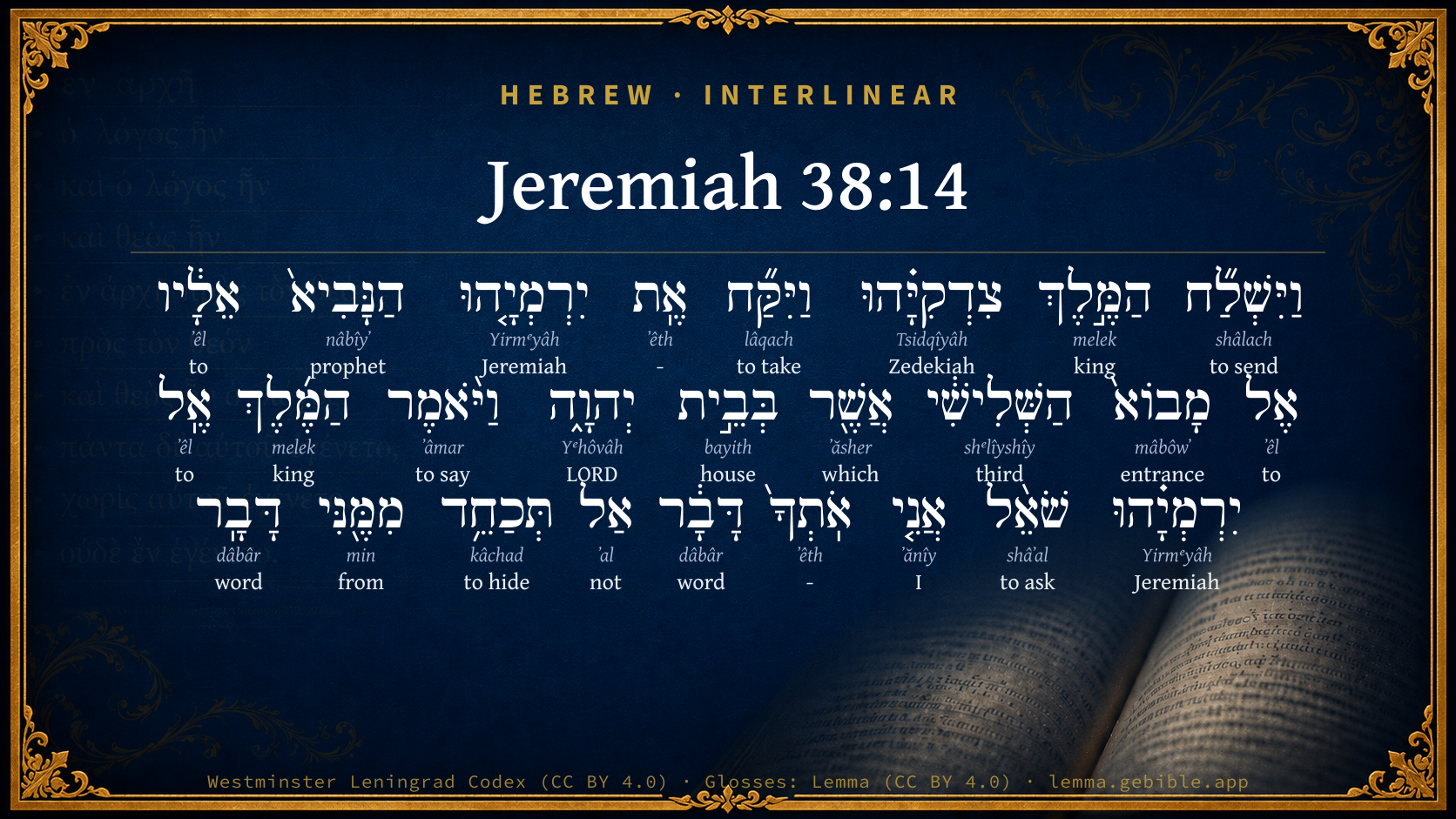
Hebrew (Westminster Leningrad Codex) Jeremiah 38:14 appears in the Hebrew Old Testament. The text above is from the Westminster Leningrad Codex. Each word links to its Strong’s number, a concise gloss, and parsing drawn from the Open Scriptures Hebrew Bible morphology. Click any word for its full Brown-Driver-Briggs (BDB) entry.
Download image
Cite this verse

Jeremiah 38:14 (World English Bible). Public Domain. Lemma interlinear Bible study tool, https://lemma.gebible.app/v/jeremiah/38/14.

Show BibTeX & RIS
BibTeX
RIS
English Translation
Then Zedekiah the king sent, and took Jeremiah the prophet to him into the third entry that is in the house of Yahweh: and the king said to Jeremiah, I will ask you a thing; hide nothing from me.
World English Bible · Public Domain
Download a study sheet

One document with this verse’s original text, its word-by-word gloss line, the meaning frame, cross-references with their text, attributed commentary, and full source and license credits — printable, and it pastes into notes with its structure intact.

This verse Autodidact and up

Study sheet (.html) Plain text (.txt)

A passage Seminary Student

Up to 50 verses in one chapter. A passage sheet keeps up to 6 commentary sources and 12 cross-references per verse, in the order this page ranks them, and says so on the sheet whenever that leaves anything out. Ask for a single verse and you get the Autodidact verse sheet above.

Everything on this page stays free to read, with no account — the sheet is a download of what is already on screen, not access to it.

Want to remove ads? Support Godless Engineer
Compare translations 3

The same verse in 3 English versions, stacked beneath the original-language interlinear above. Click any original word for its lexicon entry.

Each is an independent rendering of the whole verse — the interlinear is not word-aligned to these translations.

Highlighted words mark where these versions differ — a whole-verse word diff, not a word-by-word alignment.

  • World English Bible Public Domain
    Then Zedekiah the king sent, and took Jeremiah the prophet to him into the third entry that is in the house of Yahweh: and the king said to Jeremiah, I will ask you a thing; hide nothing from me.
  • King James Version Public Domain
    Then Zedekiah the king sent, and took Jeremiah the prophet unto him into the third entry that is in the house of the LORD: and the king said unto Jeremiah, I will ask thee a thing; hide nothing from me.
  • unfoldingWord Literal Text CC BY-SA 4.0
    Then King Zedekiah sent word and brought Jeremiah the prophet to himself, to the third entrance in Yahweh’s house. The king said to Jeremiah, “I want to ask you something. Do not keep the answer from me.”

unfoldingWord Literal Text — © unfoldingWord, licensed CC BY-SA 4.0. Word-aligned USFM3 via Door43 (git.door43.org/unfoldingWord/en_ult).

Versions to compare (up to 4)

3 of 4 selected

Show all 18 translations

Every available English version of this verse, each an independent rendering of the whole verse.

  • World English Bible Public Domain
    Then Zedekiah the king sent, and took Jeremiah the prophet to him into the third entry that is in the house of Yahweh: and the king said to Jeremiah, I will ask you a thing; hide nothing from me.
  • Berean Standard Bible Public Domain
    Then King Zedekiah sent for Jeremiah the prophet and received him at the third entrance to the house of the LORD. “I am going to ask you something,” said the king to Jeremiah. “Do not hide anything from me.”
  • Majority Standard Bible Public Domain
    Then King Zedekiah sent for Jeremiah the prophet and received him at the third entrance to the house of the LORD. “I am going to ask you something,” said the king to Jeremiah. “Do not hide anything from me.”
  • King James Version Public Domain
    Then Zedekiah the king sent, and took Jeremiah the prophet unto him into the third entry that is in the house of the LORD: and the king said unto Jeremiah, I will ask thee a thing; hide nothing from me.
  • American Standard Version (1901) Public Domain
    Then Zedekiah the king sent, and took Jeremiah the prophet unto him into the third entry that is in the house of Jehovah: and the king said unto Jeremiah, I will ask thee a thing; hide nothing from me.
  • Revised Version (1885) Public Domain
    Then Zedekiah the king sent, and took Jeremiah the prophet unto him into the third entry that is in the house of the LORD: and the king said unto Jeremiah, I will ask thee a thing; hide nothing from me.
  • Geneva Bible (1599) Public Domain
    Then Zedekiah the King sent, and tooke Ieremiah the Prophet vnto him, into the thirde entrie that is in the House of the Lord, and the King sayd vnto Ieremiah, I wil aske thee a thing: hide nothing from me.
  • Douay-Rheims (1899) Public Domain
    And king Sedecias sent, and took Jeremias the prophet to him to the third gate, that was in the house of the Lord: and the king said to Jeremias: I will ask thee a thing, hide nothing from me.
  • Young's Literal Translation Public Domain
    And the king Zedekiah sendeth, and taketh Jeremiah the prophet unto him, unto the third entrance that `is' in the house of Jehovah, and the king saith unto Jeremiah, `I am asking thee a thing, do not hide from me anything.'
  • Literal Standard Version CC BY-SA 4.0
    And King Zedekiah sends, and takes Jeremiah the prophet to him, to the third entrance that [is] in the house of YHWH, and the king says to Jeremiah, “I am asking you something, do not hide anything from me.”
  • Unlocked Literal Bible CC BY-SA 4.0
    Then King Zedekiah sent word and brought Jeremiah the prophet to himself, to the third entrance in Yahweh's house. The king said to Jeremiah, “I want to ask you something. Do not keep the answer from me.”
  • unfoldingWord Literal Text CC BY-SA 4.0
    Then King Zedekiah sent word and brought Jeremiah the prophet to himself, to the third entrance in Yahweh’s house. The king said to Jeremiah, “I want to ask you something. Do not keep the answer from me.”
  • Darby Bible Public Domain
    And king Zedekiah sent and took the prophet Jeremiah unto him, into the third entry that is in the house of Jehovah; and the king said unto Jeremiah, I will ask thee a thing: hide nothing from me.
  • World Messianic Bible Public Domain
    Then Zedekiah the king sent and took Jeremiah the prophet to himself into the third entry that is in the LORD’s house. Then the king said to Jeremiah, “I will ask you something. Hide nothing from me.”
  • Webster's Bible Public Domain
    Then Zedekiah the king sent, and took Jeremiah the prophet to him into the third entry that is in the house of the LORD: and the king said to Jeremiah, I will ask thee a thing; hide nothing from me.
  • Free Bible Version CC BY-SA 4.0
    Then King Zedekiah sent for Jeremiah the prophet and met him at the third Temple entrance. “I need to ask you something,” the king told Jeremiah. “You mustn't hide anything from me.”
  • Bible in Basic English Public Domain
    Then King Zedekiah sent for Jeremiah the prophet and took him into the rulers' doorway in the house of the Lord: and the king said to Jeremiah, I have a question to put to you; keep nothing back from me.
  • JPS Tanakh (1917) Public Domain
    Then Zedekiah the king sent, and took Jeremiah the prophet unto him into the third entry that was in the house of the LORD; and the king said unto Jeremiah: 'I will ask thee a thing; hide nothing from me.'

Literal Standard Version (2020), Covenant Press — licensed CC BY-SA 4.0. Text via the HelloAO Bible API (eBible.org). Unlocked Literal Bible (unfoldingWord) — licensed CC BY-SA 4.0. Text via the HelloAO Bible API (eBible.org). unfoldingWord Literal Text — © unfoldingWord, licensed CC BY-SA 4.0. Word-aligned USFM3 via Door43 (git.door43.org/unfoldingWord/en_ult). Free Bible Version, Dr. Jonathan Gallagher — licensed CC BY-SA 4.0. Text via the HelloAO Bible API (eBible.org).

Word by word

More ways to search: Search by grammar → Find every occurrence → Compare this word →

Practice this passage: Drill this verse → Learn its vocabulary →

מָבוֹא֙
mâbôwʼ
H3996
“entrance”
Noun, Common, Masculine, Singular, Absolute
Part of Speech
Noun
Type
Common
Gender
Masculine
Number
Singular
State
Absolute
Full BDB Definition

Origin: from H935

TWOT: 212b

entrance, a coming in, entering - sunset - sunset - sunset, west
  1. וַיִּשְׁלַ֞ח shâlach H7971 “and · to send” Conjunction + Verb, Qal, Sequential Imperfect, 3rd Person, Masculine, Singular
  2. הַמֶּ֣לֶךְ melek H4428 “the · king” Particle, Definite Article + Noun, Common, Masculine, Singular, Absolute
  3. צִדְקִיָּ֗הוּ Tsidqîyâh H6667 “Zedekiah” Noun, Proper
  4. וַיִּקַּ֞ח lâqach H3947 “and · to take” Conjunction + Verb, Qal, Sequential Imperfect, 3rd Person, Masculine, Singular
  5. אֶֽת ʼêth H853 “-” Particle, Direct Object
  6. יִרְמְיָ֤הוּ Yirmᵉyâh H3414 “Jeremiah” Noun, Proper
  7. הַנָּבִיא֙ nâbîyʼ H5030 “the · prophet” Particle, Definite Article + Noun, Common, Masculine, Singular, Absolute
  8. אֵלָ֔יו ʼêl H413 “to · him” Preposition + Suffix, Personal, 3rd Person, Masculine, Singular
  9. אֶל ʼêl H413 “to” Preposition
  10. הַשְּׁלִישִׁ֔י shᵉlîyshîy H7992 “the · third” Particle, Definite Article + Adjective, Ordinal number, Masculine, Singular, Absolute
  11. אֲשֶׁ֖ר ʼăsher H834 “which” Particle, Relative
  12. בְּבֵ֣ית bayith H1004 “in/at · house of” Preposition + Noun, Common, Masculine, Singular, Construct
  13. יְהוָ֑ה Yᵉhôvâh H3068 “LORD” Noun, Proper
  14. וַיֹּ֨אמֶר ʼâmar H559 “and · to say” Conjunction + Verb, Qal, Sequential Imperfect, 3rd Person, Masculine, Singular
  15. הַמֶּ֜לֶךְ melek H4428 “the · king” Particle, Definite Article + Noun, Common, Masculine, Singular, Absolute
  16. אֶֽל ʼêl H413 “to” Preposition
  17. יִרְמְיָ֗הוּ Yirmᵉyâh H3414 “Jeremiah” Noun, Proper
  18. שֹׁאֵ֨ל shâʼal H7592 “asking” Verb, Qal, Participle Active, Masculine, Singular, Absolute
  19. אֲנִ֤י ʼănîy H589 “I” Pronoun, Personal, 1st Person, Common, Singular
  20. אֹֽתְךָ֙ ʼêth H853 “- · you” Particle, Direct Object + Suffix, Personal, 2nd Person, Masculine, Singular
  21. דָּבָ֔ר dâbâr H1697 “word” Noun, Common, Masculine, Singular, Absolute
  22. אַל ʼal H408 “not” Particle, Negative
  23. תְּכַחֵ֥ד kâchad H3582 “to hide” Verb, Piel, Jussive, 2nd Person, Masculine, Singular
  24. מִמֶּ֖נִּי min H4480 “from · me” Preposition + Suffix, Personal, 1st Person, Common, Singular
  25. דָּבָֽר dâbâr H1697 “word” Noun, Common, Masculine, Singular, Absolute

About this verse

These counts appear in no published source. They are computed here, from the morphology-tagged text and Lemma’s own curated glosses. What Lemma adds →

26
words
20
distinct lemmas
Prophets
section

Notable vocabulary

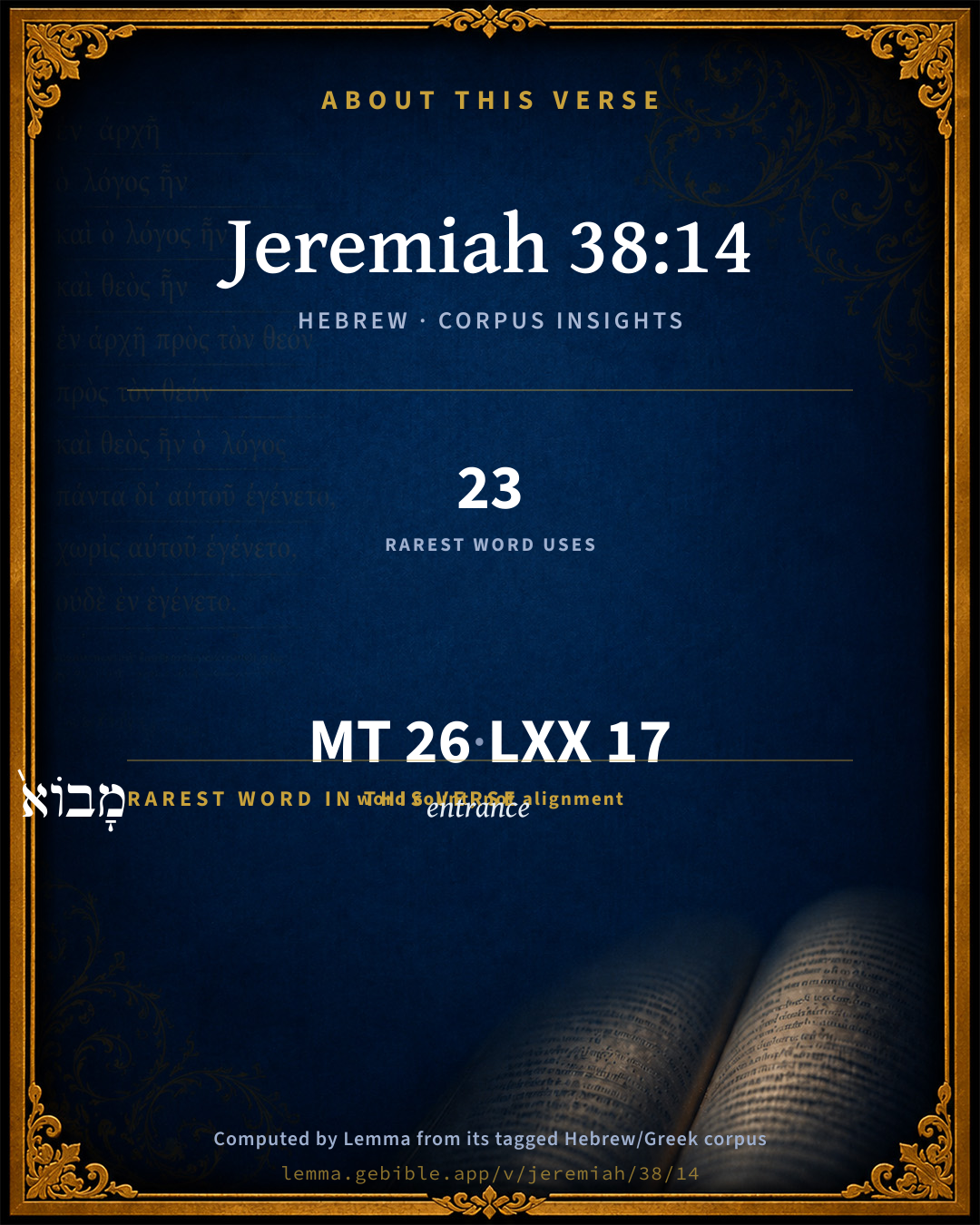
The rarest word here is מָבוֹא֙ entrance H3996 — appearing just 23 times in the whole Hebrew Bible.

Shared distinctive vocabulary

מָבוֹא֙ entrance H3996 occurs in 23 verses of the Hebrew Bible. Also found in:

Grammatical profile

  • 5 verbs
  • 11 nouns
  • 1 adjective
  • 1 pronoun
  • 4 prepositions
  • 4 particles

Verb forms

  • וַיִּשְׁלַ֞ח Qal · Sequential Imperfect
  • וַיִּקַּ֞ח Qal · Sequential Imperfect
  • וַיֹּ֨אמֶר Qal · Sequential Imperfect
  • שֹׁאֵ֨ל Qal · Participle Active
  • תְּכַחֵ֥ד Piel · Jussive

Repetition

Words recur within this verse — often emphatic in Hebrew:

  • הַמֶּ֣לֶךְ king H4428 ×2
  • יִרְמְיָ֤הוּ Jeremiah H3414 ×2
  • דָּבָ֔ר word H1697 ×2
  • אֵלָ֔יו to H413 ×3

Hebrew & Septuagint length

In the original languages it is 26 Hebrew tokens and 17 Greek tokens — but the two are counted differently (Hebrew bundles its prefixes and suffixes into one token; the Greek is in lemma form), so that isn’t a like-for-like length.

Cross-references

9

Topical passages linked to Jeremiah 38:14 in the Treasury of Scripture Knowledge — connected by theme and wording, ordered by reader-vote popularity; previews shown in the World English Bible.

  • 1 Kings 22:16 The king said to him, How many times shall I adjure you that you speak to me nothing but the truth in the name of Yahweh?
  • Jeremiah 21:1–2 The word which came to Jeremiah from Yahweh, when king Zedekiah sent to him Pashhur the son of Malchijah, and Zephaniah the son of Maaseiah, the priest, saying,
  • Jeremiah 37:17 Then Zedekiah the king sent, and fetched him: and the king asked him secretly in his house, and said, Is there any word from Yahweh? Jeremiah said, There is. He said also, You shall be delivered into the hand of the king of Babylon.
  • 1 Samuel 3:17–18 He said, "What is the thing that [Yahweh] has spoken to you? Please don't hide it from me. God do so to you, and more also, if you hide anything from me of all the things that he spoke to you."
  • Jeremiah 42:2–5 and said to Jeremiah the prophet, Let, we pray you, our supplication be presented before you, and pray for us to Yahweh your God, even for all this remnant; for we are left but a few of many, as your eyes do see us:
  • Jeremiah 42:20 For you have dealt deceitfully against your own souls; for you sent me to Yahweh your God, saying, Pray for us to Yahweh our God; and according to all that Yahweh our God shall say, so declare to us, and we will do it:
  • 1 Kings 10:5 and the food of his table, and the sitting of his servants, and the attendance of his ministers, and their clothing, and his cup bearers, and his ascent by which he went up to the house of Yahweh; there was no more spirit in her.
  • 2 Kings 16:18 The covered way for the Sabbath that they had built in the house, and the king's entry outside, turned he to the house of Yahweh, because of the king of Assyria.
  • 2 Chronicles 18:15 The king said to him, How many times shall I adjure you that you speak to me nothing but the truth in the name of Yahweh?

Cross-references courtesy of OpenBible.info (CC BY 4.0).

Hebrew and Greek witnesses Masoretic Hebrew ↔ Greek Septuagint

The same verse in the two great witnesses to the Old Testament, shown verse-for-verse.

These are two independent witnesses, not word-aligned to each other, and the Septuagint is shown in lemma (dictionary) form.

Hebrew Jeremiah 38:14 Masoretic · Westminster Leningrad Codex

וַיִּשְׁלַ֞ח הַמֶּ֣לֶךְ צִדְקִיָּ֗הוּ וַיִּקַּ֞ח אֶֽת יִרְמְיָ֤הוּ הַנָּבִיא֙ אֵלָ֔יו אֶל מָבוֹא֙ הַשְּׁלִישִׁ֔י אֲשֶׁ֖ר בְּבֵ֣ית יְהוָ֑ה וַיֹּ֨אמֶר הַמֶּ֜לֶךְ אֶֽל יִרְמְיָ֗הוּ שֹׁאֵ֨ל אֲנִ֤י אֹֽתְךָ֙ דָּבָ֔ר אַל תְּכַחֵ֥ד מִמֶּ֖נִּי דָּבָֽר

Then Zedekiah the king sent, and took Jeremiah the prophet to him into the third entry that is in the house of Yahweh: and the king said to Jeremiah, I will ask you a thing; hide nothing from me.

World English Bible · Public Domain

Greek LXX Structure differs

In the Septuagint, Jeremiah is about an eighth shorter than the Hebrew and arranges its material differently — the Oracles Against the Nations (Hebrew chapters 46–51) appear in the middle of the Greek book, after 25:13. Because the chapter and verse boundaries do not line up, a verse-for-verse comparison with the Hebrew is not shown.

A verse-for-verse comparison isn’t shown here because the chapters and verses don’t line up. Switch to the LXX edition with the MT / LXX toggle above to read the Greek directly.

Hebrew: Westminster Leningrad Codex (CC BY 4.0). Greek: Septuagint (public domain); English from a public-domain English Septuagint. How the Septuagint differs from the Hebrew →

Targum (Aramaic paraphrase)

1

The Targum is the ancient Jewish Aramaic paraphrase of the Hebrew Scriptures — an interpretive translation, not the Hebrew text itself. Onkelos (literal) and Pseudo-Jonathan (expansive) render the Torah, and Jonathan the Prophets. Coverage is partial: where no permissively-licensed English translation exists for a verse, only the Aramaic is shown. This is verse-level text, not a word-by-word alignment to the Hebrew.

  1. Targum Jonathan Prophets (Joshua–Malachi)
    וּשְׁלַח מַלְכָּא צִדְקִיָה וּדְבַר יַת יִרְמְיָה נְבִיָא לְוָתֵיהּ לְמַעֲלָנָא תְּלִיתְאָה דִי בְּבֵית מַקְדְשָׁא דַייָ וַאֲמַר מַלְכָּא לְיִרְמְיָה שְׁאַל אַנָא יָתָךְ פִּתְגָמָא לָא תְכַסֵי מִנִי פִּתְגָמָא:

    (no public-domain English translation for this verse)

    Targum Jonathan — Aramaic: “Mikraot Gedolot” (public domain). English: “Sefaria Community Translation” (CC0 1.0 (public-domain dedication)); “London "Chaldee Paraphrase," 1871” (public domain). Text via Sefaria.

Commentary

Notes on Jeremiah 38:14 from classic Christian and Jewish commentators (each source and its license shown beneath its notes). The classic Christian expositions comment on the surrounding passage and are grouped to its opening verse, so a note may address several verses; the Jewish commentaries on the Tanakh (Rashi and others) are per-verse, so they appear only where the commentator wrote on this verse.

Lemma curates 59 commentaries, every one of them public domain or Creative Commons licensed, each selected and text-cleaned for this edition rather than reprinted as found. About our sources →

Matthew Henry's Commentary

In the foregoing chapter we had the king in close conference with Jeremiah, and here again, though (Jer 38:5) he had given him up into the hands of his enemies; such a struggle there was in the breast of this unhappy prince between his convictions and his corruptions. Observe,

I. The honour that Zedekiah did to the prophet. When he was newly fetched out of the dungeon he sent for him to advise with him privately. He met him in the third entry, or (as the margin reads it) the principal entry, that is in, or leads towards, or adjoins to, the house of the Lord, Jer 38:14. In appointing this place of interview with the prophet perhaps he intended to show a respect and reverence for the house of God, which was proper enough now that he was desiring to hear the word of God. Zedekiah would ask Jeremiah a thing; it should rather be rendered, a word. "I am here asking thee for a word of prediction, of counsel, of comfort, a word from the Lord, Jer 37:17. Whatever word thou has for me hide it not from me; let me know the worst." He had been told plainly what things would come to in the foregoing chapter, but, like Balaam, he asks again, in hopes to get a more pleasing answer, as if God, who is in one mind, were altogether such a one as himself, who was in many minds.

II. The bargain that Jeremiah made with him before he would give him his advice, Jer 38:15. He would stipulate, 1. For his own safety. Zedekiah would have him deal faithfully with him: "And if I do," says Jeremiah, "wilt thou not put me to death? I am afraid thou wilt" (so some take it); "what else can I expect when thou art led blindfold by the princes?" Not that Jeremiah was backward to seal the doctrine he preached with his blood, when he was called to do so; but, in doing our duty, we ought to use all lawful means for our own preservation; even the apostles of Christ did so. 2. He would answer for the success of his advice, being no less concerned for Zedekiah's welfare than for his own. He is willing to give him wholesome advice, and does not upbraid him with his unkindness in suffering him to be put into the dungeon, nor bid him go and consult with his princes, whose judgments he had such a value for. Ministers must with meekness instruct even those that oppose themselves, and render good for evil. He is desirous that he should hear counsel and receive instruction: "Wilt thou not hearken unto me? Surely thou wilt; I am in hopes to find thee pliable at last, and now in this thy day willing to know the things that belong to thy peace." Note, Then, and then only, there is hope of sinners, when they are willing to hearken to good counsel. Some read it as spoken despairingly: "If I give thee counsel, thou wilt not hearken unto me; I have reason to fear thou wilt not, and then I might as well keep my counsel to myself." Note, Ministers have little heart to speak to those who have long and often turned a deaf ear to them. Now, as to this latter concern of Jeremiah's, Zedekiah makes him no answer, will not promise to hearken to his advice: though he desires to know what is the mind of God, yet he will reserve himself a liberty, when he does know it, to do as he things fit; as if it were the prerogative of a prince not to have his ruin prevented by good counsel. But, as to the prophet's safety, he promises him, upon the word of a king, and confirms his promise with an oath, that, whatever he should say to him, no advantage should be taken against him for it: I will neither put thee to death nor deliver thee into the hands of those that will, Jer 38:16. This, he thought, was a mighty favour, and yet Nebuchadnezzar and Belshazzar, when Daniel read their doom, not only protected him, but preferred and rewarded him, Dan 2:48; Dan 2:29. Zedekiah's oath on this occasion is solemn, and very observable: "As the Lord liveth, who made us this soul, who gave me my life and thee thine, I dare not take away thy life unjustly, knowing that then I should forfeit my own to him that is the Lord of life." Note, God is the Father of spirits; souls are his workmanship, and they are more fearfully and wonderfully made than bodies are. The soul both of the greatest prince and of the poorest prisoner is of God's making. He fashioneth their hearts alike easily. In all our appeals to God, and in all our dealings both with ourselves and others, we ought to consider this, that the living God made us these souls.

III. The good advice that Jeremiah gave him, with good reasons why he should take it, not from any prudence or politics of his own, but in the name of the Lord, the God of hosts and God of Israel. Not as a statesman, but as a prophet, he advises him by all means to surrender himself and his city to the king of Babylon's princes: "Go forth to them, and make the best terms thou canst with them," Jer 38:17. This was the advice he had given to the people (Jer 38:2, and before, Jer 21:9), to submit to divine judgments, and not think of contending with them. Note, In dealing with God, that which is good counsel to the meanest is so to the greatest, for there is no respect of persons with him. To persuade him to take this counsel, he sets before him good and evil, life and death. 1. If he will tamely yield, he shall save his children from the sword and Jerusalem from the flames. The white flag is yet hung out; if he will be acknowledge God's justice, he shall experience his mercy: The city shall not be burnt, and thou shalt live and thy house. But, 2. If he will obstinately stand it out, it will be the ruin both of his house and Jerusalem (Jer 38:18); for when God judges he will overcome. This is the case of sinners with God; let them humbly submit to his grace and government and they shall live; let them take hold on his strength, that they may make peace, and they shall make peace; but, if they harden their hearts against his proposals, it will certainly be to their destruction: they must either bend or break.

IV. The objection which Zedekiah made against the prophet's advice, Jer 38:19. Jeremiah spoke to him by prophecy, in the name of God, and therefore if he had had a due regard to the divine authority, wisdom, and goodness, as soon as he understood what the mind of God was he would immediately have acquiesced in it and resolved to observe it, without disputing; but, as if it had been the dictate only of Jeremiah's prudence, he advances against it some prudential considerations of his own: but human wisdom is folly when it contradicts the divine counsel. All he suggests is, "I am afraid, not of the Chaldeans; their princes are men of honour, but of the Jews, that have already gone over to the Chaldeans; when they see me follow them, and who had so much opposed their going, they will laugh at me, and say, Hast thou also become weak as water?" Isa 14:10. Now, 1. It was not at all likely that he should be thus exposed and ridiculed, that the Chaldeans should so far gratify the Jews, or trample upon him, as to deliver him into their hands; nor that the Jews, who were themselves captives, should be in such a gay humour as to make a jest of the misery of their prince. Note, We often frighten ourselves from our duty by foolish, causeless, groundless, fears, that are merely the creatures of our own fancy and imagination. 2. If he should be taunted at a little by the Jews, could he not despise it and make light of it? What harm would it do him? Note, Those have very weak and fretful spirits indeed that cannot bear to be laughed at for that which is both their duty and their interest. 3. Though it had been really the greatest personal mischief that he could imagine it to be, yet he ought to have ventured it, in obedience to God, and for the preservation of his family and city. He thought it would be looked upon as a piece of cowardice to surrender; whereas it would be really an instance of true courage cheerfully to bear a less evil, the mocking of the Jews, for the avoiding of a greater, the ruin of his family and kingdom.

V. The pressing importunity with which Jeremiah followed the advice he had given the king. He assures him that, if he would comply with the will of God herein, the thing he feared should not come upon him (Jer 38:20): They shall not deliver thee up, but treat thee as becomes thy character. He begs of him, after all the foolish games he had played, to manage wisely the last stake, and now at length to do well for himself: Obey, I beseech thee, the voice of the Lord, because it is his voice, so it shall be well unto thee. But he tells him what would be the consequence if he would not obey. 1. He himself would fall into the hands of the Chaldeans, as implacable enemies, whom he might now make his friends by throwing himself into their hands. if he must fall, he should contrive how to fall easily: "Thou shalt not escape, as thou hopest to do," Jer 38:23. 2. He would himself be chargeable with the destruction of Jerusalem, which he pretended a concern for the preservation of: "Thou shalt cause this city to be burnt with fire, for by a little submission and self-denial thou mightest have prevented it." Thus subjects often suffer for the pride and wilfulness of their rulers, who should be their protectors, but prove their destroyers. 3. Whereas he causelessly feared an unjust reproach for surrendering, he should certainly fall under a just reproach for standing it out, and that from women too, Jer 38:22. The court ladies who were left when Jehoiakim and Jeconiah were carried away will now at length fall into the hands of the enemy, and they shall say, "The men of thy peace, whom thou didst consult with and confide in, and who promised thee peace if thou wouldst be ruled by them, have set thee on, have encouraged thee to be bold and brace and hold out to the last extremity; and see what comes of it? They, by prevailing upon thee, have prevailed against thee, and thou findest those thy real enemies that would be thought thy only friends. Now thy feet are sunk in the mire, thou art embarrassed, and hast noway to help thyself; thy feet cannot get forward, but are turned away back." Thus will Zedekiah be bantered by the women, when all his wives and children shall be made a prey to the conquerors, Jer 38:23. Note, What we seek to avoid by sin will be justly brought upon us by the righteousness of God. And those that decline the way of duty for fear of reproach will certainly meet with much greater reproach in the way of disobedience. The fear of the wicked, it shall come upon him, Pro 10:24.

VI. The care which Zedekiah took to keep this conference private (Jer 38:24): Let no man know of these words. he does not at all incline to take God's counsel, nor so much as promise to consider of it; for so obstinate has he been to the calls of God, and so wilful in the ways of sin, that though he has good counsel given him he seems to be given up to walk in his own counsels. He has nothing to object against Jeremiah's advice, and yet he will not follow it. Many hear God's words, but will not do them. 1. Jeremiah is charged to let no man know of what had passed between the king and him. Zedekiah is concerned to keep it private, not so much for Jeremiah's safety (for he knew the princes could do him no hurt without his permission), but for his own reputation. Note, Many have really a better affection to good men and good things than they are willing to own. God's prophets are manifest in their consciences (Co2 5:11), but they care not for manifesting that to the world; they would rather do them a kindness than have it known that they do: such, it is to be feared, love the praise of men more than the praise of God. 2. He is instructed what to say to the princes if they should examine him about it. He must tell them that he was petitioning the king not to remand him back to the house of Jonathan the scribe (Jer 38:25, Jer 38:26), and he did tell them so (Jer 38:27), and no doubt it was true: he would not let slip so fair an opportunity of engaging the king's favour; so that this was no lie or equivocation, but a part of the truth, which it was lawful for him to put them off with when he was under no obligation at all to tell them the whole truth. Note, Though we must be harmless as doves, so as never to tell a wilful lie, yet we must be wise as serpents, so as not needlessly to expose ourselves to danger by telling all we know.

Matthew Henry's Commentary on the Whole Bible (1708–1710) — public domain (CC PDM 1.0). Text via the HelloAO Bible API.

The Cambridge Bible for Schools and Colleges

gen. ed. J. J. S. Perowne

14. the third entry] not mentioned elsewhere by this name, but perhaps identical with that which in 2Ki_16:18 is called “the king’s entry.” Gi. (followed by Du.) by a slight alteration of the MT. gets the meaning the entry of the body-guard. Cp. for the king’s action ch. Jer_37:17.

14–28 a. Jeremiah once more tenders solemn advice to the king

The section may be summarized as follows.

(i) Jer_38:14-18. Zedekiah again seeks counsel from the prophet, who, after demanding and receiving an assurance of immunity, declares that, if the king surrenders, his life and the city shall be spared, whereas otherwise Jerusalem shall be burned, and Zedekiah himself shall not escape. (ii) Jer_38:19-28 a. The king objects that, if he follow this advice, he will meet personal injury from those Jews who are already in the enemy’s hands. The prophet reassures him on this point and renews his urgent counsel in more detail. He pictures the women of the palace, led out in mournful procession by their captors, and chanting a lamentation as they go; while he repeats that the king shall be taken and the city burnt. Zedekiah pledges Jeremiah to secrecy. Accordingly, on being questioned by the princes as to the purport of the interview, he only reports his request not to be sent back to Jonathan’s house.

The Cambridge Bible for Schools and Colleges (gen. ed. J. J. S. Perowne; Cambridge University Press, 1878–1918) — public domain. Text from a community e-Sword module.

Trapp's Complete Commentary

John Trapp

Jer 38:14 Then Zedekiah the king sent, and took Jeremiah the prophet unto him into the third entry that [is] in the house of the LORD: and the king said unto Jeremiah, I will ask thee a thing; hide nothing from me.

Ver. 14. Then Zedekiah … took Jeremiah into the third entry.] Which was right over against the king’s house. This wretched king was so overawed by his counsellors that he dared not advise with God’s prophet in their presence, or with their privity.

John Trapp, A Commentary or Exposition upon All the Books of the Old and New Testament (1647–1656) — public domain. Text from a community e-Sword module.

Joseph Benson's Commentary

Jer 38:14. Then Zedekiah sent, &c. — Here we have an account of the honour which the king did the prophet after he was fetched out of the dungeon: he sent for him to advise with him privately what measures it would be best to take in the present calamitous state of public affairs. The interview took place in the third entry in, or leading toward, or adjoining to, the house of the Lord. Dr. Lightfoot explains this of the third passage or gate which lay between the king’s palace, where the prison was, and the temple, whither the king now retreated for fear of the Chaldean army. And the king said, I will ask thee a thing — Hebrew, שׁאל אני דבר, I am asking thee a word, namely, of prediction, counsel, or comfort, a word from the Lord, Jer 37:17. Whatever word thou hast for me, hide it not from me — Let me know the worst. He had been plainly told what would be the issue of the measures they were pursuing; but, like Balaam, he asks again, in hopes to get a more pleasing answer; as if God, who is in one mind, were altogether such a one as himself, who was in many minds.

Joseph Benson's Commentary on the Old and New Testaments (1811–1818) — public domain. Text from a community e-Sword module.

Whedon's Commentary on the Bible

Daniel D. Whedon

JEREMIAH’S SUBSEQUENT CONFERENCE WITH THE KING, Jer_38:14-28.

14. Then Zedekiah, etc. — The imbecile and helpless king oscillated betwixt the prophet and the princes. The overshadowing peril and his own sense of helplessness forbade him to be at rest.

Third entry — Nothing is known of this passage way, but Keil and others conjecture that it may have been an enclosed space leading from the palace to the temple. Hence it might be a convenient place for a private interview.

Daniel D. Whedon (gen. ed.), Commentary on the Old and New Testaments (1874–1909) — public domain. Text from a community e-Sword module.

Keil & Delitzsch

C. F. Keil & F. Delitzsch

Conversation between the king and the prophet. - Jer 38:14. King Zedekiah was desirous of once more hearing a message of God from the prophet, and for this object had him brought into the third entrance in the house of the Lord. Nothing further is known about the situation and the nature of this entrance; possibly it led from the palace to the temple, and seems to have been an enclosed space, for the king could carry on a private conversation there with the prophet. The king said to him, "I ask you about a matter, do not conceal anything from me." He meant a message from God regarding the final issue of the siege, cf. Jer 37:7. Jeremiah, knowing the aversion of the king to the truth, replies, Jer 38:15 : "If I tell thee [sc. the word of the Lord], wilt thou not assuredly kill me? And if I were to give thee advice, thou wouldst not listen to me." Jer 38:16. Then the king sware to him secretly, "As Jahveh liveth, who hath made us this soul, I shall certainly not kill thee, nor deliver thee into the hand of these men who seek thy life." את אשׁר, as in Jer 27:8, properly means, "with regard to Him who has created us." The Qeri expunges את. "These men" are the princes mentioned in Jer 38:1.

Keil & Delitzsch — Biblical Commentary on the Old Testament (1861–1891) — public domain (CC PDM 1.0). Text via the HelloAO Bible API. (Old Testament only.)

Tyndale Open Study Notes

Tyndale Open Resources

38:14-16 Zedekiah so desperately wanted a miracle to save his kingdom from the attacking Babylonian armies that he arranged a secret meeting with Jeremiah.

38:14 The location of the third entrance of the Lord’s Temple is not known. The gates of the Temple had small rooms nearby, so the private meeting probably took place in one of them.

Tyndale Open Study Notes — © Tyndale Open Resources, licensed CC BY-SA 4.0. Text via the HelloAO Bible API.

Jamieson, Fausset & Brown

Robert Jamieson, A. R. Fausset & David Brown

third entry--The Hebrews in determining the position of places faced the east, which they termed "that which is in front"; the south was thus called "that which is on the right hand"; the north, "that which is on the left hand"; the west, "that which is behind." So beginning with the east they might term it the first or principal entry; the south the second entry; the north the "third entry" of the outer or inner court [MAURER]. The third gate of the temple facing the palace; for through it the entrance lay from the palace into the temple (Kg1 10:5, Kg1 10:12). It was westward (Ch1 26:16, Ch1 26:18; Ch2 9:11) [GROTIUS]. But in the future temple it is eastward (Eze 46:1-2, Eze 46:8).

Jamieson, Fausset & Brown — Commentary Critical and Explanatory on the Whole Bible (1871) — public domain (CC PDM 1.0). Text via the HelloAO Bible API.

Adam Clarke's Commentary

Verse 14. Into the third entry] A place to enter which two others must be passed through.

Adam Clarke's Commentary on the Bible (1810–1826) — public domain. Text from a community e-Sword/MySword module.

John Calvin's Commentaries

Here is added another narrative, — that King Zedekiah again sent for Jeremiah to come to him in the Temple, that is, in the court of the Temple; for it was not lawful for the king to enter into the Sanctuary, and the court is often called the Temple. But there were, as it is well known, many entrances. The largest gate was towards the east, but there were gates on the other sides. The court also had several parts, separated from each other. Then Zedekiah, that he might speak privately to Jeremiah, came to the third entrance of the court, and there he asked the Prophet faithfully to explain to him what he had received from God.

There is no doubt but that Zedekiah in course of time entertained a higher regard for Jeremiah as God’s faithful servant. Yet he was not, as we have said, really attentive to the teaching of the Prophet. Hence the mind of the king was in a dubious state, like those hypocrites, who, having some seed of God’s fear remaining in them, fluctuate and continually change, and have nothing solid and fixed. They dare not, indeed, to despise either God or his servants; nay, they acknowledge that they are under God’s authority, and that his word is not evanescent; and yet they make evasions as much as they can, and seek to change, as it were, the nature of God. Such was the character of Zedekiah. For he was not one of those who grossly and openly despise God, as we see at this day, the world being full of Epicureans, who regard religion as a fable. Such, then, was not Zedekiah, but he retained some fear of God; nay, he even shewed regard for the Prophet; and yet he was unwilling to submit to God, and to follow the counsels of the Prophet. He was, therefore, suspended, as it were, between two opinions. But it is probable that he entertained some hope, because he had saved the life of Jeremiah. he might, then, have thought that God was pacified, or that he would remit in some degree his severity, as hypocrites always flatter themselves. For if they do the least thing, they think that they merit some favor, I know not what, at God’s hand. Hence Zedekiah, when he had relieved the holy Prophet, and fed him during the greatest scarcity, thought that this service was acceptable to God; and it was in part acceptable; but he was mistaken in thinking this to be a kind of expiation. Hence then it was that he sent for the Prophet; he expected some favorable answer, even that God’s wrath was pacified, or at least mitigated. But we must defer the rest till to-morrow.

John Calvin's Commentaries (1540-1563) — public domain. Text from the Calvin Translation Society English edition (1840s-50s) via the Christian Classics Ethereal Library (ccel.org). Calvin's coverage is partial (roughly two-thirds of the Bible); uncommented books and verses are honest gaps, never fabricated. The 19th-century editor's footnotes and remarks are omitted so the notes are faithfully Calvin's own voice.

Ellicott's Commentary for English Readers

(14) The third entry that is in the house of the Lord.—In 2Ki_16:18 we read of” the king’s entry without,” an outside entrance, and of “a covert,” or covered gallery, both leading from the palace to the Temple. The passage now mentioned (the name does not occur elsewhere) was probably distinct from both these, leading from the lower city, and may therefore have been chosen by Zedekiah as a more suitable place for a private interview with the prophet. It seems probable from 2Ki_23:11, that there was a chamber for the chief Eunuch, or chamberlain of the king’s household, and if, it may have been arranged by Ebed-melech that the meeting should take place there. As in Jer_37:17, the king has still a secret respect for Jeremiah’s mission, and, it may be, guided now by the Eunuch’s better counsels, hankers after a word of the Lord from him. Will the prophet, after what has passed, tell him the whole truth?

A Bible Commentary for English Readers, edited by Charles John Ellicott (1878–1897) — public domain. Text from a community e-Sword module.

John Gill's Exposition

Then Zedekiah the king sent and took Jeremiah the prophet unto him,.... When the prophet was taken out of the dungeon, and brought to the court of the prison, of which the king had knowledge, he sent some person or persons to bring him to him, to have some private conversation with him:

into the third entry that is in the house of the Lord; what place is meant Jarchi confesses his ignorance of, but conjectures it was the court of the Israelites; the outward court, and the court of the women, being before it. Kimchi rightly takes it to be a place through which they went from the king's house to the house of the Lord; no doubt the same that is called the king's ascent, by which he went up thither, shown to, and admired by, the queen of Sheba, Kg1 10:5; in which there were three gates or entrances, as Dr. Lightfoot observes (y); the first, the gate of the foundation; the second, the gate behind the guard; and the third, the gate Coponius; and here the king and the prophet had their interview:

and the king said to Jeremiah, I will ask thee a thing, or "a word"; a word of prophecy; or whether there was a word of prophecy from the Lord, concerning him, his people, and city, and what it was; and what would be the event of the present siege, whether it would issue well or ill:

hide nothing from me; be it what it will, whether grateful or not; he had been told again and again how things would be; but still he was in hopes that something more favourable and consolatory would come from the Lord to him.

(y) Temple-Service, c. 33. p. 2028.

John Gill's Exposition of the Whole Bible (1746–1763) — public domain (CC PDM 1.0). Text via the HelloAO Bible API.

Albert Barnes' Notes on the Bible

The third entry - There was probably a passage from the palace to the temple at this entry, and the meeting would take place in some private chamber close by.

Albert Barnes' Notes on the Bible (1834–1885) — public domain. Text from a community e-Sword/MySword module.

Haydock's Catholic Bible Commentary

Third, or officers of the guard’s gate, leading from the palace to the temple, 4 Kings xi. 19. (Calmet) --- Hebrew hashelishi; (Haydock) the third denotes also an officer of the army.

George Leo Haydock (1774–1849), Haydock's Catholic Family Bible and Commentary, 1859 edition — public domain. Excludes Psalms (Douay-Rheims chapter numbering differs from Protestant) and Deuterocanonical books (Catholic canon only).

Matthew Poole's English Annotations

That is in the house of the Lord: some think that this were better translated, that is near the house of the Lord, and that this third entry, or principal entry, was that ascent out of the king’s house into the temple mentioned 1Ki 10:5, which was one of the things the queen of Sheba admired; for it is hardly probable that Jeremiah being in a prison within the compass of the king’s house, the king should, especially at such a time, go out of his house to so public a place as the temple, for a private conference with the prophet. The king desires him faithfully to tell him what he knew in a business he should inquire of him.

Matthew Poole's English Annotations on the Holy Bible (1683–1685) — public domain. Text from a community e-Sword/MySword module.

The Pulpit Commentary

The third entry. What this means exactly is not clear; probably the "entry" led from the palace to the temple. It must have been a private place, else it would not have been chosen for this interview. I will ask thee a thing; rather, I will ask of thee a word; i.e. a revelation from Jehovah. (comp. Jer_37:17)

The Pulpit Commentary (1880–1919), ed. H.D.M. Spence-Jones & Joseph S. Exell — public domain. Text from a community e-Sword module.

Kretzmann's Popular Commentary

Paul E. Kretzmann

Jeremiah’s Advice to the King

v. 14. Then Zedekiah, the king, sent and took Jeremiah, the prophet, unto him into the third entry that is in the house of the Lord, very likely the vaulted north gate of the Temple court, which faced the palace; and the king said unto Jeremiah, I will ask thee a thing; hide nothing from me. The very attitude of the prophet, together with the definiteness of his message, filled the king with apprehension and a foreboding of evil for himself.

v. 15. Then Jeremiah said unto Zedekiah, If I declare it unto thee, telling him the plain truth as it had been revealed by the Lord, wilt thou not surely put me to death? And if I give thee counsel, namely, concerning the manner in which he was to proceed in this emergency, wilt thou not hearken unto me? It is plain that Jeremiah trusted the king neither with regard to the safety of his own person nor concerning the acceptance of any advice which he might give.

v. 16. So Zedekiah, the king, sware secretly unto Jeremiah, saying, As the Lord liveth, that made us this soul, a most solemn oath by the God of life and by his own life, I will not put thee to death, neither will I give thee into the hand of these men that seek thy life. It was a most emphatic assurance that he would safeguard the prophet’s life.

v. 17. Then said Jeremiah unto Zedekiah, in reliance upon the king’s promise. Thus saith the Lord, the God of hosts, the God of Israel: If thou wilt assuredly go forth unto the king of Babylon’s princes, voluntarily surrendering to the Chaldean generals in charge of the siege, then thy soul shall live, and this city shall not be burned with fire; and thou shalt live and thine house, their lives would be spared;

v. 18. but if thou wilt not go forth to the king of Babylon’s princes, then shall this city be given into the hand of the Chaldeans, and they shall burn it with fire, and thou shalt not escape out of their hand, an emphatic way of saying that he would be taken captive. Cf. Jer 34:2-5; Jer 32:4; Jer 21:4-10.

v. 19. And Zedekiah, the king, whose weakness of character appears here once more, said unto Jeremiah, I am afraid of the Jews that are fallen to the Chaldeans, he dreaded the insults of his fugitive subjects, lest they deliver me into their hand and they mock me. It was not merely ridicule that he feared, but actual physical abuse as well.

v. 20. But Jeremiah said, They shall not deliver thee. Obey, I beseech thee, the voice of the Lord, which I speak unto thee; so it shall be well unto thee, and thy soul shall live.

v. 21. But if thou refuse to go forth, this is the word that the Lord hath showed me, the alternative to the mockery of the fugitive Jews:

v. 22. and, behold, all the women that are left in the king of Judah’s house, all the members of his harem, including also the wives of former kings who remained in his care, shall be brought forth to the king of Babylon’s princes, as captives of the Chaldean generals, and those women shall say, in a satirical song of mockery upon Zedekiah, Thy friends have set thee on, the king’s ministers and his false prophets had misled him, and have prevailed against thee, getting the better of him with their evil counsel; thy feet are sunk in the mire, and they are turned away back, slipping in the uncertain footing of the mud into which he had been led by his alleged advisers.

v. 23. So they shall bring out all thy wives and thy children to the Chaldeans; and thou shalt not escape out of their hand, but shalt be taken by the hand of the king of Babylon, and thou shall cause this city to be burned with fire, that is, Zedekiah’s weakness, vacillation, and disobedience would bring the guilt of its destruction upon his head.

v. 24. Then said Zedekiah unto Jeremiah, still with the same lack of firmness and decision which was characteristic of him throughout, Let no man know of these words, and thou shalt not die, he should feel sure of the king’s protection.

v. 25. But if the princes hear that I have talked with thee, and they come unto thee and say unto thee, Declare unto us now what thou hast said unto the king, hide it not from us, and we will not put thee to death, the words which the princes would probably use in threatening him, also what the king said unto thee,

v. 26. then thou shalt say unto them, I presented my supplication before the king that he would not cause me to return to Jonathan’s house, 37:15, to die there.

v. 27. Then came all the princes unto Jeremiah, just as the king had expected that they would, and asked him; and he told them according to all these words that the king had commanded. So they left off speaking with him, literally, "they kept their silence away from him," that is, they went away in silence and ceased to bother him; for the matter was not perceived, the explanation given by Jeremiah seemed altogether plausible.

v. 28. So Jeremiah abode in the court of the prison until the day that Jerusalem was taken; and he was there when Jerusalem was taken. The Lord has ways and means of protecting and delivering His children from all evil, even when there seems to be no way of escape.

Paul E. Kretzmann, Popular Commentary of the Bible (1921–1924) — public domain. Text from a community e-Sword module.

unfoldingWord translationNotes

Door43 World Missions Community

If I answer you, will you not certainly kill me?

Jeremiah uses this question to express his belief that the king will kill him if he answers truthfully. AT: "If I tell you the truth, you will certainly kill me" (See: Rhetorical Question)

As Yahweh lives, the one who made us

"as surely as Yahweh, the one who made us, is alive." This is a way of making a solemn promise. The king says it to emphasize that what he is about to say next is true. See how you translated "As Yahweh lives" in Jeremiah 4:2. AT: "I solemnly swear by Yahweh, the one who made us" (See: Idiom)

I will not ... give you into the hand of those men

Here the word "hand" refers to the men's control or power. AT: "I will not ... allow those men to capture you" (See: Metonymy)

seeking your life

This phrase represents wanting or trying to kill someone. See how this phrase is translated in Jeremiah 11:21. AT: "trying to kill you" (See: Metaphor)

translationWords

king

Zedekiah

send

word

prophet

house of God

advice

oath

Yahweh

hand

life

unfoldingWord translationNotes — © Distant Shores Media and the Door43 World Missions Community, licensed CC BY-SA 4.0. Source: git.door43.org/Door43/en_tn.

Rashi

Rabbi Shlomo Yitzchaki (Rashi)

the third entrance I do not know where it is. Perhaps it is in the Israelites’ Court. The appellation “third” is to say that the hel [the wall surrounding the Temple Court], and the Women’s Court are before it.

Rashi on the Tanakh — English translations: “The Judaica Press complete Tanach with Rashi, translated by A. J. Rosenberg” (CC BY 4.0); “Pentateuch with Rashi's commentary by M. Rosenbaum and A.M. Silbermann, 1929-1934” (public domain); “The Metsudah Tanach series, Lakewood, N.J” (CC BY 4.0); and “The Book of Joshua, Metsudah Publications, 1997” (CC BY 4.0). Text via Sefaria.

Lesson kit

Teaching starters — assembled from the data on this page, not authored interpretation. Every prompt links to the verse data it draws on. Edit before teaching.

Jeremiah, in the Prophets, opens this verse with 26 words (20 distinct Hebrew lemmas). Its most distinctive word is mâbôwʼ (“entrance”). A historical commentator’s framing appears above. Read the whole chapter for the surrounding context.

Discussion questions

  1. How does “entrance” (mâbôwʼ) shape what this verse is saying?
  2. How does Deuteronomy 11:30, which shares the word «entrance», read alongside this verse?
  3. What does the repetition of “king” (2× in this one verse) do in this verse?
  4. These translations render this verse differently. What is at stake in choosing one wording over another?
  5. «וַיִּשְׁלַ֞ח» is a Qal Sequential Imperfect verb. How does that grammatical form shape the action described?
  6. Compare how Matthew Henry's Commentary and The Cambridge Bible for Schools and Colleges read this verse. Where do they agree or differ?

Things to notice

Reading settings

Reading text

Shown beneath each verse's original-language words.

Old Testament
Old Testament edition

Read the OT as the Masoretic Hebrew (MT) or the Greek Septuagint (LXX).

English shown for the Greek Septuagint (in the Hebrew ↔ Greek comparison).

Comparing translations? Open the Compare panel on any verse page to stack up to four side by side.