
Jeremiah 37:4

Hebrew (Westminster Leningrad Codex) Jeremiah 37:4 appears in the Hebrew Old Testament. The text above is from the Westminster Leningrad Codex. Each word links to its Strong’s number, a concise gloss, and parsing drawn from the Open Scriptures Hebrew Bible morphology. Click any word for its full Brown-Driver-Briggs (BDB) entry.
Download image
Cite this verse

Jeremiah 37:4 (World English Bible). Public Domain. Lemma interlinear Bible study tool, https://lemma.gebible.app/v/jeremiah/37/4.

Show BibTeX & RIS
BibTeX
RIS
English Translation
Now Jeremiah came in and went out among the people; for they had not put him into prison.
World English Bible · Public Domain
Highlights
  • 1 first appearance in the Hebrew Bible
Full analysis ↓
Download a study sheet

One document with this verse’s original text, its word-by-word gloss line, the meaning frame, cross-references with their text, attributed commentary, and full source and license credits — printable, and it pastes into notes with its structure intact.

This verse Autodidact and up

Study sheet (.html) Plain text (.txt)

A passage Seminary Student

Up to 50 verses in one chapter. A passage sheet keeps up to 6 commentary sources and 12 cross-references per verse, in the order this page ranks them, and says so on the sheet whenever that leaves anything out. Ask for a single verse and you get the Autodidact verse sheet above.

Everything on this page stays free to read, with no account — the sheet is a download of what is already on screen, not access to it.

Want to remove ads? Support Godless Engineer
Compare translations 3

The same verse in 3 English versions, stacked beneath the original-language interlinear above. Click any original word for its lexicon entry.

Each is an independent rendering of the whole verse — the interlinear is not word-aligned to these translations.

Highlighted words mark where these versions differ — a whole-verse word diff, not a word-by-word alignment.

  • World English Bible Public Domain
    Now Jeremiah came in and went out among the people; for they had not put him into prison.
  • King James Version Public Domain
    Now Jeremiah came in and went out among the people: for they had not put him into prison.
  • unfoldingWord Literal Text CC BY-SA 4.0
    Now Jeremiah was coming and going among the people, for he had not yet been put in prison.

unfoldingWord Literal Text — © unfoldingWord, licensed CC BY-SA 4.0. Word-aligned USFM3 via Door43 (git.door43.org/unfoldingWord/en_ult).

Versions to compare (up to 4)

3 of 4 selected

Show all 18 translations

Every available English version of this verse, each an independent rendering of the whole verse.

  • World English Bible Public Domain
    Now Jeremiah came in and went out among the people; for they had not put him into prison.
  • Berean Standard Bible Public Domain
    Now Jeremiah was free to come and go among the people, for they had not yet put him in prison.
  • Majority Standard Bible Public Domain
    Now Jeremiah was free to come and go among the people, for they had not yet put him in prison.
  • King James Version Public Domain
    Now Jeremiah came in and went out among the people: for they had not put him into prison.
  • American Standard Version (1901) Public Domain
    Now Jeremiah came in and went out among the people; for they had not put him into prison.
  • Revised Version (1885) Public Domain
    Now Jeremiah came in and went out among the people: for they had not put him into prison.
  • Geneva Bible (1599) Public Domain
    (Now Ieremiah went in and out among the people: for they had not put him into the prison.
  • Douay-Rheims (1899) Public Domain
    Now Jeremias walked freely in the midst of the people r for they had not as yet cast him into prison. And the army of Pharao was come out of Egypt: and the Chaldeans that besieged Jerusalem, hearing these tidings, departed from Jerusalem.
  • Young's Literal Translation Public Domain
    And Jeremiah is coming in and going out in the midst of the people, (and they have not put him in the prison-house),
  • Literal Standard Version CC BY-SA 4.0
    And Jeremiah is coming in and going out in the midst of the people (and they have not put him in the prison-house),
  • Unlocked Literal Bible CC BY-SA 4.0
    Now Jeremiah was coming and going among the people, for he had not yet been put in prison.
  • unfoldingWord Literal Text CC BY-SA 4.0
    Now Jeremiah was coming and going among the people, for he had not yet been put in prison.
  • Darby Bible Public Domain
    And Jeremiah came in and went out among the people; for they had not put him into prison.
  • World Messianic Bible Public Domain
    Now Jeremiah came in and went out among the people, for they had not put him into prison.
  • Webster's Bible Public Domain
    Now Jeremiah came in and went out among the people: for they had not put him into prison.
  • Free Bible Version CC BY-SA 4.0
    (At this time Jeremiah could come and go freely, because as yet they hadn't put him in prison.)
  • Bible in Basic English Public Domain
    (Now Jeremiah was going about among the people, for they had not put him in prison.
  • JPS Tanakh (1917) Public Domain
    Now Jeremiah came in and went out among the people; for they had not put him into prison.

Literal Standard Version (2020), Covenant Press — licensed CC BY-SA 4.0. Text via the HelloAO Bible API (eBible.org). Unlocked Literal Bible (unfoldingWord) — licensed CC BY-SA 4.0. Text via the HelloAO Bible API (eBible.org). unfoldingWord Literal Text — © unfoldingWord, licensed CC BY-SA 4.0. Word-aligned USFM3 via Door43 (git.door43.org/unfoldingWord/en_ult). Free Bible Version, Dr. Jonathan Gallagher — licensed CC BY-SA 4.0. Text via the HelloAO Bible API (eBible.org).

Word by word

More ways to search: Search by grammar → Find every occurrence → Compare this word →

Practice this passage: Drill this verse → Learn its vocabulary →

הכליא
kᵉlîyʼ
H3628
“the · imprisonment”
Particle, Definite Article + Noun, Common, Masculine, Singular, Absolute
Part of Speech
Particle + Noun
Type
Common
Gender
Masculine
Number
Singular
State
Absolute
Full BDB Definition

Origin: from H3607 [compare H3608 ]

TWOT: 980b

imprisonment
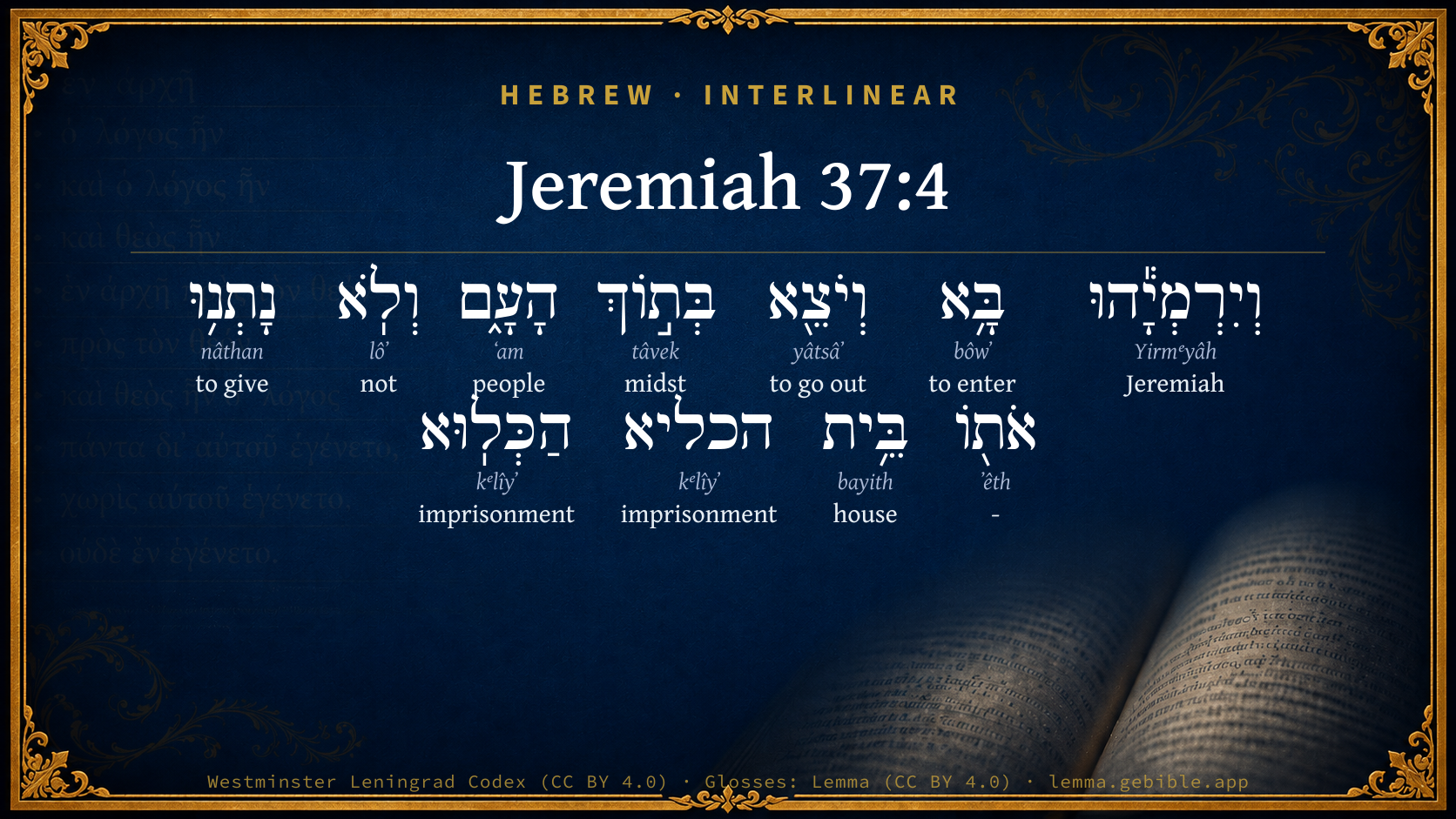
  1. וְיִרְמְיָ֕הוּ Yirmᵉyâh H3414 “and · Jeremiah” Conjunction + Noun, Proper
  2. בָּ֥א bôwʼ H935 “entering” Verb, Qal, Participle Active, Masculine, Singular, Absolute
  3. וְיֹצֵ֖א yâtsâʼ H3318 “and · going out” Conjunction + Verb, Qal, Participle Active, Masculine, Singular, Absolute
  4. בְּת֣וֹךְ tâvek H8432 “in/at · midst of” Preposition + Noun, Common, Masculine, Singular, Construct
  5. הָעָ֑ם ʻam H5971 “the · people” Particle, Definite Article + Noun, Common, Masculine, Singular, Absolute
  6. וְלֹֽא lôʼ H3808 “and · not” Conjunction + Particle, Negative
  7. נָתְנ֥וּ nâthan H5414 “to give” Verb, Qal, Perfect, 3rd Person, Common, Plural
  8. אֹת֖וֹ ʼêth H853 “- · him” Particle, Direct Object + Suffix, Personal, 3rd Person, Masculine, Singular
  9. בֵּ֥ית bayith H1004 “house of” Noun, Common, Masculine, Singular, Construct
  10. הַכְּלֽוּא kᵉlîyʼ H3628 “the · imprisonment” Particle, Definite Article + Noun, Common, Masculine, Singular, Absolute

About this verse

These counts appear in no published source. They are computed here, from the morphology-tagged text and Lemma’s own curated glosses. What Lemma adds →

11
words
10
distinct lemmas
Prophets
section

Notable vocabulary

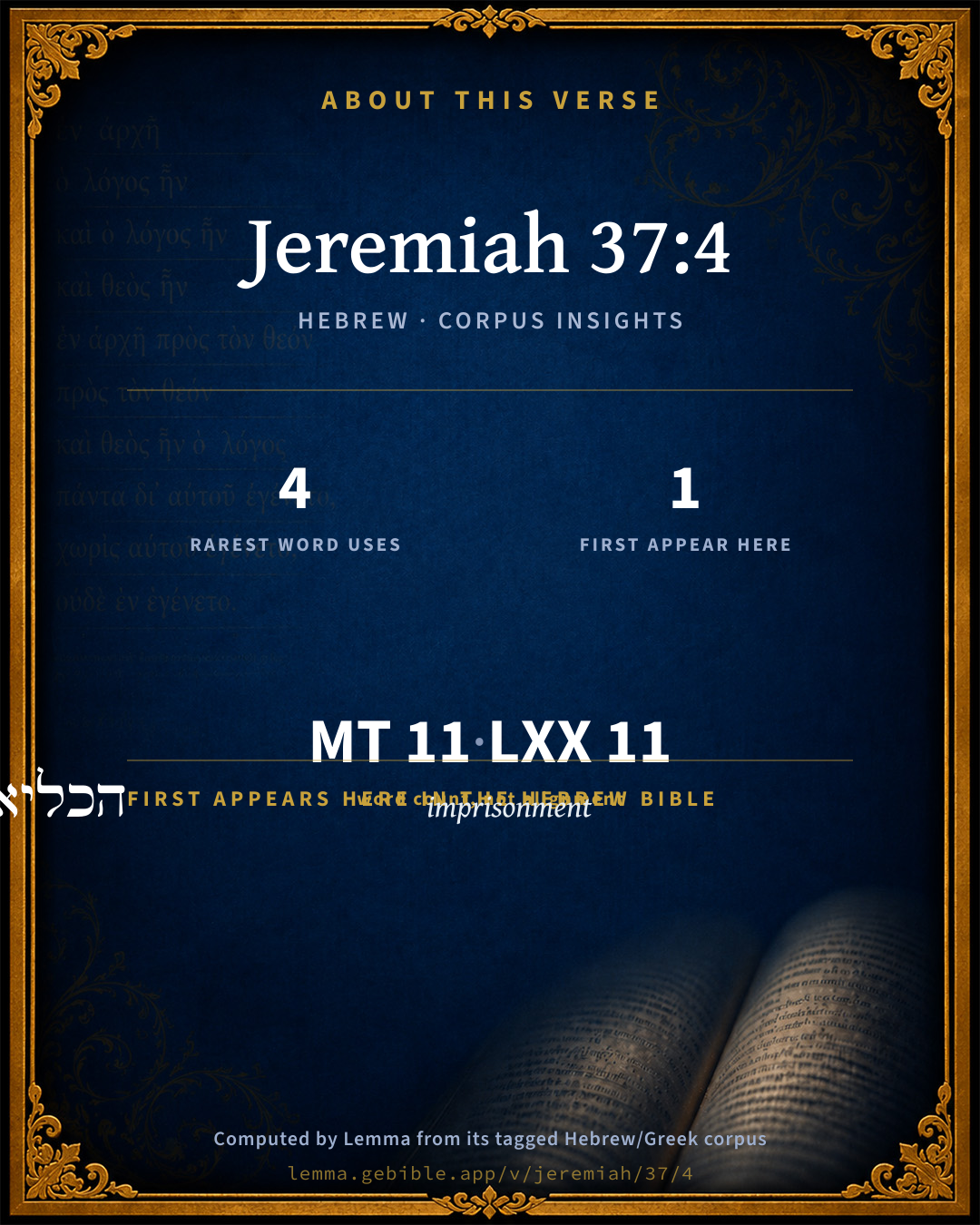
The rarest word here is הכליא imprisonment H3628 — appearing just 4 times in the whole Hebrew Bible.

First appearance in Scripture

This word makes its first canonical appearance in the Hebrew Bible here:

  • הכליא imprisonment H3628

Shared distinctive vocabulary

הכליא imprisonment H3628 occurs in 2 verses of the Hebrew Bible. Also found in:

Grammatical profile

  • 3 verbs
  • 6 nouns
  • 2 particles

Verb forms

  • בָּ֥א Qal · Participle Active
  • וְיֹצֵ֖א Qal · Participle Active
  • נָתְנ֥וּ Qal · Perfect

Repetition

A word recurs within this verse — often emphatic in Hebrew:

  • הכליא imprisonment H3628 ×2

Hebrew & Septuagint length

In the original languages it is 11 Hebrew tokens and 11 Greek tokens — but the two are counted differently (Hebrew bundles its prefixes and suffixes into one token; the Greek is in lemma form), so that isn’t a like-for-like length.

Cross-references

2

Topical passages linked to Jeremiah 37:4 in the Treasury of Scripture Knowledge — connected by theme and wording, ordered by reader-vote popularity; previews shown in the World English Bible.

  • Jeremiah 37:15 The princes were angry with Jeremiah, and struck him, and put him in prison in the house of Jonathan the scribe; for they had made that the prison.
  • Jeremiah 32:2–3 Now at that time the king of Babylon's army was besieging Jerusalem; and Jeremiah the prophet was shut up in the court of the guard, which was in the king of Judah's house.

Cross-references courtesy of OpenBible.info (CC BY 4.0).

Hebrew and Greek witnesses Masoretic Hebrew ↔ Greek Septuagint

The same verse in the two great witnesses to the Old Testament, shown verse-for-verse.

These are two independent witnesses, not word-aligned to each other, and the Septuagint is shown in lemma (dictionary) form.

Hebrew Jeremiah 37:4 Masoretic · Westminster Leningrad Codex

וְיִרְמְיָ֕הוּ בָּ֥א וְיֹצֵ֖א בְּת֣וֹךְ הָעָ֑ם וְלֹֽא נָתְנ֥וּ אֹת֖וֹ בֵּ֥ית הכליא הַכְּלֽוּא

Now Jeremiah came in and went out among the people; for they had not put him into prison.

World English Bible · Public Domain

Greek LXX Structure differs

In the Septuagint, Jeremiah is about an eighth shorter than the Hebrew and arranges its material differently — the Oracles Against the Nations (Hebrew chapters 46–51) appear in the middle of the Greek book, after 25:13. Because the chapter and verse boundaries do not line up, a verse-for-verse comparison with the Hebrew is not shown.

A verse-for-verse comparison isn’t shown here because the chapters and verses don’t line up. Switch to the LXX edition with the MT / LXX toggle above to read the Greek directly.

Hebrew: Westminster Leningrad Codex (CC BY 4.0). Greek: Septuagint (public domain); English from a public-domain English Septuagint. How the Septuagint differs from the Hebrew →

Targum (Aramaic paraphrase)

1

The Targum is the ancient Jewish Aramaic paraphrase of the Hebrew Scriptures — an interpretive translation, not the Hebrew text itself. Onkelos (literal) and Pseudo-Jonathan (expansive) render the Torah, and Jonathan the Prophets. Coverage is partial: where no permissively-licensed English translation exists for a verse, only the Aramaic is shown. This is verse-level text, not a word-by-word alignment to the Hebrew.

  1. Targum Jonathan Prophets (Joshua–Malachi)
    וְיִרְמְיָה עַלֵיל וְנָפֵיק בְּגוֹ עַמָא וְלָא יְהָבוּ יָתֵיהּ בְּבֵית אֲסִירֵי:

    (no public-domain English translation for this verse)

    Targum Jonathan — Aramaic: “Mikraot Gedolot” (public domain). English: “Sefaria Community Translation” (CC0 1.0 (public-domain dedication)); “London "Chaldee Paraphrase," 1871” (public domain). Text via Sefaria.

Commentary

Notes on Jeremiah 37:4 from classic Christian and Jewish commentators (each source and its license shown beneath its notes). The classic Christian expositions comment on the surrounding passage and are grouped to its opening verse, so a note may address several verses; the Jewish commentaries on the Tanakh (Rashi and others) are per-verse, so they appear only where the commentator wrote on this verse.

Lemma curates 59 commentaries, every one of them public domain or Creative Commons licensed, each selected and text-cleaned for this edition rather than reprinted as found. About our sources →

Trapp's Complete Commentary

John Trapp

Jer 37:4 Now Jeremiah came in and went out among the people: for they had not put him into prison.

Ver. 4. Jeremiah came in and went out.] He was yet at liberty; as the saints have some halcyons times, yet are never unexercised, as we see in the apostles, but especially in Paul. {Act 5:13}

For they had not put him in prison.] Not yet they had. It was in our late wars a like difficult thing to find a wicked man in the enemy’s prisons, or a godly man out of them.

John Trapp, A Commentary or Exposition upon All the Books of the Old and New Testament (1647–1656) — public domain. Text from a community e-Sword module.

Geneva Bible (1599)

Geneva Bible translators

That is, was out of prison, and at liberty.

Geneva Bible (1599) marginal notes — public domain. Text via Bolls.life.

Jamieson, Fausset & Brown

Robert Jamieson, A. R. Fausset & David Brown

Jeremiah . . . not put . . . into prison--He was no longer in the prison court, as he had been (Jer 32:2; Jer 33:1), which passages refer to the beginning of the siege, not to the time when the Chaldeans renewed the siege, after having withdrawn for a time to meet Pharaoh.

Jamieson, Fausset & Brown — Commentary Critical and Explanatory on the Whole Bible (1871) — public domain (CC PDM 1.0). Text via the HelloAO Bible API.

Adam Clarke's Commentary

Verse 4. Now Jeremiah came in and went out] After the siege was raised, he had a measure of liberty; he was not closely confined, as he afterwards was. See Jer 37:16.

Adam Clarke's Commentary on the Bible (1810–1826) — public domain. Text from a community e-Sword/MySword module.

John Calvin's Commentaries

But Jeremiah tells us that he was then at liberty, coming in and going out among the people It may be that he had been in prison, but that after the rage of the king and of the people had cooled, he might have been set free. It is hence said that he was among the people, that is set at liberty, and at his own disposal, so that he could safely walk through the city; for to come and to go implies that he was free to follow his own business. He is said to come and to go who undertakes this or that concern as he pleases; for men, we know, are not engaged always in the same thing, but do various things as necessity requires. Such, then, was the condition of Jeremiah; he enjoyed common liberty. It is then added, that he was not as yet cast into prison, as it happened soon after. It is further said, that the army of Pharaoh was come out from Egypt to give aid to the Jews, and that thus the siege was raised, for the Chaldeans went forth to meet the Egyptians. At this time, then, Jeremiah received an answer from God. It seems not, therefore, probable that the messengers were sent, when the report spread through the city of the coming of the enemy, but rather when the city was relieved, for the condition of the people was still doubtful, as the liberty of the city and the land depended on the uncertain issue of the war. The Chaldeans had not yet come unto an engagement with the Egyptians. A victory gained by Pharaoh would have given the prospect of peace and safety to Zedekiah and the whole people; but if the Chaldeans gained the day, they saw that the greatest danger was at hand, for they would then be deprived of every assistance.

It was in this state of things that Zedekiah sent messengers to Jeremiah, to solicit his prayers. Thus we see that hypocrites are driven by the fear of God, whom yet they proudly despise, to seek his aid when forced to do so; nor is this done, that they may appear to do so before men, but because God brings them to such straits, that they cannot but feel that they stand in need of his help. They wish, indeed, as I have said, to obliterate every recollection of God, and were they also able to do so, they would rob him of all power and authority; but as they are forced, willing or unwilling, to know that God so reigns in heaven that the whole world is subject to his power, necessity constrains them formally to pray, and, in a manner, to conciliate his favor, or, at least, to try to do so. But as I have already said, they ought to begin with repentance and faith. Hypocrites withdraw themselves as far as they can, both from the promises of God and from the duty of repentance. They so seek God that they at the same time shun him.

We must also observe, that Zedekiah felt himself so guilty, that he could not pray himself. As, then, he was conscious of his own unworthiness, he put the Prophet, as it were, between himself and God, that he might suppliantly intercede for him. This also is what the faithful often do, for they seek aid here and there that they may be more readily heard by God; and this they do according to God’s command. But there is a great difference between the godly and hypocrites. The true worshippers of God, as I have said, are not content with their own prayers, but ask others to join them, while, at the same time, they pray God themselves. But hypocrites, what do they do? As they think that an access is forbidden them, and know that they are unworthy of being heard by God, they substitute others in their place to pray for them. Thus they do not seek themselves to know whether God will be propitious to them; and though they wish the whole world to pray for them, they do not yet pray themselves. Such, then, was the sottishhess of Zedekiah, who asked the holy Prophet to pray for him to God, while he himself was lying torpid in his own dregs; for he did not acknowledge that he was suffering a just punishment, nor had he recourse to the true remedy, that is, to return to God’s favor, to embrace his mercy and the promises of salvation. All these principal things he omitted, and only attended to what is, as they say, accessory.

Now as to the time, we ought carefully to notice that it was when the Egyptians came to raise the siege. Thus God for a time permitted hypocrites to be deceived by a fortunate event; for the Jews then began to praise their own prudence in forming a league with the Egyptians, for that kingdom, as it is well known, was powerful, and at the same time populous, so that a large army could be raised. As, then, they saw that their treaty turned out beneficially to them, they, no doubt, assumed to themselves great credit, and thus their boldness increased. But God, however, so touched their liearts, that they continued in suspense, and, by turns, greatly feared: for Zedekiah would not have sent to Jeremiah, except, constrained by some great necessity; and yet, as it has been said, success might have inebriated him; but God rendered him anxious, so as to feel that the prayer of the Prophet was needed.

John Calvin's Commentaries (1540-1563) — public domain. Text from the Calvin Translation Society English edition (1840s-50s) via the Christian Classics Ethereal Library (ccel.org). Calvin's coverage is partial (roughly two-thirds of the Bible); uncommented books and verses are honest gaps, never fabricated. The 19th-century editor's footnotes and remarks are omitted so the notes are faithfully Calvin's own voice.

Ellicott's Commentary for English Readers

(4) Jeremiah came in and went out among the people.—The statement is made in reference to the event narrated in Jer_37:15. He was free when the king’s message came to him: it was his answer to that message that led to his imprisonment.

A Bible Commentary for English Readers, edited by Charles John Ellicott (1878–1897) — public domain. Text from a community e-Sword module.

The Cambridge Bible for Schools and Colleges

gen. ed. J. J. S. Perowne

4. came in and went out] was still coming in and going out, was still free, had not suffered arrest. That was immediately to follow.

The Cambridge Bible for Schools and Colleges (gen. ed. J. J. S. Perowne; Cambridge University Press, 1878–1918) — public domain. Text from a community e-Sword module.

John Gill's Exposition

Now Jeremiah came in and went out among the people,.... Was at full liberty, and could go out of the city, and come in, when he pleased; or go into any part of it, and converse with the people, and prophesy to them; which he could not do in the latter part of Jehoiakim's reign, who sent persons after him and Baruch to take them, and they were obliged to hide themselves, yea, the Lord hid them, Jer 36:19; but now he was under no restraint, as least as yet:

for they had not put him into prison; not yet; they afterwards did, Jer 37:15.

John Gill's Exposition of the Whole Bible (1746–1763) — public domain (CC PDM 1.0). Text via the HelloAO Bible API.

Matthew Poole's English Annotations

We shall read afterward, Jer 37:15, that he was imprisoned; and we have heard, Jer 32, of two revelations he had while he was in prison; but as yet he walked at liberty.

Matthew Poole's English Annotations on the Holy Bible (1683–1685) — public domain. Text from a community e-Sword/MySword module.

The Pulpit Commentary

Now Jeremiah came in and went out, etc. Had he been a prisoner, an embassy of high officials could not, with propriety, have been sent to him. (comp. ver. 17; Jer_38:14)

The Pulpit Commentary (1880–1919), ed. H.D.M. Spence-Jones & Joseph S. Exell — public domain. Text from a community e-Sword module.

Rashi

Rabbi Shlomo Yitzchaki (Rashi)

And Jeremiah was coming and going among the people When Zedekiah assumed the throne, he gave an order and they freed him from the jail where Jehoiakim had imprisoned him, for Zedekiah was a righteous man and the people of his generation were wicked, whereas Jehoiakim was a wicked man and the people of his generation were righteous.

Rashi on the Tanakh — English translations: “The Judaica Press complete Tanach with Rashi, translated by A. J. Rosenberg” (CC BY 4.0); “Pentateuch with Rashi's commentary by M. Rosenbaum and A.M. Silbermann, 1929-1934” (public domain); “The Metsudah Tanach series, Lakewood, N.J” (CC BY 4.0); and “The Book of Joshua, Metsudah Publications, 1997” (CC BY 4.0). Text via Sefaria.

Lesson kit

Teaching starters — assembled from the data on this page, not authored interpretation. Every prompt links to the verse data it draws on. Edit before teaching.

Jeremiah, in the Prophets, opens this verse with 11 words (10 distinct Hebrew lemmas). Its most distinctive word is kᵉlîyʼ (“imprisonment”). A historical commentator’s framing appears above. Read the whole chapter for the surrounding context.

Discussion questions

  1. How does “imprisonment” (kᵉlîyʼ) shape what this verse is saying?
  2. This is the first place “imprisonment” appears in Scripture (first appears here). What does its debut here establish?
  3. How does Jeremiah 52:31, which shares the word «imprisonment», read alongside this verse?
  4. What does the repetition of “imprisonment” (2× in this one verse) do in this verse?
  5. These translations render this verse differently. What is at stake in choosing one wording over another?
  6. «בָּ֥א» is a Qal Participle Active verb. How does that grammatical form shape the action described?
  7. Compare how Trapp's Complete Commentary and Geneva Bible (1599) read this verse. Where do they agree or differ?

Things to notice

Reading settings

Reading text

Shown beneath each verse's original-language words.

Old Testament
Old Testament edition

Read the OT as the Masoretic Hebrew (MT) or the Greek Septuagint (LXX).

English shown for the Greek Septuagint (in the Hebrew ↔ Greek comparison).

Comparing translations? Open the Compare panel on any verse page to stack up to four side by side.