
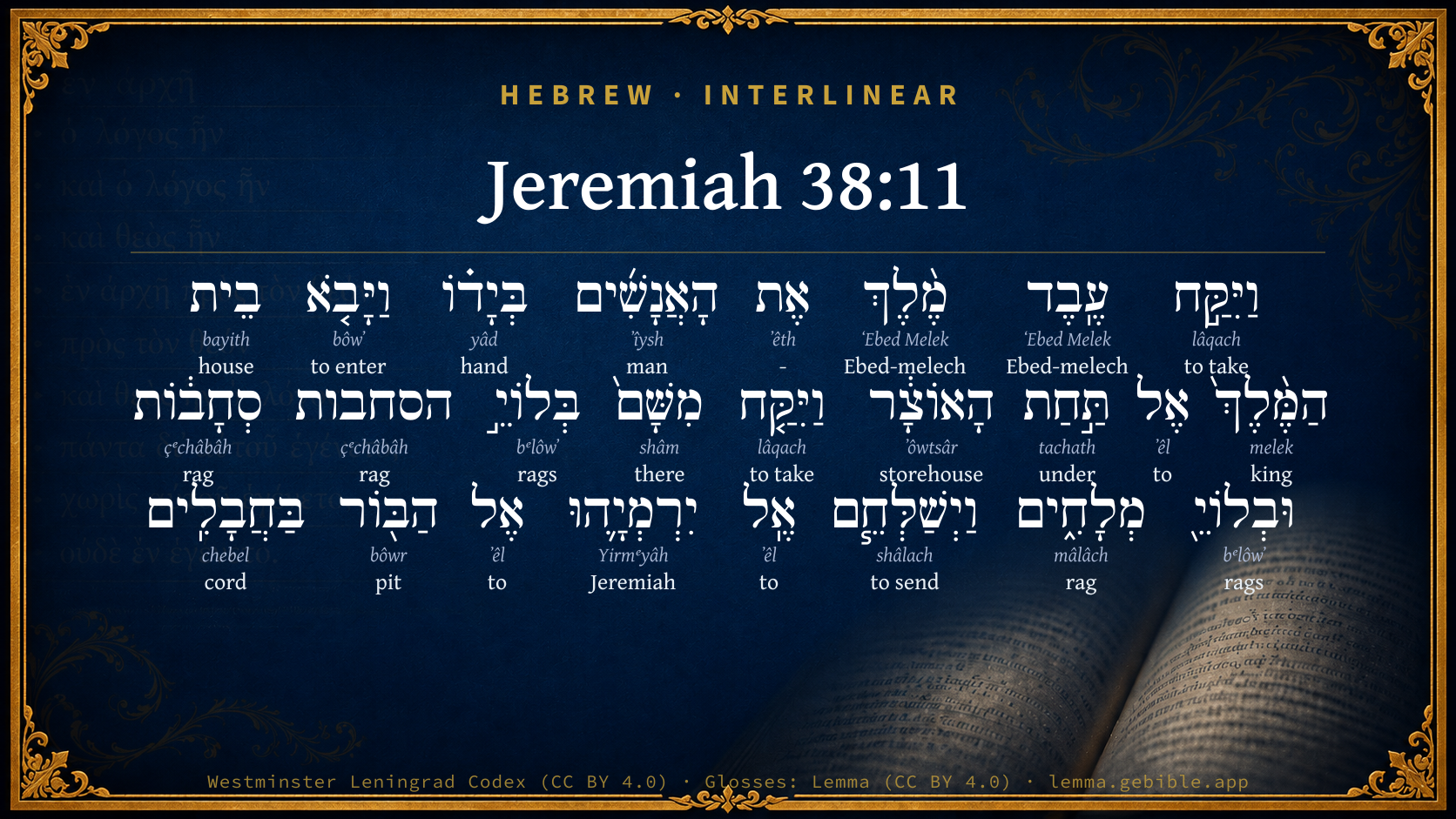
Jeremiah 38:11

Hebrew (Westminster Leningrad Codex) Jeremiah 38:11 appears in the Hebrew Old Testament. The text above is from the Westminster Leningrad Codex. Each word links to its Strong’s number, a concise gloss, and parsing drawn from the Open Scriptures Hebrew Bible morphology. Click any word for its full Brown-Driver-Briggs (BDB) entry.
Download image
Cite this verse

Jeremiah 38:11 (World English Bible). Public Domain. Lemma interlinear Bible study tool, https://lemma.gebible.app/v/jeremiah/38/11.

Show BibTeX & RIS
BibTeX
RIS
English Translation
So Ebedmelech took the men with him, and went into the house of the king under the treasury, and took there rags and worn-out garments, and let them down by cords into the dungeon to Jeremiah.
World English Bible · Public Domain
Highlights
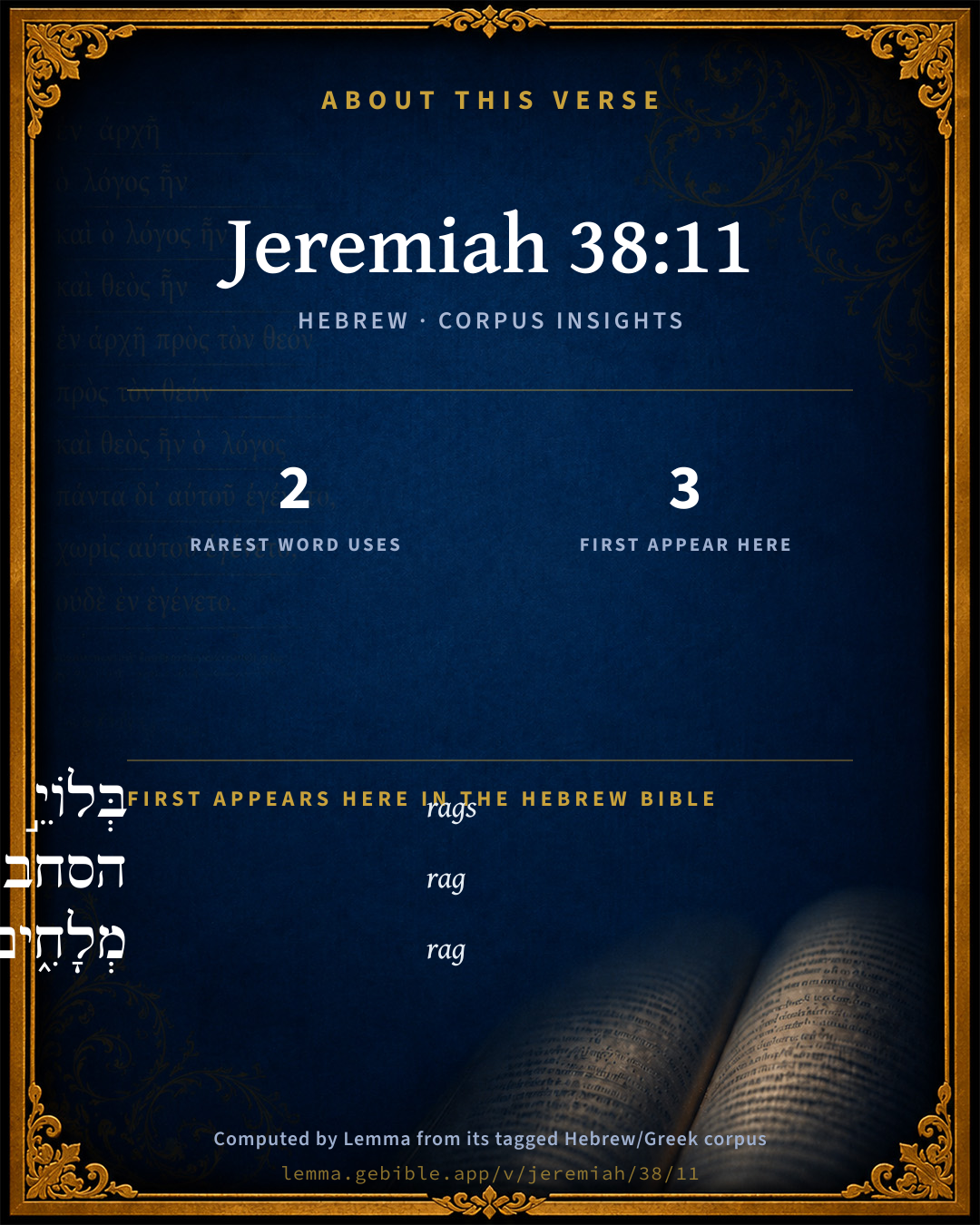
  • 3 first appearances in the Hebrew Bible
Full analysis ↓
Download a study sheet

One document with this verse’s original text, its word-by-word gloss line, the meaning frame, cross-references with their text, attributed commentary, and full source and license credits — printable, and it pastes into notes with its structure intact.

This verse Autodidact and up

Study sheet (.html) Plain text (.txt)

A passage Seminary Student

Up to 50 verses in one chapter. A passage sheet keeps up to 6 commentary sources and 12 cross-references per verse, in the order this page ranks them, and says so on the sheet whenever that leaves anything out. Ask for a single verse and you get the Autodidact verse sheet above.

Everything on this page stays free to read, with no account — the sheet is a download of what is already on screen, not access to it.

Want to remove ads? Support Godless Engineer
Compare translations 3

The same verse in 3 English versions, stacked beneath the original-language interlinear above. Click any original word for its lexicon entry.

Each is an independent rendering of the whole verse — the interlinear is not word-aligned to these translations.

Highlighted words mark where these versions differ — a whole-verse word diff, not a word-by-word alignment.

  • World English Bible Public Domain
    So Ebedmelech took the men with him, and went into the house of the king under the treasury, and took there rags and worn-out garments, and let them down by cords into the dungeon to Jeremiah.
  • King James Version Public Domain
    So Ebedmelech took the men with him, and went into the house of the king under the treasury, and took thence old cast clouts and old rotten rags, and let them down by cords into the dungeon to Jeremiah.
  • unfoldingWord Literal Text CC BY-SA 4.0
    So Ebed-Melek took command of those men and went to the king’s house, to a storeroom for clothing under the house. From there he took rags and worn-out clothing and then let them down by ropes to Jeremiah in the cistern.

unfoldingWord Literal Text — © unfoldingWord, licensed CC BY-SA 4.0. Word-aligned USFM3 via Door43 (git.door43.org/unfoldingWord/en_ult).

Versions to compare (up to 4)

3 of 4 selected

Show all 18 translations

Every available English version of this verse, each an independent rendering of the whole verse.

  • World English Bible Public Domain
    So Ebedmelech took the men with him, and went into the house of the king under the treasury, and took there rags and worn-out garments, and let them down by cords into the dungeon to Jeremiah.
  • Berean Standard Bible Public Domain
    Then Ebed-melech took the men with him and went to the king’s palace, to a place below the storehouse. From there he took old rags and worn-out clothes and lowered them with ropes to Jeremiah in the cistern.
  • Majority Standard Bible Public Domain
    Then Ebed-melech took the men with him and went to the king’s palace, to a place below the storehouse. From there he took old rags and worn-out clothes and lowered them with ropes to Jeremiah in the cistern.
  • King James Version Public Domain
    So Ebedmelech took the men with him, and went into the house of the king under the treasury, and took thence old cast clouts and old rotten rags, and let them down by cords into the dungeon to Jeremiah.
  • American Standard Version (1901) Public Domain
    So Ebed-melech took the men with him, and went into the house of the king under the treasury, and took thence rags and worn-out garments, and let them down by cords into the dungeon to Jeremiah.
  • Revised Version (1885) Public Domain
    So Ebed-melech took the men with him, and went into the house of the king under the treasury, and took thence old cast clouts and old rotten rags, and let them down by cords into the dungeon to Jeremiah.
  • Geneva Bible (1599) Public Domain
    So Ebed-melech tooke the men with him and went to the house of the King vnder the treasurie, and tooke there olde rotten ragges, and olde worne cloutes, and let them downe by coards into the dungeon to Ieremiah.
  • Douay-Rheims (1899) Public Domain
    So Abdemelech taking the men with him, went into the king's house that was under the storehouse: and he took from thence old rags, and old rotten things, and he let them down by cords to Jeremias into the dungeon.
  • Young's Literal Translation Public Domain
    And Ebed-Melech taketh the men with him, and entereth the house of the king, unto the place of the treasury, and taketh thence worn-out clouts, and worn-out rags, and sendeth them unto Jeremiah unto the pit by cords.
  • Literal Standard Version CC BY-SA 4.0
    And Ebed-Melech takes the men with him, and enters the house of the king, to the place of the treasury, and takes there worn-out shreds of cloth, and worn-out rags, and sends them by cords into the pit to Jeremiah.
  • Unlocked Literal Bible CC BY-SA 4.0
    So Ebed-Melek took command of those men and went to the king's house, to a storeroom for clothing under the house. From there he took rags and worn-out clothing and then let them down by ropes to Jeremiah in the cistern.
  • unfoldingWord Literal Text CC BY-SA 4.0
    So Ebed-Melek took command of those men and went to the king’s house, to a storeroom for clothing under the house. From there he took rags and worn-out clothing and then let them down by ropes to Jeremiah in the cistern.
  • Darby Bible Public Domain
    And Ebed-melech took the men under his order, and went into the house of the king under the treasury, and took thence old shreds and worn-out clothes, and let them down by cords into the dungeon to Jeremiah.
  • World Messianic Bible Public Domain
    So Ebedmelech took the men with him, and went into the house of the king under the treasury, and took from there rags and worn-out garments, and let them down by cords into the dungeon to Jeremiah.
  • Webster's Bible Public Domain
    So Ebed-melech took the men with him, and went into the house of the king under the treasury, and took thence old cast clouts and old decayed rags, and let them down by cords into the dungeon to Jeremiah.
  • Free Bible Version CC BY-SA 4.0
    Ebed-melech took the men and went to the storehouse under the palace. He took some rags and old clothes from there and then went to the cistern where he lowered them with ropes to Jeremiah.
  • Bible in Basic English Public Domain
    So Ebed-melech took the men with him and went into the house of the king, to the place where the clothing was kept, and got from there old clothing and bits of old cloth, and let them down by cords into the water-hole where Jeremiah was.
  • JPS Tanakh (1917) Public Domain
    So Ebed-melech took the men with him, and went into the house of the king under the treasury, and took thence worn clouts and worn rags, and let them down by cords into the pit to Jeremiah.

Literal Standard Version (2020), Covenant Press — licensed CC BY-SA 4.0. Text via the HelloAO Bible API (eBible.org). Unlocked Literal Bible (unfoldingWord) — licensed CC BY-SA 4.0. Text via the HelloAO Bible API (eBible.org). unfoldingWord Literal Text — © unfoldingWord, licensed CC BY-SA 4.0. Word-aligned USFM3 via Door43 (git.door43.org/unfoldingWord/en_ult). Free Bible Version, Dr. Jonathan Gallagher — licensed CC BY-SA 4.0. Text via the HelloAO Bible API (eBible.org).

Word by word

More ways to search: Search by grammar → Find every occurrence → Compare this word →

Practice this passage: Drill this verse → Learn its vocabulary →

מְלָחִ֑ים
mâlâch
H4418
“rags”
Noun, Common, Masculine, Plural, Absolute
Part of Speech
Noun
Type
Common
Gender
Masculine
Number
Plural
State
Absolute
Full BDB Definition

Origin: from H4414 in its original sense

TWOT: 1196a

rag
  1. וַיִּקַּ֣ח lâqach H3947 “and · to take” Conjunction + Verb, Qal, Sequential Imperfect, 3rd Person, Masculine, Singular
  2. עֶֽבֶד ʻEbed Melek H5663 “Ebed-melech” Noun, Proper
  3. מֶ֨לֶךְ ʻEbed Melek H5663 “Ebed-melech” Noun, Proper
  4. אֶת ʼêth H853 “-” Particle, Direct Object
  5. הָאֲנָשִׁ֜ים ʼîysh H376 “the · men” Particle, Definite Article + Noun, Common, Masculine, Plural, Absolute
  6. בְּיָד֗וֹ yâd H3027 “in/at · hand · his” Preposition + Noun, Common, Both, Singular, Construct + Suffix, Personal, 3rd Person, Masculine, Singular
  7. וַיָּבֹ֤א bôwʼ H935 “and · to enter” Conjunction + Verb, Qal, Sequential Imperfect, 3rd Person, Masculine, Singular
  8. בֵית bayith H1004 “house of” Noun, Common, Masculine, Singular, Construct
  9. הַמֶּ֨לֶךְ֙ melek H4428 “the · king” Particle, Definite Article + Noun, Common, Masculine, Singular, Absolute
  10. אֶל ʼêl H413 “to” Preposition
  11. תַּ֣חַת tachath H8478 “under” Preposition
  12. הָאוֹצָ֔ר ʼôwtsâr H214 “the · storehouse” Particle, Definite Article + Noun, Common, Masculine, Singular, Absolute
  13. וַיִּקַּ֤ח lâqach H3947 “and · to take” Conjunction + Verb, Qal, Sequential Imperfect, 3rd Person, Masculine, Singular
  14. מִשָּׁם֙ shâm H8033 “from · there” Preposition + Adverb
  15. בְּלוֹיֵ֣ bᵉlôwʼ H1094 “rags of” Noun, Common, Masculine, Plural, Construct
  16. הסחבות çᵉchâbâh H5499 “the · rags” Particle, Definite Article + Noun, Common, Feminine, Plural, Absolute
  17. סְחָב֔וֹת çᵉchâbâh H5499 “rags” Noun, Common, Feminine, Plural, Absolute
  18. וּבְלוֹיֵ֖ bᵉlôwʼ H1094 “and · rags of” Conjunction + Noun, Common, Masculine, Plural, Construct
  19. וַיְשַׁלְּחֵ֧ם shâlach H7971 “and · to send · them” Conjunction + Verb, Piel, Sequential Imperfect, 3rd Person, Masculine, Singular + Suffix, Personal, 3rd Person, Masculine, Plural
  20. אֶֽל ʼêl H413 “to” Preposition
  21. יִרְמְיָ֛הוּ Yirmᵉyâh H3414 “Jeremiah” Noun, Proper
  22. אֶל ʼêl H413 “to” Preposition
  23. הַבּ֖וֹר bôwr H953 “the · pit” Particle, Definite Article + Noun, Common, Masculine, Singular, Absolute
  24. בַּחֲבָלִֽים chebel H2256 “in/at · cords” Preposition + Noun, Common, Both, Plural, Absolute

About this verse

These counts appear in no published source. They are computed here, from the morphology-tagged text and Lemma’s own curated glosses. What Lemma adds →

25
words
19
distinct lemmas
Prophets
section

Notable vocabulary

The rarest word here is מְלָחִ֑ים rag H4418 — appearing just 2 times in the whole Hebrew Bible.

First appearance in Scripture

These words make their first canonical appearance in the Hebrew Bible here:

  • בְּלוֹיֵ֣ rags H1094
  • הסחבות rag H5499
  • מְלָחִ֑ים rag H4418

Shared distinctive vocabulary

מְלָחִ֑ים rag H4418 occurs in 2 verses of the Hebrew Bible. Also found in:

Grammatical profile

  • 4 verbs
  • 15 nouns
  • 4 prepositions
  • 1 adverb
  • 1 particle

Verb forms

  • וַיִּקַּ֣ח Qal · Sequential Imperfect
  • וַיָּבֹ֤א Qal · Sequential Imperfect
  • וַיִּקַּ֤ח Qal · Sequential Imperfect
  • וַיְשַׁלְּחֵ֧ם Piel · Sequential Imperfect

Repetition

Words recur within this verse — often emphatic in Hebrew:

  • וַיִּקַּ֣ח to take H3947 ×2
  • עֶֽבֶד Ebed-melech H5663 ×2
  • בְּלוֹיֵ֣ rags H1094 ×2
  • הסחבות rag H5499 ×2
  • אֶל to H413 ×3
Hebrew and Greek witnesses Masoretic Hebrew ↔ Greek Septuagint

The same verse in the two great witnesses to the Old Testament, shown verse-for-verse.

These are two independent witnesses, not word-aligned to each other, and the Septuagint is shown in lemma (dictionary) form.

Hebrew Jeremiah 38:11 Masoretic · Westminster Leningrad Codex

וַיִּקַּ֣ח עֶֽבֶד מֶ֨לֶךְ אֶת הָאֲנָשִׁ֜ים בְּיָד֗וֹ וַיָּבֹ֤א בֵית הַמֶּ֨לֶךְ֙ אֶל תַּ֣חַת הָאוֹצָ֔ר וַיִּקַּ֤ח מִשָּׁם֙ בְּלוֹיֵ֣ הסחבות סְחָב֔וֹת וּבְלוֹיֵ֖ מְלָחִ֑ים וַיְשַׁלְּחֵ֧ם אֶֽל יִרְמְיָ֛הוּ אֶל הַבּ֖וֹר בַּחֲבָלִֽים

So Ebedmelech took the men with him, and went into the house of the king under the treasury, and took there rags and worn-out garments, and let them down by cords into the dungeon to Jeremiah.

World English Bible · Public Domain

Greek LXX Structure differs

In the Septuagint, Jeremiah is about an eighth shorter than the Hebrew and arranges its material differently — the Oracles Against the Nations (Hebrew chapters 46–51) appear in the middle of the Greek book, after 25:13. Because the chapter and verse boundaries do not line up, a verse-for-verse comparison with the Hebrew is not shown.

A verse-for-verse comparison isn’t shown here because the chapters and verses don’t line up. Switch to the LXX edition with the MT / LXX toggle above to read the Greek directly.

On this verse, John Gill's Exposition discusses the Septuagint’s reading. Read the note in Commentary ↓

Hebrew: Westminster Leningrad Codex (CC BY 4.0). Greek: Septuagint (public domain); English from a public-domain English Septuagint. How the Septuagint differs from the Hebrew →

Targum (Aramaic paraphrase)

1

The Targum is the ancient Jewish Aramaic paraphrase of the Hebrew Scriptures — an interpretive translation, not the Hebrew text itself. Onkelos (literal) and Pseudo-Jonathan (expansive) render the Torah, and Jonathan the Prophets. Coverage is partial: where no permissively-licensed English translation exists for a verse, only the Aramaic is shown. This is verse-level text, not a word-by-word alignment to the Hebrew.

  1. Targum Jonathan Prophets (Joshua–Malachi)
    וּדְבַר עַבְדָא דְמַלְכָּא יַת גַבְרַיָא עִמֵיהּ וְעָל לְבֵית מַלְכָּא לִתְחוֹת אוֹצְרָא וּנְסֵיב מִתַּמָן בְּלָאֵי טַפְסָן וּבְלָאֵי שַׁחְקָן וְשַׁרְבְבִינוּן לְוַת יִרְמְיָה לְגוּבָא בְּאַטוּנַיָא:

    (no public-domain English translation for this verse)

    Targum Jonathan — Aramaic: “Mikraot Gedolot” (public domain). English: “Sefaria Community Translation” (CC0 1.0 (public-domain dedication)); “London "Chaldee Paraphrase," 1871” (public domain). Text via Sefaria.

Commentary

Notes on Jeremiah 38:11 from classic Christian and Jewish commentators (each source and its license shown beneath its notes). The classic Christian expositions comment on the surrounding passage and are grouped to its opening verse, so a note may address several verses; the Jewish commentaries on the Tanakh (Rashi and others) are per-verse, so they appear only where the commentator wrote on this verse.

Lemma curates 59 commentaries, every one of them public domain or Creative Commons licensed, each selected and text-cleaned for this edition rather than reprinted as found. About our sources →

Trapp's Complete Commentary

John Trapp

Jer 38:11 So Ebedmelech took the men with him, and went into the house of the king under the treasury, and took thence old cast clouts and old rotten rags, and let them down by cords into the dungeon to Jeremiah.

Ver. 11. So Ebedmelech took the men with him and went.] The labour of love that this Ethiopian performed to the man of God is particularly and even partly described, for his eternal commendation, and all men’s imitation.

John Trapp, A Commentary or Exposition upon All the Books of the Old and New Testament (1647–1656) — public domain. Text from a community e-Sword module.

Tyndale Open Study Notes

Tyndale Open Resources

38:11-12 Ebed-melech, the Ethiopian rescuer (38:7), was a caring person who wanted to protect Jeremiah’s weakened body as much as possible.

Tyndale Open Study Notes — © Tyndale Open Resources, licensed CC BY-SA 4.0. Text via the HelloAO Bible API.

Jamieson, Fausset & Brown

Robert Jamieson, A. R. Fausset & David Brown

cast clouts--"torn clothes" [HENDERSON].

rotten rags--"worn-out garments." God can make the meanest things His instruments of goodness to His people (Co1 1:27-29).

under . . . armholes--"under the joints of thine hands," that is, where the fingers join the hand, the clothes being in order that the hands should not be cut by the cords [MAURER].

Jamieson, Fausset & Brown — Commentary Critical and Explanatory on the Whole Bible (1871) — public domain (CC PDM 1.0). Text via the HelloAO Bible API.

Adam Clarke's Commentary

Verse 11. Went into the house of the king - and took thence] The eastern kings had their wardrobes always well furnished; as garments were a usual present to ambassadors, c. I cannot think that, in the proper acceptation of the words, these were in any part of the king's house.

Old cast clouts, and old rotten rags] The fact seems to be this: there were several garments that had been used, and would not be used again and there were others which, through continuing long there, had by insects, &c., been rendered useless. These he took, tied to the cord, let down to the prophet, that he might roll them round the ropes, and place them under his arm-pits, so that in being hauled up he might not suffer injury from the ropes, which in this case must sustain the whole weight of his body.

Adam Clarke's Commentary on the Bible (1810–1826) — public domain. Text from a community e-Sword/MySword module.

John Calvin's Commentaries

Here Jeremiah goes on with the history of his deliverance. The courage of Ebedmelech ought ever to be noticed by us, for he went immediately to the holy Prophet. And it is said, that he took from some hidden place old tatters, De vieux haillons, as we call them. It is properly a noun substantive. But if its harshness be displeasing, we may give this rendering, “old tatters which had been dragged, and old tatters which were rotten.” Yet some render the words thus, “Worn out clothes and rotten clothes.” But the former is more properly the meaning; for סחב, sacheb, means to drag, and it may be rendered in French, Vieux haillons trainez, ou, qui avoyent traine Then we have סלחים, salechim, corrupted or marred, usez; for סלח, salech, means to salt; but it is a verb in Hophal, and in that form it means to corrupt. They were torn or rotten garments, des vieux haillons a demi pourris It is said then that Ebedmelech took these old, torn, and rotten garments, and which had been used. This ought to be carefully noticed; for it appears that Ebed-melech was afraid of the violence of the princes, not so much on his own account, but lest he should be hindered in effecting his purpose.

For if he had provided other things, he might have been apprehended; report might have been brought to the princes, who would have immediately assembled and put a stop to his efforts. There is then no doubt but that Ebedmelech, being very confident, prudently considered what might prevent him in his attempt of bringing help to the holy Prophet. Hence it was, that he stealthily took from a hidden place these worn-out and marred garments. This is one thing. Then we see the miserable state of the holy Prophet; he lay half buried in mud, and he was to be drawn out by ropes or cords, and to have these torn and worn-out garments under his arms. And we are afterwards expressly told for what purpose these clothes were sent down to him.

John Calvin's Commentaries (1540-1563) — public domain. Text from the Calvin Translation Society English edition (1840s-50s) via the Christian Classics Ethereal Library (ccel.org). Calvin's coverage is partial (roughly two-thirds of the Bible); uncommented books and verses are honest gaps, never fabricated. The 19th-century editor's footnotes and remarks are omitted so the notes are faithfully Calvin's own voice.

Ellicott's Commentary for English Readers

(11) Under the treasury . . .—This was obviously what we should call the “lumber-room” of the palace. Nothing could show the acuteness of the prophet’s sufferings more vividly than the precautions which the thoughtful kindness of the Eunuch thus suggested. The pit was so deep that ropes were needed to draw him up, as they had been to let him down, and lest they should cut into the flesh of Jeremiah’s emaciated form, improvised cushions had to be fastened to the ropes, that he might rest his arm-pits on them. He was, however, at last rescued, and re-instated in his former position, as a prisoner under the king’s protection.

“Clout” in old English was used for a patch of cloth as distinct from the “rags,” which were of linen. So Spenser, “His garments nought but many ragged clouts.”

A Bible Commentary for English Readers, edited by Charles John Ellicott (1878–1897) — public domain. Text from a community e-Sword module.

The Cambridge Bible for Schools and Colleges

gen. ed. J. J. S. Perowne

11. under the treasury] to a room under the treasury, a sort of lumber-room.

old cast clouts and old rotten rags] worn out pieces of torn and ragged garments, to ease the pressure of the ropes.

The Cambridge Bible for Schools and Colleges (gen. ed. J. J. S. Perowne; Cambridge University Press, 1878–1918) — public domain. Text from a community e-Sword module.

John Gill's Exposition

So Ebedmelech took the men with him,.... The thirty men, as the king ordered: as soon as ever he had got the grant, he immediately set about the work, and lost no time to save the prophet's life:

and went unto the house of the king under the treasury; from the gate of Benjamin he went to the king's palace, and to a particular place under the treasury; by which "treasury" may be meant the treasury of garments, or the royal wardrobe, under which was a place, where clothes worn out, or cast off, were put: the Septuagint represent it as underground, a cellar under the wardrobe:

and took thence old cast clouts, and old rotten rags: the Syriac version has it, such as cattle were wiped and cleaned with:

and let them down by cords into the dungeon to Jeremiah; for it was so deep, that men could not reach to put them into the hands of the prophet; and, had they been thrown in, they might have been scattered about and be out of his reach, who stuck in the mire; or they would have been in all likelihood greatly bedaubed with the mire.

John Gill's Exposition of the Whole Bible (1746–1763) — public domain (CC PDM 1.0). Text via the HelloAO Bible API.

Albert Barnes' Notes on the Bible

Old cast clouts ... - Rags of torn garments and rags of worn-out garments.

Albert Barnes' Notes on the Bible (1834–1885) — public domain. Text from a community e-Sword/MySword module.

Whedon's Commentary on the Bible

Daniel D. Whedon

11. Old cast clouts and old rotten rags — The same word is used for “clouts” and “rags.” Hence the better translation would be, rags of torn garments and rags of worn out garments. This shows the practical sagacity as well as the kindness of the eunuch.

Daniel D. Whedon (gen. ed.), Commentary on the Old and New Testaments (1874–1909) — public domain. Text from a community e-Sword module.

The Pulpit Commentary

Under the treasury; rather, to (a room) under the treasury. Old cast clouts, etc.; literally, rags of torn garments and rags of worn-out garments.

"Old cast clouts and old rotten rags.

I THERE IS A USE FOR EVERYTHING. These rags were possibly thrown aside as useless. Yet they were found to serve a distinct purpose. Amongst the wonderful combinations of invention and economy in the present day, none are more remarkable than those which turn waste materials to serviceable ends. There is a mission for every life. No man is so low, so worn, so worthless, but that he may find some way in which to serve God and his fellows. If a rag has a mission, shall a soul find none?

II IF WE CANNOT ATTAIN THE HIGHEST OBJECT AIMED AT, WE SHOULD NOT NEGLECT THAT WHICH IS WITHIN OUR REACH. The rags may once have been prince"s robes. Now they are only fit for the lowest uses. Then let them be so used. There is an impractical idealism which paralyzes all effort. Because a thing cannot be turned to the highest account we will not use it at all. So there are those who refuse to do anything because they can do nothing very great, or who, being compelled to give up a work of honour, are too proud to undertake a more lowly task. We should remember Goethe"s maxim, "Do the thing that lieth nearest thee." Thus a useful rag may be a rebuke to a useless man.

III THE GREATEST MAN MAY HAVE NEED OF THE MOST COMMONPLACE APPLIANCES. A prophet finds comfort from a rag. We are none of us emancipated from relation to the lowest things. This should humble those who make the dignity of their nature a reason for despising the offices of lowly things and persons. It should encourage those who have but small means. They may be of material comfort to some far above them. Great and small, we are linked together for our mutual helpfulness.

IV DEEDS OF KINDNESS SHOULD BE PERFORMED IN A KIND MANNER. Carelessness and roughness of demeanour may spoil half the effect of the most well meant offices of charity. There are philanthropists who would lift the prisoner from the pit, but with hard, coarse ropes, without any consideration for his sore and, weary body. The purpose is gracious, but the manner is brutal. Christians should not be mere part ons, wounding the feelings of those whom they help in other respects, but the brethren of the distressed, aiding them carefully, gently, courteously. This is the manner of God"s great deliverance of mankind; it is by a Saviour who "shall not cry, nor lift up, nor cause his voice to be heard in the street. A bruised reed shall he not break, and the smoking flax shall he not quench". (Isa_42:2, Isa_42:3)

Vers. 11, 12. "Old cast clouts.

This incident is very vividly described; and "the touch of human kindliness in the good negro"s direction to Jeremiah to put under his armpits the soft rags thrown down to him, to prevent the chafing of the cords which drew him up, is inimitably natural." The sharp cords would otherwise have cut him so severely as to render his elevation exceedingly painful, if not practically impossible. To how many conflicting thoughts and feelings do these rags, brought from the king"s house under the treasury, not give rise? What vicissitudes must they have passed through! Now, after they have been cast aside as useless, a new, unthought of use is suddenly discovered for them. Rags it may be of royal garments used in stately pageants; was not even this a kingly service to which they were put?

I OF HOW EXQUISITE A SYMPATHY WERE THEY THE EXPRESSION! The whole situation of the prophet had been thoroughly entered into and grasped by his friend. He is not satisfied with merely drawing him up; he will do this in the gentlest and most considerate way. It is thinking of these little things that shows the depth of our sympathy for others. They are specially remembered and sought out, and are brought forward with as much care as the thirty men.

1. Our good deeds should not be half conceived or badly executed. "What is worth doing is worth doing well.

2. Where there is a real desire to be kind and helpful, the means will be discovered. We scarcely know whether to admire the most the kindliness or the ingenuity of Ebed-Melech.

3. A true sentiment will dispose of false scruples. Rags! Well, they were best fitted of anything at hand to effect the purpose in view. There was no time to settle the question of the niceties. Much loving and useful work is never done because of such scruples. The servants of God cannot often work in kid gloves.

4. The dignity of a thing consists in the use to which it is put. These rags served the best of purposes, and are worthy of all honour, There is nothing God has made but has some gracious use it we but seek for it.

II THROUGH WHAT HUMILIATIONS ARE GOD"S SERVANTS DELIVERED! As if the mire and helplessness were not enough! To an unspiritual perception it would appear almost an uncalled for indignity to inflict the rags upon the prophet of God. But they were necessary. And so is it with all the God sent humiliations of life. They are intended to subdue pride, exercise faith, and reveal the hidden grace and power of God.

III THERE ARE DIVINE USES FOR MEAN THINGS AND THINGS CAST ASIDE. God, who made all things, can see a thousand adaptations and utilities for that which man supposes has been used up. Are there not weapons in the King"s armoury that have been allowed to rust when they might have done good service? talents that have been hid in a napkin when they should have been at usury? There need be no idle members in the King"s household. He takes out of his treasury things new and old, and calls upon the blind, the halt, the maimed, the aged, the poor, the ignorant, to do him honour and service. "But I have no talents in that direction," etc. Yet God can use you if you will ask him. He will regenerate you by using you; purify you of all the moral dross and filth that adhere to you; and develop higher faculties and a diviner serviceableness, if you will but let him. There were kingly robes in Judah that day that had not a tithe of the honour of these "old rotten rags;" and there are great, wise, and noble who will have to give place in the day of judgment to the weak things, and things which have been despised. M. (1Co_1:26-31)

The Pulpit Commentary (1880–1919), ed. H.D.M. Spence-Jones & Joseph S. Exell — public domain. Text from a community e-Sword module.

Rashi

Rabbi Shlomo Yitzchaki (Rashi)

worn clouts Heb. בלוי סחבות, worn out garments, that are dragged.

Rashi on the Tanakh — English translations: “The Judaica Press complete Tanach with Rashi, translated by A. J. Rosenberg” (CC BY 4.0); “Pentateuch with Rashi's commentary by M. Rosenbaum and A.M. Silbermann, 1929-1934” (public domain); “The Metsudah Tanach series, Lakewood, N.J” (CC BY 4.0); and “The Book of Joshua, Metsudah Publications, 1997” (CC BY 4.0). Text via Sefaria.

Lesson kit

Teaching starters — assembled from the data on this page, not authored interpretation. Every prompt links to the verse data it draws on. Edit before teaching.

Jeremiah, in the Prophets, opens this verse with 25 words (19 distinct Hebrew lemmas). Its most distinctive word is mâlâch (“rag”). A historical commentator’s framing appears above. Read the whole chapter for the surrounding context.

Discussion questions

  1. How does “rag” (mâlâch) shape what this verse is saying?
  2. 3 words here appear for the first time in Scripture. What is being introduced at this debut?
  3. Jeremiah 38:12 shares the word «rag» with this verse. How do the two illuminate each other?
  4. “to take” occurs 2× in this one verse. What is the effect of the repetition?
  5. The translations on this page render this verse differently — a whole-verse word diff, not a word-by-word alignment. What might account for the different wordings?
  6. The verb «וַיִּקַּ֣ח» is Qal Sequential Imperfect. How does its form color the action?
  7. Reading how Trapp's Complete Commentary and Tyndale Open Study Notes read this verse, where do the two commentators agree and where do they part?

Things to notice

  • 3 words make their first canonical appearance in Scripture here.
  • These translations choose different wording for 22 words in this verse.
  • “to take” occurs 2× in this single verse.
  • 19 distinct Hebrew lemmas span 25 words in this verse.

Reading settings

Reading text

Shown beneath each verse's original-language words.

Old Testament
Old Testament edition

Read the OT as the Masoretic Hebrew (MT) or the Greek Septuagint (LXX).

English shown for the Greek Septuagint (in the Hebrew ↔ Greek comparison).

Comparing translations? Open the Compare panel on any verse page to stack up to four side by side.