Jeremiah 26:24

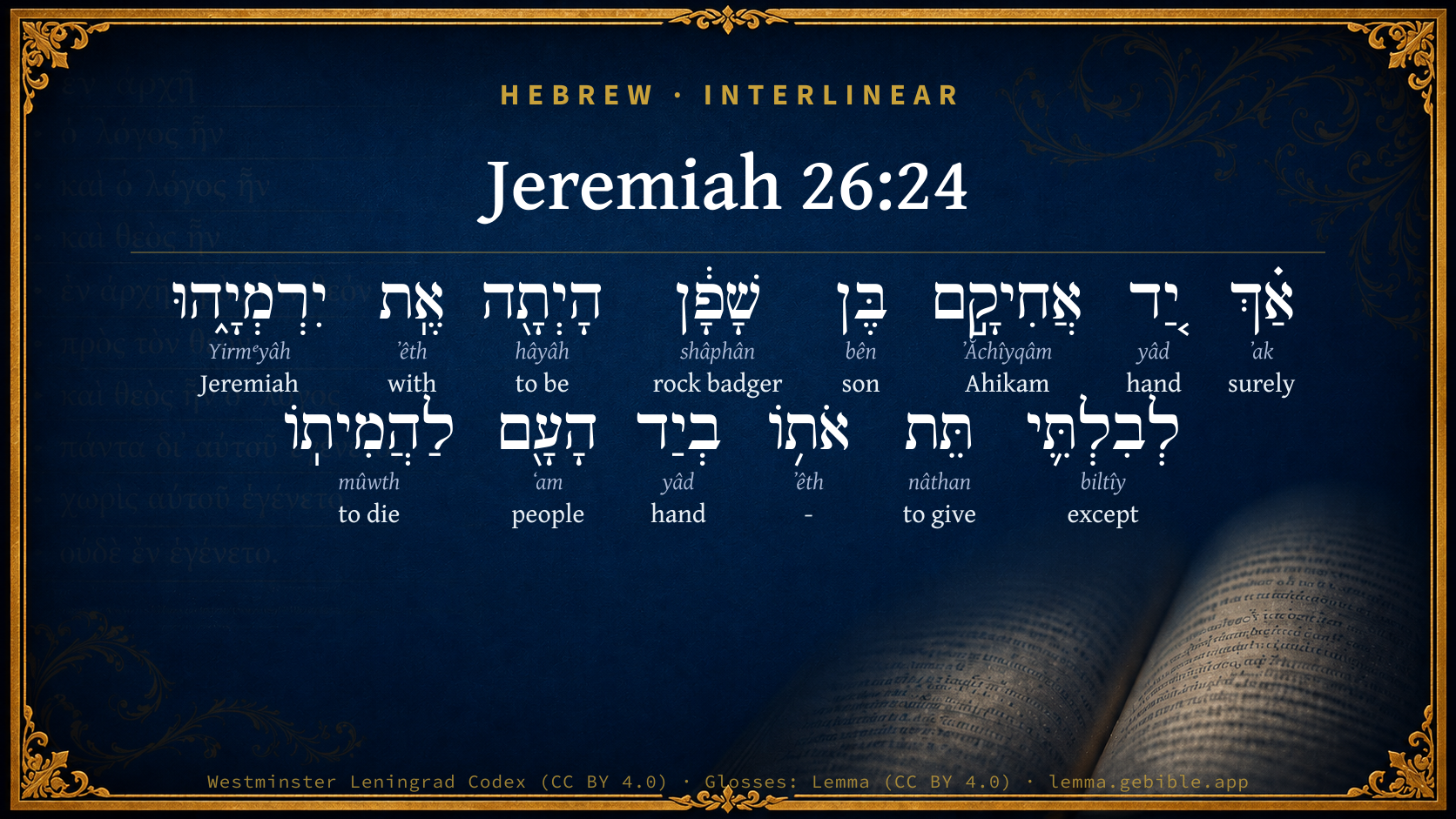
Hebrew (Westminster Leningrad Codex) Jeremiah 26:24 appears in the Hebrew Old Testament. The text above is from the Westminster Leningrad Codex. Each word links to its Strong’s number, a concise gloss, and parsing drawn from the Open Scriptures Hebrew Bible morphology. Click any word for its full Brown-Driver-Briggs (BDB) entry.
Download image
Cite this verse

Jeremiah 26:24 (World English Bible). Public Domain. Lemma interlinear Bible study tool, https://lemma.gebible.app/v/jeremiah/26/24.

Show BibTeX & RIS
BibTeX
RIS
English Translation
But the hand of Ahikam the son of Shaphan was with Jeremiah, that they should not give him into the hand of the people to put him to death.
World English Bible · Public Domain
Download a study sheet

One document with this verse’s original text, its word-by-word gloss line, the meaning frame, cross-references with their text, attributed commentary, and full source and license credits — printable, and it pastes into notes with its structure intact.

This verse Autodidact and up

Study sheet (.html) Plain text (.txt)

A passage Seminary Student

Up to 50 verses in one chapter. A passage sheet keeps up to 6 commentary sources and 12 cross-references per verse, in the order this page ranks them, and says so on the sheet whenever that leaves anything out. Ask for a single verse and you get the Autodidact verse sheet above.

Everything on this page stays free to read, with no account — the sheet is a download of what is already on screen, not access to it.

Want to remove ads? Support Godless Engineer
Compare translations 3

The same verse in 3 English versions, stacked beneath the original-language interlinear above. Click any original word for its lexicon entry.

Each is an independent rendering of the whole verse — the interlinear is not word-aligned to these translations.

Highlighted words mark where these versions differ — a whole-verse word diff, not a word-by-word alignment.

  • World English Bible Public Domain
    But the hand of Ahikam the son of Shaphan was with Jeremiah, that they should not give him into the hand of the people to put him to death.
  • King James Version Public Domain
    Nevertheless the hand of Ahikam the son of Shaphan was with Jeremiah, that they should not give him into the hand of the people to put him to death.
  • unfoldingWord Literal Text CC BY-SA 4.0
    However, the hand of Ahikam son of Shaphan was with Jeremiah, so as not to give him into the hand of the people to put him to death.

unfoldingWord Literal Text — © unfoldingWord, licensed CC BY-SA 4.0. Word-aligned USFM3 via Door43 (git.door43.org/unfoldingWord/en_ult).

Versions to compare (up to 4)

3 of 4 selected

Show all 18 translations

Every available English version of this verse, each an independent rendering of the whole verse.

  • World English Bible Public Domain
    But the hand of Ahikam the son of Shaphan was with Jeremiah, that they should not give him into the hand of the people to put him to death.
  • Berean Standard Bible Public Domain
    Nevertheless, Ahikam son of Shaphan supported Jeremiah, so he was not handed over to the people to be put to death.
  • Majority Standard Bible Public Domain
    Nevertheless, Ahikam son of Shaphan supported Jeremiah, so he was not handed over to the people to be put to death.
  • King James Version Public Domain
    Nevertheless the hand of Ahikam the son of Shaphan was with Jeremiah, that they should not give him into the hand of the people to put him to death.
  • American Standard Version (1901) Public Domain
    But the hand of Ahikam the son of Shaphan was with Jeremiah, that they should not give him into the hand of the people to put him to death.
  • Revised Version (1885) Public Domain
    But the hand of Ahikam the son of Shaphan was with Jeremiah, that they should not give him into the hand of the people to put him to death.
  • Geneva Bible (1599) Public Domain
    But the hande of Ahikam the sonne of Shaphan was with Ieremiah that they shoulde not giue him into the hande of the people to put him to death.
  • Douay-Rheims (1899) Public Domain
    So the hand of Ahicam the son of Saphan was with Jeremias, that he should not be delivered into the hands of the people, to put him to death.
  • Young's Literal Translation Public Domain
    Only, the hand of Ahikam son of Shaphan hath been with Jeremiah so as not to give him up into the hand of the people to put him to death.
  • Literal Standard Version CC BY-SA 4.0
    Only, the hand of Ahikam son of Shaphan has been with Jeremiah so as not to give him up into the hand of the people to put him to death.
  • Unlocked Literal Bible CC BY-SA 4.0
    But the hand of Ahikam son of Shaphan was with Jeremiah, so he was not given into the hand of the people to be put to death.
  • unfoldingWord Literal Text CC BY-SA 4.0
    However, the hand of Ahikam son of Shaphan was with Jeremiah, so as not to give him into the hand of the people to put him to death.
  • Darby Bible Public Domain
    -- Nevertheless the hand of Ahikam the son of Shaphan was with Jeremiah, that they should not give him into the hand of the people to put him to death.
  • World Messianic Bible Public Domain
    But the hand of Ahikam the son of Shaphan was with Jeremiah, so that they didn’t give him into the hand of the people to put him to death.
  • Webster's Bible Public Domain
    Nevertheless the hand of Ahikam the son of Shaphan was with Jeremiah, that they should not give him into the hand of the people to put him to death.
  • Free Bible Version CC BY-SA 4.0
    However, Ahikam, son of Shaphan, took Jeremiah's side so he was not handed over to the people to be killed.
  • Bible in Basic English Public Domain
    But Ahikam, the son of Shaphan, gave Jeremiah his help, so that he was not given into the hands of the people to be put to death.
  • JPS Tanakh (1917) Public Domain
    Nevertheless the hand of Ahikam the son of Shaphan was with Jeremiah, that they should not give him into the hand of the people to put him to death.

Literal Standard Version (2020), Covenant Press — licensed CC BY-SA 4.0. Text via the HelloAO Bible API (eBible.org). Unlocked Literal Bible (unfoldingWord) — licensed CC BY-SA 4.0. Text via the HelloAO Bible API (eBible.org). unfoldingWord Literal Text — © unfoldingWord, licensed CC BY-SA 4.0. Word-aligned USFM3 via Door43 (git.door43.org/unfoldingWord/en_ult). Free Bible Version, Dr. Jonathan Gallagher — licensed CC BY-SA 4.0. Text via the HelloAO Bible API (eBible.org).

Word by word

More ways to search: Search by grammar → Find every occurrence → Compare this word →

Practice this passage: Drill this verse → Learn its vocabulary →

אֲחִיקָ֣ם
ʼĂchîyqâm
H296
“Ahikam”
Noun, Proper
Part of Speech
Noun
Type
Proper
Full BDB Definition

Origin: from H251 and H6965

TWOT: None

Ahikam = "my brother has risen (arisen)" - son of Shaphan, an officer in Josiah's reign - protector of Jeremiah - father of Gedaliah
  1. אַ֗ךְ ʼak H389 “surely” Particle, Accusative
  2. יַ֚ד yâd H3027 “hand of” Noun, Common, Both, Singular, Construct
  3. בֶּן bên H1121 “son of” Noun, Common, Masculine, Singular, Construct
  4. שָׁפָ֔ן shâphân H8227 “rock badger” Noun, Proper
  5. הָיְתָ֖ה hâyâh H1961 “to be” Verb, Qal, Perfect, 3rd Person, Feminine, Singular
  6. אֶֽת ʼêth H854 “with” Preposition
  7. יִרְמְיָ֑הוּ Yirmᵉyâh H3414 “Jeremiah” Noun, Proper
  8. לְבִלְתִּ֛י biltîy H1115 “to/for · except” Preposition + Conjunction
  9. תֵּת nâthan H5414 “to give” Verb, Qal, Infinitive Construct
  10. אֹת֥וֹ ʼêth H853 “- · him” Particle, Direct Object + Suffix, Personal, 3rd Person, Masculine, Singular
  11. בְיַד yâd H3027 “in/at · hand of” Preposition + Noun, Common, Both, Singular, Construct
  12. הָעָ֖ם ʻam H5971 “the · people” Particle, Definite Article + Noun, Common, Masculine, Singular, Absolute
  13. לַהֲמִיתֽוֹ mûwth H4191 “to die · him” Preposition + Verb, Hiphil, Infinitive Construct + Suffix, Personal, 3rd Person, Masculine, Singular

About this verse

These counts appear in no published source. They are computed here, from the morphology-tagged text and Lemma’s own curated glosses. What Lemma adds →

14
words
13
distinct lemmas
Prophets
section

Notable vocabulary

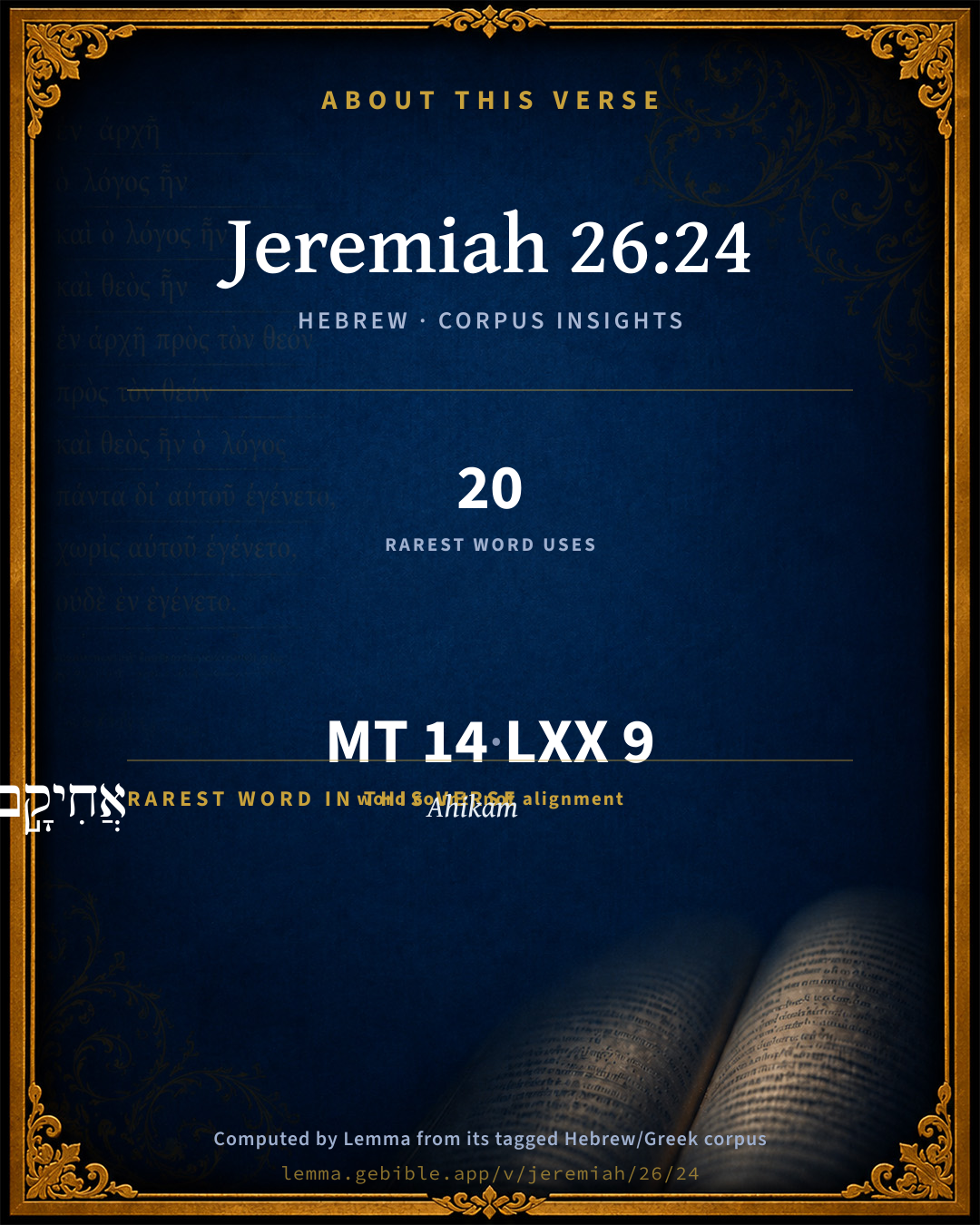
The rarest word here is אֲחִיקָ֣ם Ahikam H296 — appearing just 20 times in the whole Hebrew Bible.

Shared distinctive vocabulary

אֲחִיקָ֣ם Ahikam H296 occurs in 20 verses of the Hebrew Bible. Also found in:

Grammatical profile

  • 3 verbs
  • 7 nouns
  • 1 preposition
  • 1 conjunction
  • 2 particles

Verb forms

  • הָיְתָ֖ה Qal · Perfect
  • תֵּת Qal · Infinitive Construct
  • לַהֲמִיתֽוֹ Hiphil · Infinitive Construct

Repetition

A word recurs within this verse — often emphatic in Hebrew:

  • יַ֚ד hand H3027 ×2

Hebrew & Septuagint length

In the original languages it is 14 Hebrew tokens and 9 Greek tokens — but the two are counted differently (Hebrew bundles its prefixes and suffixes into one token; the Greek is in lemma form), so that isn’t a like-for-like length.

Cross-references

14

Topical passages linked to Jeremiah 26:24 in the Treasury of Scripture Knowledge — connected by theme and wording, ordered by reader-vote popularity; previews shown in the World English Bible.

  • 1 Kings 18:4 for it was so, when Jezebel cut off the prophets of Yahweh, that Obadiah took one hundred prophets, and hid them by fifty in a cave, and fed them with bread and water.)
  • 2 Kings 22:12–14 The king commanded Hilkiah the priest, and Ahikam the son of Shaphan, and Achbor the son of Micaiah, and Shaphan the scribe, and Asaiah the king's servant, saying,
  • Jeremiah 1:18–19 For, behold, I have made you this day a fortified city, and an iron pillar, and brazen walls, against the whole land, against the kings of Judah, against the princes of it, against the priests of it, and against the people of the land.
  • Jeremiah 39:14 they sent, and took Jeremiah out of the court of the guard, and committed him to Gedaliah the son of Ahikam, the son of Shaphan, that he should carry him home: so he lived among the people.
  • Jeremiah 40:5–7 Now while he was not yet gone back, Go back then, [said he], to Gedaliah the son of Ahikam, the son of Shaphan, whom the king of Babylon has made governor over the cities of Judah, and dwell with him among the people; or go wherever it seems right to you to go. So the captain of the guard gave him food and a present, and let him go.
  • 2 Kings 25:22 As for the people who were left in the land of Judah, whom Nebuchadnezzar king of Babylon had left, even over them he made Gedaliah the son of Ahikam, the son of Shaphan, governor.
  • 2 Chronicles 34:20 The king commanded Hilkiah, and Ahikam the son of Shaphan, and Abdon the son of Micah, and Shaphan the scribe, and Asaiah the king's servant, saying,
  • Isaiah 37:32–33 For out of Jerusalem shall go forth a remnant, and out of Mount Zion those who shall escape. The zeal of Yahweh of Hosts will perform this.
  • Jeremiah 15:15–21 Yahweh, you know; remember me, and visit me, and avenge me of my persecutors; don't take me away in your longsuffering: know that for your sake I have suffered reproach.
  • Acts 23:10 When a great argument arose, the commanding officer, fearing that Paul would be torn in pieces by them, commanded the soldiers to go down and take him by force from among them, and bring him into the barracks.
  • Acts 23:20–35 He said, "The Jews have agreed to ask you to bring Paul down to the council tomorrow, as though intending to inquire somewhat more accurately concerning him.
  • Acts 25:3–4 asking a favor against him, that he would summon him to Jerusalem; plotting to kill him on the way.
  • Acts 27:43 But the centurion, desiring to save Paul, stopped them from their purpose, and commanded that those who could swim should throw themselves overboard first to go toward the land;
  • Revelation 12:16 The earth helped the woman, and the earth opened its mouth and swallowed up the river which the dragon spewed out of his mouth.

Cross-references courtesy of OpenBible.info (CC BY 4.0).

Hebrew and Greek witnesses Masoretic Hebrew ↔ Greek Septuagint

The same verse in the two great witnesses to the Old Testament, shown verse-for-verse.

These are two independent witnesses, not word-aligned to each other, and the Septuagint is shown in lemma (dictionary) form.

Hebrew Jeremiah 26:24 Masoretic · Westminster Leningrad Codex

אַ֗ךְ יַ֚ד אֲחִיקָ֣ם בֶּן שָׁפָ֔ן הָיְתָ֖ה אֶֽת יִרְמְיָ֑הוּ לְבִלְתִּ֛י תֵּת אֹת֥וֹ בְיַד הָעָ֖ם לַהֲמִיתֽוֹ

But the hand of Ahikam the son of Shaphan was with Jeremiah, that they should not give him into the hand of the people to put him to death.

World English Bible · Public Domain

Greek LXX Structure differs

In the Septuagint, Jeremiah is about an eighth shorter than the Hebrew and arranges its material differently — the Oracles Against the Nations (Hebrew chapters 46–51) appear in the middle of the Greek book, after 25:13. Because the chapter and verse boundaries do not line up, a verse-for-verse comparison with the Hebrew is not shown.

A verse-for-verse comparison isn’t shown here because the chapters and verses don’t line up. Switch to the LXX edition with the MT / LXX toggle above to read the Greek directly.

Hebrew: Westminster Leningrad Codex (CC BY 4.0). Greek: Septuagint (public domain); English from a public-domain English Septuagint. How the Septuagint differs from the Hebrew →

Targum (Aramaic paraphrase)

1

The Targum is the ancient Jewish Aramaic paraphrase of the Hebrew Scriptures — an interpretive translation, not the Hebrew text itself. Onkelos (literal) and Pseudo-Jonathan (expansive) render the Torah, and Jonathan the Prophets. Coverage is partial: where no permissively-licensed English translation exists for a verse, only the Aramaic is shown. This is verse-level text, not a word-by-word alignment to the Hebrew.

  1. Targum Jonathan Prophets (Joshua–Malachi)
    בְּרַם יַד אֲחִיקָם בַּר שָׁפָן הֲוָת עִם יִרְמְיָה בְּדִיל דְלָא לְמִמְסַר יָתֵיהּ בִּידָא דְעַמָא לְמִקְטְלֵיהּ:

    (no public-domain English translation for this verse)

    Targum Jonathan — Aramaic: “Mikraot Gedolot” (public domain). English: “Sefaria Community Translation” (CC0 1.0 (public-domain dedication)); “London "Chaldee Paraphrase," 1871” (public domain). Text via Sefaria.

Commentary

Notes on Jeremiah 26:24 from classic Christian and Jewish commentators (each source and its license shown beneath its notes). The classic Christian expositions comment on the surrounding passage and are grouped to its opening verse, so a note may address several verses; the Jewish commentaries on the Tanakh (Rashi and others) are per-verse, so they appear only where the commentator wrote on this verse.

Lemma curates 59 commentaries, every one of them public domain or Creative Commons licensed, each selected and text-cleaned for this edition rather than reprinted as found. About our sources →

Trapp's Complete Commentary

John Trapp

Jer 26:24 Nevertheless the hand of Ahikam the son of Shaphan was with Jeremiah, that they should not give him into the hand of the people to put him to death.

Ver. 24. Nevertheless the hand of Ahikam.] Who had been one of Josiah’s counsellors. {2Ki 22:12} By this man’s authority and help Jeremiah was delivered, and God rewarded him in his son Gedaliah, made governor of the land. {2Ki 25:22}

John Trapp, A Commentary or Exposition upon All the Books of the Old and New Testament (1647–1656) — public domain. Text from a community e-Sword module.

Joseph Benson's Commentary

Jer 26:24. Nevertheless, the hand of Ahikam, &c., was with Jeremiah — Both he and his father Shaphan were chief ministers under Josiah, 2Ki 22:12-14. And the brothers of Ahikam, Gemariah, Elasah, and Jaazaniah were considerable men in those days, with Ahikam, and members of the great council; Jer 29:3; Eze 8:11. So Ahikam made use of his interest with them to deliver Jeremiah from the danger that threatened him. Thus God wonderfully preserved Jeremiah, though he did not flee as Urijah did, but stood his ground. Ordinary ministers may use ordinary means, provided they be lawful ones, for their preservation; but they that have an extraordinary mission may expect an extraordinary protection.

Joseph Benson's Commentary on the Old and New Testaments (1811–1818) — public domain. Text from a community e-Sword module.

Tyndale Open Study Notes

Tyndale Open Resources

26:24 Ahikam had served under King Josiah (2 Kgs 22:12-14).

Tyndale Open Study Notes — © Tyndale Open Resources, licensed CC BY-SA 4.0. Text via the HelloAO Bible API.

Geneva Bible (1599)

Geneva Bible translators

Which declareth that nothing could have appeased their fury, if God had not moved this noble man to stand valiantly in his defense.

Geneva Bible (1599) marginal notes — public domain. Text via Bolls.life.

Jamieson, Fausset & Brown

Robert Jamieson, A. R. Fausset & David Brown

Ahikam--son of Shaphan the scribe, or royal secretary. He was one of those whom King Josiah, when struck by the words of the book of the law, sent to inquire of the Lord (Kg2 22:12, Kg2 22:14). Hence his interference here in behalf of Jeremiah is what we should expect from his past association with that good king. His son, Gedaliah, followed in his father's steps, so that he was chosen by the Babylonians as the one to whom they committed Jeremiah for safety after taking Jerusalem, and on whose loyalty they could depend in setting him over the remnant of the people in Judea (Jer 39:14; Kg2 25:22).

people to put him to death--Princes often, when they want to destroy a good man, prefer it to be done by a popular tumult rather than by their own order, so as to reap the fruit of the crime without odium to themselves (Mat 27:20).

Next: Jeremiah Chapter 27

Jamieson, Fausset & Brown — Commentary Critical and Explanatory on the Whole Bible (1871) — public domain (CC PDM 1.0). Text via the HelloAO Bible API.

Adam Clarke's Commentary

Verse 24. The hand of Ahikam - was with Jeremiah] And it was probably by his influence that Jeremiah did not share the same fate with Urijah. The Ahikam mentioned here was probably the father of Gedaliah, who, after the capture of Jerusalem, was appointed governor of the country by Nebuchadnezzar, Jer 40:5. Of the Prophet Urijah, whether he was true or false, we know nothing but what we learn from this place.

That they should not give him into the hand of the people] Though acquitted in the supreme court, he was not out of danger; there was a popular prejudice against him, and it is likely that Ahikam was obliged to conceal him, that they might not put him to death. The genuine ministers of God have no favour to expect from those who are HIS enemies.

Adam Clarke's Commentary on the Bible (1810–1826) — public domain. Text from a community e-Sword/MySword module.

John Calvin's Commentaries

There is here an adversative particle, and not without reason; for the contention is pointed out which had so raged that it became difficult to extricate the holy Prophet from danger. We hence conclude that Jeremiah was in so much peril that it was with great and arduous effort that Ahikam saved him. There is a frequent mention of this man in sacred history, and his name will hereafter be found in several places, and he was left to govern the remnant of the people after the demolition of the city. (2 Kings 25:22; Jeremiah 39:14.) And there is no doubt but that he made progress in religion and was an upright man, and that his virtues were so valued by Nebuchadnezzar that he bestowed on him such an honor. He was soon afterwards slain by the ungodly and the wicked; but there is nothing related of him but what is honorable to him. It was indeed an extraordinary act of courage that he dared to oppose the fury of the whole people, and to check the priests and the false prophets who had conspired to put the holy man to death.

This is the reason why it is in the last place added, that the hand of Ahikam was with Jeremiah; though the people were furious, and the priests would by no means be restrained from persecuting the holy man, yet Ahikam could not be turned from his holy purpose, but persevered to defend a good cause until Jeremiah escaped in safety. It is hence said, that his hand was with Jeremiah; for by hand in Scripture is meant effort, (conatus;) for where there is anything to be done, or any difficulty, the Scripture uses the word hand But as Ahikam exerted himself to the uttermost, not only in aiding the holy Prophet by his words, but also in repressing the fury of the people, and in boldly resisting the priests and the false prophets, the hand in this place means aid; his hand was with Jeremiah, that is, he aided or helped him, so that he was not delivered up into the hand of the people

It hence also appears, as we said yesterday, that the tumult of the people was not immediately allayed, for the false prophets and the priests had so roused their virulence that they became almost implacable. Here, then, is set before us an example of courage and perseverance; for it is not enough for us to defend a good cause when we may do so with safety, except we also disregard all ill-will and despise all dangers, and resist the fury of the wicked, and undergo contentions and dangers for God’s servants whenever necessary. We are also taught at the same time how much weight belongs to the influence of one man when he boldly defends a good cause and yields not to the madness of the wicked, but risks extremities rather than betray the truth of God and his ministers. Now follows, —

John Calvin's Commentaries (1540-1563) — public domain. Text from the Calvin Translation Society English edition (1840s-50s) via the Christian Classics Ethereal Library (ccel.org). Calvin's coverage is partial (roughly two-thirds of the Bible); uncommented books and verses are honest gaps, never fabricated. The 19th-century editor's footnotes and remarks are omitted so the notes are faithfully Calvin's own voice.

Ellicott's Commentary for English Readers

(24) Nevertheless the hand of Ahikam . . .—The family to whom the prophet’s protector belonged played a conspicuous part in the history of this period, and may be said to have furnished examples of three generations of Jewish patriotism. Shaphan, the father, was prominent as a scribe in the reformation of Josiah (cir. A.D. 624). He superintended the restoration of the Temple (2Ch_34:8). To him Hilkiah the priest gave the book of the Law which had been found in the house of the Lord, and Shaphan took it to the king. He took his son Ahikam with him when he was sent to consult the prophetess Huldah (2Ki_22:12; 2Ch_34:20). Here the son meets us, true to the early lessons of his life, as the protector of the prophet, whose work rested so largely on the impression made by the Book of the Law thus discovered. A brother of Ahikam, Gemariah, appears in a like character in Jer_36:12; Jer_36:25. After the conquest of the land by Nebuchadnezzar, Jeremiah finds refuge with Gedaliah, the son of Ahikam (Jer_40:6), who had been made, apparently through the prophet’s influence, satrap, or governor, of the lands under the Chaldæan king; and he, after a fruitless warning, falls a victim to the conspiracy of the princes of the royal house (Jer_41:1-2). Here stress is laid on the fact of Ahikam’s protection, as showing how it was that Jeremiah escaped the fate which fell on Urijah.

A Bible Commentary for English Readers, edited by Charles John Ellicott (1878–1897) — public domain. Text from a community e-Sword module.

The Cambridge Bible for Schools and Colleges

gen. ed. J. J. S. Perowne

24. Ahikam the son of Shaphan] He was one of the five sent by Josiah (2Ki_22:12) to consult Huldah. His son Gedaliah, as governor of the land (Jer_39:14, Jer_40:5), stood the prophet’s friend subsequently. It was in the chamber of another son of Shaphan, Gemariah, that Baruch read Jeremiah’s Roll in the ears of the people (Jer_36:12).

The exact connexion of this v. with the rest of the story is not clear. It may refer back to the outburst of popular indignation mentioned in Jer_26:8, and so may mean that, in contrast to Uriah’s fate, Jeremiah was on this occasion saved by Ahikam.

The Cambridge Bible for Schools and Colleges (gen. ed. J. J. S. Perowne; Cambridge University Press, 1878–1918) — public domain. Text from a community e-Sword module.

John Gill's Exposition

Nevertheless, the hand of Ahikam the son of Shaphan was with Jeremiah,.... Though this instance was urged as a precedent to go by, being lately done; or though the king's cruelty had been so lately exercised in such a manner; yet this man, who had been one of Josiah's courtiers and counsellors, Kg2 22:12; stood by Jeremiah, and used all his power, authority, and influence, in his favour:

that they should not give him into the hand of the people, to put him to death; that the sanhedrim should not; who, by the last precedent mentioned, might seem inclined to it; but this great man, having several brothers, as well as other friends, that paid a regard to his arguments and solicitations; he prevailed upon them not to give leave to the people to put him to death, who appear to have been very fickle and mutable; at first they joined with the priests and false prophets against Jeremiah, to accuse him; but upon the judgment and vote of the princes, on hearing the cause, they changed their sentiments, and were for the prophet against the priests; and now, very probably, upon the instance of Urijah being given as a precedent, they altered their minds again, and were for putting him to death, could they have obtained leave of the court; and which only Ahikam's interest prevented.

Next: Jeremiah Chapter 27

John Gill's Exposition of the Whole Bible (1746–1763) — public domain (CC PDM 1.0). Text via the HelloAO Bible API.

Albert Barnes' Notes on the Bible

Ahikam - See the marginal reference. His son Gemariah lent Jeremiah his room for the public reading of Jehoiakim’s scroll, and another son Gedaliah was made governor of the land by the Chaldaeans Jer 39:14; the family probably shared the political views of Jeremiah.

Albert Barnes' Notes on the Bible (1834–1885) — public domain. Text from a community e-Sword/MySword module.

Haydock's Catholic Bible Commentary

Ahicam. A man employed under Josias, (4 Kings xxii. 12.) and father of Godolias, who was also the protector of Jeremias, chap. xxxix. 14., and 4 Kings xxv. 22. (Calmet)

George Leo Haydock (1774–1849), Haydock's Catholic Family Bible and Commentary, 1859 edition — public domain. Excludes Psalms (Douay-Rheims chapter numbering differs from Protestant) and Deuterocanonical books (Catholic canon only).

Matthew Poole's English Annotations

Though Jeremiah’s enemies pleaded this instance of Urijah, which had this advantage of the other, because it was matter of fact done lately, and a case judged in this very king’s reign; yet the hand, that is, the power and interest, of one

Ahikam, who, as appears from 2Ki 22:12, was one of Josiah’s counsellors, and the father of Gedaliah, Jer 39:14, who upon the taking of the city was made governor, Jer 40:5,

was with Jeremiah. So as, through the good providence of God, Jeremiah was not delivered into the hands of the people, some of whom were mutable, and malicious enough, ready to do any thing the priests put them upon. And the after-advancement of the son of this Ahikam to be governor of Judah may justly be interpreted a reward in this life, which God gave him for his kindness to his prophet.

Matthew Poole's English Annotations on the Holy Bible (1683–1685) — public domain. Text from a community e-Sword/MySword module.

Whedon's Commentary on the Bible

Daniel D. Whedon

24. Hand of Ahikam — The implication of this verse would seem to be, that had not Jeremiah been especially protected by a man of influence and power he would have shared a similar fate with Urijah.

Daniel D. Whedon (gen. ed.), Commentary on the Old and New Testaments (1874–1909) — public domain. Text from a community e-Sword module.

The Pulpit Commentary

Nevertheless the hand of Ahi-kant, etc.; i.e. in spite of the prepossession against prophets like Jeremiah which this incident reveals, Ahikam threw all his influence into the scale of toleration." The same Ahikam is mentioned in circumstances which reflect credit on his religion in 2Ki_22:12-14. One of his sons, Gemariah, lent Baruch his official room for the reading of the prophecies of Jeremiah; (Jer_36:10) another was the well-known Gedaliah, who became governor of Judah after the fall of Jerusalem, and who was himself friendly to Jeremiah. (Jer_39:14 Jer_40:5)

A friend in need.

Ahikam proves himself to be a true friend to Jeremiah by standing by him in the hour of danger. He is not like Joseph of Arimathaea, who was unheard of till he came and begged the dead body of his Lord. When the danger was greatest, he first made himself known on the side of the prophet.

I HE WAS JUST. Jeremiah had been maligned. But Ahikam knew him to be innocent. To have allowed him to perish would have involved complicity in the murder of the prophet. Yet how many would have washed their hands and contented themselves with taking no active part in a public crime! It is not enough to refrain from joining in an injustice; duty requires us to resist it.

II HE WAS INDEPENDENT. Jeremiah was unpopular. Though the unanswerable truthfulness of his defense secured him a verdict of acquittal at the regular trial, there can be no doubt that his life was in imminent peril from unscrupulous conspirators, now that the general sentiment was against him. It is a proof of staunch fidelity to stand by a man when he is unpopular. There is little merit in showing friendship for men who are fawned upon by fashion.

III HE WAS COURAGEOUS. He could only defend Jeremiah at the peril of his own life. By siding with the prophet he allowed his name to be associated with all that was disliked and feared in the persecuted man, and he must have known this. For a person in high station to come out in this way by himself and defend a solitary, persecuted man required no little boldness.

IV HE WAS USEFUL. Ahikam could not prophesy; but he could save a prophet"s life. Possibly but for him Jeremiah"s mission would have been cut short. To him, therefore, we owe the possibility of all the remainder of the great prophet"s work. It is noteworthy that Ahikam had shown respect for the prophetic order before this, when, with his father and others, he went on an important mission from King Josiah to consult the prophetess Huldah. (2Ki_22:12-14) Many a man who can do little directly may be the means of securing immense good by fostering and furthering the work of others. It would be happy for us to think less of our own prominence and more of the accomplishment of God"s will, no matter who may be the honored instrument. We may look beyond the human friend and see the hand of Providence in this deliverance of the prophet. God raises up helpers when we least look for them. Among all the blessings of life none should command more thankfulness to God than the gift of good friends.

Help raised up for God"s servants in times of peril.

I OF WHAT SORT IT IS.

1. Unexpected.

2. Opportune.

3. Effective.

4. Not what man would choose.

II WHAT IT TEACHES US.

1. The infinite resources of God.

2. The weakness of evil.

3. Those who will not willingly obey God are made to serve him unwillingly.

4. God chooses his own way of dealing with his servants and his truth. M.

A friend in need.

I THE EVIDENT PERIL OF JEREMIAH. A large Body of the people had been somehow influenced to take his side, but how long their favorable mood of mind might continue, who could tell? There was no Hezekiah on the throne to encourage such a feeling and make it permanent. Moreover, there is an ebullition of fury which is fatal to one who, as far as the record enables us to judge, occupied a far less prominent position than Jeremiah. If Urijah was slain, how could Jeremiah hope to escape? We must try to get a distinct impression of all the peril in which Jeremiah was in order to appreciate the services rendered to him by Ahikam.

II THE TIMELY HELP OF AHIKAM. Nothing is told us save the bare fact of protection, We must not assume that Ahikam was fully in sympathy with Jeremiah. We have no means of judging as to his character and his motives, as to the risks that he ran, and the ultimate results to him. The one clear thing is that at this time he was a man of power, and was for some reason disposed to shield the prophet. It may be that, if we could lay bare and analyze his motives, they would be found very mixed as to their kind. But, whatever the motives, the practical service was the same. Jehovah could, of course, have protected his servant by supernatural means, but it is his principle of working not to employ the supernatural when the natural would serve the purpose. Hezekiah could do more than Ahikam, seeing that he turned to God and kept hack the dreadful visitations. But Ahikam did all that was necessary for the present occasion. Compare the position of Ahikam here with that of the Duke of Lancaster towards Wickliffe and the Lollards. Y.

The Pulpit Commentary (1880–1919), ed. H.D.M. Spence-Jones & Joseph S. Exell — public domain. Text from a community e-Sword module.

John Wesley's Explanatory Notes

Nevertheless - Tho' Jeremiah's enemies pleaded this instance of Urijah, a case judged in this very king's reign; yet the hand, that is, the power and interest of Ahikam, one of Josiah's counsellors, and the father of Gedaliah, was with Jeremiah.

John Wesley, Explanatory Notes Upon the Whole Bible (1754–1765) — public domain. Text via the GEBible commentary corpus.

Keil & Delitzsch

C. F. Keil & F. Delitzsch

The narrative closes with a remark as to how, amid such hostility against the prophets of God on the part of king and people, Jeremiah escaped death. This was because the hand of Ahikam the son of Shaphan was with him. This person is named in Kg2 22:12, Kg2 22:14, as one of the great men sent by King Josiah to the prophetess Hulda to inquire of her concerning the book of the law recently discovered. According to Jer 39:14; Jer 40:5, etc., he was the father of the future Chaldean governor Gedaliah.

Keil & Delitzsch — Biblical Commentary on the Old Testament (1861–1891) — public domain (CC PDM 1.0). Text via the HelloAO Bible API. (Old Testament only.)

Lesson kit

Teaching starters — assembled from the data on this page, not authored interpretation. Every prompt links to the verse data it draws on. Edit before teaching.

Jeremiah, in the Prophets, opens this verse with 14 words (13 distinct Hebrew lemmas). Its most distinctive word is ʼĂchîyqâm (“Ahikam”). A historical commentator’s framing appears above. Read the whole chapter for the surrounding context.

Discussion questions

  1. How does “Ahikam” (ʼĂchîyqâm) shape what this verse is saying?
  2. How does 2 Kings 22:12, which shares the word «Ahikam», read alongside this verse?
  3. What does the repetition of “hand” (2× in this one verse) do in this verse?
  4. These translations render this verse differently. What is at stake in choosing one wording over another?
  5. «הָיְתָ֖ה» is a Qal Perfect verb. How does that grammatical form shape the action described?
  6. Compare how Trapp's Complete Commentary and Joseph Benson's Commentary read this verse. Where do they agree or differ?

Things to notice

Reading settings

Reading text

Shown beneath each verse's original-language words.

Old Testament
Old Testament edition

Read the OT as the Masoretic Hebrew (MT) or the Greek Septuagint (LXX).

English shown for the Greek Septuagint (in the Hebrew ↔ Greek comparison).

Comparing translations? Open the Compare panel on any verse page to stack up to four side by side.