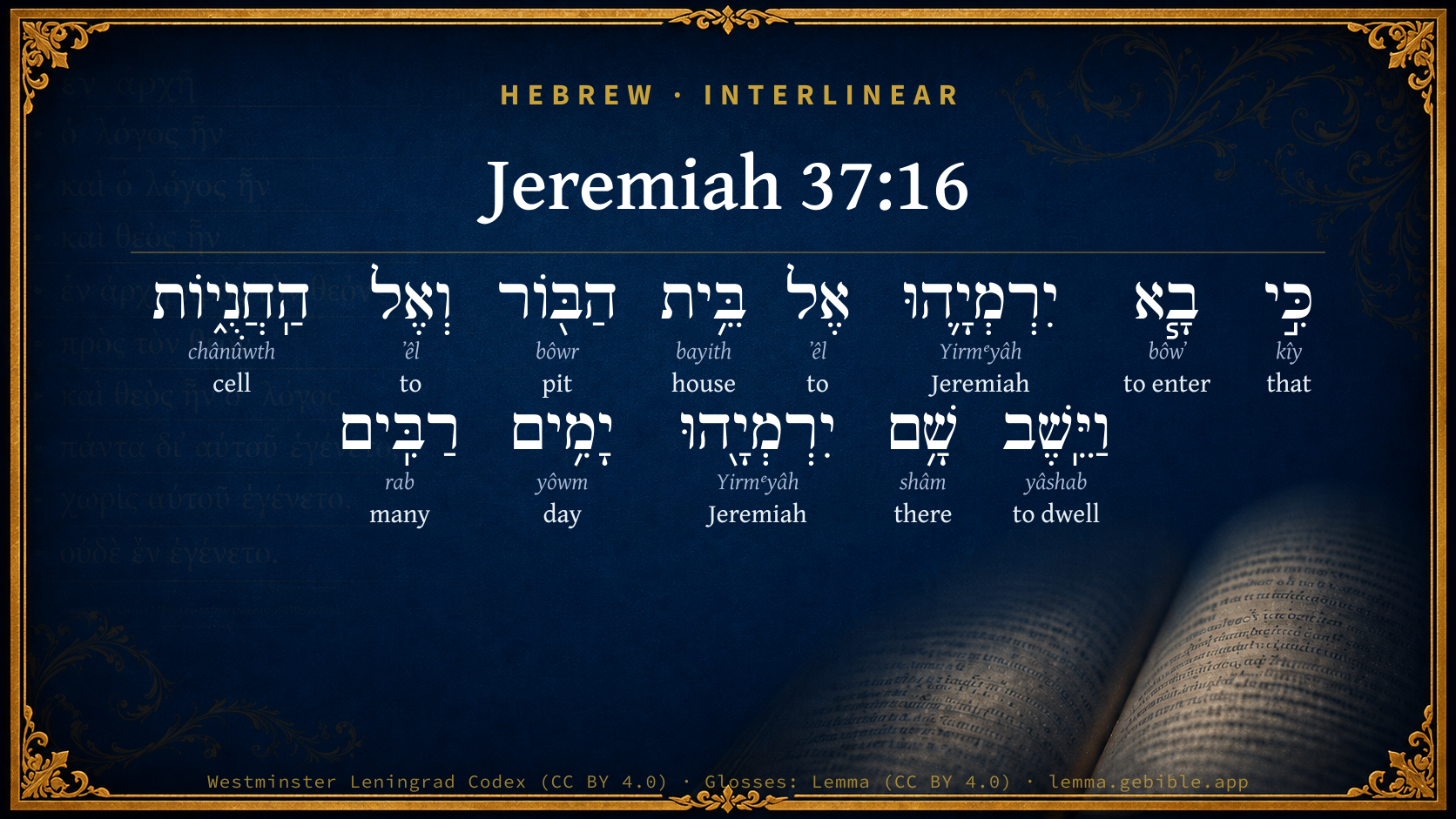
Jeremiah 37:16

Hebrew (Westminster Leningrad Codex) Jeremiah 37:16 appears in the Hebrew Old Testament. The text above is from the Westminster Leningrad Codex. Each word links to its Strong’s number, a concise gloss, and parsing drawn from the Open Scriptures Hebrew Bible morphology. Click any word for its full Brown-Driver-Briggs (BDB) entry.
Download image
Cite this verse

Jeremiah 37:16 (World English Bible). Public Domain. Lemma interlinear Bible study tool, https://lemma.gebible.app/v/jeremiah/37/16.

Show BibTeX & RIS
BibTeX
RIS
English Translation
When Jeremiah was come into the dungeon-house, and into the cells, and Jeremiah had remained there many days;
World English Bible · Public Domain
Highlights
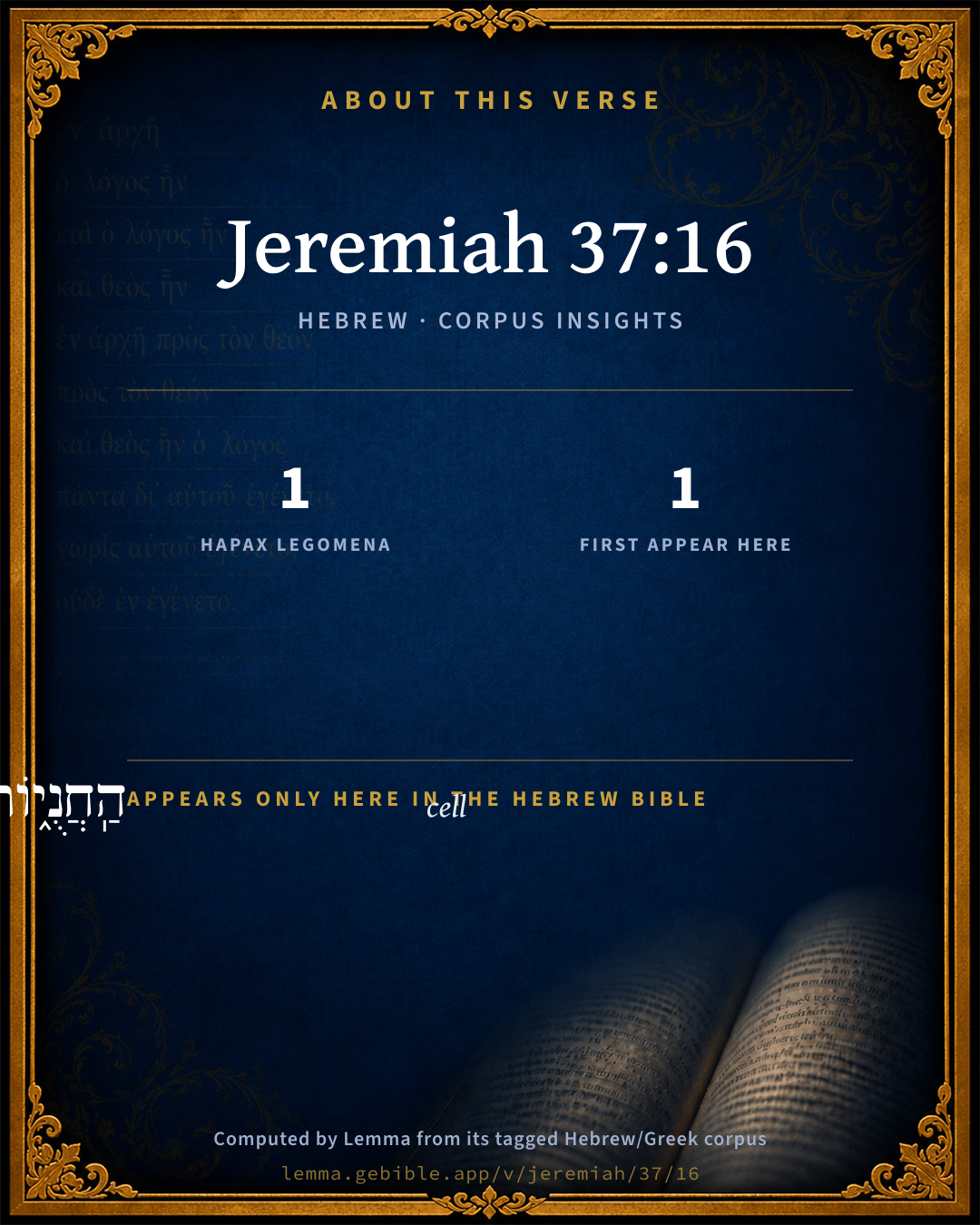
  • 1 hapax legomenon — only here in the Hebrew Bible
  • 1 first appearance in the Hebrew Bible
Full analysis ↓
Download a study sheet

One document with this verse’s original text, its word-by-word gloss line, the meaning frame, cross-references with their text, attributed commentary, and full source and license credits — printable, and it pastes into notes with its structure intact.

This verse Autodidact and up

Study sheet (.html) Plain text (.txt)

A passage Seminary Student

Up to 50 verses in one chapter. A passage sheet keeps up to 6 commentary sources and 12 cross-references per verse, in the order this page ranks them, and says so on the sheet whenever that leaves anything out. Ask for a single verse and you get the Autodidact verse sheet above.

Everything on this page stays free to read, with no account — the sheet is a download of what is already on screen, not access to it.

Want to remove ads? Support Godless Engineer
Compare translations 3

The same verse in 3 English versions, stacked beneath the original-language interlinear above. Click any original word for its lexicon entry.

Each is an independent rendering of the whole verse — the interlinear is not word-aligned to these translations.

Highlighted words mark where these versions differ — a whole-verse word diff, not a word-by-word alignment.

  • World English Bible Public Domain
    When Jeremiah was come into the dungeon-house, and into the cells, and Jeremiah had remained there many days;
  • King James Version Public Domain
    When Jeremiah was entered into the dungeon, and into the cabins, and Jeremiah had remained there many days;
  • unfoldingWord Literal Text CC BY-SA 4.0
    So Jeremiah was put into an underground cell, where he stayed for many days.

unfoldingWord Literal Text — © unfoldingWord, licensed CC BY-SA 4.0. Word-aligned USFM3 via Door43 (git.door43.org/unfoldingWord/en_ult).

Versions to compare (up to 4)

3 of 4 selected

Show all 18 translations

Every available English version of this verse, each an independent rendering of the whole verse.

  • World English Bible Public Domain
    When Jeremiah was come into the dungeon-house, and into the cells, and Jeremiah had remained there many days;
  • Berean Standard Bible Public Domain
    So Jeremiah went into a cell in the dungeon and remained there a long time.
  • Majority Standard Bible Public Domain
    So Jeremiah went into a cell in the dungeon and remained there a long time.
  • King James Version Public Domain
    When Jeremiah was entered into the dungeon, and into the cabins, and Jeremiah had remained there many days;
  • American Standard Version (1901) Public Domain
    When Jeremiah was come into the dungeon-house, and into the cells, and Jeremiah had remained there many days;
  • Revised Version (1885) Public Domain
    When Jeremiah was come into the dungeon house, and into the cells, and Jeremiah had remained there many days;
  • Geneva Bible (1599) Public Domain
    When Ieremiah was entred into the dungeon, and into the prisons, and had remained there a long time,
  • Douay-Rheims (1899) Public Domain
    Then Sedecias the king, sending, took him: and asked him secretly in his house, and said: Is there, thinkest thou, any word from the Lord? And Jeremias said: There is. And he said: Thou shalt be delivered into the hands of the king of Babylon.
  • Young's Literal Translation Public Domain
    When Jeremiah hath entered into the house of the dungeon, and unto the cells, then Jeremiah dwelleth there many days,
  • Literal Standard Version CC BY-SA 4.0
    When Jeremiah has entered into the house of the dungeon, and to the cells, then Jeremiah dwells there many days,
  • Unlocked Literal Bible CC BY-SA 4.0
    So Jeremiah was put into an underground cell, where he stayed for many days.
  • unfoldingWord Literal Text CC BY-SA 4.0
    So Jeremiah was put into an underground cell, where he stayed for many days.
  • Darby Bible Public Domain
    When Jeremiah was come into the dungeon and into the vaults, and Jeremiah had remained there many days,
  • World Messianic Bible Public Domain
    When Jeremiah had come into the dungeon house and into the cells, and Jeremiah had remained there many days,
  • Webster's Bible Public Domain
    When Jeremiah had entered into the dungeon, and into the cabins, and Jeremiah had remained there many days;
  • Free Bible Version CC BY-SA 4.0
    Jeremiah was placed in a cell in the underground dungeon and was kept there for a long time.
  • Bible in Basic English Public Domain
    So Jeremiah came into the hole of the prison, under the arches, and was there for a long time.
  • JPS Tanakh (1917) Public Domain
    When Jeremiah was come into the dungeon-house, and into the cells, and Jeremiah had remained there many days;

Literal Standard Version (2020), Covenant Press — licensed CC BY-SA 4.0. Text via the HelloAO Bible API (eBible.org). Unlocked Literal Bible (unfoldingWord) — licensed CC BY-SA 4.0. Text via the HelloAO Bible API (eBible.org). unfoldingWord Literal Text — © unfoldingWord, licensed CC BY-SA 4.0. Word-aligned USFM3 via Door43 (git.door43.org/unfoldingWord/en_ult). Free Bible Version, Dr. Jonathan Gallagher — licensed CC BY-SA 4.0. Text via the HelloAO Bible API (eBible.org).

Word by word

More ways to search: Search by grammar → Find every occurrence → Compare this word →

Practice this passage: Drill this verse → Learn its vocabulary →

הַֽחֲנֻ֑יוֹת
chânûwth
H2588
“the · cells”
Particle, Definite Article + Noun, Common, Feminine, Plural, Absolute
Part of Speech
Particle + Noun
Type
Common
Gender
Feminine
Number
Plural
State
Absolute
Full BDB Definition

Origin: from H2583

TWOT: TWOT- 690a

cell, vaulted room
  1. כִּ֣י kîy H3588 “that” Conjunction
  2. בָ֧א bôwʼ H935 “to enter” Verb, Qal, Perfect, 3rd Person, Masculine, Singular
  3. יִרְמְיָ֛הוּ Yirmᵉyâh H3414 “Jeremiah” Noun, Proper
  4. אֶל ʼêl H413 “to” Preposition
  5. בֵּ֥ית bayith H1004 “house of” Noun, Common, Masculine, Singular, Construct
  6. הַבּ֖וֹר bôwr H953 “the · pit” Particle, Definite Article + Noun, Common, Masculine, Singular, Absolute
  7. וְאֶל ʼêl H413 “and · to” Conjunction + Preposition
  8. וַיֵּֽשֶׁב yâshab H3427 “and · to dwell” Conjunction + Verb, Qal, Sequential Imperfect, 3rd Person, Masculine, Singular
  9. שָׁ֥ם shâm H8033 “there” Adverb
  10. יִרְמְיָ֖הוּ Yirmᵉyâh H3414 “Jeremiah” Noun, Proper
  11. יָמִ֥ים yôwm H3117 “days” Noun, Common, Masculine, Plural, Absolute
  12. רַבִּֽים rab H7227 “many” Adjective, Adjective, Masculine, Plural, Absolute

About this verse

These counts appear in no published source. They are computed here, from the morphology-tagged text and Lemma’s own curated glosses. What Lemma adds →

13
words
11
distinct lemmas
Prophets
section

Notable vocabulary

1 hapax legomenon — a word that appears only here in the entire Hebrew Bible:

  • הַֽחֲנֻ֑יוֹת cell H2588

First appearance in Scripture

This word makes its first canonical appearance in the Hebrew Bible here:

  • הַֽחֲנֻ֑יוֹת cell H2588

Grammatical profile

  • 2 verbs
  • 6 nouns
  • 1 adjective
  • 2 prepositions
  • 1 conjunction
  • 1 adverb

Verb forms

  • בָ֧א Qal · Perfect
  • וַיֵּֽשֶׁב Qal · Sequential Imperfect

Repetition

Words recur within this verse — often emphatic in Hebrew:

  • יִרְמְיָ֛הוּ Jeremiah H3414 ×2
  • אֶל to H413 ×2

Cross-references

5

Topical passages linked to Jeremiah 37:16 in the Treasury of Scripture Knowledge — connected by theme and wording, ordered by reader-vote popularity; previews shown in the World English Bible.

  • Jeremiah 38:6 Then took they Jeremiah, and cast him into the dungeon of Malchijah the king's son, that was in the court of the guard: and they let down Jeremiah with cords. In the dungeon there was no water, but mire; and Jeremiah sank in the mire.
  • Jeremiah 38:10–13 Then the king commanded Ebedmelech the Ethiopian, saying, Take from hence thirty men with you, and take up Jeremiah the prophet out of the dungeon, before he die.
  • Genesis 40:15 For indeed, I was stolen away out of the land of the Hebrews, and here also have I done nothing that they should put me into the dungeon."
  • Lamentations 3:53 They have cut off my life in the dungeon, and have cast a stone on me.
  • Lamentations 3:55 I called on your name, Yahweh, out of the lowest dungeon.

Cross-references courtesy of OpenBible.info (CC BY 4.0).

Hebrew and Greek witnesses Masoretic Hebrew ↔ Greek Septuagint

The same verse in the two great witnesses to the Old Testament, shown verse-for-verse.

These are two independent witnesses, not word-aligned to each other, and the Septuagint is shown in lemma (dictionary) form.

Hebrew Jeremiah 37:16 Masoretic · Westminster Leningrad Codex

כִּ֣י בָ֧א יִרְמְיָ֛הוּ אֶל בֵּ֥ית הַבּ֖וֹר וְאֶל הַֽחֲנֻ֑יוֹת וַיֵּֽשֶׁב שָׁ֥ם יִרְמְיָ֖הוּ יָמִ֥ים רַבִּֽים

When Jeremiah was come into the dungeon-house, and into the cells, and Jeremiah had remained there many days;

World English Bible · Public Domain

Greek LXX Structure differs

In the Septuagint, Jeremiah is about an eighth shorter than the Hebrew and arranges its material differently — the Oracles Against the Nations (Hebrew chapters 46–51) appear in the middle of the Greek book, after 25:13. Because the chapter and verse boundaries do not line up, a verse-for-verse comparison with the Hebrew is not shown.

A verse-for-verse comparison isn’t shown here because the chapters and verses don’t line up. Switch to the LXX edition with the MT / LXX toggle above to read the Greek directly.

Hebrew: Westminster Leningrad Codex (CC BY 4.0). Greek: Septuagint (public domain); English from a public-domain English Septuagint. How the Septuagint differs from the Hebrew →

Targum (Aramaic paraphrase)

1

The Targum is the ancient Jewish Aramaic paraphrase of the Hebrew Scriptures — an interpretive translation, not the Hebrew text itself. Onkelos (literal) and Pseudo-Jonathan (expansive) render the Torah, and Jonathan the Prophets. Coverage is partial: where no permissively-licensed English translation exists for a verse, only the Aramaic is shown. This is verse-level text, not a word-by-word alignment to the Hebrew.

  1. Targum Jonathan Prophets (Joshua–Malachi)
    אֲרֵי עַל יִרְמְיָה לְבֵית אֲסִירֵי וּלְגָיו מִן חֶנְוָתָא וִיתֵיב תַּמָן יִרְמְיָה יוֹמִין סַגִיאִין:

    (no public-domain English translation for this verse)

    Targum Jonathan — Aramaic: “Mikraot Gedolot” (public domain). English: “Sefaria Community Translation” (CC0 1.0 (public-domain dedication)); “London "Chaldee Paraphrase," 1871” (public domain). Text via Sefaria.

Commentary

Notes on Jeremiah 37:16 from classic Christian and Jewish commentators (each source and its license shown beneath its notes). The classic Christian expositions comment on the surrounding passage and are grouped to its opening verse, so a note may address several verses; the Jewish commentaries on the Tanakh (Rashi and others) are per-verse, so they appear only where the commentator wrote on this verse.

Lemma curates 59 commentaries, every one of them public domain or Creative Commons licensed, each selected and text-cleaned for this edition rather than reprinted as found. About our sources →

Trapp's Complete Commentary

John Trapp

Jer 37:16 When Jeremiah was entered into the dungeon, and into the cabins, and Jeremiah had remained there many days;

Ver. 16. When Jeremiah was entered into the dungeon.] {a} Heb., Into a place or house of the pit or hole, where the prophet could neither walk nor handsomely lie down, when worse men a great deal had what liberty they listed.

And into the cabins.] Or, Cells, where they scarce put any but traitors, and similar foul offenders. Such they had at Athens, called barathrum, the infernal region, at Rome, tullianum, underground execution chamber, or profundum maris, &c., deep sea into which whosoever was put could hardly be put to more misery.

And Jeremiah had remained there many days.] Till the return of the Chaldees likely. Canes lingunt ulcera Lazari. Dogs licked the sores of Lazarus.

{a} In domum cisternae.

John Trapp, A Commentary or Exposition upon All the Books of the Old and New Testament (1647–1656) — public domain. Text from a community e-Sword module.

Joseph Benson's Commentary

Jer 37:16. When Jeremiah was entered into the dungeon — Hebrew אל בית הבור, into the house of the pit, ditch, or lake; and into the cabins — Or, cells, as החניות signifies. “From comparing this place with chap. Jer 38:6, it seems likely that this dungeon was a deep pit, sunk perpendicularly like a well, in the middle court or quadrangle, around which the great houses were built; and that in the sides of it, near the bottom, were scooped niches, like the cabins of a ship, for the separate lodgment of the unfortunate persons who were let down there. Hence also it may be, that the same word here rendered dungeon is frequently put for the grave; the ancient repositories of the dead being often constructed with niches, in the same manner in which the bodies were placed, separately. Accordingly we read, Isa 14:15, Yet thou shalt be brought down to the grave, to the sides of the pit, אל ירכתי בור. How long Jeremiah was forced to remain in this miserable place is not said, but it seems from Jer 37:19. that it was until the Chaldean army was returned to the siege.

Joseph Benson's Commentary on the Old and New Testaments (1811–1818) — public domain. Text from a community e-Sword module.

Whedon's Commentary on the Bible

Daniel D. Whedon

JEREMIAH’S INTERVIEW WITH THE KING, Jer_37:16-21.

16. Cabins — Vaults. The mention of them indicates that Jeremiah’s imprisonment began with the extreme rigour of cruelty. The word is found nowhere else.

Daniel D. Whedon (gen. ed.), Commentary on the Old and New Testaments (1874–1909) — public domain. Text from a community e-Sword module.

Keil & Delitzsch

C. F. Keil & F. Delitzsch

Examination of the prophet by the king, and alleviation of his confinement. - Jer 37:16. "When Jeremiah had got into the dungeon and into the vaults, and had sat there many days, then Zedekiah the king sent and fetched him, and questioned him in his own house (palace) secretly," etc. Jer 37:16 is by most interpreters joined with the foregoing, but the words כּי בּא do not properly permit of this. For if we take the verse as a further confirmation of ויּקצפוּ השׂרים, "the princes vented their wrath on Jeremiah, beat him," etc., "for Jeremiah came...," then it must be acknowledged that the account would be very long and lumbering. כּי בּא is too widely separated from יקצפוּ. But the passages, Sa1 2:21, where כּי פּקד is supposed to stand for ויּפקד, and Isa 39:1, where ויּשׁמע is thought to have arisen out of כּי, Kg2 20:12, are not very strong proofs, since there, as here, no error in writing is marked. The Vulgate has itaque ingressus; many therefore would change כּי into כּן; but this also is quite arbitrary. Accordingly, with Rosenmller, we connect Jer 37:16 with the following, and take כּי as a temporal particle; in this, the most we miss is ו copulative, or ויהי. In the preceding sentence the prison of the prophet is somewhat minutely described, in order to prepare us for the request that follows in Jer 37:20. Jeremiah was in a בּית־בּור, "house of a pit," cf. Exo 12:29, i.e., a subterranean prison, and in החניּות. This word only occurs here; but in the kindred dialects it means vaults, stalls, shops; hence it possibly signifies here subterranean prison-cells, so that אל־החניּות more exactly determines what בּית־הבּור is. This meaning of the word is, at any rate, more certain than that given by Eb. Scheid in Rosenmller, who renders חניות by flexa, curvata; then, supplying ligna, he thinks of the stocks to which the prisoners were fastened. - The king questioned him בּסּתר, "in secret," namely, through fear of his ministers and court-officers, who were prejudiced against the prophet, perhaps also in the hope of receiving in a private interview a message from God of more favourable import. To the question of the king, "Is there any word from Jahveh?" Jeremiah replies in the affirmative; but the word of God is this, "Thou shalt be given into the hand of the king of Babylon," just as Jeremiah had previously announced to him; cf. Jer 32:4; Jer 34:3. - Jeremiah took this opportunity of complaining about his imprisonment, saying, Jer 37:18, "In what have I sinned against thee, or against thy servants, or against this people, that ye have put me in prison? Jer 37:19. And where are your prophets, who prophesied to you, The king of Babylon shall not come against you, nor against this land?" Jeremiah appeals to his perfect innocence (Jer 37:18), and to the confirmation of his prediction by its event. The interview with the king took place when the Chaldeans, after driving the Egyptians out of the country, had recommenced the siege of Jerusalem, and, as is evident from Jer 37:21, were pressing the city very hard. The Kethib איו is to be read איּו, formed from איּה with the suffix וׁ; the idea of the suffix has gradually become obscured, so that it stands here before a noun in the plural. The Qeri requires איּה. The question, Where are your prophets? means, Let these prophets come forward and vindicate their lying prophecies. Not what these men had prophesied, but what Jeremiah had declared had come to pass; his imprisonment, accordingly, was unjust. - Besides thus appealing to his innocence, Jeremiah, Jer 37:20, entreats the king, "Let my supplication come before thee, and do not send me back into the house of Jonathan the scribe, that I may not die there." For 'תּפּל־נא ת see on Jer 36:7. The king granted this request. "He commanded, and they put Jeremiah into the court of the watch [of the royal palace, see on Jer 32:2], and gave him a loaf of bread daily out of the bakers' street, till all the bread in the city was consumed;" cf. Jer 52:6. The king did not give him his liberty, because Jeremiah held to his views, that were so distasteful to the king (see on Jer 32:3). "So Jeremiah remained in the court of the guard."

Keil & Delitzsch — Biblical Commentary on the Old Testament (1861–1891) — public domain (CC PDM 1.0). Text via the HelloAO Bible API. (Old Testament only.)

Jamieson, Fausset & Brown

Robert Jamieson, A. R. Fausset & David Brown

dungeon . . . cabins--The prison consisted of a pit (the "dungeon") with vaulted cells round the sides of it. The "cabins," from a root, "to bend one's self."

Jamieson, Fausset & Brown — Commentary Critical and Explanatory on the Whole Bible (1871) — public domain (CC PDM 1.0). Text via the HelloAO Bible API.

Adam Clarke's Commentary

Verse 16. Entered into the dungeon, and into the cabins] The dungeon was probably a deep pit; and the cabins or cells, niches in the sides, where different malefactors were confined. See Blayney.

Adam Clarke's Commentary on the Bible (1810–1826) — public domain. Text from a community e-Sword/MySword module.

John Calvin's Commentaries

The particle כי, ki, is to be taken here as an adverb of time, as I think, though interpreters have not observed this, When Jeremiah, he says, came into the house of the pit or dungeon, or of the prison. The word בור means also sometimes the grave, but is to be taken here for a pit or a deep place: he means that it was a dark and filthy prison. And he adds, and to the dwellings I know not why some have rendered it, “victualling houses;” for the word החניות, echeniot, means narrow prisons, which we call at this day cachots: he was therefore cast into a dungeon, where there were narrow places, that, the holy man had no space either freely to rise or to stand or to sit down, or to he down. Then the Prophet shews that he was so confined by the straitness of the place, that he could hardly sit or lay down or stand erect.; and he says that he was there many days.

We must notice the circumstances of the case: It was a thing cruel enough in itself, that an innocent man, after having been beaten, should be thrust into prison: but when a dark and deep prison was chosen, and when he was confined to a narrow place, as though he was in fetters, it was a great addition to the indignity offered to him. Since then the holy Prophet was so atrociously treated, let us not think it strange, when the same thing at this day is endured by God’s children, and for the same cause, even for bearing testimony to celestial truth. When the length of time is added, it increased the evil; for he was not retained in prison for a few days or for a month, but until the city was taken; not indeed in that prison, for the king, as we shall presently see, removed him into the ccurt of the prison. He was, however, the second time cast into a filthy prison, as though he was destined to die; thence he was afterwards removed also by the order of the king. But the Prophet says, that he was in that dungeon many days. It now follows —

John Calvin's Commentaries (1540-1563) — public domain. Text from the Calvin Translation Society English edition (1840s-50s) via the Christian Classics Ethereal Library (ccel.org). Calvin's coverage is partial (roughly two-thirds of the Bible); uncommented books and verses are honest gaps, never fabricated. The 19th-century editor's footnotes and remarks are omitted so the notes are faithfully Calvin's own voice.

The Cambridge Bible for Schools and Colleges

gen. ed. J. J. S. Perowne

16. dungeon house] lit. as mg. house of the pit. Cp. Jer_38:6.

cells] The Heb. word is found here only and seems to denote a room with a vaulted roof.

many days] during which time the Chaldaeans resumed the siege and the danger became so pressing that Zedekiah was induced to send for the prophet, and ask him for some intimation of the future.

16–21. See introd. summary to ch.

The Cambridge Bible for Schools and Colleges (gen. ed. J. J. S. Perowne; Cambridge University Press, 1878–1918) — public domain. Text from a community e-Sword module.

John Gill's Exposition

When Jeremiah was entered into the dungeon,.... Or, "into the house of the pit" (l); a dungeon, like a pit or ditch, dark, dirty, or dismal:

and into the cabins; or "cells" (m); into a place more inward than the cells, as the Targum; into the innermost and worst part in all the prison, where a man could not well lie, sit, nor stand:

and Jeremiah had remained there many days; in this very uncomfortable condition; very probably till the Chaldean army returned to Jerusalem, as he foretold it should.

(l) "in, vel ad domum laci", Pagninus, Montanus; "in domum foveae", Schmidt. (m) "et in cellulas illius", Junius & Tremellius, Piscator; "et ad cellas", Schmidt.

John Gill's Exposition of the Whole Bible (1746–1763) — public domain (CC PDM 1.0). Text via the HelloAO Bible API.

Albert Barnes' Notes on the Bible

Dungeon - literally, house of a cistern or pit, and evidently underground. In this cistern-like excavation were several cells or arched vaults, in one of which with little light and less ventilation Jeremiah remained a long time.

Albert Barnes' Notes on the Bible (1834–1885) — public domain. Text from a community e-Sword/MySword module.

Matthew Poole's English Annotations

The Hebrew words which we translate

dungeon signify the house of the lake; they certainly signify some pit, or deep hole, or place in the prison, where were some cells or apartments, in which they were wont to keep those whom they judged great malefactors, or against whom they had some special anger; how many days the prophet was forced to abide in this miserable place it is not said, but it should seem by Jer 37:9, that it was until the Chaldean army was returned to the siege.

Matthew Poole's English Annotations on the Holy Bible (1683–1685) — public domain. Text from a community e-Sword/MySword module.

The Pulpit Commentary

Into the dungeon, and into the cabins. The former word undoubtedly implies an underground excavation. The latter is of more uncertain signification. It most probably means "vaults;" but it may mean "curved posts something analogous to stocks. (see on Jer_20:2)

The Pulpit Commentary (1880–1919), ed. H.D.M. Spence-Jones & Joseph S. Exell — public domain. Text from a community e-Sword module.

John Wesley's Explanatory Notes

The dungeon - The Hebrew words signify some pit, or deep hole, where were some cells or apartments, in which they were wont to keep those whom they judged great malefactors.

John Wesley, Explanatory Notes Upon the Whole Bible (1754–1765) — public domain. Text via the GEBible commentary corpus.

unfoldingWord translationNotes

Door43 World Missions Community

Jeremiah was put into an underground cell

This can be stated in active form. AT: "the officials put Jeremiah into a room that was under the ground" (See: Active or Passive)

brought him

"brought Jeremiah"

his house

the palace of King Zedekiah

You will be given into the hand of the king of Babylon

The word "hand" is a metonym for the power or control that the hand exercises. This can be translated in active form. See how you translated similar words in Jeremiah 32:4. AT: "I will certainly put you under the control of the king of Babylon" or "I will certainly allow the king of Babylon to do whatever he wants with you" (See: Metonymy and Active or Passive)

translationWords

Jeremiah

day

king

Zedekiah

send

palace

house

word

Yahweh

hand

Babylon

unfoldingWord translationNotes — © Distant Shores Media and the Door43 World Missions Community, licensed CC BY-SA 4.0. Source: git.door43.org/Door43/en_tn.

Rashi

Rabbi Shlomo Yitzchaki (Rashi)

and to the cells Jonathan renders: within the cells. There were cells before that prison.

Rashi on the Tanakh — English translations: “The Judaica Press complete Tanach with Rashi, translated by A. J. Rosenberg” (CC BY 4.0); “Pentateuch with Rashi's commentary by M. Rosenbaum and A.M. Silbermann, 1929-1934” (public domain); “The Metsudah Tanach series, Lakewood, N.J” (CC BY 4.0); and “The Book of Joshua, Metsudah Publications, 1997” (CC BY 4.0). Text via Sefaria.

Lesson kit

Teaching starters — assembled from the data on this page, not authored interpretation. Every prompt links to the verse data it draws on. Edit before teaching.

Jeremiah, in the Prophets, opens this verse with 13 words (11 distinct Hebrew lemmas). Its most distinctive word is chânûwth (“cell”). A historical commentator’s framing appears above. Read the whole chapter for the surrounding context.

Discussion questions

  1. How does “cell” (chânûwth) shape what this verse is saying?
  2. This verse holds 1 word here found nowhere else in the Hebrew Bible. What might the rare word draw attention to?
  3. The word “cell” first appears here in Scripture. What is being introduced at this debut?
  4. Jeremiah 38:6 shares this passage’s theme. How do the two illuminate each other?
  5. “Jeremiah” occurs 2× in this one verse. What is the effect of the repetition?
  6. These translations render this verse differently; the difference is in the English rendering, not the original. What questions does that raise?
  7. The verb «בָ֧א» is Qal Perfect. How does its form color the action?
  8. Reading how Trapp's Complete Commentary and Joseph Benson's Commentary read this verse, where do the two commentators agree and where do they part?

Things to notice

  • 1 word in this verse appears nowhere else in the Hebrew Bible.
  • 1 word makes its first canonical appearance in Scripture here.
  • These translations choose different wording for 15 words in this verse.
  • “Jeremiah” occurs 2× in this single verse.
  • 11 distinct Hebrew lemmas span 13 words in this verse.

Reading settings

Reading text

Shown beneath each verse's original-language words.

Old Testament
Old Testament edition

Read the OT as the Masoretic Hebrew (MT) or the Greek Septuagint (LXX).

English shown for the Greek Septuagint (in the Hebrew ↔ Greek comparison).

Comparing translations? Open the Compare panel on any verse page to stack up to four side by side.