
Jeremiah 38:19

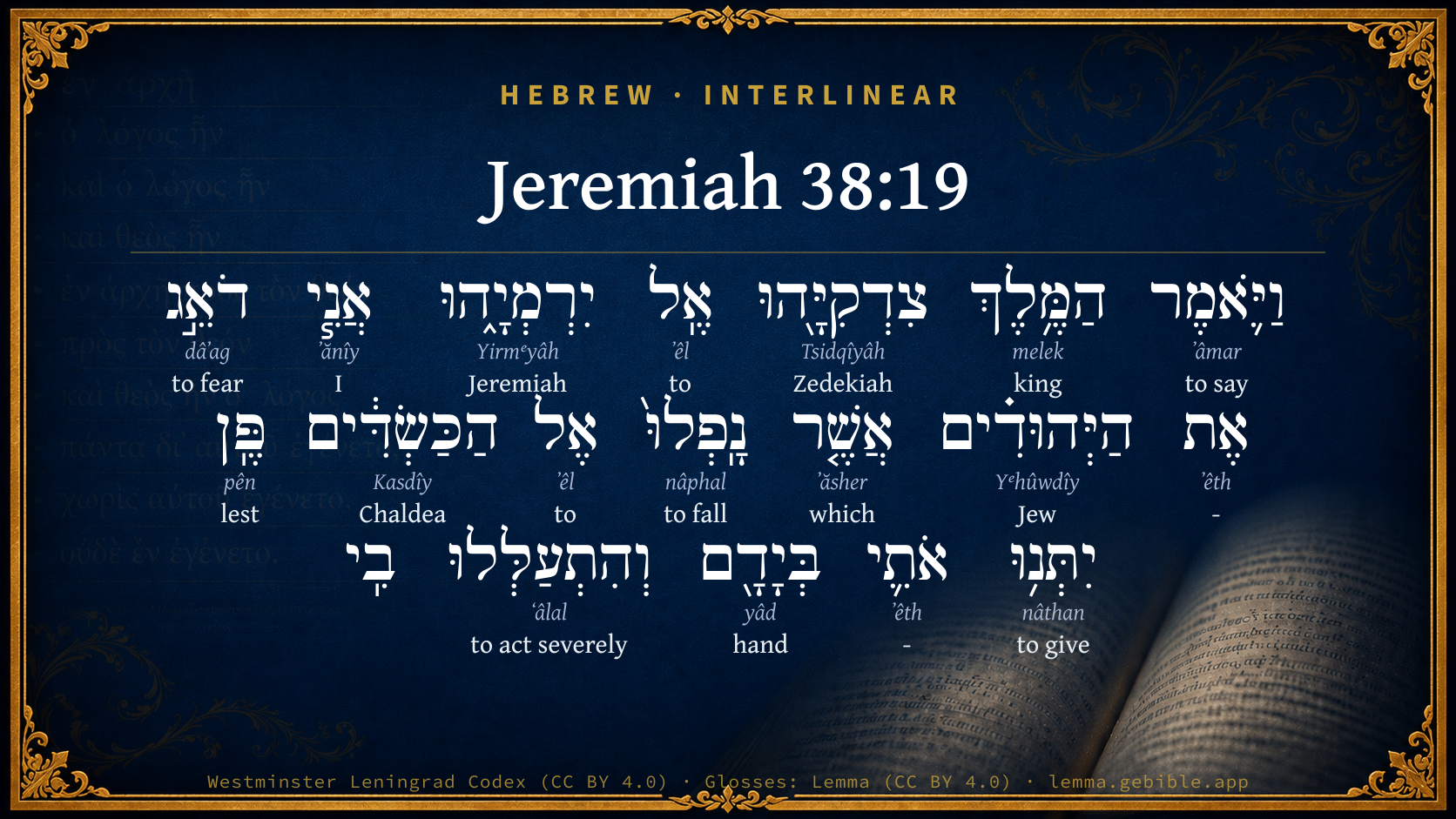
Hebrew (Westminster Leningrad Codex) Jeremiah 38:19 appears in the Hebrew Old Testament. The text above is from the Westminster Leningrad Codex. Each word links to its Strong’s number, a concise gloss, and parsing drawn from the Open Scriptures Hebrew Bible morphology. Click any word for its full Brown-Driver-Briggs (BDB) entry.
Download image
Cite this verse

Jeremiah 38:19 (World English Bible). Public Domain. Lemma interlinear Bible study tool, https://lemma.gebible.app/v/jeremiah/38/19.

Show BibTeX & RIS
BibTeX
RIS
English Translation
Zedekiah the king said to Jeremiah, I am afraid of the Jews who are fallen away to the Chaldeans, lest they deliver me into their hand, and they mock me.
World English Bible · Public Domain
Download a study sheet

One document with this verse’s original text, its word-by-word gloss line, the meaning frame, cross-references with their text, attributed commentary, and full source and license credits — printable, and it pastes into notes with its structure intact.

This verse Autodidact and up

Study sheet (.html) Plain text (.txt)

A passage Seminary Student

Up to 50 verses in one chapter. A passage sheet keeps up to 6 commentary sources and 12 cross-references per verse, in the order this page ranks them, and says so on the sheet whenever that leaves anything out. Ask for a single verse and you get the Autodidact verse sheet above.

Everything on this page stays free to read, with no account — the sheet is a download of what is already on screen, not access to it.

Want to remove ads? Support Godless Engineer
Compare translations 3

The same verse in 3 English versions, stacked beneath the original-language interlinear above. Click any original word for its lexicon entry.

Each is an independent rendering of the whole verse — the interlinear is not word-aligned to these translations.

Highlighted words mark where these versions differ — a whole-verse word diff, not a word-by-word alignment.

  • World English Bible Public Domain
    Zedekiah the king said to Jeremiah, I am afraid of the Jews who are fallen away to the Chaldeans, lest they deliver me into their hand, and they mock me.
  • King James Version Public Domain
    And Zedekiah the king said unto Jeremiah, I am afraid of the Jews that are fallen to the Chaldeans, lest they deliver me into their hand, and they mock me.
  • unfoldingWord Literal Text CC BY-SA 4.0
    King Zedekiah said to Jeremiah, “But I am afraid of the people of Judah who have deserted to the Chaldeans, because I might be given over into their hand, for them to treat me badly.”

unfoldingWord Literal Text — © unfoldingWord, licensed CC BY-SA 4.0. Word-aligned USFM3 via Door43 (git.door43.org/unfoldingWord/en_ult).

Versions to compare (up to 4)

3 of 4 selected

Show all 18 translations

Every available English version of this verse, each an independent rendering of the whole verse.

  • World English Bible Public Domain
    Zedekiah the king said to Jeremiah, I am afraid of the Jews who are fallen away to the Chaldeans, lest they deliver me into their hand, and they mock me.
  • Berean Standard Bible Public Domain
    But King Zedekiah said to Jeremiah, “I am afraid of the Jews who have deserted to the Chaldeans, for the Chaldeans may deliver me into their hands to abuse me.”
  • Majority Standard Bible Public Domain
    But King Zedekiah said to Jeremiah, “I am afraid of the Jews who have deserted to the Chaldeans, for the Chaldeans may deliver me into their hands to abuse me.”
  • King James Version Public Domain
    And Zedekiah the king said unto Jeremiah, I am afraid of the Jews that are fallen to the Chaldeans, lest they deliver me into their hand, and they mock me.
  • American Standard Version (1901) Public Domain
    And Zedekiah the king said unto Jeremiah, I am afraid of the Jews that are fallen away to the Chaldeans, lest they deliver me into their hand, and they mock me.
  • Revised Version (1885) Public Domain
    And Zedekiah the king said unto Jeremiah, I am afraid of the Jews that are fallen away to the Chaldeans, lest they deliver me into their hand, and they mock me.
  • Geneva Bible (1599) Public Domain
    And Zedekiah the King sayde vnto Ieremiah, I am carefull for the Iewes that are fled vnto the Caldeans, least they deliuer mee into their hands, and they mocke me.
  • Douay-Rheims (1899) Public Domain
    And king Sedecias said to Jeremias: I am afraid because of the Jews that are fled over to the Chaldeans: lest I should be delivered into their hands, and they should abuse me.
  • Young's Literal Translation Public Domain
    And the king Zedekiah saith unto Jeremiah, `I am fearing the Jews who have fallen unto the Chaldeans, lest they give me into their hand, and they have insulted me.'
  • Literal Standard Version CC BY-SA 4.0
    And King Zedekiah says to Jeremiah, “I am fearing the Jews who have fallen to the Chaldeans, lest they give me into their hand, and they have insulted me.”
  • Unlocked Literal Bible CC BY-SA 4.0
    King Zedekiah said to Jeremiah, “But I am afraid of the people of Judah who have deserted to the Chaldeans, because I might be given over into their hand, for them to treat me badly.”
  • unfoldingWord Literal Text CC BY-SA 4.0
    King Zedekiah said to Jeremiah, “But I am afraid of the people of Judah who have deserted to the Chaldeans, because I might be given over into their hand, for them to treat me badly.”
  • Darby Bible Public Domain
    And king Zedekiah said unto Jeremiah, I am afraid of the Jews that have deserted to the Chaldeans, lest they give me over into their hand, and they mock me.
  • World Messianic Bible Public Domain
    Zedekiah the king said to Jeremiah, “I am afraid of the Jews who have defected to the Kasdim, lest they deliver me into their hand, and they mock me.”
  • Webster's Bible Public Domain
    And Zedekiah the king said to Jeremiah, I am afraid of the Jews that have fallen to the Chaldeans, lest they deliver me into their hand, and they mock me.
  • Free Bible Version CC BY-SA 4.0
    But King Zedekiah said to Jeremiah, “I am afraid of those people of Judah who have gone over to the Babylonians, because the Babylonians might hand me over to them so they could abuse me.”
  • Bible in Basic English Public Domain
    And King Zedekiah said to Jeremiah, I am troubled on account of the Jews who have gone over to the Chaldaeans, for fear that they may give me up to them and they will put me to shame.
  • JPS Tanakh (1917) Public Domain
    And Zedekiah the king said unto Jeremiah: 'I am afraid of the Jews that are fallen away to the Chaldeans, lest they deliver me into their hand, and they mock me.'

Literal Standard Version (2020), Covenant Press — licensed CC BY-SA 4.0. Text via the HelloAO Bible API (eBible.org). Unlocked Literal Bible (unfoldingWord) — licensed CC BY-SA 4.0. Text via the HelloAO Bible API (eBible.org). unfoldingWord Literal Text — © unfoldingWord, licensed CC BY-SA 4.0. Word-aligned USFM3 via Door43 (git.door43.org/unfoldingWord/en_ult). Free Bible Version, Dr. Jonathan Gallagher — licensed CC BY-SA 4.0. Text via the HelloAO Bible API (eBible.org).

Word by word

More ways to search: Search by grammar → Find every occurrence → Compare this word →

Practice this passage: Drill this verse → Learn its vocabulary →

דֹאֵ֣ג
dâʼag
H1672
“fearing”
Verb, Qal, Participle Active, Masculine, Singular, Absolute
Part of Speech
Verb
Stem
Qal
Form
Participle Active
Gender
Masculine
Number
Singular
State
Absolute
Full BDB Definition

Origin: a primitive root

TWOT: 393

to fear, be anxious, be concerned, be afraid, be careful - (Qal) - to be anxious, be concerned - to fear, dread
  1. וַיֹּ֛אמֶר ʼâmar H559 “and · to say” Conjunction + Verb, Qal, Sequential Imperfect, 3rd Person, Masculine, Singular
  2. הַמֶּ֥לֶךְ melek H4428 “the · king” Particle, Definite Article + Noun, Common, Masculine, Singular, Absolute
  3. צִדְקִיָּ֖הוּ Tsidqîyâh H6667 “Zedekiah” Noun, Proper
  4. אֶֽל ʼêl H413 “to” Preposition
  5. יִרְמְיָ֑הוּ Yirmᵉyâh H3414 “Jeremiah” Noun, Proper
  6. אֲנִ֧י ʼănîy H589 “I” Pronoun, Personal, 1st Person, Common, Singular
  7. אֶת ʼêth H853 “-” Particle, Direct Object
  8. הַיְּהוּדִ֗ים Yᵉhûwdîy H3064 “the · Jews” Particle, Definite Article + Noun, Gentilic, Masculine, Plural, Absolute
  9. אֲשֶׁ֤ר ʼăsher H834 “which” Particle, Relative
  10. נָֽפְלוּ֙ nâphal H5307 “to fall” Verb, Qal, Perfect, 3rd Person, Common, Plural
  11. אֶל ʼêl H413 “to” Preposition
  12. הַכַּשְׂדִּ֔ים Kasdîy H3778 “the · Chaldea” Particle, Definite Article + Noun, Proper
  13. פֶּֽן pên H6435 “lest” Conjunction
  14. יִתְּנ֥וּ nâthan H5414 “to give” Verb, Qal, Imperfect, 3rd Person, Masculine, Plural
  15. אֹתִ֛י ʼêth H853 “- · me” Particle, Direct Object + Suffix, Personal, 1st Person, Common, Singular
  16. בְּיָדָ֖ם yâd H3027 “in/at · hand · their” Preposition + Noun, Common, Both, Singular, Construct + Suffix, Personal, 3rd Person, Masculine, Plural
  17. וְהִתְעַלְּלוּ ʻâlal H5953 “and · to act severely” Conjunction + Verb, Hithpael, Sequential Perfect, 3rd Person, Common, Plural

About this verse

These counts appear in no published source. They are computed here, from the morphology-tagged text and Lemma’s own curated glosses. What Lemma adds →

19
words
16
distinct lemmas
Prophets
section

Notable vocabulary

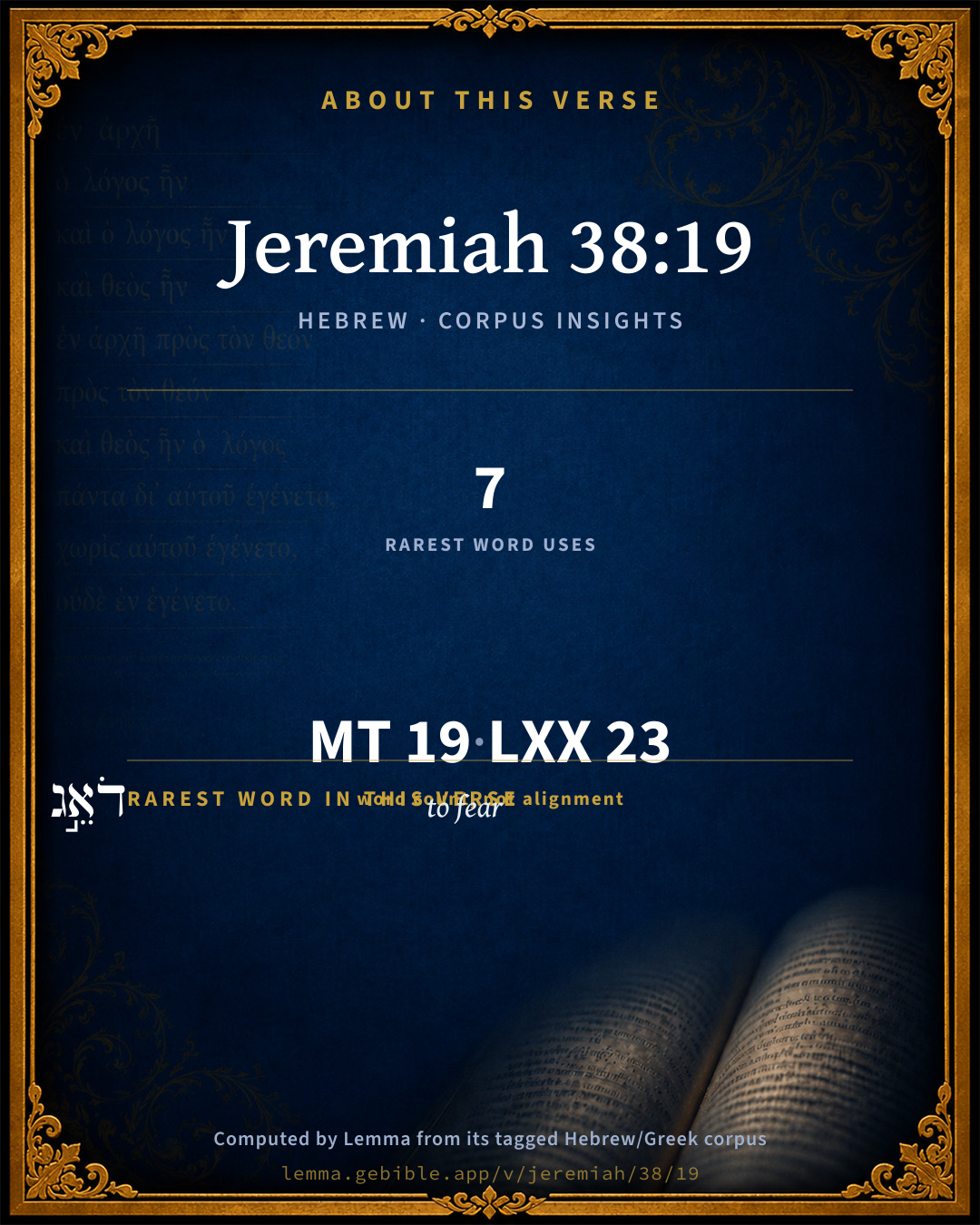
The rarest word here is דֹאֵ֣ג to fear H1672 — appearing just 7 times in the whole Hebrew Bible.

Shared distinctive vocabulary

דֹאֵ֣ג to fear H1672 occurs in 7 verses of the Hebrew Bible. Also found in:

Grammatical profile

  • 5 verbs
  • 6 nouns
  • 1 pronoun
  • 3 prepositions
  • 1 conjunction
  • 3 particles

Verb forms

  • וַיֹּ֛אמֶר Qal · Sequential Imperfect
  • דֹאֵ֣ג Qal · Participle Active
  • נָֽפְלוּ֙ Qal · Perfect
  • יִתְּנ֥וּ Qal · Imperfect
  • וְהִתְעַלְּלוּ Hithpael · Sequential Perfect

Repetition

A word recurs within this verse — often emphatic in Hebrew:

  • אֶֽל to H413 ×2

Hebrew & Septuagint length

In the original languages it is 19 Hebrew tokens and 23 Greek tokens — but the two are counted differently (Hebrew bundles its prefixes and suffixes into one token; the Greek is in lemma form), so that isn’t a like-for-like length.

Cross-references

14

Topical passages linked to Jeremiah 38:19 in the Treasury of Scripture Knowledge — connected by theme and wording, ordered by reader-vote popularity; previews shown in the World English Bible.

  • John 12:42 Nevertheless even of the rulers many believed in him, but because of the Pharisees they didn't confess it, so that they wouldn't be put out of the synagogue,
  • Isaiah 51:12–13 I, even I, am he who comforts you: who are you, that you are afraid of man who shall die, and of the son of man who shall be made as grass;
  • Isaiah 57:11 Of whom have you been afraid and in fear, that you lie, and have not remembered me, nor laid it to your heart? Haven't I held my peace even of long time, and you don't fear me?
  • Jeremiah 38:22 behold, all the women who are left in the king of Judah's house shall be brought forth to the king of Babylon's princes, and those women shall say, Your familiar friends have set you on, and have prevailed over you: [now that] your feet are sunk in the mire, they are turned away back.
  • John 19:12–13 At this, Pilate was seeking to release him, but the Jews cried out, saying, "If you release this man, you aren't Caesar's friend! Everyone who makes himself a king speaks against Caesar!"
  • 1 Samuel 31:4 Then said Saul to his armor bearer, Draw your sword, and thrust me through therewith, lest these uncircumcised come and thrust me through, and abuse me. But his armor bearer would not; for he was sore afraid. Therefore Saul took his sword, and fell on it.
  • Jeremiah 39:9 Then Nebuzaradan the captain of the guard carried away captive into Babylon the residue of the people who remained in the city, the deserters also who fell away to him, and the residue of the people who remained.
  • Judges 9:54 Then he called hastily to the young man his armor bearer, and said to him, Draw your sword, and kill me, that men not say of me, A woman killed him. His young man thrust him through, and he died.
  • Judges 16:25 It happened, when their hearts were merry, that they said, Call for Samson, that he may make us sport. They called for Samson out of the prison-house; and he made sport before them. They set him between the pillars:
  • 1 Samuel 15:24 Saul said to Samuel, I have sinned; for I have transgressed the commandment of Yahweh, and your words, because I feared the people, and obeyed their voice.
  • Proverbs 29:25 The fear of man proves to be a snare, But whoever puts his trust in Yahweh is kept safe.
  • Isaiah 45:9–10 Woe to him who strives with his Maker--a potsherd among the potsherds of the earth! Shall the clay ask him who fashions it, "What are you making?" or your work, "He has no hands?"
  • Job 31:34 Because I feared the great multitude, And the contempt of families terrified me, So that I kept silence, and didn't go out of the door--
  • Jeremiah 38:5 Zedekiah the king said, Behold, he is in your hand; for the king is not he who can do anything against you.

Cross-references courtesy of OpenBible.info (CC BY 4.0).

Hebrew and Greek witnesses Masoretic Hebrew ↔ Greek Septuagint

The same verse in the two great witnesses to the Old Testament, shown verse-for-verse.

These are two independent witnesses, not word-aligned to each other, and the Septuagint is shown in lemma (dictionary) form.

Hebrew Jeremiah 38:19 Masoretic · Westminster Leningrad Codex

וַיֹּ֛אמֶר הַמֶּ֥לֶךְ צִדְקִיָּ֖הוּ אֶֽל יִרְמְיָ֑הוּ אֲנִ֧י דֹאֵ֣ג אֶת הַיְּהוּדִ֗ים אֲשֶׁ֤ר נָֽפְלוּ֙ אֶל הַכַּשְׂדִּ֔ים פֶּֽן יִתְּנ֥וּ אֹתִ֛י בְּיָדָ֖ם וְהִתְעַלְּלוּ בִֽי

Zedekiah the king said to Jeremiah, I am afraid of the Jews who are fallen away to the Chaldeans, lest they deliver me into their hand, and they mock me.

World English Bible · Public Domain

Greek LXX Structure differs

In the Septuagint, Jeremiah is about an eighth shorter than the Hebrew and arranges its material differently — the Oracles Against the Nations (Hebrew chapters 46–51) appear in the middle of the Greek book, after 25:13. Because the chapter and verse boundaries do not line up, a verse-for-verse comparison with the Hebrew is not shown.

A verse-for-verse comparison isn’t shown here because the chapters and verses don’t line up. Switch to the LXX edition with the MT / LXX toggle above to read the Greek directly.

On this verse, Keil & Delitzsch discusses the Septuagint’s reading. Read the note in Commentary ↓

Hebrew: Westminster Leningrad Codex (CC BY 4.0). Greek: Septuagint (public domain); English from a public-domain English Septuagint. How the Septuagint differs from the Hebrew →

Targum (Aramaic paraphrase)

1

The Targum is the ancient Jewish Aramaic paraphrase of the Hebrew Scriptures — an interpretive translation, not the Hebrew text itself. Onkelos (literal) and Pseudo-Jonathan (expansive) render the Torah, and Jonathan the Prophets. Coverage is partial: where no permissively-licensed English translation exists for a verse, only the Aramaic is shown. This is verse-level text, not a word-by-word alignment to the Hebrew.

  1. Targum Jonathan Prophets (Joshua–Malachi)
    וַאֲמַר מַלְכָּא צִדְקִיָה לְיִרְמְיָה אֲנָא יָצֵיף מִן יְהוּדָאֵי דְאִשְׁתְּמָעוּ לְכַסְדָאֵי דִלְמָא יִמְסְרוּן יָתִי בִּידֵיהוֹן וְיִתְלַעֲבוּן בִּי:

    (no public-domain English translation for this verse)

    Targum Jonathan — Aramaic: “Mikraot Gedolot” (public domain). English: “Sefaria Community Translation” (CC0 1.0 (public-domain dedication)); “London "Chaldee Paraphrase," 1871” (public domain). Text via Sefaria.

Commentary

Notes on Jeremiah 38:19 from classic Christian and Jewish commentators (each source and its license shown beneath its notes). The classic Christian expositions comment on the surrounding passage and are grouped to its opening verse, so a note may address several verses; the Jewish commentaries on the Tanakh (Rashi and others) are per-verse, so they appear only where the commentator wrote on this verse.

Lemma curates 59 commentaries, every one of them public domain or Creative Commons licensed, each selected and text-cleaned for this edition rather than reprinted as found. About our sources →

Trapp's Complete Commentary

John Trapp

Jer 38:19 And Zedekiah the king said unto Jeremiah, I am afraid of the Jews that are fallen to the Chaldeans, lest they deliver me into their hand, and they mock me.

Ver. 19. Then Zedekiah said unto Jeremiah, I am afraid of the Jews.] Thus hypocrites will at one time or other detect themselves, as Zedekiah here plainly declareth that he more feared the loss of his life, honour, wealth, &c., than of God’s favour and kingdom; so do the most among us. Pilate feared how Caesar would take it if he should release Jesus. Herod laid hold on Peter, after he had killed James, that he might please the people. The Pharisees could not believe, because they received glory from men. This generous king cannot endure to think that his own fugitives should flout him; but to be ruled by God, and his holy prophet advising him for the best, he cannot yield. Thus still vain men are niggardly of their reputation and prodigal of their souls. Do we not see them run wilfully into the field, into the grave, into hell? and all lest it should be said they have as much fear as wit.

John Trapp, A Commentary or Exposition upon All the Books of the Old and New Testament (1647–1656) — public domain. Text from a community e-Sword module.

The Biblical Illustrator

Joseph S. Exell

Jer_38:19-20

I am afraid of the Jews.

Fatal timidity

I remember very well, when I first went out to Australia, that one fine evening a little bird was seen to be following the ship, evidently a land-bird driven out to sea. When the little thing got tired it tried to alight on some portion of the rigging, though it seemed afraid to do so. On one occasion the captain stretched forth his hand and tried to take hold of the little bird, but it eluded his grasp and went back far away into the darkness of the night, falling upon the waves without the hope of rescue. (T. Spurgeon.)

Obey, I beseech thee, the voice of the Lord.

Obedience

I remember, years ago, entering the bed-chamber of an eminent saint, one autumn morning, whose diminishing candles told how long he had been feeding on the Word of God. I asked him what had been the subject of his study. He said he had been engaged since four oclock in discovering all the Lords positive commandments, that he might be sure that he was not wittingly neglecting any one of them. It is very sad to find how many in the present day are neglecting to observe to do the Lords precepts--concerning His ordinances, concerning the laying-up of money, the evangelisation of the world, and the manifestation of perfect love. They know the Lords will, and do it not. They appear to think that they are absolved from that observing to do, which was so characteristic of Deuteronomy. As though love were not more inexorable than law! (F. B. Meyer, B. A.)

.

The Biblical Illustrator, edited by Joseph S. Exell (c. 1880s–1900s) — public domain. Text from a community e-Sword module.

Joseph Benson's Commentary

Jer 38:19-20. Zedekiah said, I am afraid of the Jews, &c. — The sense seems to be, that he was afraid lest the Chaldeans, when he had given himself up to them, should deliver him into the hands of those Jews who had fallen to them, and they should insult over and deride him, as being obliged at last to do what he had blamed, and, if he had been able, would have punished them for doing. Thus the Vulgate, Solicitus sum propter Judæos, qui transfugerunt ad Chaldæs: ne forte tradar in manus eorum et illudant mihi. He was conscious he had acted a base part in violating the oath of homage and fidelity which he had given to the king of Babylon, and that he was considered by many of the Jews, especially by those who had gone over to the Chaldeans, as having ruined his country by his impolitic measures. Thus he was more concerned for his honour than for his life, and the lives of his wives and children, and the safety of the whole city. And thus often great persons are more patient of death than of reproach and dishonour. But Jeremiah said, They shall not deliver thee — The Chaldeans will not do so base an act, but deal with thee as with a prince. God foresees all possible events, and what would be the consequence of the several counsels men propose to themselves. Obey, I beseech thee, the voice of the Lord: so it shall be well with thee — Let not thy fears, therefore, respecting the treatment thou wilt meet with, be a temptation to thee to disobey the command of God: for if thou doest as thou art advised to do, thou shalt live — Though not in that splendour in which thou now livest, yet in a much more comfortable state than if the city be taken by storm.

Joseph Benson's Commentary on the Old and New Testaments (1811–1818) — public domain. Text from a community e-Sword module.

Tyndale Open Study Notes

Tyndale Open Resources

38:19 Zedekiah still feared his fellow countrymen—this time, those who had defected—more than he feared the Lord or the Babylonians, so he rejected Jeremiah’s advice. This was Jeremiah’s last message to the king.

Tyndale Open Study Notes — © Tyndale Open Resources, licensed CC BY-SA 4.0. Text via the HelloAO Bible API.

Geneva Bible (1599)

Geneva Bible translators

Which declareth that he more feared the reproach of men, than the threatenings of God.

Geneva Bible (1599) marginal notes — public domain. Text via Bolls.life.

Jamieson, Fausset & Brown

Robert Jamieson, A. R. Fausset & David Brown

afraid of the Jews--more than of God (Pro 29:25; Joh 9:22; Joh 12:43).

mock me--treat me injuriously (Sa1 31:4).

Jamieson, Fausset & Brown — Commentary Critical and Explanatory on the Whole Bible (1871) — public domain (CC PDM 1.0). Text via the HelloAO Bible API.

Adam Clarke's Commentary

Verse 19. They mock me.] Insult me, and exhibit me in triumph.

Adam Clarke's Commentary on the Bible (1810–1826) — public domain. Text from a community e-Sword/MySword module.

John Calvin's Commentaries

Zedekiah seems, here to have had a good reason why he should not immediately obey the Prophet. And often the best of the faithful openly set forth their anxieties, and we have seen that even the Prophet, when any apprehension of danger was entertained, sometimes mentioned it. It was not then a thing to be blamed, that Zedekiah ingenuously confessed that he was prevented by the fear of those who had revolted to the Chaldeans. For we know that subjects, having once cast off the yoke, and violated their pledged faith, conduct themselves in an insolent way; for they know that those to whom they have not performed their duty would be implacable to them. Zedekiah then was justly anxious, and his simplicity in explaining to the Prophet his fear, seemed worthy of an excuse, for he seemed to give some sign of obedience. But the event at length will shew us, that he was so bound by fear, that he refused the counsel of God and the Prophet. It often happens, as I have just said, that the faithful also fear, and thus vacillate or stand still, when God commands them anything hard and difficult, and they would willingly withdraw from the contest, but they at length obey God, and surrender their own thoughts, and submit in obedience to God. But Zedekiah so feared, that he could not partake of God’s goodness promised to him.

We hence see what the faithful have in common with the reprobate, and also how they differ from one another. At first the faithful fear as well as the unbelieving; they are anxious, they vacillate, and make known their perplexities: the unbelieving at the same time indulge themselves, and become hardened in their perverse purposes; but the faithful fight with themselves, and subject their thoughts to the will of God, and thus overcome fear by faith; they also crucify the flesh, and give themselves up wholly to God. We have seen the same thing before in the Prophet. But we shall now see the obstinacy of King Zedekiah, to which we have referred. Then Zedekiah feared lest the Jews, who had revolted to the Chaldeans, should treat him with insolence. The Prophet thus answered him —

John Calvin's Commentaries (1540-1563) — public domain. Text from the Calvin Translation Society English edition (1840s-50s) via the Christian Classics Ethereal Library (ccel.org). Calvin's coverage is partial (roughly two-thirds of the Bible); uncommented books and verses are honest gaps, never fabricated. The 19th-century editor's footnotes and remarks are omitted so the notes are faithfully Calvin's own voice.

Ellicott's Commentary for English Readers

(19) I am afraid of the Jews . . .—The special form of fear was characteristic of the weak and vacillating king. It was not enough to know that his life would be safe. Would he also be saved from the insults of his own subjects, who had already deserted to the enemy? These were, in the nature of the case, friends and followers of the prophet, and had acted on his advice (Jer_21:9). The king, who had shrunk from Jeremiah’s taunts (Jer_37:19), could not, for very shame, expose himself to the derision of others. Perhaps even he feared more than mere derision—outrage, death, mutilation, such as Saul feared at the hands of the Philistines (1Sa_31:4).

(20–22) Obey, I beseech thee. . . .—The king’s misgiving is met in part by an earnest entreaty to obey the voice of the Lord, in part by the assurance that thus it “shall be well with him” (literally, there shall be peace to thee); in part also by bringing before him the mockery which is certain to await him if he persists in his defiance. The women of the harem, the surviving wives and concubines of former kings, as well as his own, should become the spoil of the Chaldæan princes, and should take up their taunting proverbs against him. “Thy friends” (literally, the men of thy peace, as in Jer_20:10; the men who promised peace and safety), “they set thee on, and having dragged thee into the mire of shame, have left thee there.” The imagery of the taunt seems drawn from the prophet’s recent experience (Jer_38:6). The king was plunging into a worse “slough of despond” than that into which Jeremiah had sunk in the dungeon of Malchiah.

A Bible Commentary for English Readers, edited by Charles John Ellicott (1878–1897) — public domain. Text from a community e-Sword module.

The Cambridge Bible for Schools and Colleges

gen. ed. J. J. S. Perowne

19. I am afraid of the Jews that are fallen away to the Chaldeans] See on Jer_38:4. These Jews, he fears, if the Chaldaeans delivered him into their hands, would maltreat him for not doing himself as they had done at an earlier period, and so sparing the city the miseries of a siege. Cp. Jer_37:13.

The Cambridge Bible for Schools and Colleges (gen. ed. J. J. S. Perowne; Cambridge University Press, 1878–1918) — public domain. Text from a community e-Sword module.

John Gill's Exposition

And Zedekiah the king said unto Jeremiah,.... In answer to this advice he gave him, persuading him to give up himself and the city into the hands of the Chaldeans:

I am afraid of the Jews that are fallen to the Chaldeans; who did go out of the city, and surrendered to the Chaldeans, whom Zedekiah had cruelly used, or severely threatened:

lest they deliver me into their hands, and they mock me; that is, lest the Chaldeans should deliver him into the hands of the Jews, and they should jeer and scoff at him, for doing the same thing he had forbidden them on the severest penalty; or lest they should put him to death in the most revengeful and contemptuous manner, as Kimchi's note is: but all this was either a mere excuse, or showed great weakness and pusillanimity, and was fearing where no fear was; for, on the one hand, it was not reasonable to think that the Chaldeans, when they had got such a prize as the king of the Jews, that they should easily part with him, and especially deliver him up into the hands of his own people; and, on the other hand, it is not likely, that, should he be delivered into their hands, they would ever have treated him in so scornful and cruel a manner, who was their prince, and a partner with them in their captivity.

John Gill's Exposition of the Whole Bible (1746–1763) — public domain (CC PDM 1.0). Text via the HelloAO Bible API.

Albert Barnes' Notes on the Bible

The Jews that are fallen to the Chaldaeans - These deserters probably formed a numerous party, and now would be the more indignant with Zedekiah for having rejected their original advice to submit.

Albert Barnes' Notes on the Bible (1834–1885) — public domain. Text from a community e-Sword/MySword module.

Haydock's Catholic Bible Commentary

Jews. Traitors, whom Sedecias had perhaps treated ill. (Calmet)

George Leo Haydock (1774–1849), Haydock's Catholic Family Bible and Commentary, 1859 edition — public domain. Excludes Psalms (Douay-Rheims chapter numbering differs from Protestant) and Deuterocanonical books (Catholic canon only).

Matthew Poole's English Annotations

But if Zedekiah went out according to the prophet’s advice, and delivered himself, what needed he to fear his subjects (that had deserted the city) delivering of him? It seems rather therefore to be the sense, lest the Chaldeans, when I have yielded myself to them, should deliver me into the hands of those Jews which have fallen to them, and they should mock me: so as he seems to be more concerned for his honour than for his own life, and his family’s, and the whole city: thus often great persons are more patient of death than of reproach and dishonour.

Matthew Poole's English Annotations on the Holy Bible (1683–1685) — public domain. Text from a community e-Sword/MySword module.

Whedon's Commentary on the Bible

Daniel D. Whedon

19. I am afraid of the Jews — More “afraid” of them than of God! more afraid of contumely and ridicule than of calamity and ruin!

Daniel D. Whedon (gen. ed.), Commentary on the Old and New Testaments (1874–1909) — public domain. Text from a community e-Sword module.

The Pulpit Commentary

Vers. 19-23. The fear of ridicule.

I THE FEAR OF RIDICULE IS A COMMON FAILING OF WEAK MEN. Zedekiah is a weak man. His first thought when he contemplates the possible effects of obedience to the Divine command is that it may result in his being delivered into the hands of the captives at Babylon to be mocked by them (ver. 17). This he dreads above all things. Many men who would stand up without flinching to be shot at cower before a laugh. Let them understand that their conduct is weak and foolish and wrong.

II THE FEAR OF RIDICULE IS A FREQUENT CAUSE OF NEGLECT OF DUTY. This is one of the chief weapons of persecution and temptation exercised in our own day. The rack and the stake are out of fashion; the sneer and the gibe have taken their place. Milton"s Satan has been superseded by Goethe"s Mephistopheles. The young are specially sensitive to ridicule. They especially should seek grace from God to stand firm against it.

III THE FEAR OF RIDICULE PROVOKES RIDICULE. Jeremiah showed the king that disobedience coming out of his dread of being mocked would result in worse mockery. Fearing the laughter of captive soldiers, he would be mocked by women; dreading the contempt of strangers, he should meet with that of his own house (ver. 22). Face a laugh, and you foil its spiteful intention; quail before it, and you give it the victory and furnish occasion for fresh contempt. The young man who sneaks away from his religious principles because his companions in business laugh at him for them is only despised for his contemptible weakness, while that young man who quietly holds his ground unmoved by senseless ridicule wins the secret respect of observers, and makes them inwardly ashamed of their folly.

IV THE FEAR OF RIDICULE MAY END IN FATAL RESULTS. Jeremiah pointed this out to the king (ver. 23). The horrible charge of having brought about the burning of the city would be attached to his name, and the guilt of it to his soul. Here was a far greater cause of alarm than the danger of a laugh. Weak men who are moved by such contemptible motives as those that influenced Zedekiah should be roused by a rude shock, if that is necessary, for them to see the dread and solemn issues of life and the fearful evils they may evoke while trifling with duty in childish timidity.

V IT IS OUR DUTY TO CONQUER THE FEAR OF RIDICULE BY FAITHFUL OBEDIENCE TO THE WILL OF GOD. Here lies the remedy (ver. 20). To some this fear is keen and almost irresistible. But it is wholly selfish. It is associated with morbid, self-regarding thoughts. If we realize the idea that God is speaking to us and watching us, all ideas of the thoughts of men about us should sink to the dust. With earnest convictions of duty and true efforts of obedience inspired by the grace of Christ, which is sufficient for us, we may brave this thorn in the flesh the fear of man that bringeth a snare.

The Pulpit Commentary (1880–1919), ed. H.D.M. Spence-Jones & Joseph S. Exell — public domain. Text from a community e-Sword module.

John Wesley's Explanatory Notes

Lest they - Lest the Chaldeans should deliver me into the hands of those Jews which have fallen to them.

John Wesley, Explanatory Notes Upon the Whole Bible (1754–1765) — public domain. Text via the GEBible commentary corpus.

Keil & Delitzsch

C. F. Keil & F. Delitzsch

Against the advice that he should save his life by surrendering to the Chaldeans, Zedekiah suggests the consideration, "I am afraid of the Jews, who have deserted [נפל אל as in Jer 37:13] to the Chaldeans, lest they give me into their hands and maltreat me." התעלּל בּ, illudere alicui, to abuse any one by mockery or ill-treatment; cf. Num 22:29; Ch1 10:4, etc. Jeremiah replies, Jer 38:20., "They will not give thee up. Yet, pray, listen to the voice of Jahveh, in that which I say to thee, that it may be well with thee, and that thy soul may live. Jer 38:21. But if thou dost refuse to go out i.e., to surrender thyself to the Chaldeans, this is the word which the Lord hath shown me has revealed to me: Jer 38:22. Behold, all the women that are left in the house of the king of Judah shall be brought out to the princes of the king of Babylon, and those [women] shall say, Thy friends have misled thee and have overcome thee; thy feet are sunk in the mud, they have turned away back. Jer 38:23. And all thy wives and thy children shall they bring out to the Chaldeans, and thou shalt not escape out of their hand; for thou shalt be seized by the hand of the king of Babylon, and thou shalt burn this city with fire." - After Jeremiah had once more assured the king that he would save his life by voluntary surrender, he announces to him that, on the other alternative, instead of his becoming the sport of the deserters, the women of his harem would be insulted. The women who remain in the king's house, as distinguished from "thy wives" (Jer 38:23), are the women of the royal harem, the wives of former kings, who remain in the harem as the concubines of the reigning king. These are to be brought out to the generals of the Chaldean king, and to sing a satire on him, to this effect: "Thy friends have misled thee, and overpowered thee," etc. The first sentence of this song is from Oba 1:7, where השּׁיאוּך ere stands instead of הסּיתוּך. The friends (אנשׁי שׁלמך, cf. Jer 20:10) are his great men and his false prophets. Through their counsels, these have led him astray, and brought him into a bog, in which his feet stick fast, and then they have gone back; i.e., instead of helping him out, they have deserted him, leaving him sticking in the bog. The expression is figurative, and the meaning of the figure is plain (רגלך is plural). בּץ, ἁπ λεγ.., is equivalent to בּצּה, a bog, Job 8:11. Moreover, the wives and children of Zedekiah are to fall into the hand of the Chaldeans. מוצאים, the participle, is used instead of the finite tense to express the notion of indefinite personality: "they bring them out." תּתּפשׂ בּיד ".tuo meht gnirb , properly, "to be seized in the hand," is a pregnant construction for, "to fall into the hand and be held fast by it." "Thou shalt burn this city," i.e., bring the blame of burning it upon thyself. Ewald, Hitzig, and Graf, following the lxx, Syr., and Chald., would change תּשׂרף into תּשּׂרף, but needlessly.

Keil & Delitzsch — Biblical Commentary on the Old Testament (1861–1891) — public domain (CC PDM 1.0). Text via the HelloAO Bible API. (Old Testament only.)

unfoldingWord translationNotes

Door43 World Missions Community

deserted

escaped trouble and left people who needed help. See how you translated this in Jeremiah 37:13.

I might be given over into their hand

The word "hand" is a metonym for the power or control that the hand exercises. This can be translated in active form. AT: "the Chaldeans might put me under the control of the people of Judah who have deserted" or "the Chaldeans might allow the people of Judah who have deserted to do whatever they want with me" (See: Active or Passive and Metonymy)

for them to treat me badly

Here the word "them" refers to the people of Judah who have deserted.

translationWords

fear

kingdom of Judah

hand

unfoldingWord translationNotes — © Distant Shores Media and the Door43 World Missions Community, licensed CC BY-SA 4.0. Source: git.door43.org/Door43/en_tn.

Rashi

Rabbi Shlomo Yitzchaki (Rashi)

“I fear” Heb. דֹאֵג.

lest they deliver me [Lest] the Chaldeans [deliver me] into the hands of the Jews, saying, Your king shall be your slave since you have made peace with us first.

and mock me [i. e.,] the Jews [will mock me] (engregier in O.F.), complain.

Rashi on the Tanakh — English translations: “The Judaica Press complete Tanach with Rashi, translated by A. J. Rosenberg” (CC BY 4.0); “Pentateuch with Rashi's commentary by M. Rosenbaum and A.M. Silbermann, 1929-1934” (public domain); “The Metsudah Tanach series, Lakewood, N.J” (CC BY 4.0); and “The Book of Joshua, Metsudah Publications, 1997” (CC BY 4.0). Text via Sefaria.

Lesson kit

Teaching starters — assembled from the data on this page, not authored interpretation. Every prompt links to the verse data it draws on. Edit before teaching.

Jeremiah, in the Prophets, opens this verse with 19 words (16 distinct Hebrew lemmas). Its most distinctive word is dâʼag (“to fear”). A historical commentator’s framing appears above. Read the whole chapter for the surrounding context.

Discussion questions

  1. The word dâʼag carries the sense “to fear.” How does it shape the verse?
  2. 1 Samuel 9:5 shares the word «to fear» with this verse. How do the two illuminate each other?
  3. “to” occurs 2× in this one verse. What is the effect of the repetition?
  4. These translations render this verse differently. What is at stake in choosing one wording over another?
  5. The verb «וַיֹּ֛אמֶר» is Qal Sequential Imperfect. How does its form color the action?
  6. Reading how Trapp's Complete Commentary and The Biblical Illustrator read this verse, where do the two commentators agree and where do they part?

Things to notice

Reading settings

Reading text

Shown beneath each verse's original-language words.

Old Testament
Old Testament edition

Read the OT as the Masoretic Hebrew (MT) or the Greek Septuagint (LXX).

English shown for the Greek Septuagint (in the Hebrew ↔ Greek comparison).

Comparing translations? Open the Compare panel on any verse page to stack up to four side by side.