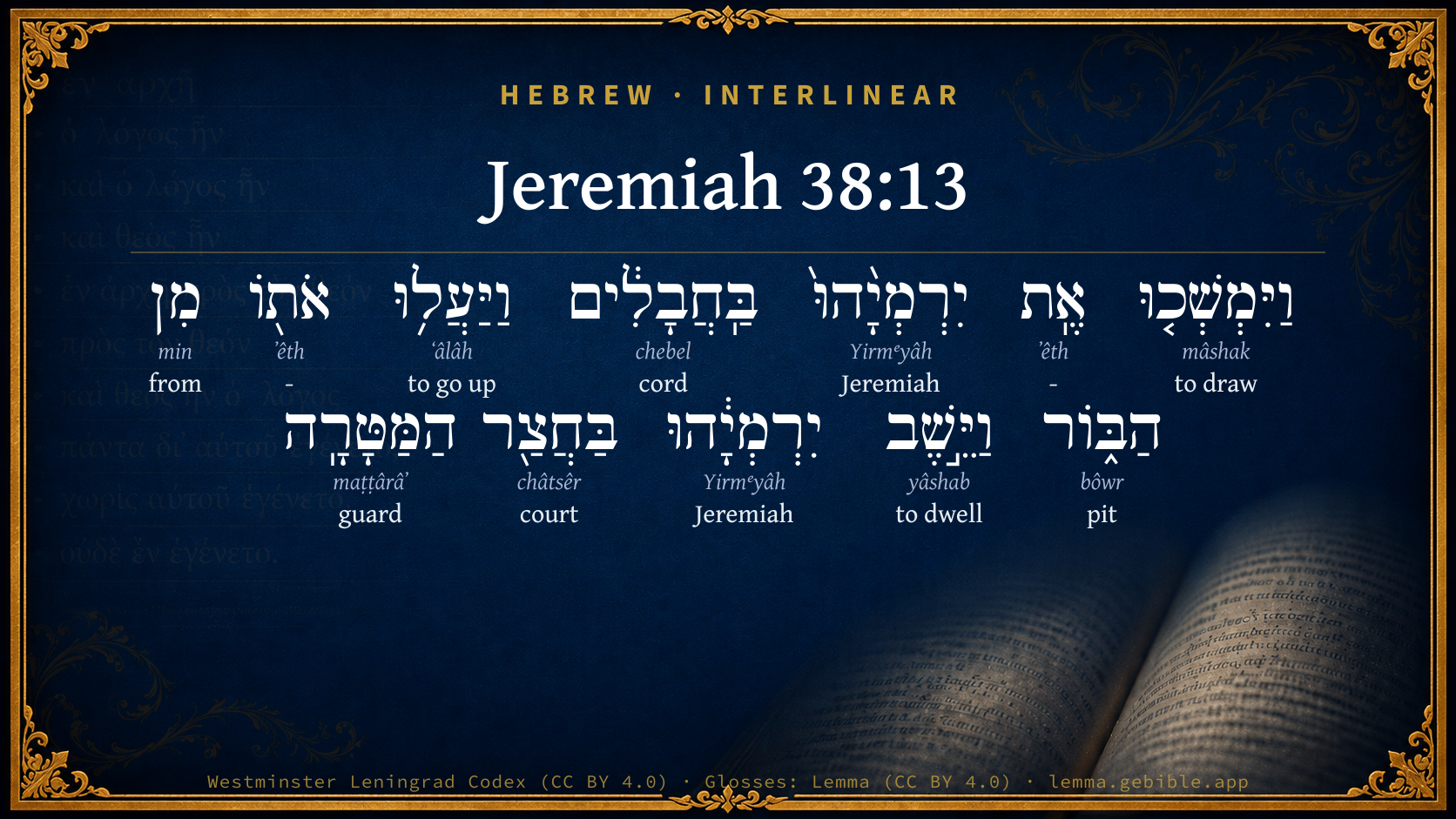
Jeremiah 38:13

Hebrew (Westminster Leningrad Codex) Jeremiah 38:13 appears in the Hebrew Old Testament. The text above is from the Westminster Leningrad Codex. Each word links to its Strong’s number, a concise gloss, and parsing drawn from the Open Scriptures Hebrew Bible morphology. Click any word for its full Brown-Driver-Briggs (BDB) entry.
Download image
Cite this verse

Jeremiah 38:13 (World English Bible). Public Domain. Lemma interlinear Bible study tool, https://lemma.gebible.app/v/jeremiah/38/13.

Show BibTeX & RIS
BibTeX
RIS
English Translation
So they drew up Jeremiah with the cords, and took him up out of the dungeon: and Jeremiah remained in the court of the guard.
World English Bible · Public Domain
Download a study sheet

One document with this verse’s original text, its word-by-word gloss line, the meaning frame, cross-references with their text, attributed commentary, and full source and license credits — printable, and it pastes into notes with its structure intact.

This verse Autodidact and up

Study sheet (.html) Plain text (.txt)

A passage Seminary Student

Up to 50 verses in one chapter. A passage sheet keeps up to 6 commentary sources and 12 cross-references per verse, in the order this page ranks them, and says so on the sheet whenever that leaves anything out. Ask for a single verse and you get the Autodidact verse sheet above.

Everything on this page stays free to read, with no account — the sheet is a download of what is already on screen, not access to it.

Want to remove ads? Support Godless Engineer
Compare translations 3

The same verse in 3 English versions, stacked beneath the original-language interlinear above. Click any original word for its lexicon entry.

Each is an independent rendering of the whole verse — the interlinear is not word-aligned to these translations.

Highlighted words mark where these versions differ — a whole-verse word diff, not a word-by-word alignment.

  • World English Bible Public Domain
    So they drew up Jeremiah with the cords, and took him up out of the dungeon: and Jeremiah remained in the court of the guard.
  • King James Version Public Domain
    So they drew up Jeremiah with cords, and took him up out of the dungeon: and Jeremiah remained in the court of the prison.
  • unfoldingWord Literal Text CC BY-SA 4.0
    Then they pulled Jeremiah by the ropes. In this way they brought him up from the cistern. So Jeremiah stayed in the courtyard of the guard.

unfoldingWord Literal Text — © unfoldingWord, licensed CC BY-SA 4.0. Word-aligned USFM3 via Door43 (git.door43.org/unfoldingWord/en_ult).

Versions to compare (up to 4)

3 of 4 selected

Show all 18 translations

Every available English version of this verse, each an independent rendering of the whole verse.

  • World English Bible Public Domain
    So they drew up Jeremiah with the cords, and took him up out of the dungeon: and Jeremiah remained in the court of the guard.
  • Berean Standard Bible Public Domain
    and they pulled him up with the ropes and lifted him out of the cistern. And Jeremiah remained in the courtyard of the guard.
  • Majority Standard Bible Public Domain
    and they pulled him up with the ropes and lifted him out of the cistern. And Jeremiah remained in the courtyard of the guard.
  • King James Version Public Domain
    So they drew up Jeremiah with cords, and took him up out of the dungeon: and Jeremiah remained in the court of the prison.
  • American Standard Version (1901) Public Domain
    So they drew up Jeremiah with the cords, and took him up out of the dungeon: and Jeremiah remained in the court of the guard.
  • Revised Version (1885) Public Domain
    So they drew up Jeremiah with the cords, and took him up out of the dungeon: and Jeremiah remained in the court of the guard.
  • Geneva Bible (1599) Public Domain
    So they drewe vp Ieremiah with coards and tooke him vp out of the dungeon, and Ieremiah remained in the court of the prison.
  • Douay-Rheims (1899) Public Domain
    And they drew up Jeremias with the cords, and brought him forth out of the dungeon. And Jeremias remained in the entry of the prison.
  • Young's Literal Translation Public Domain
    and they draw out Jeremiah with cords, and bring him up out of the pit, and Jeremiah dwelleth in the court of the prison.
  • Literal Standard Version CC BY-SA 4.0
    and they draw Jeremiah out with cords, and bring him up out of the pit, and Jeremiah dwells in the court of the prison.
  • Unlocked Literal Bible CC BY-SA 4.0
    Then they pulled Jeremiah by the ropes. In this way they brought him up from the cistern. So Jeremiah stayed in the courtyard of the guard.
  • unfoldingWord Literal Text CC BY-SA 4.0
    Then they pulled Jeremiah by the ropes. In this way they brought him up from the cistern. So Jeremiah stayed in the courtyard of the guard.
  • Darby Bible Public Domain
    And they drew up Jeremiah with cords, and brought him up out of the dungeon; and Jeremiah remained in the court of the guard.
  • World Messianic Bible Public Domain
    So they lifted Jeremiah up with the cords, and took him up out of the dungeon; and Jeremiah remained in the court of the guard.
  • Webster's Bible Public Domain
    So they drew up Jeremiah with cords, and took him out of the dungeon: and Jeremiah remained in the court of the prison.
  • Free Bible Version CC BY-SA 4.0
    and using the ropes they pulled him up and took him out of the cistern. Jeremiah stayed there in the guard's courtyard.
  • Bible in Basic English Public Domain
    So pulling Jeremiah up with the cords they got him out of the water-hole: and Jeremiah was kept in the place of the armed watchmen.
  • JPS Tanakh (1917) Public Domain
    So they drew up Jeremiah with the cords, and took him up out of the pit; and Jeremiah remained in the court of the guard.

Literal Standard Version (2020), Covenant Press — licensed CC BY-SA 4.0. Text via the HelloAO Bible API (eBible.org). Unlocked Literal Bible (unfoldingWord) — licensed CC BY-SA 4.0. Text via the HelloAO Bible API (eBible.org). unfoldingWord Literal Text — © unfoldingWord, licensed CC BY-SA 4.0. Word-aligned USFM3 via Door43 (git.door43.org/unfoldingWord/en_ult). Free Bible Version, Dr. Jonathan Gallagher — licensed CC BY-SA 4.0. Text via the HelloAO Bible API (eBible.org).

Word by word

More ways to search: Search by grammar → Find every occurrence → Compare this word →

Practice this passage: Drill this verse → Learn its vocabulary →

הַמַּטָּרָֽה
maṭṭârâʼ
H4307
“the · guard”
Particle, Definite Article + Noun, Common, Feminine, Singular, Absolute
Part of Speech
Particle + Noun
Type
Common
Gender
Feminine
Number
Singular
State
Absolute
Full BDB Definition

Origin: from H5201

TWOT: 1356a

guard, ward, prison, mark, target - guard, ward, prison - target, mark (figuratively of chastisement)
  1. וַיִּמְשְׁכ֤וּ mâshak H4900 “and · to draw” Conjunction + Verb, Qal, Sequential Imperfect, 3rd Person, Masculine, Plural
  2. אֶֽת ʼêth H853 “-” Particle, Direct Object
  3. יִרְמְיָ֨הוּ֙ Yirmᵉyâh H3414 “Jeremiah” Noun, Proper
  4. בַּֽחֲבָלִ֔ים chebel H2256 “in/at · cords” Preposition + Noun, Common, Both, Plural, Absolute
  5. וַיַּעֲל֥וּ ʻâlâh H5927 “and · to go up” Conjunction + Verb, Hiphil, Sequential Imperfect, 3rd Person, Masculine, Plural
  6. אֹת֖וֹ ʼêth H853 “- · him” Particle, Direct Object + Suffix, Personal, 3rd Person, Masculine, Singular
  7. מִן min H4480 “from” Preposition
  8. הַבּ֑וֹר bôwr H953 “the · pit” Particle, Definite Article + Noun, Common, Masculine, Singular, Absolute
  9. וַיֵּ֣שֶׁב yâshab H3427 “and · to dwell” Conjunction + Verb, Qal, Sequential Imperfect, 3rd Person, Masculine, Singular
  10. יִרְמְיָ֔הוּ Yirmᵉyâh H3414 “Jeremiah” Noun, Proper
  11. בַּחֲצַ֖ר châtsêr H2691 “in/at · court of” Preposition + Noun, Common, Both, Singular, Construct

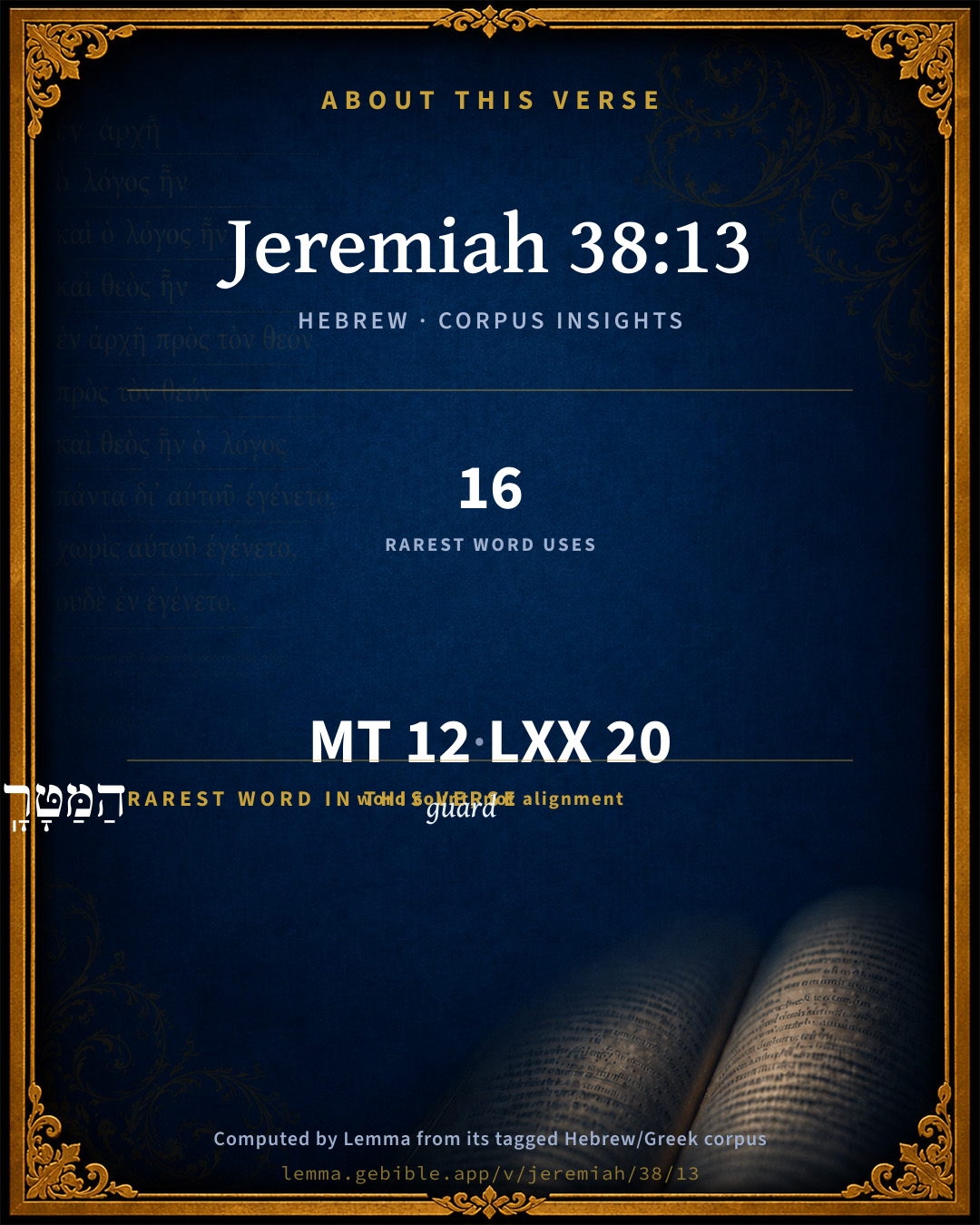
About this verse

These counts appear in no published source. They are computed here, from the morphology-tagged text and Lemma’s own curated glosses. What Lemma adds →

12
words
10
distinct lemmas
Prophets
section

Notable vocabulary

The rarest word here is הַמַּטָּרָֽה guard H4307 — appearing just 16 times in the whole Hebrew Bible.

Shared distinctive vocabulary

הַמַּטָּרָֽה guard H4307 occurs in 15 verses of the Hebrew Bible. Also found in:

Grammatical profile

  • 3 verbs
  • 6 nouns
  • 1 preposition
  • 2 particles

Verb forms

  • וַיִּמְשְׁכ֤וּ Qal · Sequential Imperfect
  • וַיַּעֲל֥וּ Hiphil · Sequential Imperfect
  • וַיֵּ֣שֶׁב Qal · Sequential Imperfect

Repetition

A word recurs within this verse — often emphatic in Hebrew:

  • יִרְמְיָ֨הוּ֙ Jeremiah H3414 ×2

Hebrew & Septuagint length

In the original languages it is 12 Hebrew tokens and 20 Greek tokens — but the two are counted differently (Hebrew bundles its prefixes and suffixes into one token; the Greek is in lemma form), so that isn’t a like-for-like length.

Cross-references

9

Topical passages linked to Jeremiah 38:13 in the Treasury of Scripture Knowledge — connected by theme and wording, ordered by reader-vote popularity; previews shown in the World English Bible.

  • Jeremiah 37:21 Then Zedekiah the king commanded, and they committed Jeremiah into the court of the guard; and they gave him daily a loaf of bread out of the bakers' street, until all the bread in the city was spent. Thus Jeremiah remained in the court of the guard.
  • Acts 23:35 "I will hear you fully when your accusers also arrive." He commanded that he be kept in Herod's palace.
  • Acts 28:16 When we entered into Rome, the centurion delivered the prisoners to the captain of the guard, but Paul was allowed to stay by himself with the soldier who guarded him.
  • Acts 28:30 Paul stayed two whole years in his own rented house, and received all who were coming to him,
  • 1 Kings 22:27 and say, Thus says the king, Put this fellow in the prison, and feed him with bread of affliction and with water of affliction, until I come in peace.
  • Jeremiah 38:6 Then took they Jeremiah, and cast him into the dungeon of Malchijah the king's son, that was in the court of the guard: and they let down Jeremiah with cords. In the dungeon there was no water, but mire; and Jeremiah sank in the mire.
  • Jeremiah 38:28 So Jeremiah abode in the court of the guard until the day that Jerusalem was taken.
  • Jeremiah 39:14–18 they sent, and took Jeremiah out of the court of the guard, and committed him to Gedaliah the son of Ahikam, the son of Shaphan, that he should carry him home: so he lived among the people.
  • Acts 24:23–26 He ordered the centurion that Paul should be kept in custody, and should have some privileges, and not to forbid any of his friends to serve him or to visit him.

Cross-references courtesy of OpenBible.info (CC BY 4.0).

Hebrew and Greek witnesses Masoretic Hebrew ↔ Greek Septuagint

The same verse in the two great witnesses to the Old Testament, shown verse-for-verse.

These are two independent witnesses, not word-aligned to each other, and the Septuagint is shown in lemma (dictionary) form.

Hebrew Jeremiah 38:13 Masoretic · Westminster Leningrad Codex

וַיִּמְשְׁכ֤וּ אֶֽת יִרְמְיָ֨הוּ֙ בַּֽחֲבָלִ֔ים וַיַּעֲל֥וּ אֹת֖וֹ מִן הַבּ֑וֹר וַיֵּ֣שֶׁב יִרְמְיָ֔הוּ בַּחֲצַ֖ר הַמַּטָּרָֽה

So they drew up Jeremiah with the cords, and took him up out of the dungeon: and Jeremiah remained in the court of the guard.

World English Bible · Public Domain

Greek LXX Structure differs

In the Septuagint, Jeremiah is about an eighth shorter than the Hebrew and arranges its material differently — the Oracles Against the Nations (Hebrew chapters 46–51) appear in the middle of the Greek book, after 25:13. Because the chapter and verse boundaries do not line up, a verse-for-verse comparison with the Hebrew is not shown.

A verse-for-verse comparison isn’t shown here because the chapters and verses don’t line up. Switch to the LXX edition with the MT / LXX toggle above to read the Greek directly.

Hebrew: Westminster Leningrad Codex (CC BY 4.0). Greek: Septuagint (public domain); English from a public-domain English Septuagint. How the Septuagint differs from the Hebrew →

Targum (Aramaic paraphrase)

1

The Targum is the ancient Jewish Aramaic paraphrase of the Hebrew Scriptures — an interpretive translation, not the Hebrew text itself. Onkelos (literal) and Pseudo-Jonathan (expansive) render the Torah, and Jonathan the Prophets. Coverage is partial: where no permissively-licensed English translation exists for a verse, only the Aramaic is shown. This is verse-level text, not a word-by-word alignment to the Hebrew.

  1. Targum Jonathan Prophets (Joshua–Malachi)
    וּנְגָדוּ יַת יִרְמְיָה בְּאַטוּנָא וְאַסִיקוּ יָתֵיהּ מִן גוּבָא וִיתֵיב יִרְמְיָה בְּדָרַת בֵּית אֲסִירַיָא:

    (no public-domain English translation for this verse)

    Targum Jonathan — Aramaic: “Mikraot Gedolot” (public domain). English: “Sefaria Community Translation” (CC0 1.0 (public-domain dedication)); “London "Chaldee Paraphrase," 1871” (public domain). Text via Sefaria.

Commentary

Notes on Jeremiah 38:13 from classic Christian and Jewish commentators (each source and its license shown beneath its notes). The classic Christian expositions comment on the surrounding passage and are grouped to its opening verse, so a note may address several verses; the Jewish commentaries on the Tanakh (Rashi and others) are per-verse, so they appear only where the commentator wrote on this verse.

Lemma curates 59 commentaries, every one of them public domain or Creative Commons licensed, each selected and text-cleaned for this edition rather than reprinted as found. About our sources →

Trapp's Complete Commentary

John Trapp

Jer 38:13 So they drew up Jeremiah with cords, and took him up out of the dungeon: and Jeremiah remained in the court of the prison.

Ver. 13. So they drew up Jeremiah with cords.] And God was not unrighteous to forget this their work and labour of love. {Heb 6:10 Jer 39:17-18}

And Jeremiah remained in the court of the prison.] Manacled and fettered, as some {a} gather from Jer 40:4.

{a} R. David, Vatabl.

John Trapp, A Commentary or Exposition upon All the Books of the Old and New Testament (1647–1656) — public domain. Text from a community e-Sword module.

Geneva Bible (1599)

Geneva Bible translators

Where the king had set him before to be at more liberty, as Jer. 37:21.

Geneva Bible (1599) marginal notes — public domain. Text via Bolls.life.

Jamieson, Fausset & Brown

Robert Jamieson, A. R. Fausset & David Brown

court of . . . prison--Ebed-melech prudently put him there to be out of the way of his enemies.

Jamieson, Fausset & Brown — Commentary Critical and Explanatory on the Whole Bible (1871) — public domain (CC PDM 1.0). Text via the HelloAO Bible API.

John Calvin's Commentaries

We here see that the Prophet was rescued from death, not however that he might be set at liberty, and sent home, for that would not have been for his benefit, as he would have been taken again by the king’s counselors. Ebedmelech could not, therefore, save his life otherwise than by having him confined in another part of the prison. He could have wished, no doubt, to have him as a guest in his own house: he doubtless wished to do for him more than he did. But his prudence deserves to be commended, that he placed the Prophet again in prison; for otherwise the fury and cruelty of the princes could not have been mitigated. Then Jeremiah dwelt in the court of the prison.

He was evidently led there by Ebedmelech. If one were to object and say that this was a proof of too much timidity; to this the answer is, that Ebedmelech was not fearful on his own account, but because he saw that he had to do with wild beasts; and he saw that their rage could not otherwise be calmed than by having Jeremiah confined in the prison. Indeed, the whole city was then like a prison, as it is well known; for they were oppressed everywhere with want, and no one could hardly go out of his house. This state of things was then wisely considered by Ebedmelech, for he had not only his own business to attend to, but he also labored to preserve God’s Prophet.

When God at any time relieves our miseries, and yet does not wholly free us from them at once, let us bear them patiently, and call to mind this example of Jeremiah. God, indeed, manifested his power in delivering him, and yet it was his will that he should continue in prison: even thus he effects his work by degrees. If then the full splendor of God’s grace does not shine on us, or if our deliverance is not as yet fully granted, let us allow God to proceed by little and little; and the least alleviation ought to be sufficient for comfort, resignation, and patience. It now follows, —

John Calvin's Commentaries (1540-1563) — public domain. Text from the Calvin Translation Society English edition (1840s-50s) via the Christian Classics Ethereal Library (ccel.org). Calvin's coverage is partial (roughly two-thirds of the Bible); uncommented books and verses are honest gaps, never fabricated. The 19th-century editor's footnotes and remarks are omitted so the notes are faithfully Calvin's own voice.

The Cambridge Bible for Schools and Colleges

gen. ed. J. J. S. Perowne

13. court of the guard] See on Jer_32:2.

The Cambridge Bible for Schools and Colleges (gen. ed. J. J. S. Perowne; Cambridge University Press, 1878–1918) — public domain. Text from a community e-Sword module.

John Gill's Exposition

So they drew up Jeremiah with cords,.... The men that were with Ebedmelech, as many as were necessary; he overlooking, directing, and encouraging:

and he took him out of the dungeon; alive, according to the king's orders and design, and in spite of the prophet's enemies: the thing succeeded according to wish; the Lord ordering and prospering every step:

and Jeremiah remained in the court of the prison; from whence he had been taken, and where he was replaced; Ebedmelech having no warrant to set him at entire liberty; nor would it have been prudent to have solicited that, which might too much have exasperated the princes; and besides, here, according to the king's order, bread was to be given him, as long as there was any in the city; so that it was the most fit and proper place for him to remain in; wherefore what Josephus (x) says, that he dismissed him, and set him free, is not true.

(x) Ut supra. (Antiqu. l. 10. c. 7. sect. 5.)

John Gill's Exposition of the Whole Bible (1746–1763) — public domain (CC PDM 1.0). Text via the HelloAO Bible API.

Matthew Poole's English Annotations

The sense of these verses is obvious. Ebed-melech having received a commission from the king, presently puts it in execution, only because the dungeon was deep, and full of mire, and the prophet possibly not over-well clothed, he prudently takes some old clouts and rags, and lets them down with cords, that Jeremiah, to prevent the galling and macerating his flesh, might put them under the cords, by which they drew him up: thus he was restored to the court of the prison, where he was before this suggestion of the princes, and where he did abide until the city was taken. The rest of the chapter is spent in a private conference betwixt king Zedekiah and the prophet, after he was restored to the court of the prison.

Matthew Poole's English Annotations on the Holy Bible (1683–1685) — public domain. Text from a community e-Sword/MySword module.

Lesson kit

Teaching starters — assembled from the data on this page, not authored interpretation. Every prompt links to the verse data it draws on. Edit before teaching.

Jeremiah, in the Prophets, opens this verse with 12 words (10 distinct Hebrew lemmas). Its most distinctive word is maṭṭârâʼ (“guard”). A historical commentator’s framing appears above. Read the whole chapter for the surrounding context.

Discussion questions

  1. What does “guard” (maṭṭârâʼ) contribute to the verse as a whole?
  2. 1 Samuel 20:20 shares the word «guard» with this verse. How do the two illuminate each other?
  3. “Jeremiah” occurs 2× in this one verse. What is the effect of the repetition?
  4. The translations on this page render this verse differently — a whole-verse word diff, not a word-by-word alignment. What might account for the different wordings?
  5. The verb «וַיִּמְשְׁכ֤וּ» is Qal Sequential Imperfect. How does its form color the action?
  6. Reading how Trapp's Complete Commentary and Geneva Bible (1599) read this verse, where do the two commentators agree and where do they part?

Things to notice

Reading settings

Reading text

Shown beneath each verse's original-language words.

Old Testament
Old Testament edition

Read the OT as the Masoretic Hebrew (MT) or the Greek Septuagint (LXX).

English shown for the Greek Septuagint (in the Hebrew ↔ Greek comparison).

Comparing translations? Open the Compare panel on any verse page to stack up to four side by side.