
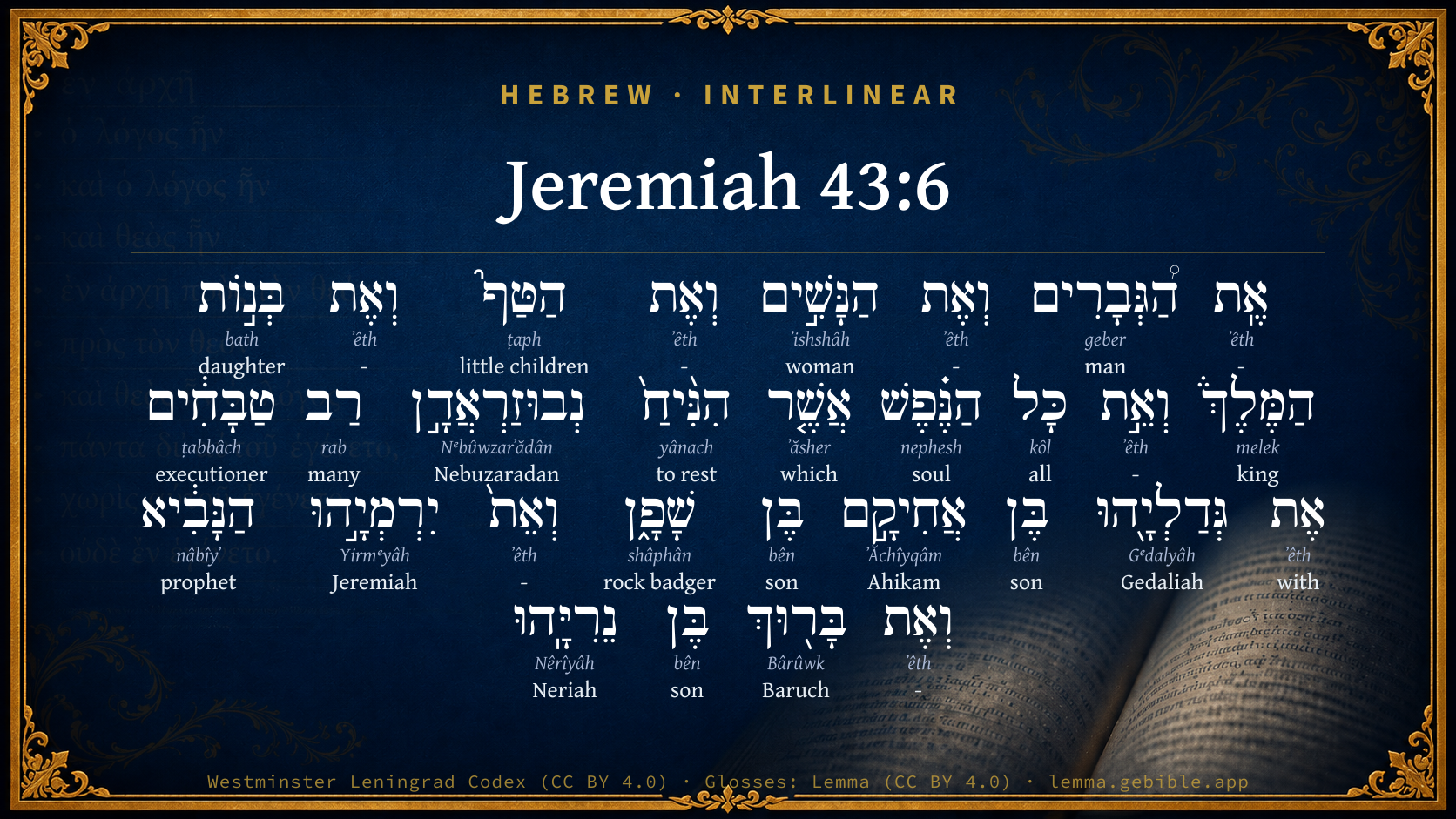
Jeremiah 43:6

Hebrew (Westminster Leningrad Codex) Jeremiah 43:6 appears in the Hebrew Old Testament. The text above is from the Westminster Leningrad Codex. Each word links to its Strong’s number, a concise gloss, and parsing drawn from the Open Scriptures Hebrew Bible morphology. Click any word for its full Brown-Driver-Briggs (BDB) entry.
Download image
Cite this verse

Jeremiah 43:6 (World English Bible). Public Domain. Lemma interlinear Bible study tool, https://lemma.gebible.app/v/jeremiah/43/6.

Show BibTeX & RIS
BibTeX
RIS
English Translation
the men, and the women, and the children, and the king's daughters, and every person who Nebuzaradan the captain of the guard had left with Gedaliah the son of Ahikam, the son of Shaphan; and Jeremiah the prophet, and Baruch the son of Neriah;
World English Bible · Public Domain
Download a study sheet

One document with this verse’s original text, its word-by-word gloss line, the meaning frame, cross-references with their text, attributed commentary, and full source and license credits — printable, and it pastes into notes with its structure intact.

This verse Autodidact and up

Study sheet (.html) Plain text (.txt)

A passage Seminary Student

Up to 50 verses in one chapter. A passage sheet keeps up to 6 commentary sources and 12 cross-references per verse, in the order this page ranks them, and says so on the sheet whenever that leaves anything out. Ask for a single verse and you get the Autodidact verse sheet above.

Everything on this page stays free to read, with no account — the sheet is a download of what is already on screen, not access to it.

Want to remove ads? Support Godless Engineer
Compare translations 3

The same verse in 3 English versions, stacked beneath the original-language interlinear above. Click any original word for its lexicon entry.

Each is an independent rendering of the whole verse — the interlinear is not word-aligned to these translations.

Highlighted words mark where these versions differ — a whole-verse word diff, not a word-by-word alignment.

  • World English Bible Public Domain
    the men, and the women, and the children, and the king's daughters, and every person who Nebuzaradan the captain of the guard had left with Gedaliah the son of Ahikam, the son of Shaphan; and Jeremiah the prophet, and Baruch the son of Neriah;
  • King James Version Public Domain
    Even men, and women, and children, and the king's daughters, and every person that Nebuzaradan the captain of the guard had left with Gedaliah the son of Ahikam the son of Shaphan, and Jeremiah the prophet, and Baruch the son of Neriah.
  • unfoldingWord Literal Text CC BY-SA 4.0
    They took the men and women, the children and the king’s daughters, and every person whom Nebuzaradan, the commander of the king’s bodyguards, had let remain with Gedaliah son of Ahikam son of Shaphan. They also took Jeremiah the prophet and Baruch son of Neriah.

unfoldingWord Literal Text — © unfoldingWord, licensed CC BY-SA 4.0. Word-aligned USFM3 via Door43 (git.door43.org/unfoldingWord/en_ult).

Versions to compare (up to 4)

3 of 4 selected

Show all 18 translations

Every available English version of this verse, each an independent rendering of the whole verse.

  • World English Bible Public Domain
    the men, and the women, and the children, and the king's daughters, and every person who Nebuzaradan the captain of the guard had left with Gedaliah the son of Ahikam, the son of Shaphan; and Jeremiah the prophet, and Baruch the son of Neriah;
  • Berean Standard Bible Public Domain
    the men, the women, the children, the king’s daughters, and everyone whom Nebuzaradan captain of the guard had allowed to remain with Gedaliah son of Ahikam, the son of Shaphan, as well as Jeremiah the prophet and Baruch son of Neriah.
  • Majority Standard Bible Public Domain
    the men, the women, the children, the king’s daughters, and everyone whom Nebuzaradan captain of the guard had allowed to remain with Gedaliah son of Ahikam, the son of Shaphan, as well as Jeremiah the prophet and Baruch son of Neriah.
  • King James Version Public Domain
    Even men, and women, and children, and the king's daughters, and every person that Nebuzaradan the captain of the guard had left with Gedaliah the son of Ahikam the son of Shaphan, and Jeremiah the prophet, and Baruch the son of Neriah.
  • American Standard Version (1901) Public Domain
    the men, and the women, and the children, and the king's daughters, and every person that Nebuzaradan the captain of the guard had left with Gedaliah the son of Ahikam, the son of Shaphan; and Jeremiah the prophet, and Baruch the son of Neriah;
  • Revised Version (1885) Public Domain
    the men, and the women, and the children, and the king’s daughters, and every person that Nebuzaradan the captain of the guard had left with Gedaliah the son of Ahikam, the son of Shaphan, and Jeremiah the prophet, and Baruch the son of Neriah;
  • Geneva Bible (1599) Public Domain
    Euen men and women, and children, and the Kinges daughters, and euery person, that Nebuzar-adan the chiefe steward had left with Gedaliah the sonne of Ahikam, ye sonne of Shaphan, and Ieremiah the Prophet, and Baruch the sonne of Neriah.
  • Douay-Rheims (1899) Public Domain
    Men, and women, and children, and the king's daughters, and every soul, which Nabuzardan the general had left with Godolias the son of Ahicam the son of Saphan, and Jeremias the prophet, and Baruch the son of Nerias.
  • Young's Literal Translation Public Domain
    the men, and the women, and the infant, and the daughters of the king, and every person that Nebuzar-Adan, chief of the executioners, had left with Gedaliah son of Ahikam, son of Shaphan, and Jeremiah the prophet, and Baruch son of Neriah,
  • Literal Standard Version CC BY-SA 4.0
    the men, and the women, and the infant, and the daughters of the king, and every person that Nebuzar-Adan, chief of the executioners, had left with Gedaliah son of Ahikam, son of Shaphan, and Jeremiah the prophet, and Baruch son of Neriah,
  • Unlocked Literal Bible CC BY-SA 4.0
    They took the men and women, the children and the king's daughters, and every person whom Nebuzaradan, the commander of the king's bodyguards, had let remain with Gedaliah son of Ahikam son of Shaphan. They also took Jeremiah the prophet and Baruch son of Neriah.
  • unfoldingWord Literal Text CC BY-SA 4.0
    They took the men and women, the children and the king’s daughters, and every person whom Nebuzaradan, the commander of the king’s bodyguards, had let remain with Gedaliah son of Ahikam son of Shaphan. They also took Jeremiah the prophet and Baruch son of Neriah.
  • Darby Bible Public Domain
    men, and women, and children, and the king's daughters, and every person that Nebuzar-adan the captain of the body-guard had left with Gedaliah the son of Ahikam the son of Shaphan, and Jeremiah the prophet, and Baruch the son of Nerijah;
  • World Messianic Bible Public Domain
    the men, the women, the children, the king’s daughters, and every person who Nebuzaradan the captain of the guard had left with Gedaliah the son of Ahikam, the son of Shaphan; and Jeremiah the prophet, and Baruch the son of Neriah.
  • Webster's Bible Public Domain
    Even men, and women, and children, and the king's daughters, and every person that Nebuzar-adan the captain of the guard had left with Gedaliah the son of Ahikam the son of Shaphan, and Jeremiah the prophet, and Baruch the son of Neriah.
  • Free Bible Version CC BY-SA 4.0
    These included men, women, and children, the king's daughters, and everyone Nebuzaradan the commander of the guard had allowed to remain with Gedaliah, as well as Jeremiah and Baruch.
  • Bible in Basic English Public Domain
    The men and the women and the children and the king's daughters, and every person whom Nebuzaradan, the captain of the armed men, had put under the care of Gedaliah, the son of Ahikam, the son of Shaphan, and Jeremiah the prophet and Baruch, the son of Neriah;
  • JPS Tanakh (1917) Public Domain
    the men, and the women, and the children, and the king's daughters, and every person that Nebuzaradan the captain of the guard had left with Gedaliah the son of Ahikam, the son of Shaphan, and Jeremiah the prophet, and Baruch the son of Neriah;

Literal Standard Version (2020), Covenant Press — licensed CC BY-SA 4.0. Text via the HelloAO Bible API (eBible.org). Unlocked Literal Bible (unfoldingWord) — licensed CC BY-SA 4.0. Text via the HelloAO Bible API (eBible.org). unfoldingWord Literal Text — © unfoldingWord, licensed CC BY-SA 4.0. Word-aligned USFM3 via Door43 (git.door43.org/unfoldingWord/en_ult). Free Bible Version, Dr. Jonathan Gallagher — licensed CC BY-SA 4.0. Text via the HelloAO Bible API (eBible.org).

Word by word

More ways to search: Search by grammar → Find every occurrence → Compare this word →

Practice this passage: Drill this verse → Learn its vocabulary →

נֵרִיָּֽהוּ
Nêrîyâh
H5374
“Neriah”
Noun, Proper
Part of Speech
Noun
Type
Proper
Full BDB Definition

Origin: from H5216 and H3050

TWOT: None

Neriah = "lamp of Jehovah" - son of Maaseiah and father of Baruch and Seraiah
  1. אֶֽת ʼêth H853 “-” Particle, Direct Object
  2. הַ֠גְּבָרִים geber H1397 “the · men” Particle, Definite Article + Noun, Common, Masculine, Plural, Absolute
  3. וְאֶת ʼêth H853 “and · -” Conjunction + Particle, Direct Object
  4. הַנָּשִׁ֣ים ʼishshâh H802 “the · women” Particle, Definite Article + Noun, Common, Feminine, Plural, Absolute
  5. וְאֶת ʼêth H853 “and · -” Conjunction + Particle, Direct Object
  6. הַטַּף֮ ṭaph H2945 “the · little children” Particle, Definite Article + Noun, Common, Masculine, Singular, Absolute
  7. וְאֶת ʼêth H853 “and · -” Conjunction + Particle, Direct Object
  8. בְּנ֣וֹת bath H1323 “daughters of” Noun, Common, Feminine, Plural, Construct
  9. הַמֶּלֶךְ֒ melek H4428 “the · king” Particle, Definite Article + Noun, Common, Masculine, Singular, Absolute
  10. וְאֵ֣ת ʼêth H853 “and · -” Conjunction + Particle, Direct Object
  11. כָּל kôl H3605 “all of” Noun, Common, Masculine, Singular, Construct
  12. הַנֶּ֗פֶשׁ nephesh H5315 “the · soul” Particle, Definite Article + Noun, Common, Both, Singular, Absolute
  13. אֲשֶׁ֤ר ʼăsher H834 “which” Particle, Relative
  14. הִנִּ֨יחַ֙ yânach H3240 “to rest” Verb, Hiphil, Perfect, 3rd Person, Masculine, Singular
  15. נְבוּזַרְאֲדָ֣ן Nᵉbûwzarʼădân H5018 “Nebuzaradan” Noun, Proper
  16. רַב rab H7227 “many of” Noun, Common, Masculine, Singular, Construct
  17. טַבָּחִ֔ים ṭabbâch H2876 “executioners” Noun, Common, Masculine, Plural, Absolute
  18. אֶת ʼêth H854 “with” Preposition
  19. גְּדַלְיָ֖הוּ Gᵉdalyâh H1436 “Gedaliah” Noun, Proper
  20. בֶּן bên H1121 “son of” Noun, Common, Masculine, Singular, Construct
  21. אֲחִיקָ֣ם ʼĂchîyqâm H296 “Ahikam” Noun, Proper
  22. בֶּן bên H1121 “son of” Noun, Common, Masculine, Singular, Construct
  23. שָׁפָ֑ן shâphân H8227 “rock badger” Noun, Proper
  24. וְאֵת֙ ʼêth H853 “and · -” Conjunction + Particle, Direct Object
  25. יִרְמְיָ֣הוּ Yirmᵉyâh H3414 “Jeremiah” Noun, Proper
  26. הַנָּבִ֔יא nâbîyʼ H5030 “the · prophet” Particle, Definite Article + Noun, Common, Masculine, Singular, Absolute
  27. וְאֶת ʼêth H853 “and · -” Conjunction + Particle, Direct Object
  28. בָּר֖וּךְ Bârûwk H1263 “Baruch” Noun, Proper
  29. בֶּן bên H1121 “son of” Noun, Common, Masculine, Singular, Construct

About this verse

These counts appear in no published source. They are computed here, from the morphology-tagged text and Lemma’s own curated glosses. What Lemma adds →

30
words
22
distinct lemmas
Prophets
section

Notable vocabulary

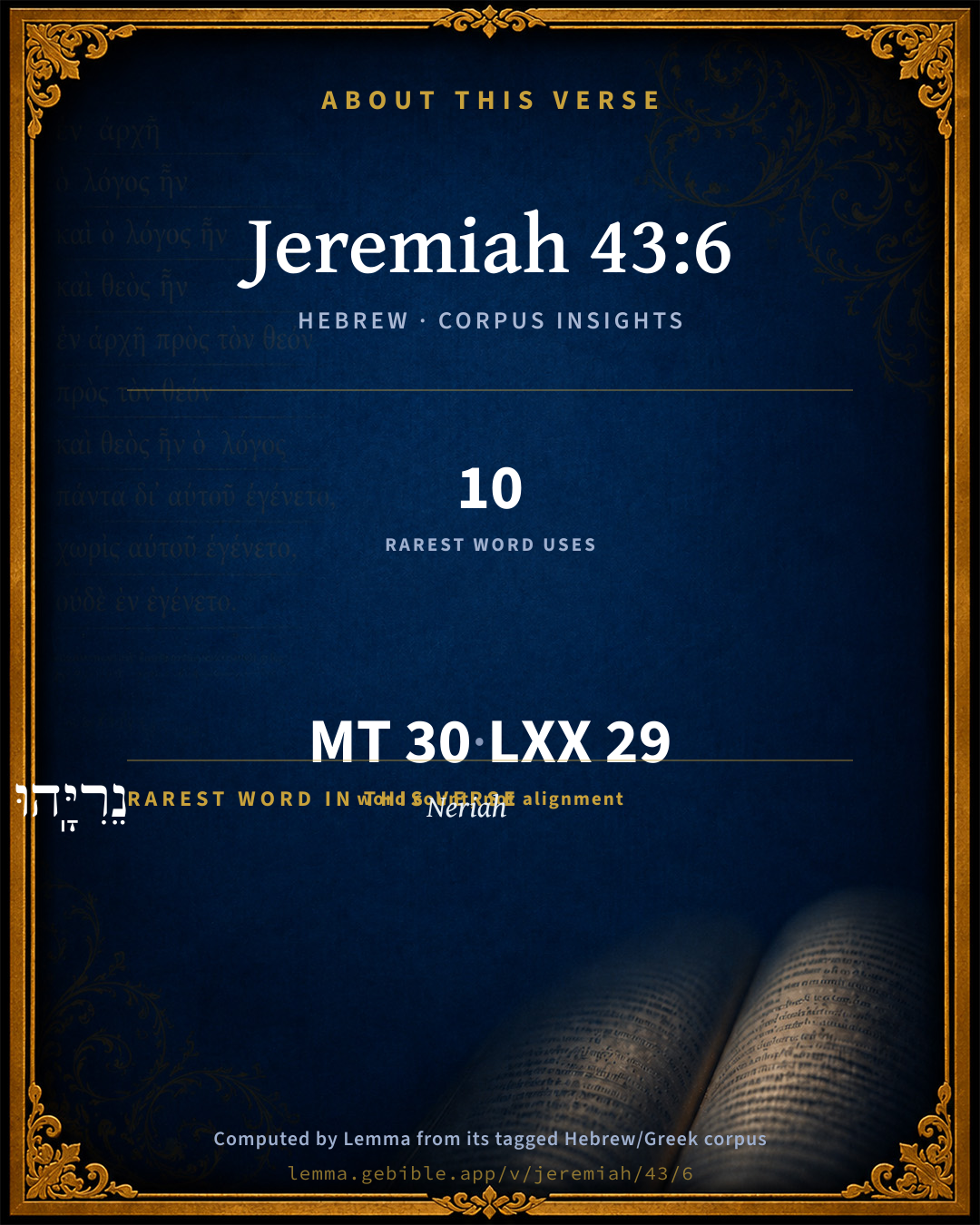
The rarest word here is נֵרִיָּֽהוּ Neriah H5374 — appearing just 10 times in the whole Hebrew Bible.

Shared distinctive vocabulary

נֵרִיָּֽהוּ Neriah H5374 occurs in 10 verses of the Hebrew Bible. Also found in:

Grammatical profile

  • 1 verb
  • 20 nouns
  • 1 preposition
  • 8 particles

Verb forms

  • הִנִּ֨יחַ֙ Hiphil · Perfect

Repetition

A word recurs within this verse — often emphatic in Hebrew:

Hebrew & Septuagint length

In the original languages it is 30 Hebrew tokens and 29 Greek tokens — but the two are counted differently (Hebrew bundles its prefixes and suffixes into one token; the Greek is in lemma form), so that isn’t a like-for-like length.

Cross-references

7

Topical passages linked to Jeremiah 43:6 in the Treasury of Scripture Knowledge — connected by theme and wording, ordered by reader-vote popularity; previews shown in the World English Bible.

  • Jeremiah 39:10 But Nebuzaradan the captain of the guard left of the poor of the people, who had nothing, in the land of Judah, and gave them vineyards and fields at the same time.
  • Jeremiah 40:7 Now when all the captains of the forces who were in the fields, even they and their men, heard that the king of Babylon had made Gedaliah the son of Ahikam governor in the land, and had committed to him men, and women, and children, and of the poorest of the land, of those who were not carried away captive to Babylon;
  • Ecclesiastes 9:1–2 For all this I laid to my heart, even to explore all this: that the righteous, and the wise, and their works, are in the hand of God; whether it is love or hatred, man doesn't know it; all is before them.
  • Jeremiah 41:10 Then Ishmael carried away captive all the residue of the people who were in Mizpah, even the king's daughters, and all the people who remained in Mizpah, whom Nebuzaradan the captain of the guard had committed to Gedaliah the son of Ahikam; Ishmael the son of Nethaniah carried them away captive, and departed to go over to the children of Ammon.
  • Lamentations 3:1 I am the man that has seen affliction by the rod of his wrath.
  • Jeremiah 52:10 The king of Babylon killed the sons of Zedekiah before his eyes: he killed also all the princes of Judah in Riblah.
  • John 21:18 Most assuredly I tell you, when you were young, you dressed yourself, and walked where you wanted to. But when you are old, you will stretch out your hands, and another will dress you, and carry you where you don't want to go."

Cross-references courtesy of OpenBible.info (CC BY 4.0).

Hebrew and Greek witnesses Masoretic Hebrew ↔ Greek Septuagint

The same verse in the two great witnesses to the Old Testament, shown verse-for-verse.

These are two independent witnesses, not word-aligned to each other, and the Septuagint is shown in lemma (dictionary) form.

Hebrew Jeremiah 43:6 Masoretic · Westminster Leningrad Codex

אֶֽת הַ֠גְּבָרִים וְאֶת הַנָּשִׁ֣ים וְאֶת הַטַּף֮ וְאֶת בְּנ֣וֹת הַמֶּלֶךְ֒ וְאֵ֣ת כָּל הַנֶּ֗פֶשׁ אֲשֶׁ֤ר הִנִּ֨יחַ֙ נְבוּזַרְאֲדָ֣ן רַב טַבָּחִ֔ים אֶת גְּדַלְיָ֖הוּ בֶּן אֲחִיקָ֣ם בֶּן שָׁפָ֑ן וְאֵת֙ יִרְמְיָ֣הוּ הַנָּבִ֔יא וְאֶת בָּר֖וּךְ בֶּן נֵרִיָּֽהוּ

the men, and the women, and the children, and the king's daughters, and every person who Nebuzaradan the captain of the guard had left with Gedaliah the son of Ahikam, the son of Shaphan; and Jeremiah the prophet, and Baruch the son of Neriah;

World English Bible · Public Domain

Greek LXX Structure differs

In the Septuagint, Jeremiah is about an eighth shorter than the Hebrew and arranges its material differently — the Oracles Against the Nations (Hebrew chapters 46–51) appear in the middle of the Greek book, after 25:13. Because the chapter and verse boundaries do not line up, a verse-for-verse comparison with the Hebrew is not shown.

A verse-for-verse comparison isn’t shown here because the chapters and verses don’t line up. Switch to the LXX edition with the MT / LXX toggle above to read the Greek directly.

Hebrew: Westminster Leningrad Codex (CC BY 4.0). Greek: Septuagint (public domain); English from a public-domain English Septuagint. How the Septuagint differs from the Hebrew →

Targum (Aramaic paraphrase)

1

The Targum is the ancient Jewish Aramaic paraphrase of the Hebrew Scriptures — an interpretive translation, not the Hebrew text itself. Onkelos (literal) and Pseudo-Jonathan (expansive) render the Torah, and Jonathan the Prophets. Coverage is partial: where no permissively-licensed English translation exists for a verse, only the Aramaic is shown. This is verse-level text, not a word-by-word alignment to the Hebrew.

  1. Targum Jonathan Prophets (Joshua–Malachi)
    יַת גַבְרַיָא וְיַת נְשַׁיָא וְיַת טַפְלָא וְיַת בְּנַת מַלְכָּא וְיַת כָּל נַפְשָׁתָא דִי שְׁבַק נְבוּזַרְאַדָן רַב קָטוֹלַיָא עַל גְדַלְיָה בַּר אֲחִיקָם בַּר שָׁפָן וְיַת יִרְמְיָה נְבִיָא וְיַת בָּרוּךְ בַּר נֵרִיָה:

    (no public-domain English translation for this verse)

    Targum Jonathan — Aramaic: “Mikraot Gedolot” (public domain). English: “Sefaria Community Translation” (CC0 1.0 (public-domain dedication)); “London "Chaldee Paraphrase," 1871” (public domain). Text via Sefaria.

Commentary

Notes on Jeremiah 43:6 from classic Christian and Jewish commentators (each source and its license shown beneath its notes). The classic Christian expositions comment on the surrounding passage and are grouped to its opening verse, so a note may address several verses; the Jewish commentaries on the Tanakh (Rashi and others) are per-verse, so they appear only where the commentator wrote on this verse.

Lemma curates 59 commentaries, every one of them public domain or Creative Commons licensed, each selected and text-cleaned for this edition rather than reprinted as found. About our sources →

Trapp's Complete Commentary

John Trapp

Jer 43:6 [Even] men, and women, and children, and the king’s daughters, and every person that Nebuzaradan the captain of the guard had left with Gedaliah the son of Ahikam the son of Shaphan, and Jeremiah the prophet, and Baruch the son of Neriah.

Ver. 6. And Jeremiah the prophet, and Baruch the son of Neriah.] This was not without a special providence of God, that these desperadoes might still have a prophet with them, for the making of them the more inexcusable. If it befall any of God’s faithful servants to be hurried whither they would not, as it did Jeremiah and Baruch here, Paul also and Peter, {Joh 21:18} Ignatius, Polycarp, and other prisoners and sufferers for the truth in all ages, let them comfort themselves with these examples.

John Trapp, A Commentary or Exposition upon All the Books of the Old and New Testament (1647–1656) — public domain. Text from a community e-Sword module.

Geneva Bible (1599)

Geneva Bible translators

Whom these wicked lead away by force.

Geneva Bible (1599) marginal notes — public domain. Text via Bolls.life.

Jamieson, Fausset & Brown

Robert Jamieson, A. R. Fausset & David Brown

the king's daughters--Zedekiah's (Jer 41:10).

Jamieson, Fausset & Brown — Commentary Critical and Explanatory on the Whole Bible (1871) — public domain (CC PDM 1.0). Text via the HelloAO Bible API.

Adam Clarke's Commentary

Verse 6. Men, and women, and children, and the king's daughters] See the note on Jer 41:10. It is truly surprising that the Chaldeans should have left behind any of the royal family of Judah! But,

1. Perhaps they knew not there were any.

2. If they did know, they might think, being children of concubines, they could not inherit. Or,

3. That being females, they were not eligible. And they had taken care to seize all Zedekiah's sons, and slay them before his eyes.

Adam Clarke's Commentary on the Bible (1810–1826) — public domain. Text from a community e-Sword/MySword module.

John Calvin's Commentaries

The Prophet also mentions particularly who they were; they were men and women and children Some render the last word “puberty,” which I do not approve, since Scripture speaks thus of children. Then John and his associates took childhood, or children; and he adds, the daughters of the king We have before inquired who these daughters of the king were: the probability is that they were his daughters by his concubines; and that they had been put in some safe place, so that if any great evil happened, they might not fall into the hands of enemies. Then these daughters of the king had returned with the other exiles, but were afterwards carried into Egypt.

John Calvin's Commentaries (1540-1563) — public domain. Text from the Calvin Translation Society English edition (1840s-50s) via the Christian Classics Ethereal Library (ccel.org). Calvin's coverage is partial (roughly two-thirds of the Bible); uncommented books and verses are honest gaps, never fabricated. The 19th-century editor's footnotes and remarks are omitted so the notes are faithfully Calvin's own voice.

John Gill's Exposition

Even men, and women, and children, and the king's daughters,.... This, according to the supplement of our version, explains who they were that were taken and had into Egypt, persons of every sex, age, and rank; though rather these words design and describe persons distinct from the former, that came out of other countries; see Jer 41:10;

and every person that Nebuzaradan the captain of the guard had left with Gedaliah the son of Ahikam the son of Shaphan: even the poor of the land to till it; and to whom he gave fields and vineyards, and committed them to the care and government of Gedaliah, when the rest were carried captive to Babylon; and now these, in some sort, may be said to be carried captive by their own brethren into Egypt:

and Jeremiah the prophet, and Baruch the son of Neriah; whom they forced with them, partly to punish them, and partly to give countenance to their conduct; but not without the will of God, who so ordered it in his providence, that they might have the prophet with then, to reprove them for their sins, and warn them of their danger and ruin, and so leave them inexcusable.

John Gill's Exposition of the Whole Bible (1746–1763) — public domain (CC PDM 1.0). Text via the HelloAO Bible API.

Haydock's Catholic Bible Commentary

And Baruch, by compulsion. (Worthington) (Calmet) --- Hence God did not cease to speak by their mouth. (Haydock)

George Leo Haydock (1774–1849), Haydock's Catholic Family Bible and Commentary, 1859 edition — public domain. Excludes Psalms (Douay-Rheims chapter numbering differs from Protestant) and Deuterocanonical books (Catholic canon only).

Matthew Poole's English Annotations

Of

the king’s daughters here mentioned, see Jer 41:10.

Matthew Poole's English Annotations on the Holy Bible (1683–1685) — public domain. Text from a community e-Sword/MySword module.

Lesson kit

Teaching starters — assembled from the data on this page, not authored interpretation. Every prompt links to the verse data it draws on. Edit before teaching.

Jeremiah, in the Prophets, opens this verse with 30 words (22 distinct Hebrew lemmas). Its most distinctive word is Nêrîyâh (“Neriah”). A historical commentator’s framing appears above. Read the whole chapter for the surrounding context.

Discussion questions

  1. How does “Neriah” (Nêrîyâh) shape what this verse is saying?
  2. Jeremiah 32:12 shares the word «Neriah» with this verse. How do the two illuminate each other?
  3. “son” occurs 3× in this one verse. What is the effect of the repetition?
  4. These translations render this verse differently. What is at stake in choosing one wording over another?
  5. The verb «הִנִּ֨יחַ֙» is Hiphil Perfect. How does its form color the action?
  6. Reading how Trapp's Complete Commentary and Geneva Bible (1599) read this verse, where do the two commentators agree and where do they part?

Things to notice

Reading settings

Reading text

Shown beneath each verse's original-language words.

Old Testament
Old Testament edition

Read the OT as the Masoretic Hebrew (MT) or the Greek Septuagint (LXX).

English shown for the Greek Septuagint (in the Hebrew ↔ Greek comparison).

Comparing translations? Open the Compare panel on any verse page to stack up to four side by side.