
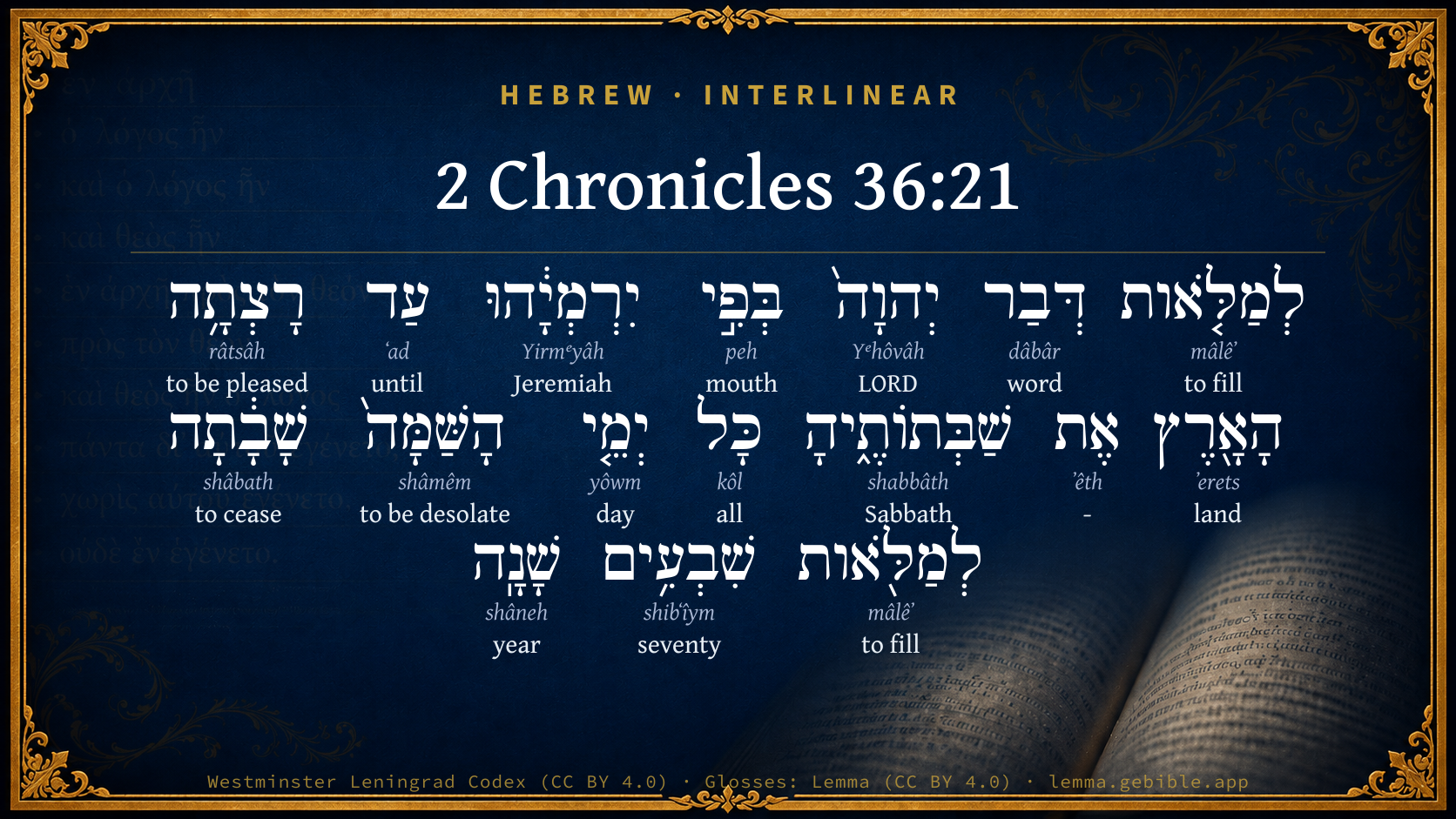
2 Chronicles 36:21

Hebrew (Westminster Leningrad Codex) 2 Chronicles 36:21 appears in the Hebrew Old Testament. The text above is from the Westminster Leningrad Codex. Each word links to its Strong’s number, a concise gloss, and parsing drawn from the Open Scriptures Hebrew Bible morphology. Click any word for its full Brown-Driver-Briggs (BDB) entry.
Download image
Cite this verse

2 Chronicles 36:21 (World English Bible). Public Domain. Lemma interlinear Bible study tool, https://lemma.gebible.app/v/2-chronicles/36/21.

Show BibTeX & RIS
BibTeX
RIS
English Translation
to fulfill the word of Yahweh by the mouth of Jeremiah, until the land had enjoyed its Sabbaths: [for] as long as it lay desolate it kept Sabbath, to fulfill seventy years.
World English Bible · Public Domain
Download a study sheet

One document with this verse’s original text, its word-by-word gloss line, the meaning frame, cross-references with their text, attributed commentary, and full source and license credits — printable, and it pastes into notes with its structure intact.

This verse Autodidact and up

Study sheet (.html) Plain text (.txt)

A passage Seminary Student

Up to 50 verses in one chapter. A passage sheet keeps up to 6 commentary sources and 12 cross-references per verse, in the order this page ranks them, and says so on the sheet whenever that leaves anything out. Ask for a single verse and you get the Autodidact verse sheet above.

Everything on this page stays free to read, with no account — the sheet is a download of what is already on screen, not access to it.

Want to remove ads? Support Godless Engineer
Compare translations 3

The same verse in 3 English versions, stacked beneath the original-language interlinear above. Click any original word for its lexicon entry.

Each is an independent rendering of the whole verse — the interlinear is not word-aligned to these translations.

Highlighted words mark where these versions differ — a whole-verse word diff, not a word-by-word alignment.

  • World English Bible Public Domain
    to fulfill the word of Yahweh by the mouth of Jeremiah, until the land had enjoyed its Sabbaths: [for] as long as it lay desolate it kept Sabbath, to fulfill seventy years.
  • King James Version Public Domain
    To fulfil the word of the LORD by the mouth of Jeremiah, until the land had enjoyed her sabbaths: for as long as she lay desolate she kept sabbath, to fulfil threescore and ten years.
  • unfoldingWord Literal Text CC BY-SA 4.0
    to fulfill the word of Yahweh by the mouth of Jeremiah, until the land restored its Sabbaths. All the days of its being desolate, it kept to fulfill 70 years.

unfoldingWord Literal Text — © unfoldingWord, licensed CC BY-SA 4.0. Word-aligned USFM3 via Door43 (git.door43.org/unfoldingWord/en_ult).

Versions to compare (up to 4)

3 of 4 selected

Show all 18 translations

Every available English version of this verse, each an independent rendering of the whole verse.

  • World English Bible Public Domain
    to fulfill the word of Yahweh by the mouth of Jeremiah, until the land had enjoyed its Sabbaths: [for] as long as it lay desolate it kept Sabbath, to fulfill seventy years.
  • Berean Standard Bible Public Domain
    So the land enjoyed its Sabbath rest all the days of the desolation, until seventy years were completed, in fulfillment of the word of the LORD through Jeremiah.
  • Majority Standard Bible Public Domain
    So the land enjoyed its Sabbath rest all the days of the desolation, until seventy years were completed, in fulfillment of the word of the LORD spoken through Jeremiah.
  • King James Version Public Domain
    To fulfil the word of the LORD by the mouth of Jeremiah, until the land had enjoyed her sabbaths: for as long as she lay desolate she kept sabbath, to fulfil threescore and ten years.
  • American Standard Version (1901) Public Domain
    to fulfil the word of Jehovah by the mouth of Jeremiah, until the land had enjoyed its sabbaths: `for' as long as it lay desolate it kept sabbath, to fulfil threescore and ten years.
  • Revised Version (1885) Public Domain
    to fulfill the word of the LORD by the mouth of Jeremiah, until the land had enjoyed her sabbaths for as long as she lay desolate she kept sabbath, to fulfill threescore and ten years.
  • Geneva Bible (1599) Public Domain
    To fulfill the worde of the Lord by the mouth of Ieremiah, vntill the lande had her fill of her Sabbaths: for all the dayes that she lay desolate, she kept Sabbath, to fulfill seuentie yeeres.
  • Douay-Rheims (1899) Public Domain
    That the word of the Lord by the mouth of Jeremias might be fulfilled, and the land might keep her sabbaths: for all the days of the desolation she kept a sabbath, till the seventy years were expired.
  • Young's Literal Translation Public Domain
    to fulfil the word of Jehovah in the mouth of Jeremiah, till the land hath enjoyed its sabbaths; all the days of the desolation it kept sabbath -- to the fulness of seventy years.
  • Literal Standard Version CC BY-SA 4.0
    to fulfill the word of YHWH in the mouth of Jeremiah, until the land has enjoyed its Sabbaths; all the days of the desolation it kept Sabbath—to the fullness of seventy years.
  • Unlocked Literal Bible CC BY-SA 4.0
    This happened to fulfill the word of Yahweh by the mouth of Jeremiah, until the land should have enjoyed its Sabbath rests. It observed its Sabbath for as long as it lay abandoned, in order to pass seventy years in this way.
  • unfoldingWord Literal Text CC BY-SA 4.0
    to fulfill the word of Yahweh by the mouth of Jeremiah, until the land restored its Sabbaths. All the days of its being desolate, it kept to fulfill 70 years.
  • Darby Bible Public Domain
    to fulfil the word of Jehovah by the mouth of Jeremiah, until the land had enjoyed its sabbaths. All the days of its desolation it kept sabbath, to fulfil seventy years.
  • World Messianic Bible Public Domain
    to fulfill the LORD’s word by Jeremiah’s mouth, until the land had enjoyed its Sabbaths. As long as it lay desolate, it kept Sabbath, to fulfill seventy years.
  • Webster's Bible Public Domain
    To fulfill the word of the LORD by the mouth of Jeremiah, until the land had enjoyed her sabbaths: for as long as she lay desolate she kept sabbath, to fulfill seventy years.
  • Free Bible Version CC BY-SA 4.0
    So to fulfill the Lord's prophecy given through Jeremiah, the land enjoyed its Sabbaths as rest all the time it was left desolate, keeping the Sabbath until seventy years were completed.
  • Bible in Basic English Public Domain
    So that the words of the Lord, which he said by the mouth of Jeremiah, might come true, till the land had had pleasure in her Sabbaths; for as long as she was waste the land kept the Sabbath, till seventy years were complete.
  • JPS Tanakh (1917) Public Domain
    to fulfil the word of the LORD by the mouth of Jeremiah, until the land had been paid her sabbaths; for as long as she lay desolate she kept sabbath, to fulfil threescore and ten years.

Literal Standard Version (2020), Covenant Press — licensed CC BY-SA 4.0. Text via the HelloAO Bible API (eBible.org). Unlocked Literal Bible (unfoldingWord) — licensed CC BY-SA 4.0. Text via the HelloAO Bible API (eBible.org). unfoldingWord Literal Text — © unfoldingWord, licensed CC BY-SA 4.0. Word-aligned USFM3 via Door43 (git.door43.org/unfoldingWord/en_ult). Free Bible Version, Dr. Jonathan Gallagher — licensed CC BY-SA 4.0. Text via the HelloAO Bible API (eBible.org).

Word by word

More ways to search: Search by grammar → Find every occurrence → Compare this word →

Practice this passage: Drill this verse → Learn its vocabulary →

רָצְתָ֥ה
râtsâh
H7521
“to be pleased”
Verb, Qal, Perfect, 3rd Person, Feminine, Singular
Part of Speech
Verb
Stem
Qal
Form
Perfect
Person
3rd Person
Gender
Feminine
Number
Singular
Full BDB Definition

Origin: a primitive root

TWOT: 2207

to be pleased with, be favourable to, accept favourably - (Qal) - to be pleased with, be favourable to - to accept - to be pleased, be determined - to make acceptable, satisfy - to please - (Niphal) to be accepted, be pleased with - (Piel) to seek favour of - (Hiphil) to please, pay off - (Hithpael) to make oneself acceptable or pleasing
  1. לְמַלֹּ֤אות mâlêʼ H4390 “to fill” Preposition + Verb, Piel, Infinitive Construct
  2. דְּבַר dâbâr H1697 “word of” Noun, Common, Masculine, Singular, Construct
  3. יְהוָה֙ Yᵉhôvâh H3068 “LORD” Noun, Proper
  4. בְּפִ֣י peh H6310 “in/at · mouth of” Preposition + Noun, Common, Masculine, Singular, Construct
  5. יִרְמְיָ֔הוּ Yirmᵉyâh H3414 “Jeremiah” Noun, Proper
  6. עַד ʻad H5704 “until” Preposition
  7. הָאָ֖רֶץ ʼerets H776 “the · land” Particle, Definite Article + Noun, Common, Both, Singular, Absolute
  8. אֶת ʼêth H853 “-” Particle, Direct Object
  9. שַׁבְּתוֹתֶ֑יהָ shabbâth H7676 “Sabbaths · her” Noun, Common, Both, Plural, Construct + Suffix, Personal, 3rd Person, Feminine, Singular
  10. כָּל kôl H3605 “all of” Noun, Common, Masculine, Singular, Construct
  11. יְמֵ֤י yôwm H3117 “days of” Noun, Common, Masculine, Plural, Construct
  12. הָשַּׁמָּה֙ shâmêm H8074 “to be desolate · her” Verb, Hophal, Infinitive Construct + Suffix, Personal, 3rd Person, Feminine, Singular
  13. שָׁבָ֔תָה shâbath H7673 “to cease” Verb, Qal, Perfect, 3rd Person, Feminine, Singular
  14. לְמַלֹּ֖אות mâlêʼ H4390 “to fill” Preposition + Verb, Piel, Infinitive Construct
  15. שִׁבְעִ֥ים shibʻîym H7657 “seventy” Adjective, Cardinal number, Both, Plural, Absolute
  16. שָׁנָֽה shâneh H8141 “year” Noun, Common, Feminine, Singular, Absolute

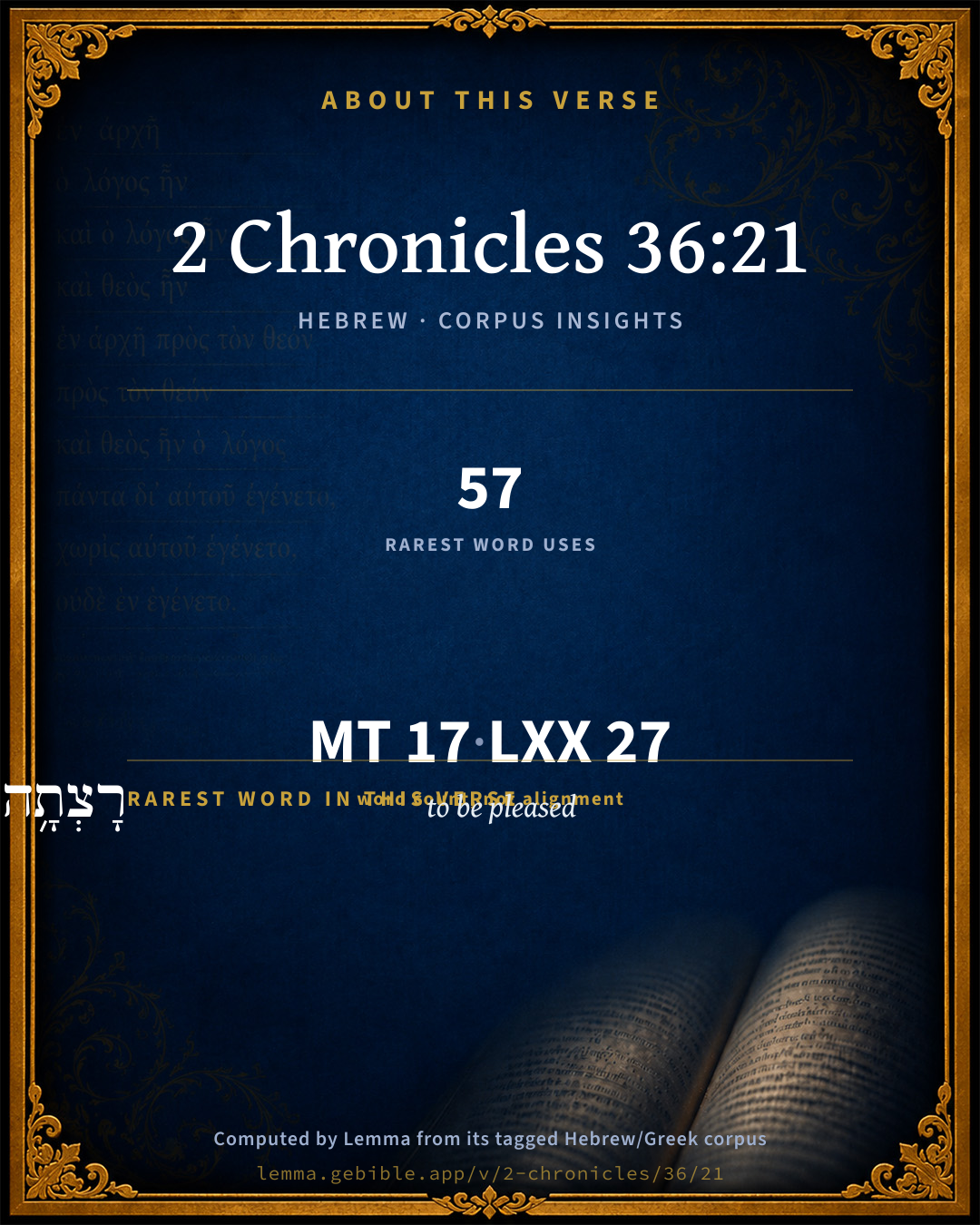
About this verse

These counts appear in no published source. They are computed here, from the morphology-tagged text and Lemma’s own curated glosses. What Lemma adds →

17
words
16
distinct lemmas
Historical
section

Shared distinctive vocabulary

רָצְתָ֥ה to be pleased H7521 occurs in 55 verses of the Hebrew Bible. Also found in:

Grammatical profile

  • 5 verbs
  • 9 nouns
  • 1 adjective
  • 1 preposition
  • 1 particle

Verb forms

  • לְמַלֹּ֤אות Piel · Infinitive Construct
  • רָצְתָ֥ה Qal · Perfect
  • הָשַּׁמָּה֙ Hophal · Infinitive Construct
  • שָׁבָ֔תָה Qal · Perfect
  • לְמַלֹּ֖אות Piel · Infinitive Construct

Repetition

A word recurs within this verse — often emphatic in Hebrew:

  • לְמַלֹּ֤אות to fill H4390 ×2

Hebrew & Septuagint length

In English translation the verse runs 32 words from the Hebrew and 38 from the Septuagint (LXX English) — closely comparable.

A rough comparison of the two English renderings, which tokenize alike — not a word-level alignment.

Word counts can differ between the Hebrew and the Greek without any difference in meaning — e.g. the Hebrew direct-object marker אֵת has no separate Greek word, and Greek often adds the article ὁ.

In the original languages it is 17 Hebrew tokens and 27 Greek tokens — but the two are counted differently (Hebrew bundles its prefixes and suffixes into one token; the Greek is in lemma form), so that isn’t a like-for-like length.

Cross-references

11

Topical passages linked to 2 Chronicles 36:21 in the Treasury of Scripture Knowledge — connected by theme and wording, ordered by reader-vote popularity; previews shown in the World English Bible.

  • Jeremiah 29:10 For thus says Yahweh, After seventy years are accomplished for Babylon, I will visit you, and perform my good word toward you, in causing you to return to this place.
  • Leviticus 26:34–35 Then the land will enjoy its sabbaths as long as it lies desolate and you are in your enemies' land. Even then the land will rest and enjoy its sabbaths.
  • Jeremiah 25:11–12 This whole land shall be a desolation, and an astonishment; and these nations shall serve the king of Babylon seventy years.
  • Daniel 9:2 in the first year of his reign I, Daniel, understood by the books the number of the years about which the word of Yahweh came to Jeremiah the prophet, for the accomplishing of the desolations of Jerusalem, even seventy years.
  • Zechariah 1:12 Then the angel of Yahweh replied, "O Yahweh of Hosts, how long will you not have mercy on Jerusalem and on the cities of Judah, against which you have had indignation these seventy years?"
  • Leviticus 26:43 The land also will be left by them, and will enjoy its sabbaths while it lies desolate without them: and they will accept the punishment of their iniquity; because, even because they rejected my ordinances, and their soul abhorred my statutes.
  • Leviticus 25:4–6 but in the seventh year there shall be a Sabbath of solemn rest for the land, a Sabbath to Yahweh. You shall not sow your field or prune your vineyard.
  • Jeremiah 25:9 behold, I will send and take all the families of the north, says Yahweh, and [I will send] to Nebuchadrezzar the king of Babylon, my servant, and will bring them against this land, and against the inhabitants of it, and against all these nations round about; and I will utterly destroy them, and make them an astonishment, and a hissing, and perpetual desolations.
  • Jeremiah 26:6–7 then will I make this house like Shiloh, and will make this city a curse to all the nations of the earth.
  • Jeremiah 27:12–13 I spoke to Zedekiah king of Judah according to all these words, saying, Bring your necks under the yoke of the king of Babylon, and serve him and his people, and live.
  • Zechariah 1:4–6 Don't you be like your fathers, to whom the former prophets proclaimed, saying: Thus says Yahweh of hosts, 'Return now from your evil ways, and from your evil doings;' but they did not hear, nor listen to me, says Yahweh.

Cross-references courtesy of OpenBible.info (CC BY 4.0).

Hebrew and Greek witnesses Masoretic Hebrew ↔ Greek Septuagint

The same verse in the two great witnesses to the Old Testament, shown verse-for-verse.

These are two independent witnesses, not word-aligned to each other, and the Septuagint is shown in lemma (dictionary) form.

Hebrew 2 Chronicles 36:21 Masoretic · Westminster Leningrad Codex

לְמַלֹּ֤אות דְּבַר יְהוָה֙ בְּפִ֣י יִרְמְיָ֔הוּ עַד רָצְתָ֥ה הָאָ֖רֶץ אֶת שַׁבְּתוֹתֶ֑יהָ כָּל יְמֵ֤י הָשַּׁמָּה֙ שָׁבָ֔תָה לְמַלֹּ֖אות שִׁבְעִ֥ים שָׁנָֽה

to fulfill the word of Yahweh by the mouth of Jeremiah, until the land had enjoyed its Sabbaths: [for] as long as it lay desolate it kept Sabbath, to fulfill seventy years.

World English Bible · Public Domain

Greek LXX 2 Chronicles 36:21 Septuagint · lemma form

ὁ πληρόω λόγος κύριος διά στόμα ἰερεμίας ἕως ὁ προςδέχομαι ὁ γῆ ὁ σάββατον αὐτός σαββατίζω πᾶς ὁ ἡμέρα ὁ ἐρημώσις αὐτός σαββατίζω εἰς συνπληρόω ἔτος ἑβδομήκοντα

That the word of the Lord by the mouth of Jeremias might be fulfilled, until the land should enjoy its sabbaths in resting and sabbath keeping all the days of its desolation, till the accomplishment of seventy years.

LXX2012 (modern English Septuagint) · Public Domain

Hebrew: Westminster Leningrad Codex (CC BY 4.0). Greek: Septuagint (public domain); English from LXX2012 (modern English Septuagint) (Public Domain). How the Septuagint differs from the Hebrew →

Commentary

Notes on 2 Chronicles 36:21 from classic Christian and Jewish commentators (each source and its license shown beneath its notes). The classic Christian expositions comment on the surrounding passage and are grouped to its opening verse, so a note may address several verses; the Jewish commentaries on the Tanakh (Rashi and others) are per-verse, so they appear only where the commentator wrote on this verse.

Lemma curates 59 commentaries, every one of them public domain or Creative Commons licensed, each selected and text-cleaned for this edition rather than reprinted as found. About our sources →

Trapp's Complete Commentary

John Trapp

2Ch 36:21 To fulfil the word of the LORD by the mouth of Jeremiah, until the land had enjoyed her sabbaths: [for] as long as she lay desolate she kept sabbath, to fulfil threescore and ten years.

Ver. 21. To fulfil the word of the Lord.] See Jer 25:9; Jer 25:12; Jer 29:10 Dan 9:2.

Until the land had enjoyed her Sabbaths.] As had likewise been foretold. {Lev 26:34-35; Lev 23:32} The land was eased from the wicked weight of such inhabitants, which brought upon it heavy curses, and toiled and tired it out with continual tillage.

John Trapp, A Commentary or Exposition upon All the Books of the Old and New Testament (1647–1656) — public domain. Text from a community e-Sword module.

Joseph Benson's Commentary

2Ch 36:21. Until the land had enjoyed her sabbaths — “God had commanded them to let their land rest every seventh year; and because the Jews had violated this, as well as other precepts, God gave their land a long sabbath, or rest, for no less than ten times seven years, which Jeremiah threatened, as in the margin. If it be true, that they had neglected this law for the space of four hundred and ninety years, having ploughed their ground in the seventh as well as in other years, then the judgment of God upon them was very remarkable, in causing their ground to rest, and be free from tillage, just as long as it should have been if they had observed his law. For in those four hundred and ninety years, says Procopius Gazæus, when they were under the government of kings, there were seventy years to be kept as sabbaths, which, that the land might enjoy its sabbath, were spent in the captivity of Babylon. Their punishment, too, was made more remarkable in this particular, if it be true, as some have observed, that both the kingdom of Samaria and the kingdom of Judah were destroyed in a sabbatical year; and that immediately after a jubilee, the city and temple were destroyed by Titus, according to Scaliger’s computation.” See Patrick, Calmet, and Dodd.

Joseph Benson's Commentary on the Old and New Testaments (1811–1818) — public domain. Text from a community e-Sword module.

Tyndale Open Study Notes

Tyndale Open Resources

36:21 The length of the captivity had been predicted by Jeremiah (Jer 25:11-12; 29:10; see study note on Ezra 6:15). • The land finally enjoyed its Sabbath rest: See Lev 26:34-35, 43, where the punishment for disobedience is exile; the land is left unused for all the Sabbaths of which it had been deprived. The land’s time of rest was also a preparation for the time of restoration. • the prophet: That is, Jeremiah.

Tyndale Open Study Notes — © Tyndale Open Resources, licensed CC BY-SA 4.0. Text via the HelloAO Bible API.

Geneva Bible (1599)

Geneva Bible translators

Who threatened the vengeance of God and seventy years captivity, which he calleth the Sabbaths or rest of the land, Jer. 25:11.

Geneva Bible (1599) marginal notes — public domain. Text via Bolls.life.

Jamieson, Fausset & Brown

Robert Jamieson, A. R. Fausset & David Brown

until the land had enjoyed her sabbaths--The return of every seventh was to be held as a sabbatic year, a season of rest to all classes, even to the land itself, which was to be fallow. This divine institution, however, was neglected--how soon and how long, appears from the prophecy of Moses (see on Lev 26:34), and of Jeremiah in this passage (see Jer 25:9-12), which told that for divine retribution it was now to remain desolate seventy years. As the Assyrian conquerors usually colonized their conquered provinces, so remarkable a deviation in Palestine from their customary policy must be ascribed to the overruling providence of God.

Jamieson, Fausset & Brown — Commentary Critical and Explanatory on the Whole Bible (1871) — public domain (CC PDM 1.0). Text via the HelloAO Bible API.

Adam Clarke's Commentary

Verse 21. To fulfill the word of the Lord] See Jer 25:9, Jer 25:12; Jer 26:6-7; Jer 29:12. For the miserable death of Zedekiah, see 2Kg 25:4, c.

Adam Clarke's Commentary on the Bible (1810–1826) — public domain. Text from a community e-Sword/MySword module.

Ellicott's Commentary for English Readers

(21) To fulfil.—lĕmalûth (an Aramaised form).

The word . . . Jeremiah.—The seventy years of Babylonian exile are predicted in Jer_25:11-12. (Comp. also Jer_29:10 : “Thus saith the Lord, After seventy years be accomplished for Babylon, I will visit you.”)

Until the land had enjoyed her sabbaths.—“Enjoyed” is râçĕthâh, which Gesenius renders persolvit, “made good,” “discharged,” as a debt. The meaning is that during the long years of the exile, the land would enjoy that rest of which it had been defrauded by the neglect of the law concerning the sabbatical years (Lev_25:1-7). The following words, “as long as she lay desolate she kept sabbath” (literally, all the days of the desolation she rested) are taken from Lev_26:34-35.

To fulfil threescore and ten years.—i.e., in order to fulfil the seventy years of exile foretold by Jeremiah.

We have no right whatever to press the words of the sacred writer, in the sense of assuming that he means to say that when Jerusalem was taken by the Chaldeans exactly seventy sabbatical years had been neglected—that is, that the law in this respect had not been observed for 490 years (70×7), or ever since the institution of monarchy in Israel (490 + 588 = 1,078).

The seventy years are reckoned from the 4th of Jehoiakim, when the prophecy was uttered (Jer_25:1; Jer_25:12), to the first year of Cyrus, and the return under Zernbbabel, 536 B.C.

THE EDICT OF CYRUS, AUTHORISING THE RETURN (2Ch_36:22-23). (Comp. Ezr_1:1-3; 3 Esdr. 2:1-5; Isa_44:28; Isaiah 45-47)

(22) Now in the first year of Cyrus.—This verse is the same as Ezr_1:1, save that it has “by the mouth “instead of “from the mouth.” The latter is probably correct. (Comp. 2Ch_36:12 supra.) So some MSS. here also.

That the word . . . Jeremiah.—Concerning the seventy years.

Stirred up the spirit.—1Ch_5:26;2Ch_21:16.

That he made a proclamation.—And he made a voice pass (2Ch_30:5).

Throughout all his kingdom . . . and put it also in writing.—Into all . . . and also into a writing.

Writing.—Miktâb (2Ch_35:4.)

The Lord.—Iahweh. Instead of this Ezr_1:3 has, Iehi, “Be;” so also 3 Esdr. 2:5. “The Lord—with him!” (Iahiveh ‘immô) is a frequent formula in the chronicle, and is probably correct here. (Some Hebrew MSS. and the Vulg. unite the readings.)

And let him go up.—Whither The sentence is abruptly broken off here, but continued in Ezr_1:3. As to the relation between the Chronicles and Ezra, see Introduction.

Thus saith Cyrus, king of Persia.—Comp. the words of Darius Hystaspes on the famous Behistuu Inscription, which begins “I am Darius, the great king, the king of kings, the king of Persia;” while every paragraph opens with “Saith Darius the king.”

All the kingdoms . . . given me.—Comp. the words of Darius: “Saith Darius the king :—By the grace of Ormazd I am king; Ormazd has granted me the empire.”

The Lord God of heaven.—Jehovah, the God of heaven. “The god of heaven” was a title of Ormazd or Ahuramazda, the Supreme Being according to Persian belief, which was Zoroastrianism. It is not at all wonderful that Cyrus should have identified the God of Israel with his own deity, especially if he had heard of the prophecies Isa_44:28, &c. Such a politic syncretism was the settled practice of the Roman empire in a later age.

A Bible Commentary for English Readers, edited by Charles John Ellicott (1878–1897) — public domain. Text from a community e-Sword module.

The Cambridge Bible for Schools and Colleges

gen. ed. J. J. S. Perowne

21. by the mouth of Jeremiah] Cp. Jer_25:11; Jer_29:10.

until the land had enjoyed her sabbaths] Cp. Lev_25:1-7; Lev_26:34-35.

threescore and ten years] i.e. two whole generations. It is very unlikely that the Chronicler intended to suggest that the Sabbatical years had been neglected throughout the period (about 490 = 70 × 7 years) during which the kingdom lasted, for he mentions several God-fearing kings (David, Solomon, Jehoshaphat) whose reigns would need to be subtracted from this total, so that the number of violated Sabbatical years would fall considerably below 70.

The Cambridge Bible for Schools and Colleges (gen. ed. J. J. S. Perowne; Cambridge University Press, 1878–1918) — public domain. Text from a community e-Sword module.

Albert Barnes' Notes on the Bible

See the marginal references. The 70 years of desolation prophesied by Jeremiah, commenced in the fourth year of Jehoiakim (Jer 25:1, Jer 25:12; compare Dan 1:1), or 605 B.C.; and should therefore have terminated, if they were fully complete, in 536 B.C. As, however, the historical date of the taking of Babylon by Cyrus is 538 B.C., or two years earlier, it has been usual to suppose that the Jews reckoned “the reign of the kingdom of Persia” as commencing two years after the capture of Babylon, on the death or supersession of “Darius the Mede.” But the term “seventy” may be taken as a round number, and the prophecy as sufficiently fulfilled by a desolation which lasted 68 years.

Until the land had enjoyed her sabbaths - Between the time of Moses and the commencement of the captivity, there had been (about) 70 occasions on which the Law of the sabbatical year Lev 25:4-7 had been violated.

Albert Barnes' Notes on the Bible (1834–1885) — public domain. Text from a community e-Sword/MySword module.

Haydock's Catholic Bible Commentary

Sabbaths, every seventh year, Lev. xxv. 2., and xxvi. 43., and Jeremias xxv. 11., and xxix. 10. --- Expired: not that the earth was quite neglected, all that time, from the third year of Joakim, the year of the world 3398 till 3468. C. --- But it was almost: particularly after the murder of Godolias, (M.) the public worship was at a stand, &c. H. --- During this fifth age, the true religion subsisted invariable, not only in the kingdom of Juda, but also in that of Israel. See W. H.

George Leo Haydock (1774–1849), Haydock's Catholic Family Bible and Commentary, 1859 edition — public domain. Excludes Psalms (Douay-Rheims chapter numbering differs from Protestant) and Deuterocanonical books (Catholic canon only).

Matthew Poole's English Annotations

Had enjoyed her sabbaths, i.e. had rested from the labour of the husbandmen in ploughing and harrowing it, &c., the people that should have managed it being destroyed. Of the phrase, See Poole "Lev 25:2".

To fulfil threescore and ten years; that so the seventy years’ captivity prophesied of by Jeremiah might be accomplished.

Matthew Poole's English Annotations on the Holy Bible (1683–1685) — public domain. Text from a community e-Sword/MySword module.

Whedon's Commentary on the Bible

Daniel D. Whedon

21. The word of the Lord by… Jeremiah — Jer_25:9-12; Jer_29:10; and the note on Ezr_1:1.

Until the land had enjoyed her sabbaths — See Lev_26:34-35; Lev_26:43. We need not assume that the observance of the sabbatic years had been neglected exactly seventy times in succession, or for the period of four hundred and ninety years preceding this exile. But it is probable that during the thousand years between Moses and the Babylonish exile as many as seventy sabbatic years had been neglected, and, at last, judgment that had seemed to slumber long, exacted all.

THE PROCLAMATION OF CYRUS, 2Ch_36:22-23.

For exposition of these verses, see notes on Ezr_1:1-4.

As the books of Kings end with a notice of Jehoiachin’s release from prison, thus shedding a ray of light on Judah’s future, (see note on 2Ki_25:30,) so these Chronicles close with a recital of the proclamation of Cyrus, the Lord’s anointed shepherd, of whom Isaiah (Isa_44:28; Isa_45:1) had prophesied long years before as “saying to Jerusalem, Thou shalt be built, and to the temple, Thy foundation shall be laid.” It was a sound of grace, the trumpet blast that shook the dry bones of fallen Israel, (Eze_37:1-14,) and raised the nation to a new and purer life. It was the opening of a new age, and our author felt he could not close his work without directing the eye of his reader across the dark gulf of his people’s exile to the dawn of a brighter era.

Daniel D. Whedon (gen. ed.), Commentary on the Old and New Testaments (1874–1909) — public domain. Text from a community e-Sword module.

The Pulpit Commentary

The word of the Lord. Note marginal references. (Jer_25:9-12 Jer_29:10) The three score and ten years of desolateness may probably best be dated from Nebuchadnezzar"s first taking of Jerusalem, B.C. 606-5. Although this date does not tally exactly with the B.C. 538 of Cyrus"s conquest of Babylon, yet the discrepancy is easily explained on more than one sufficiently natural supposition (e.g. that Cyrus"s reign was not exactly synchronous in the beginning of it with his conquest of Babylon, etc.). Enjoyed her sabbaths. (see Lev_26:34, Lev_26:35, Lev_26:43-46)

The Pulpit Commentary (1880–1919), ed. H.D.M. Spence-Jones & Joseph S. Exell — public domain. Text from a community e-Sword module.

John Wesley's Explanatory Notes

Sabbaths - Had rested from the labour of the husbandman in plowing and harrowing it; the people that should have managed it being destroyed. Many a time had they ploughed and sowed their land in the seventh year, when it should have rested: and now it lay unploughed and unsown for ten times seven years. Yet even this might encourage them to hope, that they should in due time return to it again. Had others come and taken possession of it, they might have despaired of ever recovering it. But while it lay desolate, it, as it were, waited for them, and refused to acknowledge any other owners.

John Wesley, Explanatory Notes Upon the Whole Bible (1754–1765) — public domain. Text via the GEBible commentary corpus.

Rashi

Rabbi Shlomo Yitzchaki (Rashi)

until the land was appeased for its Sabbaths Because prior to that, the land was not appeased for its Sabbaths.

all the days of its desolation it rested until the completion of seventy years [corresponding to] the Sabbatical and Jubilee years that Israel had neglected to observe in the land, and corresponding to them they were exiled for seventy years. The land of Israel rested for those seventy years. The Israelites provoked [God] in their land for 430 years. These included 390 years from the time they entered the land until the ten tribes were exiled therefrom, and they are explained (as follows): 243 years from the time Jeroboam ascended the throne until Hoshea the son of Elah was exiled, and 111 years during the administration of the judges, when they provoked [Him], and the rest are obscure. That is what is stated in Ezekiel (4:4ff.): “And you shall lie on your left side, and you shall place the iniquity of the house of Israel, etc., 390 days, etc. And when you complete these, you shall lie on your right a second time, and you shall bear the iniquity of the house of Judah, 40 days, a day for a year, a day for a year.” This teaches that the house of Judah sinned from the time that the ten tribes were exiled until Jerusalem was destroyed, for 40 years. How so? Twenty-two years of Manasseh, as it is written (II Kings 21:3): “according to all that Ahab did,” and Ahab reigned 22 years (and he [Manasseh] repented for thirty-three years, totaling fifty-five years.) Add 2 years of Amon, and 11 of Jehoiakim, totaling thirty-five years, and this prophecy was transmitted to Ezekiel in the 5th year of Zedekiah, totaling 40 years. The sum total of them all, of both Israel and Judah, is 430 years. Note that there are 64 Sabbatical and Jubilee years in 400 years. There are 5 Sabbatical years in 35 years, totaling 69, and the last Jubilee year was counted for them as iniquity, for because of their iniquity they were exiled therefrom. Hence the 70 hallowed years of Shemittah that Israel did not observe. They were consequently exiled for seventy years to fulfill what was said, (Lev. 26:34): “Then the land will be appeased regarding its Sabbaths.” So it is explained in Seder Olam (see ch. 26). Chronicles is concluded with this since he says: “until the completion of seventy years.” He had to state these verses and those of Ezra (in the beginning) to let us know that when those seventy years were over, “the wheel rotated” and they returned to their land. He therefore said here: “in the first year of Cyrus, the king of Persia” until “Who among you is of all His people, etc., and he may ascend.” The reason that the “vav” [and] of “And in the first year” is added, is because the Book of Daniel intervenes, for the book of Ezra continues in sequence after the Book of Daniel, and this “vav” connects them together.”

Rashi on the Tanakh — English translations: “The Judaica Press complete Tanach with Rashi, translated by A. J. Rosenberg” (CC BY 4.0); “Pentateuch with Rashi's commentary by M. Rosenbaum and A.M. Silbermann, 1929-1934” (public domain); “The Metsudah Tanach series, Lakewood, N.J” (CC BY 4.0); and “The Book of Joshua, Metsudah Publications, 1997” (CC BY 4.0). Text via Sefaria.

Lesson kit

Teaching starters — assembled from the data on this page, not authored interpretation. Every prompt links to the verse data it draws on. Edit before teaching.

2 Chronicles, in the Historical, opens this verse with 17 words (16 distinct Hebrew lemmas). Its most distinctive word is râtsâh (“to be pleased”). A historical commentator’s framing appears above. Read the whole chapter for the surrounding context.

Discussion questions

  1. The word râtsâh carries the sense “to be pleased.” How does it shape the verse?
  2. Genesis 33:10 shares the word «to be pleased» with this verse. How do the two illuminate each other?
  3. “to fill” occurs 2× in this one verse. What is the effect of the repetition?
  4. These translations render this verse differently. What is at stake in choosing one wording over another?
  5. The verb «לְמַלֹּ֤אות» is Piel Infinitive Construct. How does its form color the action?
  6. Reading how Trapp's Complete Commentary and Joseph Benson's Commentary read this verse, where do the two commentators agree and where do they part?

Things to notice

Reading settings

Reading text

Shown beneath each verse's original-language words.

Old Testament
Old Testament edition

Read the OT as the Masoretic Hebrew (MT) or the Greek Septuagint (LXX).

English shown for the Greek Septuagint (in the Hebrew ↔ Greek comparison).

Comparing translations? Open the Compare panel on any verse page to stack up to four side by side.