
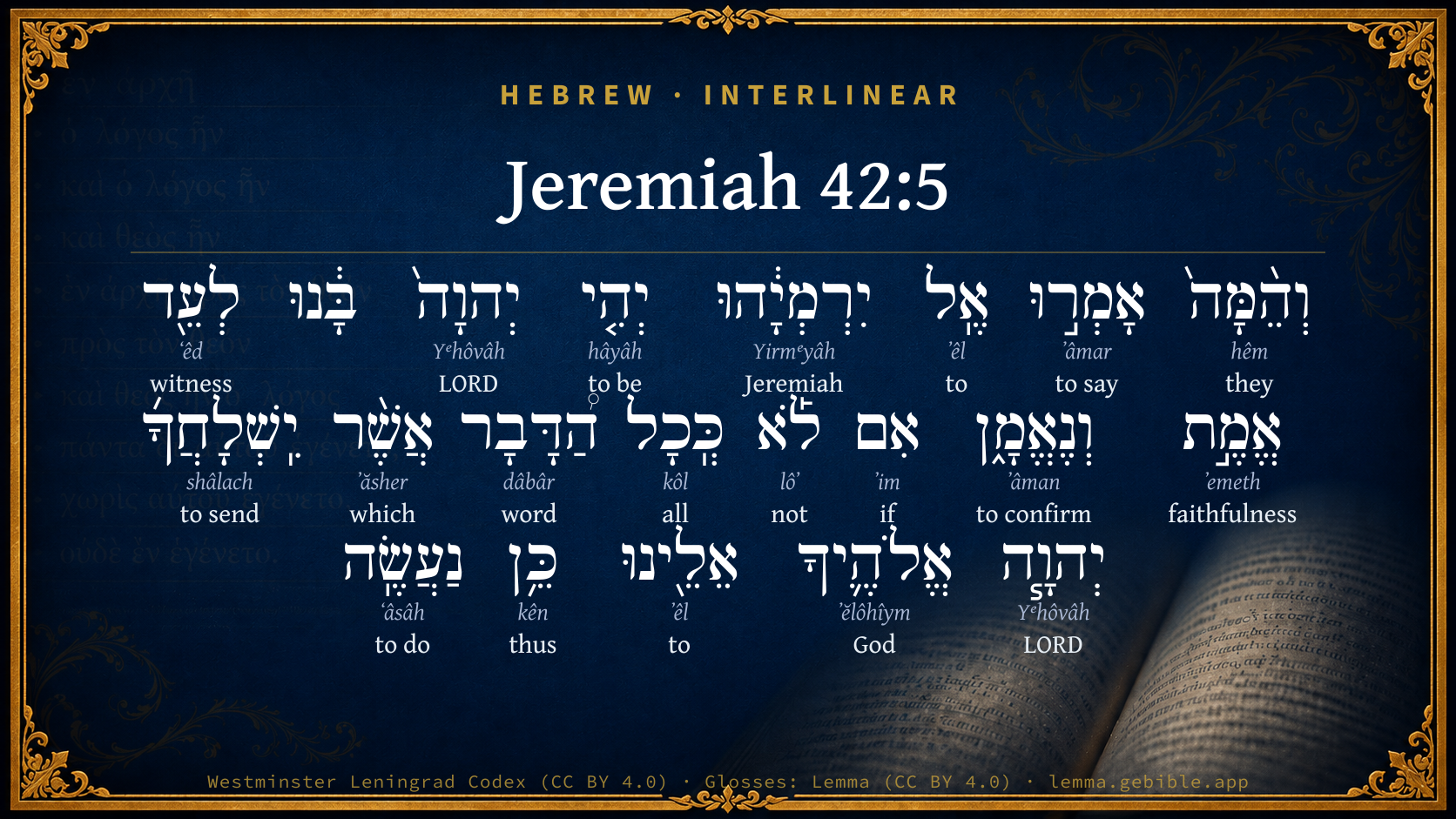
Jeremiah 42:5

Hebrew (Westminster Leningrad Codex) Jeremiah 42:5 appears in the Hebrew Old Testament. The text above is from the Westminster Leningrad Codex. Each word links to its Strong’s number, a concise gloss, and parsing drawn from the Open Scriptures Hebrew Bible morphology. Click any word for its full Brown-Driver-Briggs (BDB) entry.
Download image
Cite this verse

Jeremiah 42:5 (World English Bible). Public Domain. Lemma interlinear Bible study tool, https://lemma.gebible.app/v/jeremiah/42/5.

Show BibTeX & RIS
BibTeX
RIS
English Translation
Then they said to Jeremiah, Yahweh be a true and faithful witness among us, if we don't do according to all the word with which Yahweh your God shall send you to us.
World English Bible · Public Domain
Download a study sheet

One document with this verse’s original text, its word-by-word gloss line, the meaning frame, cross-references with their text, attributed commentary, and full source and license credits — printable, and it pastes into notes with its structure intact.

This verse Autodidact and up

Study sheet (.html) Plain text (.txt)

A passage Seminary Student

Up to 50 verses in one chapter. A passage sheet keeps up to 6 commentary sources and 12 cross-references per verse, in the order this page ranks them, and says so on the sheet whenever that leaves anything out. Ask for a single verse and you get the Autodidact verse sheet above.

Everything on this page stays free to read, with no account — the sheet is a download of what is already on screen, not access to it.

Want to remove ads? Support Godless Engineer
Compare translations 3

The same verse in 3 English versions, stacked beneath the original-language interlinear above. Click any original word for its lexicon entry.

Each is an independent rendering of the whole verse — the interlinear is not word-aligned to these translations.

Highlighted words mark where these versions differ — a whole-verse word diff, not a word-by-word alignment.

  • World English Bible Public Domain
    Then they said to Jeremiah, Yahweh be a true and faithful witness among us, if we don't do according to all the word with which Yahweh your God shall send you to us.
  • King James Version Public Domain
    Then they said to Jeremiah, The LORD be a true and faithful witness between us, if we do not even according to all things for the which the LORD thy God shall send thee to us.
  • unfoldingWord Literal Text CC BY-SA 4.0
    They said to Jeremiah, “May Yahweh be a true and faithful witness against us, if we do not do everything that Yahweh your God tells us to do.

unfoldingWord Literal Text — © unfoldingWord, licensed CC BY-SA 4.0. Word-aligned USFM3 via Door43 (git.door43.org/unfoldingWord/en_ult).

Versions to compare (up to 4)

3 of 4 selected

Show all 18 translations

Every available English version of this verse, each an independent rendering of the whole verse.

  • World English Bible Public Domain
    Then they said to Jeremiah, Yahweh be a true and faithful witness among us, if we don't do according to all the word with which Yahweh your God shall send you to us.
  • Berean Standard Bible Public Domain
    Then they said to Jeremiah, “May the LORD be a true and faithful witness against us if we do not act upon every word that the LORD your God sends you to tell us.
  • Majority Standard Bible Public Domain
    Then they said to Jeremiah, “May the LORD be a true and faithful witness against us if we do not act upon every word that the LORD your God sends you to tell us.
  • King James Version Public Domain
    Then they said to Jeremiah, The LORD be a true and faithful witness between us, if we do not even according to all things for the which the LORD thy God shall send thee to us.
  • American Standard Version (1901) Public Domain
    Then they said to Jeremiah, Jehovah be a true and faithful witness amongst us, if we do not according to all the word wherewith Jehovah thy God shall send thee to us.
  • Revised Version (1885) Public Domain
    Then they said to Jeremiah, The LORD be a true and faithful witness amongst us, if we do not even according to all the word wherewith the LORD thy God shall send thee to us.
  • Geneva Bible (1599) Public Domain
    Then they said to Ieremiah, The Lord be a witnesse of trueth, and faith betweene vs, if we doe not, euen according to all things for ye which the Lord thy God shall send thee to vs.
  • Douay-Rheims (1899) Public Domain
    And they said to Jeremias: The Lord be witness between us of truth and faithfulness, if we do not according to every thing for which the Lord thy God shall send thee to us.
  • Young's Literal Translation Public Domain
    And they have said to Jeremiah, `Jehovah is against us for a witness true and faithful, if -- according to all the word with which Jehovah thy God doth send thee unto us -- we do not so.
  • Literal Standard Version CC BY-SA 4.0
    And they have said to Jeremiah, “YHWH is against us for a true and faithful witness, if—according to all the word with which your God YHWH sends you to us—we do not do so.
  • Unlocked Literal Bible CC BY-SA 4.0
    They said to Jeremiah, “May Yahweh be a true and faithful witness against us, if we do not do everything that Yahweh your God tells us to do.
  • unfoldingWord Literal Text CC BY-SA 4.0
    They said to Jeremiah, “May Yahweh be a true and faithful witness against us, if we do not do everything that Yahweh your God tells us to do.
  • Darby Bible Public Domain
    And they said to Jeremiah, Jehovah be a true and faithful witness amongst us, if we do not even according to all the word for which Jehovah thy God shall send thee to us.
  • World Messianic Bible Public Domain
    Then they said to Jeremiah, “May the LORD be a true and faithful witness among us, if we don’t do according to all the word with which the LORD your God sends you to tell us.
  • Webster's Bible Public Domain
    Then they said to Jeremiah, The LORD be a true and faithful witness between us, if we do not even according to all things for which the LORD thy God shall send thee to us.
  • Free Bible Version CC BY-SA 4.0
    Then they said to Jeremiah, “May the Lord be a true and faithful witness against us if we don't do everything that the Lord your God tells you we should.
  • Bible in Basic English Public Domain
    Then they said to Jeremiah, May the Lord be a true witness against us in good faith, if we do not do everything which the Lord your God sends you to say to us.
  • JPS Tanakh (1917) Public Domain
    Then they said to Jeremiah: 'The LORD be a true and faithful witness against us, if we do not even according to all the word wherewith the LORD thy God shall send thee to us.

Literal Standard Version (2020), Covenant Press — licensed CC BY-SA 4.0. Text via the HelloAO Bible API (eBible.org). Unlocked Literal Bible (unfoldingWord) — licensed CC BY-SA 4.0. Text via the HelloAO Bible API (eBible.org). unfoldingWord Literal Text — © unfoldingWord, licensed CC BY-SA 4.0. Word-aligned USFM3 via Door43 (git.door43.org/unfoldingWord/en_ult). Free Bible Version, Dr. Jonathan Gallagher — licensed CC BY-SA 4.0. Text via the HelloAO Bible API (eBible.org).

Word by word

More ways to search: Search by grammar → Find every occurrence → Compare this word →

Practice this passage: Drill this verse → Learn its vocabulary →

לְעֵ֖ד
ʻêd
H5707
“to/for · witness of”
Preposition + Noun, Common, Masculine, Singular, Construct
Part of Speech
Preposition + Noun
Type
Common
Gender
Masculine
Number
Singular
State
Construct
Full BDB Definition

Origin: contracted from H5749

TWOT: 1576b

witness - witness, testimony, evidence (of things) - witness (of people)
  1. וְהֵ֨מָּה֙ hêm H1992 “and · they” Conjunction + Pronoun, Personal, 3rd Person, Masculine, Plural
  2. אָמְר֣וּ ʼâmar H559 “to say” Verb, Qal, Perfect, 3rd Person, Common, Plural
  3. אֶֽל ʼêl H413 “to” Preposition
  4. יִרְמְיָ֔הוּ Yirmᵉyâh H3414 “Jeremiah” Noun, Proper
  5. יְהִ֤י hâyâh H1961 “to be” Verb, Qal, Jussive, 3rd Person, Masculine, Singular
  6. יְהוָה֙ Yᵉhôvâh H3068 “LORD” Noun, Proper
  7. אֱמֶ֣ת ʼemeth H571 “faithfulness” Noun, Common, Feminine, Singular, Absolute
  8. וְנֶאֱמָ֑ן ʼâman H539 “and · confirmed” Conjunction + Verb, Niphal, Participle Passive, Masculine, Singular, Absolute
  9. אִם ʼim H518 “if” Conjunction
  10. לֹ֡א lôʼ H3808 “not” Particle, Negative
  11. כְּֽכָל kôl H3605 “like/as · all of” Preposition + Noun, Common, Masculine, Singular, Construct
  12. הַ֠דָּבָר dâbâr H1697 “the · word” Particle, Definite Article + Noun, Common, Masculine, Singular, Absolute
  13. אֲשֶׁ֨ר ʼăsher H834 “which” Particle, Relative
  14. יִֽשְׁלָחֲךָ֜ shâlach H7971 “to send · you” Verb, Qal, Imperfect, 3rd Person, Masculine, Singular + Suffix, Personal, 2nd Person, Masculine, Singular
  15. יְהוָ֧ה Yᵉhôvâh H3068 “LORD” Noun, Proper
  16. אֱלֹהֶ֛יךָ ʼĕlôhîym H430 “God(s) · your” Noun, Common, Masculine, Plural, Construct + Suffix, Personal, 2nd Person, Masculine, Singular
  17. אֵלֵ֖ינוּ ʼêl H413 “to · us” Preposition + Suffix, Personal, 1st Person, Common, Plural
  18. כֵּ֥ן kên H3651 “thus” Particle, Demonstrative
  19. נַעֲשֶֽׂה ʻâsâh H6213 “to do” Verb, Qal, Imperfect, 1st Person, Common, Plural

About this verse

These counts appear in no published source. They are computed here, from the morphology-tagged text and Lemma’s own curated glosses. What Lemma adds →

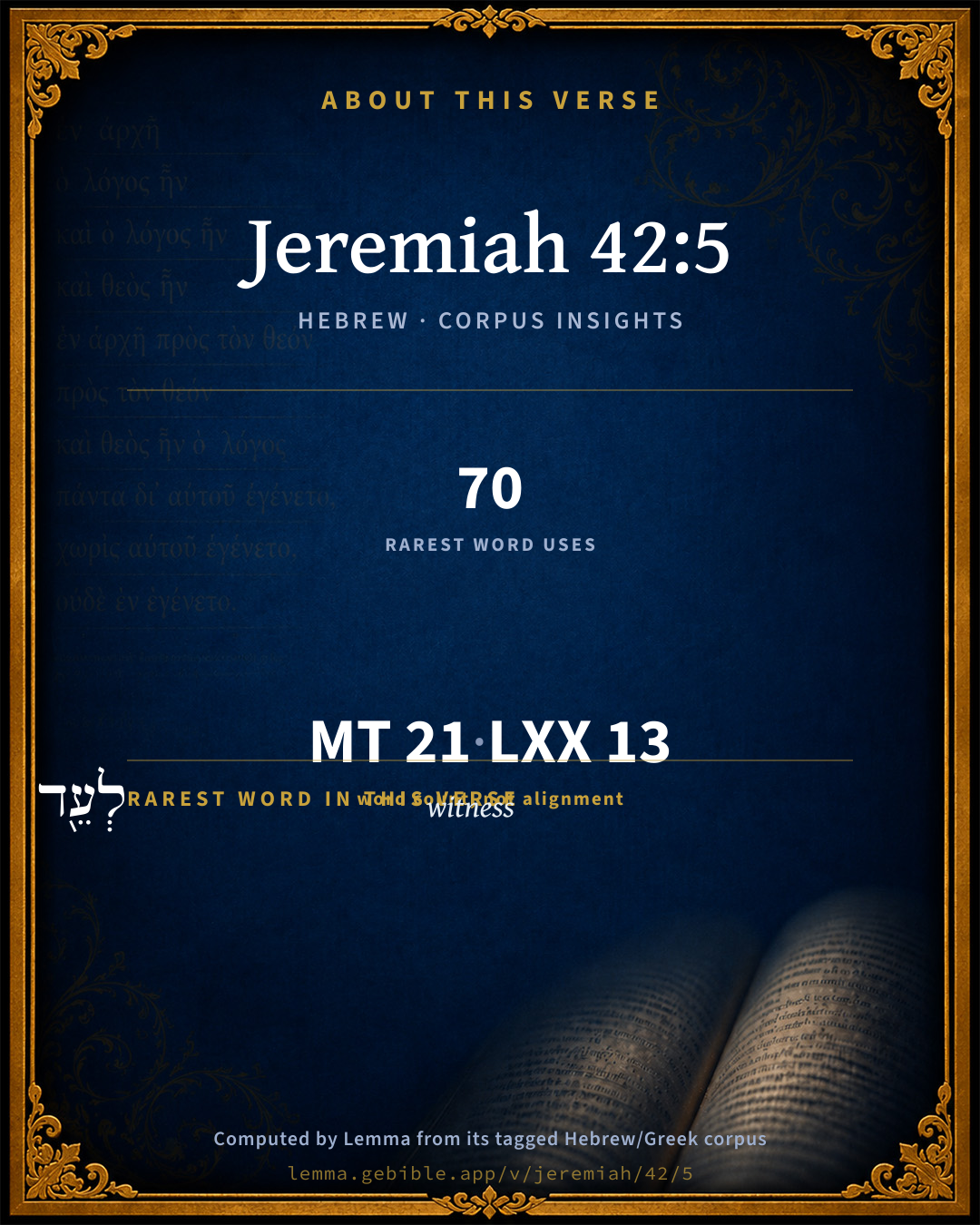
21
words
18
distinct lemmas
Prophets
section

Grammatical profile

  • 5 verbs
  • 8 nouns
  • 1 pronoun
  • 3 prepositions
  • 1 conjunction
  • 3 particles

Verb forms

  • אָמְר֣וּ Qal · Perfect
  • יְהִ֤י Qal · Jussive
  • וְנֶאֱמָ֑ן Niphal · Participle Passive
  • יִֽשְׁלָחֲךָ֜ Qal · Imperfect
  • נַעֲשֶֽׂה Qal · Imperfect

Repetition

Words recur within this verse — often emphatic in Hebrew:

  • יְהוָה֙ LORD H3068 ×2
  • אֶֽל to H413 ×2

Hebrew & Septuagint length

In the original languages it is 21 Hebrew tokens and 13 Greek tokens — but the two are counted differently (Hebrew bundles its prefixes and suffixes into one token; the Greek is in lemma form), so that isn’t a like-for-like length.

Cross-references

14

Topical passages linked to Jeremiah 42:5 in the Treasury of Scripture Knowledge — connected by theme and wording, ordered by reader-vote popularity; previews shown in the World English Bible.

  • Genesis 31:50 If you will afflict my daughters, and if you will take wives besides my daughters, no man is with us; behold, God is witness between me and you."
  • Judges 11:10 The elders of Gilead said to Jephthah, Yahweh shall be witness between us; surely according to your word so will we do.
  • Malachi 2:14 Yet you say, 'Why?' Because Yahweh has been witness between you and the wife of your youth, against whom you have dealt treacherously, though she is your companion, and the wife of your covenant.
  • Malachi 3:5 I will come near to you to judgment; and I will be a swift witness against the sorcerers, and against the adulterers, and against the perjurers, and against those who oppress the hireling in his wages, the widow, and the fatherless, and who deprive the foreigner of justice, and don't fear me," says Yahweh of Hosts.
  • Micah 1:2 Hear, you peoples, all of you. Listen, O earth, and all that is therein: And let the Lord Yahweh be witness against you, The Lord from his holy temple.
  • Revelation 1:5 and from Jesus Christ, the faithful witness, the firstborn of the dead, and the ruler of the kings of the earth. To him who loves us, and washed us from our sins by his blood;
  • Revelation 3:14 "To the angel of the assembly in Laodicea write: "The Amen, the Faithful and True Witness, the Head of God's creation, says these things:
  • Exodus 20:7 "You shall not take the name of Yahweh your God in vain, for Yahweh will not hold him guiltless who takes his name in vain.
  • Exodus 20:19 They said to Moses, "Speak with us yourself, and we will listen; but don't let God speak with us, lest we die."
  • Deuteronomy 5:27–29 Go you near, and hear all that Yahweh our God shall say: and speak you to us all that Yahweh our God shall speak to you; and we will hear it, and do it.
  • 1 Samuel 12:5 He said to them, Yahweh is witness against you, and his anointed is witness this day, that you have not found anything in my hand. They said, He is witness.
  • 1 Samuel 20:42 Jonathan said to David, Go in peace, because we have sworn both of us in the name of Yahweh, saying, Yahweh shall be between me and you, and between my seed and your seed, forever. He arose and departed: and Jonathan went into the city.
  • Jeremiah 5:2 Though they say, As Yahweh lives; surely they swear falsely.
  • Romans 1:9 For God is my witness, whom I serve in my spirit in the Gospel of his Son, how unceasingly I make mention of you always in my prayers,

Cross-references courtesy of OpenBible.info (CC BY 4.0).

Hebrew and Greek witnesses Masoretic Hebrew ↔ Greek Septuagint

The same verse in the two great witnesses to the Old Testament, shown verse-for-verse.

These are two independent witnesses, not word-aligned to each other, and the Septuagint is shown in lemma (dictionary) form.

Hebrew Jeremiah 42:5 Masoretic · Westminster Leningrad Codex

וְהֵ֨מָּה֙ אָמְר֣וּ אֶֽל יִרְמְיָ֔הוּ יְהִ֤י יְהוָה֙ בָּ֔נוּ לְעֵ֖ד אֱמֶ֣ת וְנֶאֱמָ֑ן אִם לֹ֡א כְּֽכָל הַ֠דָּבָר אֲשֶׁ֨ר יִֽשְׁלָחֲךָ֜ יְהוָ֧ה אֱלֹהֶ֛יךָ אֵלֵ֖ינוּ כֵּ֥ן נַעֲשֶֽׂה

Then they said to Jeremiah, Yahweh be a true and faithful witness among us, if we don't do according to all the word with which Yahweh your God shall send you to us.

World English Bible · Public Domain

Greek LXX Structure differs

In the Septuagint, Jeremiah is about an eighth shorter than the Hebrew and arranges its material differently — the Oracles Against the Nations (Hebrew chapters 46–51) appear in the middle of the Greek book, after 25:13. Because the chapter and verse boundaries do not line up, a verse-for-verse comparison with the Hebrew is not shown.

A verse-for-verse comparison isn’t shown here because the chapters and verses don’t line up. Switch to the LXX edition with the MT / LXX toggle above to read the Greek directly.

On this verse, The Cambridge Bible for Schools and Colleges discusses the Septuagint’s reading. Read the note in Commentary ↓

Hebrew: Westminster Leningrad Codex (CC BY 4.0). Greek: Septuagint (public domain); English from a public-domain English Septuagint. How the Septuagint differs from the Hebrew →

Targum (Aramaic paraphrase)

1

The Targum is the ancient Jewish Aramaic paraphrase of the Hebrew Scriptures — an interpretive translation, not the Hebrew text itself. Onkelos (literal) and Pseudo-Jonathan (expansive) render the Torah, and Jonathan the Prophets. Coverage is partial: where no permissively-licensed English translation exists for a verse, only the Aramaic is shown. This is verse-level text, not a word-by-word alignment to the Hebrew.

  1. Targum Jonathan Prophets (Joshua–Malachi)
    וְאִינוּן אֲמַרוּ לְיִרְמְיָה יְהִי מֵימְרָא דַייָ בָּנָא לְסָהִיד קְשׁוֹט וּמְהֵימָן אִם לָא כְּכָל פִּתְגָמַיָא דִי שַׁלְחִינָךְ יְיָ אֱלָהָךְ לְוָתָנָא כֵּן נַעֲבֵיד:

    (no public-domain English translation for this verse)

    Targum Jonathan — Aramaic: “Mikraot Gedolot” (public domain). English: “Sefaria Community Translation” (CC0 1.0 (public-domain dedication)); “London "Chaldee Paraphrase," 1871” (public domain). Text via Sefaria.

Commentary

Notes on Jeremiah 42:5 from classic Christian and Jewish commentators (each source and its license shown beneath its notes). The classic Christian expositions comment on the surrounding passage and are grouped to its opening verse, so a note may address several verses; the Jewish commentaries on the Tanakh (Rashi and others) are per-verse, so they appear only where the commentator wrote on this verse.

Lemma curates 59 commentaries, every one of them public domain or Creative Commons licensed, each selected and text-cleaned for this edition rather than reprinted as found. About our sources →

Trapp's Complete Commentary

John Trapp

Jer 42:5 Then they said to Jeremiah, The LORD be a true and faithful witness between us, if we do not even according to all things for the which the LORD thy God shall send thee to us.

Ver. 5. The Lord be a true and faithful witness between us.] Did these men know what it was so solemnly to swear a thing? Or were they stark atheists, thus to promise that with an oath which they never meant to perform?

“ At sperate Deum memorem fandi atque nefandi. ”

Their king, Zedekiah, paid dearly for his perjury to God and men.

John Trapp, A Commentary or Exposition upon All the Books of the Old and New Testament (1647–1656) — public domain. Text from a community e-Sword module.

Tyndale Open Study Notes

Tyndale Open Resources

42:5-6 Perhaps these people sensed that Jeremiah doubted their sincerity. They responded by making a solemn oath: They committed to obey the Lord’s instructions and to submit to punishment if they failed to keep the oath. They were confident that the Lord’s answer would be what they wanted to hear.

Tyndale Open Study Notes — © Tyndale Open Resources, licensed CC BY-SA 4.0. Text via the HelloAO Bible API.

Geneva Bible (1599)

Geneva Bible translators

There are none more ready to abuse the Name of God and take it in vain, than the hypocrites, which to color their falsehood use it without all reverence, and make it a means for them to deceive the simple and the godly.

Geneva Bible (1599) marginal notes — public domain. Text via Bolls.life.

Jamieson, Fausset & Brown

Robert Jamieson, A. R. Fausset & David Brown

Lord be a true . . . witness-- (Gen 31:50; Psa 89:37; Rev 1:5; Rev 3:14; Rev 19:11).

Jamieson, Fausset & Brown — Commentary Critical and Explanatory on the Whole Bible (1871) — public domain (CC PDM 1.0). Text via the HelloAO Bible API.

Adam Clarke's Commentary

Verse 5. The Lord be a true and faithful Witness] The Lord is such; and as ye have bound yourselves to obey his voice, he will register the covenant, and bless or curse according as ye shall conduct yourselves in this matter.

Adam Clarke's Commentary on the Bible (1810–1826) — public domain. Text from a community e-Sword/MySword module.

John Calvin's Commentaries

It hence appears that the people understood for what purpose Jeremiah, before he consulted God, assured them of his faithfulness and sincerity; for it was not without reason that they promised to be obedient to God; but as they saw that they were suspected as being not sincere by Jeremiah, and as he had promised to be a true and faithful teacher, they on the other hand declared that they would be sincere disciples, and would receive whatever God might command them. But they soon betrayed their perfidy, for when they heard that what they had resolved to do did not please God, they not only rejected the counsel of God and the Prophet, but treated him insolently, and even loaded the holy man with reproaches, as though he had told them what was false. Their hypocrisy ought at the same time to be a lesson to us, so that when God is pleased through a singular favor to shew us the way of acting rightly by faithful instructors and competent teachers, we may not be like them, but be teachable and ready to obey, and prove this not only by the mouth but also by our deeds.

The Prophet then says, that they spoke thus, Let God be a faithful and true witness between us. Being not content with a simple affirmation, they dared to interpose the name of God; and thus we see how blind is hypocrisy. For if men duly weigh what it is to profane God’s name, surely they would dread and abominate all perjury. As then they rushed on so audaciously to swear, it is evident that they were as it were stupefied; and there is no inebriety which so confuses the minds of men and all their senses as hypocrisy.

They then added, According to whatever word which Jehovah thy God shall send to us, so will we do, that is, whatever Jehovah shall command us by thee; for God is said to send to men, when he sends a messenger in his name to bring his commands. Jeremiah then was, as it were, a middle person to address the people in God’s name, as though he had been sent from heaven. They therefore said, that they would do whatever God commanded. A stronger expression follows, Whether good or evil, we will obey the voice of Jehovah our God They did not here charge God’s word with being wrong, as though it had anything unjust in it; but they used good in the sense of joyful, and evil as meaning what is sad or grievous, as though they had said, that they asked for no other thing but that God should declare what pleased him, and that they were so submissive as to refuse nothing though contrary to the flesh. Had this declaration proceeded from the heart, it would have been a testimony of true piety; for the minds of the godly ought to be so framed as to obey God without making any exception, whether he commands what is contrary to their purpose, or leads them where they do not wish to go; for they who wish to make a compact with God, that he should require nothing but what is agreeable to them, shew that they know not what it is to serve God. Hence the obedience of faith in an especial manner requires this, that man should renounce his own desires, that he should not set up his own counsels and wishes against the word of God, nor object and say, this is hard, that is not quite agreeable. Whether then it be good or evil, that is, though it may be contrary to the feelings of the flesh, we ought still to embrace what God requires and commands: this is the rule of true religion.

John Calvin's Commentaries (1540-1563) — public domain. Text from the Calvin Translation Society English edition (1840s-50s) via the Christian Classics Ethereal Library (ccel.org). Calvin's coverage is partial (roughly two-thirds of the Bible); uncommented books and verses are honest gaps, never fabricated. The 19th-century editor's footnotes and remarks are omitted so the notes are faithfully Calvin's own voice.

Ellicott's Commentary for English Readers

(5, 6) The Lord be a true and faithful witness . . .—The emphatic adjuration implies that they are ready to accept the punishment which the righteous Judge will inflict in the event of their proving unfaithful to their promise. The name of the place where they had lately been staying may have reminded them of the history of Gen_31:49 (though that refers to another Mizpah), in which we find the same formula.

A Bible Commentary for English Readers, edited by Charles John Ellicott (1878–1897) — public domain. Text from a community e-Sword module.

The Cambridge Bible for Schools and Colleges

gen. ed. J. J. S. Perowne

5. amongst] better, as mg. against, i.e. to bear witness and punish us if we fail to do our part as we now promise.

5. from all the nations] These words, as implying a much wider dispersion of inhabitants of the Southern kingdom than had actually taken place, may be a scribe’s insertion from ch. Jer_40:11 f. The LXX omit “from all the nations … driven.”

The Cambridge Bible for Schools and Colleges (gen. ed. J. J. S. Perowne; Cambridge University Press, 1878–1918) — public domain. Text from a community e-Sword module.

John Gill's Exposition

Then they said to Jeremiah, the Lord be a true and faithful witness between us,.... Which is the form of an oath; a solemn appeal to God, as a witness to what they were about to say, and to the sincerity of their hearts in it; who is true to his word, and faithful to his promises and threatenings; and who bears a true and faithful testimony, and will do what is just and right; and yet these people never intended to perform what they promised; which is a most shocking piece of atheism in a professing people; and who, at this very time, could not but observe the judgments of God upon their nation, city, and temple:

if we do not even according to all things for the which the Lord thy God shall send thee to us; they promise to do everything the Lord should signify by the prophet as his will; and, if they did not, wish the severest judgments of God might fall upon them.

John Gill's Exposition of the Whole Bible (1746–1763) — public domain (CC PDM 1.0). Text via the HelloAO Bible API.

Albert Barnes' Notes on the Bible

Between us - Against us, as in Jer 42:19 (margin.)

According to all things - literally, “according to the whole word as to which Yahweh thy God shall send thee to us.”

Albert Barnes' Notes on the Bible (1834–1885) — public domain. Text from a community e-Sword/MySword module.

Haydock's Catholic Bible Commentary

Witness. Jeremias knew their fickle temper. They will obey, only if God comply with their desires. (Calmet) --- They began with piety, but soon refused to obey the directions given, chap. xliii. 2. (Worthington)

George Leo Haydock (1774–1849), Haydock's Catholic Family Bible and Commentary, 1859 edition — public domain. Excludes Psalms (Douay-Rheims chapter numbering differs from Protestant) and Deuterocanonical books (Catholic canon only).

Whedon's Commentary on the Bible

Daniel D. Whedon

5. A true and faithful witness — “True and faithful” are from the same root, and both occupy emphatic positions in the sentence. “True and faithful is Jehovah.”

Daniel D. Whedon (gen. ed.), Commentary on the Old and New Testaments (1874–1909) — public domain. Text from a community e-Sword module.

The Pulpit Commentary

A true and faithful witness between us; rather, against us. If they broke their promise, Jehovah was to "witness against" them by punishing them.

Vers. 5, 6. Implicit obedience.

The people swear to obey the voice of God before they know what injunctions it will lay upon them, They contemplate the possibility of receiving unpleasant commands; but they leave the decision in the hands of God, undertaking to follow it, whatever form it may take. Thus they bind themselves to implicit obedience. Let us consider the obligation and the limitation of implicit obedience.

I THE OBLIGATION OF IMPLICIT OBEDIENCE. This requires us to obey the voice of God when it calls us to do anything within the range of right and possibility; i.e. anything which a wise and good God would ever command. It implies a possible conflict with our inclination, our opinion, or our worldly interest. Otherwise the obedience becomes a mere form. If we only obey when we like to do the thing required, we are not really obeying a higher will, but simply following out our own will in accidental coincidence with the will above us. True obedience only begins when it leads us to do what Our own wisdom or desire would not have prompted. It must, therefore, be prepared to run counter to these private tendencies. It must be the submission of our will and opinion to God"s will and wisdom. Now, not only is this implicit obedience obligatory, but it is a certain fact that God will put it to the test. His higher will and larger wisdom must often conflict with our foolishness and self-will. Moreover, amid the trials of life, God will certainly sometimes require us to do what seems evil to us, i.e. what is painful and contrary to our wish. Therefore faith is essential to obedience. In so far as we can trust God, we shall be able to obey his darker counsels.

II THE LIMITATION OF IMPLICIT OBEDIENCE. The highest obligation is to do right. If, therefore, we could be required by a supreme being to do what we knew was wrong, it would be our plain duty to disobey his will. The being who laid such a mandate upon us could not be God. He would be an almighty demon. Were such a monster to exist, it would be the duty of all creatures to resist him, though they became martyrs for their fidelity to righteousness. Our obligation to obey God rests on the fact that he is supremely good, and not merely on his infinite power and greatness. Let us suppose that we received a seemingly Divine mandate requiring what we felt to be wrong what should we do? Three courses would then be open to us. We might believe that it emanated from a supreme being who was wicked, and should therefore be disobeyed; we might conclude that we were mistaken in supposing it to come from a supreme being that we were suffering from a hallucination; or we might feel convinced that it was sent by the holy God, and that we were wrong in our impression of its unrighteous character. To Christians who believe in a perfectly good God, only the two latter alternatives could present themselves. But here the choice lies between the inward and the outward voice. If, then, the inward voice is clear and unmistakable, we are bound to give the preference to this. The outward voice claims to come from God; but so does the inward voice. If the two conflict, we must choose between them, and then we should feel that it is more likely we are suffering from a delusion in our external perceptions than that what we firmly believe in our conscience to be wrong is yet right. loyalty to God will lead us to obey God"s voice in the conscience above all things. At all events, so long as we believe though even erroneously that a thing is wrong to us, it is wrong, and no prophet"s or angel"s words should lead us to perform it without first convincing us that it is right.

The Pulpit Commentary (1880–1919), ed. H.D.M. Spence-Jones & Joseph S. Exell — public domain. Text from a community e-Sword module.

Lesson kit

Teaching starters — assembled from the data on this page, not authored interpretation. Every prompt links to the verse data it draws on. Edit before teaching.

Jeremiah, in the Prophets, opens this verse with 21 words (18 distinct Hebrew lemmas). Its most distinctive word is ʻêd (“witness”). A historical commentator’s framing appears above. Read the whole chapter for the surrounding context.

Discussion questions

  1. How does “witness” (ʻêd) shape what this verse is saying?
  2. Genesis 31:50 shares this passage’s theme. How do the two illuminate each other?
  3. “LORD” occurs 2× in this one verse. What is the effect of the repetition?
  4. These translations render this verse differently; the difference is in the English rendering, not the original. What questions does that raise?
  5. The verb «אָמְר֣וּ» is Qal Perfect. How does its form color the action?
  6. Reading how Trapp's Complete Commentary and Tyndale Open Study Notes read this verse, where do the two commentators agree and where do they part?

Things to notice

Reading settings

Reading text

Shown beneath each verse's original-language words.

Old Testament
Old Testament edition

Read the OT as the Masoretic Hebrew (MT) or the Greek Septuagint (LXX).

English shown for the Greek Septuagint (in the Hebrew ↔ Greek comparison).

Comparing translations? Open the Compare panel on any verse page to stack up to four side by side.