
Jeremiah 38:24

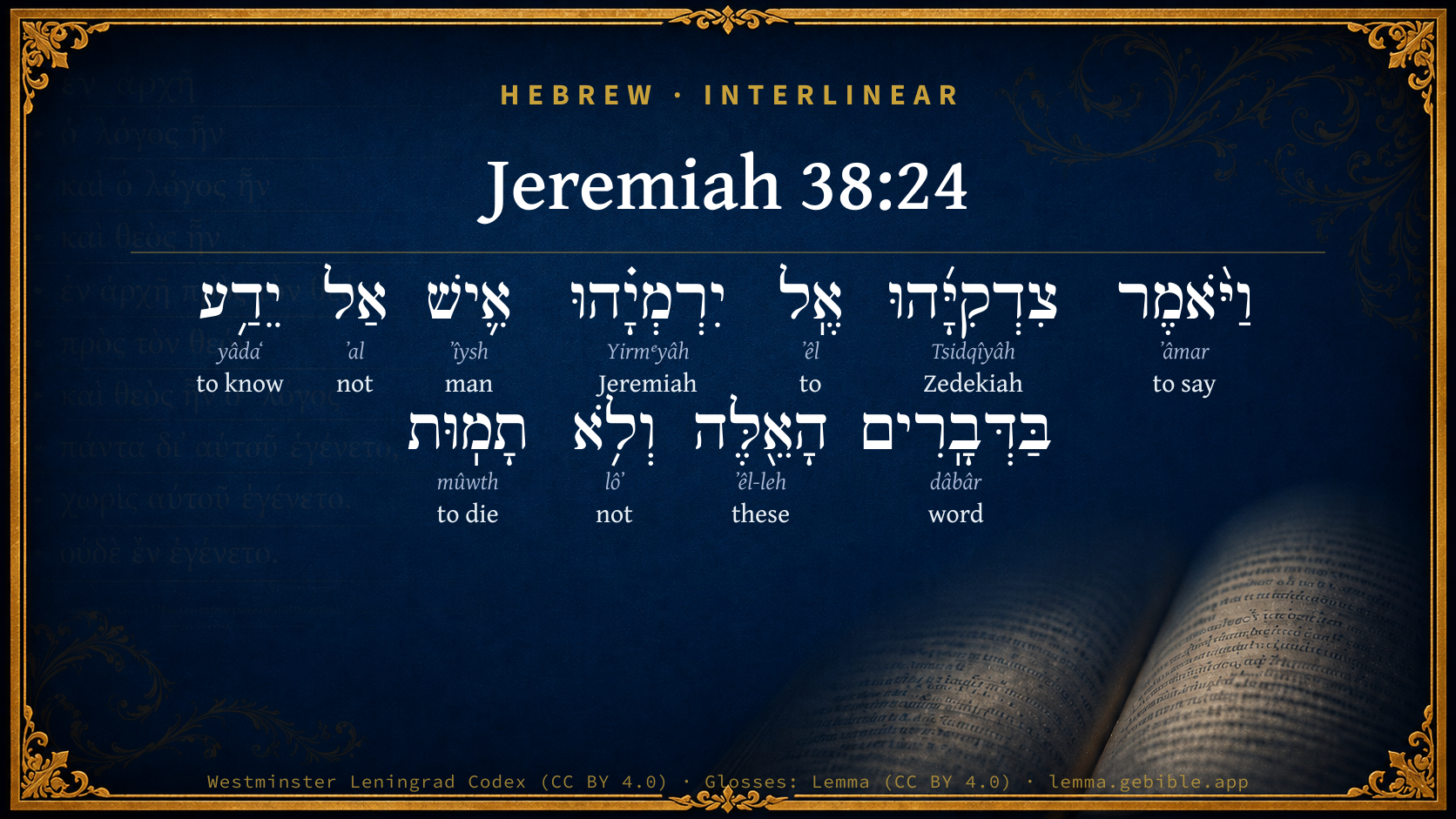
Hebrew (Westminster Leningrad Codex) Jeremiah 38:24 appears in the Hebrew Old Testament. The text above is from the Westminster Leningrad Codex. Each word links to its Strong’s number, a concise gloss, and parsing drawn from the Open Scriptures Hebrew Bible morphology. Click any word for its full Brown-Driver-Briggs (BDB) entry.
Download image
Cite this verse

Jeremiah 38:24 (World English Bible). Public Domain. Lemma interlinear Bible study tool, https://lemma.gebible.app/v/jeremiah/38/24.

Show BibTeX & RIS
BibTeX
RIS
English Translation
Then said Zedekiah to Jeremiah, Let no man know of these words, and you shall not die.
World English Bible · Public Domain
Download a study sheet

One document with this verse’s original text, its word-by-word gloss line, the meaning frame, cross-references with their text, attributed commentary, and full source and license credits — printable, and it pastes into notes with its structure intact.

This verse Autodidact and up

Study sheet (.html) Plain text (.txt)

A passage Seminary Student

Up to 50 verses in one chapter. A passage sheet keeps up to 6 commentary sources and 12 cross-references per verse, in the order this page ranks them, and says so on the sheet whenever that leaves anything out. Ask for a single verse and you get the Autodidact verse sheet above.

Everything on this page stays free to read, with no account — the sheet is a download of what is already on screen, not access to it.

Want to remove ads? Support Godless Engineer
Compare translations 3

The same verse in 3 English versions, stacked beneath the original-language interlinear above. Click any original word for its lexicon entry.

Each is an independent rendering of the whole verse — the interlinear is not word-aligned to these translations.

Highlighted words mark where these versions differ — a whole-verse word diff, not a word-by-word alignment.

  • World English Bible Public Domain
    Then said Zedekiah to Jeremiah, Let no man know of these words, and you shall not die.
  • King James Version Public Domain
    Then said Zedekiah unto Jeremiah, Let no man know of these words, and thou shalt not die.
  • unfoldingWord Literal Text CC BY-SA 4.0
    Then Zedekiah said to Jeremiah, “Do not inform anyone about these words, so that you do not die.

unfoldingWord Literal Text — © unfoldingWord, licensed CC BY-SA 4.0. Word-aligned USFM3 via Door43 (git.door43.org/unfoldingWord/en_ult).

Versions to compare (up to 4)

3 of 4 selected

Show all 18 translations

Every available English version of this verse, each an independent rendering of the whole verse.

  • World English Bible Public Domain
    Then said Zedekiah to Jeremiah, Let no man know of these words, and you shall not die.
  • Berean Standard Bible Public Domain
    Then Zedekiah warned Jeremiah, “Do not let anyone know about this conversation, or you will die.
  • Majority Standard Bible Public Domain
    Then Zedekiah warned Jeremiah, “Do not let anyone know about this conversation, or you will die.
  • King James Version Public Domain
    Then said Zedekiah unto Jeremiah, Let no man know of these words, and thou shalt not die.
  • American Standard Version (1901) Public Domain
    Then said Zedekiah unto Jeremiah, Let no man know of these words, and thou shalt not die.
  • Revised Version (1885) Public Domain
    Then said Zedekiah unto Jeremiah, Let no man know of these words, and thou shalt not die.
  • Geneva Bible (1599) Public Domain
    Then said Zedekiah vnto Ieremiah, Let no man know of these words, and thou shalt not die.
  • Douay-Rheims (1899) Public Domain
    Then Sedecias said to Jeremias: Let no man know these words, and thou shalt not die.
  • Young's Literal Translation Public Domain
    And Zedekiah saith unto Jeremiah, `Let no man know of these words, and thou dost not die;
  • Literal Standard Version CC BY-SA 4.0
    And Zedekiah says to Jeremiah, “Let no man know of these words, and you do not die;
  • Unlocked Literal Bible CC BY-SA 4.0
    Then Zedekiah said to Jeremiah, “Do not inform anyone about these words, so that you do not die.
  • unfoldingWord Literal Text CC BY-SA 4.0
    Then Zedekiah said to Jeremiah, “Do not inform anyone about these words, so that you do not die.
  • Darby Bible Public Domain
    And Zedekiah said unto Jeremiah, Let no man know of these words, and thou shalt not die.
  • World Messianic Bible Public Domain
    Then Zedekiah said to Jeremiah, “Let no man know of these words, and you won’t die.
  • Webster's Bible Public Domain
    Then said Zedekiah to Jeremiah, Let no man know of these words, and thou shalt not die.
  • Free Bible Version CC BY-SA 4.0
    Zedekiah warned Jeremiah, “Nobody can find out about this conversation, otherwise you'll die.
  • Bible in Basic English Public Domain
    Then Zedekiah said to Jeremiah, Let no man have knowledge of these words, and you will not be put to death.
  • JPS Tanakh (1917) Public Domain
    Then said Zedekiah unto Jeremiah: 'Let no man know of these words, and thou shalt not die.

Literal Standard Version (2020), Covenant Press — licensed CC BY-SA 4.0. Text via the HelloAO Bible API (eBible.org). Unlocked Literal Bible (unfoldingWord) — licensed CC BY-SA 4.0. Text via the HelloAO Bible API (eBible.org). unfoldingWord Literal Text — © unfoldingWord, licensed CC BY-SA 4.0. Word-aligned USFM3 via Door43 (git.door43.org/unfoldingWord/en_ult). Free Bible Version, Dr. Jonathan Gallagher — licensed CC BY-SA 4.0. Text via the HelloAO Bible API (eBible.org).

Word by word

More ways to search: Search by grammar → Find every occurrence → Compare this word →

Practice this passage: Drill this verse → Learn its vocabulary →

צִדְקִיָּ֜הוּ
Tsidqîyâh
H6667
“Zedekiah”
Noun, Proper
Part of Speech
Noun
Type
Proper
Full BDB Definition

Origin: from H6664 and H3050

TWOT: None

Zedekiah = "Jehovah is righteous" - the last king of Judah renamed from 'Mattaniah' by Nebuchadnezzar; son of Josiah by wife Hamutal; placed on the throne by Nebuchadnezzar when he carried his nephew Jehoiakim in captivity - false prophet at the court of king Ahab of the northern kingdom of Israel - son of Maaseiah, a false prophet in Babylon - son of Hananiah, one of the princes of Judah in the time of Jeremiah - a priest who sealed the covenant with Nehemiah - son of king Jehoiakim of Judah
  1. וַיֹּ֨אמֶר ʼâmar H559 “and · to say” Conjunction + Verb, Qal, Sequential Imperfect, 3rd Person, Masculine, Singular
  2. אֶֽל ʼêl H413 “to” Preposition
  3. יִרְמְיָ֗הוּ Yirmᵉyâh H3414 “Jeremiah” Noun, Proper
  4. אִ֛ישׁ ʼîysh H376 “man” Noun, Common, Masculine, Singular, Absolute
  5. אַל ʼal H408 “not” Particle, Negative
  6. יֵדַ֥ע yâdaʻ H3045 “to know” Verb, Qal, Jussive, 3rd Person, Masculine, Singular
  7. בַּדְּבָֽרִים dâbâr H1697 “in/at the · words” Preposition, Determined + Noun, Common, Masculine, Plural, Absolute
  8. הָאֵ֖לֶּה ʼêl-leh H428 “the · these” Particle, Definite Article + Pronoun, Demonstrative, Common, Plural
  9. וְלֹ֥א lôʼ H3808 “and · not” Conjunction + Particle, Negative
  10. תָמֽוּת mûwth H4191 “to die” Verb, Qal, Imperfect, 2nd Person, Masculine, Singular

About this verse

These counts appear in no published source. They are computed here, from the morphology-tagged text and Lemma’s own curated glosses. What Lemma adds →

11
words
11
distinct lemmas
Prophets
section

Grammatical profile

  • 3 verbs
  • 4 nouns
  • 1 pronoun
  • 1 preposition
  • 2 particles

Verb forms

  • וַיֹּ֨אמֶר Qal · Sequential Imperfect
  • יֵדַ֥ע Qal · Jussive
  • תָמֽוּת Qal · Imperfect

Hebrew & Septuagint length

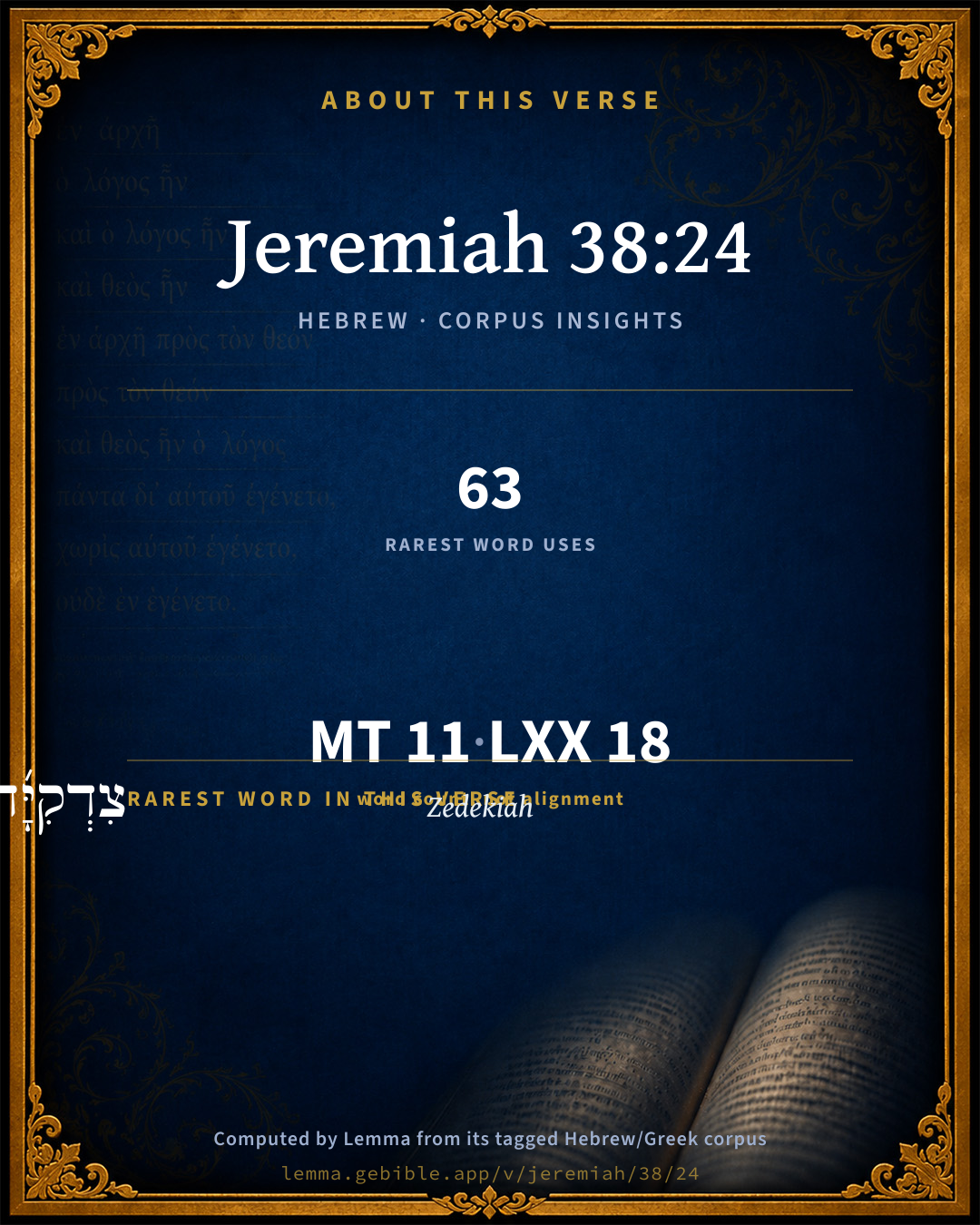
In the original languages it is 11 Hebrew tokens and 18 Greek tokens — but the two are counted differently (Hebrew bundles its prefixes and suffixes into one token; the Greek is in lemma form), so that isn’t a like-for-like length.

Hebrew and Greek witnesses Masoretic Hebrew ↔ Greek Septuagint

The same verse in the two great witnesses to the Old Testament, shown verse-for-verse.

These are two independent witnesses, not word-aligned to each other, and the Septuagint is shown in lemma (dictionary) form.

Hebrew Jeremiah 38:24 Masoretic · Westminster Leningrad Codex

וַיֹּ֨אמֶר צִדְקִיָּ֜הוּ אֶֽל יִרְמְיָ֗הוּ אִ֛ישׁ אַל יֵדַ֥ע בַּדְּבָֽרִים הָאֵ֖לֶּה וְלֹ֥א תָמֽוּת

Then said Zedekiah to Jeremiah, Let no man know of these words, and you shall not die.

World English Bible · Public Domain

Greek LXX Structure differs

In the Septuagint, Jeremiah is about an eighth shorter than the Hebrew and arranges its material differently — the Oracles Against the Nations (Hebrew chapters 46–51) appear in the middle of the Greek book, after 25:13. Because the chapter and verse boundaries do not line up, a verse-for-verse comparison with the Hebrew is not shown.

A verse-for-verse comparison isn’t shown here because the chapters and verses don’t line up. Switch to the LXX edition with the MT / LXX toggle above to read the Greek directly.

Hebrew: Westminster Leningrad Codex (CC BY 4.0). Greek: Septuagint (public domain); English from a public-domain English Septuagint. How the Septuagint differs from the Hebrew →

Targum (Aramaic paraphrase)

1

The Targum is the ancient Jewish Aramaic paraphrase of the Hebrew Scriptures — an interpretive translation, not the Hebrew text itself. Onkelos (literal) and Pseudo-Jonathan (expansive) render the Torah, and Jonathan the Prophets. Coverage is partial: where no permissively-licensed English translation exists for a verse, only the Aramaic is shown. This is verse-level text, not a word-by-word alignment to the Hebrew.

  1. Targum Jonathan Prophets (Joshua–Malachi)
    וַאֲמַר צִדְקִיָה לְיִרְמְיָה אֱנַשׁ לָא יְדַע בְּפִתְגָמַיָא הָאִלֵין וְלָא תְמוּת:

    (no public-domain English translation for this verse)

    Targum Jonathan — Aramaic: “Mikraot Gedolot” (public domain). English: “Sefaria Community Translation” (CC0 1.0 (public-domain dedication)); “London "Chaldee Paraphrase," 1871” (public domain). Text via Sefaria.

Commentary

Notes on Jeremiah 38:24 from classic Christian and Jewish commentators (each source and its license shown beneath its notes). The classic Christian expositions comment on the surrounding passage and are grouped to its opening verse, so a note may address several verses; the Jewish commentaries on the Tanakh (Rashi and others) are per-verse, so they appear only where the commentator wrote on this verse.

Lemma curates 59 commentaries, every one of them public domain or Creative Commons licensed, each selected and text-cleaned for this edition rather than reprinted as found. About our sources →

Trapp's Complete Commentary

John Trapp

Jer 38:24 Then said Zedekiah unto Jeremiah, Let no man know of these words, and thou shalt not die.

Ver. 24. Let no man know of these words,] Muliebriter deprecatur rex incredulus fidelem. Thus he who feareth not God, feareth his own servants and counsellors.

And thou shalt not die.] The crafty king would seem to be solicitous of the prophet’s safety, but mainly intendeth his own.

John Trapp, A Commentary or Exposition upon All the Books of the Old and New Testament (1647–1656) — public domain. Text from a community e-Sword module.

Joseph Benson's Commentary

Jer 38:24-27. Then said Zedekiah, Let no man know of these words, &c. — Keep what has passed between us secret, and I will keep my promise to thee of preserving thy life. These words sufficiently show that Zedekiah stood in fear of his courtiers. This is the righteous judgment of God, that those who will not sanctify the Lord of hosts in their hearts, and make him their fear, shall fear men, whom to fear is to be in a state of ignoble and miserable bondage. But if the princes hear, &c. — It was hardly possible that Zedekiah should have this private discourse with Jeremiah, but some or other of his courtiers should come to the knowledge of it. But here we see in what a state of miserable subjection this poor prince was to them, in that he could discourse to nobody, but they must come and inquire what he had said. Thou shalt say, I presented my supplication, &c. — Jeremiah had been formerly kept prisoner in Jonathan’s house, Jer 37:15. But the last time he was imprisoned was in the dungeon of Hammelech, Jer 38:6 of this chapter: a place which, perhaps, might at this time be put to some other use. Then came all the princes to Jeremiah — As the king suspected, so it came to pass: his private discourse with the prophet transpired, and all the princes then at court came and inquired of Jeremiah what was the substance of it. And he told them according to all that the king had commanded — He told them part of the truth, but not all, concealing from them the advice which he had given to the king, with relation to the questions he had proposed to him. For a man is not bound in all cases to discover the whole truth, particularly to those who have no right to the knowledge of it, which, in this case, these princes had not. So the matter was not perceived — The princes never got to know what was the principal subject of the king’s conference with the prophet.

Joseph Benson's Commentary on the Old and New Testaments (1811–1818) — public domain. Text from a community e-Sword module.

Tyndale Open Study Notes

Tyndale Open Resources

38:24-28 When Zedekiah’s fear of his officials surfaced again, he demanded that Jeremiah keep secret what he had told the king. • The officials might have suspected that Zedekiah was about to surrender to the enemy. Jeremiah obeyed the king’s order to keep quiet, and he spent the final days of the siege in the palace prison under the king’s protection.

Tyndale Open Study Notes — © Tyndale Open Resources, licensed CC BY-SA 4.0. Text via the HelloAO Bible API.

Jamieson, Fausset & Brown

Robert Jamieson, A. R. Fausset & David Brown

Let no man know--If thou wilt not tell this to the people, I will engage thy safety.

Jamieson, Fausset & Brown — Commentary Critical and Explanatory on the Whole Bible (1871) — public domain (CC PDM 1.0). Text via the HelloAO Bible API.

John Calvin's Commentaries

Here is seen the miserable condition of the king. Had he no faith in the answer of Jeremiah, he would not have thus feared. But he acknowledged that what he had heard from the mouth of the Prophet was true. In the meanwhile he delayed and extended time as far as he could, and chose rather to spend his life in trembling than to be immediately freed from all care and anxiety. This was by no means to act like a king; for had he any courage, he would not have waited to the last hour. We indeed know that men of courage boldly meet death, when they see no hope of honor remaining. Zedekiah had lost his authority; he held indeed the title of a king, but he was without power; for he was compelled servilely to obey his counselors; and now he feared his own shadow, and yet protracted time, as I have said, as much as he could; and on this account he requested the Prophet, that this conversation might remain as buried.

By saying, thou shalt not die, he did not threaten the Prophet, but intimated that silence would not be less a benefit to Jeremiah than to himself: “Thou wilt rouse the fury of all against thyself, if thou speakest of this interview, for no one can bear to hear anything of the ruin of the city: if then thou consultest thine own benefit, say not a word of this, and let it not come to the people nor to my counselors.” Under the color of an advice then he said to Jeremiah, “See lest thou die He therefore did not speak threateningly.

John Calvin's Commentaries (1540-1563) — public domain. Text from the Calvin Translation Society English edition (1840s-50s) via the Christian Classics Ethereal Library (ccel.org). Calvin's coverage is partial (roughly two-thirds of the Bible); uncommented books and verses are honest gaps, never fabricated. The 19th-century editor's footnotes and remarks are omitted so the notes are faithfully Calvin's own voice.

The Cambridge Bible for Schools and Colleges

gen. ed. J. J. S. Perowne

24. Let no man know] Zedekiah’s feebleness is again conspicuous in this and the two following verses. Although the saving of the prophet from conditions likely to prove fatal is not directly mentioned in the narrative as preserved to us, it is far from unlikely that it was one subject of the conversation. Thus the prophet may well have held himself justified in limiting his statement to the princes in accordance with Zedekiah’s desire, especially when we remember that moral standards at that age were not altogether identical with our own.

The Cambridge Bible for Schools and Colleges (gen. ed. J. J. S. Perowne; Cambridge University Press, 1878–1918) — public domain. Text from a community e-Sword module.

John Gill's Exposition

Then said Zedekiah to Jeremiah,.... Not a word signifying his approbation of the counsel given him, or that he intended to take it; his silence showed the reverse:

let no man know of these words: that had passed between them; of the conference and conversation they had had together, at least not the particulars of it; the thing itself was known, as appears by what follows, that the king and prophet had been discoursing together; but what they talked of, he desires might be concealed, pretending the prophet's good, though it was his own honour and safety he sought:

and thou shall not die; as he had promised he should not, and had sworn to it; but suggests by this, that if he disclosed the conversation, he should took upon himself free from his word and oath; so that this carried something menacing in it: or it may be rendered "that thou die not" (c); intimating, that if the princes should come to the knowledge of what he had said, of the advice he had given, they would surely put him to death; and therefore, for his own safety, he desires the whole may be kept a secret.

(c) "ne moriaris", Gataker, Schmidt; "ut non moriaris", Piscator.

John Gill's Exposition of the Whole Bible (1746–1763) — public domain (CC PDM 1.0). Text via the HelloAO Bible API.

Matthew Poole's English Annotations

These words sufficiently let us know that Zedekiah stood in awe of his courtiers, and we might probably think, that had it not been for them, he would have done better. This is the righteous judgment of God; those that will not sanctify the Lord of hosts, and make him their fear, shall fear men, whom to fear is much more base and ignoble.

Matthew Poole's English Annotations on the Holy Bible (1683–1685) — public domain. Text from a community e-Sword/MySword module.

Whedon's Commentary on the Bible

Daniel D. Whedon

24. Let no man know — A king, and yet did not dare to have the particulars of this interview known!

Daniel D. Whedon (gen. ed.), Commentary on the Old and New Testaments (1874–1909) — public domain. Text from a community e-Sword module.

The Pulpit Commentary

Trying to serve two masters.

Zedekiah was seeking to do this. He wanted to be on the prophet"s side, and yet not to break with the princes who were the prophet"s foes. We see the shifts to which he was driven, and we know the miserable outcome of his impossible attempt. We learn from it

I How DESPICABLE SUCH ATTEMPTS MAKE A MAN IN HIS OWN EYES. To thine own self be true, And it shall follow, as the night the day, Thou canst not then be false to any man.

But how far from this conscious rectitude he must be who seeks to serve two masters, who acts as Zedekiah did!

II HOW OTHER MEN DESPISE THEM.

III HOW GOD CONDEMNS THEM. How do the instances of Balaam, Pilate, Judas, and others shine out as warning beacons!

IV HOW USELESS, AFTER ALL, SUCH ATTEMPTS ARE. No more miserable fate could have befallen a man than that which came upon King Zedekiah. And in the highest matter of all, what are they who say, "Lord, Lord," but do not the things the Lord commands what are they but would be servers of two masters? And to them the Lord will say, "I never knew you; depart," etc.

V HOW MUCH FULL DECISION FOR GOD IS NEEDED. This alone will keep us from such sad endeavour; but this will. Therefore seek grace from God to make and abide by this choice; and bring yourselves under the blessed attraction of Christ; so shall you be drawn to him more and more, and made to abide in him. C.

Vers. 24-28. The unkingly position of a king.

I THE PROFESSION OF A KINGLY ATTRIBUTE. The king holds the power of life and death. He can pardon without giving a reason. And Zedekiah maintains the name of this kingly right, even upon the very heels of Jeremiah"s awful words. Such is the power of long accepted habit and privilege. Did he really think that if Jeremiah published the conversation he had power to put him to death? Or did he think that such a suggestion would move the prophet in the least? Possibly he did; or more likely he was talking at random; or it may be that in these last decaying days of dignity he asserted, by a kind of instinct, all that was left him to assert. We know well that he had no real power over Jeremiah, for the Lord who had hidden his prophet before could hide him again. (Jer_36:26) Pilate followed in the train of Zedekiah when he said to Jesus, "Knowest thou not that I have power to crucify thee, and have power to release thee?". (Joh_19:10) This, then, is the first element in the unkingly position, that Zedekiah is professing what he cannot perform.

II HE IS AFRAID OF THE LEADING MEN IN THE STATE. He will not rise independent of them, neither will he consult them. Instead of fearing Jehovah and trembling at the thought of what he has just heard, his soul is filled with the fear of men who probably derived their places from his own appointment. He shrinks from being forced to tell any of them that he has had to contemplate as a possibility a voluntary surrender to the Chaldeans. Truly it was quite time for a new order of things to rise in Jerusalem, even if it meant the destruction of a city. A true king would not have feared that his interview with a prophet of God should be known anywhere. Kings among men, thee who are kings by nature and by the grandeur of their acts, fear no one but God. They act in the darkness just as if they were in the light; in private relations just as if they were in public. They never need to go begging and entreating people to conceal things.

III HE IS A SUPPLIANT TO ONE OF HIS SUBJECTS. In the same breath he tells Jeremiah he shall not die and begs Jeremiah to grant him a favour. All at once he sets before this prophet, so straightforward and unreserved, a nice question of casuistry. With the suggestion of burning Jerusalem before him, he is thinking first on the present inconvenience to himself and providing a nice quibble to escape from it. Yet even here is a sign of God"s bearing with him to the last. The request he makes, undignified as it is, is nevertheless one within the power of the prophet to grant. If Zedekiah feels it to be consistent with his regal dignity, Jeremiah feels it not inconsistent with his integrity. The impression we get from the whole conversation is that the torches of the Chaldeans did not come at all too soon. Y.

The Pulpit Commentary (1880–1919), ed. H.D.M. Spence-Jones & Joseph S. Exell — public domain. Text from a community e-Sword module.

Keil & Delitzsch

C. F. Keil & F. Delitzsch

From the king's weakness of character, and his dependence on his evil counsellors, neither could this interview have any result. Partly from want of firmness, but chiefly from fear of the reproaches of his princes, he did not venture to surrender himself and the city to the Chaldeans. Hence he did not wish that his interview with the prophet should be known, partly for the purpose of sparing himself reproaches from the princes, partly also, perhaps, not to expose the prophet to further persecutions on the part of the great men. Accordingly, he dismissed Jeremiah with this instruction: "Let no man know of these words, lest thou die." But if the princes should learn that the king had been speaking with him, and asked him, "Tell us, now, what thou hast said to the king, do not hide it from us, and we will not kill thee; and what did the king say to thee?" then he was to say to them, "I presented my supplication before the king, that he would not send me back to the house of Jonathan, to die there." As to the house of Jonathan, see on Jer 37:15. On מפּיל תּחנּתי cf. Jer 36:7; Jer 37:20.

Keil & Delitzsch — Biblical Commentary on the Old Testament (1861–1891) — public domain (CC PDM 1.0). Text via the HelloAO Bible API. (Old Testament only.)

unfoldingWord translationNotes

Door43 World Missions Community

Jonathan

See how you translated this man's name in Jeremiah 37:15.

translationWords

Zedekiah

word

king

plea

unfoldingWord translationNotes — © Distant Shores Media and the Door43 World Missions Community, licensed CC BY-SA 4.0. Source: git.door43.org/Door43/en_tn.

Lesson kit

Teaching starters — assembled from the data on this page, not authored interpretation. Every prompt links to the verse data it draws on. Edit before teaching.

Jeremiah, in the Prophets, opens this verse with 11 words (11 distinct Hebrew lemmas). Its most distinctive word is Tsidqîyâh (“Zedekiah”). A historical commentator’s framing appears above. Read the whole chapter for the surrounding context.

Discussion questions

  1. How does “Zedekiah” (Tsidqîyâh) shape what this verse is saying?
  2. These translations render this verse differently. What is at stake in choosing one wording over another?
  3. The verb «וַיֹּ֨אמֶר» is Qal Sequential Imperfect. How does its form color the action?
  4. Reading how Trapp's Complete Commentary and Joseph Benson's Commentary read this verse, where do the two commentators agree and where do they part?

Things to notice

Reading settings

Reading text

Shown beneath each verse's original-language words.

Old Testament
Old Testament edition

Read the OT as the Masoretic Hebrew (MT) or the Greek Septuagint (LXX).

English shown for the Greek Septuagint (in the Hebrew ↔ Greek comparison).

Comparing translations? Open the Compare panel on any verse page to stack up to four side by side.