
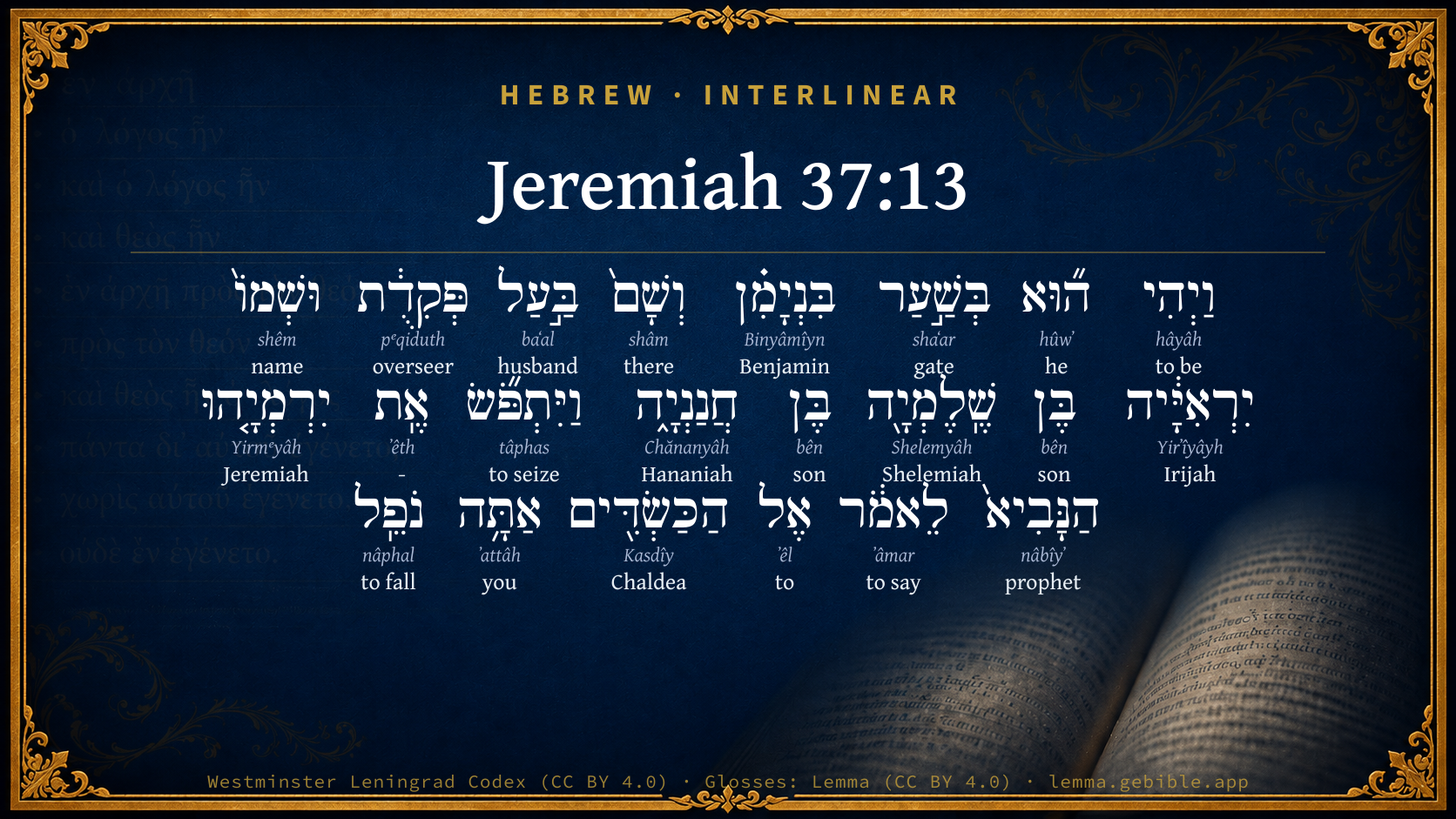
Jeremiah 37:13

Hebrew (Westminster Leningrad Codex) Jeremiah 37:13 appears in the Hebrew Old Testament. The text above is from the Westminster Leningrad Codex. Each word links to its Strong’s number, a concise gloss, and parsing drawn from the Open Scriptures Hebrew Bible morphology. Click any word for its full Brown-Driver-Briggs (BDB) entry.
Download image
Cite this verse

Jeremiah 37:13 (World English Bible). Public Domain. Lemma interlinear Bible study tool, https://lemma.gebible.app/v/jeremiah/37/13.

Show BibTeX & RIS
BibTeX
RIS
English Translation
When he was in the gate of Benjamin, a captain of the guard was there, whose name was Irijah, the son of Shelemiah, the son of Hananiah; and he laid hold on Jeremiah the prophet, saying, You are falling away to the Chaldeans.
World English Bible · Public Domain
Highlights
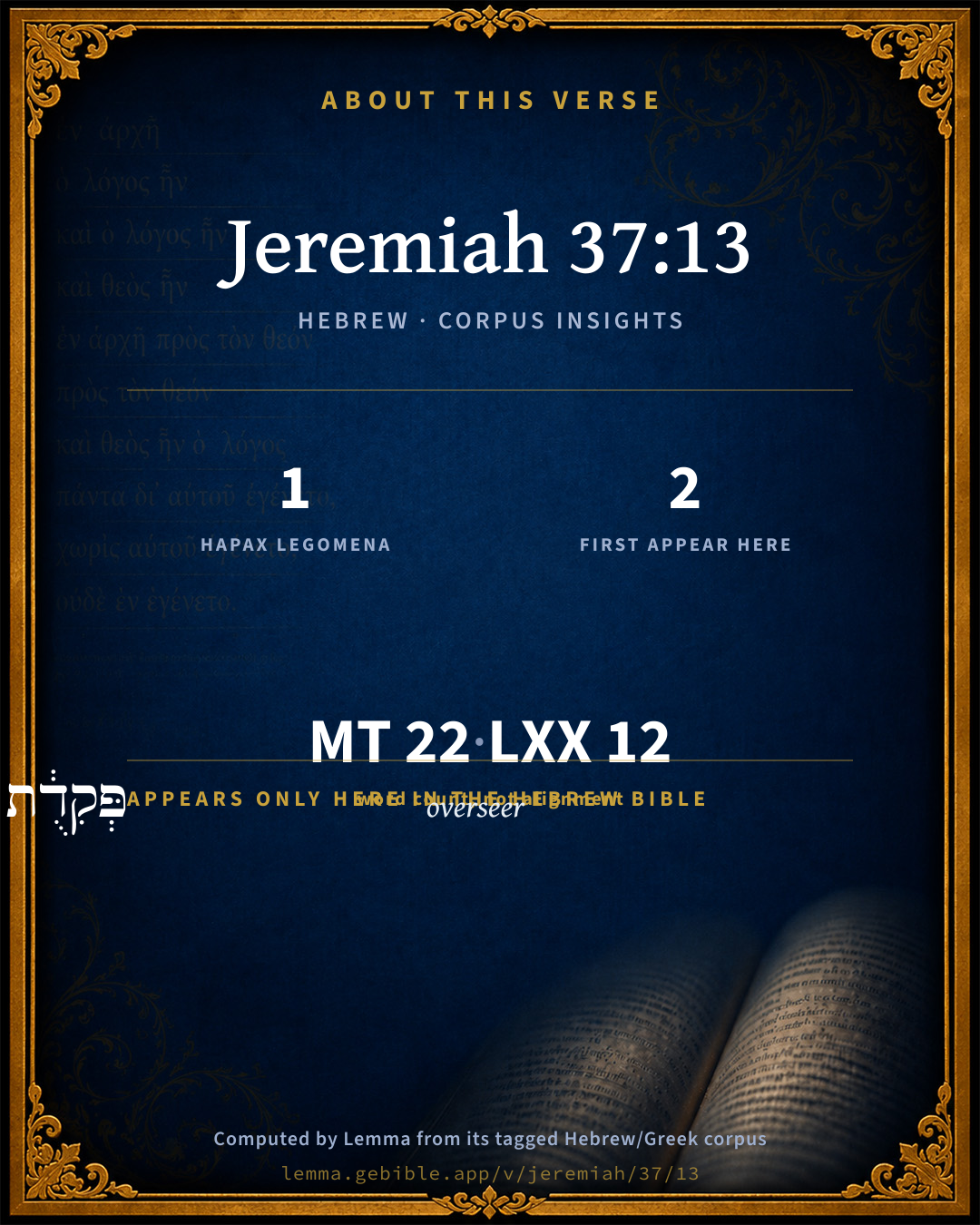
  • 1 hapax legomenon — only here in the Hebrew Bible
  • 2 first appearances in the Hebrew Bible
Full analysis ↓
Download a study sheet

One document with this verse’s original text, its word-by-word gloss line, the meaning frame, cross-references with their text, attributed commentary, and full source and license credits — printable, and it pastes into notes with its structure intact.

This verse Autodidact and up

Study sheet (.html) Plain text (.txt)

A passage Seminary Student

Up to 50 verses in one chapter. A passage sheet keeps up to 6 commentary sources and 12 cross-references per verse, in the order this page ranks them, and says so on the sheet whenever that leaves anything out. Ask for a single verse and you get the Autodidact verse sheet above.

Everything on this page stays free to read, with no account — the sheet is a download of what is already on screen, not access to it.

Want to remove ads? Support Godless Engineer
Compare translations 3

The same verse in 3 English versions, stacked beneath the original-language interlinear above. Click any original word for its lexicon entry.

Each is an independent rendering of the whole verse — the interlinear is not word-aligned to these translations.

Highlighted words mark where these versions differ — a whole-verse word diff, not a word-by-word alignment.

  • World English Bible Public Domain
    When he was in the gate of Benjamin, a captain of the guard was there, whose name was Irijah, the son of Shelemiah, the son of Hananiah; and he laid hold on Jeremiah the prophet, saying, You are falling away to the Chaldeans.
  • King James Version Public Domain
    And when he was in the gate of Benjamin, a captain of the ward was there, whose name was Irijah, the son of Shelemiah, the son of Hananiah; and he took Jeremiah the prophet, saying, Thou fallest away to the Chaldeans.
  • unfoldingWord Literal Text CC BY-SA 4.0
    As he was in the Benjamin Gate, a chief guard was there. His name was Irijah son of Shelemiah son of Hananiah. He grabbed hold of Jeremiah the prophet and said, “You are deserting to the Chaldeans.”

unfoldingWord Literal Text — © unfoldingWord, licensed CC BY-SA 4.0. Word-aligned USFM3 via Door43 (git.door43.org/unfoldingWord/en_ult).

Versions to compare (up to 4)

3 of 4 selected

Show all 18 translations

Every available English version of this verse, each an independent rendering of the whole verse.

  • World English Bible Public Domain
    When he was in the gate of Benjamin, a captain of the guard was there, whose name was Irijah, the son of Shelemiah, the son of Hananiah; and he laid hold on Jeremiah the prophet, saying, You are falling away to the Chaldeans.
  • Berean Standard Bible Public Domain
    But when he reached the Gate of Benjamin, the captain of the guard, whose name was Irijah son of Shelemiah, the son of Hananiah, seized him and said, “You are deserting to the Chaldeans!”
  • Majority Standard Bible Public Domain
    But when he reached the Gate of Benjamin, the captain of the guard, whose name was Irijah son of Shelemiah, the son of Hananiah, seized him and said, “You are deserting to the Chaldeans!”
  • King James Version Public Domain
    And when he was in the gate of Benjamin, a captain of the ward was there, whose name was Irijah, the son of Shelemiah, the son of Hananiah; and he took Jeremiah the prophet, saying, Thou fallest away to the Chaldeans.
  • American Standard Version (1901) Public Domain
    And when he was in the gate of Benjamin, a captain of the ward was there, whose name was Irijah, the son of Shelemiah, the son of Hananiah; and he laid hold on Jeremiah the prophet, saying, Thou art falling away to the Chaldeans.
  • Revised Version (1885) Public Domain
    And when he was in the gate of Benjamin, a captain of the ward was there, whose name was Irijah, the son of Shelemiah, the son of Hananiah; and he laid hold on Jeremiah the prophet, saying, Thou fallest away to the Chaldeans.
  • Geneva Bible (1599) Public Domain
    And when hee was in the gate of Beniamin, there was a chiefe officer, whose name was Iriiah, the sonne of Shelemiah, the sonne of Hananiah, and he tooke Ieremiah the Prophet, saying, Thou fleest to the Caldeans.
  • Douay-Rheims (1899) Public Domain
    And Jeremias answered: It is not so, I am not fleeing to the Chaldeans. But he hearkened not to him: so Jerias took Jeremias and brought him to the princes.
  • Young's Literal Translation Public Domain
    And it cometh to pass, he is at the gate of Benjamin, and there `is' a master of the ward -- and his name is Irijah son of Shelemiah, son of Hananiah -- and he catcheth Jeremiah the prophet, saying, `Unto the Chaldeans thou art falling.'
  • Literal Standard Version CC BY-SA 4.0
    And it comes to pass, he is at the Gate of Benjamin, and there [is] a master of the ward, and his name is Irijah son of Shelemiah, son of Hananiah; and he catches Jeremiah the prophet, saying, “You are defecting to the Chaldeans!”
  • Unlocked Literal Bible CC BY-SA 4.0
    As he was in the Benjamin Gate, a chief guard was there. His name was Irijah son of Shelemiah son of Hananiah. He grabbed hold of Jeremiah the prophet and said, “You are deserting to the Chaldeans.”
  • unfoldingWord Literal Text CC BY-SA 4.0
    As he was in the Benjamin Gate, a chief guard was there. His name was Irijah son of Shelemiah son of Hananiah. He grabbed hold of Jeremiah the prophet and said, “You are deserting to the Chaldeans.”
  • Darby Bible Public Domain
    And when he was in the gate of Benjamin, a captain of the guard was there whose name was Irijah, the son of Shelemiah, the son of Hananiah; and he laid hold on the prophet Jeremiah, saying, Thou art deserting to the Chaldeans.
  • World Messianic Bible Public Domain
    When he was in Benjamin’s gate, a captain of the guard was there, whose name was Irijah, the son of Shelemiah, the son of Hananiah; and he seized Jeremiah the prophet, saying, “You are defecting to the Kasdim!”
  • Webster's Bible Public Domain
    And when he was in the gate of Benjamin, a captain of the ward was there, whose name was Irijah, the son of Shelemiah, the son of Hananiah; and he took Jeremiah the prophet, saying, Thou fallest away to the Chaldeans.
  • Free Bible Version CC BY-SA 4.0
    However, when he reached the Benjamin Gate, the guard captain, whose name was Irijah son of Shelemiah, son of Hananiah, arrested him, saying, “You're defecting to the Babylonians!”
  • Bible in Basic English Public Domain
    But when he was at the Benjamin door, a captain of the watch named Irijah, the son of Shelemiah, the son of Hananiah, who was stationed there, put his hand on Jeremiah the prophet, saying, You are going to give yourself up to the Chaldaeans.
  • JPS Tanakh (1917) Public Domain
    And when he was in the gate of Benjamin, a captain of the ward was there, whose name was Irijah, the son of Shelemiah, the son of Hananiah; and he laid hold on Jeremiah the prophet, saying: 'Thou fallest away to the Chaldeans.'

Literal Standard Version (2020), Covenant Press — licensed CC BY-SA 4.0. Text via the HelloAO Bible API (eBible.org). Unlocked Literal Bible (unfoldingWord) — licensed CC BY-SA 4.0. Text via the HelloAO Bible API (eBible.org). unfoldingWord Literal Text — © unfoldingWord, licensed CC BY-SA 4.0. Word-aligned USFM3 via Door43 (git.door43.org/unfoldingWord/en_ult). Free Bible Version, Dr. Jonathan Gallagher — licensed CC BY-SA 4.0. Text via the HelloAO Bible API (eBible.org).

Word by word

More ways to search: Search by grammar → Find every occurrence → Compare this word →

Practice this passage: Drill this verse → Learn its vocabulary →

פְּקִדֻ֔ת
pᵉqiduth
H6488
“overseer”
Noun, Common, Feminine, Singular, Absolute
Part of Speech
Noun
Type
Common
Gender
Feminine
Number
Singular
State
Absolute
Full BDB Definition

Origin: from H6496

TWOT: 1802d

oversight, overseer, guard
  1. וַיְהִי hâyâh H1961 “and · to be” Conjunction + Verb, Qal, Sequential Imperfect, 3rd Person, Masculine, Singular
  2. ה֞וּא hûwʼ H1931 “he” Pronoun, Personal, 3rd Person, Masculine, Singular
  3. בְּשַׁ֣עַר shaʻar H8179 “in/at · gate of” Preposition + Noun, Common, Masculine, Singular, Construct
  4. בִּנְיָמִ֗ן Binyâmîyn H1144 “Benjamin” Noun, Proper
  5. וְשָׁם֙ shâm H8033 “and · there” Conjunction + Adverb
  6. בַּ֣עַל baʻal H1167 “husband of” Noun, Common, Masculine, Singular, Construct
  7. וּשְׁמוֹ֙ shêm H8034 “and · name · his” Conjunction + Noun, Common, Masculine, Singular, Construct + Suffix, Personal, 3rd Person, Masculine, Singular
  8. יִרְאִיָּ֔יה Yirʼîyâyh H3376 “Irijah” Noun, Proper
  9. בֶּן bên H1121 “son of” Noun, Common, Masculine, Singular, Construct
  10. שֶֽׁלֶמְיָ֖ה Shelemyâh H8018 “Shelemiah” Noun, Proper
  11. בֶּן bên H1121 “son of” Noun, Common, Masculine, Singular, Construct
  12. חֲנַנְיָ֑ה Chănanyâh H2608 “Hananiah” Noun, Proper
  13. וַיִּתְפֹּ֞שׂ tâphas H8610 “and · to seize” Conjunction + Verb, Qal, Sequential Imperfect, 3rd Person, Masculine, Singular
  14. אֶֽת ʼêth H853 “-” Particle, Direct Object
  15. יִרְמְיָ֤הוּ Yirmᵉyâh H3414 “Jeremiah” Noun, Proper
  16. הַנָּבִיא֙ nâbîyʼ H5030 “the · prophet” Particle, Definite Article + Noun, Common, Masculine, Singular, Absolute
  17. לֵאמֹ֔ר ʼâmar H559 “to say” Preposition + Verb, Qal, Infinitive Construct
  18. אֶל ʼêl H413 “to” Preposition
  19. הַכַּשְׂדִּ֖ים Kasdîy H3778 “the · Chaldea” Particle, Definite Article + Noun, Proper
  20. אַתָּ֥ה ʼattâh H859 “you” Pronoun, Personal, 2nd Person, Masculine, Singular
  21. נֹפֵֽל nâphal H5307 “falling” Verb, Qal, Participle Active, Masculine, Singular, Absolute

About this verse

These counts appear in no published source. They are computed here, from the morphology-tagged text and Lemma’s own curated glosses. What Lemma adds →

22
words
21
distinct lemmas
Prophets
section

Notable vocabulary

1 hapax legomenon — a word that appears only here in the entire Hebrew Bible:

  • פְּקִדֻ֔ת overseer H6488

First appearance in Scripture

These words make their first canonical appearance in the Hebrew Bible here:

  • פְּקִדֻ֔ת overseer H6488
  • יִרְאִיָּ֔יה Irijah H3376

Shared distinctive vocabulary

יִרְאִיָּ֔יה Irijah H3376 occurs in 2 verses of the Hebrew Bible. Also found in:

Grammatical profile

  • 4 verbs
  • 13 nouns
  • 2 pronouns
  • 1 preposition
  • 1 adverb
  • 1 particle

Verb forms

  • וַיְהִי Qal · Sequential Imperfect
  • וַיִּתְפֹּ֞שׂ Qal · Sequential Imperfect
  • לֵאמֹ֔ר Qal · Infinitive Construct
  • נֹפֵֽל Qal · Participle Active

Repetition

A word recurs within this verse — often emphatic in Hebrew:

Hebrew & Septuagint length

In the original languages it is 22 Hebrew tokens and 12 Greek tokens — but the two are counted differently (Hebrew bundles its prefixes and suffixes into one token; the Greek is in lemma form), so that isn’t a like-for-like length.

Cross-references

18

Topical passages linked to Jeremiah 37:13 in the Treasury of Scripture Knowledge — connected by theme and wording, ordered by reader-vote popularity; previews shown in the World English Bible.

  • Jeremiah 38:7 Now when Ebedmelech the Ethiopian, a eunuch, who was in the king's house, heard that they had put Jeremiah in the dungeon (the king then sitting in the gate of Benjamin),
  • Zechariah 14:10 All the land will be made like the Arabah, from Geba to Rimmon south of Jerusalem; and she will be lifted up, and will dwell in her place, from Benjamin's gate to the place of the first gate, to the corner gate, and from the tower of Hananel to the king's wine-presses.
  • Jeremiah 18:18 Then said they, Come, and let us devise devices against Jeremiah; for the law shall not perish from the priest, nor counsel from the wise, nor the word from the prophet. Come, and let us strike him with the tongue, and let us not give heed to any of his words.
  • Jeremiah 20:10 For I have heard the defaming of many, terror on every side. Denounce, and we will denounce him, [say] all my familiar friends, those who watch for my fall; peradventure he will be persuaded, and we shall prevail against him, and we shall take our revenge on him.
  • Jeremiah 21:9 He who remains in this city shall die by the sword, and by the famine, and by the pestilence; but he who goes out, and passes over to the Chaldeans who besiege you, he shall live, and his life shall be to him for a prey.
  • Jeremiah 38:1 Shephatiah the son of Mattan, and Gedaliah the son of Pashhur, and Jucal the son of Shelemiah, and Pashhur the son of Malchijah, heard the words that Jeremiah spoke to all the people, saying,
  • Luke 23:2 They began to accuse him, saying, "We found this man perverting the nation, forbidding paying taxes to Caesar, and saying that he himself is Christ, a king."
  • Acts 6:11 Then they secretly induced men to say, "We have heard him speak blasphemous words against Moses and God."
  • Acts 24:5–9 For we have found this man to be a plague, an instigator of insurrections among all the Jews throughout the world, and a ringleader of the sect of the Nazarenes.
  • Acts 24:13 Nor can they prove to you the things of which they now accuse me.
  • Jeremiah 27:6 Now have I given all these lands into the hand of Nebuchadnezzar the king of Babylon, my servant; and the animals of the field also have I given him to serve him.
  • Jeremiah 27:12–13 I spoke to Zedekiah king of Judah according to all these words, saying, Bring your necks under the yoke of the king of Babylon, and serve him and his people, and live.
  • Jeremiah 28:14 For thus says Yahweh of Hosts, the God of Israel: I have put a yoke of iron on the neck of all these nations, that they may serve Nebuchadnezzar king of Babylon; and they shall serve him: and I have given him the animals of the field also.
  • Jeremiah 36:12 he went down into the king's house, into the scribe's chamber: and, behold, all the princes were sitting there, [to wit], Elishama the scribe, and Delaiah the son of Shemaiah, and Elnathan the son of Achbor, and Gemariah the son of Shaphan, and Zedekiah the son of Hananiah, and all the princes.
  • Jeremiah 38:4 Then the princes said to the king, Let this man, we pray you, be put to death; because he weakens the hands of the men of war who remain in this city, and the hands of all the people, in speaking such words to them: for this man doesn't seek the welfare of this people, but the hurt.
  • Jeremiah 38:10–17 Then the king commanded Ebedmelech the Ethiopian, saying, Take from hence thirty men with you, and take up Jeremiah the prophet out of the dungeon, before he die.
  • Amos 7:10 Then Amaziah the priest of Beth El sent to Jeroboam king of Israel, saying, "Amos has conspired against you in the midst of the house of Israel. The land is not able to bear all his words.
  • 2 Corinthians 6:8 by glory and dishonor, by evil report and good report; as deceivers, and yet true;

Cross-references courtesy of OpenBible.info (CC BY 4.0).

Hebrew and Greek witnesses Masoretic Hebrew ↔ Greek Septuagint

The same verse in the two great witnesses to the Old Testament, shown verse-for-verse.

These are two independent witnesses, not word-aligned to each other, and the Septuagint is shown in lemma (dictionary) form.

Hebrew Jeremiah 37:13 Masoretic · Westminster Leningrad Codex

וַיְהִי ה֞וּא בְּשַׁ֣עַר בִּנְיָמִ֗ן וְשָׁם֙ בַּ֣עַל פְּקִדֻ֔ת וּשְׁמוֹ֙ יִרְאִיָּ֔יה בֶּן שֶֽׁלֶמְיָ֖ה בֶּן חֲנַנְיָ֑ה וַיִּתְפֹּ֞שׂ אֶֽת יִרְמְיָ֤הוּ הַנָּבִיא֙ לֵאמֹ֔ר אֶל הַכַּשְׂדִּ֖ים אַתָּ֥ה נֹפֵֽל

When he was in the gate of Benjamin, a captain of the guard was there, whose name was Irijah, the son of Shelemiah, the son of Hananiah; and he laid hold on Jeremiah the prophet, saying, You are falling away to the Chaldeans.

World English Bible · Public Domain

Greek LXX Structure differs

In the Septuagint, Jeremiah is about an eighth shorter than the Hebrew and arranges its material differently — the Oracles Against the Nations (Hebrew chapters 46–51) appear in the middle of the Greek book, after 25:13. Because the chapter and verse boundaries do not line up, a verse-for-verse comparison with the Hebrew is not shown.

A verse-for-verse comparison isn’t shown here because the chapters and verses don’t line up. Switch to the LXX edition with the MT / LXX toggle above to read the Greek directly.

Hebrew: Westminster Leningrad Codex (CC BY 4.0). Greek: Septuagint (public domain); English from a public-domain English Septuagint. How the Septuagint differs from the Hebrew →

Targum (Aramaic paraphrase)

1

The Targum is the ancient Jewish Aramaic paraphrase of the Hebrew Scriptures — an interpretive translation, not the Hebrew text itself. Onkelos (literal) and Pseudo-Jonathan (expansive) render the Torah, and Jonathan the Prophets. Coverage is partial: where no permissively-licensed English translation exists for a verse, only the Aramaic is shown. This is verse-level text, not a word-by-word alignment to the Hebrew.

  1. Targum Jonathan Prophets (Joshua–Malachi)
    וַהֲוָה הוּא בִתְרַע שִׁבְטָא בִּנְיָמִין וְתַמָן גַבְרָא מְמַנָא וּשְׁמֵיהּ יִרְאִיָה בַּר שְׁלֶמְיָה בַּר חֲנַנְיָה וַאֲחַד יַת יִרְמְיָה נְבִיָא לְמֵימַר לְכַסְדְאֵי אַתְּ מִשְׁתְּמָע:

    (no public-domain English translation for this verse)

    Targum Jonathan — Aramaic: “Mikraot Gedolot” (public domain). English: “Sefaria Community Translation” (CC0 1.0 (public-domain dedication)); “London "Chaldee Paraphrase," 1871” (public domain). Text via Sefaria.

Commentary

Notes on Jeremiah 37:13 from classic Christian and Jewish commentators (each source and its license shown beneath its notes). The classic Christian expositions comment on the surrounding passage and are grouped to its opening verse, so a note may address several verses; the Jewish commentaries on the Tanakh (Rashi and others) are per-verse, so they appear only where the commentator wrote on this verse.

Lemma curates 59 commentaries, every one of them public domain or Creative Commons licensed, each selected and text-cleaned for this edition rather than reprinted as found. About our sources →

Trapp's Complete Commentary

John Trapp

Jer 37:13 And when he was in the gate of Benjamin, a captain of the ward [was] there, whose name [was] Irijah, the son of Shelemiah, the son of Hananiah; and he took Jeremiah the prophet, saying, Thou fallest away to the Chaldeans.

Ver. 13. Irijah, the son of Shelemiah, the son of Hananiah.] Of that Hananiah, say the Rabbis whose death Jeremiah foretold. {Jer 28:16-17} This Hierias ferox adogescens, as Josephus calleth him, a fierce young man, bearing Jeremiah a grudge, layeth hold on him in the gate, and layeth treachery to his charge; unicum crimen eorum qui crimine vacabant. {a}

Saying, Thou fullest away to the Chaldeans.] Jeremiah had spoken much of the Chaldeans’ power, and foretold their victory. Hence he is here falsely accused of falling away to them, and being false to his country. Indeed, if the Chaldees could have fetched off Jeremiah, as the French King Louis did Philip de Comines from the Duke of Burgundy - whose affairs thereupon declined immediately - they might have made very good advantage of him; but he was far enough from any such compliance with them, and could better have said than ever Cicero did, Ne immortalitatem contra temp. aceiperem, I would not be false to my country for more than all this world’s good.

{a} Tacitus.

John Trapp, A Commentary or Exposition upon All the Books of the Old and New Testament (1647–1656) — public domain. Text from a community e-Sword module.

Joseph Benson's Commentary

Jer 37:13-14. When he was in the gate of Benjamin — The gate leading toward the country of Benjamin; Irijah, the son of Hananiah — Probably of that Hananiah whose death Jeremiah had foretold, Jer 28:17; took Jeremiah the prophet — Apprehended him as one who was about to desert the city, and fall off to the Chaldeans; the ground of which accusation was the prophet’s having foretold that the Chaldeans should take the city, and exhorted the Jews to submit to them. Then said Jeremiah, It is false — Though, as the Lord’s prophet, he had faithfully revealed his will, and foretold the calamity that was about to come upon the nation, by means of the Chaldeans, this did not prove that he took their part, for at the same time he gave advice both to the king and people how they might, in some measure at least, escape the judgments he had denounced against them; nor had he now any design to flee to the Chaldeans; so far from it, that, when the city was taken, and the captain of the guard gave him his choice, either to go along with him to Babylon, or to go back to Gedaliah, whom the king of Babylon had left as deputy governor in Judea, he chose rather to go and live under Gedaliah’s government in a poor condition, than to enjoy protection and plenty in an idolatrous country. But he hearkened not unto him — The captain of the ward would not believe him, but carried him before the princes.

Joseph Benson's Commentary on the Old and New Testaments (1811–1818) — public domain. Text from a community e-Sword module.

Tyndale Open Study Notes

Tyndale Open Resources

37:13-16 The sentry and other officials of Judah misinterpreted Jeremiah’s action as desertion.

Tyndale Open Study Notes — © Tyndale Open Resources, licensed CC BY-SA 4.0. Text via the HelloAO Bible API.

Geneva Bible (1599)

Geneva Bible translators

By the which men went into the country of Benjamin.

Hebrew, fallest.

Geneva Bible (1599) marginal notes — public domain. Text via Bolls.life.

Jamieson, Fausset & Brown

Robert Jamieson, A. R. Fausset & David Brown

ward--that is, the "guard," or "watch."

Hananiah--whose death Jeremiah predicted (Jer 28:16). The grandson in revenge takes Jeremiah into custody on the charge of deserting ("thou fallest away," Jer 38:19; Jer 52:15; Sa1 29:3) to the enemy. His prophecies gave color to the charge (Jer 21:9; Jer 38:4).

Jamieson, Fausset & Brown — Commentary Critical and Explanatory on the Whole Bible (1871) — public domain (CC PDM 1.0). Text via the HelloAO Bible API.

Adam Clarke's Commentary

Verse 13. Thou fallest away to the Chaldeans.] Thou art a deserter, and a traitor to thy country. As he had always declared that the Chaldeans should take the city, &c., his enemies took occasion from this to say he was in the interest of the Chaldeans, and that he wished now to go to them, and betray the place.

Adam Clarke's Commentary on the Bible (1810–1826) — public domain. Text from a community e-Sword/MySword module.

John Calvin's Commentaries

But he then adds, that he was intercepted by the prefect of the ward in the gate of Benjamin That gate had its name from its situation, for a part of Jerusalem belonged to the tribe of Benjamin; and hence it was not strange that the gate which led to the heritage of the tribe of Benjamin was so called. There then was Jeremiah intercepted by Irijah, the prefect of the ward, and not without a grievous charge, that he was escaping to the Chaldeans. The Prophet attempted to clear himself, but with no effect; for an opinion had prevailed, that he was already in league with the enemies. He thus gained nothing by defending himself, but was taken to the princes, the king’s counsellors.

This passage teaches us that God’s servants cannot escape without being exposed to many calumnies and false suspicions. Jeremiah might at the beginning have evaded this, and according to the perception of the flesh, his exemption or immunity might have been viewed as lawful, for there was now before his eyes the danger, not only of losing his life, but also of his name and reputation, which, to ingenuous and wise men, is of much more value. Had Jeremiah then chosen to evade, he might have made this pretense, — “I am indeed ready to offer my life as a sacrifice a hundred times, but what will it avail me, if I am to be regarded as a revolter?” For he must have thus exposed the very name of God to many blasphemies: they might have said,” This is the Prophet who boasted that he had been sent from above, but he is now become perfidious and a traitor to his own countw, and has tried to deliver up the city into the hands of enemies.” Jeremiah then might have shaken off this burden laid on him; but it was nccessary for him to bear this reproach, with which he was falsely charged. Faithful teachers ought indeed to remove, as far as they can, all calumnies, and to check the wicked and malicious, so that they may not have the occasion to speak evil; but when they have done all, they will not yet exempt themselves from calumny; for their words and their deeds will be misconstrued. Thus Jeremiah was loaded with false charges; for all had persuaded themselves, that as he had so much extolled the power of King Nebuchadnezzar, he had been hired by him for the purpose of depressing the people by fear; and it may be that the violent among them did wilfully and knowingly make his case to appear worse to the ignorant, even by false reports. As then this conviction respecting him prevailed everywhere, he was apprehended as a revolter, as he was going out of the city.

But he says, that he intended to go into the land of Benjamin, so as to separate himself. The verb חלק, chelak, means to divide, to scatter, to dissipate; and hence some have given this meaning, that he went into the land of Benjamin in order to divide his heritage; but this seems harsh and forced. They add, “In the midst of the people,” as though Jeremiah wished to make his land common, and to give it to the people: but in this explanation there is nothing probable or suitable. I therefore doubt not but that Jeremiah sought this as a quiet place, as it is understood by most interpreters, he then went forth towards the land of Benjamin, that he might separate himself; that is, that he might be secluded there in the midst of his people. It is, indeed, a brief mode of speaking, but the meaning is not ambiguous, — that he might be there, where he might separate himself from the people, as the places were distant from one another. For he was tired with the city, because he saw that he spent his labor in vain. Some think that he was afraid of being cast into prison, because he had just announced a command greatly disliked; but it is more probable that, he was worn out with weariness, because he saw that he made no impression on men so hard and refractory. Hence then it was, that he wished to withdraw from the presence of the whole people.

Then follows what we have already mentioned, that he was taken in the gate by the keeper Irijah, as though he were revolting to the Chaldeans. We have stated how this suspicion arose, even because he had faithfillly proclaimed the commands of God. We hence see how God tried his servant, when he thus constrained him to speak, so that his words became suspected. And hence also we may gather how thoroughly fixed in the minds of men was that false opinion, for Jeremiah was not heard in his own defense. He indeed said openly that he was not fleeing away, nay, that this was a false charge. It is a lie, he says, I am not fleeing to the Chaldeans

I have already reminded you that the verb נפל nuphal, found here, means properly to fall, but it is to be taken here metaphorically, as signifying to fall away, or to incline to another side. Thou then fallest away or inclinest to the Chaldeans, which was the same thing as to revolt. We see that the Prophet was not charged with a common offense, for it would have been the highest to forsake his own country and to pass over to the enemies: it would have been better for him to die a hundred deaths. But, as I have already said, the servants of God ought to be so courageous as to despise the slanders of the unprincipled, and, when it so pleases God, to prepare themselves for patience whenever any reproach is to be undergone, only let their conscience be always clear before God and angels; and let also their integrity confute all slanders, and let them disprove them too, provided there be those who can bear to hear them: but if a defense be not always admitted, let them patiently bear this indignity. And this also we ought to notice, that God’s servants, though ready to clear themselves of crimes ascribed to them, and to defend their innocence at the peril of life, are yet often repelled and condemned unheard. This is, indeed, a great indignity; but yet as Jeremiah met with such a treatment, it ought not at this day to appear to us unendurable or new. It now follows —

John Calvin's Commentaries (1540-1563) — public domain. Text from the Calvin Translation Society English edition (1840s-50s) via the Christian Classics Ethereal Library (ccel.org). Calvin's coverage is partial (roughly two-thirds of the Bible); uncommented books and verses are honest gaps, never fabricated. The 19th-century editor's footnotes and remarks are omitted so the notes are faithfully Calvin's own voice.

Ellicott's Commentary for English Readers

(13) And when he was in the gate of Benjamin . . .—The prophet’s fears were not groundless. He had to leave the city by the entrance known as the gate of Benjamin (Jer_38:7), on the north side (Zec_14:10). The officer in command, Irijah, the son of Shelemiah (probably, therefore, the brother of Jehucal, who is named in Jer_37:3, and so probably acquainted with Jeremiah’s last prophetic utterance), charged him with treachery. He was “falling away to the Chaldæans.” It was assumed that, though the Chaldæans had gone, the prophet was about to make his way to their encampment to incite them to return, and so work out the fulfilment of his own prediction. The very phrase “thou fallest away” may have been an allusive reference to Jeremiah’s own words in Jer_21:9, if, with the best critics, we refer those words to an earlier date than the raising of the siege.

A Bible Commentary for English Readers, edited by Charles John Ellicott (1878–1897) — public domain. Text from a community e-Sword module.

The Cambridge Bible for Schools and Colleges

gen. ed. J. J. S. Perowne

13. the gate of Benjamin] in the N. wall of the city, mentioned also Jer_38:7; Zec_14:10.

a captain of the ward] lit. a master of the watch, a sentinel, charged with the duty of taking cognisance of those who passed the gate.

Thou fallest away] The views which Jeremiah was known to hold as to the propriety of yielding to the Chaldaeans (e.g. ch. Jer_21:9) would give plausibility to the charge, and of this the princes in their hostility to the policy he advocated would gladly avail themselves to put him under arrest. Evidently there had been a considerable number of such departures (Jer_38:19; cp. Jer_52:15); but there was no real inconsistency between Jeremiah’s counselling others to withdraw, and his conviction that it was his personal duty to remain in the doomed city.

The Cambridge Bible for Schools and Colleges (gen. ed. J. J. S. Perowne; Cambridge University Press, 1878–1918) — public domain. Text from a community e-Sword module.

John Gill's Exposition

And when he was in the gate of Benjamin,.... One of the gates of the city so called, either because it stood in the tribe of Benjamin, as part of Jerusalem did; or because it led to the land of Benjamin, whither the prophet was going: and just as he had got to that gate, and was going through it, he was stopped by

a captain of the ward there; who was placed at this gate, that none should go out to the Chaldeans, according to Kimchi; but rather he was the keeper of the gate, not at this time only, but always; Josephus (i) calls him one of the rulers:

whose name was Irijah, the son of Shelemiah, the son of Hananiah: the grandson as some think, of that Hananiah the false prophet, of whose death Jeremiah the prophet prophesied, Jer 28:16; and the Jews have a tradition that Hananiah ordered his son Shelemiah, that if he ever had an opportunity to bring Jeremiah to ruin, to do it; and the same charge Shelemiah gave to his son Irijah, who, having this opportunity, laid hold on him; Jarchi, Kimchi, and Abarbinel, make mention of it:

and he took Jeremiah the prophet, saying, thou fallest away to the Chaldeans; it looks as if, though he might not have a family grudge against him, as the Jews suggest, yet had a hatred of him for his prophecies, and therefore fixes this calumny on him; for otherwise, why did he suffer the people to pass in great numbers without any such charge?

(i) Antiqu. l. 10. c. 7. sect. 3.

John Gill's Exposition of the Whole Bible (1746–1763) — public domain (CC PDM 1.0). Text via the HelloAO Bible API.

Albert Barnes' Notes on the Bible

A captain of the ward - Captain of the watch, whose business was to examine all who went in and out.

The gate of Benjamin - The northern gate, also called the gate of Ephraim.

Thou fallest away ... - His well-known views made Jeremiah a suspected person, though the charge was groundless.

Albert Barnes' Notes on the Bible (1834–1885) — public domain. Text from a community e-Sword/MySword module.

Matthew Poole's English Annotations

The gate of Benjamin was some gate that looked toward the inheritance of that tribe, or where those used to go out who went that way; we read of it Jer 38:7. Irijah was a captain of the guard that was set to watch at the gates, to keep people from going out, or at least some persons; for it should seem by Jeremiah’s endeavour to go out in the crowd, they suffered many to go out, as is usual in sieges, when victuals grow scarce; and though the Chaldeans were at present gone, yet they were not out of fear of their coming back. This captain apprehends Jeremiah, as one who was about to desert the city, and fall off to the Chaldeans. That Hananiah the grandfather of this Irijah was the false prophet we read of Jer 28, who died according to Jeremiah’s prophecy, and this his grandchild apprehended Jeremiah in some revenge of his grandfather, is but uncertainly guessed. But Jeremiah’s so frequent prophesying that the Chaldeans should take the city exposed him to this suspicion probably.

Matthew Poole's English Annotations on the Holy Bible (1683–1685) — public domain. Text from a community e-Sword/MySword module.

Whedon's Commentary on the Bible

Daniel D. Whedon

13. Gate of Benjamin — The north gate of the city, called also the gate of Ephraim; as in 2Ki_14:13.

Captain of the ward — Literally, lord of the oversight, the commander of the watch at the gate.

Fallest away to the Chaldeans — The charge was probably the offspring of personal malice, but the known views of Jeremiah gave colour to it.

Daniel D. Whedon (gen. ed.), Commentary on the Old and New Testaments (1874–1909) — public domain. Text from a community e-Sword module.

The Pulpit Commentary

The gate of Benjamin; i.e. the gate looking northwards towards Benjamin. (comp. Jer_20:2 Jer_38:7 Zec_14:10) It appears to be the same as the gate of Ephraim. (2Ki_14:13 Neh_8:16) Thou fallest away, etc. Perhaps an allusion to Jeremiah"s declaration (Jer_21:9) that "he that falleth away to the Chaldeans... he shall live,

Falsely accused.

Our Lord Jesus said, "It is sufficient for the servant that he be as his Master." Now, as he was falsely accused, so here we find his servant likewise. Note

I TO BE FALSELY ACCUSED IS THE COMMON LOT OF GOD"S PEOPLE. How many instances we have! Abel, Joseph, Moses, David, etc. Because of such slanders the psalmist said, "All men are liars." And here the Prophet Jeremiah, having no thought of deserting his countrymen, is nevertheless accused of so doing. And today the world is ever ready with its slander. It avows that all the godly are but hypocrites, knaves, or fools. With what eagerness does it fasten upon the faults of a good man! How ready to take up an accusation against him!

II HOW IS IT TO BE ACCOUNTED FOR? We reply:

1. Men of the world do not understand the principles on which the godly act. Hence what they do not understand they misrepresent.

2. They know their own motives, and attribute the like to the godly. They act from purely worldly motives, and hence they conclude godly men do the same.

3. They hate religion, and therefore are always ready to revile it.

4. It is "a comfort to Sodom" to think that the godly are no better than themselves after all. But

III HOW IS IT TO BE DEALT WITH?

1. Sometimes by silence. Silence leaves opportunity for and suggests reflection. How often of our Lord is it said, "He answered not a word" (cf. Joh 13)

2. Sometimes by indignant denial. Thus the prophet acted here; ver. 14, "It is false," etc. They might have known, and probably did know, bow false their accusation was. Where there is great and true indignation felt at being thought capable of a given crime, that feeling, may often be shown; often, indeed, it ought to be, as when

a. the honour of God is concerned;

b. the good of his Church;

c. what is shameful as well as sinful is charged against us.

3. Sometimes by showing the necessary untruthfulness of the accusation. This also our Lord did, as when they charged him with being in league with Beelzebub.

4. Sometimes by committing it all to God. Of our Lord it is said, "When

he was reviled, he reviled not again, ... but committed himself to him that judgeth righteously.

5. Sometimes by showing the motive of the false accusation. As when our Lord likened those who found fault with him to petulant children playing in the market place, who would be pleased with nothing.

6. Always by remembering that we are in the fellowship of Christ herein, and seeking his Spirit"s aid to rightly bear this trial. C.

The Pulpit Commentary (1880–1919), ed. H.D.M. Spence-Jones & Joseph S. Exell — public domain. Text from a community e-Sword module.

John Wesley's Explanatory Notes

Of Benjamin - The gate that looked toward the inheritance of that tribe.

John Wesley, Explanatory Notes Upon the Whole Bible (1754–1765) — public domain. Text via the GEBible commentary corpus.

Keil & Delitzsch

C. F. Keil & F. Delitzsch

When he was entering the gate of Benjamin, where Jeriah the son of Shelemiah kept watch, the latter seized him, saying, "Thou desirest to go over to the Chaldeans" (נפל אל־, see on Jer 21:9). The gate of Benjamin (Jer 38:7; Jer 14:10) was the north gate of the city, through which ran the road to Benjamin and Ephraim; hence it was also called the gate of Ephraim, Kg2 14:13; Neh 8:16. בּעל, "holder of the oversight," he who kept the watch, or commander of the watch at the gate. "The accusation was founded on the well-known views and opinions of Jeremiah (Jer 21:9); but it was mere sophistry, for the simple reason that the Chaldeans were no longer lying before the city" (Hitzig).

Keil & Delitzsch — Biblical Commentary on the Old Testament (1861–1891) — public domain (CC PDM 1.0). Text via the HelloAO Bible API. (Old Testament only.)

Rashi

Rabbi Shlomo Yitzchaki (Rashi)

and there was the captain of the guard Appointed to guard so that no man should leave the city to make peace with the Chaldeans.

the son of Shelemiah the son of Hananiah That is Hananiah the son of Azzur. He was his grandson, and for the following reason Scripture traced his lineage, [viz.] to teach that whoever flatters a wicked man eventually falls into his hands or into the hands of his son or into the hands of his grandson, and Jeremiah flattered him, for he said to him, “Amen! (28:6) [So may the Lord do.] May the Lord fulfil your words” (Sotah 41b). And [according to] the Midrash Aggadah, Hananiah commanded his son, “See that I am dying because of Jeremiah, and he made me a liar in my prophecy. If you can cause him to stumble, cause him to stumble. And his son commanded his son also in that manner, and when the time came, he caused him to stumble.

Rashi on the Tanakh — English translations: “The Judaica Press complete Tanach with Rashi, translated by A. J. Rosenberg” (CC BY 4.0); “Pentateuch with Rashi's commentary by M. Rosenbaum and A.M. Silbermann, 1929-1934” (public domain); “The Metsudah Tanach series, Lakewood, N.J” (CC BY 4.0); and “The Book of Joshua, Metsudah Publications, 1997” (CC BY 4.0). Text via Sefaria.

Lesson kit

Teaching starters — assembled from the data on this page, not authored interpretation. Every prompt links to the verse data it draws on. Edit before teaching.

Jeremiah, in the Prophets, opens this verse with 22 words (21 distinct Hebrew lemmas). Its most distinctive word is pᵉqiduth (“overseer”). A historical commentator’s framing appears above. Read the whole chapter for the surrounding context.

Discussion questions

  1. What does “overseer” (pᵉqiduth) contribute to the verse as a whole?
  2. 1 word here appears nowhere else in the Hebrew Bible. Why might the author reach for such rare wording?
  3. 2 words make their first appearance in Scripture here. What does this debut establish?
  4. How does Jeremiah 37:14, which shares the word «Irijah», read alongside this verse?
  5. What does the repetition of “son” (2× in this one verse) do in this verse?
  6. These translations render this verse differently. What is at stake in choosing one wording over another?
  7. «וַיְהִי» is a Qal Sequential Imperfect verb. How does that grammatical form shape the action described?
  8. Compare how Trapp's Complete Commentary and Joseph Benson's Commentary read this verse. Where do they agree or differ?

Things to notice

  • 1 word in this verse appears nowhere else in the Hebrew Bible.
  • 2 words make their first canonical appearance in Scripture here.
  • This verse counts 22 Hebrew ↔ 12 Greek words.
  • These translations choose different wording for 17 words in this verse.
  • “son” occurs 2× in this single verse.

Reading settings

Reading text

Shown beneath each verse's original-language words.

Old Testament
Old Testament edition

Read the OT as the Masoretic Hebrew (MT) or the Greek Septuagint (LXX).

English shown for the Greek Septuagint (in the Hebrew ↔ Greek comparison).

Comparing translations? Open the Compare panel on any verse page to stack up to four side by side.