
Jeremiah 32:6

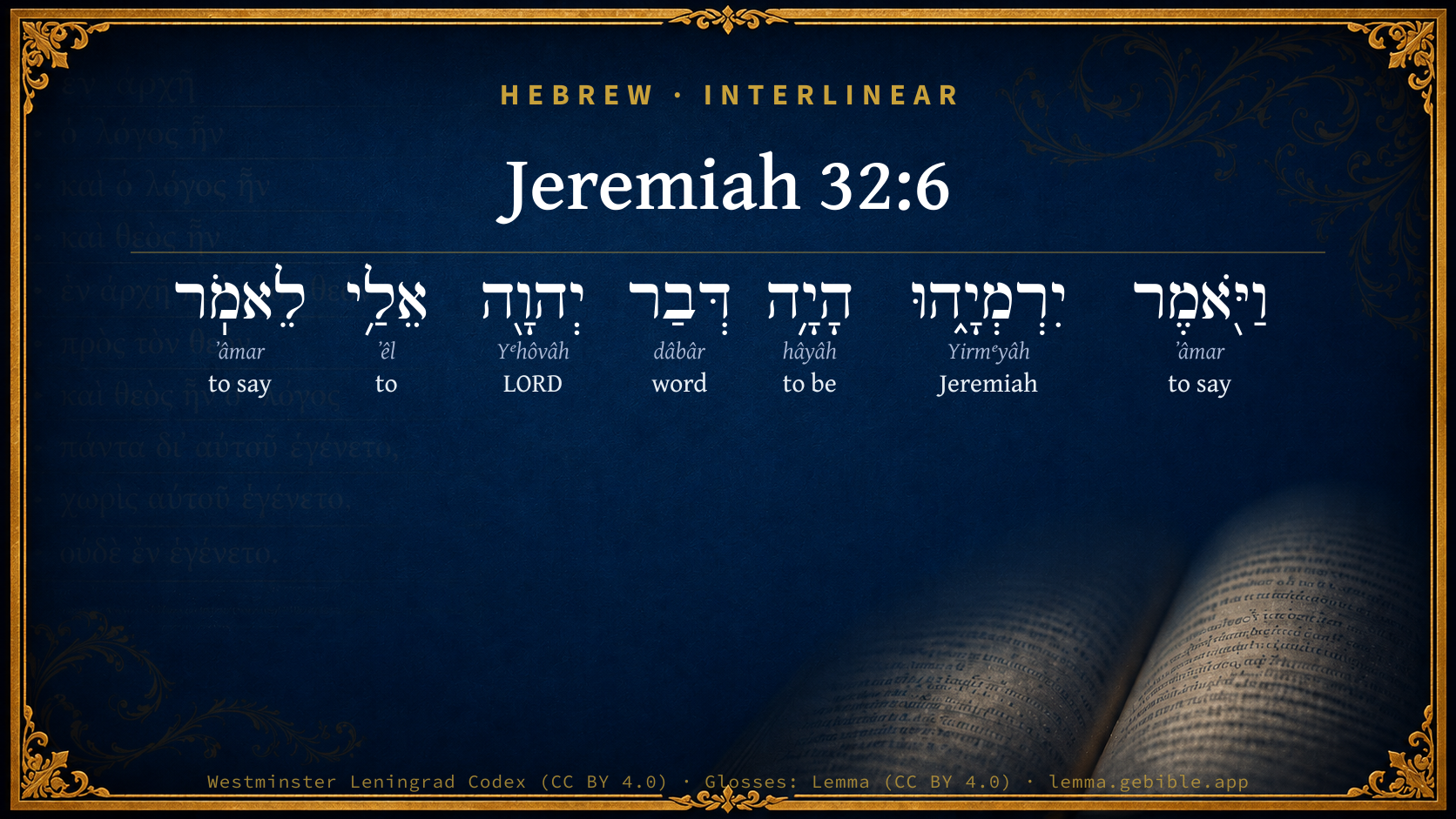
Hebrew (Westminster Leningrad Codex) Jeremiah 32:6 appears in the Hebrew Old Testament. The text above is from the Westminster Leningrad Codex. Each word links to its Strong’s number, a concise gloss, and parsing drawn from the Open Scriptures Hebrew Bible morphology. Click any word for its full Brown-Driver-Briggs (BDB) entry.
Download image
Cite this verse

Jeremiah 32:6 (World English Bible). Public Domain. Lemma interlinear Bible study tool, https://lemma.gebible.app/v/jeremiah/32/6.

Show BibTeX & RIS
BibTeX
RIS
English Translation
Jeremiah said, The word of Yahweh came to me, saying,
World English Bible · Public Domain
Download a study sheet

One document with this verse’s original text, its word-by-word gloss line, the meaning frame, cross-references with their text, attributed commentary, and full source and license credits — printable, and it pastes into notes with its structure intact.

This verse Autodidact and up

Study sheet (.html) Plain text (.txt)

A passage Seminary Student

Up to 50 verses in one chapter. A passage sheet keeps up to 6 commentary sources and 12 cross-references per verse, in the order this page ranks them, and says so on the sheet whenever that leaves anything out. Ask for a single verse and you get the Autodidact verse sheet above.

Everything on this page stays free to read, with no account — the sheet is a download of what is already on screen, not access to it.

Want to remove ads? Support Godless Engineer
Compare translations 3

The same verse in 3 English versions, stacked beneath the original-language interlinear above. Click any original word for its lexicon entry.

Each is an independent rendering of the whole verse — the interlinear is not word-aligned to these translations.

Highlighted words mark where these versions differ — a whole-verse word diff, not a word-by-word alignment.

  • World English Bible Public Domain
    Jeremiah said, The word of Yahweh came to me, saying,
  • King James Version Public Domain
    And Jeremiah said, The word of the LORD came unto me, saying,
  • unfoldingWord Literal Text CC BY-SA 4.0
    Jeremiah said, “The word of Yahweh came to me, saying,

unfoldingWord Literal Text — © unfoldingWord, licensed CC BY-SA 4.0. Word-aligned USFM3 via Door43 (git.door43.org/unfoldingWord/en_ult).

Versions to compare (up to 4)

3 of 4 selected

Show all 18 translations

Every available English version of this verse, each an independent rendering of the whole verse.

  • World English Bible Public Domain
    Jeremiah said, The word of Yahweh came to me, saying,
  • Berean Standard Bible Public Domain
    Jeremiah replied, “The word of the LORD came to me, saying:
  • Majority Standard Bible Public Domain
    Jeremiah replied, “The word of the LORD came to me, saying:
  • King James Version Public Domain
    And Jeremiah said, The word of the LORD came unto me, saying,
  • American Standard Version (1901) Public Domain
    And Jeremiah said, The word of Jehovah came unto me, saying,
  • Revised Version (1885) Public Domain
    And Jeremiah said, The word of the LORD came unto me, saying,
  • Geneva Bible (1599) Public Domain
    And Ieremiah said, The word of the Lord came vnto me, saying,
  • Douay-Rheims (1899) Public Domain
    And Jeremias said: The word of the Lord came to me, saying:
  • Young's Literal Translation Public Domain
    And Jeremiah saith, `A word of Jehovah hath been unto me saying,
  • Literal Standard Version CC BY-SA 4.0
    And Jeremiah says, “A word of YHWH has been to me, saying,
  • Unlocked Literal Bible CC BY-SA 4.0
    Jeremiah said, “The word of Yahweh came to me, saying,
  • unfoldingWord Literal Text CC BY-SA 4.0
    Jeremiah said, “The word of Yahweh came to me, saying,
  • Darby Bible Public Domain
    And Jeremiah said, The word of Jehovah came unto me, saying,
  • World Messianic Bible Public Domain
    Jeremiah said, “The LORD’s word came to me, saying,
  • Webster's Bible Public Domain
    And Jeremiah said, The word of the LORD came to me, saying,
  • Free Bible Version CC BY-SA 4.0
    Jeremiah answered, “The Lord gave me a message, saying:
  • Bible in Basic English Public Domain
    And Jeremiah said, The word of the Lord came to me, saying,
  • JPS Tanakh (1917) Public Domain
    And Jeremiah said: 'The word of the LORD came unto me, saying:

Literal Standard Version (2020), Covenant Press — licensed CC BY-SA 4.0. Text via the HelloAO Bible API (eBible.org). Unlocked Literal Bible (unfoldingWord) — licensed CC BY-SA 4.0. Text via the HelloAO Bible API (eBible.org). unfoldingWord Literal Text — © unfoldingWord, licensed CC BY-SA 4.0. Word-aligned USFM3 via Door43 (git.door43.org/unfoldingWord/en_ult). Free Bible Version, Dr. Jonathan Gallagher — licensed CC BY-SA 4.0. Text via the HelloAO Bible API (eBible.org).

Word by word

More ways to search: Search by grammar → Find every occurrence → Compare this word →

Practice this passage: Drill this verse → Learn its vocabulary →

יִרְמְיָ֑הוּ
Yirmᵉyâh
H3414
“Jeremiah”
Noun, Proper
Part of Speech
Noun
Type
Proper
Full BDB Definition

Origin: from H7311 and H3050

TWOT: None

Jeremiah = "whom Jehovah has appointed" - the major prophet, son of Hilkiah of the priestly family in Anathoth; author of the prophetic book bearing his name - a man of Libnah and father of Hamutal the wife of king Josiah - a Gadite who joined David at Ziklag - a Manassehite, one of the mighty men of valour of the Transjordanic half tribe of Manasseh - a Gadite and warrior of David - a warrior of David - a priest who joined Nehemiah in the covenant ceremony - a priest also in the time of Nehemiah; maybe same as 7 - father of Jaazaniah the Rechabites
  1. וַיֹּ֖אמֶר ʼâmar H559 “and · to say” Conjunction + Verb, Qal, Sequential Imperfect, 3rd Person, Masculine, Singular
  2. הָיָ֥ה hâyâh H1961 “to be” Verb, Qal, Perfect, 3rd Person, Masculine, Singular
  3. דְּבַר dâbâr H1697 “word of” Noun, Common, Masculine, Singular, Construct
  4. יְהוָ֖ה Yᵉhôvâh H3068 “LORD” Noun, Proper
  5. אֵלַ֥י ʼêl H413 “to · me” Preposition + Suffix, Personal, 1st Person, Common, Singular
  6. לֵאמֹֽר ʼâmar H559 “to say” Preposition + Verb, Qal, Infinitive Construct

About this verse

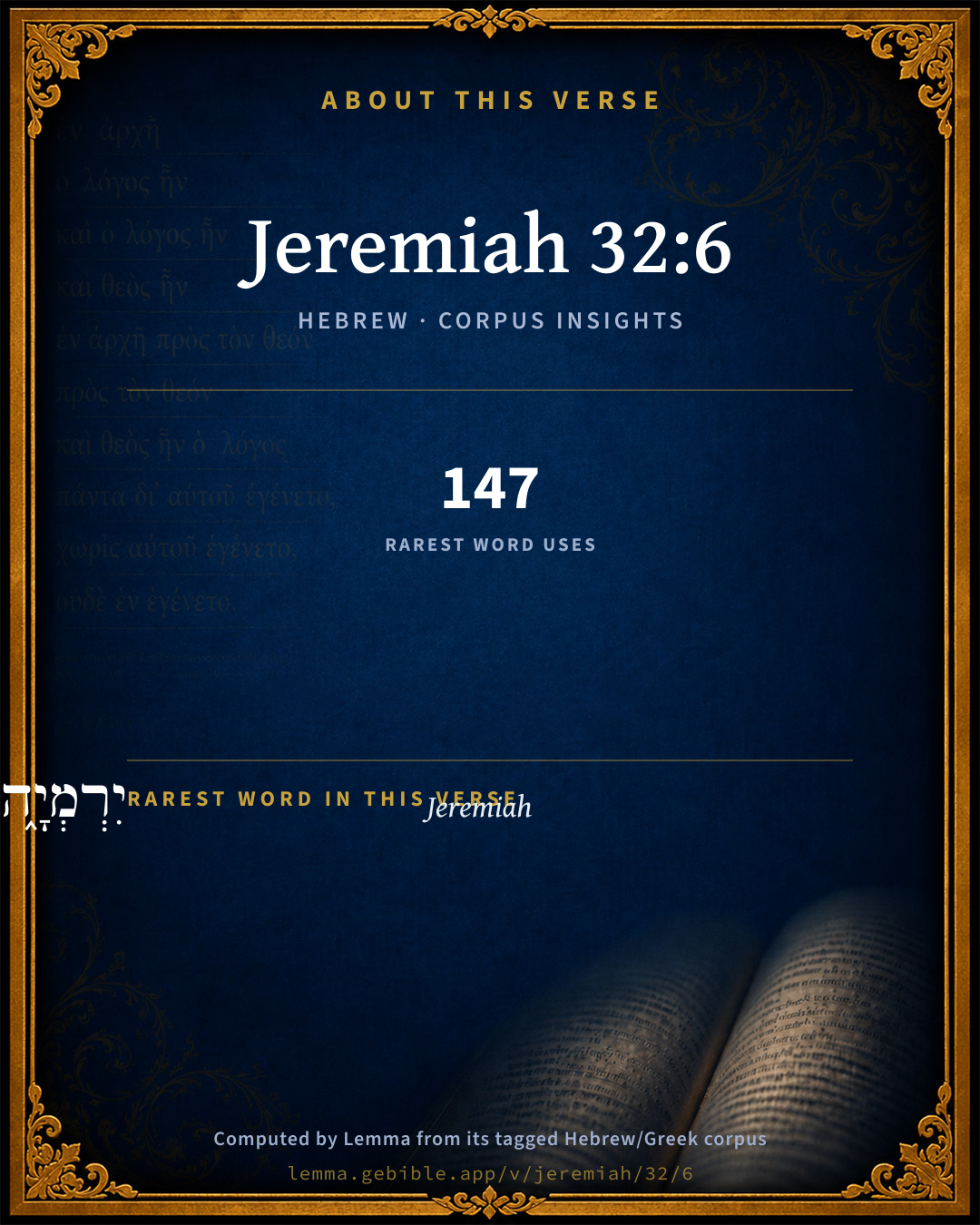
These counts appear in no published source. They are computed here, from the morphology-tagged text and Lemma’s own curated glosses. What Lemma adds →

7
words
6
distinct lemmas
Prophets
section

Grammatical profile

  • 3 verbs
  • 3 nouns
  • 1 preposition

Verb forms

  • וַיֹּ֖אמֶר Qal · Sequential Imperfect
  • הָיָ֥ה Qal · Perfect
  • לֵאמֹֽר Qal · Infinitive Construct

Repetition

A word recurs within this verse — often emphatic in Hebrew:

  • וַיֹּ֖אמֶר to say H559 ×2
Hebrew and Greek witnesses Masoretic Hebrew ↔ Greek Septuagint

The same verse in the two great witnesses to the Old Testament, shown verse-for-verse.

These are two independent witnesses, not word-aligned to each other, and the Septuagint is shown in lemma (dictionary) form.

Hebrew Jeremiah 32:6 Masoretic · Westminster Leningrad Codex

וַיֹּ֖אמֶר יִרְמְיָ֑הוּ הָיָ֥ה דְּבַר יְהוָ֖ה אֵלַ֥י לֵאמֹֽר

Jeremiah said, The word of Yahweh came to me, saying,

World English Bible · Public Domain

Greek LXX Structure differs

In the Septuagint, Jeremiah is about an eighth shorter than the Hebrew and arranges its material differently — the Oracles Against the Nations (Hebrew chapters 46–51) appear in the middle of the Greek book, after 25:13. Because the chapter and verse boundaries do not line up, a verse-for-verse comparison with the Hebrew is not shown.

A verse-for-verse comparison isn’t shown here because the chapters and verses don’t line up. Switch to the LXX edition with the MT / LXX toggle above to read the Greek directly.

Hebrew: Westminster Leningrad Codex (CC BY 4.0). Greek: Septuagint (public domain); English from a public-domain English Septuagint. How the Septuagint differs from the Hebrew →

Targum (Aramaic paraphrase)

1

The Targum is the ancient Jewish Aramaic paraphrase of the Hebrew Scriptures — an interpretive translation, not the Hebrew text itself. Onkelos (literal) and Pseudo-Jonathan (expansive) render the Torah, and Jonathan the Prophets. Coverage is partial: where no permissively-licensed English translation exists for a verse, only the Aramaic is shown. This is verse-level text, not a word-by-word alignment to the Hebrew.

  1. Targum Jonathan Prophets (Joshua–Malachi)
    וַאֲמַר יִרְמְיָה הֲוָה פִּתְגַם נְבוּאָה מִן קֳדָם יְיָ עִמִי לְמֵימָר:

    (no public-domain English translation for this verse)

    Targum Jonathan — Aramaic: “Mikraot Gedolot” (public domain). English: “Sefaria Community Translation” (CC0 1.0 (public-domain dedication)); “London "Chaldee Paraphrase," 1871” (public domain). Text via Sefaria.

Commentary

Notes on Jeremiah 32:6 from classic Christian and Jewish commentators (each source and its license shown beneath its notes). The classic Christian expositions comment on the surrounding passage and are grouped to its opening verse, so a note may address several verses; the Jewish commentaries on the Tanakh (Rashi and others) are per-verse, so they appear only where the commentator wrote on this verse.

Lemma curates 59 commentaries, every one of them public domain or Creative Commons licensed, each selected and text-cleaned for this edition rather than reprinted as found. About our sources →

Trapp's Complete Commentary

John Trapp

Jer 32:6 And Jeremiah said, The word of the LORD came unto me, saying,

Ver. 6. The word of the Lord came unto me, saying.] He had God’s word for his warrant, and this bore him out against the jeers of the ungodly, who would easily think it a very simple part in him who prophesied a desolation of the whole land to go about to buy land.

John Trapp, A Commentary or Exposition upon All the Books of the Old and New Testament (1647–1656) — public domain. Text from a community e-Sword module.

Joseph Benson's Commentary

Jer 32:6-8. The word of the Lord came unto me — “Jeremiah, after having just informed us why he was put in prison, returns to his design, and tells us that God had advised him, probably in a dream or vision, that Hanameel, his cousin, should come to him with the offer of a field in Anathoth; the right of redeeming whereof was in him. Jeremiah might have given up this right, as not being in a situation to make the purchase; but, understanding from the revelation of the Lord, that this affair had a mystical reference, and that he ought to accept the offer of his cousin, he purchased the field, as is afterward related, with the full process and meaning of the affair.” — Dodd. The field, being in Anathoth, near Jerusalem, was consequently at this time actually in the possession of the Chaldean army. And the design of God in directing Jeremiah to purchase it was to signify, that though Jerusalem was now besieged, and the whole country was likely to be laid waste, yet the time should come when houses, and fields, and vineyards should be again possessed in that land, Jer 32:15. As God appointed Jeremiah to confirm his predictions of the approaching destruction of Jerusalem by his own practice in living unmarried, so he now appointed him to confirm his predictions of the future restoration of Jerusalem by his own practice in purchasing this field. The Roman historian, Florus, relates, as a great instance of the bravery of the Roman citizens, that in the time of the second Punic war, when Hannibal besieged Rome, and was very near making himself master of it, a field, on which part of his army lay, being offered for sale at that time, was presently purchased, in a firm belief that the Roman valour would raise the siege, lib. 2. cap. 6. And have not we much more reason to venture our all upon the word of God, and to embark in Zion’s interests, which will undoubtedly be the prevailing interests at last?

Joseph Benson's Commentary on the Old and New Testaments (1811–1818) — public domain. Text from a community e-Sword module.

Keil & Delitzsch

C. F. Keil & F. Delitzsch

The purchase of the field. - In Jer 32:6, the introduction, which has been interrupted by long parentheses, is resumed with the words, "And Jeremiah said," etc. The word of the Lord follows, Jer 32:7. The Lord said to him: "Behold, Hanamel, the son of Shallum, thine uncle, cometh to thee, saying, 'Buy thee my field at Anathoth, for thou hast the redemption-right to purchase it.' " According to a mode of construction common elsewhere, דּדך might be taken as in apposition to חנמאל: "Hanamel, son of Shallum, thine uncle." But Jer 32:8, Jer 32:9, in which Jeremiah calls Hanamel בּן־דּדי, son of my uncle, show that דּדך is in apposition to שׁלּם: "son of Shallum, [who is] thine uncle." The right of redemption consisted in this, that if any one was forced through circumstances to sell his landed property, the nearest blood-relation had the right, or rather was obliged, to preserve the possession for the family, either through pre-emption, or redemption from the stranger who had bought it (Lev 25:25). For the land which God had given to the tribes and families of Israel for a hereditary possession could not be sold, so as to pass into the hands of strangers; and for this reason, in the year of jubilee, what had bee sold since the previous jubilee reverted, without payment of any kind, to the original possessor or his heirs. (Cf. Lev 25:23-28, and Keil's Bibl. Archol. ii. 141, p. 208ff.)

Keil & Delitzsch — Biblical Commentary on the Old Testament (1861–1891) — public domain (CC PDM 1.0). Text via the HelloAO Bible API. (Old Testament only.)

Tyndale Open Study Notes

Tyndale Open Resources

32:6-8 Anathoth was Jeremiah’s hometown (1:1). • By law you have the right: Hebrew custom required Jeremiah’s cousin to offer the land first to his nearest relative (see Lev 25:25, 32; Ruth 4:1-4).

Tyndale Open Study Notes — © Tyndale Open Resources, licensed CC BY-SA 4.0. Text via the HelloAO Bible API.

Jamieson, Fausset & Brown

Robert Jamieson, A. R. Fausset & David Brown

Jeremiah said--resuming the thread of Jer 32:1, which was interrupted by the parenthesis (Jer 32:2-5).

Jamieson, Fausset & Brown — Commentary Critical and Explanatory on the Whole Bible (1871) — public domain (CC PDM 1.0). Text via the HelloAO Bible API.

John Calvin's Commentaries

The whole of this passage ought to be read together, for the Prophet at large explains how and by what symbol this prophecy had been confirmed. Now the purpose of the whole is to shew that after a long time the Jews would return to their own country, for God would restore them, and their captivity would have an end. God’s design, then, was to give them a hope of deliverance, but yet they were admonished to wait patiently for the end of their exile.

Let us now come to the external symbol. The Prophet was commanded to buy a field of his uncle’s son. Now this appeared strange, for the enemies had taken possession of that part of the country, and none of the Jews could then venture to go out to their own fields. As then they were deprived of the very sight of their own fields, the Prophet must have appeared to have been beside himself when he bought a field in the possession of enemies. But in this way God intended to shew, that after the Jews had for a time been deprived of the possession of the land, they would again return to it, so that every one would recover his own right, and thus everything would become completely their own, that is, after God had shewed them mercy.

John Calvin's Commentaries (1540-1563) — public domain. Text from the Calvin Translation Society English edition (1840s-50s) via the Christian Classics Ethereal Library (ccel.org). Calvin's coverage is partial (roughly two-thirds of the Bible); uncommented books and verses are honest gaps, never fabricated. The 19th-century editor's footnotes and remarks are omitted so the notes are faithfully Calvin's own voice.

The Cambridge Bible for Schools and Colleges

gen. ed. J. J. S. Perowne

6–15. See introd. summary to the section.

The Cambridge Bible for Schools and Colleges (gen. ed. J. J. S. Perowne; Cambridge University Press, 1878–1918) — public domain. Text from a community e-Sword module.

John Gill's Exposition

And Jeremiah said, the word of the Lord came unto me, saying. Not that he said this to Zedekiah; but the prophet, after the above preface, returns to declare what the word of the Lord was, which came to him at the time before mentioned.

And Jeremiah said, the word of the Lord came unto me, saying. Not that he said this to Zedekiah; but the prophet, after the above preface, returns to declare what the word of the Lord was, which came to him at the time before mentioned.

Jeremiah 32:7

jer 32:7

jer 32:7

jer 32:7Behold, Hanameel the son of Shallum thine uncle shall come unto thee,.... Hilkiah, the father of Jeremiah, and this Shallum, were own brothers; so that Jeremiah and Hanameel were brothers' sons, or own cousins: this coming of Hanameel to Jeremiah being a contingent event, with respect to second causes, and yet foretold as what would certainly be, shows that such events are foreknown by the Lord, and are sure to him:

saying, buy thee my field that is in Anathoth; the place from whence Jeremiah came, and was but about two or three miles from Jerusalem, and therefore must be now in the possession of the Chaldean army; wherefore it may seem very strange in Hanameel to propose it to sale, and stranger still in Jeremiah to buy it: though something of this kind was done at Rome, while Hannibal was besieging it; the field where Hannibal pitched his camp was offered to sale at Rome, and found a buyer (t); but then he that bought it was in high spirits, and in a strong belief that the city would not be taken, and that the enemy would be obliged to quit the siege; but Jeremiah knew, and firmly believed, on the other hand, that the city of Jerusalem, and all the country round it, would fall into the hands of the king of Babylon. Moreover, Anathoth was a city of the priests, and the fields adjoining to it belonged to them; as some of them did to Abiathar the priest in his time, Kg1 2:26; and such fields as belonged to the priests and Levites were not to be sold, according to the law in Lev 25:34; to which it is answered, that this was not arable land, which the Levites might not possess; but some meadow, orchard, or garden, in the suburbs of the city, which though it might not be sold to strangers, yet might be sold among themselves; though it is more probable that this was a field that came fro, in some of his ancestors by his mother's or grandmother's side, and so might be disposed of; as it seems certain to be lawfully done, not only as it was the will of God, who could indeed dispense with his own law, was that in the way, but since it was a matter of right, and incumbent on him, as follows:

for the right of redemption is thine to buy it; that is, had it been sold to another, it would have lain upon him to have redeemed it, as being next of kin, that so it might not pass to another tribe and family.

(t) Florus, l. 2. c. 6.

John Gill's Exposition of the Whole Bible (1746–1763) — public domain (CC PDM 1.0). Text via the HelloAO Bible API.

The Pulpit Commentary

Vers. 6-15. The purchase of the field. Ver. 6 resumes ver. 1, after the long parenthesis in vers. 2-5.

Vers. 6-9. Faith tested by action.

Jerusalem is besieged; the fields are occupied by the invader; Jeremiah knows that the Jews will be driven from their country; he is a prisoner. Yet he buys of piece of land! The transaction is carried out calmly, carefully, with all legal exactitude, and every precaution against future mistakes as to ownership, just as if the prophet were at liberty to enter into possession and enjoy his purchase without fear of molestation. His conduct is striking; to those who heard his warnings of the approaching Captivity it would seem singularly inconsistent. But the secret of it is explained to us, and this shews it to be a sublime act of faith. It was right that Jeremiah should make the purchase under ordinary circumstances, to keep the land in the family. He was now urged by a Divine impulse, which made him feel without doubt that it was God"s will that he should buy the land, and he did it without questioning. After he had made the purchase, however, he inquired of God for the meaning of it, and was assured that the land of Israel would revert to the Jews after the Captivity, and would be bought and sold again with confidence in security of possession. Jeremiah"s purchase was to be an anticipation of that happy future. His conduct is thus an illustration of the influence of faith on outward actions.

I FAITH WILL REVEAL ITSELF IN DEEDS. Faith is not a merely intellectual exercise. It is primarily that which connects thought with action, and it is invariably an active principle. "Faith without works is dead." Jeremiah showed his faith by his works. A man"s faith may be measured by the influence it has upon his conduct. The trying time is when faith comes into conflict with present impressions. Then, if those impressions are vivid and faith is feeble, they may overcome it. It is useless to claim to have an unquestioning conviction in face of such a failure. The failure proves the deficiency of faith. We should all ask ourselves How far does our faith mould our conduct? How different would our life be if our faith were to cease? Would the effect be but slight or would it be a very revolution? The answer to these questions will determine whether our faith is a solid reality or a dreamy sentiment.

II THOUGH FAITH IS A SPIRITUAL GRACE, IT WILL INFLUENCE OUR CONDUCT IN SECULAR AFFAIRS. Jeremiah showed his faith by the very thorough way in which he carried through an elaborate piece of conveyancing business. He did not confine his faith to the temple and to his preaching. He showed it in the market place and in business. The sharp line which we draw between the spiritual and the secular is false and irreligious. Religion will be satisfied with no limited sphere. It claims the whole domain of life. Faith cannot be confined to any section of our conduct. If it is real, it will be a broad fundamental principle influencing all we do. If our faith bears no fruit in our business, it is a vain and worthless thing.

III FAITH IN GOD WILL LEAD TO IMPLICIT OBEDIENCE TO HIS WILL. Jeremiah believed that God wished him to buy the field, and he did so, though at first he could not discover the utility of the purchase.

1. Faith will lead to obedience. It has two sides a passive side, that shows itself in trust, submission, resignation; and an active side, that expresses itself in obedience. There are those who seem to ignore the latter. To them faith is wholly receptive, simply a leaving of our case in the hands of God and accepting what he gives. But the obedience of faith is not less important than its submission.

2. This obedience must be implicit. From the nature of the case we cannot at first understand all the reasons of the command. If we could there would be no room for faith. But when we know that God is great and good, and know that a certain act is according to his will, faith will find her place in doing it in the darkness, resting assured that all is right.

IV GOD"S PROMISES FULLY JUSTIFY HOPEFUL ACTION UNDER DARK CIRCUMSTANCES. Jeremiah"s conduct looked inconsistent. It was justified by God"s promise of the restoration. When all is dark in the present we are inclined to despair of the future. But the future is in God"s hands, and he has promised deliverance and blessedness to his people. Faith in God, therefore, will be a parent of hope. Because we trust God, we know that he will fulfil his good promises, and therefore we can act as though we saw the accomplishment of them.

Vers. 6-15. Purchasing by Divine command.

The passage a locus classicus for various questions and formalities connected with the Mosaic Law. Abraham bought a field for his dead; Jeremiah bought one for a nation yet unborn. If no other circumstance had been recorded concerning the latter, this alone would entitle him to be enrolled amongst the fathers of the faithful.

I GOD"S SERVANTS ARE SOMETIMES CALLED TO PERFORM STRANGE AND SINGULAR ACTIONS. The prophet bidden to purchase a field when the land is overrun by the Chaldeans; a poor man to procure and expend money upon a speculation for which there was no earthly security; a prisoner to acquire laud there seemed so little likelihood of his ever seeing. Much of Christian duty is summed up in that experience. We are not to stumble at earthly anomalies or anachronisms, but to live and labour and spend "as seeing him who is invisible.

II THE WILL OF GOD IS A SUFFICIENT REASON FOR DOING SUCH THINGS. That is, the revealed will. Men who act by revelation have not to ask for reasons before acting. Obedience is their role; afterwards they may ask for light. Christians have to commit their way unto the Lord, and trust where they cannot trace. They are led by a higher reason, which cannot err.

III WHAT GOD COMMANDS OUGHT TO BE DONE PROMPTLY, LOVINGLY, AND WITH EXACTITUDE. Jeremiah at once performs the duty. He hastens to relieve his kinsman from perplexity and loss. And the business part of the engagement is executed with the greatest care and all the formalities of law. No flaw is suffered to enter into the bargain. The importance and duty of Christians being model business men. What is done for God and under his supervision should be done thoroughly. Justice precedes and facilitates charity.

IV TRANSACTIONS APPARENTLY SMALL AND TRIFLING MAY HAVE GREAT MEANINGS. How different the feelings of the parties to this transaction! The money absolutely of little amount; relatively it was worth much. We are reminded of the widow"s mite. That document was the title deed to a kingdom. This is the spirit in which Christians should do business. We ought never to forget that we are heirs of the kingdom. The world has been sold under sin, but we are free. Let us strive to "lay up treasure in heaven." Let us make our title clear to its liberties and joys. In the meanest undertaking let us be guided by this spirit. In the confidence of Christ let us redeem the world. Let our motto be "Everything in the spirit of Christ!" Men cannot be just and honest unless they are inspired, even for the least things, as Jeremiah was. A large and general brotherliness, an implicit faith in God"s Word, ought to govern us in all our affairs. Above all, our own relation to Christ, our personal transactions with him, should at once, with prayer and faith, be made sure! M.

Vers. 6-15. A parable of redemption.

For the sake of variety and interest, it is lawful now and then to make the transactions of earth tell of the transactions of heaven; to make prosaic matters of fact as the redeeming of this field parables of spiritual realities. Let us so deal with this narrative. Here was

I A POSSESSION IN AN ENEMY"S POWER. The field, as the whole land virtually was so at that very moment. So man.

II THE LORD PROMPTING REDEMPTION. Jeremiah knew that it was "of the Lord." God is the Author of redemption. "He so loved the world that," etc. "God was in Christ reconciling," etc.

III THE REDEEMER VOLUNTARILY UNDERTAKING THE WORK. Jeremiah might have refused. So Christ thought not his equality with God a thing he should tenaciously retain, but emptied himself. (Php 3) "For our sakes, though he was rich, yet he became poor.

IV THE SEEMING HOPELESSNESS OF SUCH REDEMPTION. What likelihood did there seem in Jeremiah"s payment that he should ever possess the land? What could Christ"s cross do to redeem man? "The offence of the cross.

V REDEMPTION ACCOMPLISHED AND ATTESTED. The prophet paid the silver, and the transaction was attested in due form. Christ paid our ransom, and that that great purchase was valid was attested by the resurrection from the dead: that was the seal.

VI WITNESSES ARE COMMISSIONED TO DECLARE THE TRUTH. (Vers. 12, 13) So Christ commanded his apostles to testify of what he had done.

VII THE TWOFOLD TESTIMONY. (Ver. 14.) There was that which was sealed and that which was open. So is it of the great redemption. There is a testimony that is sealed, hidden from the world, but revealed to the believer by the Spirit of God in his inward experience, the witness of God in his soul, the Spirit bearing witness with his spirit. And there is that which is open the historic evidence of the resurrection of Christ and of the truth of Christianity.

VIII THE DEPOSITARIES OF THIS TESTIMONY. The prophet put his in an earthen vessel. We, too, have this treasure in earthen vessels. Let the literal suggest the spiritual; Jeremiah, Paul.

The Pulpit Commentary (1880–1919), ed. H.D.M. Spence-Jones & Joseph S. Exell — public domain. Text from a community e-Sword module.

unfoldingWord translationNotes

Door43 World Missions Community

Jeremiah said, "The word of Yahweh came to me, saying, 'Look, Hanamel son of Shallum your uncle is coming to you and will say, "Buy my field that is in Anathoth for yourself, for the right to buy it belongs to you."'"

You may translate this as indirect speech. AT: "Jeremiah said that the word of Yahweh had come to him and told him that Hanamel son of Shallum his uncle was coming to him and would tell him to buy his uncle's field that was in Anathoth for himself, for the right to buy it belonged to Jeremiah" (See: Direct and Indirect Quotations)

Jeremiah said

It is not clear why Jeremiah is referring to himself by name here. You may translate using first person, as the UDB does. (See: First, Second, or Third Person)

The word of Yahweh came to me, saying, 'Look

This idiom is used to introduce a special message from God. See how you translated it in Jeremiah 1:4. AT: "Yahweh gave me a message. He said, 'Look" or "Yahweh spoke this message to me: 'Look" (See: Idiom)

Hanamel ... Shallum

These are the names of men. (See: How to Translate Names)

Anathoth

This is the name of a place. See how you translated this in Jeremiah 1:1. (See: How to Translate Names)

translationWords

word of God

unfoldingWord translationNotes — © Distant Shores Media and the Door43 World Missions Community, licensed CC BY-SA 4.0. Source: git.door43.org/Door43/en_tn.

Rashi

Rabbi Shlomo Yitzchaki (Rashi)

And Jeremiah said, etc. He did not say this to Zedekiah but Scripture explained why he imprisoned him and then returned to its first statement to explain what the word was that came to Jeremiah.

Rashi on the Tanakh — English translations: “The Judaica Press complete Tanach with Rashi, translated by A. J. Rosenberg” (CC BY 4.0); “Pentateuch with Rashi's commentary by M. Rosenbaum and A.M. Silbermann, 1929-1934” (public domain); “The Metsudah Tanach series, Lakewood, N.J” (CC BY 4.0); and “The Book of Joshua, Metsudah Publications, 1997” (CC BY 4.0). Text via Sefaria.

Lesson kit

Teaching starters — assembled from the data on this page, not authored interpretation. Every prompt links to the verse data it draws on. Edit before teaching.

Jeremiah, in the Prophets, opens this verse with 7 words (6 distinct Hebrew lemmas). Its most distinctive word is Yirmᵉyâh (“Jeremiah”). A historical commentator’s framing appears above. Read the whole chapter for the surrounding context.

Discussion questions

  1. What does “Jeremiah” (Yirmᵉyâh) contribute to the verse as a whole?
  2. “to say” occurs 2× in this one verse. What is the effect of the repetition?
  3. These translations render this verse differently; the difference is in the English rendering, not the original. What questions does that raise?
  4. The verb «וַיֹּ֖אמֶר» is Qal Sequential Imperfect. How does its form color the action?
  5. Reading how Trapp's Complete Commentary and Joseph Benson's Commentary read this verse, where do the two commentators agree and where do they part?

Things to notice

  • These translations choose different wording for 2 words in this verse.
  • “to say” occurs 2× in this single verse.
  • 6 distinct Hebrew lemmas span 7 words in this verse.

Reading settings

Reading text

Shown beneath each verse's original-language words.

Old Testament
Old Testament edition

Read the OT as the Masoretic Hebrew (MT) or the Greek Septuagint (LXX).

English shown for the Greek Septuagint (in the Hebrew ↔ Greek comparison).

Comparing translations? Open the Compare panel on any verse page to stack up to four side by side.