
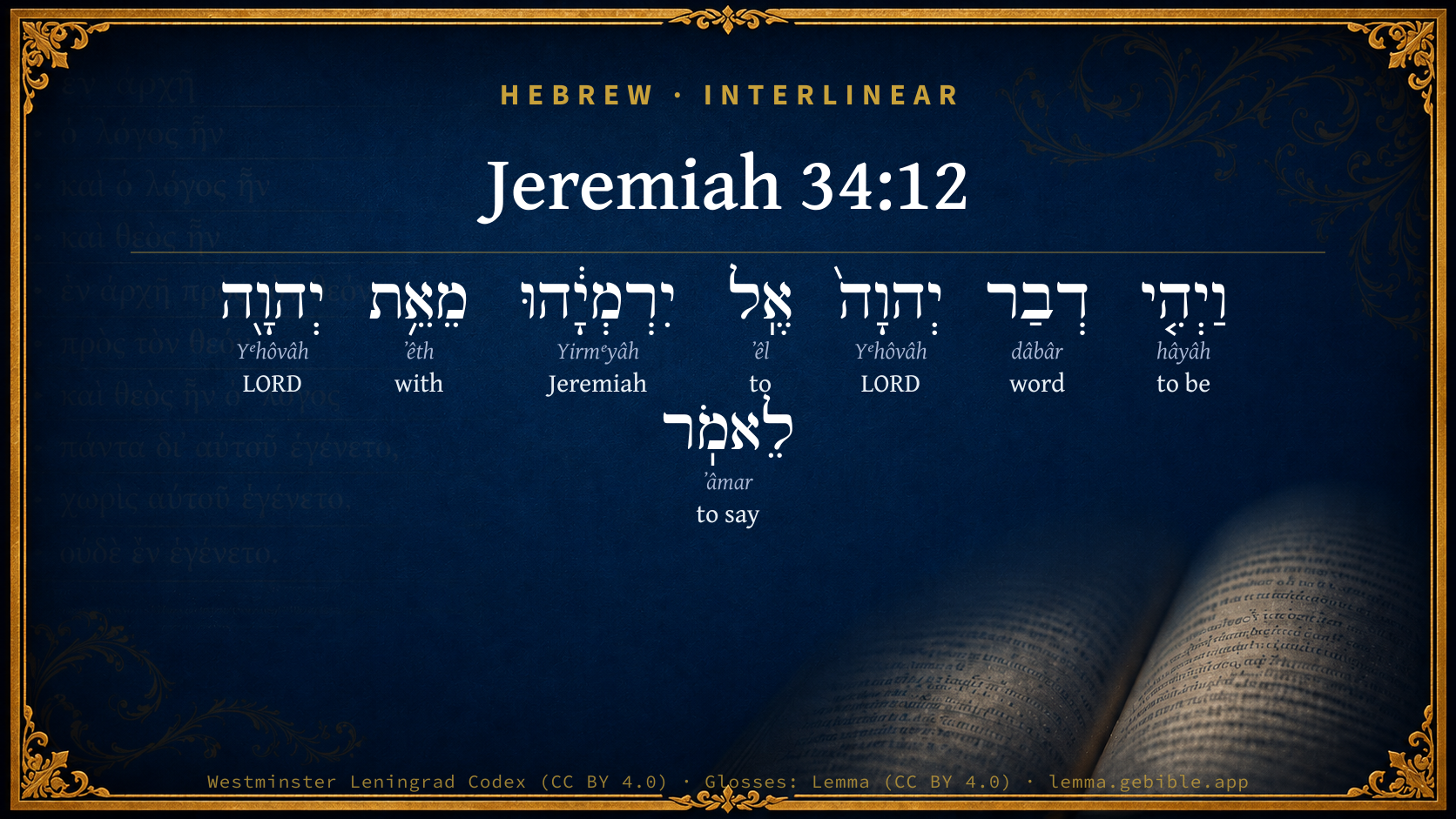
Jeremiah 34:12

Hebrew (Westminster Leningrad Codex) Jeremiah 34:12 appears in the Hebrew Old Testament. The text above is from the Westminster Leningrad Codex. Each word links to its Strong’s number, a concise gloss, and parsing drawn from the Open Scriptures Hebrew Bible morphology. Click any word for its full Brown-Driver-Briggs (BDB) entry.
Download image
Cite this verse

Jeremiah 34:12 (World English Bible). Public Domain. Lemma interlinear Bible study tool, https://lemma.gebible.app/v/jeremiah/34/12.

Show BibTeX & RIS
BibTeX
RIS
English Translation
Therefore the word of Yahweh came to Jeremiah from Yahweh, saying,
World English Bible · Public Domain
Download a study sheet

One document with this verse’s original text, its word-by-word gloss line, the meaning frame, cross-references with their text, attributed commentary, and full source and license credits — printable, and it pastes into notes with its structure intact.

This verse Autodidact and up

Study sheet (.html) Plain text (.txt)

A passage Seminary Student

Up to 50 verses in one chapter. A passage sheet keeps up to 6 commentary sources and 12 cross-references per verse, in the order this page ranks them, and says so on the sheet whenever that leaves anything out. Ask for a single verse and you get the Autodidact verse sheet above.

Everything on this page stays free to read, with no account — the sheet is a download of what is already on screen, not access to it.

Want to remove ads? Support Godless Engineer
Compare translations 3

The same verse in 3 English versions, stacked beneath the original-language interlinear above. Click any original word for its lexicon entry.

Each is an independent rendering of the whole verse — the interlinear is not word-aligned to these translations.

Highlighted words mark where these versions differ — a whole-verse word diff, not a word-by-word alignment.

  • World English Bible Public Domain
    Therefore the word of Yahweh came to Jeremiah from Yahweh, saying,
  • King James Version Public Domain
    Therefore the word of the LORD came to Jeremiah from the LORD, saying,
  • unfoldingWord Literal Text CC BY-SA 4.0
    So the word of Yahweh came to Jeremiah, saying,

unfoldingWord Literal Text — © unfoldingWord, licensed CC BY-SA 4.0. Word-aligned USFM3 via Door43 (git.door43.org/unfoldingWord/en_ult).

Versions to compare (up to 4)

3 of 4 selected

Show all 18 translations

Every available English version of this verse, each an independent rendering of the whole verse.

  • World English Bible Public Domain
    Therefore the word of Yahweh came to Jeremiah from Yahweh, saying,
  • Berean Standard Bible Public Domain
    Then the word of the LORD came to Jeremiah from the LORD, saying,
  • Majority Standard Bible Public Domain
    Then the word of the LORD came to Jeremiah from the LORD, saying,
  • King James Version Public Domain
    Therefore the word of the LORD came to Jeremiah from the LORD, saying,
  • American Standard Version (1901) Public Domain
    Therefore the word of Jehovah came to Jeremiah from Jehovah, saying,
  • Revised Version (1885) Public Domain
    Therefore the word of the LORD came to Jeremiah from the LORD, saying,
  • Geneva Bible (1599) Public Domain
    Therefore the worde of the Lord came vnto Ieremiah from the Lord, saying,
  • Douay-Rheims (1899) Public Domain
    And the word of the Lord came to Jeremias from the Lord, saying:
  • Young's Literal Translation Public Domain
    And there is a word of Jehovah unto Jeremiah from Jehovah, saying:
  • Literal Standard Version CC BY-SA 4.0
    And there is a word of YHWH to Jeremiah from YHWH, saying,
  • Unlocked Literal Bible CC BY-SA 4.0
    So the word of Yahweh came to Jeremiah, saying,
  • unfoldingWord Literal Text CC BY-SA 4.0
    So the word of Yahweh came to Jeremiah, saying,
  • Darby Bible Public Domain
    And the word of Jehovah came to Jeremiah from Jehovah, saying,
  • World Messianic Bible Public Domain
    Therefore the LORD’s word came to Jeremiah from the LORD, saying,
  • Webster's Bible Public Domain
    Therefore the word of the LORD came to Jeremiah from the LORD, saying,
  • Free Bible Version CC BY-SA 4.0
    A message from the Lord came to Jeremiah, saying,
  • Bible in Basic English Public Domain
    For this reason the word of the Lord came to Jeremiah from the Lord, saying,
  • JPS Tanakh (1917) Public Domain
    therefore the word of the LORD came to Jeremiah from the LORD, saying:

Literal Standard Version (2020), Covenant Press — licensed CC BY-SA 4.0. Text via the HelloAO Bible API (eBible.org). Unlocked Literal Bible (unfoldingWord) — licensed CC BY-SA 4.0. Text via the HelloAO Bible API (eBible.org). unfoldingWord Literal Text — © unfoldingWord, licensed CC BY-SA 4.0. Word-aligned USFM3 via Door43 (git.door43.org/unfoldingWord/en_ult). Free Bible Version, Dr. Jonathan Gallagher — licensed CC BY-SA 4.0. Text via the HelloAO Bible API (eBible.org).

Word by word

More ways to search: Search by grammar → Find every occurrence → Compare this word →

Practice this passage: Drill this verse → Learn its vocabulary →

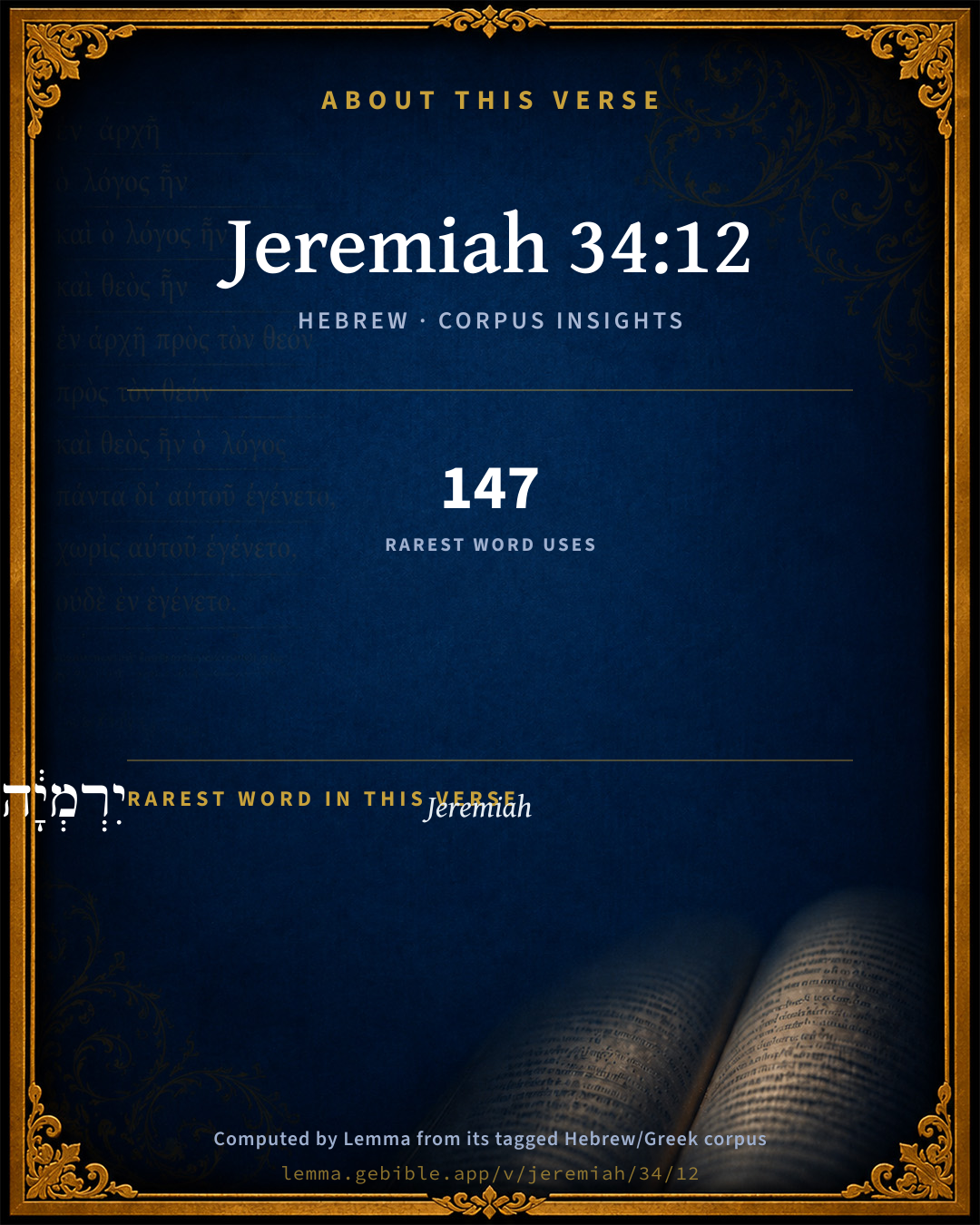
יִרְמְיָ֔הוּ
Yirmᵉyâh
H3414
“Jeremiah”
Noun, Proper
Part of Speech
Noun
Type
Proper
Full BDB Definition

Origin: from H7311 and H3050

TWOT: None

Jeremiah = "whom Jehovah has appointed" - the major prophet, son of Hilkiah of the priestly family in Anathoth; author of the prophetic book bearing his name - a man of Libnah and father of Hamutal the wife of king Josiah - a Gadite who joined David at Ziklag - a Manassehite, one of the mighty men of valour of the Transjordanic half tribe of Manasseh - a Gadite and warrior of David - a warrior of David - a priest who joined Nehemiah in the covenant ceremony - a priest also in the time of Nehemiah; maybe same as 7 - father of Jaazaniah the Rechabites
  1. וַיְהִ֤י hâyâh H1961 “and · to be” Conjunction + Verb, Qal, Sequential Imperfect, 3rd Person, Masculine, Singular
  2. דְבַר dâbâr H1697 “word of” Noun, Common, Masculine, Singular, Construct
  3. יְהוָה֙ Yᵉhôvâh H3068 “LORD” Noun, Proper
  4. אֶֽל ʼêl H413 “to” Preposition
  5. מֵאֵ֥ת ʼêth H854 “from · with” Preposition + Preposition
  6. יְהוָ֖ה Yᵉhôvâh H3068 “LORD” Noun, Proper
  7. לֵאמֹֽר ʼâmar H559 “to say” Preposition + Verb, Qal, Infinitive Construct

About this verse

These counts appear in no published source. They are computed here, from the morphology-tagged text and Lemma’s own curated glosses. What Lemma adds →

8
words
7
distinct lemmas
Prophets
section

Grammatical profile

  • 2 verbs
  • 4 nouns
  • 2 prepositions

Verb forms

  • וַיְהִ֤י Qal · Sequential Imperfect
  • לֵאמֹֽר Qal · Infinitive Construct

Repetition

A word recurs within this verse — often emphatic in Hebrew:

  • יְהוָה֙ LORD H3068 ×2
Hebrew and Greek witnesses Masoretic Hebrew ↔ Greek Septuagint

The same verse in the two great witnesses to the Old Testament, shown verse-for-verse.

These are two independent witnesses, not word-aligned to each other, and the Septuagint is shown in lemma (dictionary) form.

Hebrew Jeremiah 34:12 Masoretic · Westminster Leningrad Codex

וַיְהִ֤י דְבַר יְהוָה֙ אֶֽל יִרְמְיָ֔הוּ מֵאֵ֥ת יְהוָ֖ה לֵאמֹֽר

Therefore the word of Yahweh came to Jeremiah from Yahweh, saying,

World English Bible · Public Domain

Greek LXX Structure differs

In the Septuagint, Jeremiah is about an eighth shorter than the Hebrew and arranges its material differently — the Oracles Against the Nations (Hebrew chapters 46–51) appear in the middle of the Greek book, after 25:13. Because the chapter and verse boundaries do not line up, a verse-for-verse comparison with the Hebrew is not shown.

A verse-for-verse comparison isn’t shown here because the chapters and verses don’t line up. Switch to the LXX edition with the MT / LXX toggle above to read the Greek directly.

Hebrew: Westminster Leningrad Codex (CC BY 4.0). Greek: Septuagint (public domain); English from a public-domain English Septuagint. How the Septuagint differs from the Hebrew →

Targum (Aramaic paraphrase)

1

The Targum is the ancient Jewish Aramaic paraphrase of the Hebrew Scriptures — an interpretive translation, not the Hebrew text itself. Onkelos (literal) and Pseudo-Jonathan (expansive) render the Torah, and Jonathan the Prophets. Coverage is partial: where no permissively-licensed English translation exists for a verse, only the Aramaic is shown. This is verse-level text, not a word-by-word alignment to the Hebrew.

  1. Targum Jonathan Prophets (Joshua–Malachi)
    וַהֲוָה פִּתְגַם נְבוּאָה מִן קֳדָם יְיָ עִם יִרְמְיָה מִן קֳדָם יְיָ לְמֵימָר:

    (no public-domain English translation for this verse)

    Targum Jonathan — Aramaic: “Mikraot Gedolot” (public domain). English: “Sefaria Community Translation” (CC0 1.0 (public-domain dedication)); “London "Chaldee Paraphrase," 1871” (public domain). Text via Sefaria.

Commentary

Notes on Jeremiah 34:12 from classic Christian and Jewish commentators (each source and its license shown beneath its notes). The classic Christian expositions comment on the surrounding passage and are grouped to its opening verse, so a note may address several verses; the Jewish commentaries on the Tanakh (Rashi and others) are per-verse, so they appear only where the commentator wrote on this verse.

Lemma curates 59 commentaries, every one of them public domain or Creative Commons licensed, each selected and text-cleaned for this edition rather than reprinted as found. About our sources →

Trapp's Complete Commentary

John Trapp

Jer 34:12 Therefore the word of the LORD came to Jeremiah from the LORD, saying,

Ver. 12. Therefore the word of the Lord.] Of God the Son. {a}

Came to Jeremiah from the Lord.] From God the Father.

{a} Junius.

John Trapp, A Commentary or Exposition upon All the Books of the Old and New Testament (1647–1656) — public domain. Text from a community e-Sword module.

Keil & Delitzsch

C. F. Keil & F. Delitzsch

The threat of punishment. - Jer 34:12. "Then came the word of Jahveh to Jeremiah from Jahveh, saying: Jer 34:13. Thus saith Jahveh, the God of Israel, 'I made a covenant with your fathers in the day when I brought them out of the land of Egypt, from a house of bondmen, saying, Jer 34:14. At the end of seven years shall ye set free each man his brother, who is a Hebrew that sold himself to thee; and he shall serve thee six years, then shalt thou send him away from thee free: but your fathers hearkened not unto me, nor inclined their ear. Jer 34:15. But you had turned just now, and had done what is right in mine eyes, because each man proclaimed liberty to his neighbour, ad ye had made a covenant before me in the house on which my name is called. Jer 34:16. But ye turned again and profaned my name, and each one made his man-servant and his handmaid, whom he had sent away free, at their pleasure, to return, and ye brought them into subjection, to be men-and maid-servants to you. Jer 34:17. Therefore, thus saith Jahveh, Ye have not hearkened unto me in proclaiming liberty each man to his brother, and each man to his neighbour: behold, I proclaim a liberty for you, saith Jahveh, to the sword, to the pestilence, and to famine, and I will deliver you up for maltreatment to all the kingdoms of the earth. Jer 34:18. And I shall make the men who have transgressed my covenant, that have not kept the words of the covenant which they concluded before me, like the calf which they cut in two, and between whose pieces they passed. Jer 34:19. The princes of Judah and the princes of Jerusalem, the courtiers, and the priests, and all he people of the land, who passed through between the pieces of the calf, Jer 34:20. Them will I give into the hand of their enemies, and into the hand of those who seek their life, so that their corpses shall be for food to the birds of heaven and to the beasts of the earth. Jer 34:21. And Zedekiah, king of Judah, and his princes will I give into the hand of their enemies, and into the hand of those who seek their life, and into the hand of the army of the king of Babylon, that has departed from against you. Jer 34:22. Behold, I will command, saith Jahveh, and will make them return to this city, and they shall fight against it, and shall take it, and shall burn it with fire; and the cities of Judah will I make a desolation, without an inhabitant."

Jer 34:13-16

In Jer 34:13-16 the Lord sets before the people and their rulers their new offence; in Jer 34:17-22 He announces to them the punishment for this new deed by which the covenant is broken. In order to place the transgression in its proper light, He mentions, first of all, that, when He led Israel out of Egypt, He concluded with them a covenant to the effect that every one of them should set free his Hebrew servant at the end of seven years; He also mentions that their fathers had transgressed this covenant (Jer 34:13, Jer 34:14). The designation of Egypt as a house of bondmen, as in Exo 13:3, Exo 13:14; Exo 20:2; Deu 6:12, etc., possesses a special emphasis, and points to what is mentioned in Deu 15:15 as the motive for obeying the law referred to in the address. Because Israel was a servant in Egypt, and the Lord has redeemed him out of this house of bondmen, therefore must they not treat as slaves their brethren who had fallen into poverty, but set them free after six years of service. The expression "at the end (after the lapse) of seven years" is to be understood in the same way as the expression "after eight days." As this just means "when seven days are completed," so also, according to the law, Exo 21:2; Deu 15:12, the emancipation was to follow in the seventh year, after six full years of service. "Who sold himself to thee" is an expression copied from Deu 15:12. - From this sin of their fathers they had now for a little turned away, and, in a solemn covenant, resolved to free the bondmen, as the law decreed (Jer 34:15); but they have immediately profaned the name of the Lord again by revoking this decree, viz., by breaking the covenant made before God. לנפשׁם, "according to their pleasure," like eלנפשׁהּ, Deu 21:14.

Jer 34:17-18

The announcement of punishment. Because ye have not hearkened, by proclaiming, every one, liberty to his bondman (this certainly had been done, but was again undone by annulling the decree), therefore I proclaim liberty for you; i.e., you, who have hitherto been my servants (Lev 25:55), I discharge from this relation, - deliver you up to your fate as regards the sword, etc., that the sword, famine, and pestilence may have power over you. For לזועה see Jer 15:4. - In Jer 34:18 the construction is disputed. Many, including Luther, take העגל as the second object to נתתּי: "I will make the men...the calf," i.e., like the calf. But, though נתן is frequently construed with a double accusative with the meaning of making some thing another thing (cf. e.g., Jer 34:22, Gen 17:5; Exo 7:1), yet in such a case the predicative-object does not readily take the article. Moreover, נתן, in the sense required here, to make like = treat as, is joined with כּ, as in Isa 41:2; Eze 28:2, Eze 28:6; Gen 42:30; Kg1 10:27, etc. Finally, Rosenmller objects: continuata versu 19 personarum descriptio et repetitio verbi yṭitanfw̱ Jer 34:20 vix permittunt, propositionem hoc versu absolvi. For these reasons, L. de Dieu, Rosenmller, Ewald, and Graf have taken העגל as being in apposition to הבּרית, and the enumeration "princes of Judah," etc., Jer 34:19, as a continuation or exposition of האנשׁים, Jer 34:18, and ונתתּי אותם, Jer 34:20, as a resumption of the same words in Jer 34:18. According to this view, Jer 34:18-20 would form a series of appositions: "I will give the men...that have not kept the words of the covenant which they concluded before me...the princes of Judah who passed between the parts of the calf, - these will I give into the hands of their enemies." But, apart from the consideration that the enumeration of the covenant-breakers (viz., the princes of Judah, etc.), which is added by way of apposition in Jer 34:19, ought not to come in till after the apposition to הבּרית, which would be a harsh and complicated arrangement of the members of the sentence, this construction seems untenable for the following reasons: (a) "The calf that they cut," etc., which forms the explanatory apposition to "the covenant," is separated from it by the intervening clause, "which they made before me." And (b), even though we might modify this harshness by repeating את־דּברי before העגל, yet the mode of expression, "they have not performed the words of the calf which they cut in two, and between whose parts they passed," would be a very stiff and unnatural one for "they have not performed what they vowed or sware in presence of the parts of the calf which they had halved, and when they passed through between these pieces." With Maurer and Hitzig, therefore, we abide by the older view, which takes העגל as the second object to ונתתּי: "I will make the men...the calf," or, better, "like the calf which they cut in two," etc. The article is used with עגל because this predicate is more exactly determined by relative clauses, and העגל stands for כּעגל, since, as often happens, the כּ of likeness is dropped to give more point to the idea. We make Jer 34:19 begin a new sentence, and take the names of this verse as objects absolute, which, by אותם following ונתתּי, are subordinated to the verb: "As for the princes of Judah...them shall I give...." - From Jer 34:18 we see that, when alliances were entered into, the contracting parties slaughtered an עגל, "calf," i.e., a young bullock, cut it in two halves, and went through between the pieces that were placed opposite one another. See on Gen 15:10 for details regarding this most ancient custom and its meaning: according to the account of Ephraem Syrus, it is of Chaldean origin. Thus are explained the phrases used to signify the making of a covenant. כּרת בּרית, to cut a covenant, ὅρκια τέμνειν, faedus ferire, i.e., ferienda hostia faedus facere. We cannot with certainty infer, from the threatening pronounced in this passage, that this rite originally signified nothing more than that he who broke his promise would be treated like the animal that had been slaughtered. For the threatening is merely a conclusion drawn from the sacred act; but this does not exclude a deeper meaning of the rite.

Jer 34:19-22

Jer 34:19-22 give the real explanation of the threatening attached to the ritual of the covenant. Princes, officers of the court, priests and people, who have transgressed the covenant, shall die by the hand of the enemy, and perish ignominiously. On Jer 34:20, cf. Jer 7:33; Jer 16:4, etc. On סריסים see on Gen 37:36. King Zedekiah also, with his princes, his retinue, shall fall into the hand of his enemies, ay, into the hands of the Chaldeans, who have now withdrawn from Jerusalem (on עלה see on Jer 21:2). See also Gen 37:5-8.

Keil & Delitzsch — Biblical Commentary on the Old Testament (1861–1891) — public domain (CC PDM 1.0). Text via the HelloAO Bible API. (Old Testament only.)

The Cambridge Bible for Schools and Colleges

gen. ed. J. J. S. Perowne

12–16. See introd. summary to the subsection.

The Cambridge Bible for Schools and Colleges (gen. ed. J. J. S. Perowne; Cambridge University Press, 1878–1918) — public domain. Text from a community e-Sword module.

John Gill's Exposition

Therefore the word of the Lord came to Jeremiah from the Lord,.... The word of Jehovah the Son, from Jehovah the Father, because of this transgression of the princes and people, and as soon as it was committed by them; for it is plain, from Jer 34:21, that it was before the Chaldean army returned to Jerusalem, after its departure from it:

saying; as follows:

John Gill's Exposition of the Whole Bible (1746–1763) — public domain (CC PDM 1.0). Text via the HelloAO Bible API.

unfoldingWord translationNotes

Door43 World Missions Community

Connecting Statement:

Jeremiah resumes the story from Jeremiah 34:8 after the background information of Jeremiah 34:8-Jeremiah 11.

the word of Yahweh came to Jeremiah, saying, "Yahweh

This idiom is used to introduce a special message from God. See how you translated a similar phrase in Jeremiah 1:4. AT: "Yahweh gave a message to Jeremiah. He said, 'Yahweh" or "Yahweh spoke this message to Jeremiah: 'Yahweh" (See: Idiom)

house of slavery

This is an idiom. "place where you were slaves" (See: Idiom)

each man must send away his brother, his fellow Hebrew who had sold himself to you and served you

"each of you must free any fellow Hebrews who sold themselves to you and have been your slaves"

Send him away in freedom

"You must let them be free from serving you"

did not ... incline their ears to me

To incline the ear, to lean the head toward the speaker so as to hear better, is a metonym for paying attention to what the speaker is saying. AT: "did not ... pay attention to what I said" (See: Metonymy)

translationWords

Jeremiah

Israel

covenant

Egypt

Hebrew

unfoldingWord translationNotes — © Distant Shores Media and the Door43 World Missions Community, licensed CC BY-SA 4.0. Source: git.door43.org/Door43/en_tn.

Lesson kit

Teaching starters — assembled from the data on this page, not authored interpretation. Every prompt links to the verse data it draws on. Edit before teaching.

Jeremiah, in the Prophets, opens this verse with 8 words (7 distinct Hebrew lemmas). Its most distinctive word is Yirmᵉyâh (“Jeremiah”). A historical commentator’s framing appears above. Read the whole chapter for the surrounding context.

Discussion questions

  1. How does “Jeremiah” (Yirmᵉyâh) shape what this verse is saying?
  2. What does the repetition of “LORD” (2× in this one verse) do in this verse?
  3. These translations render this verse differently; the difference is in the English rendering, not the original. What questions does that raise?
  4. «וַיְהִ֤י» is a Qal Sequential Imperfect verb. How does that grammatical form shape the action described?
  5. Compare how Trapp's Complete Commentary and Keil & Delitzsch read this verse. Where do they agree or differ?

Things to notice

Reading settings

Reading text

Shown beneath each verse's original-language words.

Old Testament
Old Testament edition

Read the OT as the Masoretic Hebrew (MT) or the Greek Septuagint (LXX).

English shown for the Greek Septuagint (in the Hebrew ↔ Greek comparison).

Comparing translations? Open the Compare panel on any verse page to stack up to four side by side.