Jeremiah 28:12

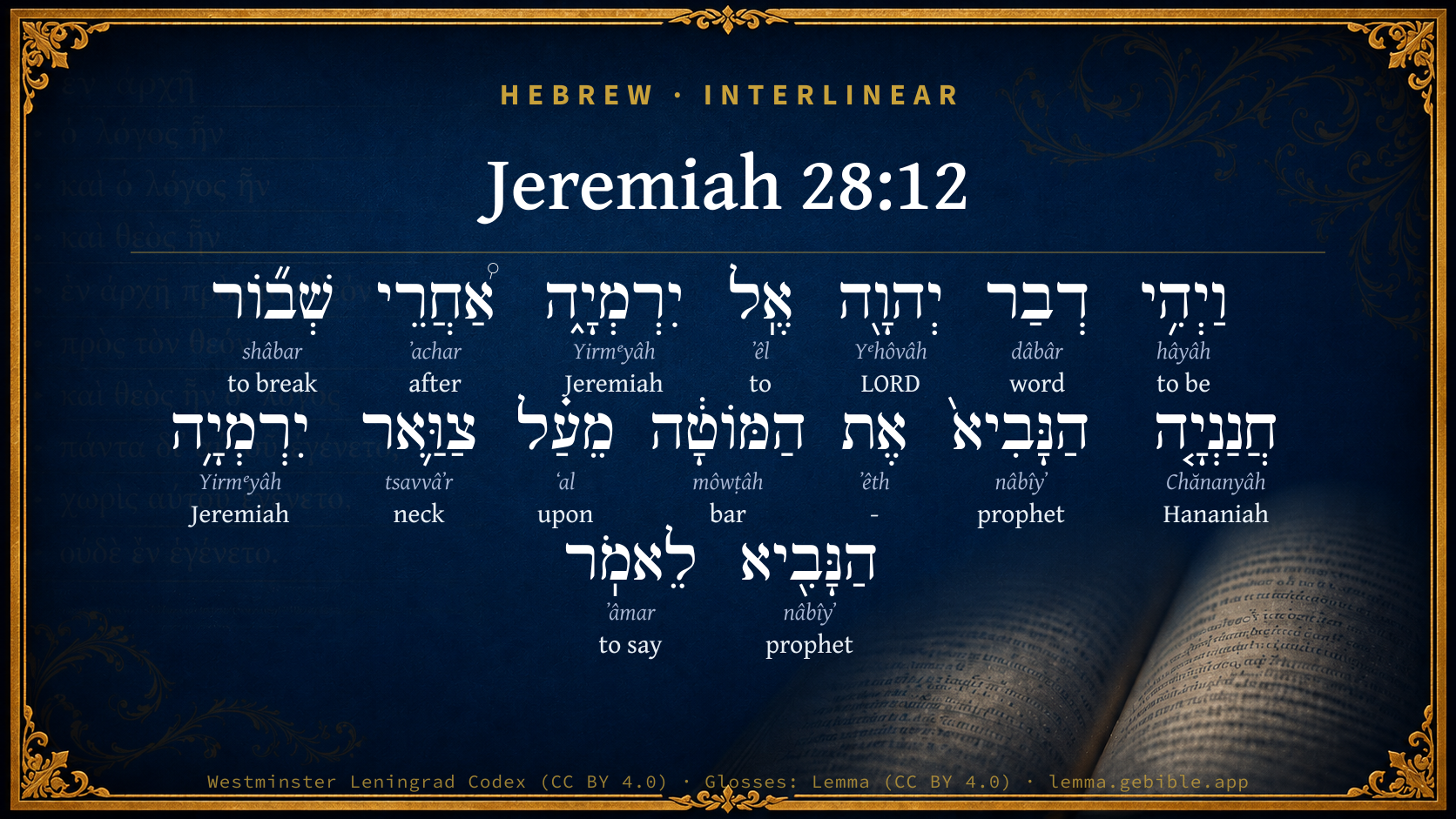
Hebrew (Westminster Leningrad Codex) Jeremiah 28:12 appears in the Hebrew Old Testament. The text above is from the Westminster Leningrad Codex. Each word links to its Strong’s number, a concise gloss, and parsing drawn from the Open Scriptures Hebrew Bible morphology. Click any word for its full Brown-Driver-Briggs (BDB) entry.
Download image
Cite this verse

Jeremiah 28:12 (World English Bible). Public Domain. Lemma interlinear Bible study tool, https://lemma.gebible.app/v/jeremiah/28/12.

Show BibTeX & RIS
BibTeX
RIS
English Translation
Then the word of Yahweh came to Jeremiah, after that Hananiah the prophet had broken the bar from off the neck of the prophet Jeremiah, saying,
World English Bible · Public Domain
Download a study sheet

One document with this verse’s original text, its word-by-word gloss line, the meaning frame, cross-references with their text, attributed commentary, and full source and license credits — printable, and it pastes into notes with its structure intact.

This verse Autodidact and up

Study sheet (.html) Plain text (.txt)

A passage Seminary Student

Up to 50 verses in one chapter. A passage sheet keeps up to 6 commentary sources and 12 cross-references per verse, in the order this page ranks them, and says so on the sheet whenever that leaves anything out. Ask for a single verse and you get the Autodidact verse sheet above.

Everything on this page stays free to read, with no account — the sheet is a download of what is already on screen, not access to it.

Want to remove ads? Support Godless Engineer
Compare translations 3

The same verse in 3 English versions, stacked beneath the original-language interlinear above. Click any original word for its lexicon entry.

Each is an independent rendering of the whole verse — the interlinear is not word-aligned to these translations.

Highlighted words mark where these versions differ — a whole-verse word diff, not a word-by-word alignment.

  • World English Bible Public Domain
    Then the word of Yahweh came to Jeremiah, after that Hananiah the prophet had broken the bar from off the neck of the prophet Jeremiah, saying,
  • King James Version Public Domain
    Then the word of the LORD came unto Jeremiah the prophet, after that Hananiah the prophet had broken the yoke from off the neck of the prophet Jeremiah, saying,
  • unfoldingWord Literal Text CC BY-SA 4.0
    And the word of Yahweh came to Jeremiah after Hananiah the prophet broke the yoke bar from upon the neck of Jeremiah the prophet, saying,

unfoldingWord Literal Text — © unfoldingWord, licensed CC BY-SA 4.0. Word-aligned USFM3 via Door43 (git.door43.org/unfoldingWord/en_ult).

Versions to compare (up to 4)

3 of 4 selected

Show all 18 translations

Every available English version of this verse, each an independent rendering of the whole verse.

  • World English Bible Public Domain
    Then the word of Yahweh came to Jeremiah, after that Hananiah the prophet had broken the bar from off the neck of the prophet Jeremiah, saying,
  • Berean Standard Bible Public Domain
    But shortly after Hananiah the prophet had broken the yoke off his neck, the word of the LORD came to Jeremiah:
  • Majority Standard Bible Public Domain
    But shortly after Hananiah the prophet had broken the yoke off his neck, the word of the LORD came to Jeremiah:
  • King James Version Public Domain
    Then the word of the LORD came unto Jeremiah the prophet, after that Hananiah the prophet had broken the yoke from off the neck of the prophet Jeremiah, saying,
  • American Standard Version (1901) Public Domain
    Then the word of Jehovah came unto Jeremiah, after that Hananiah the prophet had broken the bar from off the neck of the prophet Jeremiah, saying,
  • Revised Version (1885) Public Domain
    Then the word of the LORD came unto Jeremiah, after that Hananiah the prophet had broken the bar from off the neck of the prophet Jeremiah, saying,
  • Geneva Bible (1599) Public Domain
    Then the word of the Lord came vnto Ieremiah the Prophet, (after that Hananiah the Prophet had broken the yoke from the necke of the Prophet Ieremiah) saying,
  • Douay-Rheims (1899) Public Domain
    And Jeremias the prophet went his way. And the word of the Lord came to Jeremias, after that Hananias the prophet had broken the chain from off the neck of Jeremias the prophet, saying:
  • Young's Literal Translation Public Domain
    And there is a word of Jehovah unto Jeremiah after the breaking, by Hananiah the prophet, of the yoke from off the neck of Jeremiah the prophet, saying,
  • Literal Standard Version CC BY-SA 4.0
    And there is a word of YHWH to Jeremiah after the breaking, by Hananiah the prophet, of the yoke from off the neck of Jeremiah the prophet, saying,
  • Unlocked Literal Bible CC BY-SA 4.0
    After Hananiah the prophet had broken the yoke from the neck of Jeremiah the prophet, the word of Yahweh came to Jeremiah, saying,
  • unfoldingWord Literal Text CC BY-SA 4.0
    And the word of Yahweh came to Jeremiah after Hananiah the prophet broke the yoke bar from upon the neck of Jeremiah the prophet, saying,
  • Darby Bible Public Domain
    And the word of Jehovah came unto Jeremiah, after that the prophet Hananiah had broken the yoke from off the neck of the prophet Jeremiah, saying,
  • World Messianic Bible Public Domain
    Then the LORD’s word came to Jeremiah, after Hananiah the prophet had broken the bar from off the neck of the prophet Jeremiah, saying,
  • Webster's Bible Public Domain
    Then the word of the LORD came to Jeremiah, after Hananiah the prophet had broken the yoke from off the neck of the prophet Jeremiah, saying,
  • Free Bible Version CC BY-SA 4.0
    However, right after Hananiah the prophet had broken the yoke from his neck, a message of the Lord came to Jeremiah:
  • Bible in Basic English Public Domain
    Then after the yoke had been broken off the neck of the prophet Jeremiah by Hananiah the prophet, the word of the Lord came to Jeremiah, saying,
  • JPS Tanakh (1917) Public Domain
    Then the word of the LORD came unto Jeremiah, after that Hananiah the prophet had broken the bar from off the neck of the prophet Jeremiah, saying:

Literal Standard Version (2020), Covenant Press — licensed CC BY-SA 4.0. Text via the HelloAO Bible API (eBible.org). Unlocked Literal Bible (unfoldingWord) — licensed CC BY-SA 4.0. Text via the HelloAO Bible API (eBible.org). unfoldingWord Literal Text — © unfoldingWord, licensed CC BY-SA 4.0. Word-aligned USFM3 via Door43 (git.door43.org/unfoldingWord/en_ult). Free Bible Version, Dr. Jonathan Gallagher — licensed CC BY-SA 4.0. Text via the HelloAO Bible API (eBible.org).

Word by word

More ways to search: Search by grammar → Find every occurrence → Compare this word →

Practice this passage: Drill this verse → Learn its vocabulary →

הַמּוֹטָ֔ה
môwṭâh
H4133
“the · bar”
Particle, Definite Article + Noun, Common, Feminine, Singular, Absolute
Part of Speech
Particle + Noun
Type
Common
Gender
Feminine
Number
Singular
State
Absolute
Full BDB Definition

Origin: from H4132

TWOT: 1158b

pole, bar of yoke - pole - bar of yoke - of oppression (figuratively)
  1. וַיְהִ֥י hâyâh H1961 “and · to be” Conjunction + Verb, Qal, Sequential Imperfect, 3rd Person, Masculine, Singular
  2. דְבַר dâbâr H1697 “word of” Noun, Common, Masculine, Singular, Construct
  3. יְהוָ֖ה Yᵉhôvâh H3068 “LORD” Noun, Proper
  4. אֶֽל ʼêl H413 “to” Preposition
  5. יִרְמְיָ֑ה Yirmᵉyâh H3414 “Jeremiah” Noun, Proper
  6. אַ֠חֲרֵי ʼachar H310 “after” Preposition
  7. שְׁב֞וֹר shâbar H7665 “to break” Verb, Qal, Infinitive Construct
  8. חֲנַנְיָ֤ה Chănanyâh H2608 “Hananiah” Noun, Proper
  9. הַנָּבִיא֙ nâbîyʼ H5030 “the · prophet” Particle, Definite Article + Noun, Common, Masculine, Singular, Absolute
  10. אֶת ʼêth H853 “-” Particle, Direct Object
  11. מֵעַ֗ל ʻal H5921 “from · upon” Preposition + Preposition
  12. צַוַּ֛אר tsavvâʼr H6677 “neck of” Noun, Common, Masculine, Singular, Construct
  13. יִרְמְיָ֥ה Yirmᵉyâh H3414 “Jeremiah” Noun, Proper
  14. הַנָּבִ֖יא nâbîyʼ H5030 “the · prophet” Particle, Definite Article + Noun, Common, Masculine, Singular, Absolute
  15. לֵאמֹֽר ʼâmar H559 “to say” Preposition + Verb, Qal, Infinitive Construct

About this verse

These counts appear in no published source. They are computed here, from the morphology-tagged text and Lemma’s own curated glosses. What Lemma adds →

16
words
14
distinct lemmas
Prophets
section

Notable vocabulary

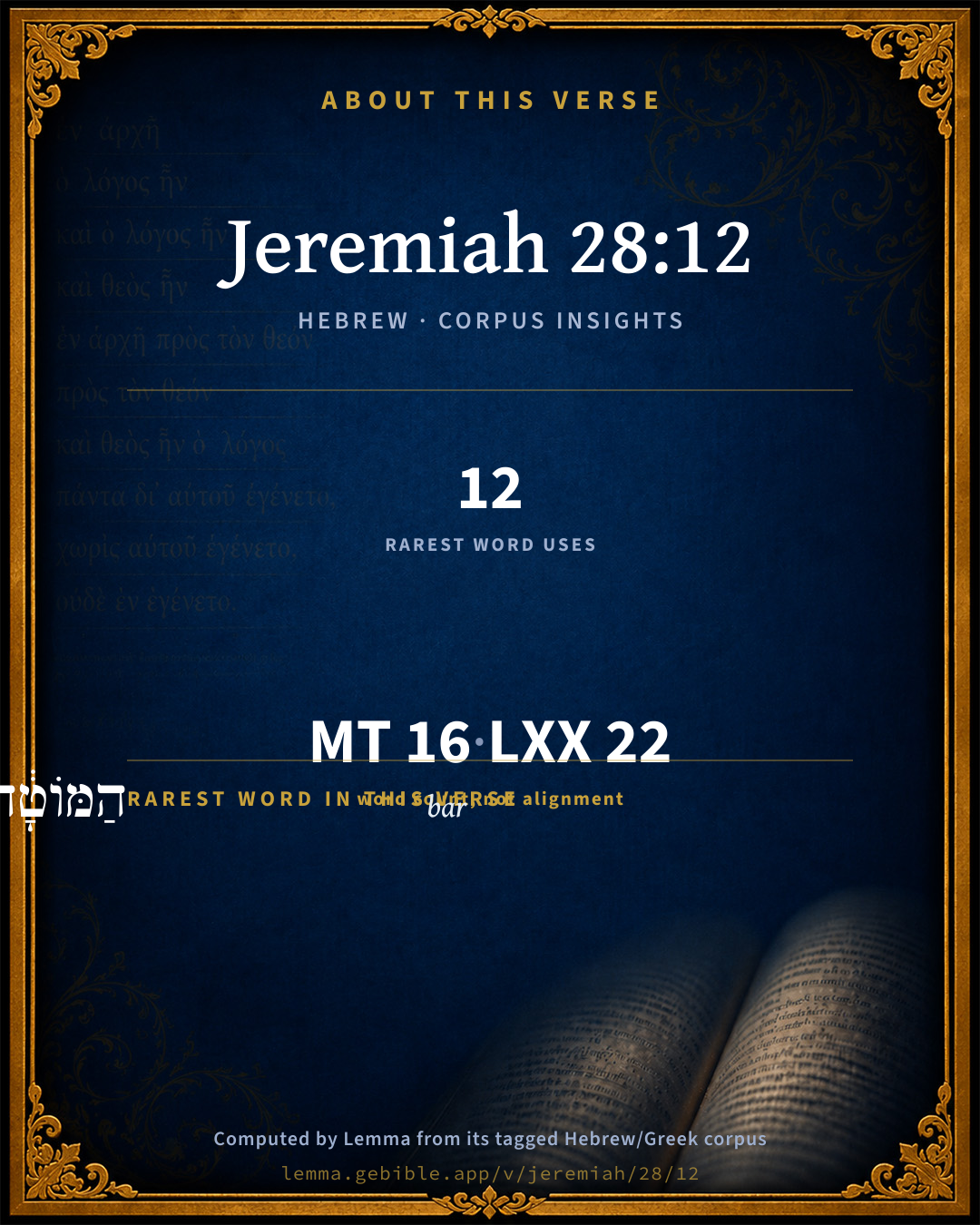
The rarest word here is הַמּוֹטָ֔ה bar H4133 — appearing just 12 times in the whole Hebrew Bible.

Shared distinctive vocabulary

הַמּוֹטָ֔ה bar H4133 occurs in 10 verses of the Hebrew Bible. Also found in:

Grammatical profile

  • 3 verbs
  • 9 nouns
  • 3 prepositions
  • 1 particle

Verb forms

  • וַיְהִ֥י Qal · Sequential Imperfect
  • שְׁב֞וֹר Qal · Infinitive Construct
  • לֵאמֹֽר Qal · Infinitive Construct

Repetition

Words recur within this verse — often emphatic in Hebrew:

  • יִרְמְיָ֑ה Jeremiah H3414 ×2
  • הַנָּבִיא֙ prophet H5030 ×2

Hebrew & Septuagint length

In the original languages it is 16 Hebrew tokens and 22 Greek tokens — but the two are counted differently (Hebrew bundles its prefixes and suffixes into one token; the Greek is in lemma form), so that isn’t a like-for-like length.

Cross-references

5

Topical passages linked to Jeremiah 28:12 in the Treasury of Scripture Knowledge — connected by theme and wording, ordered by reader-vote popularity; previews shown in the World English Bible.

  • Jeremiah 1:2 to whom the word of Yahweh came in the days of Josiah the son of Amon, king of Judah, in the thirteenth year of his reign.
  • 2 Kings 20:4 It happened, before Isaiah was gone out into the middle part of the city, that the word of Yahweh came to him, saying,
  • 1 Chronicles 17:3 It happened the same night, that the word of God came to Nathan, saying,
  • Jeremiah 29:30 Then came the word of Yahweh to Jeremiah, saying,
  • Daniel 9:2 in the first year of his reign I, Daniel, understood by the books the number of the years about which the word of Yahweh came to Jeremiah the prophet, for the accomplishing of the desolations of Jerusalem, even seventy years.

Cross-references courtesy of OpenBible.info (CC BY 4.0).

Hebrew and Greek witnesses Masoretic Hebrew ↔ Greek Septuagint

The same verse in the two great witnesses to the Old Testament, shown verse-for-verse.

These are two independent witnesses, not word-aligned to each other, and the Septuagint is shown in lemma (dictionary) form.

Hebrew Jeremiah 28:12 Masoretic · Westminster Leningrad Codex

וַיְהִ֥י דְבַר יְהוָ֖ה אֶֽל יִרְמְיָ֑ה אַ֠חֲרֵי שְׁב֞וֹר חֲנַנְיָ֤ה הַנָּבִיא֙ אֶת הַמּוֹטָ֔ה מֵעַ֗ל צַוַּ֛אר יִרְמְיָ֥ה הַנָּבִ֖יא לֵאמֹֽר

Then the word of Yahweh came to Jeremiah, after that Hananiah the prophet had broken the bar from off the neck of the prophet Jeremiah, saying,

World English Bible · Public Domain

Greek LXX Structure differs

In the Septuagint, Jeremiah is about an eighth shorter than the Hebrew and arranges its material differently — the Oracles Against the Nations (Hebrew chapters 46–51) appear in the middle of the Greek book, after 25:13. Because the chapter and verse boundaries do not line up, a verse-for-verse comparison with the Hebrew is not shown.

A verse-for-verse comparison isn’t shown here because the chapters and verses don’t line up. Switch to the LXX edition with the MT / LXX toggle above to read the Greek directly.

Hebrew: Westminster Leningrad Codex (CC BY 4.0). Greek: Septuagint (public domain); English from a public-domain English Septuagint. How the Septuagint differs from the Hebrew →

Targum (Aramaic paraphrase)

1

The Targum is the ancient Jewish Aramaic paraphrase of the Hebrew Scriptures — an interpretive translation, not the Hebrew text itself. Onkelos (literal) and Pseudo-Jonathan (expansive) render the Torah, and Jonathan the Prophets. Coverage is partial: where no permissively-licensed English translation exists for a verse, only the Aramaic is shown. This is verse-level text, not a word-by-word alignment to the Hebrew.

  1. Targum Jonathan Prophets (Joshua–Malachi)
    וַהֲוָה פִּתְגַם נְבוּאָה מִן קֳדָם יְיָ עִם יִרְמְיָה בָּתַר דְתָבַר חֲנַנְיָה נְבִיָא שִׁקְרָא יַת נִירָא מֵעַל צַוַר יִרְמְיָה נְבִיָא לְמֵימָר:

    (no public-domain English translation for this verse)

    Targum Jonathan — Aramaic: “Mikraot Gedolot” (public domain). English: “Sefaria Community Translation” (CC0 1.0 (public-domain dedication)); “London "Chaldee Paraphrase," 1871” (public domain). Text via Sefaria.

Commentary

Notes on Jeremiah 28:12 from classic Christian and Jewish commentators (each source and its license shown beneath its notes). The classic Christian expositions comment on the surrounding passage and are grouped to its opening verse, so a note may address several verses; the Jewish commentaries on the Tanakh (Rashi and others) are per-verse, so they appear only where the commentator wrote on this verse.

Lemma curates 59 commentaries, every one of them public domain or Creative Commons licensed, each selected and text-cleaned for this edition rather than reprinted as found. About our sources →

Trapp's Complete Commentary

John Trapp

Jer 28:12 Then the word of the LORD came unto Jeremiah [the prophet], after that Hananiah the prophet had broken the yoke from off the neck of the prophet Jeremiah, saying,

Ver. 12. After that Hananiah had broken the yoke.] Which he looked upon as an eyesore while it was whole, and a real contradiction to his false predictions.

John Trapp, A Commentary or Exposition upon All the Books of the Old and New Testament (1647–1656) — public domain. Text from a community e-Sword module.

Tyndale Open Study Notes

Tyndale Open Resources

28:12-14 Jeremiah received and delivered the Lord’s response to the false prophecy. The wooden yoke that Hananiah broke was replaced by a metaphorical yoke of iron. Subjection to Babylon was an absolute certainty, for the Lord had decreed it.

Tyndale Open Study Notes — © Tyndale Open Resources, licensed CC BY-SA 4.0. Text via the HelloAO Bible API.

John Calvin's Commentaries

It hence appears that Jeremiah had regard only to the common benefit of the people, and that he wisely kept silence for a time, that he might not throw pearls before swine, and thus expose in a manner the holy name of God to the insolence of the ungodly. He therefore waited until he might again go forth with new messages, and thus secure more credit to himself. For had he contended longer with Hananiah, contentions would have been kindled on every side, there would have been no hearing in a tumult, and the Jews would have wholly disregarded anything he might have then spoken. But as he had withdrawn from the crowd, and was afterwards sent by God, the Jews could not have so presumptuously despised him or his doctrine. This, then, was the reason why he was for a short time silent.

If he feared and trembled in the midst of these commotions, God in due time confirmed him by giving him new commands: The word of Jehovah, he says, came to Jeremiah, after Hananiah broke the band from his neck. By these words he intimates, that the ungodly, however insolently they may rise up against God, ever depart with shame and reproach. For Hananiah had not only opposed Jeremiah by his words and tongue, but had also broken the cords or bands from his neck. This, then, the Prophet now repeats, in order that he might shew, as it were by his finger, that Hananiah by his audacity gained nothing, except that he rendered his vanity more notorious.

John Calvin's Commentaries (1540-1563) — public domain. Text from the Calvin Translation Society English edition (1840s-50s) via the Christian Classics Ethereal Library (ccel.org). Calvin's coverage is partial (roughly two-thirds of the Bible); uncommented books and verses are honest gaps, never fabricated. The 19th-century editor's footnotes and remarks are omitted so the notes are faithfully Calvin's own voice.

Ellicott's Commentary for English Readers

(12) Then the word of the Lord . . .—The narrative suggests the thought of a time of silent suffering and of prayer, to which the “word of the Lord” came as an answer. And that word declared, keeping to the same symbolism as before, that all attempts at resistance to the power which was for the time the scourge, and therefore the servant, of Jehovah, would only end in a more bitter and aggravated bondage. In the “iron yoke” we have an echo of Deu_28:48.

A Bible Commentary for English Readers, edited by Charles John Ellicott (1878–1897) — public domain. Text from a community e-Sword module.

The Cambridge Bible for Schools and Colleges

gen. ed. J. J. S. Perowne

12–17. Jeremiah’s emphatic contradiction of Hananiah’s forecast.

The Cambridge Bible for Schools and Colleges (gen. ed. J. J. S. Perowne; Cambridge University Press, 1878–1918) — public domain. Text from a community e-Sword module.

John Gill's Exposition

Then the word of the Lord came to Jeremiah the prophet,.... When in his own house or apartment, to which he retired; and this came to him either in a vision or dream, or by some articulate voice, or by an impulse upon his spirit, directing him what to say to the false prophet:

after that Hananiah the prophet had broken the yoke from off the neck of the Prophet Jeremiah: how long afterwards is not known, perhaps the same day; or, however, it is certain it was in the same year, and less than two months after, Jer 28:17; and very probably in a few hours after:

saying; as follows:

John Gill's Exposition of the Whole Bible (1746–1763) — public domain (CC PDM 1.0). Text via the HelloAO Bible API.

Haydock's Catholic Bible Commentary

Way, mildly. God inspired him what to say soon after.

George Leo Haydock (1774–1849), Haydock's Catholic Family Bible and Commentary, 1859 edition — public domain. Excludes Psalms (Douay-Rheims chapter numbering differs from Protestant) and Deuterocanonical books (Catholic canon only).

Matthew Poole's English Annotations

Some time after this, God taking notice of the affront put upon his prophet Jeremiah, for faithfully discharging the message with which he had intrusted him, revealeth his mind unto Jeremiah, that he might declare it unto the people, and particularly to this false prophet.

Matthew Poole's English Annotations on the Holy Bible (1683–1685) — public domain. Text from a community e-Sword/MySword module.

The Pulpit Commentary

Vers. 12-17. No long time after this the prophet is commissioned to tell the bitter truth more fully than he had done before, and to warn Hananiah of his coming punishment.

The Pulpit Commentary (1880–1919), ed. H.D.M. Spence-Jones & Joseph S. Exell — public domain. Text from a community e-Sword module.

John Wesley's Explanatory Notes

Then - Some time after.

John Wesley, Explanatory Notes Upon the Whole Bible (1754–1765) — public domain. Text via the GEBible commentary corpus.

Keil & Delitzsch

C. F. Keil & F. Delitzsch

The Lord's testimony against Hananiah. - Apparently not long after Jeremiah had departed, he received from the Lord the commission to go to Hananiah and to say to him: Jer 28:13. "Thus saith Jahveh: Yokes of wood hast thou broken, but hast made in place of them yokes of iron. Jer 28:14. For thus saith Jahveh of hosts, the God of Israel: A yoke of iron I lay upon the neck of all these nations, that they may serve Nebuchadnezzar king of Babylon, and they shall serve him; and the beasts of the field also have I given him." - When the prophet says: Yokes of wood hast thou broken, etc., we are not to understand him as speaking of the breaking of the wooden yoke Jeremiah had been wearing; he gives the deeper meaning of that occurrence. By breaking Jeremiah's wooden yoke, Hananiah has only signified that the yoke Nebuchadnezzar lays on the nations will not be so easily broken as a wooden one, but is of iron, i.e., not to be broken. The plural "yokes" is to be explained by the emblematical import of the words, and is not here to be identified, as it sometimes may be, with the singular, Jer 28:10. Jer 28:14 shows in what sense Hananiah put an iron yoke in the place of the wooden one: Jahveh will lay iron yokes on all nations, that they may serve the king of Babel. Hananiah's breaking the wooden yoke does not alter the divine decree, but is made to contribute to its fuller revelation. With the last clause of Jer 28:14, cf. Jer 27:6. - Hereupon Jeremiah forewarns the false prophets what is to be God's punishment on them for their false and audacious declarations. Jer 28:15. "Hear now, Hananiah: Jahveh hath not sent thee, and thou hast made this people to believe a lie. Jer 28:16. Therefore thus saith Jahveh: Behold, I cast thee from off the face of the earth; this year shalt thou die, for thou hast spoken rebellion against Jahveh." "The year" = this year, as in Isa 37:30. The words "for thou hast spoken," etc., recall Deu 13:6. They involve an application to Hananiah's case of the command there given to put such a prophet to death, and show how it can with justice be said that the Lord will cast him from off the face of the earth. The verb משׁלּחך is chosen for the sake of the play on לא שׁלחך. God has not sent him as prophet to His people, but will send him away from off the earth, i.e., cause him to die. - In Jer 28:17 it is recorded that this saying was soon fulfilled. Hananiah died in the seventh month of that year, i.e., two months after his controversy with Jeremiah (cf. Jer 28:1).

Keil & Delitzsch — Biblical Commentary on the Old Testament (1861–1891) — public domain (CC PDM 1.0). Text via the HelloAO Bible API. (Old Testament only.)

Kretzmann's Popular Commentary

Paul E. Kretzmann

The Rebuke Given to Hananiah

v. 12. Then the word of the Lord came unto Jeremiah, the prophet, after that Hananiah, the prophet, had broken the yoke from off the neck of the prophet Jeremiah, that is, within a few weeks or a month later, saying,

v. 13. Go and tell Hananiah, Saying, Thus saith the Lord, Thou hast broken the yokes of wood, but thou shall make for them, in their stead, yokes of iron. The result of Hananiah’s rash and impertinent action was merely to increase the emphasis which the Lord placed upon the fulfillment of His prophecy against Judah.

v. 14. For thus saith the Lord of hosts, the God of Israel, speaking with the solemnity of His majestic power, I have put a yoke of iron upon the neck of all these nations, Cf Deu 28:48, that they may serve Nebuchadnezzar, king of Babylon, and they shall serve him, the punishment of the Lord being certain to strike them; and I have given him the beasts of the field also, a power which was, for the time being, practically unlimited. Cf. Jer 27:6.

v. 15. Then said the prophet Jeremiah unto Hananiah, the prophet, Hear now, Hananiah: The Lord hath not sent thee, thus confronting the false prophet with his base deception; but thou makest this people to trust in a lie, in getting them to believe the message which he imagined.

v. 16. Therefore, thus saith the Lord, Behold, I will cast thee from off the face of the earth, the words implying a complete removal, to take away also the effect of his false prophecy; this year thou shalt die, because thou hast taught rebellion against the Lord, causing men to forsake Him and the Word of Truth.

v. 17. So Hananiah, the prophet, died the same year in the seventh month, the quick fulfillment of Jeremiah’s prophecy serving to emphasize all the more strongly the seriousness of his offense against Jehovah. The punishment of the Lord upon the false prophets of our day may often seem to be delayed in coming, but He will certainly vindicate His honor against all who assail His Word.

Paul E. Kretzmann, Popular Commentary of the Bible (1921–1924) — public domain. Text from a community e-Sword module.

unfoldingWord translationNotes

Door43 World Missions Community

the word of Yahweh came to Jeremiah, saying, "Go

This idiom is used to introduce a special message from God. See how you translated a similar phrase in Jeremiah 1:4. AT: "Yahweh gave a message to Jeremiah. He said, 'Go" or "Yahweh spoke this message to Jeremiah: 'Go" (See: Idiom)

You broke a yoke of wood, but I will make instead a yoke of iron

"You broke a weak yoke but I will replace it with a yoke that you cannot break"

Yahweh of hosts ... says this

Jeremiah often uses these words to introduce an important message from Yahweh. See how you translated this in Jeremiah 6:6.

I have placed a yoke of iron on the neck of all of these nations to serve Nebuchadnezzar

Yahweh speaks of making nations to be slaves of Nebuchadnezzar as if he were putting yokes on oxen to make them do heavy work. AT: "I have made all of these nations slaves, and they will have to serve Nebuchadnezzar" (See: Metaphor)

translationWords

word of God

Yahweh of hosts

God

Israel

servant

beast

rule

unfoldingWord translationNotes — © Distant Shores Media and the Door43 World Missions Community, licensed CC BY-SA 4.0. Source: git.door43.org/Door43/en_tn.

Lesson kit

Teaching starters — assembled from the data on this page, not authored interpretation. Every prompt links to the verse data it draws on. Edit before teaching.

Jeremiah, in the Prophets, opens this verse with 16 words (14 distinct Hebrew lemmas). Its most distinctive word is môwṭâh (“bar”). A historical commentator’s framing appears above. Read the whole chapter for the surrounding context.

Discussion questions

  1. What does “bar” (môwṭâh) contribute to the verse as a whole?
  2. Leviticus 26:13 shares the word «bar» with this verse. How do the two illuminate each other?
  3. “Jeremiah” occurs 2× in this one verse. What is the effect of the repetition?
  4. These translations render this verse differently; the difference is in the English rendering, not the original. What questions does that raise?
  5. The verb «וַיְהִ֥י» is Qal Sequential Imperfect. How does its form color the action?
  6. Reading how Trapp's Complete Commentary and Tyndale Open Study Notes read this verse, where do the two commentators agree and where do they part?

Things to notice

Reading settings

Reading text

Shown beneath each verse's original-language words.

Old Testament
Old Testament edition

Read the OT as the Masoretic Hebrew (MT) or the Greek Septuagint (LXX).

English shown for the Greek Septuagint (in the Hebrew ↔ Greek comparison).

Comparing translations? Open the Compare panel on any verse page to stack up to four side by side.