Jeremiah 35:3

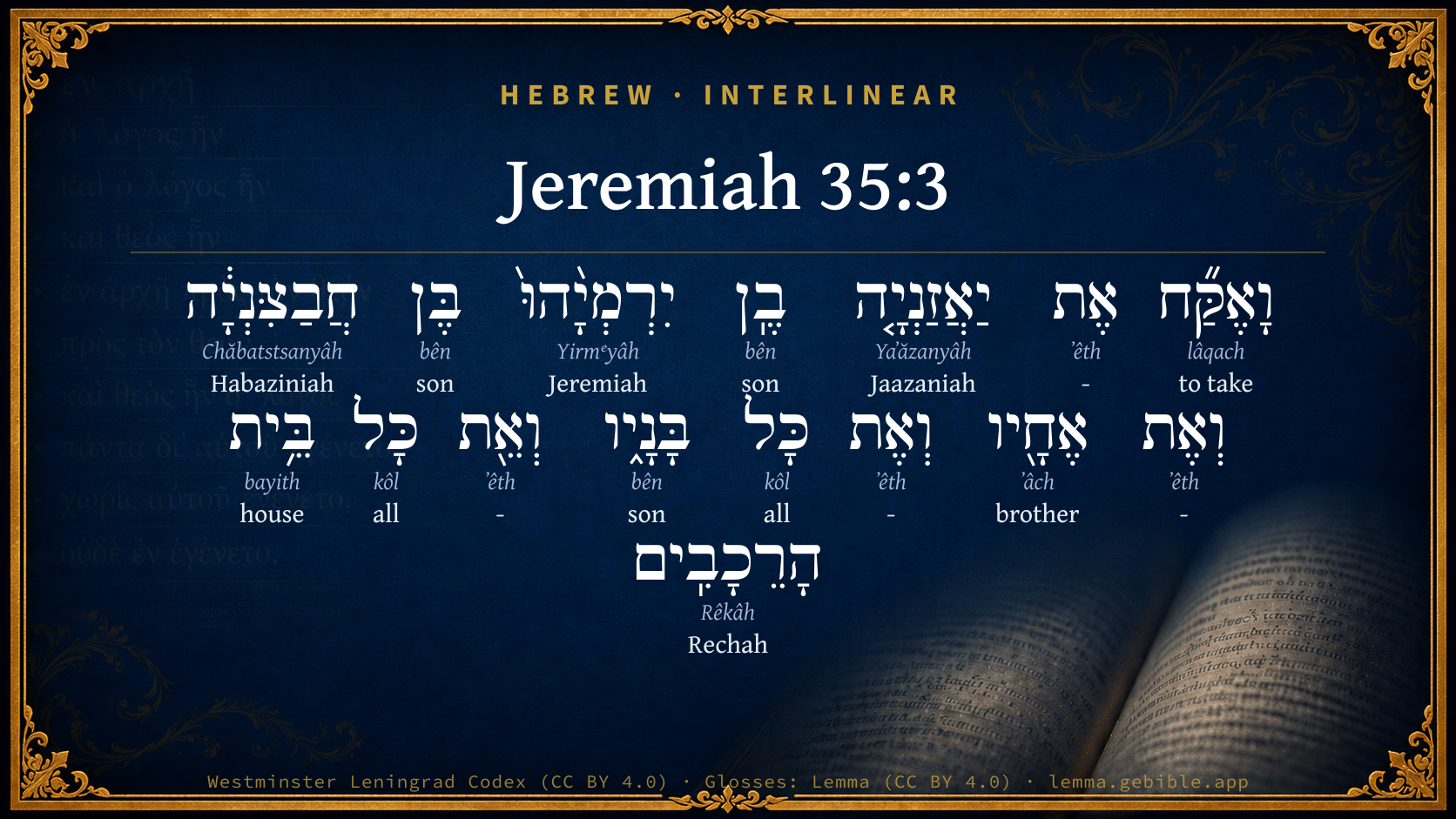
Hebrew (Westminster Leningrad Codex) Jeremiah 35:3 appears in the Hebrew Old Testament. The text above is from the Westminster Leningrad Codex. Each word links to its Strong’s number, a concise gloss, and parsing drawn from the Open Scriptures Hebrew Bible morphology. Click any word for its full Brown-Driver-Briggs (BDB) entry.
Download image
Cite this verse

Jeremiah 35:3 (World English Bible). Public Domain. Lemma interlinear Bible study tool, https://lemma.gebible.app/v/jeremiah/35/3.

Show BibTeX & RIS
BibTeX
RIS
English Translation
Then I took Jaazaniah the son of Jeremiah, the son of Habazziniah, and his brothers, and all his sons, and the whole house of the Rechabites;
World English Bible · Public Domain
Highlights
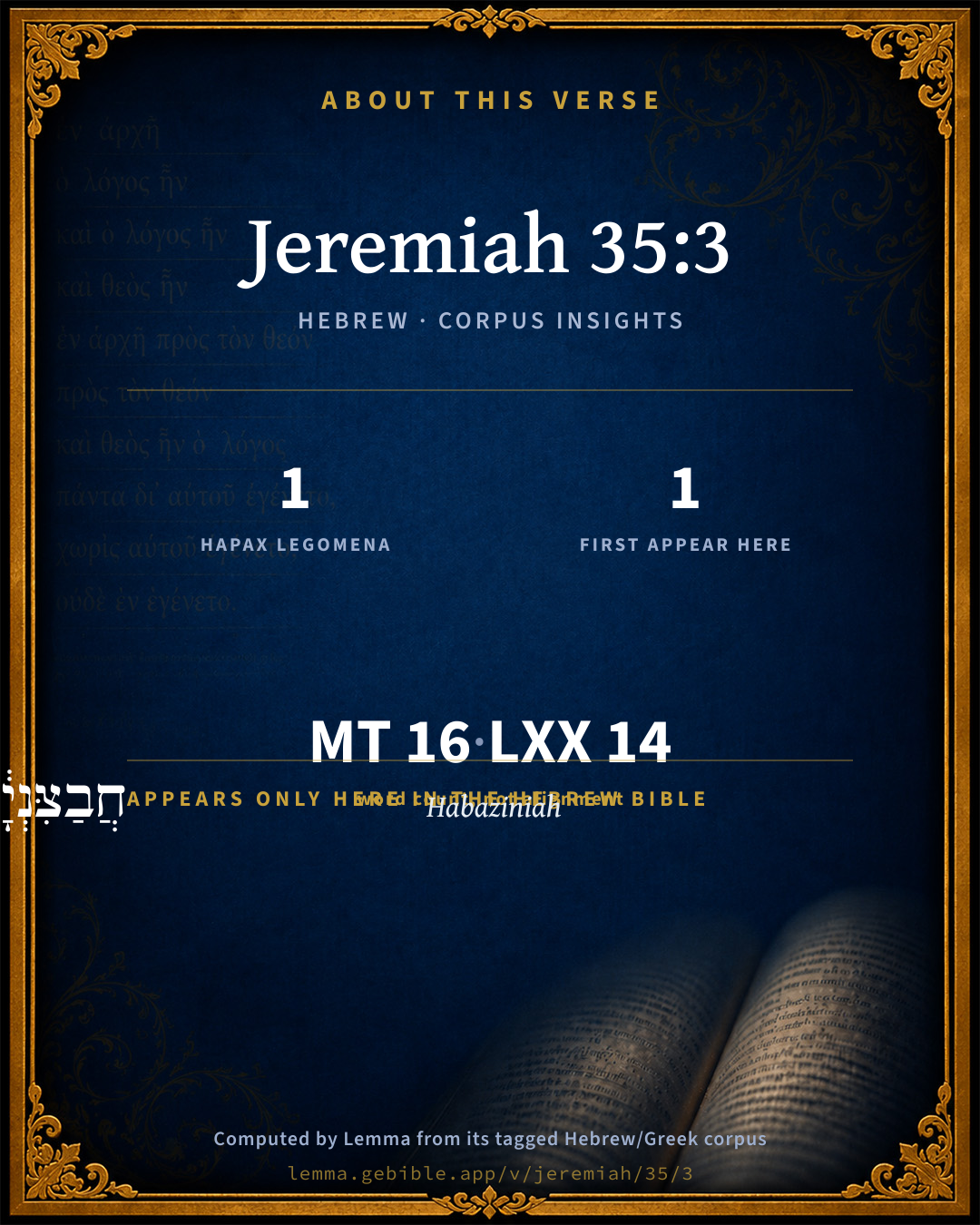
  • 1 hapax legomenon — only here in the Hebrew Bible
  • 1 first appearance in the Hebrew Bible
Full analysis ↓
Download a study sheet

One document with this verse’s original text, its word-by-word gloss line, the meaning frame, cross-references with their text, attributed commentary, and full source and license credits — printable, and it pastes into notes with its structure intact.

This verse Autodidact and up

Study sheet (.html) Plain text (.txt)

A passage Seminary Student

Up to 50 verses in one chapter. A passage sheet keeps up to 6 commentary sources and 12 cross-references per verse, in the order this page ranks them, and says so on the sheet whenever that leaves anything out. Ask for a single verse and you get the Autodidact verse sheet above.

Everything on this page stays free to read, with no account — the sheet is a download of what is already on screen, not access to it.

Want to remove ads? Support Godless Engineer
Compare translations 3

The same verse in 3 English versions, stacked beneath the original-language interlinear above. Click any original word for its lexicon entry.

Each is an independent rendering of the whole verse — the interlinear is not word-aligned to these translations.

Highlighted words mark where these versions differ — a whole-verse word diff, not a word-by-word alignment.

  • World English Bible Public Domain
    Then I took Jaazaniah the son of Jeremiah, the son of Habazziniah, and his brothers, and all his sons, and the whole house of the Rechabites;
  • King James Version Public Domain
    Then I took Jaazaniah the son of Jeremiah, the son of Habaziniah, and his brethren, and all his sons, and the whole house of the Rechabites;
  • unfoldingWord Literal Text CC BY-SA 4.0
    So I took Jaazaniah son of Jeremiah son of Habazziniah and his brothers, all his sons, and all the family of the Rekabites.

unfoldingWord Literal Text — © unfoldingWord, licensed CC BY-SA 4.0. Word-aligned USFM3 via Door43 (git.door43.org/unfoldingWord/en_ult).

Versions to compare (up to 4)

3 of 4 selected

Show all 18 translations

Every available English version of this verse, each an independent rendering of the whole verse.

  • World English Bible Public Domain
    Then I took Jaazaniah the son of Jeremiah, the son of Habazziniah, and his brothers, and all his sons, and the whole house of the Rechabites;
  • Berean Standard Bible Public Domain
    So I took Jaazaniah son of Jeremiah, the son of Habazziniah, and his brothers and all his sons—the entire house of the Rechabites—
  • Majority Standard Bible Public Domain
    So I took Jaazaniah son of Jeremiah, the son of Habazziniah, and his brothers and all his sons—the entire house of the Rechabites—
  • King James Version Public Domain
    Then I took Jaazaniah the son of Jeremiah, the son of Habaziniah, and his brethren, and all his sons, and the whole house of the Rechabites;
  • American Standard Version (1901) Public Domain
    Then I took Jaazaniah the son of Jeremiah, the son of Habazziniah, and his brethren, and all his sons, and the whole house of the Rechabites;
  • Revised Version (1885) Public Domain
    Then I took Jaazaniah the son of Jeremiah, the son of Habazziniah, and his brethren, and all his sons, and the whole house of the Rechabites;
  • Geneva Bible (1599) Public Domain
    Then tooke I Iaazaniah, the sonne of Ieremiah the sonne of Habazziniah, and his brethren, and all his sonnes, and the whole house of the Rechabites,
  • Douay-Rheims (1899) Public Domain
    And I took Jezonias the son of Jeremias the son of Habsanias, and his brethren, and all his sons, and the whole house of the Rechabites.
  • Young's Literal Translation Public Domain
    And I take Jaazaniah son of Jeremiah, son of Habazziniah, and his brethren, and all his sons, and all the house of the Rechabites,
  • Literal Standard Version CC BY-SA 4.0
    And I take Jaazaniah son of Jeremiah, son of Habazziniah, and his brothers, and all his sons, and all the house of the Rechabites,
  • Unlocked Literal Bible CC BY-SA 4.0
    So I took Jaazaniah son of Jeremiah son of Habazziniah and his brothers, all his sons, and all the family of the Rekabites.
  • unfoldingWord Literal Text CC BY-SA 4.0
    So I took Jaazaniah son of Jeremiah son of Habazziniah and his brothers, all his sons, and all the family of the Rekabites.
  • Darby Bible Public Domain
    And I took Jaazaniah the son of Jeremiah, the son of Habazziniah, and his brethren, and all his sons, and the whole house of the Rechabites,
  • World Messianic Bible Public Domain
    Then I took Jaazaniah the son of Jeremiah, the son of Habazziniah, with his brothers, all his sons, and the whole house of the Rechabites;
  • Webster's Bible Public Domain
    Then I took Jaazaniah the son of Jeremiah, the son of Habaziniah, and his brethren, and all his sons, and the whole house of the Rechabites;
  • Free Bible Version CC BY-SA 4.0
    So I went to visit Jaazaniah son of Jeremiah, the son of Habazziniah, and his brothers and all his sons—the whole Rechabite family.
  • Bible in Basic English Public Domain
    Then I took Jaazaniah, the son of Jeremiah, the son of Habazziniah, and his brothers and all his sons and all the Rechabites;
  • JPS Tanakh (1917) Public Domain
    Then I took Jaazaniah the son of Jeremiah, the son of Habazziniah, and his brethren, and all his sons, and the whole house of the Rechabites;

Literal Standard Version (2020), Covenant Press — licensed CC BY-SA 4.0. Text via the HelloAO Bible API (eBible.org). Unlocked Literal Bible (unfoldingWord) — licensed CC BY-SA 4.0. Text via the HelloAO Bible API (eBible.org). unfoldingWord Literal Text — © unfoldingWord, licensed CC BY-SA 4.0. Word-aligned USFM3 via Door43 (git.door43.org/unfoldingWord/en_ult). Free Bible Version, Dr. Jonathan Gallagher — licensed CC BY-SA 4.0. Text via the HelloAO Bible API (eBible.org).

Word by word

More ways to search: Search by grammar → Find every occurrence → Compare this word →

Practice this passage: Drill this verse → Learn its vocabulary →

חֲבַצִּנְיָ֔ה
Chăbatstsanyâh
H2262
“Habaziniah”
Noun, Proper
Part of Speech
Noun
Type
Proper
Full BDB Definition

Origin: of uncertain derivation

TWOT: None

Habaziniah = "light of Jehovah" - apparently the head of one of the families of the Rechabites
  1. וָאֶקַּ֞ח lâqach H3947 “and · to take” Conjunction + Verb, Qal, Sequential Imperfect, 1st Person, Common, Singular
  2. אֶת ʼêth H853 “-” Particle, Direct Object
  3. יַאֲזַנְיָ֤ה Yaʼăzanyâh H2970 “Jaazaniah” Noun, Proper
  4. בֶֽן bên H1121 “son of” Noun, Common, Masculine, Singular, Construct
  5. יִרְמְיָ֨הוּ֙ Yirmᵉyâh H3414 “Jeremiah” Noun, Proper
  6. בֶּן bên H1121 “son of” Noun, Common, Masculine, Singular, Construct
  7. וְאֶת ʼêth H853 “and · -” Conjunction + Particle, Direct Object
  8. אֶחָ֖יו ʼâch H251 “brothers · his” Noun, Common, Masculine, Plural, Construct + Suffix, Personal, 3rd Person, Masculine, Singular
  9. וְאֶת ʼêth H853 “and · -” Conjunction + Particle, Direct Object
  10. כָּל kôl H3605 “all of” Noun, Common, Masculine, Singular, Construct
  11. בָּנָ֑יו bên H1121 “sons · his” Noun, Common, Masculine, Plural, Construct + Suffix, Personal, 3rd Person, Masculine, Singular
  12. וְאֵ֖ת ʼêth H853 “and · -” Conjunction + Particle, Direct Object
  13. כָּל kôl H3605 “all of” Noun, Common, Masculine, Singular, Construct
  14. בֵּ֥ית bayith H1004 “house of” Noun, Common, Masculine, Singular, Construct
  15. הָרֵכָבִֽים Rêkâh H7397 “the · Rechah” Particle, Definite Article + Noun, Gentilic, Masculine, Plural, Absolute

About this verse

These counts appear in no published source. They are computed here, from the morphology-tagged text and Lemma’s own curated glosses. What Lemma adds →

16
words
10
distinct lemmas
Prophets
section

Notable vocabulary

1 hapax legomenon — a word that appears only here in the entire Hebrew Bible:

  • חֲבַצִּנְיָ֔ה Habaziniah H2262

First appearance in Scripture

This word makes its first canonical appearance in the Hebrew Bible here:

  • חֲבַצִּנְיָ֔ה Habaziniah H2262

Shared distinctive vocabulary

יַאֲזַנְיָ֤ה Jaazaniah H2970 occurs in 4 verses of the Hebrew Bible. Also found in:

Grammatical profile

  • 1 verb
  • 11 nouns
  • 4 particles

Verb forms

  • וָאֶקַּ֞ח Qal · Sequential Imperfect

Repetition

Words recur within this verse — often emphatic in Hebrew:

Hebrew & Septuagint length

In the original languages it is 16 Hebrew tokens and 14 Greek tokens — but the two are counted differently (Hebrew bundles its prefixes and suffixes into one token; the Greek is in lemma form), so that isn’t a like-for-like length.

Hebrew and Greek witnesses Masoretic Hebrew ↔ Greek Septuagint

The same verse in the two great witnesses to the Old Testament, shown verse-for-verse.

These are two independent witnesses, not word-aligned to each other, and the Septuagint is shown in lemma (dictionary) form.

Hebrew Jeremiah 35:3 Masoretic · Westminster Leningrad Codex

וָאֶקַּ֞ח אֶת יַאֲזַנְיָ֤ה בֶֽן יִרְמְיָ֨הוּ֙ בֶּן חֲבַצִּנְיָ֔ה וְאֶת אֶחָ֖יו וְאֶת כָּל בָּנָ֑יו וְאֵ֖ת כָּל בֵּ֥ית הָרֵכָבִֽים

Then I took Jaazaniah the son of Jeremiah, the son of Habazziniah, and his brothers, and all his sons, and the whole house of the Rechabites;

World English Bible · Public Domain

Greek LXX Structure differs

In the Septuagint, Jeremiah is about an eighth shorter than the Hebrew and arranges its material differently — the Oracles Against the Nations (Hebrew chapters 46–51) appear in the middle of the Greek book, after 25:13. Because the chapter and verse boundaries do not line up, a verse-for-verse comparison with the Hebrew is not shown.

A verse-for-verse comparison isn’t shown here because the chapters and verses don’t line up. Switch to the LXX edition with the MT / LXX toggle above to read the Greek directly.

Hebrew: Westminster Leningrad Codex (CC BY 4.0). Greek: Septuagint (public domain); English from a public-domain English Septuagint. How the Septuagint differs from the Hebrew →

Targum (Aramaic paraphrase)

1

The Targum is the ancient Jewish Aramaic paraphrase of the Hebrew Scriptures — an interpretive translation, not the Hebrew text itself. Onkelos (literal) and Pseudo-Jonathan (expansive) render the Torah, and Jonathan the Prophets. Coverage is partial: where no permissively-licensed English translation exists for a verse, only the Aramaic is shown. This is verse-level text, not a word-by-word alignment to the Hebrew.

  1. Targum Jonathan Prophets (Joshua–Malachi)
    וּדְבָּרֵית יַת יַאֲזַנְיָה בַר יִרְמְיָה בַּר חֲבַצִנְיָה וְיַת אֲחוֹהִי וְיַת כָּל בְּנוֹהִי וְיַת כָּל בְּנֵי בֵית רֵכָב:

    (no public-domain English translation for this verse)

    Targum Jonathan — Aramaic: “Mikraot Gedolot” (public domain). English: “Sefaria Community Translation” (CC0 1.0 (public-domain dedication)); “London "Chaldee Paraphrase," 1871” (public domain). Text via Sefaria.

Commentary

Notes on Jeremiah 35:3 from classic Christian and Jewish commentators (each source and its license shown beneath its notes). The classic Christian expositions comment on the surrounding passage and are grouped to its opening verse, so a note may address several verses; the Jewish commentaries on the Tanakh (Rashi and others) are per-verse, so they appear only where the commentator wrote on this verse.

Lemma curates 59 commentaries, every one of them public domain or Creative Commons licensed, each selected and text-cleaned for this edition rather than reprinted as found. About our sources →

Trapp's Complete Commentary

John Trapp

Jer 35:3 Then I took Jaazaniah the son of Jeremiah, the son of Habaziniah, and his brethren, and all his sons, and the whole house of the Rechabites;

Ver. 3. Then I took Jaazaniah.] Whether actually or in vision only it skilleth not; but the former way probably.

John Trapp, A Commentary or Exposition upon All the Books of the Old and New Testament (1647–1656) — public domain. Text from a community e-Sword module.

Tyndale Open Study Notes

Tyndale Open Resources

35:3 The Jeremiah mentioned here was not the prophet; he and the others represented the Recabite community.

Tyndale Open Study Notes — © Tyndale Open Resources, licensed CC BY-SA 4.0. Text via the HelloAO Bible API.

Jamieson, Fausset & Brown

Robert Jamieson, A. R. Fausset & David Brown

Jaazaniah--the elder and chief of the clan.

Jamieson, Fausset & Brown — Commentary Critical and Explanatory on the Whole Bible (1871) — public domain (CC PDM 1.0). Text via the HelloAO Bible API.

Adam Clarke's Commentary

Verse 3. The whole house of the Rechabites] That is, the family - the chiefs of which are here specified.

Adam Clarke's Commentary on the Bible (1810–1826) — public domain. Text from a community e-Sword/MySword module.

John Calvin's Commentaries

Now the Prophet adds that he took Jaazaniah, who was a chief man, and as it were the head of the family. And he names his father, even Jeremiah, the son of Habaziniah; and he then says, his whole house It is added, that he brought them into the Temple, into the chamber of the sons of Hanan, the son of Igdaliah, a man of God The Prophet no doubt chose a well-known place, that the report of this might spread through the whole city, and even throughout Judea, and also that the dignity of the place might add credit to the report; for we know that when a thing is done in an obscure corner, it may be regarded as doubtful or fabulous. But the Prophet brought the Rechabites into an honorable place, even into the chamber of the sons of Hanan And he afterwards says, that he was the son of Igdaliah, a man of God Doubtless such was the reverence in which this man was held, that no one dared to call into question what had been done there. Then he adds that the chamber was nigh the chamber of the princes, which was over the chamber of the keeper of the treasury Some render the last word, “the entrance,” the word means a vessel; and it signifies here the sacred furniture; and there is a change of number, for this word included all the vessels of the Temple. We hence see that the place was select, superior to other places, so that it might be as a notable theater, and that the prophecy might thus gain more credit among all the Jews.

John Calvin's Commentaries (1540-1563) — public domain. Text from the Calvin Translation Society English edition (1840s-50s) via the Christian Classics Ethereal Library (ccel.org). Calvin's coverage is partial (roughly two-thirds of the Bible); uncommented books and verses are honest gaps, never fabricated. The 19th-century editor's footnotes and remarks are omitted so the notes are faithfully Calvin's own voice.

Ellicott's Commentary for English Readers

(3) Then I took Jaazaniah the son of Jeremiah . . .—The names (Jaazaniah = Jehovah hears, Jeremiah = Jehovah exalts, Habaziniah = Jehovah gathers) are not without significance, as showing that the Rechabites were sharers in the faith of Israel, perhaps, as an order, conspicuous witnesses for that faith. The name Jeremiah may possibly indicate that there was some previous connexion between the Rechabites and the prophet’s family.

His brethren, and all his sons . . .—The words may be taken in their literal sense, but on the assumption that the Rechabites were a religious order rather than a family, the terms may indicate different stages or degrees of membership, the “brethren” being those who were fully incorporated, the “sons,” those who like “the sons of the prophets” (2Ki_4:38; 2Ki_6:1; 2Ki_9:1; Amo_7:14) were still in training as probationers. Such a use of the word “brethren” would grow naturally out of that of “sons,” and is found in this wider sense of priests and Levites (1Ch_15:5-18; 1Ch_26:7-32 and elsewhere) and of prophets (Rev_22:9).

A Bible Commentary for English Readers, edited by Charles John Ellicott (1878–1897) — public domain. Text from a community e-Sword module.

John Gill's Exposition

Then I took Jaazaniah the son of Jeremiah, the son of Habaziniah,.... Who was, no doubt, the most famous and leading man in this family:

and his brethren, and all his sons, and the whole house of the Rechabites; the several branches of the family, especially the males; the women perhaps only excepted; whom it might not be so decent to gather together on such an occasion, to drink wine; or at least offer it to them.

John Gill's Exposition of the Whole Bible (1746–1763) — public domain (CC PDM 1.0). Text via the HelloAO Bible API.

Albert Barnes' Notes on the Bible

Jaazaniah was the chief of that portion of the tribe which had taken refuge in Jerusalem.

Albert Barnes' Notes on the Bible (1834–1885) — public domain. Text from a community e-Sword/MySword module.

Whedon's Commentary on the Bible

Daniel D. Whedon

3. Jaazaniah — Probably the elder and chief of the tribe.

Daniel D. Whedon (gen. ed.), Commentary on the Old and New Testaments (1874–1909) — public domain. Text from a community e-Sword module.

unfoldingWord translationNotes

Door43 World Missions Community

Jaazaniah ... Habazziniah ... Hanan ... Igdaliah ... Maaseiah ... Shallum

These are the names of men. (See: How to Translate Names)

translationWords

house of God

God

unfoldingWord translationNotes — © Distant Shores Media and the Door43 World Missions Community, licensed CC BY-SA 4.0. Source: git.door43.org/Door43/en_tn.

Lesson kit

Teaching starters — assembled from the data on this page, not authored interpretation. Every prompt links to the verse data it draws on. Edit before teaching.

Jeremiah, in the Prophets, opens this verse with 16 words (10 distinct Hebrew lemmas). Its most distinctive word is Chăbatstsanyâh (“Habaziniah”). A historical commentator’s framing appears above. Read the whole chapter for the surrounding context.

Discussion questions

  1. How does “Habaziniah” (Chăbatstsanyâh) shape what this verse is saying?
  2. This verse holds 1 word here found nowhere else in the Hebrew Bible. What might the rare word draw attention to?
  3. The word “Habaziniah” first appears here in Scripture. What is being introduced at this debut?
  4. 2 Kings 25:23 shares the word «Jaazaniah» with this verse. How do the two illuminate each other?
  5. “son” occurs 3× in this one verse. What is the effect of the repetition?
  6. These translations render this verse differently. What is at stake in choosing one wording over another?
  7. The verb «וָאֶקַּ֞ח» is Qal Sequential Imperfect. How does its form color the action?
  8. Reading how Trapp's Complete Commentary and Tyndale Open Study Notes read this verse, where do the two commentators agree and where do they part?

Things to notice

  • 1 word in this verse appears nowhere else in the Hebrew Bible.
  • 1 word makes its first canonical appearance in Scripture here.
  • This verse counts 16 Hebrew ↔ 14 Greek words.
  • These translations choose different wording for 9 words in this verse.
  • “son” occurs 3× in this single verse.

Reading settings

Reading text

Shown beneath each verse's original-language words.

Old Testament
Old Testament edition

Read the OT as the Masoretic Hebrew (MT) or the Greek Septuagint (LXX).

English shown for the Greek Septuagint (in the Hebrew ↔ Greek comparison).

Comparing translations? Open the Compare panel on any verse page to stack up to four side by side.