
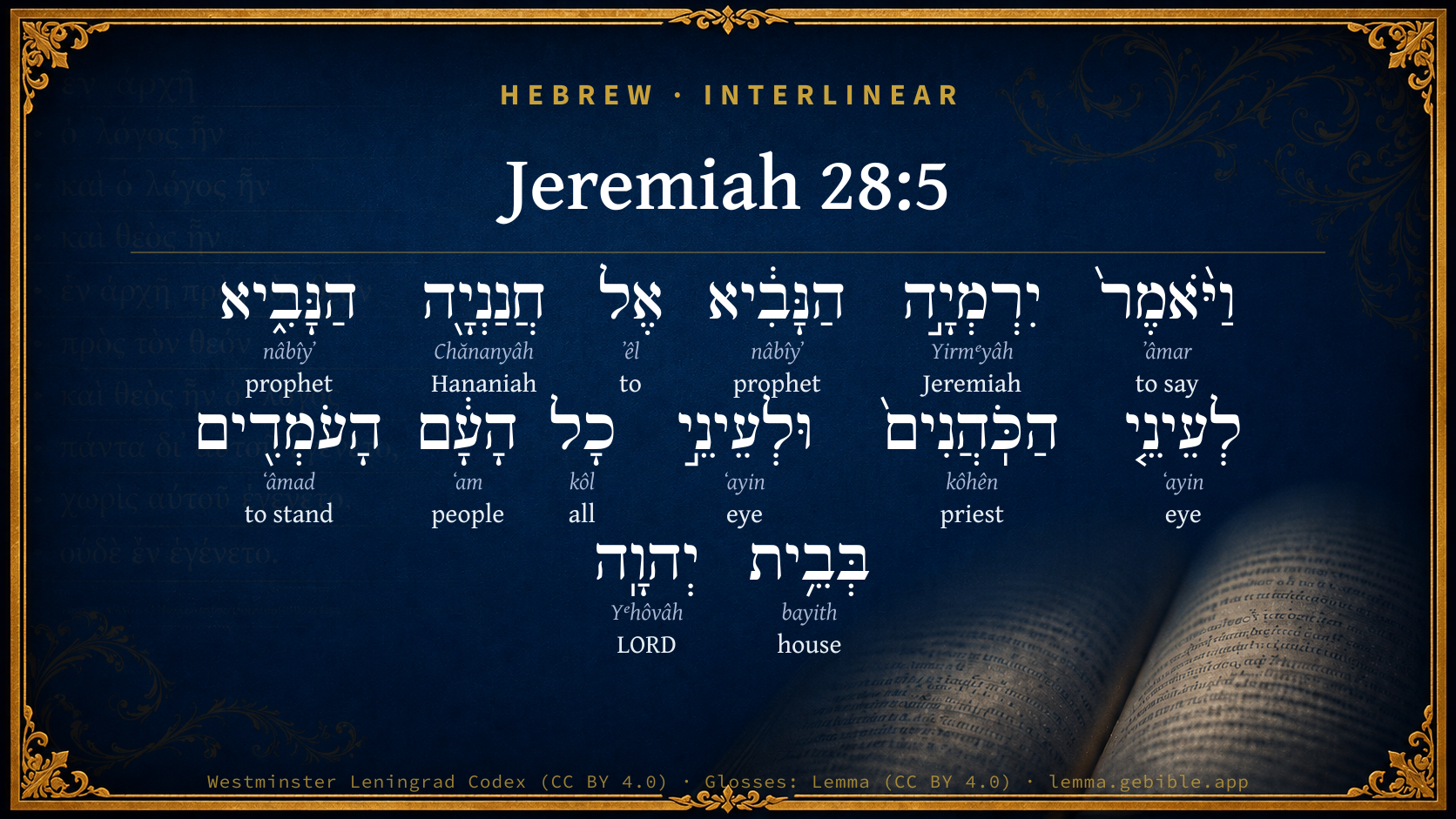
Jeremiah 28:5

Hebrew (Westminster Leningrad Codex) Jeremiah 28:5 appears in the Hebrew Old Testament. The text above is from the Westminster Leningrad Codex. Each word links to its Strong’s number, a concise gloss, and parsing drawn from the Open Scriptures Hebrew Bible morphology. Click any word for its full Brown-Driver-Briggs (BDB) entry.
Download image
Cite this verse

Jeremiah 28:5 (World English Bible). Public Domain. Lemma interlinear Bible study tool, https://lemma.gebible.app/v/jeremiah/28/5.

Show BibTeX & RIS
BibTeX
RIS
English Translation
Then the prophet Jeremiah said to the prophet Hananiah in the presence of the priests, and in the presence of all the people who stood in the house of Yahweh,
World English Bible · Public Domain
Download a study sheet

One document with this verse’s original text, its word-by-word gloss line, the meaning frame, cross-references with their text, attributed commentary, and full source and license credits — printable, and it pastes into notes with its structure intact.

This verse Autodidact and up

Study sheet (.html) Plain text (.txt)

A passage Seminary Student

Up to 50 verses in one chapter. A passage sheet keeps up to 6 commentary sources and 12 cross-references per verse, in the order this page ranks them, and says so on the sheet whenever that leaves anything out. Ask for a single verse and you get the Autodidact verse sheet above.

Everything on this page stays free to read, with no account — the sheet is a download of what is already on screen, not access to it.

Want to remove ads? Support Godless Engineer
Compare translations 3

The same verse in 3 English versions, stacked beneath the original-language interlinear above. Click any original word for its lexicon entry.

Each is an independent rendering of the whole verse — the interlinear is not word-aligned to these translations.

Highlighted words mark where these versions differ — a whole-verse word diff, not a word-by-word alignment.

  • World English Bible Public Domain
    Then the prophet Jeremiah said to the prophet Hananiah in the presence of the priests, and in the presence of all the people who stood in the house of Yahweh,
  • King James Version Public Domain
    Then the prophet Jeremiah said unto the prophet Hananiah in the presence of the priests, and in the presence of all the people that stood in the house of the LORD,
  • unfoldingWord Literal Text CC BY-SA 4.0
    And Jeremiah the prophet said to Hananiah the prophet, to the eyes of the priests and to the eyes of all the people, the ones standing in the house of Yahweh.

unfoldingWord Literal Text — © unfoldingWord, licensed CC BY-SA 4.0. Word-aligned USFM3 via Door43 (git.door43.org/unfoldingWord/en_ult).

Versions to compare (up to 4)

3 of 4 selected

Show all 18 translations

Every available English version of this verse, each an independent rendering of the whole verse.

  • World English Bible Public Domain
    Then the prophet Jeremiah said to the prophet Hananiah in the presence of the priests, and in the presence of all the people who stood in the house of Yahweh,
  • Berean Standard Bible Public Domain
    Then the prophet Jeremiah replied to the prophet Hananiah in the presence of the priests and all the people who were standing in the house of the LORD.
  • Majority Standard Bible Public Domain
    Then the prophet Jeremiah replied to the prophet Hananiah in the presence of the priests and all the people who were standing in the house of the LORD.
  • King James Version Public Domain
    Then the prophet Jeremiah said unto the prophet Hananiah in the presence of the priests, and in the presence of all the people that stood in the house of the LORD,
  • American Standard Version (1901) Public Domain
    Then the prophet Jeremiah said unto the prophet Hananiah in the presence of the priests, and in the presence of all the people that stood in the house of Jehovah,
  • Revised Version (1885) Public Domain
    Then the prophet Jeremiah said unto the prophet Hananiah in the presence of the priests, and in the presence of all the people that stood in the house of the LORD,
  • Geneva Bible (1599) Public Domain
    Then the Prophet Ieremiah saide vnto the Prophet Hananiah in the presence of ye Priests, and in the presence of all the people that stoode in the House of the Lord.
  • Douay-Rheims (1899) Public Domain
    And Jeremias the prophet said to Hananias the prophet in the presence of the priests, and in the presence of all the people that stood in the house of the Lord:
  • Young's Literal Translation Public Domain
    And Jeremiah the prophet saith unto Hananiah the prophet, before the eyes of the priests, and before the eyes of all the people who are standing in the house of Jehovah,
  • Literal Standard Version CC BY-SA 4.0
    And Jeremiah the prophet says to Hananiah the prophet, before the eyes of the priests, and before the eyes of all the people who are standing in the house of YHWH,
  • Unlocked Literal Bible CC BY-SA 4.0
    So Jeremiah the prophet spoke to Hananiah the prophet in front of the priests and to all the people who stood in Yahweh's house.
  • unfoldingWord Literal Text CC BY-SA 4.0
    And Jeremiah the prophet said to Hananiah the prophet, to the eyes of the priests and to the eyes of all the people, the ones standing in the house of Yahweh.
  • Darby Bible Public Domain
    And the prophet Jeremiah spoke unto the prophet Hananiah in the presence of the priests, and in the presence of all the people that stood in the house of Jehovah.
  • World Messianic Bible Public Domain
    Then the prophet Jeremiah said to the prophet Hananiah in the presence of the priests, and in the presence of all the people who stood in the LORD’s house,
  • Webster's Bible Public Domain
    Then the prophet Jeremiah said to the prophet Hananiah in the presence of the priests, and in the presence of all the people that stood in the house of the LORD,
  • Free Bible Version CC BY-SA 4.0
    Then the prophet Jeremiah responded to the prophet Hananiah in front of the priests and all the people who were standing in the Lord's Temple.
  • Bible in Basic English Public Domain
    Then the prophet Jeremiah said to the prophet Hananiah, before the priests and all the people who had come into the house of the Lord,
  • JPS Tanakh (1917) Public Domain
    Then the prophet Jeremiah said unto the prophet Hananiah in the presence of the priests, and in the presence of all the people that stood in the house of the LORD,

Literal Standard Version (2020), Covenant Press — licensed CC BY-SA 4.0. Text via the HelloAO Bible API (eBible.org). Unlocked Literal Bible (unfoldingWord) — licensed CC BY-SA 4.0. Text via the HelloAO Bible API (eBible.org). unfoldingWord Literal Text — © unfoldingWord, licensed CC BY-SA 4.0. Word-aligned USFM3 via Door43 (git.door43.org/unfoldingWord/en_ult). Free Bible Version, Dr. Jonathan Gallagher — licensed CC BY-SA 4.0. Text via the HelloAO Bible API (eBible.org).

Word by word

More ways to search: Search by grammar → Find every occurrence → Compare this word →

Practice this passage: Drill this verse → Learn its vocabulary →

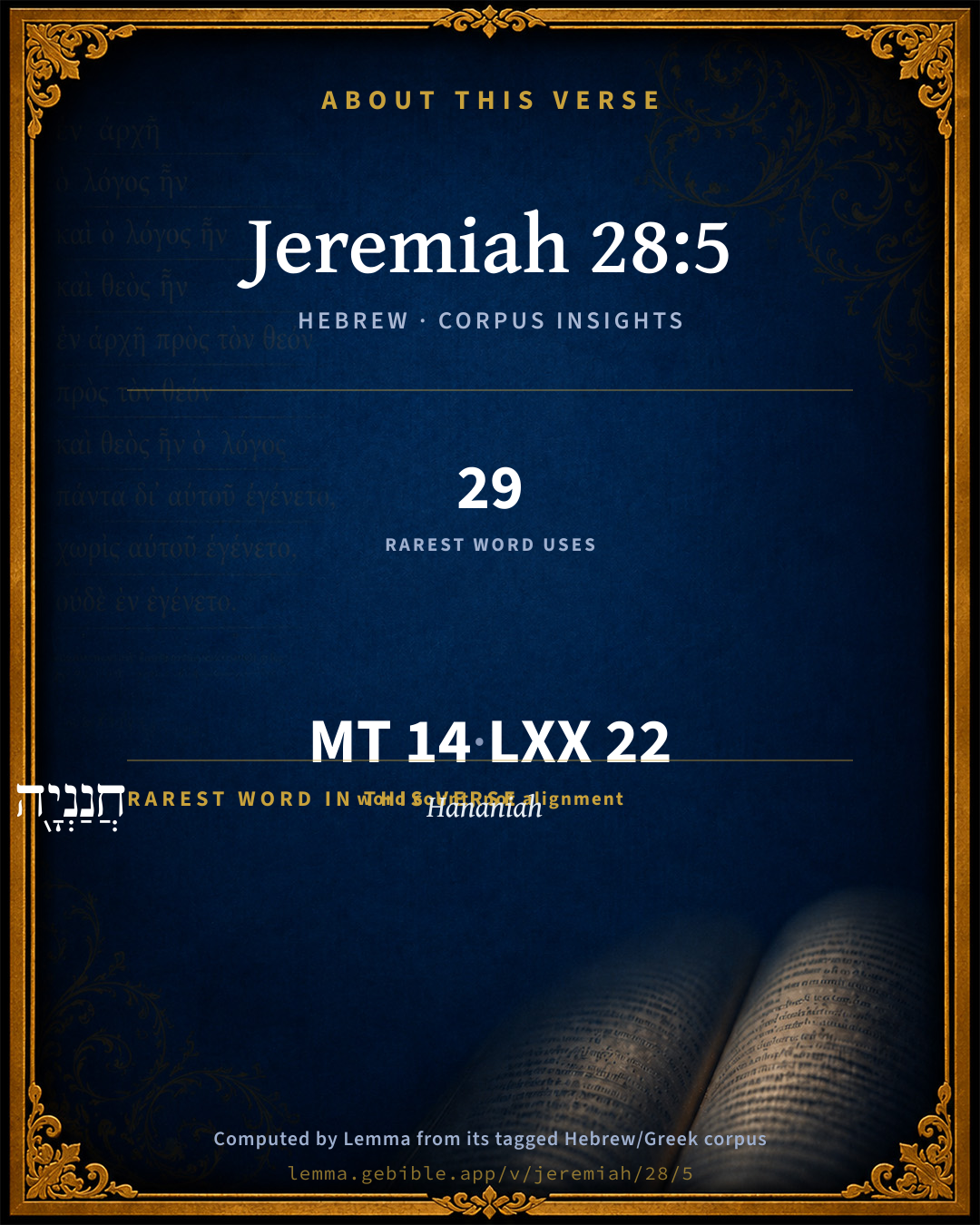
חֲנַנְיָ֖ה
Chănanyâh
H2608
“Hananiah”
Noun, Proper
Part of Speech
Noun
Type
Proper
Full BDB Definition

Origin: from H2603 and H3050

TWOT: None

Hananiah = "God has favoured" - one of the 14 sons of Heman and chief of the 16th course - a general in the army of King Uzziah - father of Zedekiah in the time of Jehoiakim - son of Azur, a Benjamite of Gibeon and a false prophet in the reign of Zedekiah king of Judah - grandfather of Irijah, the captain of the ward at the gate of Benjamin who arrested Jeremiah on the charge of deserting to the Chaldeans - a head of a Benjamite house - son of Zerubbabel from whom Christ derived His descent also called 'Joanna' by Luke - one of the sons of Bebai who returned with Ezra from Babylon - a priest, one of the makers of the sacred ointments and incense, who built a portion of the wall of Jerusalem in the days of Nehemiah - head of the priestly course of Jeremiah in the days of Joiakim - ruler of the palace at Jerusalem under Nehemiah and also, along with Hanani, the Tirshatha's brother, entrusted with the arrangements of guarding the gates of Jerusalem - Two post exilic Israelites
  1. וַיֹּ֨אמֶר֙ ʼâmar H559 “and · to say” Conjunction + Verb, Qal, Sequential Imperfect, 3rd Person, Masculine, Singular
  2. יִרְמְיָ֣ה Yirmᵉyâh H3414 “Jeremiah” Noun, Proper
  3. הַנָּבִ֔יא nâbîyʼ H5030 “the · prophet” Particle, Definite Article + Noun, Common, Masculine, Singular, Absolute
  4. אֶל ʼêl H413 “to” Preposition
  5. הַנָּבִ֑יא nâbîyʼ H5030 “the · prophet” Particle, Definite Article + Noun, Common, Masculine, Singular, Absolute
  6. לְעֵינֵ֤י ʻayin H5869 “to/for · eyes of” Preposition + Noun, Common, Both, Dual, Construct
  7. הַכֹּֽהֲנִים֙ kôhên H3548 “the · priests” Particle, Definite Article + Noun, Common, Masculine, Plural, Absolute
  8. וּלְעֵינֵ֣י ʻayin H5869 “and · to/for · eyes of” Conjunction + Preposition + Noun, Common, Both, Dual, Construct
  9. כָל kôl H3605 “all of” Noun, Common, Masculine, Singular, Construct
  10. הָעָ֔ם ʻam H5971 “the · people” Particle, Definite Article + Noun, Common, Masculine, Singular, Absolute
  11. הָעֹמְדִ֖ים ʻâmad H5975 “the · standing” Particle, Definite Article + Verb, Qal, Participle Active, Masculine, Plural, Absolute
  12. בְּבֵ֥ית bayith H1004 “in/at · house of” Preposition + Noun, Common, Masculine, Singular, Construct
  13. יְהוָֽה Yᵉhôvâh H3068 “LORD” Noun, Proper

About this verse

These counts appear in no published source. They are computed here, from the morphology-tagged text and Lemma’s own curated glosses. What Lemma adds →

14
words
12
distinct lemmas
Prophets
section

Shared distinctive vocabulary

חֲנַנְיָ֖ה Hananiah H2608 occurs in 28 verses of the Hebrew Bible. Also found in:

Grammatical profile

  • 2 verbs
  • 11 nouns
  • 1 preposition

Verb forms

  • וַיֹּ֨אמֶר֙ Qal · Sequential Imperfect
  • הָעֹמְדִ֖ים Qal · Participle Active

Repetition

Words recur within this verse — often emphatic in Hebrew:

  • הַנָּבִ֔יא prophet H5030 ×2
  • לְעֵינֵ֤י eye H5869 ×2

Hebrew & Septuagint length

In the original languages it is 14 Hebrew tokens and 22 Greek tokens — but the two are counted differently (Hebrew bundles its prefixes and suffixes into one token; the Greek is in lemma form), so that isn’t a like-for-like length.

Cross-references

4

Topical passages linked to Jeremiah 28:5 in the Treasury of Scripture Knowledge — connected by theme and wording, ordered by reader-vote popularity; previews shown in the World English Bible.

  • Jeremiah 28:1 It happened the same year, in the beginning of the reign of Zedekiah king of Judah, in the fourth year, in the fifth month, that Hananiah the son of Azzur, the prophet, who was of Gibeon, spoke to me in the house of Yahweh, in the presence of the priests and of all the people, saying,
  • Jeremiah 7:2 Stand in the gate of Yahweh's house, and proclaim there this word, and say, Hear the word of Yahweh, all you of Judah, who enter in at these gates to worship Yahweh.
  • Jeremiah 19:14 Then came Jeremiah from Topheth, where Yahweh had sent him to prophesy; and he stood in the court of Yahweh's house, and said to all the people:
  • Jeremiah 26:2 Thus says Yahweh: Stand in the court of Yahweh's house, and speak to all the cities of Judah, which come to worship in Yahweh's house, all the words that I command you to speak to them; don't diminish a word.

Cross-references courtesy of OpenBible.info (CC BY 4.0).

Hebrew and Greek witnesses Masoretic Hebrew ↔ Greek Septuagint

The same verse in the two great witnesses to the Old Testament, shown verse-for-verse.

These are two independent witnesses, not word-aligned to each other, and the Septuagint is shown in lemma (dictionary) form.

Hebrew Jeremiah 28:5 Masoretic · Westminster Leningrad Codex

וַיֹּ֨אמֶר֙ יִרְמְיָ֣ה הַנָּבִ֔יא אֶל חֲנַנְיָ֖ה הַנָּבִ֑יא לְעֵינֵ֤י הַכֹּֽהֲנִים֙ וּלְעֵינֵ֣י כָל הָעָ֔ם הָעֹמְדִ֖ים בְּבֵ֥ית יְהוָֽה

Then the prophet Jeremiah said to the prophet Hananiah in the presence of the priests, and in the presence of all the people who stood in the house of Yahweh,

World English Bible · Public Domain

Greek LXX Structure differs

In the Septuagint, Jeremiah is about an eighth shorter than the Hebrew and arranges its material differently — the Oracles Against the Nations (Hebrew chapters 46–51) appear in the middle of the Greek book, after 25:13. Because the chapter and verse boundaries do not line up, a verse-for-verse comparison with the Hebrew is not shown.

A verse-for-verse comparison isn’t shown here because the chapters and verses don’t line up. Switch to the LXX edition with the MT / LXX toggle above to read the Greek directly.

Hebrew: Westminster Leningrad Codex (CC BY 4.0). Greek: Septuagint (public domain); English from a public-domain English Septuagint. How the Septuagint differs from the Hebrew →

Targum (Aramaic paraphrase)

1

The Targum is the ancient Jewish Aramaic paraphrase of the Hebrew Scriptures — an interpretive translation, not the Hebrew text itself. Onkelos (literal) and Pseudo-Jonathan (expansive) render the Torah, and Jonathan the Prophets. Coverage is partial: where no permissively-licensed English translation exists for a verse, only the Aramaic is shown. This is verse-level text, not a word-by-word alignment to the Hebrew.

  1. Targum Jonathan Prophets (Joshua–Malachi)
    וַאֲמַר יִרְמְיָה נְבִיָא לַחֲנַנְיָה נְבִיָא שִׁקְרָא לְעֵינֵי כַהֲנַיָא וּלְעֵינֵי כָל עַמָא דְקַיְמִין בְּבֵית מַקְדְשָׁא דַיָי:

    (no public-domain English translation for this verse)

    Targum Jonathan — Aramaic: “Mikraot Gedolot” (public domain). English: “Sefaria Community Translation” (CC0 1.0 (public-domain dedication)); “London "Chaldee Paraphrase," 1871” (public domain). Text via Sefaria.

Commentary

Notes on Jeremiah 28:5 from classic Christian and Jewish commentators (each source and its license shown beneath its notes). The classic Christian expositions comment on the surrounding passage and are grouped to its opening verse, so a note may address several verses; the Jewish commentaries on the Tanakh (Rashi and others) are per-verse, so they appear only where the commentator wrote on this verse.

Lemma curates 59 commentaries, every one of them public domain or Creative Commons licensed, each selected and text-cleaned for this edition rather than reprinted as found. About our sources →

Trapp's Complete Commentary

John Trapp

Jer 28:5 Then the prophet Jeremiah said unto the prophet Hananiah in the presence of the priests, and in the presence of all the people that stood in the house of the LORD,

Ver. 5. Then the prophet Jeremiah said.] Without gall or guile. Like the waters of Siloah at the foot of Sion, {Isa 8:6} which runs softly; he made but small noise, though he heard great words and full of falsehood.

In the presence of the priests, and in the presence of the people.] Publicly he took him up, though mildly; because he had publicly offended. See Gal 2:14 1Ti 5:20.

John Trapp, A Commentary or Exposition upon All the Books of the Old and New Testament (1647–1656) — public domain. Text from a community e-Sword module.

Joseph Benson's Commentary

Jer 28:5-9. The Prophet Jeremiah said, Amen: the Lord do so! — Thereby expressing his hearty concern for the good of his nation, and wishing that God would repent him of the evil wherewith he had threatened them by his ministry; for such an affection had he for them, and so truly desirous was he of their welfare, that he would have been content to lie under the imputation of being a false prophet so that their ruin might have been prevented. Nevertheless, hear thou now this word — As if he had said, The word which I am about to speak concerns thee, and not thee alone, but all the people, therefore do thou mark it well, and let them observe it also. The prophets that have been before me and before thee — Namely, Joel, Amos, Hosea, Micah, Zephaniah, Nahum, Habakkuk, and others; prophesied both against many countries and great kingdoms, &c. — “Jeremiah offers two reasons in defence of his own prophecies, and against those of Hananiah. 1st, That many other prophets agreed with him in prophesying evil against the Jews, and other neighbouring countries; whereas Hananiah, being single in his predictions, nothing but the perfect answering of the event to them could give him the authority of a true prophet. 2d, That, considering the general corruption of the people’s manners, it was highly probable that God would punish their iniquities. To this the Jews add a third explication of the words, namely, that when any prophet foretold peace and prosperity, (namely, unconditionally and absolutely, as Hananiah here did,) his prophecy must certainly be fulfilled to prove him to be a true prophet; whereas, when a prophet foretold evil, which was Jeremiah’s case, the event might be suspended by the repentance of the persons concerned.” — Lowth.

Joseph Benson's Commentary on the Old and New Testaments (1811–1818) — public domain. Text from a community e-Sword module.

Whedon's Commentary on the Bible

Daniel D. Whedon

JEREMIAH’S MILD AND PEACEABLE ANSWER, Jer_28:5-11.

5, 6. Jeremiah said — The answer of Jeremiah does high honour to his judgment and his heart. He speaks with meekness and moderation, and yet without abating in the smallest measure the rigour of his appeal to God and his immutable law. Amen, etc. — This clause expresses the sympathy of the prophet. Could all this be true, who, as Jeremiah, would rejoice? He preferred the welfare of his country to his own honour. As Moses prayed to be “blotted out of the book” of God, or as Paul could wish himself “accursed from Christ” for the sake of Israel, so Jeremiah would joyfully offer up himself on the altar of his people and country.

Daniel D. Whedon (gen. ed.), Commentary on the Old and New Testaments (1874–1909) — public domain. Text from a community e-Sword module.

Tyndale Open Study Notes

Tyndale Open Resources

28:5-6 Amen! (literally So be it!): Jeremiah would have been happy to see this prediction fulfilled.

Tyndale Open Study Notes — © Tyndale Open Resources, licensed CC BY-SA 4.0. Text via the HelloAO Bible API.

Geneva Bible (1599)

Geneva Bible translators

He was so esteemed though he was a false prophet.

Geneva Bible (1599) marginal notes — public domain. Text via Bolls.life.

Jamieson, Fausset & Brown

Robert Jamieson, A. R. Fausset & David Brown

the prophet Jeremiah--the epithet, "the prophet," is prefixed to "Jeremiah" throughout this chapter, to correspond to the same epithet before "Hananiah"; except in Jer 28:12, where "the prophet" has been inserted in English Version. The rival claims of the true and the false prophet are thus put in the more prominent contrast.

Jamieson, Fausset & Brown — Commentary Critical and Explanatory on the Whole Bible (1871) — public domain (CC PDM 1.0). Text via the HelloAO Bible API.

John Calvin's Commentaries

I have shortly reminded you of the design of the Prophet; for it was to be feared that the people would not hear him, or at least that they would not well receive him, as he had threatened them and handled them roughly and severely. We know that men ever seek to be flattered; hence adulations are ever delightfully received. Such is the pride of men, that they cannot bear to be called to an account for what they have done; and they become also indignant, when they see their crimes and vices brought to light; besides, they are so delicate and tender, that they avoid as much as they can all adverse rumors; and if any fear assails them, they instantly resist.

Now Jeremiah had been furnished with a twofold message, to expose the vices of the people, to shew that the Jews were unworthy to inherit the land, as they were covenant-breakers and despisers of God and of his Law; and then, as they had been so often refractory and perverse, he had another message, that they would not be suffered to escape unpunished, as they had in so many ways, and for so long a time continued to provoke God’s wrath; all this was very displeasing to the people. It was therefore Jeremiah’s object to turn aside the false suspicion under which he labored, and he testified that he desired nothing more than the well-being of the people; “Amen,” he said, “may it thus happen, I wish I were a false prophet; I would willingly retract, and that with shame, all that I have hitherto predicted, so great is my care and anxiety for the safety of the public; for I would prefer the welfare of the whole people to my own reputation.” But he afterwards added, as we shall see, that the promise of Hananiah was wholly vain, and that nothing would save the people from the calamity that was very near at hand.

John Calvin's Commentaries (1540-1563) — public domain. Text from the Calvin Translation Society English edition (1840s-50s) via the Christian Classics Ethereal Library (ccel.org). Calvin's coverage is partial (roughly two-thirds of the Bible); uncommented books and verses are honest gaps, never fabricated. The 19th-century editor's footnotes and remarks are omitted so the notes are faithfully Calvin's own voice.

John Gill's Exposition

Then the prophet Jeremiah said unto the prophet Hananiah,.... The false prophet, as he is called by the Targum, Syriac, and Arabic versions:

in the presence of the priests, and in the presence of all the people that stood in the house of the Lord; waiting and worshipping in the temple; and said boldly and before them all, in answer to Hananiah's prophecy, what follows.

John Gill's Exposition of the Whole Bible (1746–1763) — public domain (CC PDM 1.0). Text via the HelloAO Bible API.

The Pulpit Commentary

Vers. 5-9. Jeremiah"s reply. He heartily wishes that Hananiah"s prediction were capable of fulfillment, but it runs directly counter to the declarations of all the older prophets. "War, and evil, and pestilence" was their constant burden, for the people to whom they prophesied were unworthy of the golden age of felicity in which the prophets so firmly believed. Only by a terrible judgment could the people of Israel be purified for the Messianic age. This appears to be what Jeremiah means by ver. 8. True, he speaks of "countries" and "kingdoms" in the plural, but all the great prophets include the nations best known to them within the range of their preaching, and even of their Messianic preaching. Isaiah, for instance, threatens sore judgment upon Egypt and Assyria, and yet he holds out the cheering prospect that Egypt and Assyria will have a part in the Messianic felicity. Thus Hananiah"s prediction has probabilities very strongly against it He not only prophesies "peace," but attaches no condition to his promise, which, therefore, has double need of verification by the event. (comp. Deu_18:22)

The Pulpit Commentary (1880–1919), ed. H.D.M. Spence-Jones & Joseph S. Exell — public domain. Text from a community e-Sword module.

Keil & Delitzsch

C. F. Keil & F. Delitzsch

Jeremiah's reply. - First Jeremiah admits that the fulfilment of this prediction would be desirable (Jer 28:6), but then reminds his opponent that all the prophets of the Lord up till this time have prophesied of war and calamity (Jer 28:7 and Jer 28:8). So that if a prophet, in opposition to these witnesses of God, predicts nothing but peace and safety, then nothing short of the fulfilment of his prediction can make good his claim to be a true prophet (Jer 28:9). - Jeremiah's answer is to this effect: Jer 28:6. "Amen (i.e., yea), may Jahveh so do! may Jahveh perform thy words which thou hast prophesied, to bring again the vessels of Jahveh's house and all the captives from Babylon into this place. Jer 28:7. Only hear now this word that I speak in thine ears, and in the ears of all the people. Jer 28:8. The prophets that were before me and before thee from of old, they prophesied concerning many lands and great kingdoms, of war, and of trouble, and of pestilence. Jer 28:9. The prophet that prophesieth of peace, when the word of the prophet cometh to pass, shall be known as the prophet that Jahveh hath truly sent. - As to אמן, yea, see on Jer 11:5. The scope of this assent is straightway defined in "may Jahveh so do." But in order that the hearers may not misunderstand his assent, Jeremiah proceeds to show that hitherto only threatening predictions have carried with them the presumption of their being true prophecies, inasmuch as it is these alone that have been in harmony with the predictions of all previous prophets. ויּנּבאוּ (Jer 28:8) is explained by the fact that "the prophets" with the accompany relative clause is made to precede absolute-wise. In the same absolute manner the clause "the prophet...peace" is disposed so that after the verb יוּדע the word הנּביא is repeated. For לרעה many MSS have לרעב; manifestly an adaptation to passages like Jer 14:12; Jer 21:9; Jer 24:10; Jer 27:8, Jer 27:13; Jer 29:17., where sword, famine, and pestilence are mentioned together as three modes of visitation by God; whereas only the general word רעה seems in place here, when mentioned alongside of "war." For this very reason Hitz. rejects רעב as being the least difficult reading, while Ew. takes it under his protection on account of the parallel passages, not considering that the train of thought is different there. - The truth expressed in Jer 28:9 is based on the Mosaic law concerning prophecy, Deu 18:21., where the fulfilment of the prediction is given as the test of true, God-inspired prophecy.

Keil & Delitzsch — Biblical Commentary on the Old Testament (1861–1891) — public domain (CC PDM 1.0). Text via the HelloAO Bible API. (Old Testament only.)

unfoldingWord translationNotes

Door43 World Missions Community

May Yahweh confirm the words that you prophesied

"May Yahweh prove you have prophesied truly"

translationWords

Jeremiah

prophet

Hananiah

priest

house of God

Yahweh

confirm

captive

preach

unfoldingWord translationNotes — © Distant Shores Media and the Door43 World Missions Community, licensed CC BY-SA 4.0. Source: git.door43.org/Door43/en_tn.

Lesson kit

Teaching starters — assembled from the data on this page, not authored interpretation. Every prompt links to the verse data it draws on. Edit before teaching.

Jeremiah, in the Prophets, opens this verse with 14 words (12 distinct Hebrew lemmas). Its most distinctive word is Chănanyâh (“Hananiah”). A historical commentator’s framing appears above. Read the whole chapter for the surrounding context.

Discussion questions

  1. The word Chănanyâh carries the sense “Hananiah.” How does it shape the verse?
  2. 1 Chronicles 3:19 shares the word «Hananiah» with this verse. How do the two illuminate each other?
  3. “prophet” occurs 2× in this one verse. What is the effect of the repetition?
  4. The translations on this page render this verse differently — a whole-verse word diff, not a word-by-word alignment. What might account for the different wordings?
  5. The verb «וַיֹּ֨אמֶר֙» is Qal Sequential Imperfect. How does its form color the action?
  6. Reading how Trapp's Complete Commentary and Joseph Benson's Commentary read this verse, where do the two commentators agree and where do they part?

Things to notice

Reading settings

Reading text

Shown beneath each verse's original-language words.

Old Testament
Old Testament edition

Read the OT as the Masoretic Hebrew (MT) or the Greek Septuagint (LXX).

English shown for the Greek Septuagint (in the Hebrew ↔ Greek comparison).

Comparing translations? Open the Compare panel on any verse page to stack up to four side by side.