Jeremiah 39:11

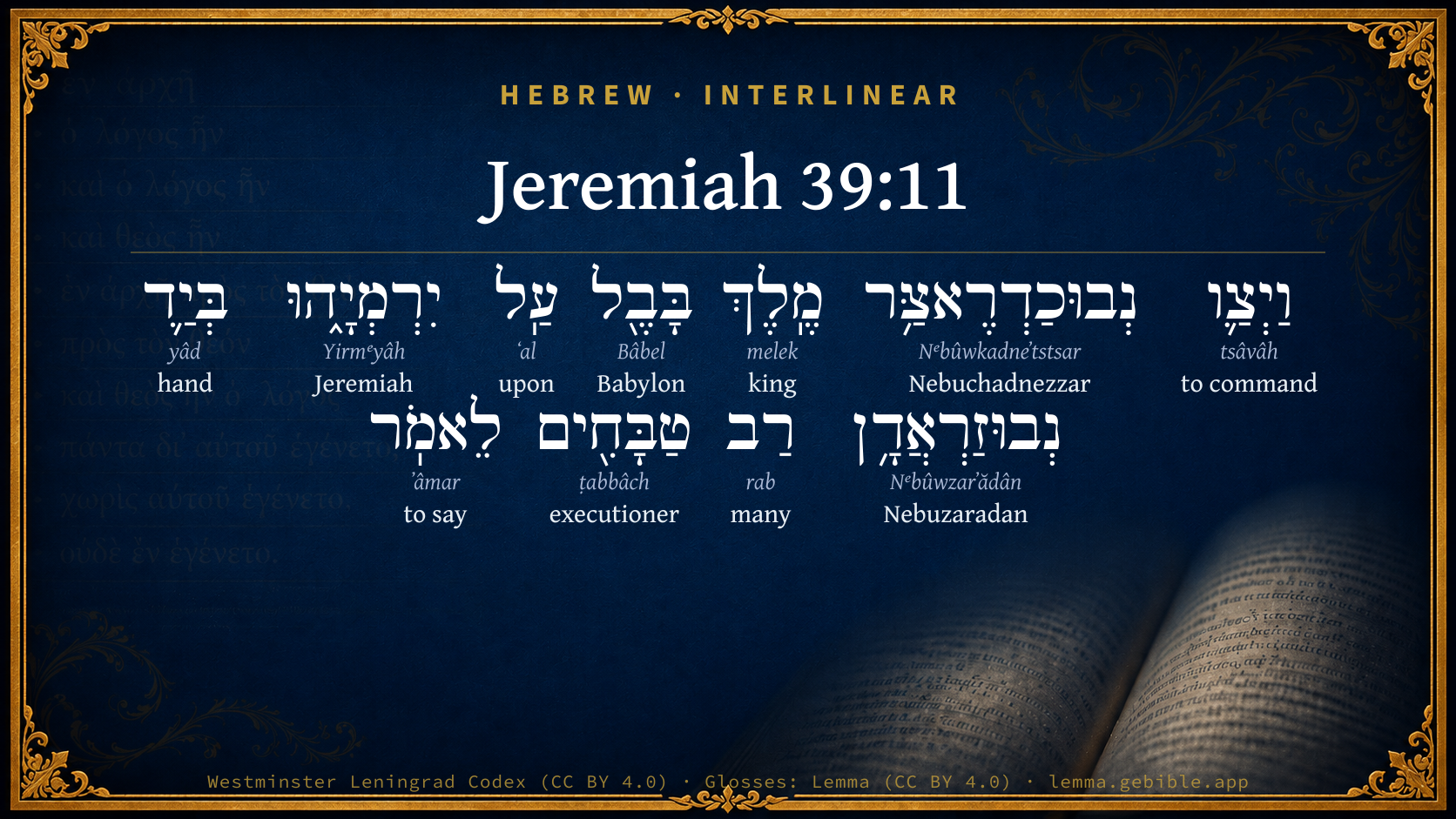
Hebrew (Westminster Leningrad Codex) Jeremiah 39:11 appears in the Hebrew Old Testament. The text above is from the Westminster Leningrad Codex. Each word links to its Strong’s number, a concise gloss, and parsing drawn from the Open Scriptures Hebrew Bible morphology. Click any word for its full Brown-Driver-Briggs (BDB) entry.
Download image
Cite this verse

Jeremiah 39:11 (World English Bible). Public Domain. Lemma interlinear Bible study tool, https://lemma.gebible.app/v/jeremiah/39/11.

Show BibTeX & RIS
BibTeX
RIS
English Translation
Now Nebuchadrezzar king of Babylon gave charge concerning Jeremiah to Nebuzaradan the captain of the guard, saying,
World English Bible · Public Domain
Download a study sheet

One document with this verse’s original text, its word-by-word gloss line, the meaning frame, cross-references with their text, attributed commentary, and full source and license credits — printable, and it pastes into notes with its structure intact.

This verse Autodidact and up

Study sheet (.html) Plain text (.txt)

A passage Seminary Student

Up to 50 verses in one chapter. A passage sheet keeps up to 6 commentary sources and 12 cross-references per verse, in the order this page ranks them, and says so on the sheet whenever that leaves anything out. Ask for a single verse and you get the Autodidact verse sheet above.

Everything on this page stays free to read, with no account — the sheet is a download of what is already on screen, not access to it.

Want to remove ads? Support Godless Engineer
Compare translations 3

The same verse in 3 English versions, stacked beneath the original-language interlinear above. Click any original word for its lexicon entry.

Each is an independent rendering of the whole verse — the interlinear is not word-aligned to these translations.

Highlighted words mark where these versions differ — a whole-verse word diff, not a word-by-word alignment.

  • World English Bible Public Domain
    Now Nebuchadrezzar king of Babylon gave charge concerning Jeremiah to Nebuzaradan the captain of the guard, saying,
  • King James Version Public Domain
    Now Nebuchadrezzar king of Babylon gave charge concerning Jeremiah to Nebuzaradan the captain of the guard, saying,
  • unfoldingWord Literal Text CC BY-SA 4.0
    Nebuchadnezzar the king of Babylon had given an order about Jeremiah to Nebuzaradan the commander of the king’s bodyguards. He had said,

unfoldingWord Literal Text — © unfoldingWord, licensed CC BY-SA 4.0. Word-aligned USFM3 via Door43 (git.door43.org/unfoldingWord/en_ult).

Versions to compare (up to 4)

3 of 4 selected

Show all 18 translations

Every available English version of this verse, each an independent rendering of the whole verse.

  • World English Bible Public Domain
    Now Nebuchadrezzar king of Babylon gave charge concerning Jeremiah to Nebuzaradan the captain of the guard, saying,
  • Berean Standard Bible Public Domain
    Now Nebuchadnezzar king of Babylon had given orders about Jeremiah through Nebuzaradan captain of the guard, saying,
  • Majority Standard Bible Public Domain
    Now Nebuchadnezzar king of Babylon had given orders about Jeremiah through Nebuzaradan captain of the guard, saying,
  • King James Version Public Domain
    Now Nebuchadrezzar king of Babylon gave charge concerning Jeremiah to Nebuzaradan the captain of the guard, saying,
  • American Standard Version (1901) Public Domain
    Now Nebuchadrezzar king of Babylon gave charge concerning Jeremiah to Nebuzaradan the captain of the guard, saying,
  • Revised Version (1885) Public Domain
    Now Nebuchadrezzar king of Babylon gave charge concerning Jeremiah to Nebuzaradan the captain of the guard, saying,
  • Geneva Bible (1599) Public Domain
    Nowe Nebuchad-nezzar King of Babel gaue charge concerning Ieremiah vnto Nebuzar-adan the chiefe stewarde, saying,
  • Douay-Rheims (1899) Public Domain
    Now Nabuchodonosor king of Babylon had given charge to Nabuzardan the general concerning Jeremias, saying:
  • Young's Literal Translation Public Domain
    And Nebuchadrezzar king of Babylon giveth a charge concerning Jeremiah, by the hand of Nebuzar-Adan, chief of the executioners, saying,
  • Literal Standard Version CC BY-SA 4.0
    And Nebuchadnezzar king of Babylon gives a charge concerning Jeremiah, by the hand of Nebuzar-Adan, chief of the executioners, saying,
  • Unlocked Literal Bible CC BY-SA 4.0
    Nebuchadnezzar the king of Babylon had given an order about Jeremiah to Nebuzaradan the commander of the king's bodyguards. He had said,
  • unfoldingWord Literal Text CC BY-SA 4.0
    Nebuchadnezzar the king of Babylon had given an order about Jeremiah to Nebuzaradan the commander of the king’s bodyguards. He had said,
  • Darby Bible Public Domain
    And Nebuchadrezzar king of Babylon had given charge concerning Jeremiah by Nebuzar-adan the captain of the body-guard, saying,
  • World Messianic Bible Public Domain
    Now Nebuchadnezzar king of Babylon commanded Nebuzaradan the captain of the guard concerning Jeremiah, saying,
  • Webster's Bible Public Domain
    Now Nebuchadrezzar king of Babylon gave charge concerning Jeremiah to Nebuzar-adan the captain of the guard, saying,
  • Free Bible Version CC BY-SA 4.0
    Nebuchadnezzar king of Babylon had given orders to Nebuzaradan the commander of the guard regarding Jeremiah, saying,
  • Bible in Basic English Public Domain
    Now Nebuchadrezzar, king of Babylon, gave orders about Jeremiah to Nebuzaradan, the captain of the armed men, saying,
  • JPS Tanakh (1917) Public Domain
    Now Nebuchadrezzar king of Babylon gave charge concerning Jeremiah to Nebuzaradan the captain of the guard, saying:

Literal Standard Version (2020), Covenant Press — licensed CC BY-SA 4.0. Text via the HelloAO Bible API (eBible.org). Unlocked Literal Bible (unfoldingWord) — licensed CC BY-SA 4.0. Text via the HelloAO Bible API (eBible.org). unfoldingWord Literal Text — © unfoldingWord, licensed CC BY-SA 4.0. Word-aligned USFM3 via Door43 (git.door43.org/unfoldingWord/en_ult). Free Bible Version, Dr. Jonathan Gallagher — licensed CC BY-SA 4.0. Text via the HelloAO Bible API (eBible.org).

Word by word

More ways to search: Search by grammar → Find every occurrence → Compare this word →

Practice this passage: Drill this verse → Learn its vocabulary →

About this verse

These counts appear in no published source. They are computed here, from the morphology-tagged text and Lemma’s own curated glosses. What Lemma adds →

11
words
11
distinct lemmas
Prophets
section

Notable vocabulary

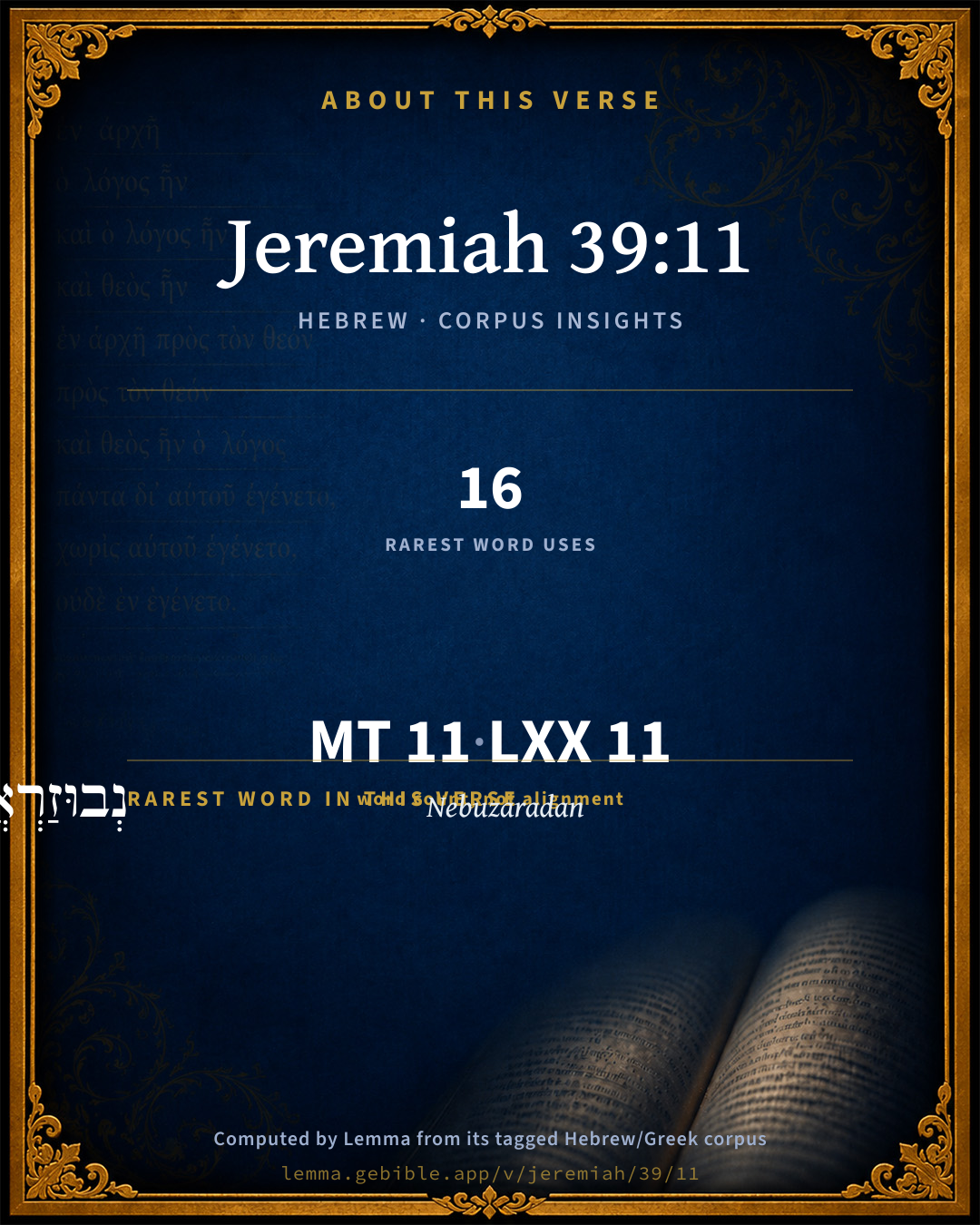
The rarest word here is נְבוּזַרְאֲדָ֥ן Nebuzaradan H5018 — appearing just 16 times in the whole Hebrew Bible.

Shared distinctive vocabulary

נְבוּזַרְאֲדָ֥ן Nebuzaradan H5018 occurs in 15 verses of the Hebrew Bible. Also found in:

Grammatical profile

  • 2 verbs
  • 8 nouns
  • 1 preposition

Verb forms

  • וַיְצַ֛ו Piel · Sequential Imperfect
  • לֵאמֹֽר Qal · Infinitive Construct

Hebrew & Septuagint length

In the original languages it is 11 Hebrew tokens and 11 Greek tokens — but the two are counted differently (Hebrew bundles its prefixes and suffixes into one token; the Greek is in lemma form), so that isn’t a like-for-like length.

Cross-references

5

Topical passages linked to Jeremiah 39:11 in the Treasury of Scripture Knowledge — connected by theme and wording, ordered by reader-vote popularity; previews shown in the World English Bible.

  • Jeremiah 15:21 I will deliver you out of the hand of the wicked, and I will redeem you out of the hand of the terrible.
  • Acts 24:23 He ordered the centurion that Paul should be kept in custody, and should have some privileges, and not to forbid any of his friends to serve him or to visit him.
  • Job 5:19 He will deliver you in six troubles; Yes, in seven there shall no evil touch you.
  • Jeremiah 15:11 Yahweh said, Most assuredly I will strengthen you for good; most assuredly I will cause the enemy to make supplication to you in the time of evil and in the time of affliction.
  • Jeremiah 37:2 But neither he, nor his servants, nor the people of the land, did listen to the words of Yahweh, which he spoke by the prophet Jeremiah.

Cross-references courtesy of OpenBible.info (CC BY 4.0).

Hebrew and Greek witnesses Masoretic Hebrew ↔ Greek Septuagint

The same verse in the two great witnesses to the Old Testament, shown verse-for-verse.

These are two independent witnesses, not word-aligned to each other, and the Septuagint is shown in lemma (dictionary) form.

Hebrew Jeremiah 39:11 Masoretic · Westminster Leningrad Codex

וַיְצַ֛ו נְבוּכַדְרֶאצַּ֥ר מֶֽלֶךְ בָּבֶ֖ל עַֽל יִרְמְיָ֑הוּ בְּיַ֛ד נְבוּזַרְאֲדָ֥ן רַב טַבָּחִ֖ים לֵאמֹֽר

Now Nebuchadrezzar king of Babylon gave charge concerning Jeremiah to Nebuzaradan the captain of the guard, saying,

World English Bible · Public Domain

Greek LXX Structure differs

In the Septuagint, Jeremiah is about an eighth shorter than the Hebrew and arranges its material differently — the Oracles Against the Nations (Hebrew chapters 46–51) appear in the middle of the Greek book, after 25:13. Because the chapter and verse boundaries do not line up, a verse-for-verse comparison with the Hebrew is not shown.

A verse-for-verse comparison isn’t shown here because the chapters and verses don’t line up. Switch to the LXX edition with the MT / LXX toggle above to read the Greek directly.

Hebrew: Westminster Leningrad Codex (CC BY 4.0). Greek: Septuagint (public domain); English from a public-domain English Septuagint. How the Septuagint differs from the Hebrew →

Targum (Aramaic paraphrase)

1

The Targum is the ancient Jewish Aramaic paraphrase of the Hebrew Scriptures — an interpretive translation, not the Hebrew text itself. Onkelos (literal) and Pseudo-Jonathan (expansive) render the Torah, and Jonathan the Prophets. Coverage is partial: where no permissively-licensed English translation exists for a verse, only the Aramaic is shown. This is verse-level text, not a word-by-word alignment to the Hebrew.

  1. Targum Jonathan Prophets (Joshua–Malachi)
    וּפַקֵיד נְבוּכַדְרֶאצַר מַלְכָּא דְבָבֶל עַל יִרְמְיָה בְּיַד נְבוּזַרְאֲדָן רַב קָטוֹלַיָא לְמֵימָר:

    (no public-domain English translation for this verse)

    Targum Jonathan — Aramaic: “Mikraot Gedolot” (public domain). English: “Sefaria Community Translation” (CC0 1.0 (public-domain dedication)); “London "Chaldee Paraphrase," 1871” (public domain). Text via Sefaria.

Commentary

Notes on Jeremiah 39:11 from classic Christian and Jewish commentators (each source and its license shown beneath its notes). The classic Christian expositions comment on the surrounding passage and are grouped to its opening verse, so a note may address several verses; the Jewish commentaries on the Tanakh (Rashi and others) are per-verse, so they appear only where the commentator wrote on this verse.

Lemma curates 59 commentaries, every one of them public domain or Creative Commons licensed, each selected and text-cleaned for this edition rather than reprinted as found. About our sources →

Matthew Henry's Commentary

Here we must sing of mercy, as in the former part of the chapter we sang of judgment, and must sing unto God of both. We may observe here,

I. A gracious providence concerning Jeremiah. When Jerusalem was laid in ruins, and all men's hearts failed them for fear, then might he lift up his head with comfort, knowing that his redemption drew nigh, as Christ's followers when the second destruction of Jerusalem was hastening on, Luk 21:28. Nebuchadnezzar had given particular orders that care should be taken of him, and that he should be in all respects well used, Jer 39:11, Jer 39:12. Hebuzar-adan and the rest of the king of Babylon's princes observed these orders, discharged him out of prison, and did every thing to make him easy, Jer 39:13, Jer 39:14. Now we may look upon this, 1. As a very generous act of Nebuchadnezzar, who, though he was a haughty potentate, yet took cognizance of this poor prophet. Doubtless he had received information concerning him from the deserters, that he had foretold the king of Babylon's successes against Judah and other countries, that he had pressed his prince and people to submit to him, and that he had suffered very hard things for so doing; and in consideration of all this (though perhaps he might have heard also that he had foretold the destruction of Babylon at length) he gave him these extraordinary marks of his favour. Note, It is the character of a great soul to take notice of the services and sufferings of the meanest. It was honourably done of the king to give this charge even before the city was taken, and of the captains to observe it even in the heat of action, and it is recorded for imitation. 2. As a reproach to Zedekiah and the princes of Israel. They put him in prison, and the king of Babylon and his princes took him out. God's people and ministers have often found fairer and kinder usage among strangers and infidels than among those that call themselves of the holy city. Paul found more favour and justice with king Agrippa than with Ananias the high priest. 3. As the performance of God's promise to Jeremiah, in recompence for his services. I will cause the enemy to treat thee well in the day of evil, Jer 15:11. Jeremiah had been faithful to his trust as a prophet, and now God approves himself faithful to him and the promise he had made him. Now he is comforted according to the time wherein he had been afflicted, and sees thousands fall on each hand and himself safe. The false prophets fell by those judgments which they said should never come (Jer 14:15), which made their misery the more terrible to them. The true prophet escaped those judgments which he said would come, and that made his escape the more comfortable to him. The same that were the instruments of punishing the persecutors were the instruments of relieving the persecuted; and Jeremiah thought never the worse of his deliverance for its coming by the hand of the king of Babylon, but saw the more of the hand of God in it. A fuller account of this matter we shall meet with in the next chapter.

II. A gracious message to Ebed-melech, to assure him of a recompence for his kindness to Jeremiah. This message was sent to him by Jeremiah himself, who, when he returned him thanks for his kindness to him, thus turned him over to God to be his paymaster. He relieved a prophet in the name of a prophet, and thus he had a prophet's reward. This message was delivered to him immediately after he had done that kindness to Jeremiah, but it is mentioned here after the taking of the city, to show that, as God was kind to Jeremiah at that time, so he was to Ebed-melech for his sake; and it was a token of special favour to both, and they ought so to account it, that they were not involved in any of the common calamities. Jeremiah is directed to tell him, 1. That God would certainly bring upon Jerusalem the ruin that had been long and often threatened; and, for his further satisfaction in having been kind to Jeremiah, he should see him abundantly proved a true prophet, Jer 39:16. 2. That God took notice of the fear he had of the judgments coming. Though he was bravely bold in the service of God, yet he was afraid of the rod of God. The enemies were men of whom he was afraid, Note, God knows how to adapt and accommodate his comforts to the fears and griefs of his people, for he knows their souls in adversity. 3. That he shall be delivered from having a share in the common calamity: I will deliver thee; I will surely deliver thee. He had been instrumental to deliver God's prophet out of the dungeon, and now God promises to deliver him; for he will be behind-hand with none for any service they do, directly or indirectly, for his name: "Thou has saved Jeremiah's life, that was precious to thee, and therefore thy life shall be given thee for a prey." 4. The reason given for this distinguishing favour which God had in store for him is because thou hast put thy trust in me, saith the Lord. God, in recompensing men's services, has an eye to the principle they go upon in those services, and rewards according to those principles; and there is no principle of obedience that will be more acceptable to God, nor have a greater influence upon us, than a believing confidence in God. Ebed-melech trusted in God that he would own him, and stand by him, and then he was not afraid of the face of man. And those who trust God, as this good man did, in the way of duty, will find that their hope shall not make them ashamed in times of the greatest danger.

Matthew Henry's Commentary on the Whole Bible (1708–1710) — public domain (CC PDM 1.0). Text via the HelloAO Bible API.

Trapp's Complete Commentary

John Trapp

Jer 39:11 Now Nebuchadrezzar king of Babylon gave charge concerning Jeremiah to Nebuzaradan the captain of the guard, saying,

Ver. 11. Now Nebuchadnezzar … gave charge, &c.] He had heard of Jeremiah and his preaching by those Jews that, by the prophet’s persuasion, fell to the Chaldees; and now that promise took place, I will cause the enemy to entreat thee well: {Jer 15:11}

“ Tandem bona causa triumphat. ”

John Trapp, A Commentary or Exposition upon All the Books of the Old and New Testament (1647–1656) — public domain. Text from a community e-Sword module.

Joseph Benson's Commentary

Jer 39:11-12. Now Nebuchadrezzar gave charge concerning Jeremiah — He had undoubtedly been informed of the advice which Jeremiah had given, both to the king and people, to submit themselves to his authority: which advice, if it had been taken, would have prevented the charge and labour of so long a siege, and the bloodshed that attended it. Saying, Take him and look well to him — Through this order of the king of Babylon, God fulfilled his promise made Jer 15:11, I will cause the enemy to treat thee well in the day of evil. Jeremiah had been faithful to his God as a prophet, and now God approves himself faithful to him, and the promise he had made him. Now he is comforted, according to the time wherein he had been afflicted, and sees many fall on each hand while he is safe. The false prophets fell by those judgments which they affirmed would never come, (Jer 14:15,) which made their misery the more terrible to them. The true prophet escaped those judgments which he said would come, and that made his escape the more comfortable to him. The same persons who were the instruments of punishing the persecutors, were the instruments of relieving the persecuted; and Jeremiah did not the less prize his deliverance, because it came by the hand of the king of Babylon, but saw thereby more of the hand of God in it.

Joseph Benson's Commentary on the Old and New Testaments (1811–1818) — public domain. Text from a community e-Sword module.

Tyndale Open Study Notes

Tyndale Open Resources

39:11–44:30 These chapters describe the events that followed the destruction of Jerusalem, especially as they affected Jeremiah.

39:11-14 It is not fully known how Jeremiah and his urging the king to surrender to Babylon came to Nebuchadnezzar’s attention. Perhaps it was through the messages that Jeremiah sent to the exiles (ch 29; see 40:2-3).

Tyndale Open Study Notes — © Tyndale Open Resources, licensed CC BY-SA 4.0. Text via the HelloAO Bible API.

Geneva Bible (1599)

Geneva Bible translators

Hebrew, by the hand of.

Geneva Bible (1599) marginal notes — public domain. Text via Bolls.life.

Jamieson, Fausset & Brown

Robert Jamieson, A. R. Fausset & David Brown

Jeremiah's prophecies were known to Nebuchadnezzar through deserters (Jer 39:9; Jer 38:19), also through the Jews carried to Babylon with Jeconiah (compare Jer 40:2). Hence the king's kindness to him.

Jamieson, Fausset & Brown — Commentary Critical and Explanatory on the Whole Bible (1871) — public domain (CC PDM 1.0). Text via the HelloAO Bible API.

John Calvin's Commentaries

The Prophet now sets forth the paternal care of God, which he had experienced in the preservation of his life and safety. The innocent, we know, are often killed in a tumult, and the storming of cities is turbulent, so that many things are done without any thought; nay, even the leaders are not able to moderate the excesses of the victorious. When, therefore, the Chaldeans burnt the palace, Jeremiah might have perished at the same time, being suffocated by the very smoke of the fire. We know what happened at the taking of Syracuse. Marcellus did not wish that Archimedes should perish, nay, he commanded that he should be preserved; for he wished to save that man on account of his singular industry and noble genius. However, while he was drawing circles on the ground, he was killed by a common soldier. If no one had come to Jeremiah, he might, as I have said, have been buried under the ruins of the palace, when the king’s court was burnt down. But he says that he had been wonderfully preserved, for Nebuchadnezzar had given a command respecting him, that he might not be exposed to any trouble, but that Nebuzaradan as well as the whole army should secure his safety.

John Calvin's Commentaries (1540-1563) — public domain. Text from the Calvin Translation Society English edition (1840s-50s) via the Christian Classics Ethereal Library (ccel.org). Calvin's coverage is partial (roughly two-thirds of the Bible); uncommented books and verses are honest gaps, never fabricated. The 19th-century editor's footnotes and remarks are omitted so the notes are faithfully Calvin's own voice.

Ellicott's Commentary for English Readers

(11) Nebuchadrezzar king of Babylon. . . .—It is clear that Nebuchadrezzar had been well informed of the part which Jeremiah had taken from first to last in counselling submission. This he may have heard from the deserters named in Jer_39:9, or even from the lips of Zedekiah. Possibly the journey to Euphrates, of which we read in Jer_13:5, may, at even an earlier period, have brought the king and the prophet into contact. From the time of Nebuzar-adan’s arrival, the position of Jeremiah was obviously changed for the better, and he became an honoured and trusted counsellor. It appears from Jer_40:1 that the prophet had at first been taken in chains to Ramah, with the other captives. Probably he had been sent back to Jerusalem when the others were carried off to Riblah, or Babylon (Jer_39:6-9).

A Bible Commentary for English Readers, edited by Charles John Ellicott (1878–1897) — public domain. Text from a community e-Sword module.

The Cambridge Bible for Schools and Colleges

gen. ed. J. J. S. Perowne

11–14. See introd. summary to the section.

The Cambridge Bible for Schools and Colleges (gen. ed. J. J. S. Perowne; Cambridge University Press, 1878–1918) — public domain. Text from a community e-Sword module.

John Gill's Exposition

Now Nebuchadrezzar king of Babylon gave charge concerning Jeremiah to Nebuzaradan the captain of the guard,.... Of whom he had heard, by one or another of his generals or officers; who had been informed, by those Jews that deserted to them, that Jeremiah had prophesied of the taking of the city by the Chaldeans; had advised the people to fall off to them; and had even exhorted the king and princes to surrender up the city, and themselves, unto them; and that he had suffered much on this account; wherefore the Lord put it into the heart of this monarch, otherwise not at all disposed to the prophets of the Lord, to show regard to him; and therefore, when he sent Nebuzaradan upon an expedition to Jerusalem, he gave him a particular charge concerning Jeremiah:

saying; as follows:

John Gill's Exposition of the Whole Bible (1746–1763) — public domain (CC PDM 1.0). Text via the HelloAO Bible API.

Haydock's Catholic Bible Commentary

Had given, after the prisoners had got to Rama, chap. xl. 1.

George Leo Haydock (1774–1849), Haydock's Catholic Family Bible and Commentary, 1859 edition — public domain. Excludes Psalms (Douay-Rheims chapter numbering differs from Protestant) and Deuterocanonical books (Catholic canon only).

Whedon's Commentary on the Bible

Daniel D. Whedon

11. Nebuchadrezzar… gave charge — For what reason we are not informed. Perhaps on account of his prophecies, of which he had knowledge through the deserters; perhaps because he had been imprisoned as an ally of Babylon; perhaps because of some personal influence, which in a royal court is not always known. At all events, this command is no slight recognition of the personal importance accorded to Jeremiah, and of his prophecies as a factor in the history of the times.

Daniel D. Whedon (gen. ed.), Commentary on the Old and New Testaments (1874–1909) — public domain. Text from a community e-Sword module.

The Pulpit Commentary

Vers. 11, 12. A prophet befriended by a heathen king.

Rumours of Jeremiah"s efforts to induce the Jews to submit to the Babylonian power must have reached the ears of Nebuchadnezzar, and have led him to regard the prophet with favour. If his fellow; countrymen considered Jeremiah to be a traitor, it was natural that the Chaldeans should think he was on their side. Both parties were ignorant of the motives and aims of the prophet, which were as patriotic as they were prudent. But, though perhaps from an undue opinion of his friendliness to them, the invaders did a real service to Jeremiah, and that was good on its own account.

I GOD BEINGS DELIVERANCE TO HIS CHILDREN IN THEIR GREATEST DANGER. Jeremiah was a prisoner. Jerusalem was given over to the rapine of a lawless soldiery. Then came the prophet"s escape.

II GOD CAN USE THE MOST UNLIKELY MEANS AS INSTRUMENTS OF HIS GRACE. He does use means, delivering through the action of men overruled by his providence. Such is his wise and mighty control that fierce despots may be his angels and ministers of grace.

III THE SCOURGE OF JUDGMENT FOR THE WICKED MAY BE THE ARM OF DELIVERANCE TO GOD"S PEOPLE. Nebuchadnezzar was the fearful foe whose approach had been foreshadowed as the advent of doom and ruin to the guilty city of Jerusalem. This man was the friend and deliverer of Jeremiah. So the awful judgment at the end of the world will be, to the Christian, the occasion of the "salvation ready to be revealed in the last time." The greatest evils in the world are overruled to work the good of God"s children.

IV A HEATHEN MAY BE AN EXAMPLE OF HUMANENESS TO MEN WHO PROFESS THE HIGHEST RELIGION. There is no cruelty so bitter as that of persons who call themselves enlightened and religious. This is the most refined and heartless cruelty. Corruptio optimi pessima. On the other hand, with all that is brutal and lawless, there maybe a genuine unsophisticated kindliness among men who are in great moral and religious darkness. Let us thank God that he has not left himself without a witness in the conscience even of a Nebuchadnezzar.

V IF A HEATHEN KING"S FAVOUR IS VALUABLE, HOW SHALL WE ESTIMATE THE BLESSEDNESS OF THE FAVOUR OF THE DIVINE KING? If Jeremiah profited by the patronage of Nebuchadnezzar, what shall the grace of Christ be to us? If the prophet found release and comfort at the approach of the Babylonian monarch, what greater good is in store for those who shall "behold the King in his beauty"? Jeremiah was protected by Nebuchadnezzar, but he did not put his trust in the human monarch. The one safe trust is in the one true Prince and Saviour.

Vers. 11-14. (Jer_40:1-6) God"s servant delivered from the judgment of transgressors.

The whole proceedings in connection with Jeremiah"s deliverance are striking and noteworthy. It is a heathen prince to whose care and respect he owes his liberation, when his own people have treated him so cruelly. Very evident is the hand of God "disposing the hearts of princes," and making "all things work together for good to them that love him.

I JEREMIAH"S EXCEPTIONAL CASE SHOWED THAT, IN THE MIDST OF THE MOST TERRIBLE CALAMITIES, GOD IS FREE TO WORK OUT THE PEACEABLE ENDS AND GRACIOUS REWARDS OF HIS KINGDOM. He was but one out of the entire nation, and might easily have been overlooked. Indeed, his sympathetic brotherliness had all but destroyed the advantage so specially designed for him. An interposition like this, so marked and resolute, had an evidently supernatural origin, and bore a moral or spiritual character. If his welfare could be so thorough]y and carefully attended to in the midst of such heart rending and widely disastrous circumstances, the whole of the political changes then taking place must have been a portion of the moral order of the world, and under the direct superintendence of God. In the midst of judgment he remembers and pursues his merciful schemes. The darkest hour of a nation"s or an individual"s history is charged with ministries of light, and the most awful judgments do not interfere with the persistent will of God to save and to bless mankind. And how nicely adjusted and delicately balanced are the deserts of saints and transgressors!

II SOME OF THE PURPOSES TO BE SERVED BY THIS PROVIDENCE.

1. It showed that the calamity did not arise from a mere necessity or accident of circumstances. Even the heathen Nebuchadnezzar learnt that.

2. Spiritual guidance and comfort were secured for those left behind.

3. Jeremiah learned to perceive and obey the Divine will as respected his future. His sallies from Jerusalem proved how needful the lesson.

4. God commended his love to his servant in making good accrue to him in the general evil of the time.

5. The reverence to God and consideration towards his prophet shown by heathen princes put to shame the unbelief and disobedience of the chosen people. M.

Vers. 11-14. Churchwardens.

1. These are generally chosen from the friends of the Church, as they who are to defend and guard the Church"s interests should be. Who should care for the Church if not her friends?

2. But sometimes men who are no friends of the Church have charge of her interests.

3. And not seldom they are amongst her best servants, and do their work diligently and well.

4. In these verses we have a signal instance of this. Here is the fierce, heathen, Israel-destroying Nebuchadnezzar, busying himself seriously about the safety of God"s prophet Jeremiah. It is not simply a case of God shutting the lions" mouths, but constituting the lions his servant"s sure though strange defence (aft ver. 12). "Is Saul also among the prophets? that was thought to be a marvel. But that the Chaldean monarch should be the faith"s defender and the prophet"s guard is no less strange.

5. And there have been other such instances before and since this. See what Egypt was to Joseph and Moses, the Philistines to David, the Persians to Daniel, Greece to Jews in Alexandria, Rome to Paul; see also history of the Lollards, Reformers, etc. And how often in the straits of God"s people have they had to confess that he has raised up for them from most unlikely sources the helpers they have needed! "The barbarous people showed us no little kindness", (Act_28:2) as we have seen sometimes a weak, defenceless creature dwelling in the same cage with strong, cruel beasts, and not only unharmed, but protected by them.

6. How is all this to be explained? In this instance of Jeremiah the motives of Nebuchadnezzar are clear and comprehensible. Jeremiah had done his best to persuade his countrymen to submit to Babylon. His influence would be strong with the captives in Babylon and serviceable to her monarch. The king would show that, whilst he punished his foes, he did not forget his friends. The reverence and awe which Jeremiah, so evidently God"s prophet, aroused in the monarch"s mind. But:

7. He was guarded of God. Jeremiah was no partisan of Babylon. The most terrible prophecies against her are his (cf. ch. 1.). No other explanation than that the care of God was over him can account for their favour to one who spoke so plainly and so evil concerning them. And their forbearance is the more remarkable when we remember the proud, cruel, and arrogant character of the monarch whom Jeremiah thus, as it were, defied.

8. Many and most helpful are the lessons of such.facts as these. Enemies God can make our friends, perils our protectors; and because "the Lord"s portion is his people," his will is ever to do them good. Such deliverances as these are designed to foreshadow our final and perfect deliverance, and to deepen our confidence in regard thereto. C.

Vers. 11-14. The safety of God"s prophet.

I THE MANNER IN WHICH IT IS ASSURED. There is no working of miracle, though miracle was available if it had been needed. But natural forces were carrying out Divine intentions in working the safety of the man who had been faithful to his duty. We have no exact information as to why Nebuchadnezzar was so interested in the prophet"s safety, but we may well suppose that he had a sort of respect for a man who served his God so faithfully. The news of fidelity, courage, and endurance goes far, when only one here and there shows the qualities. Moreover, the King of Babylon was very likely to have heard of Jeremiah"s predictions; the very knowledge that such predictions existed would nerve him in his attack; and when the attack succeeded, the very fulfilment of the predictions would produce in him a superstitious fear lest the utterer of them should come to any harm. Thus we see how the course of human affairs, without any special intervention, works out good for the brave maintainers of right.

II SAFETY IN SUCH CIRCUMSTANCES. This is of great importance to notice. Jehovah was not concerned to preserve the life of every prophet from a violent end. His prophets, at times, had to trust him even to death, and prophesy even when the prophecy was sure to be followed by a mortal blow. Jeremiah was preserved in safety at this time, not so much for his own sake, as for the effect his preservation would have on the minds of others. His safety was specially provided for at the time when unrestrained destruction was going on. Thus his very preservation was itself a prophecy. And it is all the more noticeable Because Jeremiah himself had, in due course, to make predictions against Babylon. Why some of God"s servants live long lives and some short ones is not a fortuitous matter; there is always a reason, could we but see it, and sometimes, as in this instance, there is a glimmer of light upon the reason.

III THE PROPHET"S DESTINATION. Nebuchadnezzar"s order was that he should be treated as he desired. We read that in the end "he dwelt among the people." Hence we may conclude that this was his desire. And where could a prophet better be? Especially if he went among the poor of the people, toiling away in their vineyards and fields, and tried to inspire them with the promises of better times. "Dwelling among the people" is a very suggestive expression when applied to a man like Jeremiah, his office, his character, his experience, being such as they were. The people knew that he lived among them by his own free choice, preferring to share their hardship and poverty. As far as we can see, he might have enjoyed the luxuries of Babylon; but what were these to a man like him? Y.

The Pulpit Commentary (1880–1919), ed. H.D.M. Spence-Jones & Joseph S. Exell — public domain. Text from a community e-Sword module.

Kretzmann's Popular Commentary

Paul E. Kretzmann

Concerning The Fate of Jeremiah and of Ebed-Melech. —

v. 11. Now Nebuchadnezzar, king of Babylon, gave charge concerning Jeremiah, whose prophecies and warning were known to him through deserters and through Jews carried to Babylon with Jeconiah, to Nebuzar-adan, the captain of the guard, saying,

v. 12. Take him and look well to him, literally, "thine eyes set upon him," in providing for, and watching over, his well-being, and do him no harm, the protection against the wiles of others being included in this care; but do unto him even as he shall say unto thee, as he might request to safeguard his person.

v. 13. So Nebuzar-adan, the captain of the guard, sent, and Nebu-shasban, Bab-saris, and Nergal-sharezer, Rab-mag, that is, the chief of the magi, and all the king of Babylon’s princes, all the commanders of the army which made the campaign against Judah;

v. 14. even they sent and took Jeremiah out of the court of the prison, gave him his liberty after the shameful imprisonment which he had suffered, and committed him unto Gedaliah, the son of Ahikam, the son of Shaphan, Ahikam being the man who had protected him on a former occasion, 26:24, that he should carry him home; so he dwelt among the people, as a free man, not as a captive under restraint. The apparent contradiction between this statement and that of 40:1 is very easily adjusted if we remember that Jeremiah, although transported to Ramah with the prisoners among his own countrymen, was still technically their prisoner, for he had not been released from his place in the court of the prison in Jerusalem. Nebuzar-adan separated Jeremiah from the other captives and gave him his choice of places to dwell.

v. 15. Now the word of the Lord came unto Jeremiah, while he was shut up in the court of the prison, before the Jews of the city were taken down to Ramah and the prophet was given his liberty, saying,

v. 16. Go and speak to Ebed-melech, the Ethiopian, who had befriended Jeremiah when his life was in the greatest danger, 38:7-14, saying, Thus saith the Lord of hosts, the God of Israel: Behold, I will bring My words upon this city for evil and not for good, Cf Dan 9:12; and they shall be accomplished in that day before thee, so that the threatened misfortune would strike the city in its full force, Ebed-melech being a witness of this calamity.

v. 17. But I will deliver thee in that day, saith the Lord, as a reward of his goodness in rescuing the Lord’s prophet; and thou shalt not be given into the hand of the men of whom thou art afraid, for the Ethiopian shared the fear of the other inhabitants of the city.

v. 18. For I will surely deliver thee, and thou shalt not fall by the sword, but thy life shall be for a prey unto thee, a precious treasure to be carried away and safely hidden, because thou hast put thy trust in Me, saith the Lord. Jehovah, the true God, is the Hope and Refuge of all those who put their trust in Him, and He delivers them from all the evil which may threaten and overwhelm them.

Paul E. Kretzmann, Popular Commentary of the Bible (1921–1924) — public domain. Text from a community e-Sword module.

unfoldingWord translationNotes

Door43 World Missions Community

Nebushazban ... Gedaliah ... Ahikam ... Shaphan

These are the names of men. (See: How to Translate Names)

sent men out

They sent them out to get Jeremiah. This can be stated explicitly. AT: "sent men out to get Jeremiah" (See: Assumed Knowledge and Implicit Information)

the courtyard of the guard

This was an open area attached to the king's palace that was surrounded by buildings and in which they kept prisoners. See how you translated this in Jeremiah 32:2.

among the people

You may need to make explicit which people the speaker is speaking of. AT: "among the people who remained in Judah" (See: Assumed Knowledge and Implicit Information)

translationWords

Nebuchadnezzar

king

Babylon

Jeremiah

eunuch

court

unfoldingWord translationNotes — © Distant Shores Media and the Door43 World Missions Community, licensed CC BY-SA 4.0. Source: git.door43.org/Door43/en_tn.

Lesson kit

Teaching starters — assembled from the data on this page, not authored interpretation. Every prompt links to the verse data it draws on. Edit before teaching.

Jeremiah, in the Prophets, opens this verse with 11 words (11 distinct Hebrew lemmas). Its most distinctive word is Nᵉbûwzarʼădân (“Nebuzaradan”). A historical commentator’s framing appears above. Read the whole chapter for the surrounding context.

Discussion questions

  1. What does “Nebuzaradan” (Nᵉbûwzarʼădân) contribute to the verse as a whole?
  2. How does 2 Kings 25:8, which shares the word «Nebuzaradan», read alongside this verse?
  3. These translations render this verse differently. What is at stake in choosing one wording over another?
  4. «וַיְצַ֛ו» is a Piel Sequential Imperfect verb. How does that grammatical form shape the action described?
  5. Compare how Matthew Henry's Commentary and Trapp's Complete Commentary read this verse. Where do they agree or differ?

Things to notice

Reading settings

Reading text

Shown beneath each verse's original-language words.

Old Testament
Old Testament edition

Read the OT as the Masoretic Hebrew (MT) or the Greek Septuagint (LXX).

English shown for the Greek Septuagint (in the Hebrew ↔ Greek comparison).

Comparing translations? Open the Compare panel on any verse page to stack up to four side by side.